steering FORD F650 2002 10.G Owners Manual
[x] Cancel search | Manufacturer: FORD, Model Year: 2002, Model line: F650, Model: FORD F650 2002 10.GPages: 256, PDF Size: 1.75 MB
Page 1 of 256
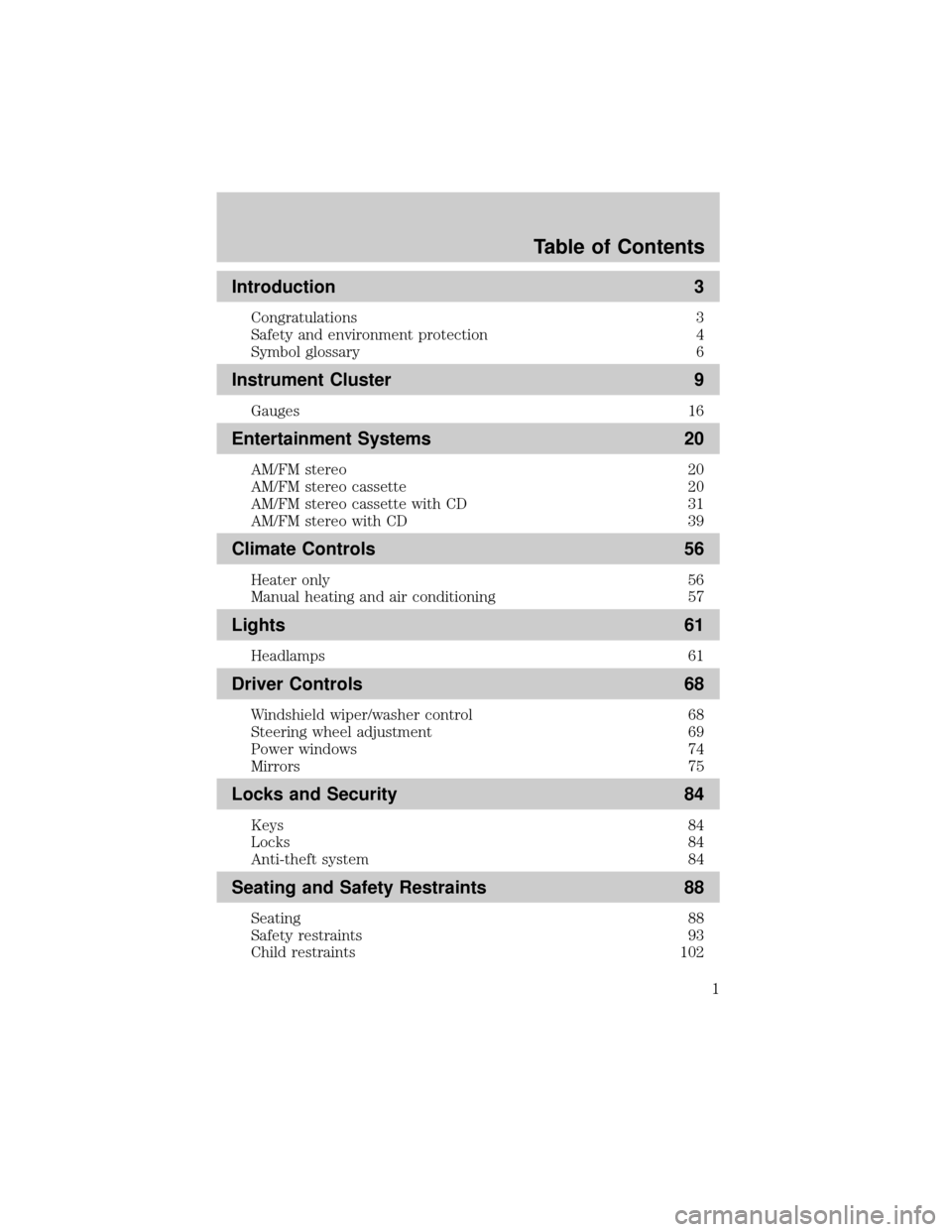
Introduction 3
Congratulations 3
Safety and environment protection 4
Symbol glossary 6
Instrument Cluster 9
Gauges 16
Entertainment Systems 20
AM/FM stereo 20
AM/FM stereo cassette 20
AM/FM stereo cassette with CD 31
AM/FM stereo with CD 39
Climate Controls 56
Heater only 56
Manual heating and air conditioning 57
Lights 61
Headlamps 61
Driver Controls 68
Windshield wiper/washer control 68
Steering wheel adjustment 69
Power windows 74
Mirrors 75
Locks and Security 84
Keys 84
Locks 84
Anti-theft system 84
Seating and Safety Restraints 88
Seating 88
Safety restraints 93
Child restraints 102
Table of Contents
1
Page 7 of 256
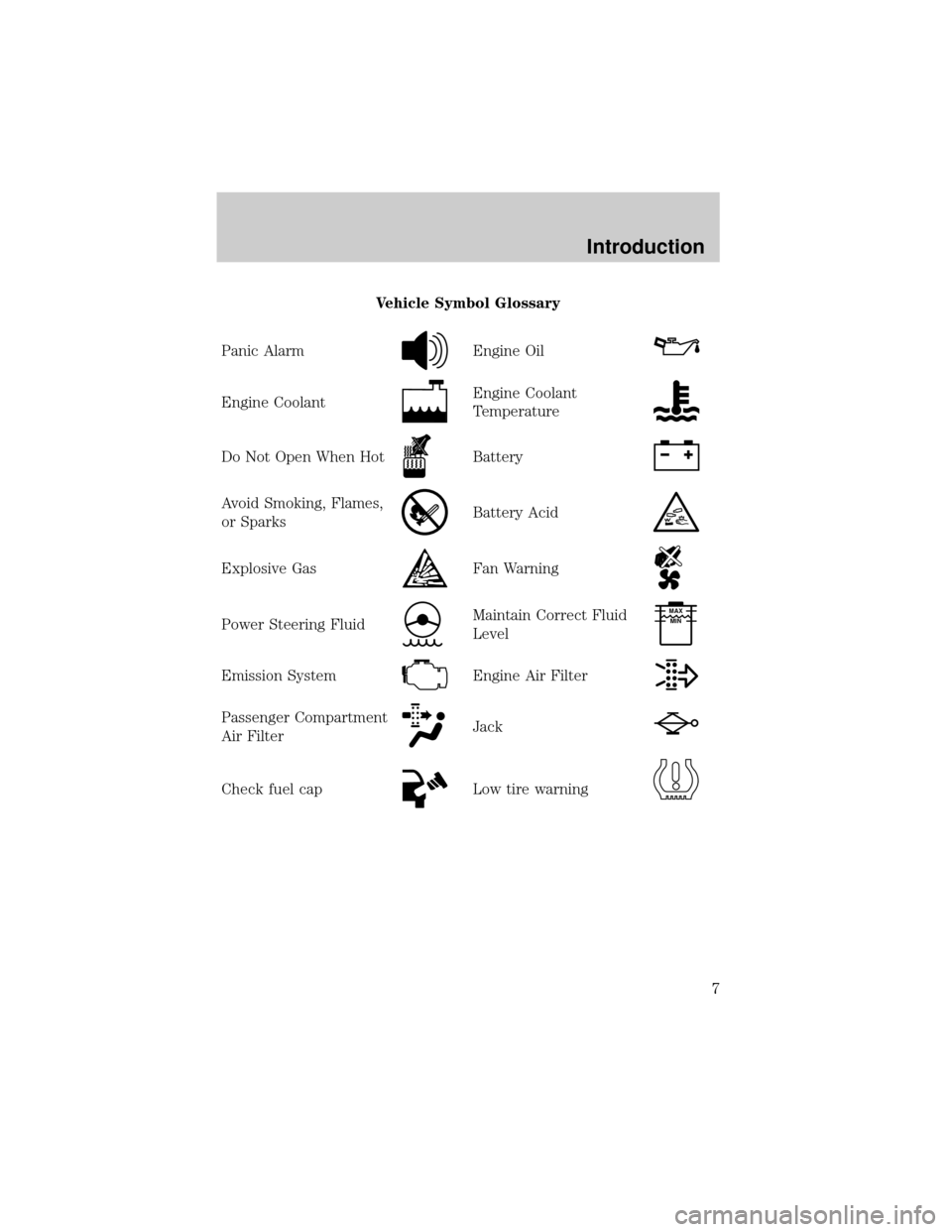
Vehicle Symbol Glossary
Panic Alarm
Engine Oil
Engine CoolantEngine Coolant
Temperature
Do Not Open When HotBattery
Avoid Smoking, Flames,
or SparksBattery Acid
Explosive GasFan Warning
Power Steering FluidMaintain Correct Fluid
LevelMAX
MIN
Emission SystemEngine Air Filter
Passenger Compartment
Air FilterJack
Check fuel capLow tire warning
Introduction
7
Page 11 of 256
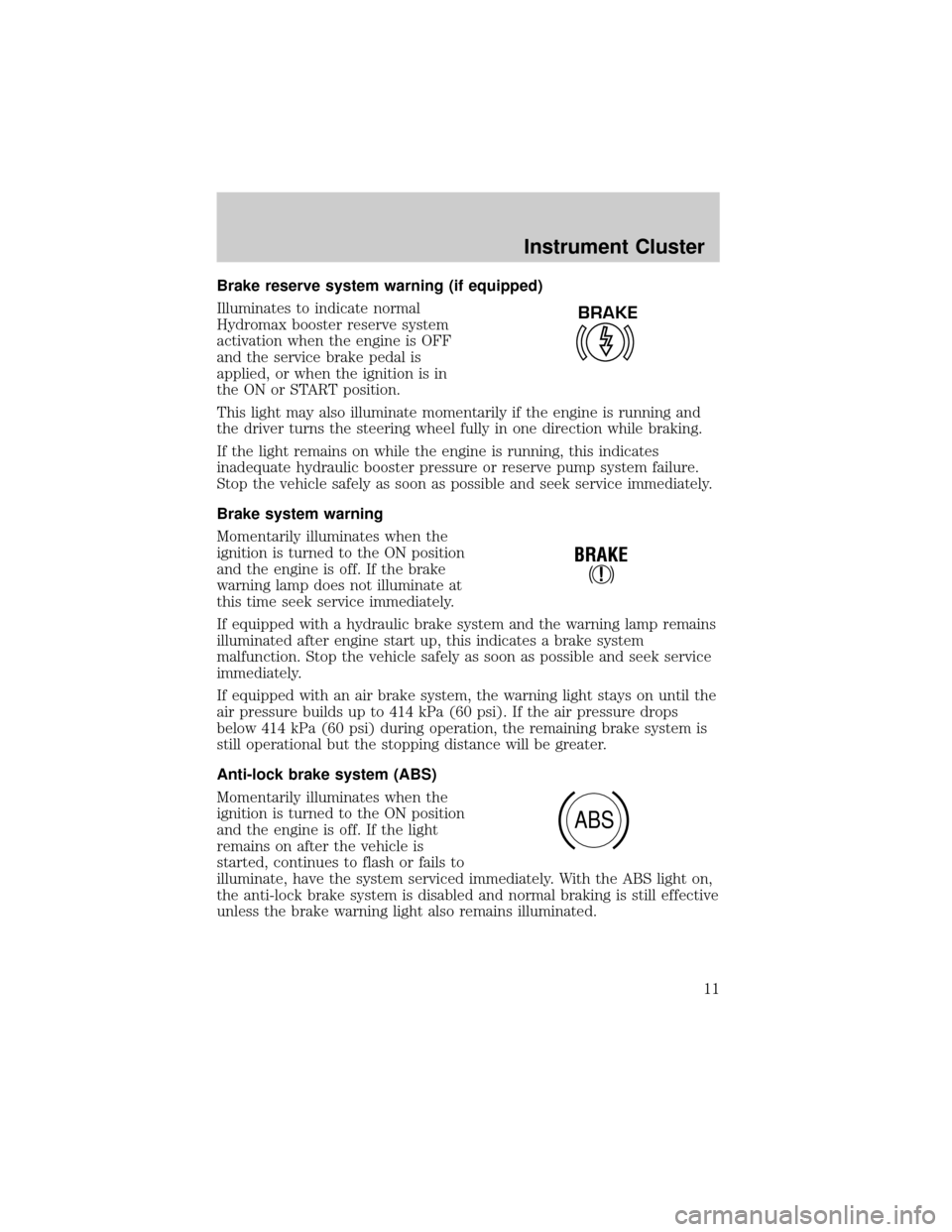
Brake reserve system warning (if equipped)
Illuminates to indicate normal
Hydromax booster reserve system
activation when the engine is OFF
and the service brake pedal is
applied, or when the ignition is in
the ON or START position.
This light may also illuminate momentarily if the engine is running and
the driver turns the steering wheel fully in one direction while braking.
If the light remains on while the engine is running, this indicates
inadequate hydraulic booster pressure or reserve pump system failure.
Stop the vehicle safely as soon as possible and seek service immediately.
Brake system warning
Momentarily illuminates when the
ignition is turned to the ON position
and the engine is off. If the brake
warning lamp does not illuminate at
this time seek service immediately.
If equipped with a hydraulic brake system and the warning lamp remains
illuminated after engine start up, this indicates a brake system
malfunction. Stop the vehicle safely as soon as possible and seek service
immediately.
If equipped with an air brake system, the warning light stays on until the
air pressure builds up to 414 kPa (60 psi). If the air pressure drops
below 414 kPa (60 psi) during operation, the remaining brake system is
still operational but the stopping distance will be greater.
Anti-lock brake system (ABS)
Momentarily illuminates when the
ignition is turned to the ON position
and the engine is off. If the light
remains on after the vehicle is
started, continues to flash or fails to
illuminate, have the system serviced immediately. With the ABS light on,
the anti-lock brake system is disabled and normal braking is still effective
unless the brake warning light also remains illuminated.
BRAKE
!
BRAKE
ABS
Instrument Cluster
11
Page 69 of 256
Changing the wiper blades
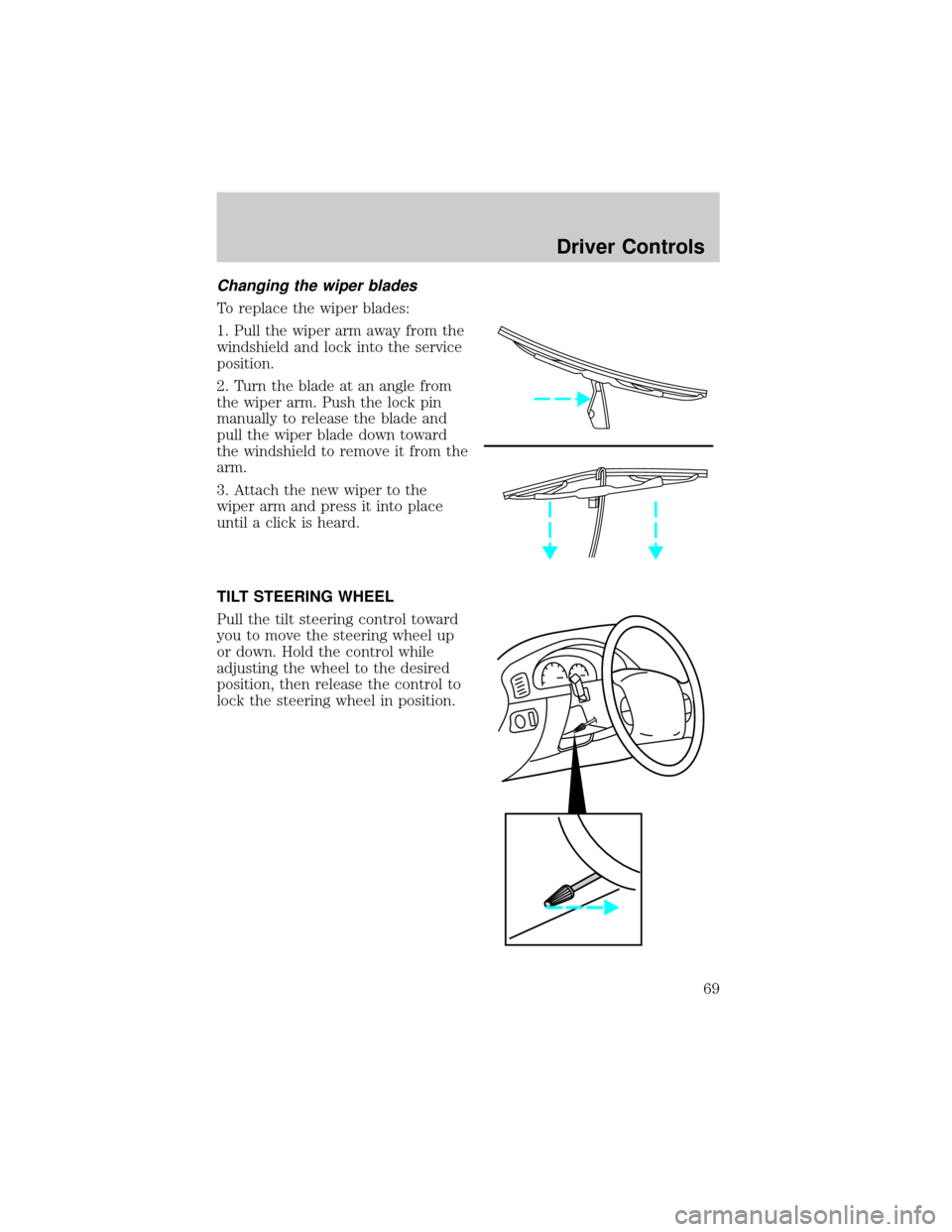
To replace the wiper blades:
1. Pull the wiper arm away from the
windshield and lock into the service
position.
2. Turn the blade at an angle from
the wiper arm. Push the lock pin
manually to release the blade and
pull the wiper blade down toward
the windshield to remove it from the
arm.
3. Attach the new wiper to the
wiper arm and press it into place
until a click is heard.
TILT STEERING WHEEL
Pull the tilt steering control toward
you to move the steering wheel up
or down. Hold the control while
adjusting the wheel to the desired
position, then release the control to
lock the steering wheel in position.
Driver Controls
69
Page 70 of 256
Never adjust the steering wheel when the vehicle is moving.
OVERHEAD CONSOLE (IF EQUIPPED)
The overhead console will show the outside temperature and compass
display.
Electronic compass/temperature display Ð SuperCrewzer only
Mode control
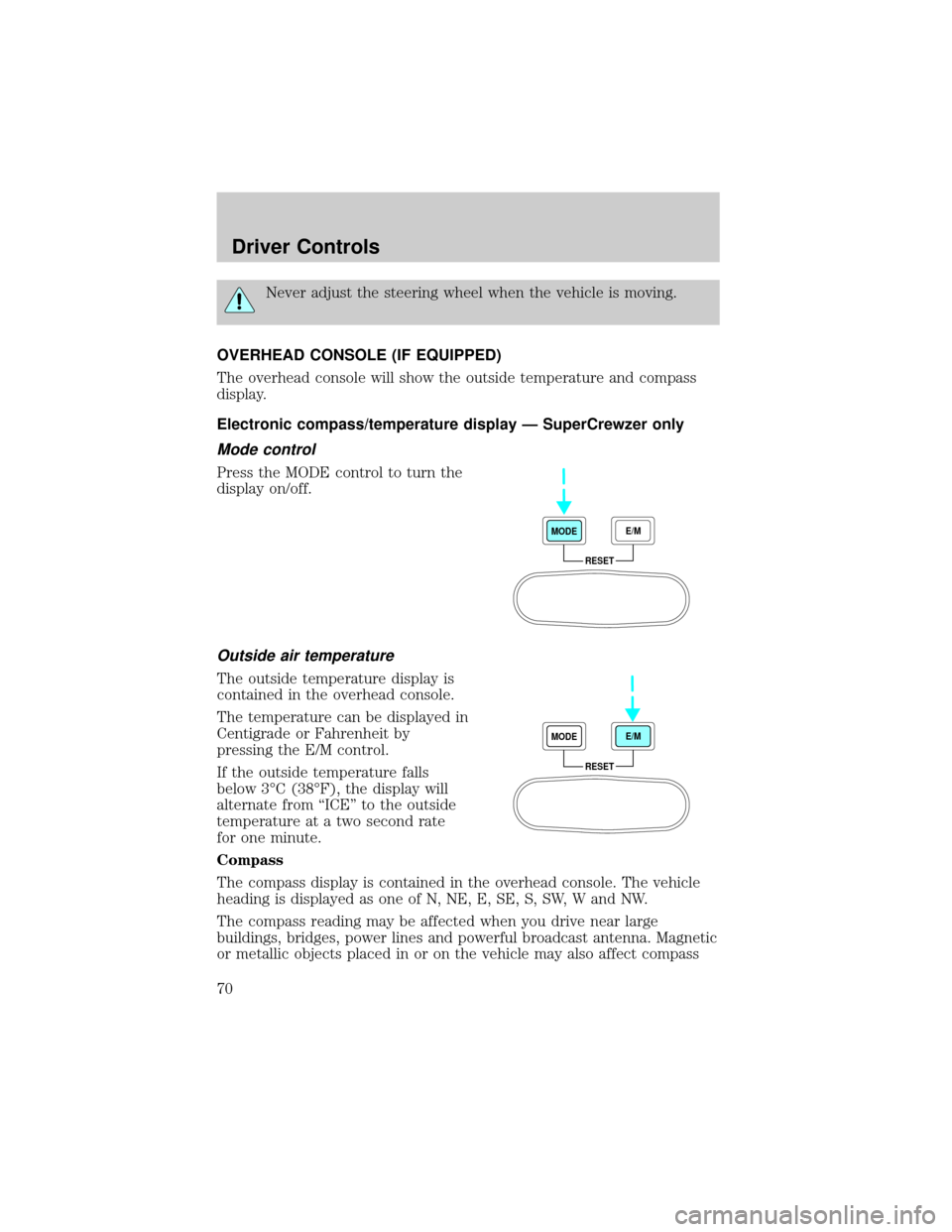
Press the MODE control to turn the
display on/off.
Outside air temperature
The outside temperature display is
contained in the overhead console.
The temperature can be displayed in
Centigrade or Fahrenheit by
pressing the E/M control.
If the outside temperature falls
below 3ÉC (38ÉF), the display will
alternate from ªICEº to the outside
temperature at a two second rate
for one minute.
Compass
The compass display is contained in the overhead console. The vehicle
heading is displayed as one of N, NE, E, SE, S, SW, W and NW.
The compass reading may be affected when you drive near large
buildings, bridges, power lines and powerful broadcast antenna. Magnetic
or metallic objects placed in or on the vehicle may also affect compass
RESET MODEE/M
RESET MODEE/M
Driver Controls
70
Page 113 of 256
HYDRAULIC BRAKES (IF EQUIPPED)
Your service brakes are self-adjusting. Refer to the Scheduled
maintenance guide for scheduled maintenance.
Occasional brake noise is normal and often does not indicate a
performance concern with the vehicle's brake system. In normal
operation, automotive brake systems may emit occasional or intermittent
squeal or groan noises when the brakes are applied. Such noises are
usually heard during the first few brake applications in the morning;
however, they may be heard at any time while braking and can be
aggravated by environmental conditions such as cold, heat, moisture,
road dust, salt or mud. If a ªmetal-to-metal,º ªcontinuous grindingº or
ªcontinuous squealº sound is present while braking, the brake linings
may be worn-out and should be inspected by a qualified service
technician.
If you are driving down a long or steep hill, shift to a lower gear.
Do not apply your brakes continuously, as they may overheat
and become less effective.
HYDRAULIC BRAKE BOOSTER SYSTEM (HYDROMAX)
The Hydromax systems receive fluid pressure from the power steering
pump to provide power assist during braking.
The Hydromax booster receives backup pressure from the reserve
system electric pump whenever the fluid in the power steering system is
not flowing. When the engine is OFF, the pump will turn on if the brake
pedal is applied, or if the ignition is turned to the ON position.
The sound of the pump operating may be heard by the driver, but this is
a normal characteristic of the system.
The reserve system provides reduced braking power, so the vehicle
should be operated under these conditions with caution, and only to seek
service repair and remove the vehicle from the roadway.
For Hydromax under normal operating conditions noise of the fluid
flowing through the booster may be heard whenever the brake is applied.
This condition is normal. Vehicle service is not required.
If braking performance or pedal response becomes very poor, even when
the pedal is strongly applied, this may indicate the presence of air in the
hydraulic system or fluid leakage. Stop the vehicle safely as soon as
possible and seek service immediately.
Driving
113
Page 114 of 256
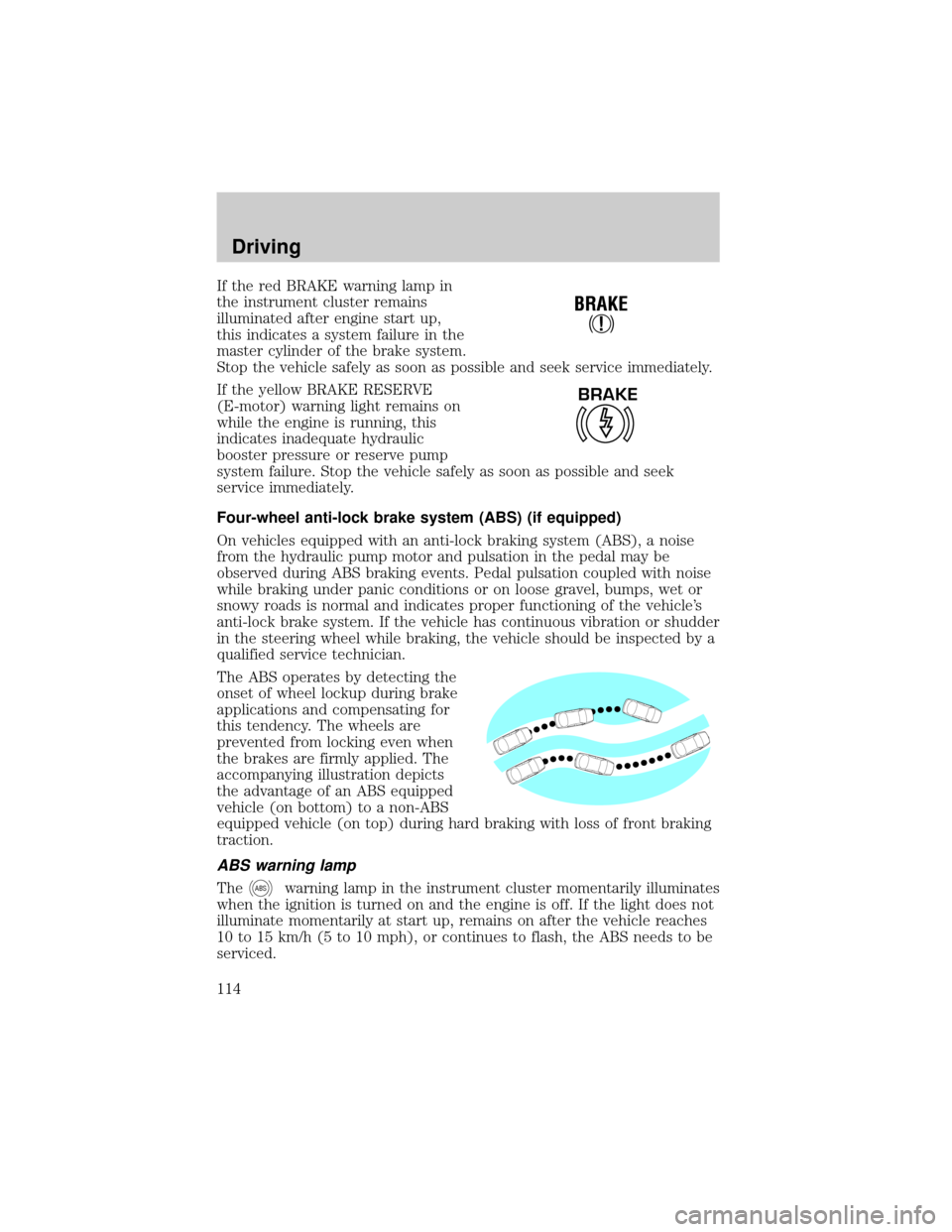
If the red BRAKE warning lamp in
the instrument cluster remains
illuminated after engine start up,
this indicates a system failure in the
master cylinder of the brake system.
Stop the vehicle safely as soon as possible and seek service immediately.
If the yellow BRAKE RESERVE
(E-motor) warning light remains on
while the engine is running, this
indicates inadequate hydraulic
booster pressure or reserve pump
system failure. Stop the vehicle safely as soon as possible and seek
service immediately.
Four-wheel anti-lock brake system (ABS) (if equipped)
On vehicles equipped with an anti-lock braking system (ABS), a noise
from the hydraulic pump motor and pulsation in the pedal may be
observed during ABS braking events. Pedal pulsation coupled with noise
while braking under panic conditions or on loose gravel, bumps, wet or
snowy roads is normal and indicates proper functioning of the vehicle's
anti-lock brake system. If the vehicle has continuous vibration or shudder
in the steering wheel while braking, the vehicle should be inspected by a
qualified service technician.
The ABS operates by detecting the
onset of wheel lockup during brake
applications and compensating for
this tendency. The wheels are
prevented from locking even when
the brakes are firmly applied. The
accompanying illustration depicts
the advantage of an ABS equipped
vehicle (on bottom) to a non-ABS
equipped vehicle (on top) during hard braking with loss of front braking
traction.
ABS warning lamp
TheABSwarning lamp in the instrument cluster momentarily illuminates
when the ignition is turned on and the engine is off. If the light does not
illuminate momentarily at start up, remains on after the vehicle reaches
10 to 15 km/h (5 to 10 mph), or continues to flash, the ABS needs to be
serviced.
!
BRAKE
BRAKE
Driving
114
Page 115 of 256
With the ABS light on, the anti-lock brake system is disabled and normal
braking is still effective unless the brake warning light also remains
illuminated. (If your parking brake warning lamp illuminates, have your
vehicle serviced immediately).
Using ABS
²In an emergency or when maximum efficiency from the ABS is
required, apply continuous full force on the brake. The ABS will be
activated immediately, thus allowing you to retain full steering control
of your vehicle and, providing there is sufficient space, will enable you
to avoid obstacles and bring the vehicle to a controlled stop.
²The Anti-Lock system does not decrease the time necessary to apply
the brakes or always reduce stopping distance. Always leave enough
room between your vehicle and the vehicle in front of you to stop.
²We recommend that you familiarize yourself with this braking
technique. However, avoid taking any unnecessary risks.
Parking brake
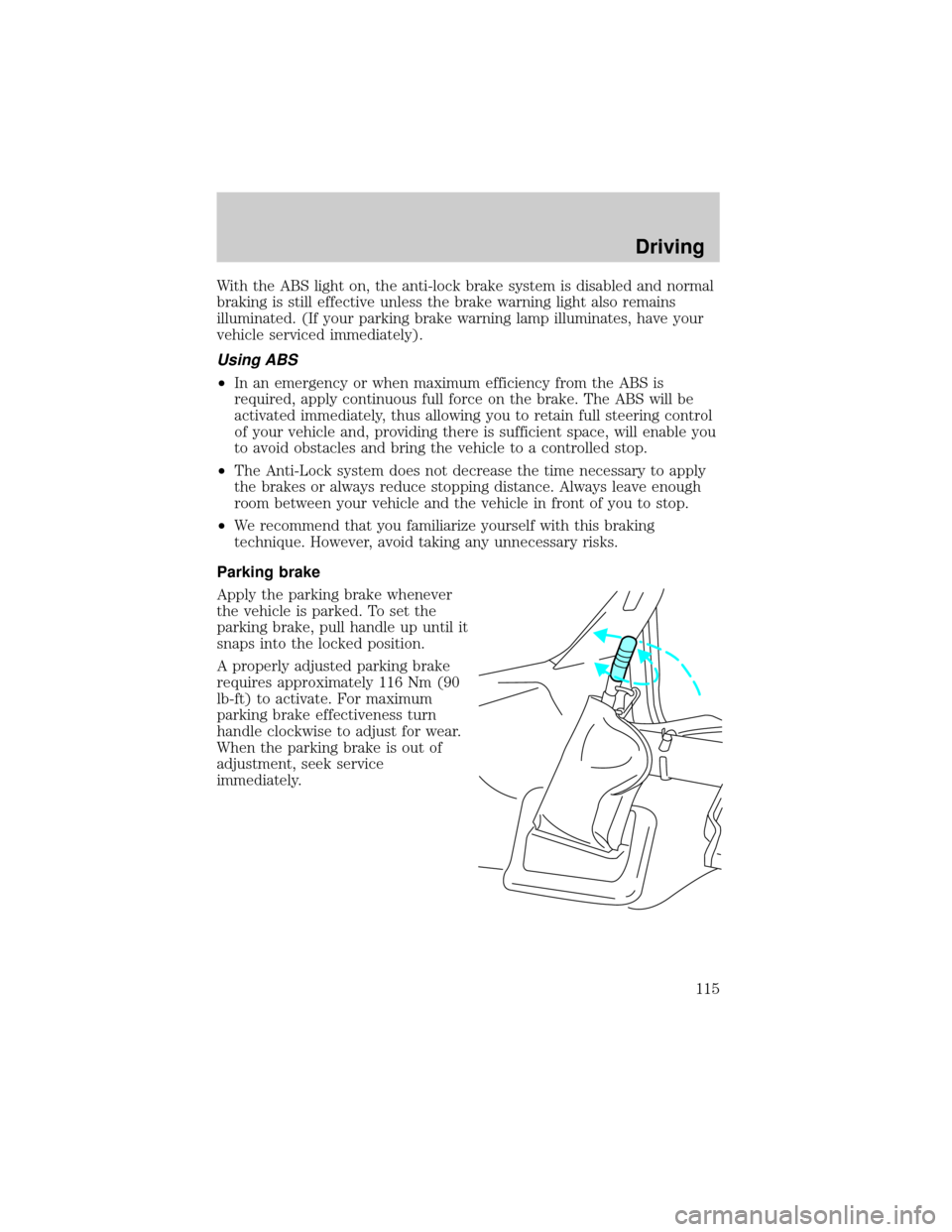
Apply the parking brake whenever
the vehicle is parked. To set the
parking brake, pull handle up until it
snaps into the locked position.
A properly adjusted parking brake
requires approximately 116 Nm (90
lb-ft) to activate. For maximum
parking brake effectiveness turn
handle clockwise to adjust for wear.
When the parking brake is out of
adjustment, seek service
immediately.
Driving
115
Page 130 of 256
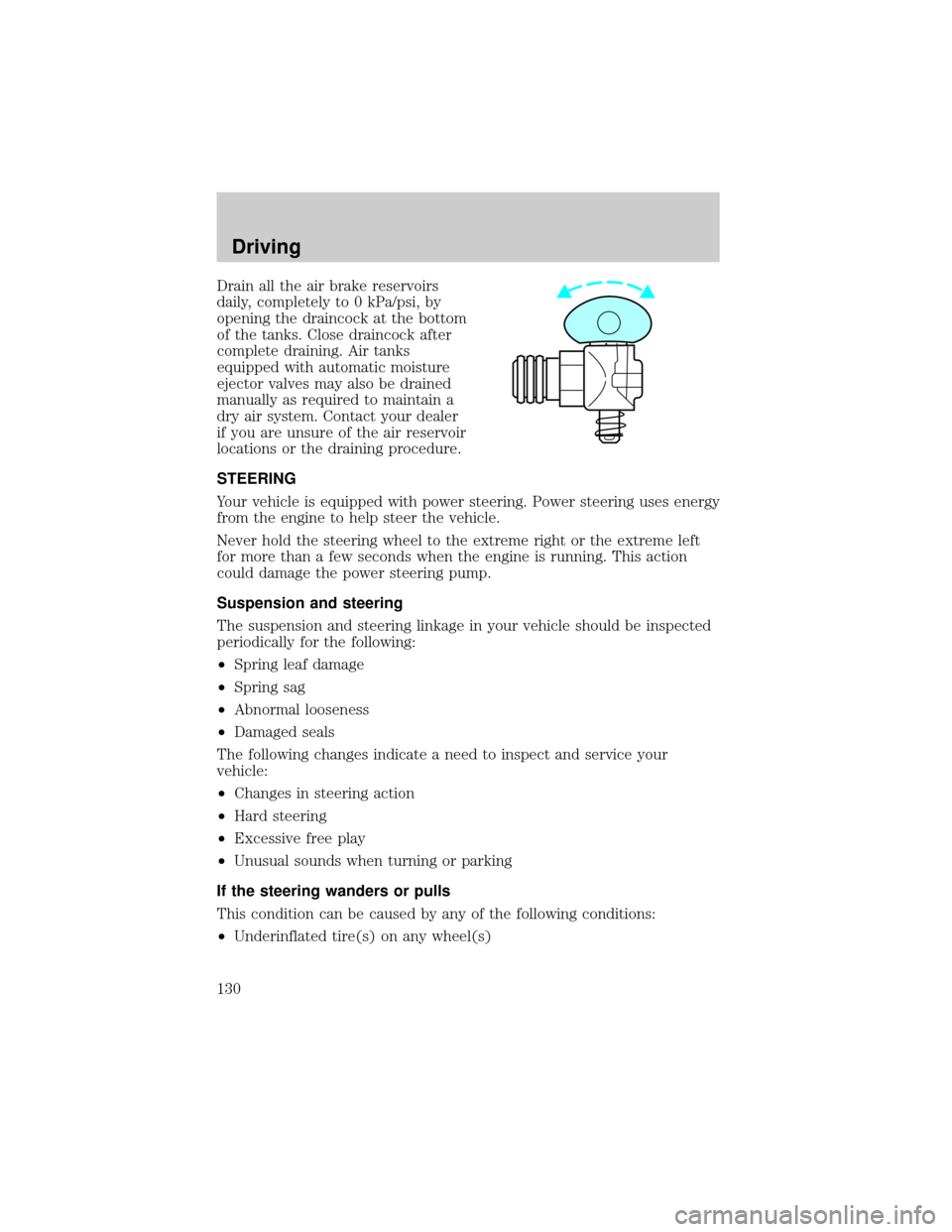
Drain all the air brake reservoirs
daily, completely to 0 kPa/psi, by
opening the draincock at the bottom
of the tanks. Close draincock after
complete draining. Air tanks
equipped with automatic moisture
ejector valves may also be drained
manually as required to maintain a
dry air system. Contact your dealer
if you are unsure of the air reservoir
locations or the draining procedure.
STEERING
Your vehicle is equipped with power steering. Power steering uses energy
from the engine to help steer the vehicle.
Never hold the steering wheel to the extreme right or the extreme left
for more than a few seconds when the engine is running. This action
could damage the power steering pump.
Suspension and steering
The suspension and steering linkage in your vehicle should be inspected
periodically for the following:
²Spring leaf damage
²Spring sag
²Abnormal looseness
²Damaged seals
The following changes indicate a need to inspect and service your
vehicle:
²Changes in steering action
²Hard steering
²Excessive free play
²Unusual sounds when turning or parking
If the steering wanders or pulls
This condition can be caused by any of the following conditions:
²Underinflated tire(s) on any wheel(s)
Driving
130
Page 131 of 256
![FORD F650 2002 10.G Owners Manual ²Front end out of alignment
²Total vehicle out of alignment (i.e. rear axle[s] out of alignment with
front axle)
²Improper adjustment in the steering gear
²Vehicle overloaded or unevenly loaded
²](/img/11/5068/w960_5068-130.png "FORD F650 2002 10.G Owners Manual ²Front end out of alignment
²Total vehicle out of alignment (i.e. rear axle[s] out of alignment with
front axle)
²Improper adjustment in the steering gear
²Vehicle overloaded or unevenly loaded
²")
²Front end out of alignment
²Total vehicle out of alignment (i.e. rear axle[s] out of alignment with
front axle)
²Improper adjustment in the steering gear
²Vehicle overloaded or unevenly loaded
²High crosswinds
²High crown in center of road
²Components in steering linkage loose or worn
²Wheel bearings improperly adjusted
²Excessive lash in steering shaft or universal joints
If the vehicle steers hard
Hard steering can be caused by any of the following conditions:
²Underinflated tire(s) on any wheel(s)
²Vehicle overload
²Misalignment of the front tires
²Lack of lubricant in the front spindle bearings or linkage components
²Low oil level in the power steering system
²Broken or loose power steering pump direct drive connection
²Malfunctioning relief valve in power steering gear or steering pump
²Malfunctioning power steering pump
²Restriction in power steering lines
²Improperly set turn stops
²Air entrapped in power steering system fluid
AIR SUSPENSION SYSTEM (IF EQUIPPED)
The on-highway air suspension system is designed to provide a superior
ride, outstanding driver comfort while minimizing wear on the cab, frame
and payload.
The height control valve automatically keeps the vehicle at a constant
level due to load changes and uneven road surfaces.
Driving
131