brakes FORD F650 2004 11.G Owners Manual
[x] Cancel search | Manufacturer: FORD, Model Year: 2004, Model line: F650, Model: FORD F650 2004 11.GPages: 264, PDF Size: 1.47 MB
Page 2 of 264
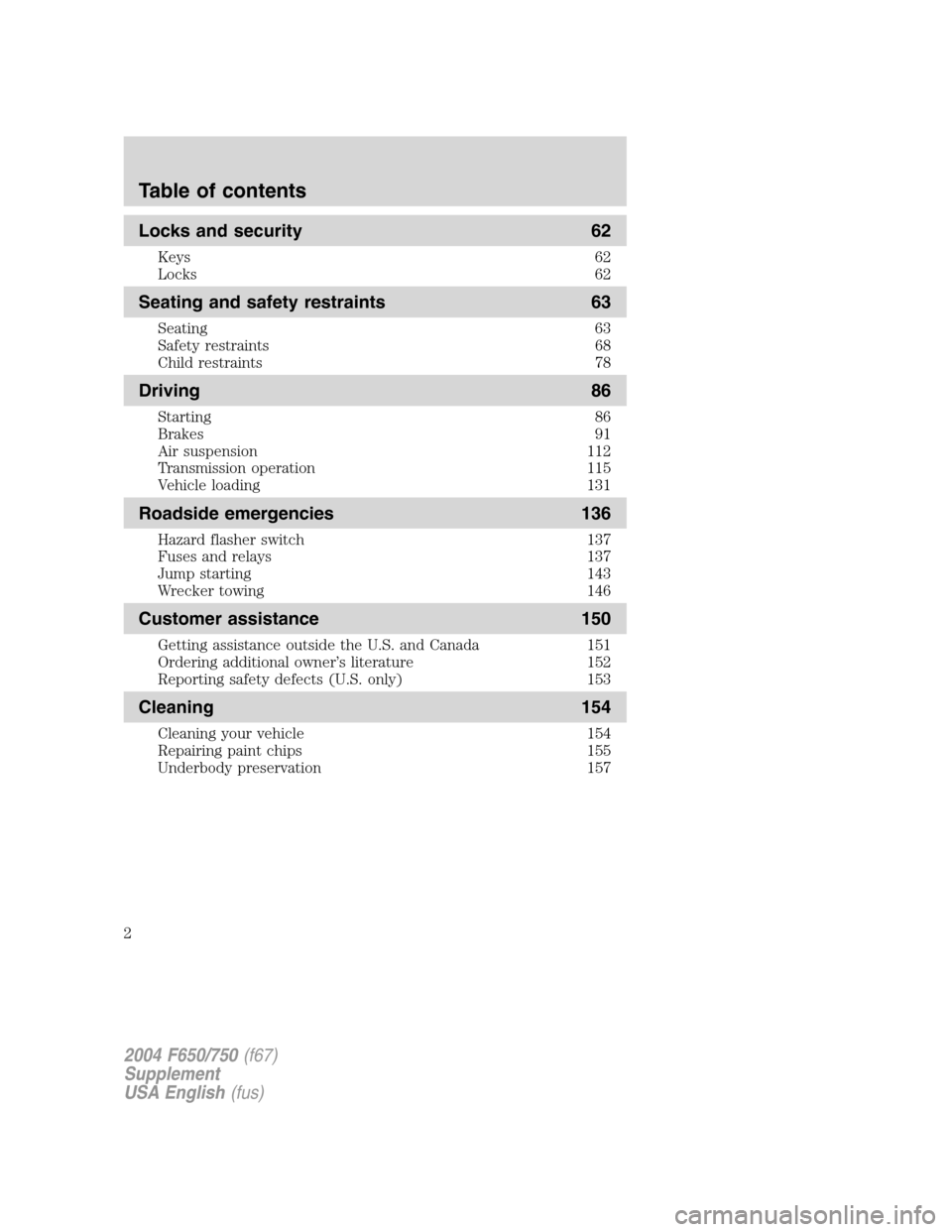
Locks and security 62
Keys 62
Locks 62
Seating and safety restraints 63
Seating 63
Safety restraints 68
Child restraints 78
Driving 86
Starting 86
Brakes 91
Air suspension 112
Transmission operation 115
Vehicle loading 131
Roadside emergencies 136
Hazard flasher switch 137
Fuses and relays 137
Jump starting 143
Wrecker towing 146
Customer assistance 150
Getting assistance outside the U.S. and Canada 151
Ordering additional owner’s literature 152
Reporting safety defects (U.S. only) 153
Cleaning 154
Cleaning your vehicle 154
Repairing paint chips 155
Underbody preservation 157
2004 F650/750(f67)
Supplement
USA English(fus)
Table of contents
2
Page 12 of 264
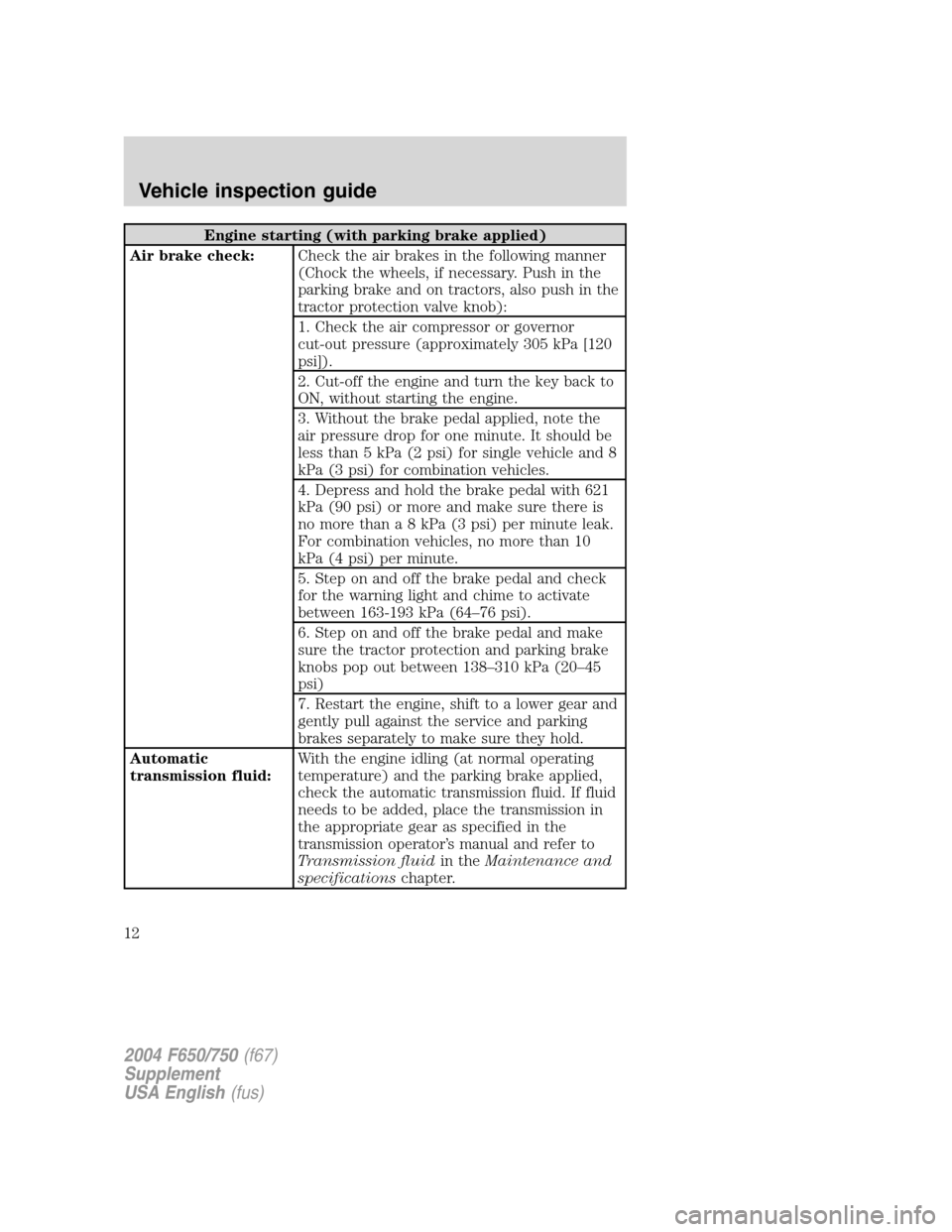
Engine starting (with parking brake applied)
Air brake check:Check the air brakes in the following manner
(Chock the wheels, if necessary. Push in the
parking brake and on tractors, also push in the
tractor protection valve knob):
1. Check the air compressor or governor
cut-out pressure (approximately 305 kPa [120
psi]).
2. Cut-off the engine and turn the key back to
ON, without starting the engine.
3. Without the brake pedal applied, note the
air pressure drop for one minute. It should be
less than 5 kPa (2 psi) for single vehicle and 8
kPa (3 psi) for combination vehicles.
4. Depress and hold the brake pedal with 621
kPa (90 psi) or more and make sure there is
no more than a 8 kPa (3 psi) per minute leak.
For combination vehicles, no more than 10
kPa (4 psi) per minute.
5. Step on and off the brake pedal and check
for the warning light and chime to activate
between 163-193 kPa (64–76 psi).
6. Step on and off the brake pedal and make
sure the tractor protection and parking brake
knobs pop out between 138–310 kPa (20–45
psi)
7. Restart the engine, shift to a lower gear and
gently pull against the service and parking
brakes separately to make sure they hold.
Automatic
transmission fluid:With the engine idling (at normal operating
temperature) and the parking brake applied,
check the automatic transmission fluid. If fluid
needs to be added, place the transmission in
the appropriate gear as specified in the
transmission operator’s manual and refer to
Transmission fluidin theMaintenance and
specificationschapter.
2004 F650/750(f67)
Supplement
USA English(fus)
Vehicle inspection guide
12
Page 14 of 264
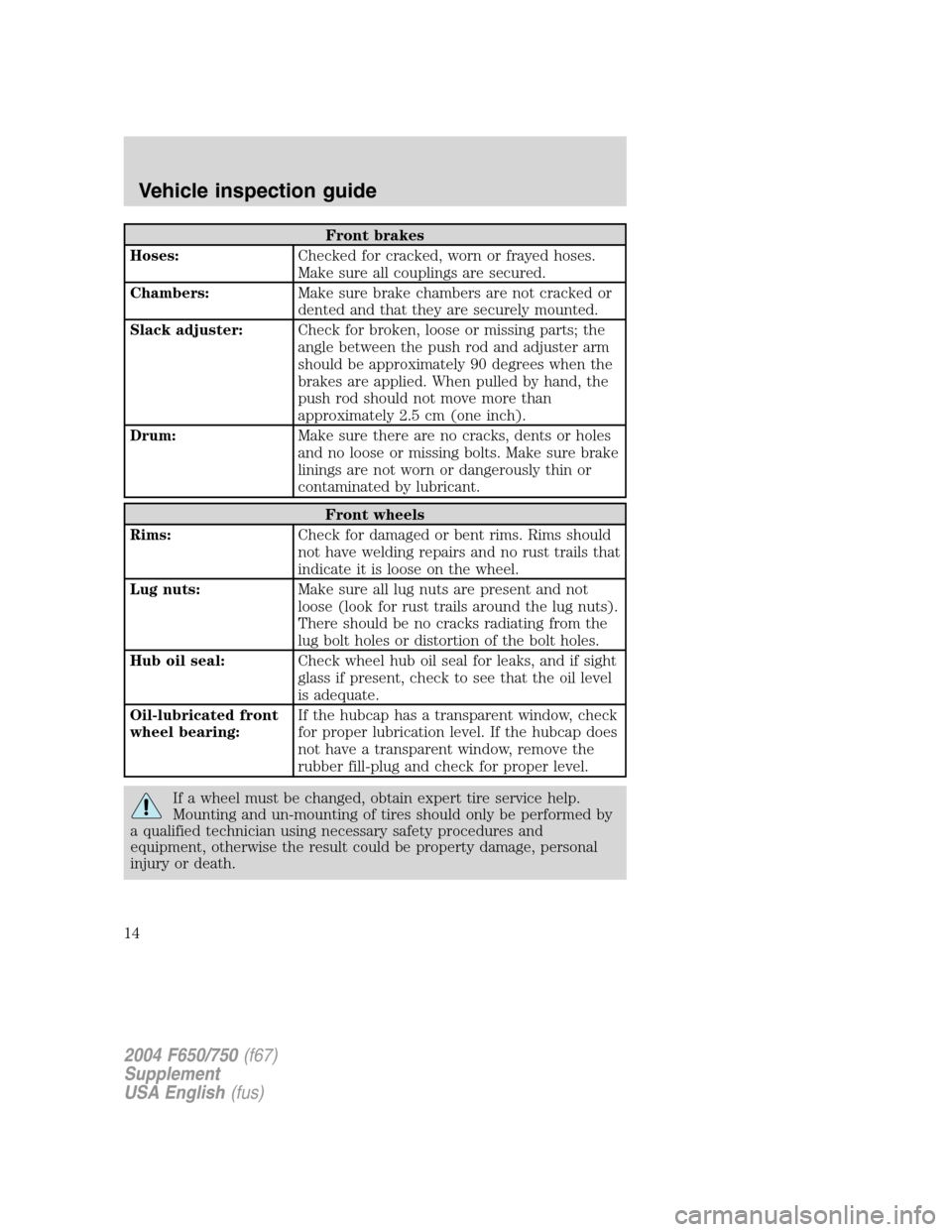
Front brakes
Hoses:Checked for cracked, worn or frayed hoses.
Make sure all couplings are secured.
Chambers:Make sure brake chambers are not cracked or
dented and that they are securely mounted.
Slack adjuster:Check for broken, loose or missing parts; the
angle between the push rod and adjuster arm
should be approximately 90 degrees when the
brakes are applied. When pulled by hand, the
push rod should not move more than
approximately 2.5 cm (one inch).
Drum:Make sure there are no cracks, dents or holes
and no loose or missing bolts. Make sure brake
linings are not worn or dangerously thin or
contaminated by lubricant.
Front wheels
Rims:Check for damaged or bent rims. Rims should
not have welding repairs and no rust trails that
indicate it is loose on the wheel.
Lug nuts:Make sure all lug nuts are present and not
loose (look for rust trails around the lug nuts).
There should be no cracks radiating from the
lug bolt holes or distortion of the bolt holes.
Hub oil seal:Check wheel hub oil seal for leaks, and if sight
glass if present, check to see that the oil level
is adequate.
Oil-lubricated front
wheel bearing:If the hubcap has a transparent window, check
for proper lubrication level. If the hubcap does
not have a transparent window, remove the
rubber fill-plug and check for proper level.
If a wheel must be changed, obtain expert tire service help.
Mounting and un-mounting of tires should only be performed by
a qualified technician using necessary safety procedures and
equipment, otherwise the result could be property damage, personal
injury or death.
2004 F650/750(f67)
Supplement
USA English(fus)
Vehicle inspection guide
14
Page 17 of 264
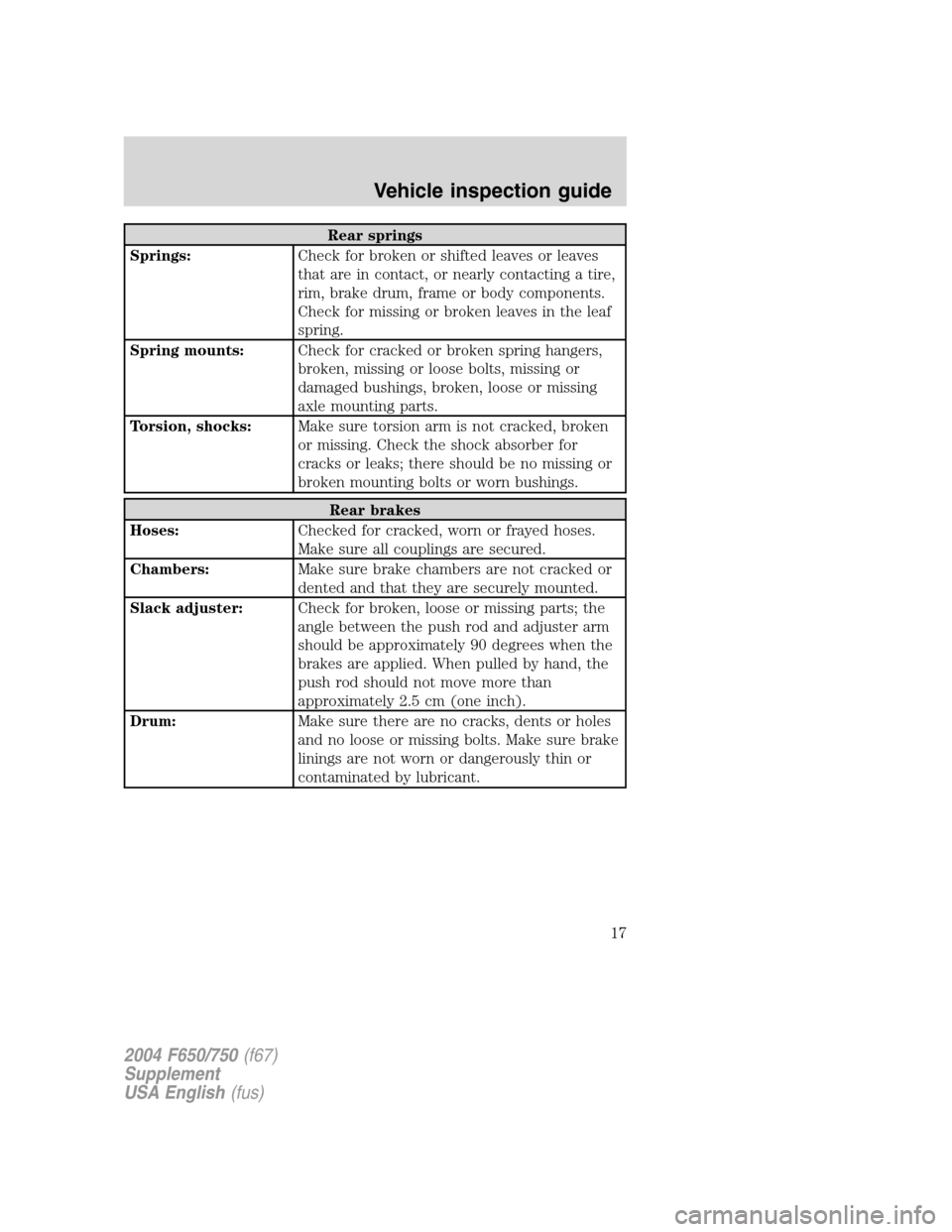
Rear springs
Springs:Check for broken or shifted leaves or leaves
that are in contact, or nearly contacting a tire,
rim, brake drum, frame or body components.
Check for missing or broken leaves in the leaf
spring.
Spring mounts:Check for cracked or broken spring hangers,
broken, missing or loose bolts, missing or
damaged bushings, broken, loose or missing
axle mounting parts.
Torsion, shocks:Make sure torsion arm is not cracked, broken
or missing. Check the shock absorber for
cracks or leaks; there should be no missing or
broken mounting bolts or worn bushings.
Rear brakes
Hoses:Checked for cracked, worn or frayed hoses.
Make sure all couplings are secured.
Chambers:Make sure brake chambers are not cracked or
dented and that they are securely mounted.
Slack adjuster:Check for broken, loose or missing parts; the
angle between the push rod and adjuster arm
should be approximately 90 degrees when the
brakes are applied. When pulled by hand, the
push rod should not move more than
approximately 2.5 cm (one inch).
Drum:Make sure there are no cracks, dents or holes
and no loose or missing bolts. Make sure brake
linings are not worn or dangerously thin or
contaminated by lubricant.
2004 F650/750(f67)
Supplement
USA English(fus)
Vehicle inspection guide
17
Page 18 of 264
Rear wheels
Spacers:Make sure dual wheels are evenly separated
and that tires are not touching one another.
Rims:Check for damaged or bent rims. Rims should
not have welding repairs and no rust trails that
indicate it is loose on the wheel.
Lug nuts:Make sure all lug nuts are present and not
loose (look for rust trails around the lug nuts).
There should be no cracks radiating from the
lug bolt holes or distortion of the bolt holes.
Rear of vehicle
Signal/Brake lights:Make sure both brake lights illuminate when
the brake pedal is applied. Also, make sure
each signal flashes. Make sure that four-way
flashers work properly.
Lights, reflectors:Make sure all lights illuminate and are clean.
Make sure headlights function on both high
and low beams. Make sure reflectors are clean
and unbroken and of proper color (red on
rear, amber elsewhere). Make sure the running
lights are also clean and unbroken. Rear
running lights must be checked separately
from signal, flasher and brake lights.
TRAILER
If you are operating a tractor with a trailer attached, an inspection of the
trailer similar to that of the tractor should be done. Such an inspection
should follow trailer manufacturer recommendation and should include at
a minimum: general condition, landing gear, doors, sides, lights,
reflectors, suspension, brakes, tires and wheels.
2004 F650/750(f67)
Supplement
USA English(fus)
Vehicle inspection guide
18
Page 27 of 264
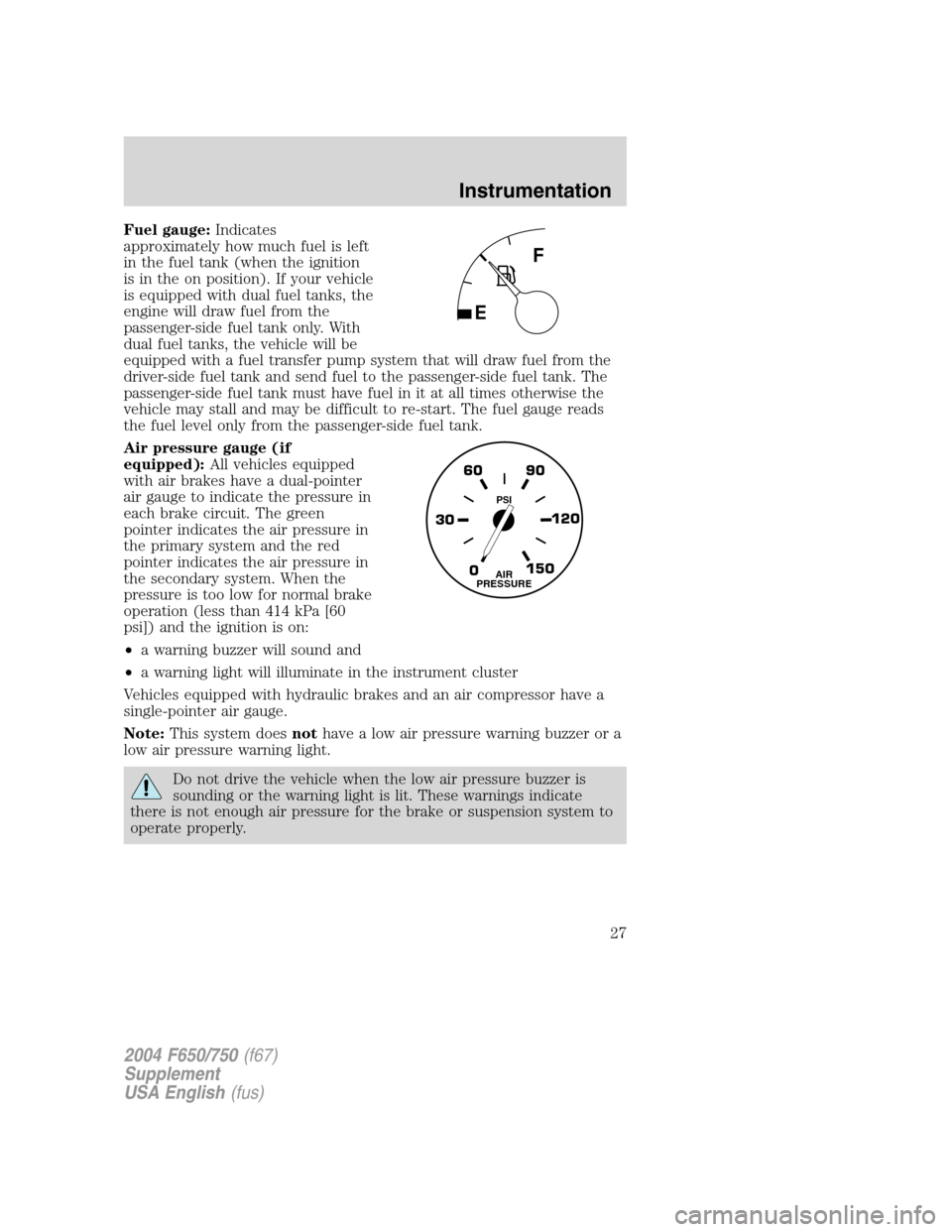
Fuel gauge:Indicates
approximately how much fuel is left
in the fuel tank (when the ignition
is in the on position). If your vehicle
is equipped with dual fuel tanks, the
engine will draw fuel from the
passenger-side fuel tank only. With
dual fuel tanks, the vehicle will be
equipped with a fuel transfer pump system that will draw fuel from the
driver-side fuel tank and send fuel to the passenger-side fuel tank. The
passenger-side fuel tank must have fuel in it at all times otherwise the
vehicle may stall and may be difficult to re-start. The fuel gauge reads
the fuel level only from the passenger-side fuel tank.
Air pressure gauge (if
equipped):All vehicles equipped
with air brakes have a dual-pointer
air gauge to indicate the pressure in
each brake circuit. The green
pointer indicates the air pressure in
the primary system and the red
pointer indicates the air pressure in
the secondary system. When the
pressure is too low for normal brake
operation (less than 414 kPa [60
psi]) and the ignition is on:
•a warning buzzer will sound and
•a warning light will illuminate in the instrument cluster
Vehicles equipped with hydraulic brakes and an air compressor have a
single-pointer air gauge.
Note:This system doesnothave a low air pressure warning buzzer or a
low air pressure warning light.
Do not drive the vehicle when the low air pressure buzzer is
sounding or the warning light is lit. These warnings indicate
there is not enough air pressure for the brake or suspension system to
operate properly.
0 30120 90 60
150AIR
PRESSURE
PSI
2004 F650/750(f67)
Supplement
USA English(fus)
Instrumentation
27
Page 58 of 264
If you drive up or down a steep hill, your vehicle speed may vary
momentarily slower or faster than the set speed; this is normal.
Speed control cannot reduce the vehicle speed if it increases above the
set speed on a downhill. If your vehicle speed is faster than the set
speed while driving on a downhill, you may want to shift to the next
lower gear or apply the brakes to reduce your vehicle speed.
If the vehicle speed falls below 48 km/h (30 mph) or engine RPM falls
below 1,000 RPM, your speed control will disengage; this is normal.
Pressing RESUME - (instrument panel-mounted controls) or RES
(steering wheel-mounted controls) will re-engage it.
Do not use the speed control in heavy traffic or on roads that
are winding, slippery, or unpaved.
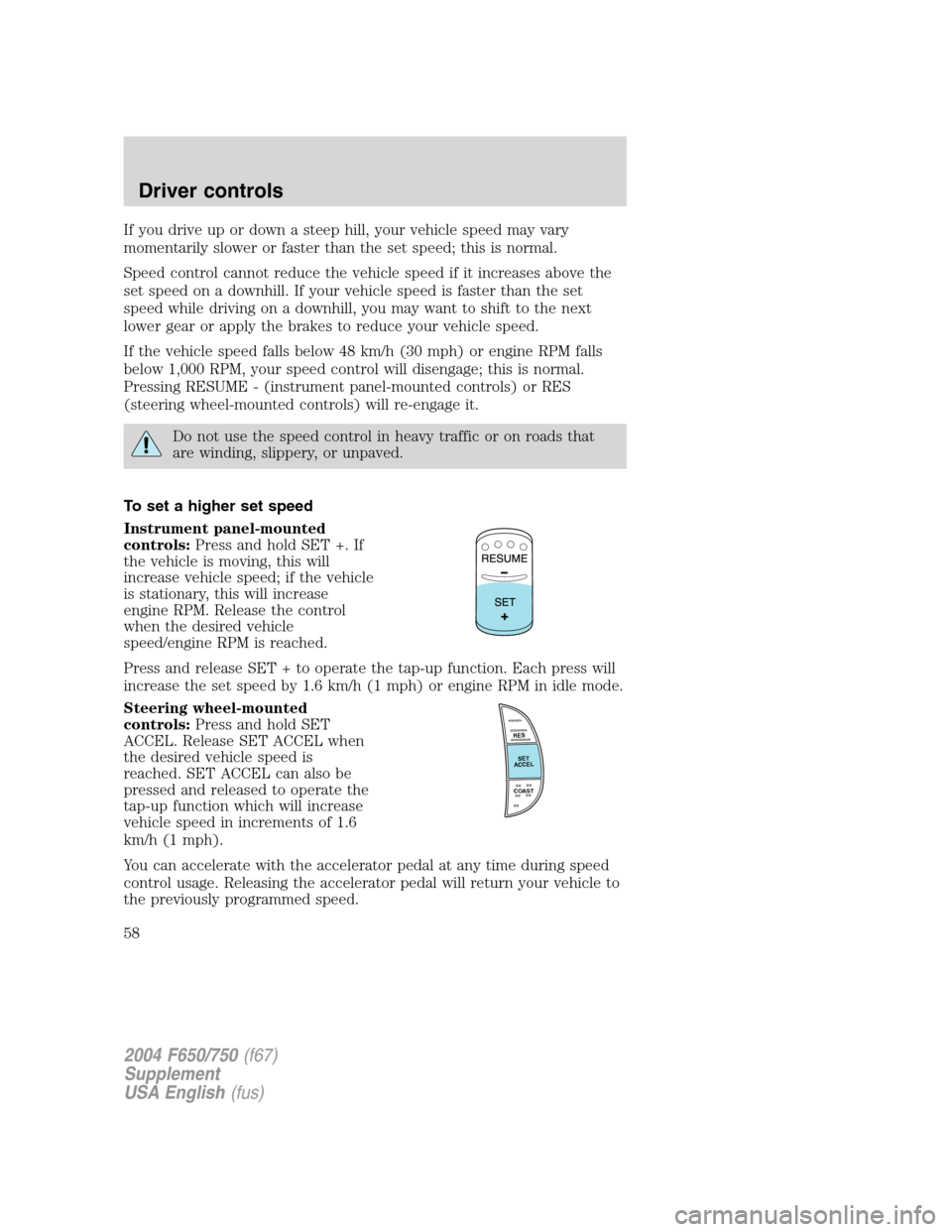
To set a higher set speed
Instrument panel-mounted
controls:Press and hold SET +. If
the vehicle is moving, this will
increase vehicle speed; if the vehicle
is stationary, this will increase
engine RPM. Release the control
when the desired vehicle
speed/engine RPM is reached.
Press and release SET + to operate the tap-up function. Each press will
increase the set speed by 1.6 km/h (1 mph) or engine RPM in idle mode.
Steering wheel-mounted
controls:Press and hold SET
ACCEL. Release SET ACCEL when
the desired vehicle speed is
reached. SET ACCEL can also be
pressed and released to operate the
tap-up function which will increase
vehicle speed in increments of 1.6
km/h (1 mph).
You can accelerate with the accelerator pedal at any time during speed
control usage. Releasing the accelerator pedal will return your vehicle to
the previously programmed speed.
RES
SET
ACCEL
COAST
2004 F650/750(f67)
Supplement
USA English(fus)
Driver controls
58
Page 70 of 264
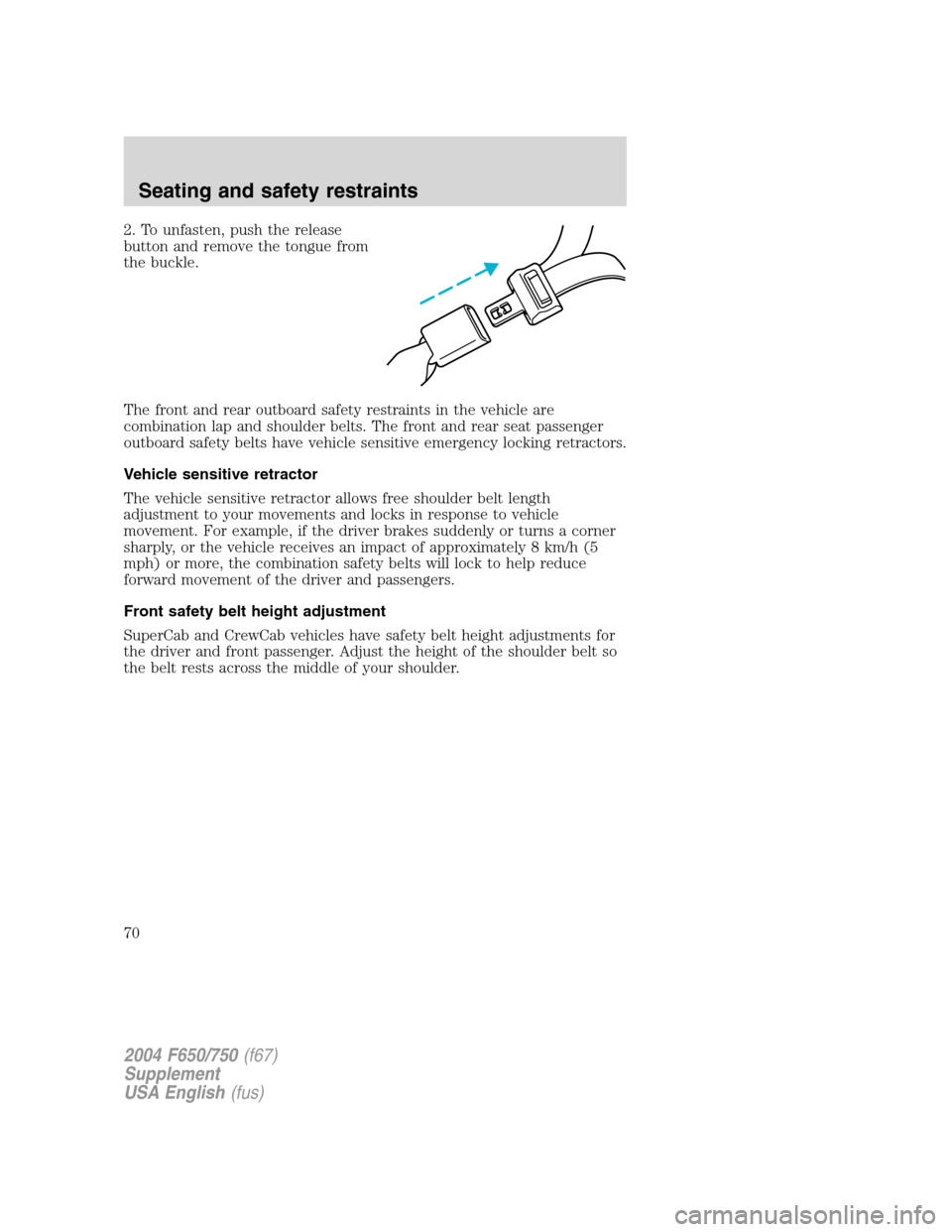
2. To unfasten, push the release
button and remove the tongue from
the buckle.
The front and rear outboard safety restraints in the vehicle are
combination lap and shoulder belts. The front and rear seat passenger
outboard safety belts have vehicle sensitive emergency locking retractors.
Vehicle sensitive retractor
The vehicle sensitive retractor allows free shoulder belt length
adjustment to your movements and locks in response to vehicle
movement. For example, if the driver brakes suddenly or turns a corner
sharply, or the vehicle receives an impact of approximately 8 km/h (5
mph) or more, the combination safety belts will lock to help reduce
forward movement of the driver and passengers.
Front safety belt height adjustment
SuperCab and CrewCab vehicles have safety belt height adjustments for
the driver and front passenger. Adjust the height of the shoulder belt so
the belt rests across the middle of your shoulder.
2004 F650/750(f67)
Supplement
USA English(fus)
Seating and safety restraints
70
Page 91 of 264
Driving through water
If driving through deep or standing water is unavoidable, proceed very
slowly especially if the depth is not known. Never drive through water
that is higher than the bottom of the hubs (for trucks) or the bottom of
the wheel rims (for cars). Traction or brake capability may be limited
and your vehicle may stall. Water may also enter your engine’s air intake
and severely damage your engine.
Once through the water, always dry the brakes by moving your vehicle
slowly while applying light pressure on the brake pedal. Wet brakes do
not stop the vehicle as quickly as dry brakes.Driving through deep
water where the transmission vent tube is submerged may allow
water into the transmission and cause internal transmission
damage.
HYDRAULIC BRAKES (IF EQUIPPED)
Your service brakes are self-adjusting. Refer to theGeneral
Maintenance Informationfor scheduled maintenance.
Occasional brake noise is normal and often does not indicate a performance
concern with the vehicle’s brake system. In normal operation, automotive
brake systems may emit occasional or intermittent squeal or groan noises
when the brakes are applied. Such noises are usually heard during the first
few brake applications in the morning; however, they may be heard at any
time while braking and can be aggravated by environmental conditions
such as cold, heat, moisture, road dust, salt or mud. If a“metal-to-metal,”
“continuous grinding”or“continuous squeal”sound is present while
braking, the brake linings may be worn-out and should be inspected by a
qualified service technician.
If you are driving down a long or steep hill, shift to a lower gear.
Do not apply your brakes continuously, as they may overheat
and become less effective.
IF BRAKES DO NOT GRIP WELL
•If you have been driving through deep water, gently apply the brakes
several times while the vehicle is moving slowly.
•Let the brakes cool if you have been using them excessively, as in
mountain driving or after several fast, high speed stops.
•Check brake adjustment.
•Check brake linings for excessive wear.
2004 F650/750(f67)
Supplement
USA English(fus)
Driving
91
Page 94 of 264
The parking brake is not recommended to stop a moving vehicle.
However, if the normal brakes fail, the parking brake can be used to stop
your vehicle in an emergency. Since the parking brake only applies
retardation to the rear wheels, the vehicle’s stopping distance will
increase greatly and the handling of your vehicle will be adversely
affected.
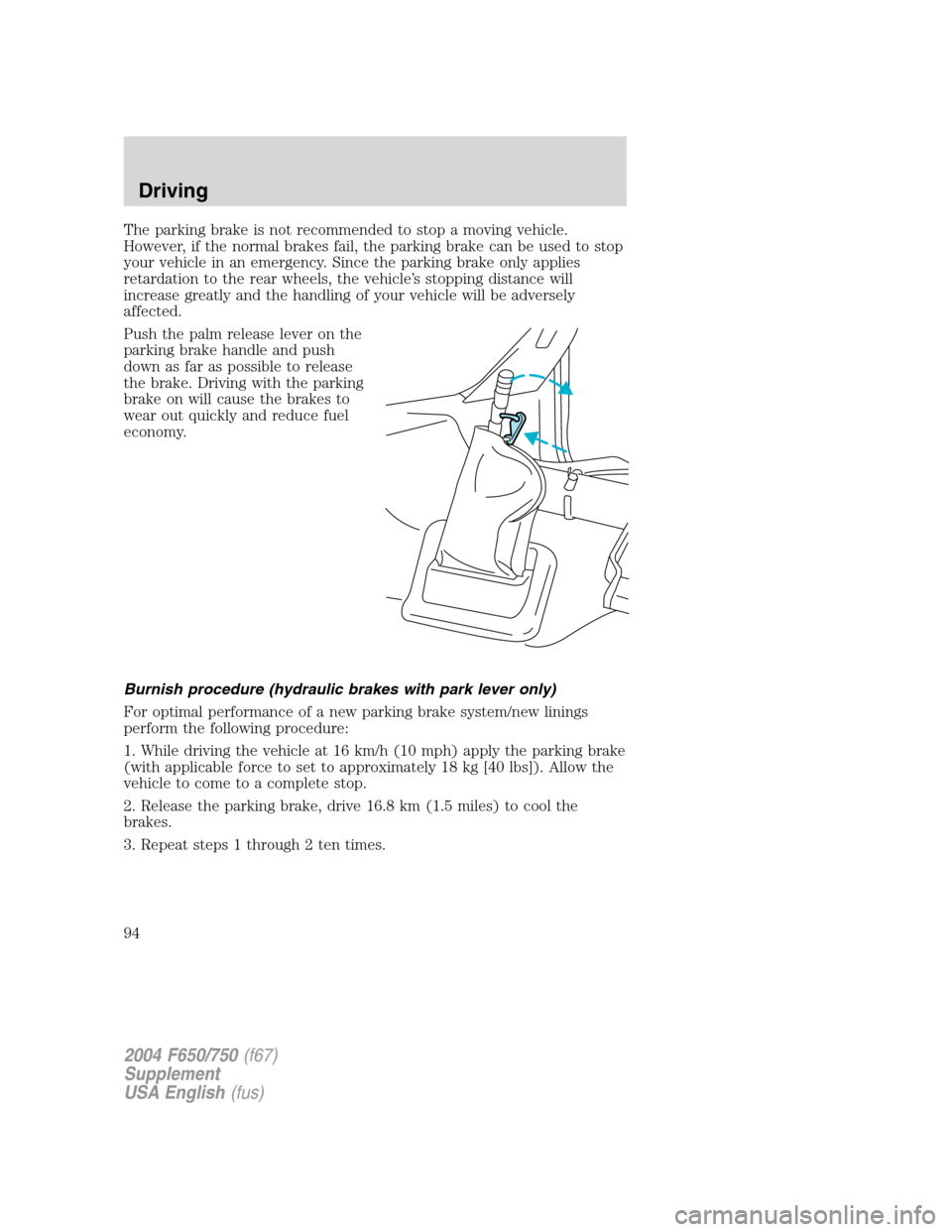
Push the palm release lever on the
parking brake handle and push
down as far as possible to release
the brake. Driving with the parking
brake on will cause the brakes to
wear out quickly and reduce fuel
economy.
Burnish procedure (hydraulic brakes with park lever only)
For optimal performance of a new parking brake system/new linings
perform the following procedure:
1. While driving the vehicle at 16 km/h (10 mph) apply the parking brake
(with applicable force to set to approximately 18 kg [40 lbs]). Allow the
vehicle to come to a complete stop.
2. Release the parking brake, drive 16.8 km (1.5 miles) to cool the
brakes.
3. Repeat steps 1 through 2 ten times.
2004 F650/750(f67)
Supplement
USA English(fus)
Driving
94