battery FORD F650 2005 11.G User Guide
[x] Cancel search | Manufacturer: FORD, Model Year: 2005, Model line: F650, Model: FORD F650 2005 11.GPages: 272, PDF Size: 1.5 MB
Page 162 of 272
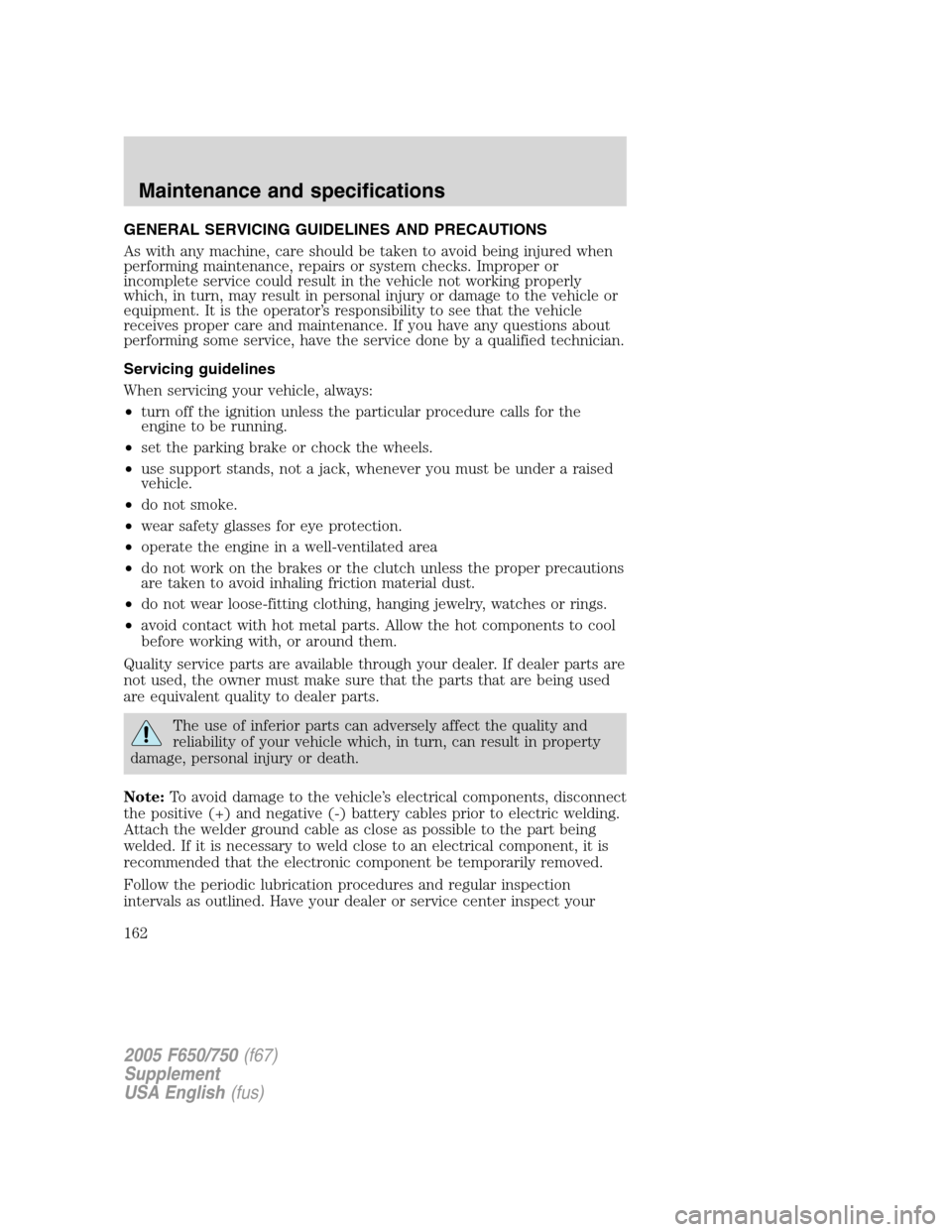
GENERAL SERVICING GUIDELINES AND PRECAUTIONS
As with any machine, care should be taken to avoid being injured when
performing maintenance, repairs or system checks. Improper or
incomplete service could result in the vehicle not working properly
which, in turn, may result in personal injury or damage to the vehicle or
equipment. It is the operator’s responsibility to see that the vehicle
receives proper care and maintenance. If you have any questions about
performing some service, have the service done by a qualified technician.
Servicing guidelines
When servicing your vehicle, always:
•turn off the ignition unless the particular procedure calls for the
engine to be running.
•set the parking brake or chock the wheels.
•use support stands, not a jack, whenever you must be under a raised
vehicle.
•do not smoke.
•wear safety glasses for eye protection.
•operate the engine in a well-ventilated area
•do not work on the brakes or the clutch unless the proper precautions
are taken to avoid inhaling friction material dust.
•do not wear loose-fitting clothing, hanging jewelry, watches or rings.
•avoid contact with hot metal parts. Allow the hot components to cool
before working with, or around them.
Quality service parts are available through your dealer. If dealer parts are
not used, the owner must make sure that the parts that are being used
are equivalent quality to dealer parts.
The use of inferior parts can adversely affect the quality and
reliability of your vehicle which, in turn, can result in property
damage, personal injury or death.
Note:To avoid damage to the vehicle’s electrical components, disconnect
the positive (+) and negative (-) battery cables prior to electric welding.
Attach the welder ground cable as close as possible to the part being
welded. If it is necessary to weld close to an electrical component, it is
recommended that the electronic component be temporarily removed.
Follow the periodic lubrication procedures and regular inspection
intervals as outlined. Have your dealer or service center inspect your
2005 F650/750(f67)
Supplement
USA English(fus)
Maintenance and specifications
Maintenance and specifications
162
Page 180 of 272

BATTERY
Your vehicle is equipped with two maintenance-free batteries which are
mounted in a covered tray and located on the left frame rail. The
covered battery tray, depending upon application, may also have one or
two steps attached.
•Covered battery tray shown.
Battery tray with steps similar.
The two rubber straps on top of
the cover must be pulled up and
moved to the side of the battery
in order to remove the lid.
•Battery tray with cover removed.
Maintenance-free batteries do not normally require adding additional
water. However, for severe usage or in high temperature climates, check
the battery electrolyte levels. Refer to the general maintenance
information section for the service interval schedules.
Keep the electrolyte level in each cell up to the“level indicator”.
Do not overfill the battery cells.
If the electrolyte level in the battery is low, you can add plain tap water
to the battery, as long as you do not use hard water (water with a high
mineral or alkali content). If possible, however, try to only fill the battery
cells with distilled water. If the battery needs water often, have the
charging system checked.
Make sure the battery cover/shield is reinstalled after the battery
has been cleaned or replaced.
2005 F650/750(f67)
Supplement
USA English(fus)
Maintenance and specifications
180
Page 181 of 272

For longer, trouble-free operation, keep the top of the batteries clean
and dry. Also, make certain the battery cables are always tightly fastened
to the battery terminals.
If you see any corrosion on the battery or terminals, remove the cables
from the terminals and clean with a wire brush. You can neutralize the
acid with a solution of baking soda and water.
Batteries normally produce explosive gases which can cause
personal injury. Therefore, do not allow flames, sparks or lighted
substances to come near the battery. When working near the battery,
always shield your face and protect your eyes. Always provide proper
ventilation.
When lifting a plastic-cased battery, excessive pressure on the
end walls could cause acid to flow through the vent caps,
resulting in personal injury and/or damage to the vehicle or battery.
Lift the battery with a battery carrier or with your hands on opposite
corners.
Keep batteries out of reach of children. Batteries contain sulfuric
acid. Avoid contact with skin, eyes or clothing. Shield your eyes
when working near the battery to protect against possible splashing of
acid solution. In case of acid contact with skin or eyes, flush
immediately with water for a minimum of 15 minutes and get prompt
medical attention. If acid is swallowed, call a physician immediately.
Battery posts, terminals and related accessories contain lead and
lead compounds.Wash hands after handling.
Always dispose of automotive
batteries in a responsible manner.
Follow your local authorized
standards for disposal. Call your
local authorized recycling center to
find out more about recycling
automotive batteries.
LEAD
RETURN
RECYCLE
2005 F650/750(f67)
Supplement
USA English(fus)
Maintenance and specifications
181
Page 201 of 272
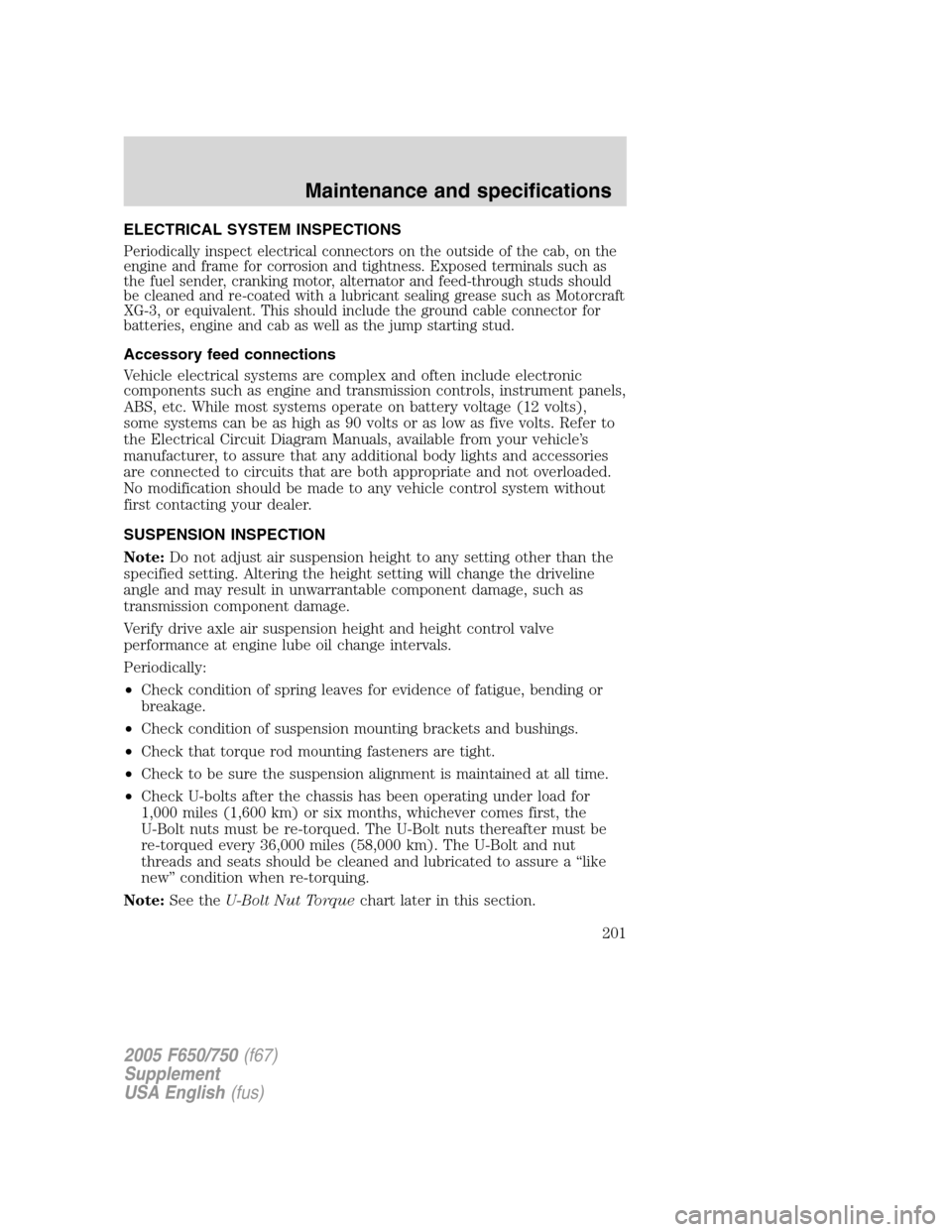
ELECTRICAL SYSTEM INSPECTIONS
Periodically inspect electrical connectors on the outside of the cab, on the
engine and frame for corrosion and tightness. Exposed terminals such as
the fuel sender, cranking motor, alternator and feed-through studs should
be cleaned and re-coated with a lubricant sealing grease such as Motorcraft
XG-3, or equivalent. This should include the ground cable connector for
batteries, engine and cab as well as the jump starting stud.
Accessory feed connections
Vehicle electrical systems are complex and often include electronic
components such as engine and transmission controls, instrument panels,
ABS, etc. While most systems operate on battery voltage (12 volts),
some systems can be as high as 90 volts or as low as five volts. Refer to
the Electrical Circuit Diagram Manuals, available from your vehicle’s
manufacturer, to assure that any additional body lights and accessories
are connected to circuits that are both appropriate and not overloaded.
No modification should be made to any vehicle control system without
first contacting your dealer.
SUSPENSION INSPECTION
Note:Do not adjust air suspension height to any setting other than the
specified setting. Altering the height setting will change the driveline
angle and may result in unwarrantable component damage, such as
transmission component damage.
Verify drive axle air suspension height and height control valve
performance at engine lube oil change intervals.
Periodically:
•Check condition of spring leaves for evidence of fatigue, bending or
breakage.
•Check condition of suspension mounting brackets and bushings.
•Check that torque rod mounting fasteners are tight.
•Check to be sure the suspension alignment is maintained at all time.
•Check U-bolts after the chassis has been operating under load for
1,000 miles (1,600 km) or six months, whichever comes first, the
U-Bolt nuts must be re-torqued. The U-Bolt nuts thereafter must be
re-torqued every 36,000 miles (58,000 km). The U-Bolt and nut
threads and seats should be cleaned and lubricated to assure a“like
new”condition when re-torquing.
Note:See theU-Bolt Nut Torquechart later in this section.
2005 F650/750(f67)
Supplement
USA English(fus)
Maintenance and specifications
201
Page 238 of 272
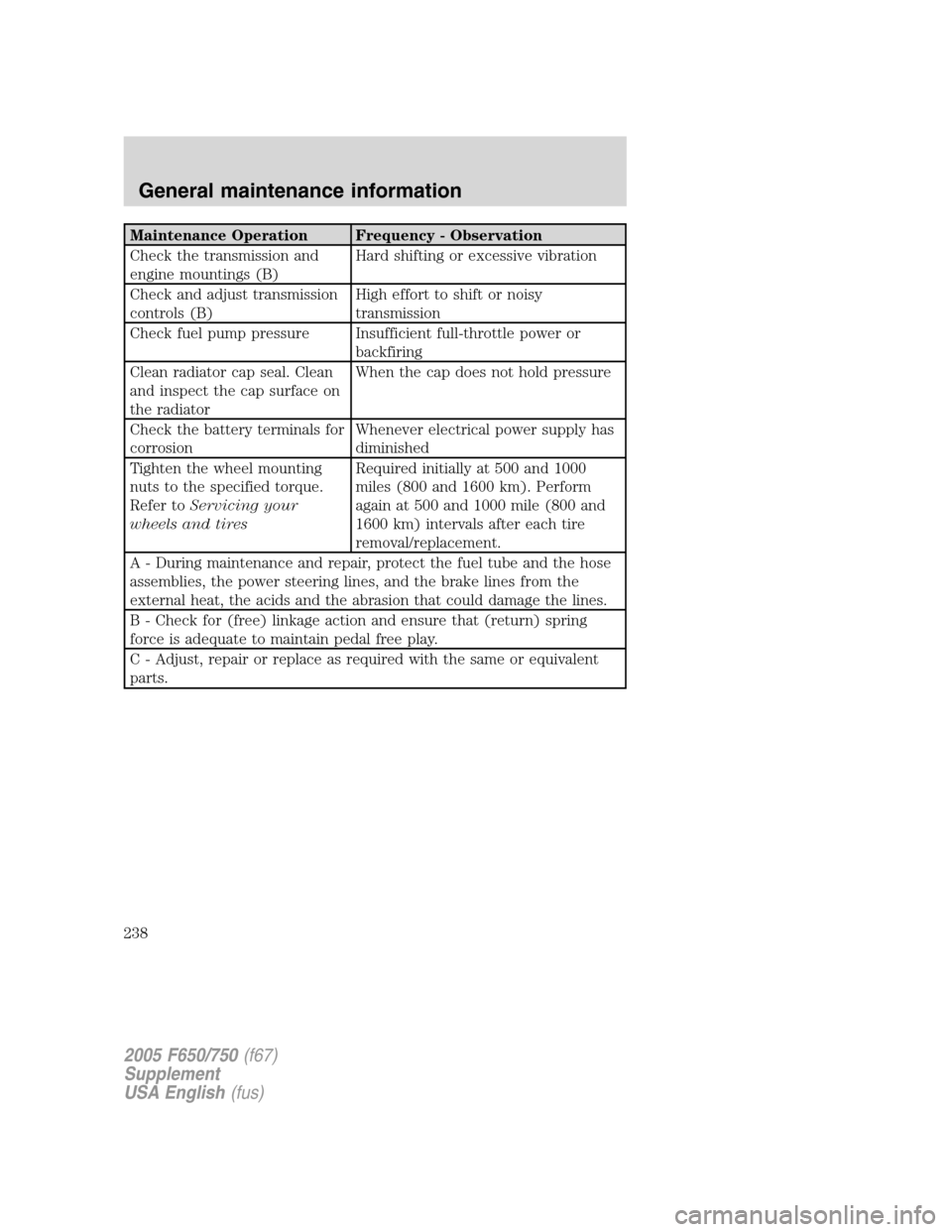
Maintenance Operation Frequency - Observation
Check the transmission and
engine mountings (B)Hard shifting or excessive vibration
Check and adjust transmission
controls (B)High effort to shift or noisy
transmission
Check fuel pump pressure Insufficient full-throttle power or
backfiring
Clean radiator cap seal. Clean
and inspect the cap surface on
the radiatorWhen the cap does not hold pressure
Check the battery terminals for
corrosionWhenever electrical power supply has
diminished
Tighten the wheel mounting
nuts to the specified torque.
Refer toServicing your
wheels and tiresRequired initially at 500 and 1000
miles (800 and 1600 km). Perform
again at 500 and 1000 mile (800 and
1600 km) intervals after each tire
removal/replacement.
A - During maintenance and repair, protect the fuel tube and the hose
assemblies, the power steering lines, and the brake lines from the
external heat, the acids and the abrasion that could damage the lines.
B - Check for (free) linkage action and ensure that (return) spring
force is adequate to maintain pedal free play.
C - Adjust, repair or replace as required with the same or equivalent
parts.
2005 F650/750(f67)
Supplement
USA English(fus)
General maintenance information
238
Page 263 of 272
A
Air conditioning ..........................45
manual heating and air
conditioning system .................45
Air suspension ...........................115
Anti-lock brake system
(see Brakes) ..............................113
Audio system
(see Radio) ................30, 32, 35, 39
Automatic transmission ............118
fluid, adding ............................185
fluid, checking ........................185
fluid, refill capacities ..............223
fluid, specification ..................213
Auxiliary power point .................54
Axle ............................130, 164, 204
lubricant specifications ..........213
refill capacities ........................222
B
Battery .......................................180
charging system warning
light ............................................21
jumping a disabled battery ....147
voltage gauge ............................26
BeltMinder ...................................75
Brakes ............................93, 99, 164
adjustment ..............................167
anti-lock ...........................113–114
anti-lock brake system
(ABS) warning light .........21, 114
brake warning light ..................21
fluid, checking and adding ...167,
179
fluid, specifications .................213
parking ......................95, 102, 168
Bulbs ............................................49C
Cassette tape player ...................39
Catalytic converter
(see Emission control) .............188
CD-single premium .........30, 32, 35
Cell phone use ............................54
Child safety restraints ................80
child safety belts ......................80
Child safety seats ........................83
attaching with tether straps ....86
in front seat ..............................84
in rear seat ................................84
tether anchorage hardware .....86
Child safety seats - booster
seats .............................................80
Cleaning your vehicle
chrome and aluminum
parts .........................................159
engine compartment ..............159
exterior ....................................161
instrument panel ....................160
interior .....................................160
interior trim ............................160
plastic parts ............................160
washing ....................................158
waxing .....................................158
wheels ......................................159
Climate control (see Air
conditioning or Heating) ......44–45
Clutch ................................122, 184
adjusting ..................................184
fluid ..........................................184
operation while driving ..........122
specifications ..........................213
Controls
power seat .................................68
2005 F650/750(f67)
Supplement
USA English(fus)
Index
263
Page 264 of 272

Coolant ......................................174
checking and adding ..............174
refill capacities ........................223
specifications ..........................213
temperature gauge ...................26
Cruise control
(see Speed control) ....................58
Customer Assistance ........139, 154
Getting assistance outside the
U.S. and Canada .............154, 156
Getting roadside assistance ...139
Getting the service you
need .........................................154
Ordering additional owner’s
literature .................................157
D
Daytime running lamps
(see Lamps) ................................47
Defects, reporting .....................157
Defrost ...................................44–45
windshield ...........................44–45
with heating and air
conditioning system .................45
with standard heating
system .......................................44
Doors
lubricant specifications ..........213
Driving under special
conditions
through water ...........................92
E
Emergencies, roadside
jump-starting ..........................147
Emission control system ..199, 228
catalytic converter ..................188Engine
cleaning ...................................159
lubrication specifications .......213
Engine fan .................................178
Engine oil ..................................170
checking and adding ..............170
oil pressure gauge ....................26
recommendations ...................171
refill capacities ........................223
specifications ..........................213
F
Flashers, hazard ........................140
Fuel ............................................189
calculating fuel
economy ..........................196–197
capacity ...................................224
choosing the right fuel ...........190
filling your vehicle with fuel ..189
filter,
specifications ..........191–192, 194
gauge .........................................26
improving fuel
economy ..........................196–197
running out of fuel ...........88, 191
safety information relating to
automotive fuels .....................189
Fuses ..........................................140
G
Gas mileage
(see Fuel economy) .........196–197
Gauges .........................................26
battery voltage gauge ...............26
engine coolant temperature
gauge .........................................26
engine oil pressure gauge ........26
fuel gauge ..................................26
odometer ...................................26
2005 F650/750(f67)
Supplement
USA English(fus)
Index
264
Page 267 of 272

Turn signal ..................................48
V
Vehicle loading ..................134–135
Voltmeter
(see Battery voltage gauge) ......26
W
Warning chimes ...........................21
Warning lights (see Lights) .......21
Warranty coverage ........................6
Washer fluid ..............................178
Washing your vehicle ................158Water, Driving through ...............92
Waxing your vehicle .................158
Wheels .......................................205
Windows
power .........................................55
Windshield
defrosting
............................44–45
Windshield washer fluid and
wipers
..........................................52
checking and cleaning
..............52
operation
...................................52
replacing wiper blades
.............53
Wrecker towing
.........................150
2005 F650/750(f67)
Supplement
USA English(fus)
Index
267