light FORD F650 2006 11.G Repair Manual
[x] Cancel search | Manufacturer: FORD, Model Year: 2006, Model line: F650, Model: FORD F650 2006 11.GPages: 272, PDF Size: 1.86 MB
Page 157 of 272
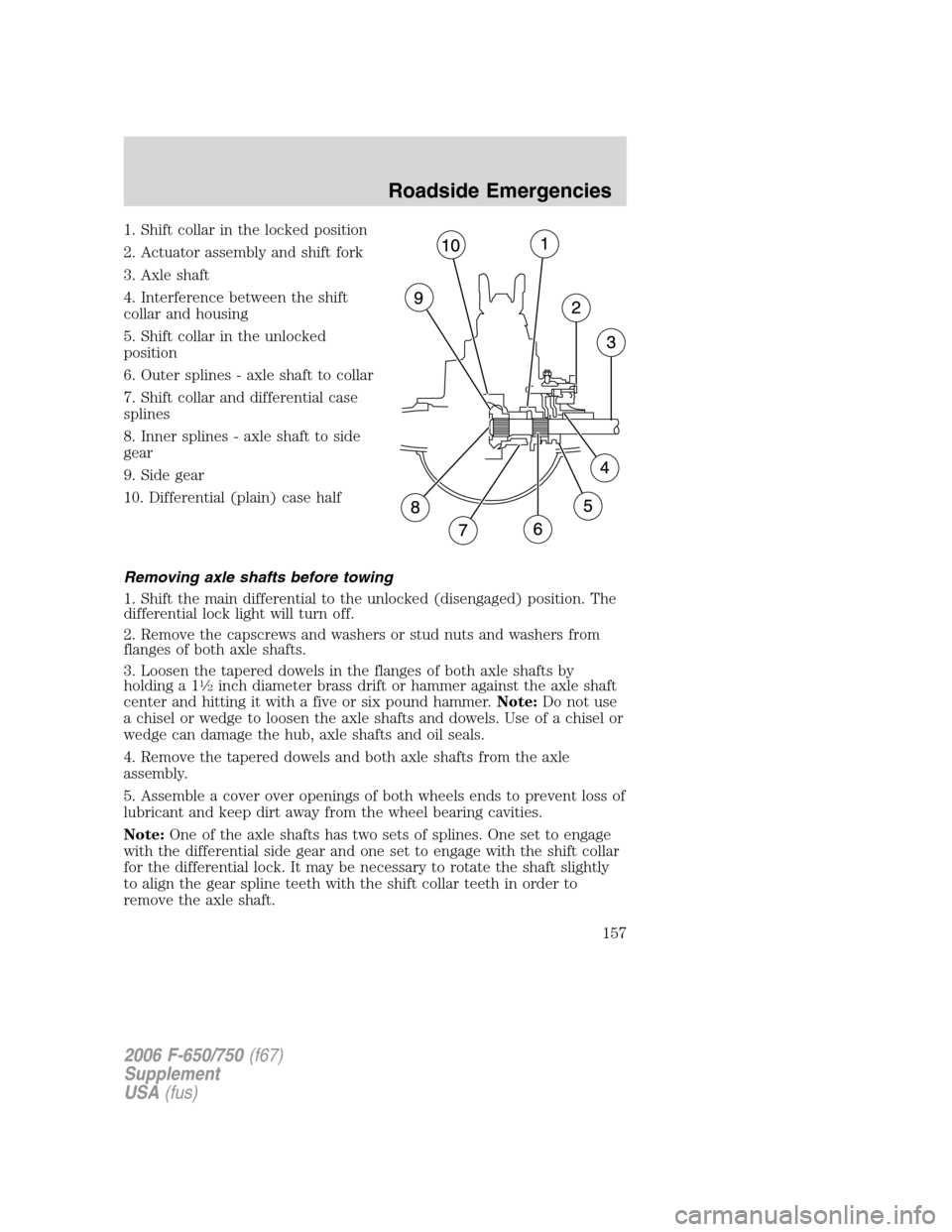
1. Shift collar in the locked position
2. Actuator assembly and shift fork
3. Axle shaft
4. Interference between the shift
collar and housing
5. Shift collar in the unlocked
position
6. Outer splines - axle shaft to collar
7. Shift collar and differential case
splines
8. Inner splines - axle shaft to side
gear
9. Side gear
10. Differential (plain) case half
Removing axle shafts before towing
1. Shift the main differential to the unlocked (disengaged) position. The
differential lock light will turn off.
2. Remove the capscrews and washers or stud nuts and washers from
flanges of both axle shafts.
3. Loosen the tapered dowels in the flanges of both axle shafts by
holding a 1
12inch diameter brass drift or hammer against the axle shaft
center and hitting it with a five or six pound hammer.Note:Do not use
a chisel or wedge to loosen the axle shafts and dowels. Use of a chisel or
wedge can damage the hub, axle shafts and oil seals.
4. Remove the tapered dowels and both axle shafts from the axle
assembly.
5. Assemble a cover over openings of both wheels ends to prevent loss of
lubricant and keep dirt away from the wheel bearing cavities.
Note:One of the axle shafts has two sets of splines. One set to engage
with the differential side gear and one set to engage with the shift collar
for the differential lock. It may be necessary to rotate the shaft slightly
to align the gear spline teeth with the shift collar teeth in order to
remove the axle shaft.
2006 F-650/750(f67)
Supplement
USA(fus)
Roadside Emergencies
157
Page 163 of 272
WASHING THE EXTERIOR
Wash your vehicle regularly with cool or lukewarm water and a neutral
pH shampoo, such as Motorcraft Detail Wash (ZC-3–A), which is
available from your dealer.
•Never use strong household detergents or soap, such as dish washing
or laundry liquid. These products can discolor and spot painted
surfaces.
•Never wash a vehicle that is “hot to the touch” or during exposure to
strong, direct sunlight.
•Always use a clean sponge or car wash mitt with plenty of water for
best results.
•Dry the vehicle with a chamois or soft terry cloth towel in order to
eliminate water spotting.
•It is especially important to wash the vehicle regularly during the
winter months, as dirt and road salt are difficult to remove and cause
damage to the vehicle.
•Immediately remove items such as gasoline, diesel fuel, bird droppings
and insect deposits because they can cause damage to the vehicle’s
paintwork and trim over time.
•Remove any exterior accessories, such as antennas, before entering a
car wash.
•Suntan lotions and insect repellents can damage any painted
surface; if these substances come in contact with your vehicle,
wash off as soon as possible.
WAXING
Applying a polymer paint sealant to your vehicle every six months will
assist in reducing minor scratches and paint damage.
•Wash the vehicle first.
•Do not use waxes that contain abrasives.
•Do not allow paint sealant to come in contact with any non-body
(low-gloss black) colored trim, such as grained door handles, roof
racks, bumpers, side moldings, mirror housings or the windshield cowl
area. The paint sealant will “gray” or stain the parts over time.
PAINT CHIPS
Your dealer has touch-up paint and sprays to match your vehicle’s color.
Take your color code (printed on a sticker in the driver’s door jam) to
your dealer to ensure you get the correct color.
2006 F-650/750(f67)
Supplement
USA(fus)
Cleaning
163
Page 165 of 272
WINDOWS AND WIPER BLADES
The windshield, rear and side windows and the wiper blades should be
cleaned regularly. If the wipers do not wipe properly, substances on the
vehicle’s glass or the wiper blades may be the cause. These may include
hot wax treatments used by commercial car washes, tree sap, or other
organic contamination. To clean these items, please follow these tips:
•The windshield, rear windows and side windows may be cleaned with
a non-abrasive cleaner such as Motorcraft Ultra Clear Spray Glass
Cleaner (ZC-23), available from your dealer.
•Do not use abrasives, as they may cause scratches.
•Do not use fuel, kerosene, or paint thinner to clean any parts.
•Wiper blades can be cleaned with isopropyl (rubbing) alcohol or
windshield washer solution. Be sure to replace wiper blades when they
appear worn or do not function properly.
INSTRUMENT PANEL AND CLUSTER LENS
Clean the instrument panel with a damp cloth, then dry with a dry cloth.
•Avoid cleaners or polish that increase the gloss of the upper portion of
the instrument panel. The dull finish in this area helps protect the
driver from undesirable windshield reflection.
•Be certain to wash or wipe your hands clean if you have been in
contact with certain products such as insect repellent and suntan
lotion in order to avoid possible damage to the painted surfaces.
INTERIOR TRIM
•Clean the interior trim areas with a damp cloth, then dry by wiping
with a dry, soft, clean cloth.
•Do not use household or glass cleaners as these may damage the
finish.
INTERIOR
For fabric, carpets, cloth seats and safety belts:
•Remove dust and loose dirt with a vacuum cleaner.
•Remove light stains and soil with Ford Extra Strength Upholstery
Cleaner (E8AZ-19523–AA).
•If grease or tar is present on the material, spot-clean the area first
with Motorcraft Spot and Stain Remover (ZC-14).
•Never saturate the seat covers with cleaning solution.
2006 F-650/750(f67)
Supplement
USA(fus)
Cleaning
165
Page 181 of 272
ENGINE COOLING SYSTEM
If your vehicle is equipped with a Caterpillar or Cummins engine,
refer to your engine operator’s manual for engine coolant check and
adding instructions as well as fluid specifications and capacities.
Inspect cooling system daily
Note:The engine coolant reservoir requires air space for expansion
volume. The proper fill level is identified on the reservoir; do not overfill
the reservoir.
To reduce the risk of personal injury or death, use only the
following procedure to remove the pressure-type cap from the
radiator or expansion tank.
1. Always allow the engine to cool first.
2. Wrap a thick, heavy cloth around the cap.
3. Loosen the cap slowly, then pause a moment. This will reduce the risk
of possible scalding by hot water or steam.
4. Continue to unscrew the cap and remove only after pressure in the
radiator is fully released.
Note:If the coolant should get extremely low and the engine very hot,
let the engine cool for approximately 15 minutes before adding coolant.
After the engine has cooled, start the engine and add coolant slowly.
Adding coolant to a hot engine may crack the cylinder head or
crankcase. Never use only water to fill the cooling system.
Adding engine coolant - 6.0L Power Stroke
When adding coolant, make sure it is a 50/50 mixture of engine coolant
and distilled water. Add the mixture to the coolant reservoir,when the
engine is cool, until the appropriate fill level is obtained.
To reduce the risk of personal injury, make sure the engine is
cool before unscrewing the coolant pressure relief cap. The
cooling system is under pressure; steam and hot liquid can come out
forcefully when the cap is loosened slightly.
Do not add engine coolant when the engine is hot. Steam and
scalding liquids released from a hot cooling system can burn you
badly. Also, you can be burned if you spill coolant on hot engine parts.
2006 F-650/750(f67)
Supplement
USA(fus)
Maintenance and Specifications
181
Page 188 of 272
If the engine cranks but does not start, remove the battery box cover
and check the 40A inline fuse loacted on the battery cable above the
battery.
Batteries normally produce explosive gases which can cause
personal injury. Therefore, do not allow flames, sparks or lighted
substances to come near the battery. When working near the battery,
always shield your face and protect your eyes. Always provide proper
ventilation.
When lifting a plastic-cased battery, excessive pressure on the
end walls could cause acid to flow through the vent caps,
resulting in personal injury and/or damage to the vehicle or battery.
Lift the battery with a battery carrier or with your hands on opposite
corners.
Keep batteries out of reach of children. Batteries contain sulfuric
acid. Avoid contact with skin, eyes or clothing. Shield your eyes
when working near the battery to protect against possible splashing of
acid solution. In case of acid contact with skin or eyes, flush
immediately with water for a minimum of 15 minutes and get prompt
medical attention. If acid is swallowed, call a physician immediately.
Battery posts, terminals and related accessories contain lead and
lead compounds.Wash hands after handling.
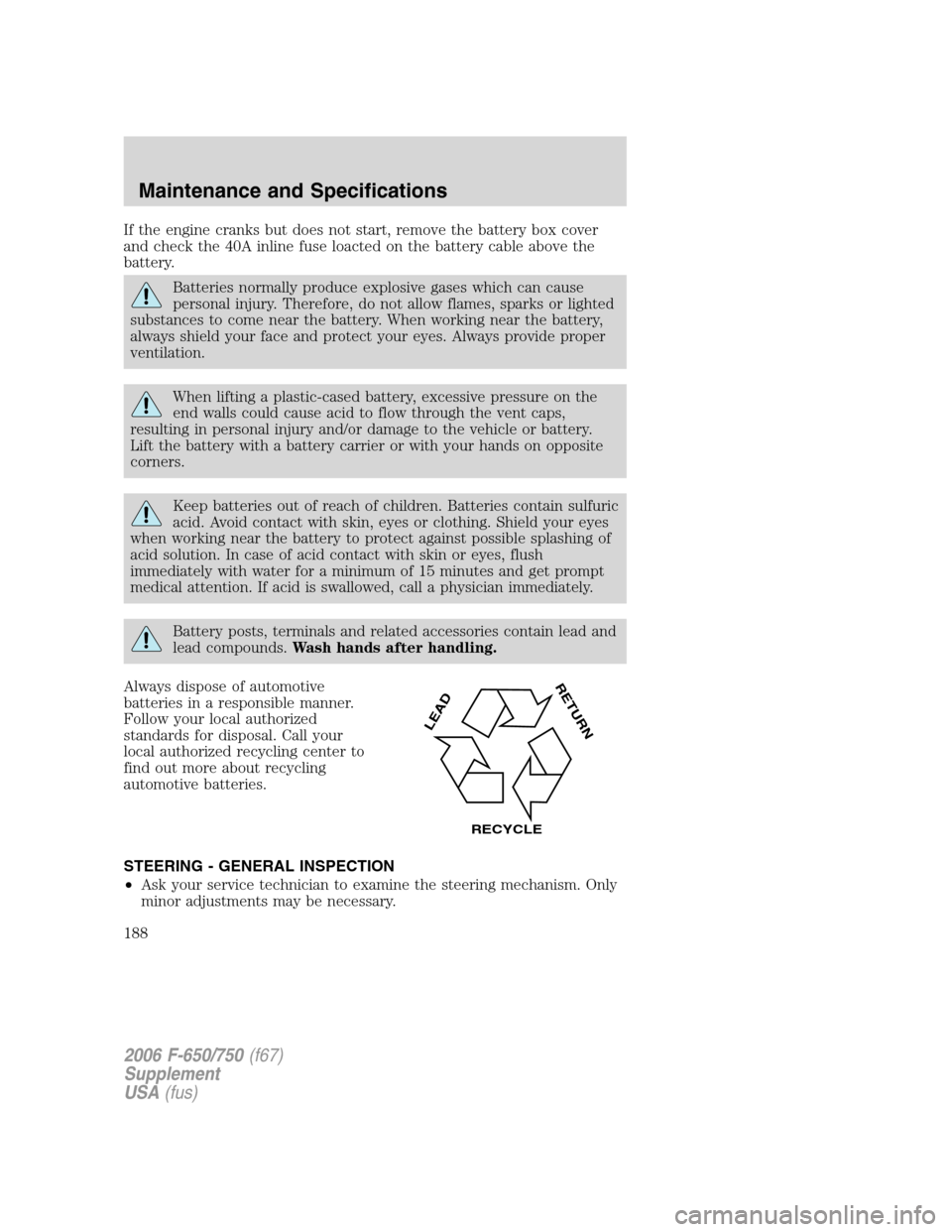
Always dispose of automotive
batteries in a responsible manner.
Follow your local authorized
standards for disposal. Call your
local authorized recycling center to
find out more about recycling
automotive batteries.
STEERING - GENERAL INSPECTION
•Ask your service technician to examine the steering mechanism. Only
minor adjustments may be necessary.
L
E
A
D
RETURN
RECYCLE
2006 F-650/750(f67)
Supplement
USA(fus)
Maintenance and Specifications
188
Page 194 of 272
FUEL FILTER/WATER SEPARATOR
Do not drain water separator while engine is running. Fuel may
ignite if separator is drained while engine is running or vehicle is
moving.
The fuel filter/water separator removes any contaminated particles
and/or water from the fuel before the fuel enters the engine.
The fuel filter/water separator should be drained as recommended in the
Scheduled Maintenance Guidechapter.
DRAINING THE FUEL FILTER/WATER SEPARATOR – 6.0L POWER
STROKE ENGINE
Water should be drained whenever
the warning light comes on or every
5,000 miles (8,000 km).
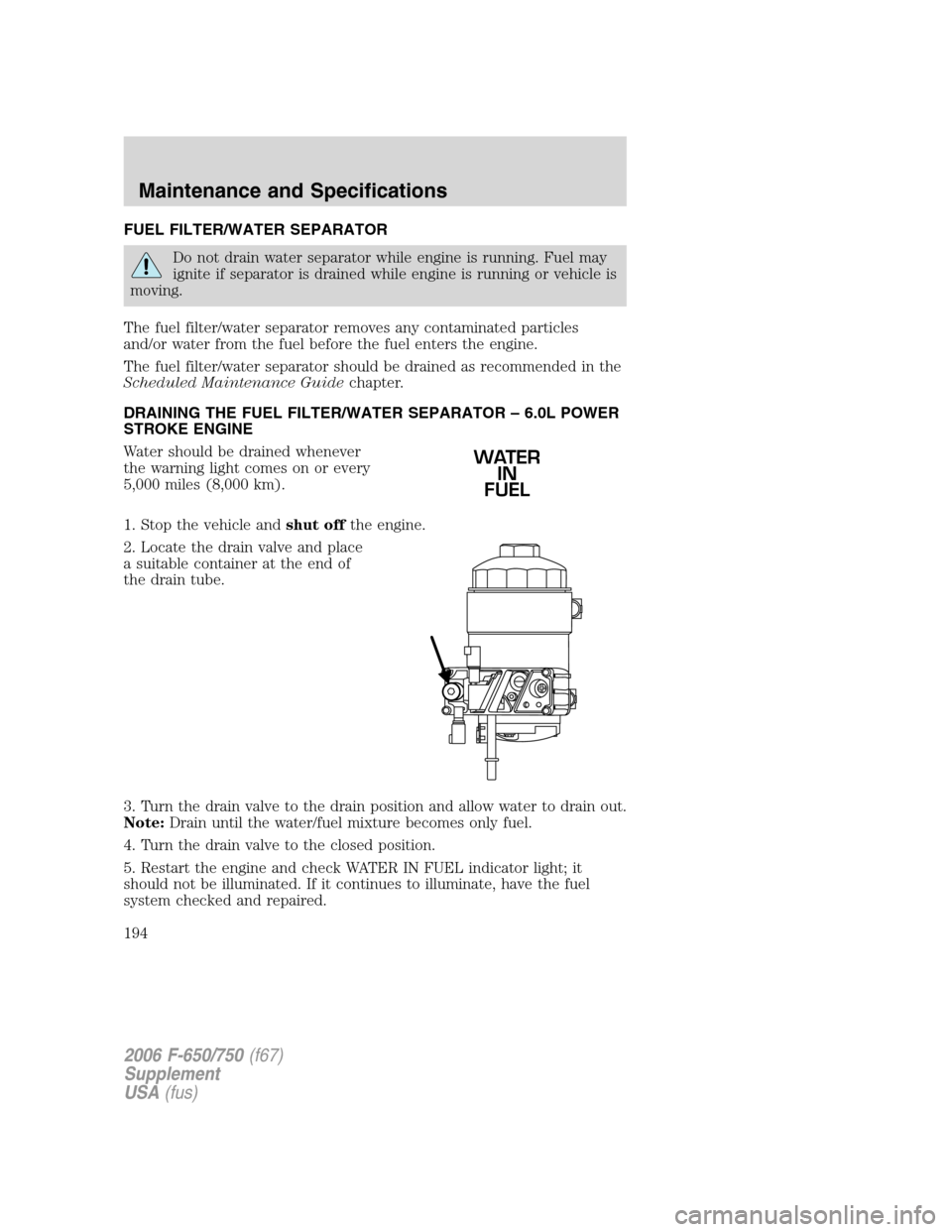
1. Stop the vehicle andshut offthe engine.
2. Locate the drain valve and place
a suitable container at the end of
the drain tube.
3. Turn the drain valve to the drain position and allow water to drain out.
Note:Drain until the water/fuel mixture becomes only fuel.
4. Turn the drain valve to the closed position.
5. Restart the engine and check WATER IN FUEL indicator light; it
should not be illuminated. If it continues to illuminate, have the fuel
system checked and repaired.
WATER
IN
FUEL
2006 F-650/750(f67)
Supplement
USA(fus)
Maintenance and Specifications
194
Page 201 of 272
this chapter. The advertised capacity is the amount of the Indicated
Capacity and the Empty Reserve combined. Indicated Capacity is the
difference in the amount of fuel in a full tank and a tank when the fuel
gauge indicates empty. Empty Reserve is the small amount of usable fuel
remaining in the fuel tank after the fuel gauge indicates empty.
The amount of Empty Reserve varies and should not be relied
upon to increase driving range. When refueling your vehicle after
the fuel gauge indicates empty, you might not be able to refuel
the full amount of the advertised capacity of the fuel tank due to
the empty reserve still present in the tank.
Filling the tank
For consistent results:
•Use the same fill rate setting (low - medium - high) each time during
filling.
•Allow three automatic click-offs when filling.
•Always use fuel of a known quality, preferably a national brand.
•Have the vehicle loading and distribution the same every time.
•When refueling a vehicle equipped with dual fuel tanks, if the two
tanks are not filled equally, the fuel gauge reading may fluctuate
slightly until the fuel level between the two tanks balance out and
become equal.
Your results will be most accurate if your filling method is consistent.
Note:For vehicles equipped with dual fuel tanks, engine performance
may degrade if fuel is not added to both tanks when refueling.
Calculating fuel economy
1. Fill the fuel tank(s) completely and record the initial odometer
reading (in miles or kilometers).
2. Each time you fill the tank(s), record the amount of fuel added (in
gallons or liters).
3. After at least three to five tank fill-ups, fill the fuel tank(s) and record
the current odometer reading.
4. Subtract your initial odometer reading from the current odometer
reading.
5. Follow one of the simple calculations in order to determine fuel
economy:
•Divide total miles traveled by total gallons used.
2006 F-650/750(f67)
Supplement
USA(fus)
Maintenance and Specifications
201
Page 204 of 272
•Turbocharger-to-charge air cooler
•Charge air cooler-to-intake manifold pipe
•Mounting bracket
•Chassis-mounted charge air cooler core
Inspect air intake piping
•Check for accumulation of salt deposits (where applicable). If present,
disassemble and clean the complete air intake piping system. If the
intake piping is pitted, use Motorcraft Silicone Gasket and Sealant
TA-30 to seal joints against leakage.
•Check for loose hoses and clamps.
•Check for ruptured or collapsed hoses.
•Check air cleaner housing for cracks.
ELECTRICAL SYSTEM INSPECTIONS
Periodically inspect electrical connectors on the outside of the cab, on
the engine and frame for corrosion and tightness. Exposed terminals
such as the fuel sender, cranking motor, alternator and feed-through
studs should be cleaned and re-coated with a lubricant sealing grease
such as Motorcraft Silicone Brake Caliper Grease and Dielectic
Compound XG-3, or equivalent. This should include the ground cable
connector for batteries, engine and cab as well as the jump starting stud.
Accessory feed connections
Vehicle electrical systems are complex and often include electronic
components such as engine and transmission controls, instrument panels,
ABS, etc. While most systems operate on battery voltage (12 volts),
some systems can be as high as 90 volts or as low as five volts. Refer to
the Electrical Circuit Diagram Manuals, available from your vehicle’s
manufacturer, to ensure that any additional body lights and accessories
are connected to circuits that are both appropriate and not overloaded.
No modification should be made to any vehicle control system without
first contacting your dealer.
SUSPENSION INSPECTION
Note:Do not adjust air suspension height to any setting other than the
specified setting. Altering the height setting will change the driveline
angle and may result in unwarrantable component damage, such as
transmission component damage.
2006 F-650/750(f67)
Supplement
USA(fus)
Maintenance and Specifications
204
Page 209 of 272
Normal maintenance
Over a period of time, if not routinely cleaned, a slight film of oil can
collect dirt around the rubber fill plug and face, which could appear to
be a leak. Routine cleaning ensures that the lube level can be easily
observed through the clear window as intended. In situations where the
window is clean on the outside but discolored on the inside, the lube
level may be checked by inserting a finger through the rubber check
vent hole.
The specified lube level for a clear window type hubcaps is from the
minimum line to + 5/16 inch above the minimum line.
If the lube level should suddenly drop dramatically below the minimum
level, see the Service Manual for diagnostic procedure.
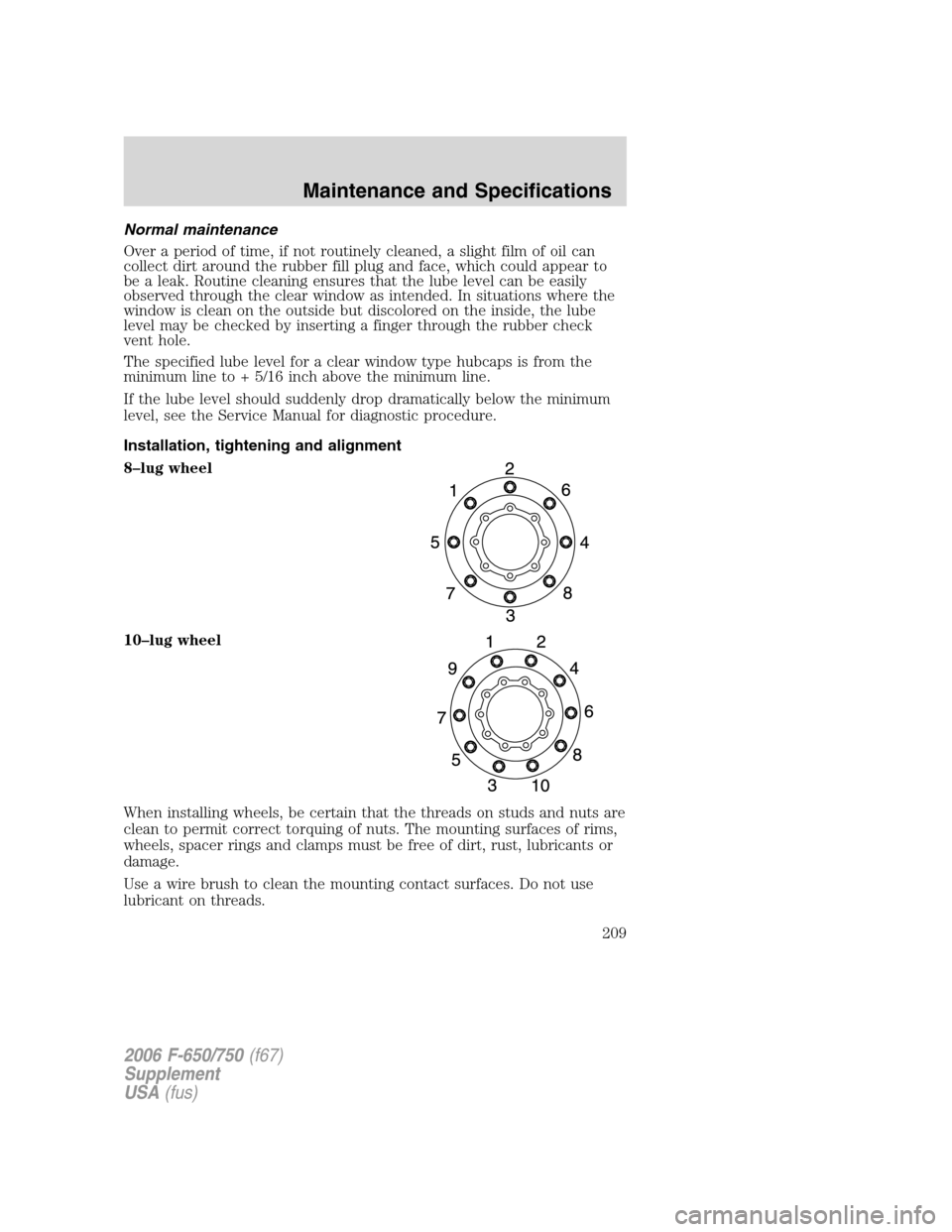
Installation, tightening and alignment
8–lug wheel
10–lug wheel
When installing wheels, be certain that the threads on studs and nuts are
clean to permit correct torquing of nuts. The mounting surfaces of rims,
wheels, spacer rings and clamps must be free of dirt, rust, lubricants or
damage.
Use a wire brush to clean the mounting contact surfaces. Do not use
lubricant on threads.
2006 F-650/750(f67)
Supplement
USA(fus)
Maintenance and Specifications
209
Page 212 of 272
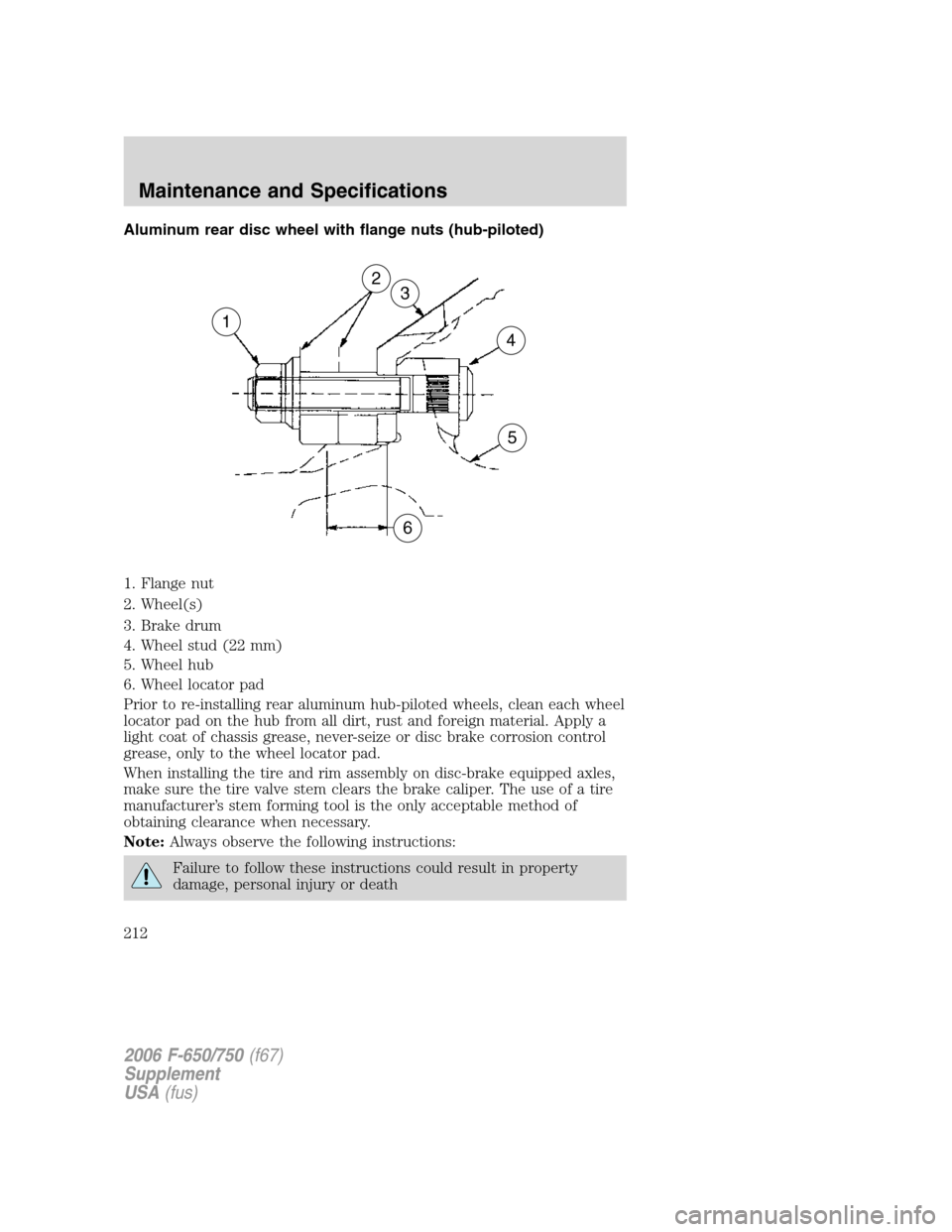
Aluminum rear disc wheel with flange nuts (hub-piloted)
1. Flange nut
2. Wheel(s)
3. Brake drum
4. Wheel stud (22 mm)
5. Wheel hub
6. Wheel locator pad
Prior to re-installing rear aluminum hub-piloted wheels, clean each wheel
locator pad on the hub from all dirt, rust and foreign material. Apply a
light coat of chassis grease, never-seize or disc brake corrosion control
grease, only to the wheel locator pad.
When installing the tire and rim assembly on disc-brake equipped axles,
make sure the tire valve stem clears the brake caliper. The use of a tire
manufacturer’s stem forming tool is the only acceptable method of
obtaining clearance when necessary.
Note:Always observe the following instructions:
Failure to follow these instructions could result in property
damage, personal injury or death
1
6
5
4
32
2006 F-650/750(f67)
Supplement
USA(fus)
Maintenance and Specifications
212