fuse FORD F650 2007 11.G User Guide
[x] Cancel search | Manufacturer: FORD, Model Year: 2007, Model line: F650, Model: FORD F650 2007 11.GPages: 280, PDF Size: 1.93 MB
Page 147 of 280
Fuse/Relay
LocationFuse Amp
RatingFuse Description
209 — Stoplamps relay (Caterpillar and Cummins)
ECM ISO relay (V8 engines)
301 — Fuel heater/Fuel transfer pump relay
302 — Park lamps relay
303 — Blower motor relay
304 — Air ABS relay
Hydraulic modulator relay
401 — Not used
501 — Not used
502 — Not used
503 — Not used
* Mini fuse **Maxi fuse
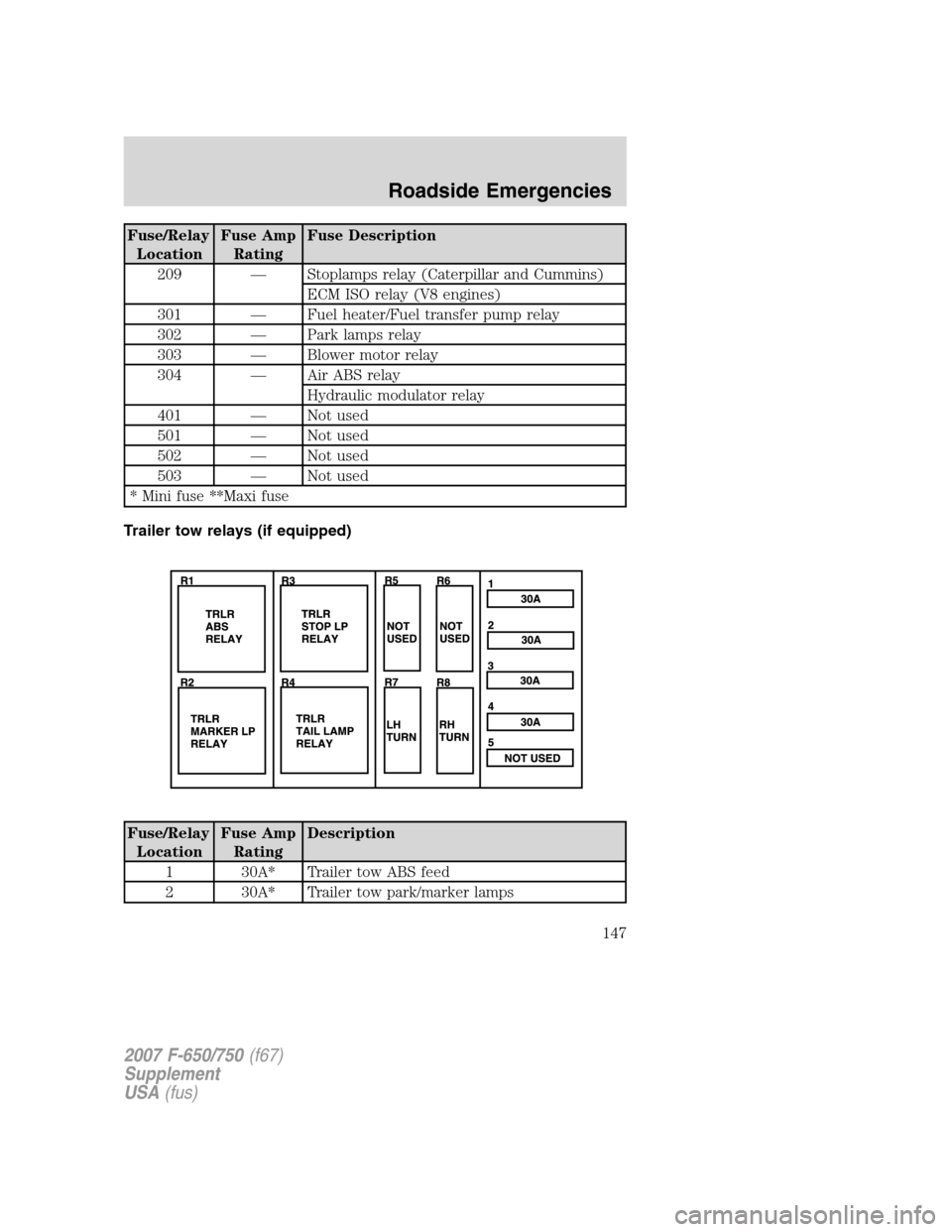
Trailer tow relays (if equipped)
Fuse/Relay
LocationFuse Amp
RatingDescription
1 30A* Trailer tow ABS feed
2 30A* Trailer tow park/marker lamps
2007 F-650/750(f67)
Supplement
USA(fus)
Roadside Emergencies
147
Page 148 of 280
Fuse/Relay
LocationFuse Amp
RatingDescription
3 30A* Trailer tow stop lamps
4 30A* Trailer tow turn/stop lamps (combined)
Trailer tow turn lamps (separate)
5 — Not used
R1 — Trailer tow ABS relay
R2 — Trailer tow park/marker lamp relay
R3 — Trailer tow stop lamp relay
R4 — Trailer tow tail lamp relay
R5 — Not used
R6 — Not used
R7 — Trailer tow left turn/stop lamp relay
(combined)
Trailer tow left turn lamp relay (separate)
R8 — Trailer tow right turn/stop lamp relay
(combined)
Trailer tow right turn lamp relay (separate)
*Maxi fuse
Inline fuses
Your vehicle has two inline fuses located in/on the battery cables by the
battery. A 10A fuse for the transmission control module and a 40A fuse
for the engine control module. Refer toAutomatic transmissionin the
Drivingchapter andBatteryin theMaintenance and Specifications
chapter for more information.
JUMP STARTING
The gases around the battery can explode if exposed to flames,
sparks, or lit cigarettes. An explosion could result in injury or
vehicle damage.
Batteries contain sulfuric acid which can burn skin, eyes and
clothing, if contacted.
Do not attempt to push-start your automatic transmission
vehicle. Automatic transmissions do not have push-start
2007 F-650/750(f67)
Supplement
USA(fus)
Roadside Emergencies
148
Page 180 of 280
Make sure the battery cover/shield is reinstalled after the battery
has been cleaned or replaced.
For longer, trouble-free operation, keep the top of the batteries clean
and dry. Also, make certain the battery cables are always tightly fastened
to the battery terminals.
If you see any corrosion on the battery or terminals, remove the cables
from the terminals and clean with a wire brush. You can neutralize the
acid with a solution of baking soda and water.
It is recommended that the negative battery cable terminal be
disconnected from the battery if you plan to store your vehicle for an
extended period of time. This will minimize the discharge of your battery
during storage.
If the engine cranks but does not start, remove the battery box cover
and check the 40A inline fuse located on the battery cable above the
battery.
Batteries normally produce explosive gases which can cause
personal injury. Therefore, do not allow flames, sparks or lighted
substances to come near the battery. When working near the battery,
always shield your face and protect your eyes. Always provide proper
ventilation.
When lifting a plastic-cased battery, excessive pressure on the
end walls could cause acid to flow through the vent caps,
resulting in personal injury and/or damage to the vehicle or battery.
Lift the battery with a battery carrier or with your hands on opposite
corners.
Keep batteries out of reach of children. Batteries contain sulfuric
acid. Avoid contact with skin, eyes or clothing. Shield your eyes
when working near the battery to protect against possible splashing of
acid solution. In case of acid contact with skin or eyes, flush
immediately with water for a minimum of 15 minutes and get prompt
medical attention. If acid is swallowed, call a physician immediately.
Battery posts, terminals and related accessories contain lead and
lead compounds.Wash hands after handling.
2007 F-650/750(f67)
Supplement
USA(fus)
Maintenance and Specifications
180
Page 272 of 280
recovery reservoir ..................181
refill capacities ........................228
specifications ..........................214
temperature gauge ...................27
Cruise control
(see Speed control) ....................63
Customer Assistance ........140, 156 Ford accessories for your
vehicle .....................................163
Getting assistance outside
the U.S. and Canada ......156, 158
Getting roadside assistance ...140
Getting the service you
need .........................................156
Ordering additional owner’s
literature .................................159
D
Daytime running lamps
(see Lamps) ................................52
Defects, reporting .....................159
Defrost ...................................49–50 windshield ...........................49–50
with heating and air
conditioning system .................50
with standard heating
system .......................................49
Doors lubricant specifications ..........214
Driving under special
conditions through water ...........................96
E
Emergencies, roadside jump-starting ..........................148
Emission control system ..194, 233 catalytic converter ..................171 Engine
cleaning ...................................161
coolant .....................................181
lubrication specifications .......214
Engine fan .................................185
Engine oil ..................................176 checking and adding ..............176
oil pressure gauge ....................27
recommendations ...................177
refill capacities ........................228
specifications ..........................214
F
Fan, Engine Cooling .................185
Flashers, hazard ........................141
Fuel ............................................189 calculating fuel
economy ..........................191–192
capacity ...................................229
choosing the right fuel ...........190
filling your vehicle with fuel ..189
filter,
specifications ..........185, 187–188
gauge .........................................27
improving fuel
economy ..........................191–192
running out of fuel ...........95, 191
safety information relating to
automotive fuels .....................189
Fuses ..................................141, 148
G
Gas mileage
(see Fuel economy) .........191–192
Gauges .........................................27 battery voltage gauge ...............27
engine coolant temperature
gauge .........................................27
2007 F-650/750 (f67)
Supplement
USA (fus)
Index
272