parking brake FORD F650 2007 11.G User Guide
[x] Cancel search | Manufacturer: FORD, Model Year: 2007, Model line: F650, Model: FORD F650 2007 11.GPages: 280, PDF Size: 1.93 MB
Page 100 of 280
Parking brake
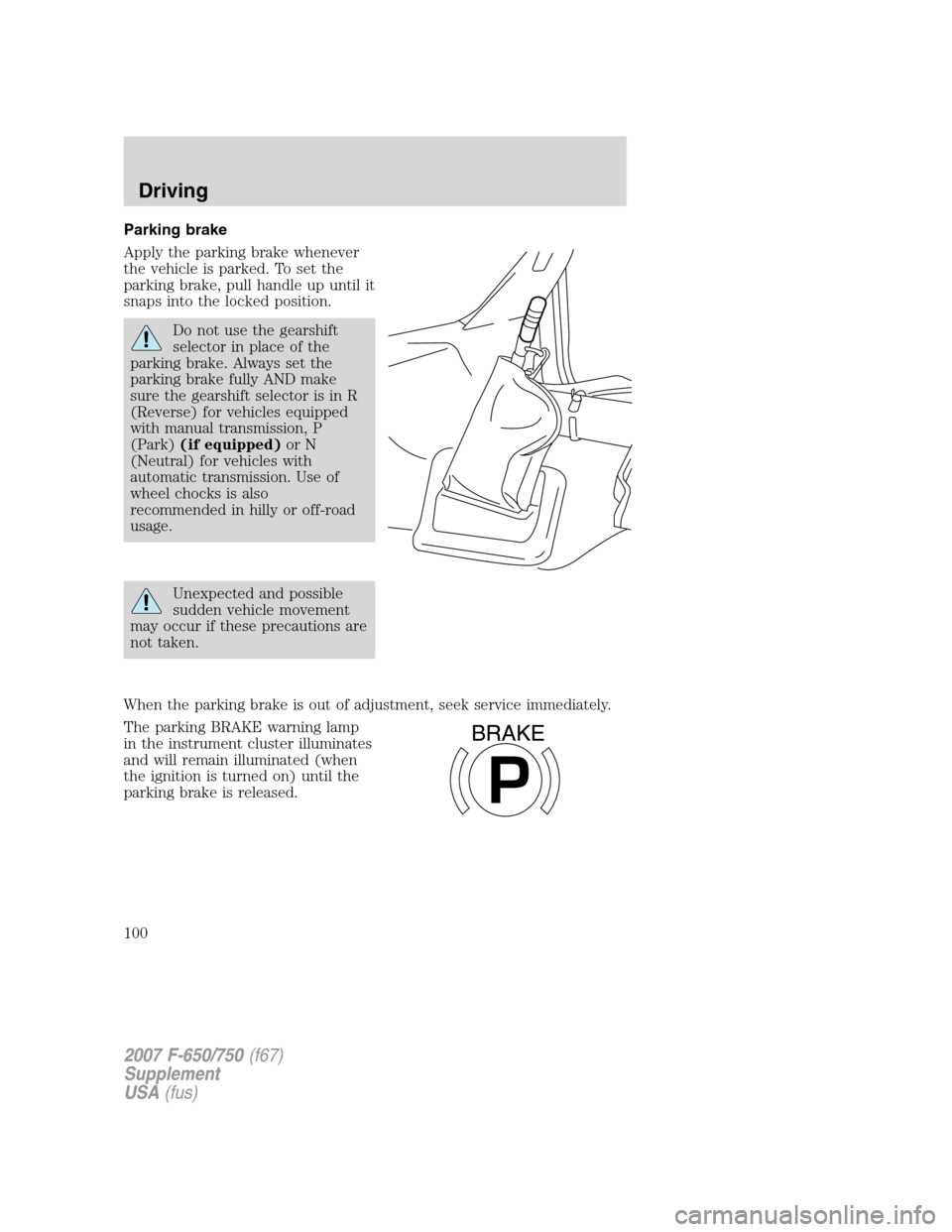
Apply the parking brake whenever
the vehicle is parked. To set the
parking brake, pull handle up until it
snaps into the locked position.
Do not use the gearshift
selector in place of the
parking brake. Always set the
parking brake fully AND make
sure the gearshift selector is in R
(Reverse) for vehicles equipped
with manual transmission, P
(Park)(if equipped)or N
(Neutral) for vehicles with
automatic transmission. Use of
wheel chocks is also
recommended in hilly or off-road
usage.
Unexpected and possible
sudden vehicle movement
may occur if these precautions are
not taken.
When the parking brake is out of adjustment, seek service immediately.
The parking BRAKE warning lamp
in the instrument cluster illuminates
and will remain illuminated (when
the ignition is turned on) until the
parking brake is released.
P
BRAKE
2007 F-650/750(f67)
Supplement
USA(fus)
Driving
100
Page 101 of 280
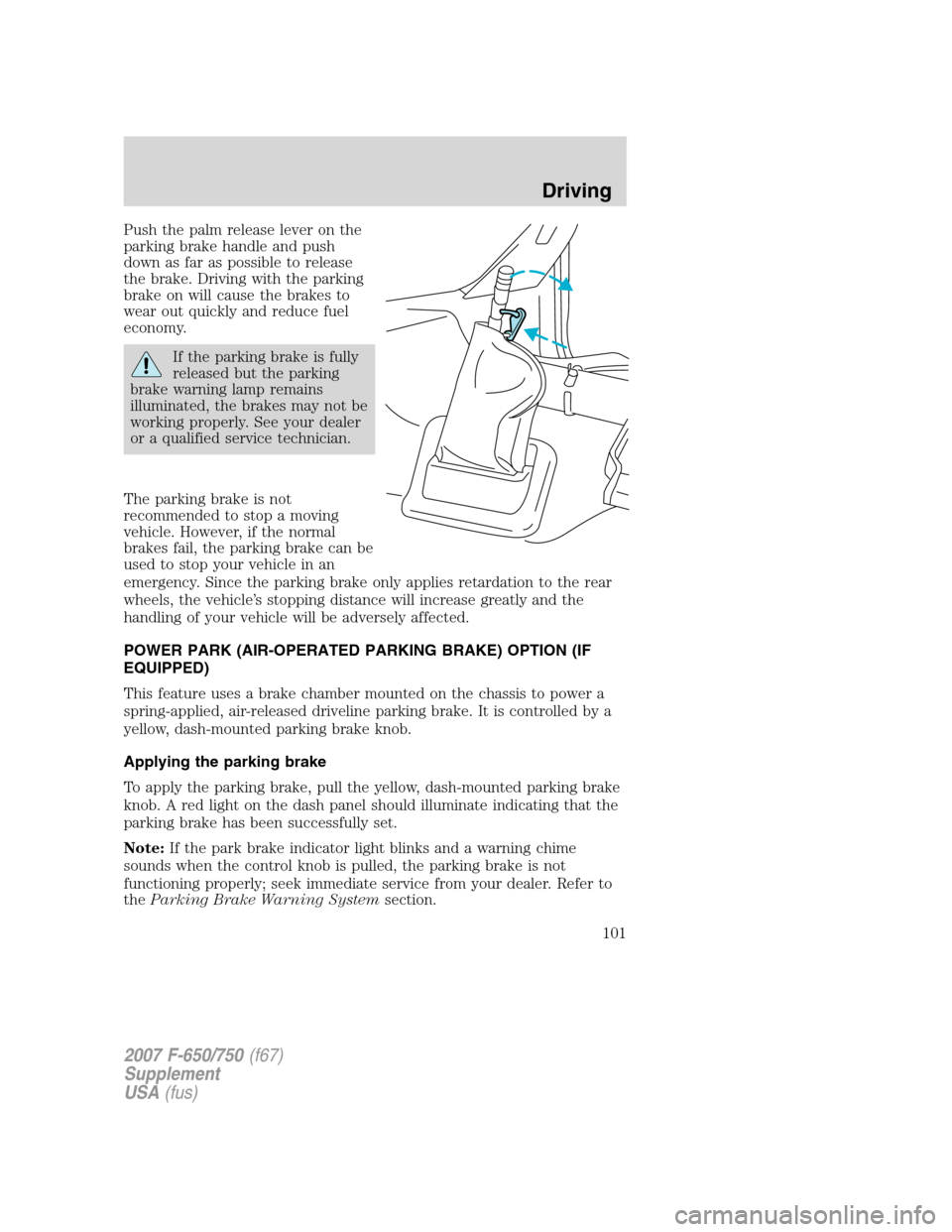
Push the palm release lever on the
parking brake handle and push
down as far as possible to release
the brake. Driving with the parking
brake on will cause the brakes to
wear out quickly and reduce fuel
economy.
If the parking brake is fully
released but the parking
brake warning lamp remains
illuminated, the brakes may not be
working properly. See your dealer
or a qualified service technician.
The parking brake is not
recommended to stop a moving
vehicle. However, if the normal
brakes fail, the parking brake can be
used to stop your vehicle in an
emergency. Since the parking brake only applies retardation to the rear
wheels, the vehicle’s stopping distance will increase greatly and the
handling of your vehicle will be adversely affected.
POWER PARK (AIR-OPERATED PARKING BRAKE) OPTION (IF
EQUIPPED)
This feature uses a brake chamber mounted on the chassis to power a
spring-applied, air-released driveline parking brake. It is controlled by a
yellow, dash-mounted parking brake knob.
Applying the parking brake
To apply the parking brake, pull the yellow, dash-mounted parking brake
knob. A red light on the dash panel should illuminate indicating that the
parking brake has been successfully set.
Note:If the park brake indicator light blinks and a warning chime
sounds when the control knob is pulled, the parking brake is not
functioning properly; seek immediate service from your dealer. Refer to
theParking Brake Warning Systemsection.
2007 F-650/750(f67)
Supplement
USA(fus)
Driving
101
Page 102 of 280
Releasing the parking brake
Note:Read and understand the following steps and perform them
whenever you prepare to drive the vehicle.
Note:The parking brake will not disengage unless sufficient system air
pressure is available.
For vehicles with automatic transmissions - dash-mounted push
button (Allison 3000 Series) and steering column-mounted (Allison
2200 and 2500) gear selection:
1. With the engine running, depress and hold the service brake pedal.
2. Wait until system air pressure is above 100 psi (690 kPa).
3. Select the appropriate drive gear.
4. Push the yellow, dash-mounted parking brake knob.
For vehicles with manual transmissions - (TTC 7–speed,
Eaton/Fuller 5–speed and 6–speed):
1. With the engine running, depress and hold the service brake pedal.
2. Wait until system air pressure is above 100 psi (690 kPa).
3. Depress and hold the clutch pedal.
4. Select the appropriate drive gear.
5. Push the yellow, dash-mounted parking brake knob.
Hold the brake pedal down while moving the gearshift lever from
position to position. If the brake pedal is not held down, the
vehicle may move unexpectedly resulting in property damage, personal
injury or death.
Parking brake light illumination due to low air pressure
If at any time during vehicle operation air pressure is too low, the
parking brake may apply and the parking brake light will turn on.
If the parking brake is applied due to low air pressure, immediate service
is required to the parking brake system.
Parking brake warning system
If the park brake light blinks and a chime sounds when pulling the yellow
control knob out, this indicates the parking brake is not functioning
properly; seek service for the parking brake immediately.
The light will blink and the chime will sound until the yellow control
knob is pushed in or approximately eight minutes have passed. If the
2007 F-650/750(f67)
Supplement
USA(fus)
Driving
102
Page 103 of 280
yellow control knob is pulled out again, the light will blink and the chime
will sound as a reminder that immediate service is required to the
parking brake system.
Releasing spring manually
Do not attempt to disassemble the parking brake chamber under
any circumstances. The high spring load may cause serious
injury.
If air pressure is released from the spring brake chamber the power
spring applies the brake and, unless air pressure can be re-established,
the spring brake must be released as follows in order to move the
vehicle.
Block the wheels to help prevent the vehicle from moving.
Unexpected and possibly sudden vehicle movement may occur if
these precautions are not taken.
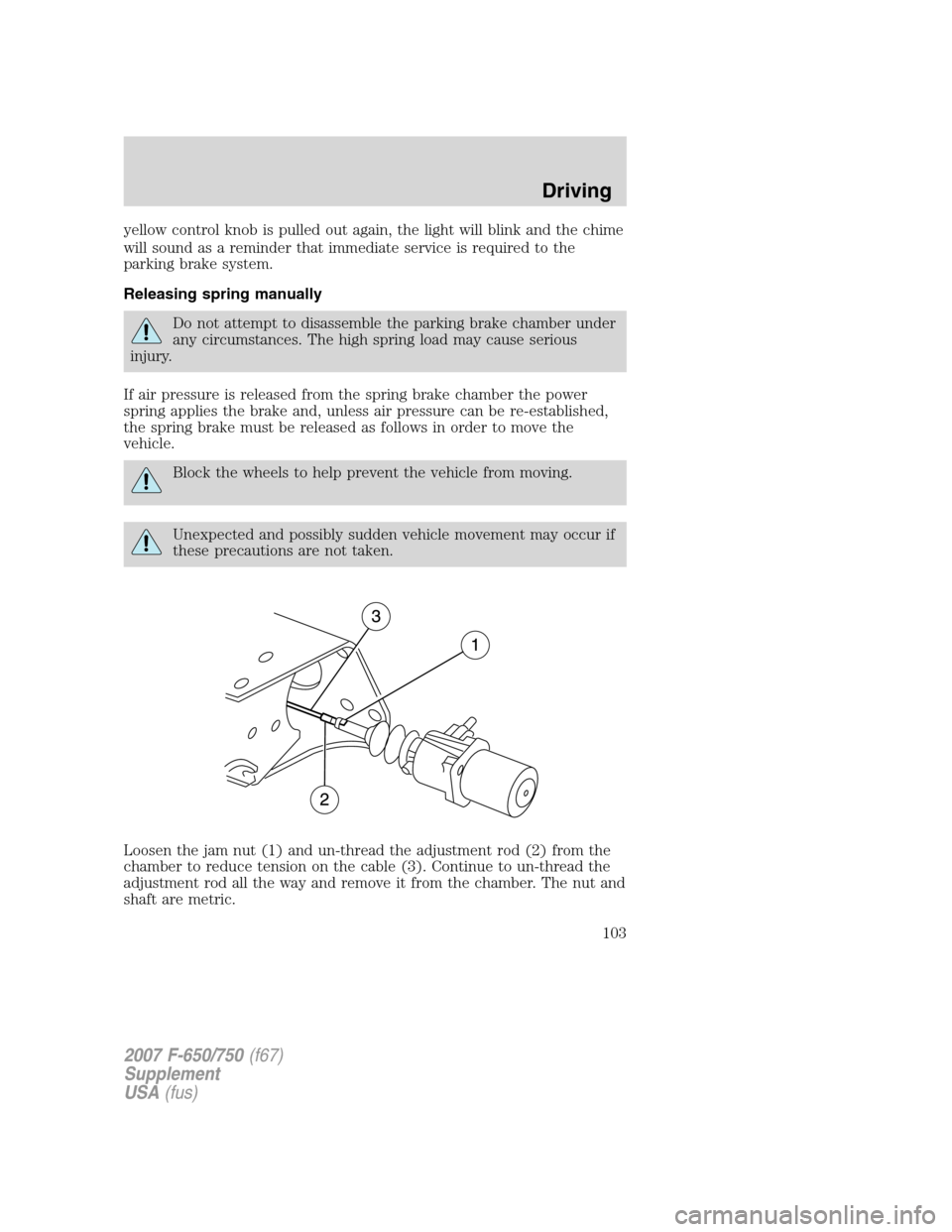
Loosen the jam nut (1) and un-thread the adjustment rod (2) from the
chamber to reduce tension on the cable (3). Continue to un-thread the
adjustment rod all the way and remove it from the chamber. The nut and
shaft are metric.
2007 F-650/750(f67)
Supplement
USA(fus)
Driving
103
Page 106 of 280
Do not continue to operate the vehicle with a failure of one of
the systems. Take the vehicle to your dealer for service
immediately.
Air brake reservoir draining
Failure to drain air brake reservoirs can result in a reduction or
loss of braking ability due to fluid accumulation in the reservoir
and/or possible freeze-up during cold weather.
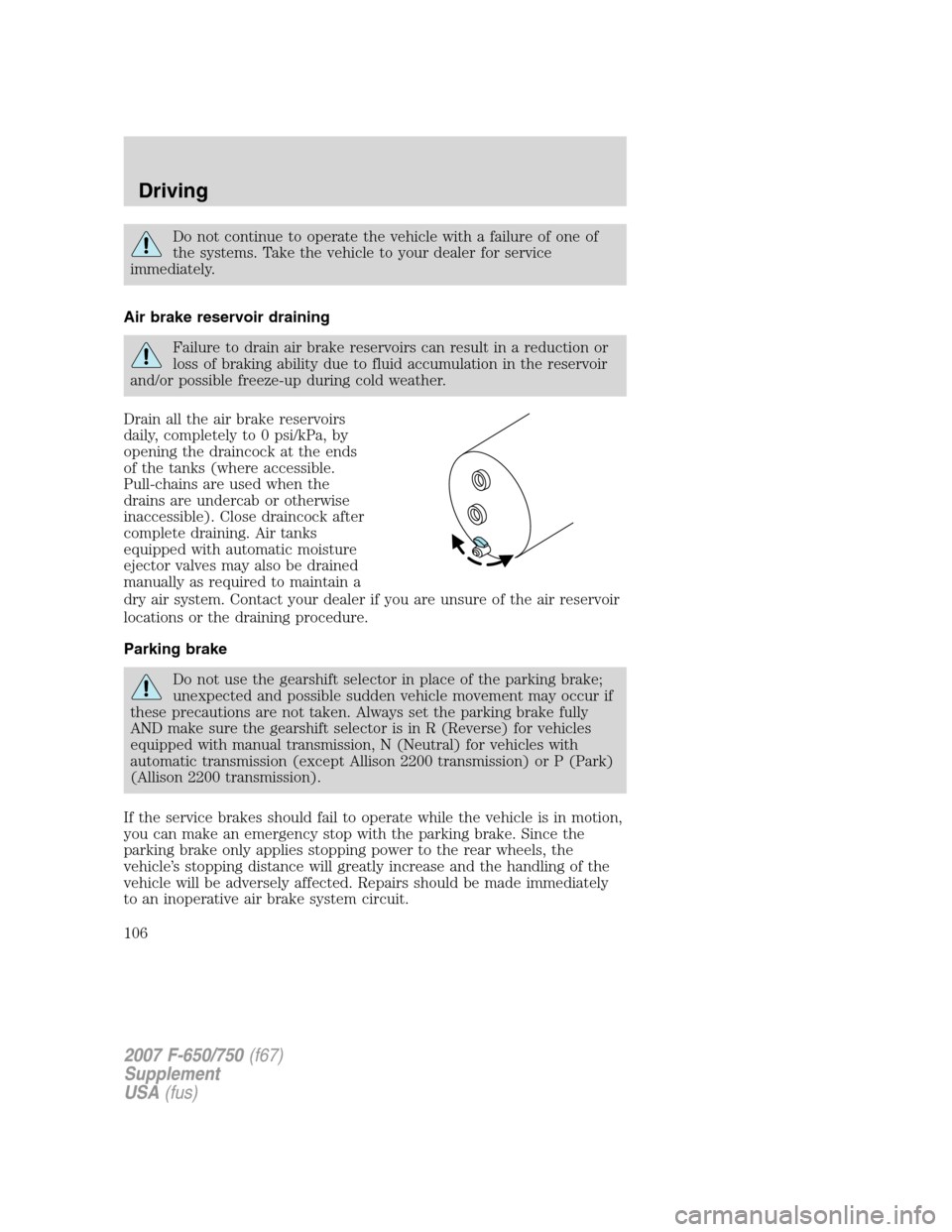
Drain all the air brake reservoirs
daily, completely to 0 psi/kPa, by
opening the draincock at the ends
of the tanks (where accessible.
Pull-chains are used when the
drains are undercab or otherwise
inaccessible). Close draincock after
complete draining. Air tanks
equipped with automatic moisture
ejector valves may also be drained
manually as required to maintain a
dry air system. Contact your dealer if you are unsure of the air reservoir
locations or the draining procedure.
Parking brake
Do not use the gearshift selector in place of the parking brake;
unexpected and possible sudden vehicle movement may occur if
these precautions are not taken. Always set the parking brake fully
AND make sure the gearshift selector is in R (Reverse) for vehicles
equipped with manual transmission, N (Neutral) for vehicles with
automatic transmission (except Allison 2200 transmission) or P (Park)
(Allison 2200 transmission).
If the service brakes should fail to operate while the vehicle is in motion,
you can make an emergency stop with the parking brake. Since the
parking brake only applies stopping power to the rear wheels, the
vehicle’s stopping distance will greatly increase and the handling of the
vehicle will be adversely affected. Repairs should be made immediately
to an inoperative air brake system circuit.
2007 F-650/750 (f67)
Supplement
USA (fus)
Driving
106
Page 107 of 280
Parking brake control (knob)
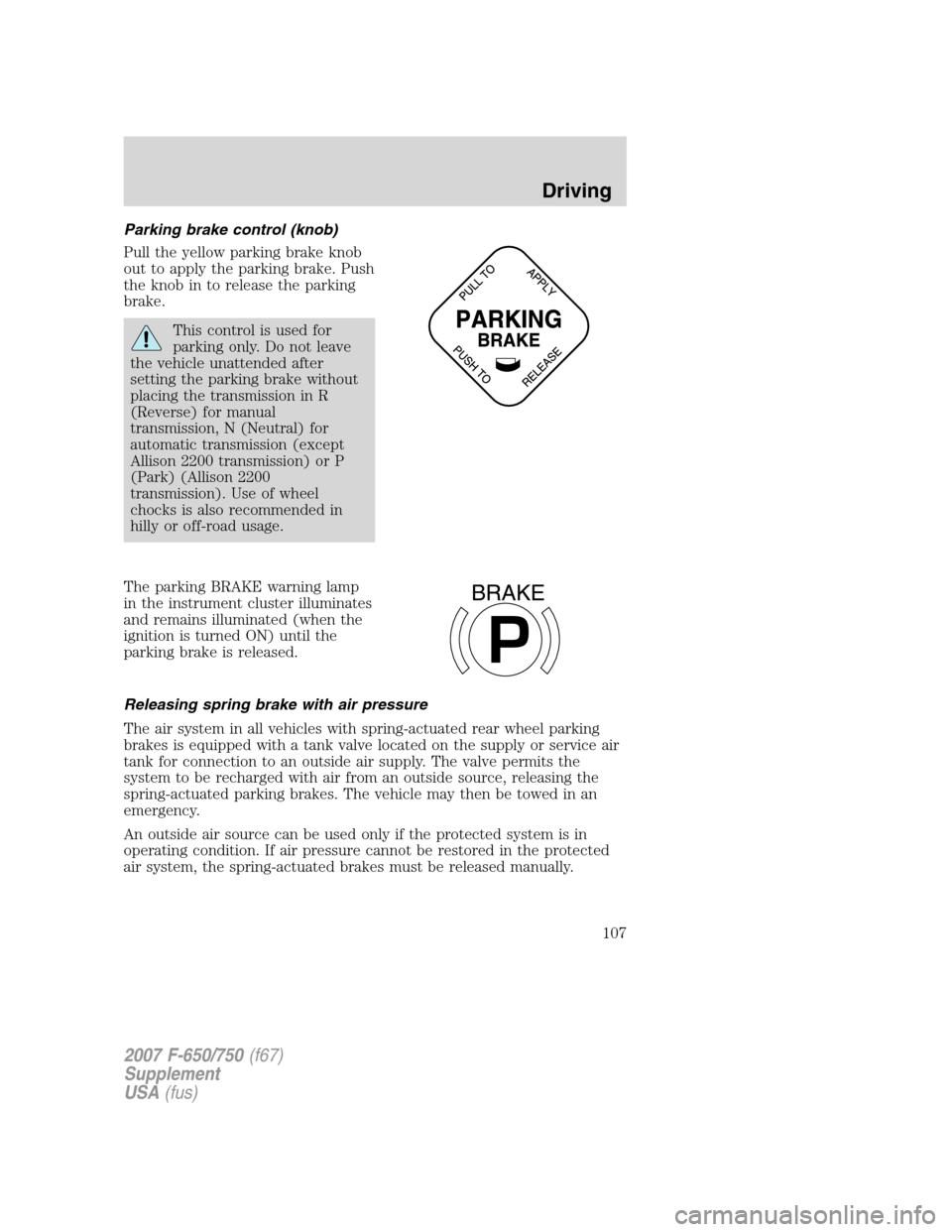
Pull the yellow parking brake knob
out to apply the parking brake. Push
the knob in to release the parking
brake.
This control is used for
parking only. Do not leave
the vehicle unattended after
setting the parking brake without
placing the transmission in R
(Reverse) for manual
transmission, N (Neutral) for
automatic transmission (except
Allison 2200 transmission) or P
(Park) (Allison 2200
transmission). Use of wheel
chocks is also recommended in
hilly or off-road usage.
The parking BRAKE warning lamp
in the instrument cluster illuminates
and remains illuminated (when the
ignition is turned ON) until the
parking brake is released.
Releasing spring brake with air pressure
The air system in all vehicles with spring-actuated rear wheel parking
brakes is equipped with a tank valve located on the supply or service air
tank for connection to an outside air supply. The valve permits the
system to be recharged with air from an outside source, releasing the
spring-actuated parking brakes. The vehicle may then be towed in an
emergency.
An outside air source can be used only if the protected system is in
operating condition. If air pressure cannot be restored in the protected
air system, the spring-actuated brakes must be released manually.
P
BRAKE
2007 F-650/750(f67)
Supplement
USA(fus)
Driving
107
Page 108 of 280
Releasing spring brake manually
Do not attempt to disassemble the parking brake chamber under
any circumstances. The high spring load may cause serious
injury if the chamber clamps are removed.
If air pressure is released from the spring brake chamber the power
spring applies the brake and, unless air pressure can be re-established,
the spring brake must be released as follows in order to move the
vehicle.
Block the wheels to help prevent the vehicle from moving.
Unexpected and possibly sudden vehicle movement may occur if
these precautions are not taken.
Impact wrenches should not be used as they may damage the piston and
prevent proper caging of the spring. Do not apply more than 50 lb. ft.
(68 N•m) torque to the release bolt nut.
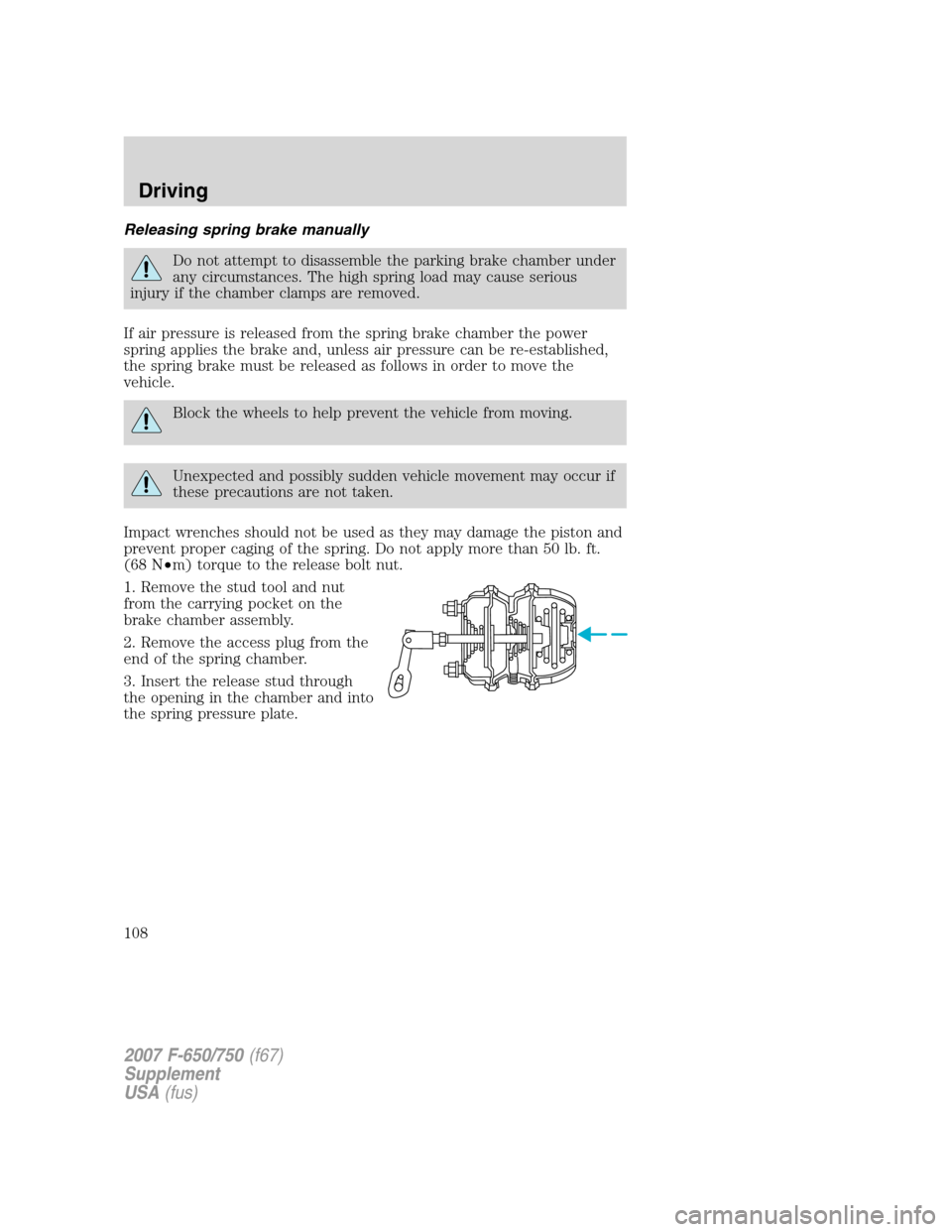
1. Remove the stud tool and nut
from the carrying pocket on the
brake chamber assembly.
2. Remove the access plug from the
end of the spring chamber.
3. Insert the release stud through
the opening in the chamber and into
the spring pressure plate.
2007 F-650/750(f67)
Supplement
USA(fus)
Driving
108
Page 113 of 280
To apply the trailer brakes using the hand control, move the lever
downward. The further the lever is pushed downward, the greater the air
pressure is applied to the brakes. The lever will remain in place until
manually moved.
To release the trailer brakes, move the lever upward completely.
TRAILER AIR SUPPLY AND PARKING BRAKE MODULAR
CONTROLS (IF EQUIPPED)
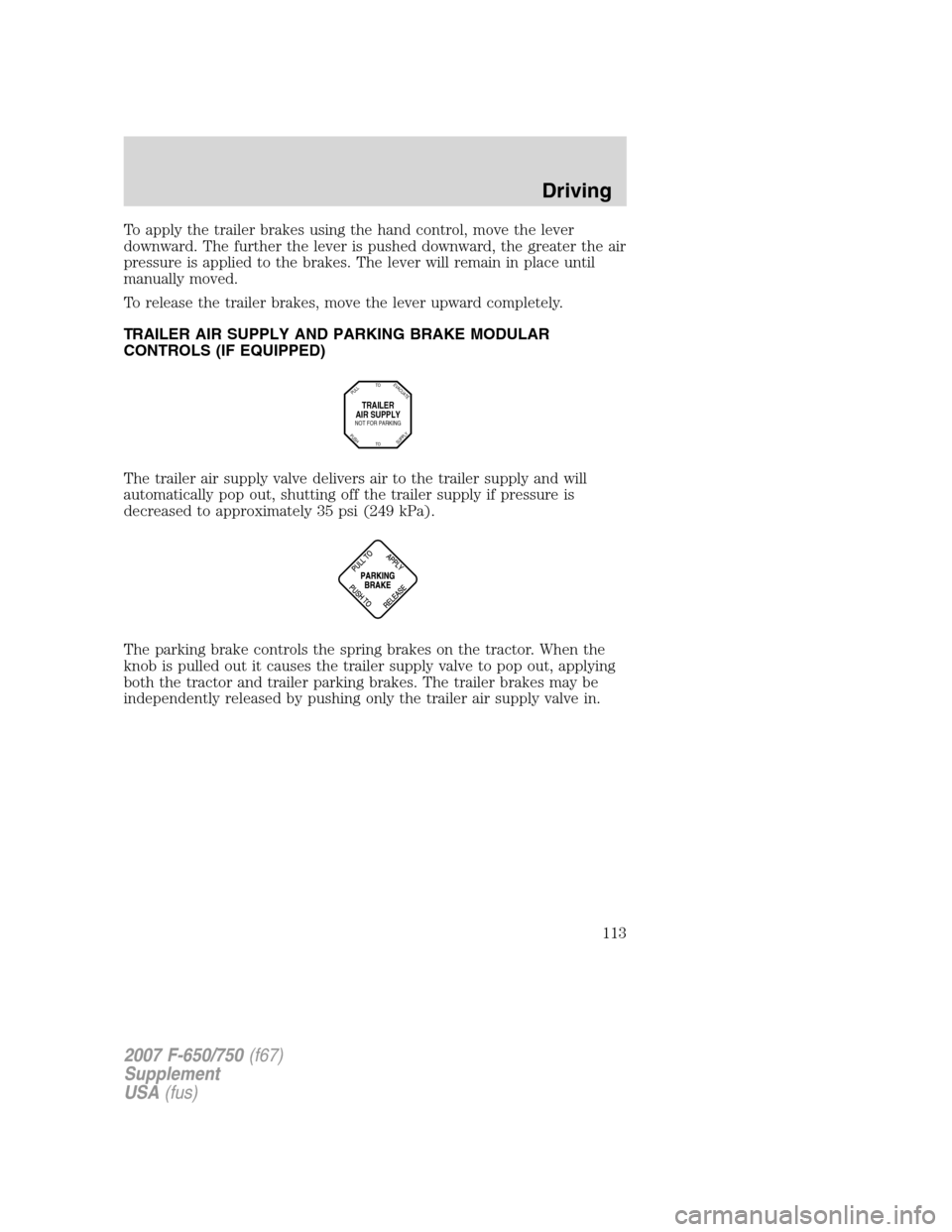
The trailer air supply valve delivers air to the trailer supply and will
automatically pop out, shutting off the trailer supply if pressure is
decreased to approximately 35 psi (249 kPa).
The parking brake controls the spring brakes on the tractor. When the
knob is pulled out it causes the trailer supply valve to pop out, applying
both the tractor and trailer parking brakes. The trailer brakes may be
independently released by pushing only the trailer air supply valve in.
TRAILER
AIR SUPPLY
NOT FOR PARKING
TO
TOPULL
SUPPLY
EVACUATE
PUSH
2007 F-650/750(f67)
Supplement
USA(fus)
Driving
113
Page 114 of 280
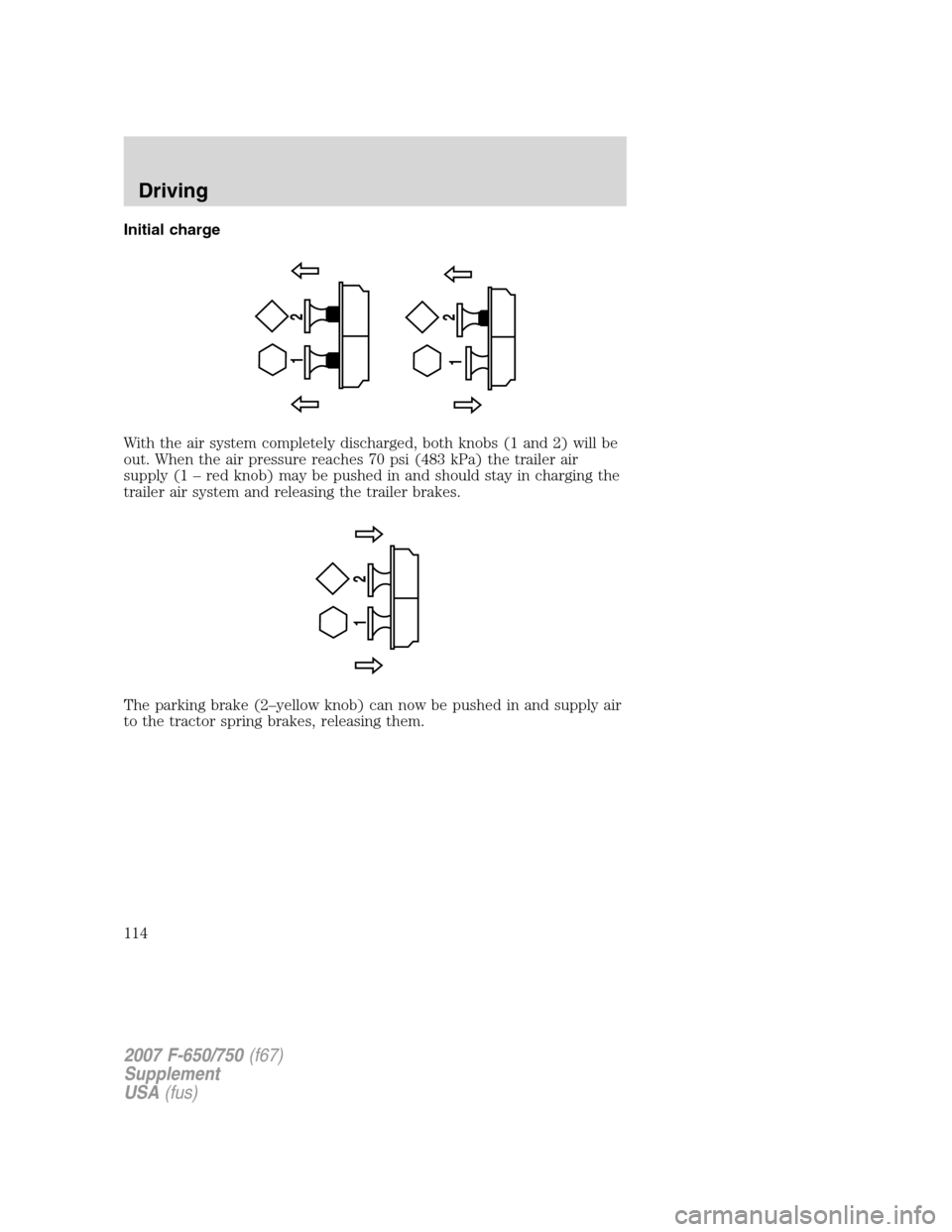
Initial charge
With the air system completely discharged, both knobs (1 and 2) will be
out. When the air pressure reaches 70 psi (483 kPa) the trailer air
supply (1 – red knob) may be pushed in and should stay in charging the
trailer air system and releasing the trailer brakes.
The parking brake (2–yellow knob) can now be pushed in and supply air
to the tractor spring brakes, releasing them.
12 12
12
2007 F-650/750(f67)
Supplement
USA(fus)
Driving
114
Page 115 of 280
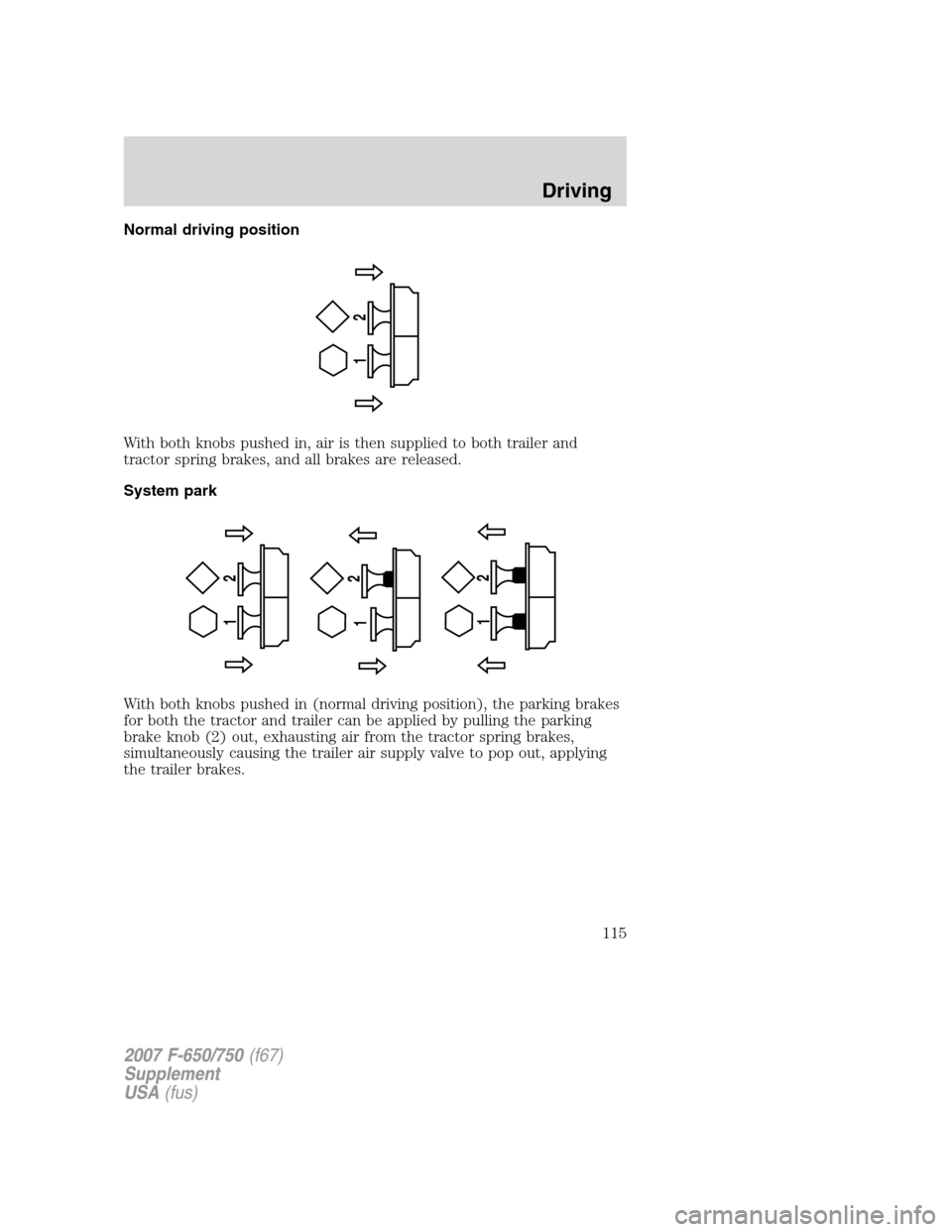
Normal driving position
With both knobs pushed in, air is then supplied to both trailer and
tractor spring brakes, and all brakes are released.
System park
With both knobs pushed in (normal driving position), the parking brakes
for both the tractor and trailer can be applied by pulling the parking
brake knob (2) out, exhausting air from the tractor spring brakes,
simultaneously causing the trailer air supply valve to pop out, applying
the trailer brakes.
12
12
12
12
2007 F-650/750(f67)
Supplement
USA(fus)
Driving
115