clutch FORD F650 2007 11.G Owner's Manual
[x] Cancel search | Manufacturer: FORD, Model Year: 2007, Model line: F650, Model: FORD F650 2007 11.GPages: 280, PDF Size: 1.93 MB
Page 185 of 280
If you drive in extremely hot climates:
•It is still necessary to maintain the coolant concentration
above 40%.
•NEVER decrease the coolant concentration below 40%.
•Engine coolant concentrations below 40% will decrease the
corrosion protection characteristics of the engine coolant and
may cause engine damage.
•Engine coolant concentrations below 40% will decrease the
freeze protection characteristics of the engine coolant and may
cause engine damage.
•If available, refer to the chart on the coolant container to
ensure the coolant concentration in your vehicle will provide
adequate protection at the temperatures in which you drive.
Vehicles driven year-round in non-extreme climates should use a 50/50
mixture of engine coolant and distilled water for optimum cooling system
and engine protection.
Fan clutches
Your vehicle’s cooling system is equipped with a viscous fan clutch.
•The fan clutch helps control cooling, increase performance, improve
fuel economy and reduce noise.
•The fan clutch is controlled by bimetallic spring sensors. Do not
tamper with these sensors as this may change their calibration or keep
the fan clutch from operating at all.
Stay clear of the fan/fan area while the engine is running or
possible personal injury may occur.
FUEL FILTER/WATER SEPARATOR
Do not drain water separator while engine is running. Fuel may
ignite if separator is drained while engine is running or vehicle is
moving.
The fuel filter/water separator removes any contaminated particles
and/or water from the fuel before the fuel enters the engine.
The fuel filter/water separator should be drained as recommended in the
Scheduled Maintenance Guidechapter.
2007 F-650/750(f67)
Supplement
USA(fus)
Maintenance and Specifications
185
Page 194 of 280
•Fuel economy may decrease with lower temperatures during the first
8–10 miles (12–16 km) of driving.
•Flat terrain driving improves fuel economy over hilly roads.
•Transmissions give their best fuel economy when operated in the top
cruise gear and with steady pressure on the accelerator.
•Close windows for highway driving.
NOISE EMISSIONS – EXTERIOR
In order to comply with the federal exterior noise regulations, your
vehicle may be equipped with noise emission items. Depending on the
vehicle configuration, it may have all or some of the following items:
Air Intake System
•Air Cleaner:should be inspected and its location should not be
altered. Do not alter inlet and outlet piping.
Body
•Wheel Well:splash shields, cab shields and under-hood insulation
should be inspected for deterioration, dislocation, and orientation.
Cooling System
•Check the fan for damage to blades; replace, if damaged, with the
recommended parts. Inspect for fan to shroud interference, and any
damage to shroud such as cracks and holes.
•The fan ratio should not be changed and the fan spacer dimensions
and positions should not be altered.
•Inspect the fan clutch for proper operation, make sure that the fan is
disengaged when cooling of the engine is not required.
•Check for proper operation of radiator shutters, if equipped. The
shutters should be open during normal operating temperatures.
Engine and Driveline System
•Transmission Enclosure:inspect for cracks, holes, and tears. Clean
any deposits such as oil, dirt, and stones.
•Engine valve covers and block covers are made to damp out engine
mechanical noise and, if needed, should be replaced with
recommended parts. Check for mechanical isolations.
Exhaust System
•Inspect the exhaust system for leaks at various joint connections and
tighten the clamps.
2007 F-650/750(f67)
Supplement
USA(fus)
Maintenance and Specifications
194
Page 197 of 280
Do not let the reservoir for the master cylinder run dry. This
may cause the brakes to fail.
CLUTCH FLUID/LINKAGE ADJUSTMENTS
Clutch fluid (if equipped)
Check the clutch fluid level. Refer to theScheduled Maintenance
Guidechapter for the service interval schedules.
During normal operation, the fluid level in the clutch reservoir should
remain constant. If the fluid level drops, maintain the fluid level at the
step in the reservoir.
Use only a DOT 3 brake fluid designed to meet manufacturer
specifications. Refer toLubricant specificationsin this chapter.
Carefully read cautionary information on product label. For
additional information see product Material Safety Data Sheet
(MSDS). For 24-hour MEDICAL EMERGENCY INFORMATION on
Ford-Motorcraft products call: 1-800-959-3673 (FORD). Failure to
follow these instructions may result in personal injury
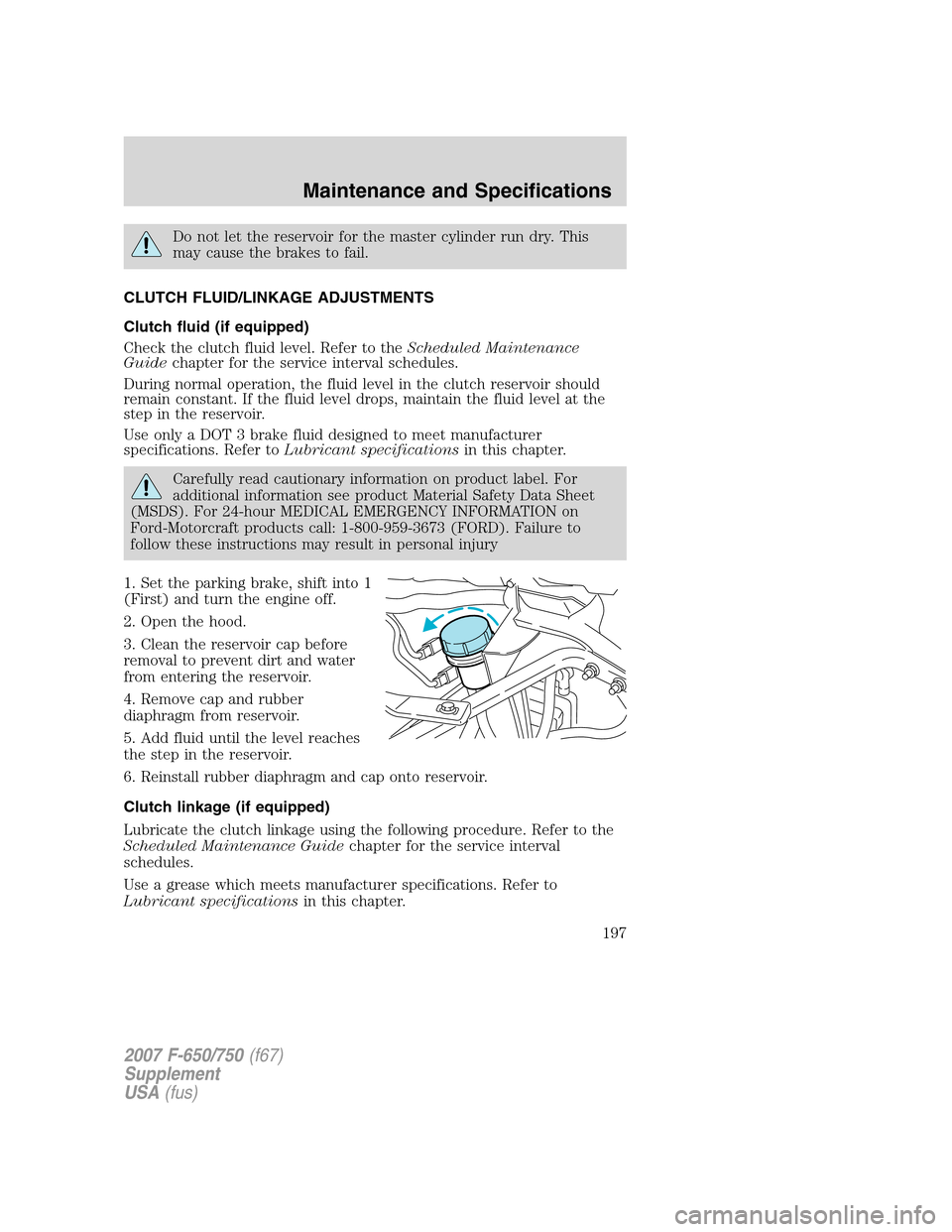
1. Set the parking brake, shift into 1
(First) and turn the engine off.
2. Open the hood.
3. Clean the reservoir cap before
removal to prevent dirt and water
from entering the reservoir.
4. Remove cap and rubber
diaphragm from reservoir.
5. Add fluid until the level reaches
the step in the reservoir.
6. Reinstall rubber diaphragm and cap onto reservoir.
Clutch linkage (if equipped)
Lubricate the clutch linkage using the following procedure. Refer to the
Scheduled Maintenance Guidechapter for the service interval
schedules.
Use a grease which meets manufacturer specifications. Refer to
Lubricant specificationsin this chapter.
2007 F-650/750(f67)
Supplement
USA(fus)
Maintenance and Specifications
197
Page 198 of 280
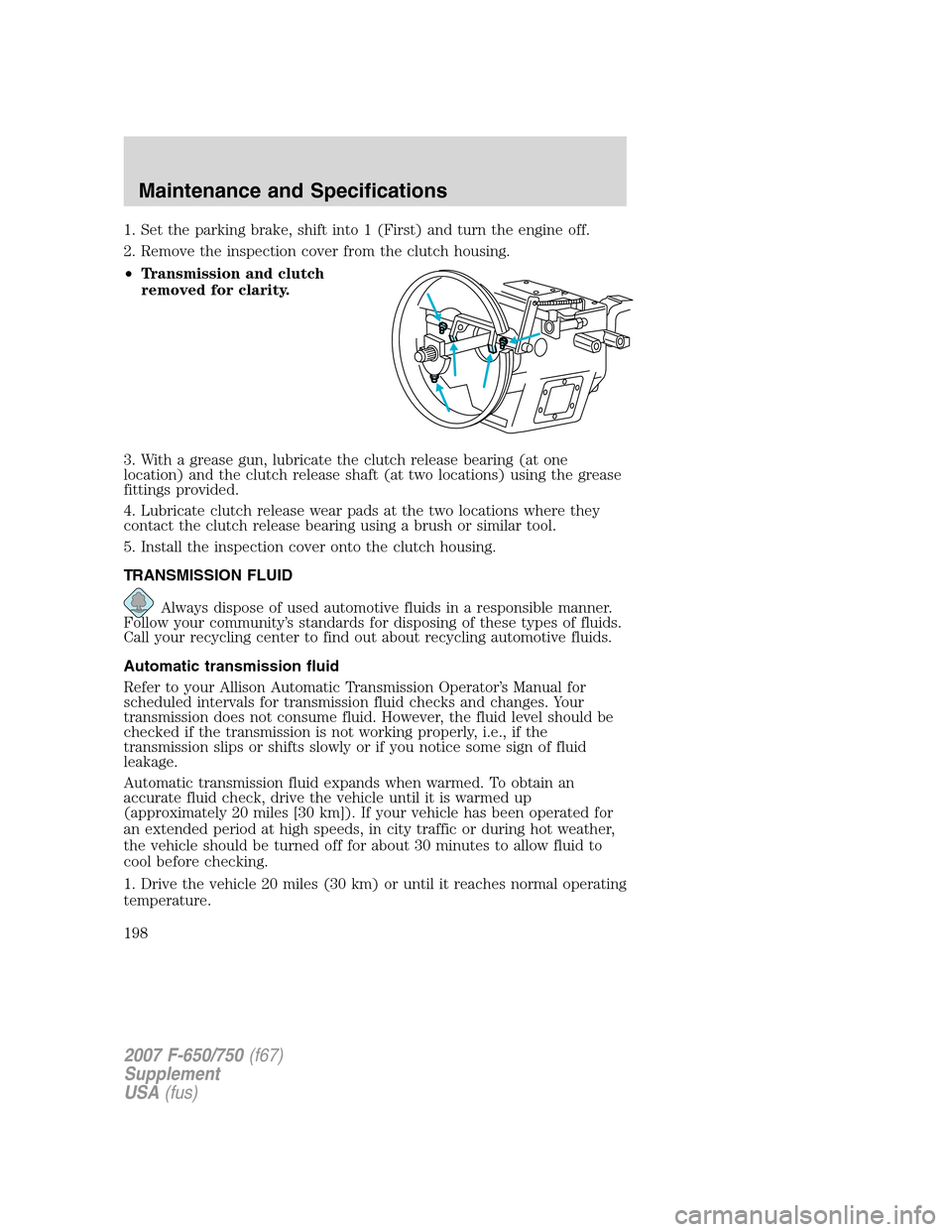
1. Set the parking brake, shift into 1 (First) and turn the engine off.
2. Remove the inspection cover from the clutch housing.
•Transmission and clutch
removed for clarity.
3. With a grease gun, lubricate the clutch release bearing (at one
location) and the clutch release shaft (at two locations) using the grease
fittings provided.
4. Lubricate clutch release wear pads at the two locations where they
contact the clutch release bearing using a brush or similar tool.
5. Install the inspection cover onto the clutch housing.
TRANSMISSION FLUID
Always dispose of used automotive fluids in a responsible manner.
Follow your community’s standards for disposing of these types of fluids.
Call your recycling center to find out about recycling automotive fluids.
Automatic transmission fluid
Refer to your Allison Automatic Transmission Operator’s Manual for
scheduled intervals for transmission fluid checks and changes. Your
transmission does not consume fluid. However, the fluid level should be
checked if the transmission is not working properly, i.e., if the
transmission slips or shifts slowly or if you notice some sign of fluid
leakage.
Automatic transmission fluid expands when warmed. To obtain an
accurate fluid check, drive the vehicle until it is warmed up
(approximately 20 miles [30 km]). If your vehicle has been operated for
an extended period at high speeds, in city traffic or during hot weather,
the vehicle should be turned off for about 30 minutes to allow fluid to
cool before checking.
1. Drive the vehicle 20 miles (30 km) or until it reaches normal operating
temperature.
2007 F-650/750(f67)
Supplement
USA(fus)
Maintenance and Specifications
198
Page 217 of 280
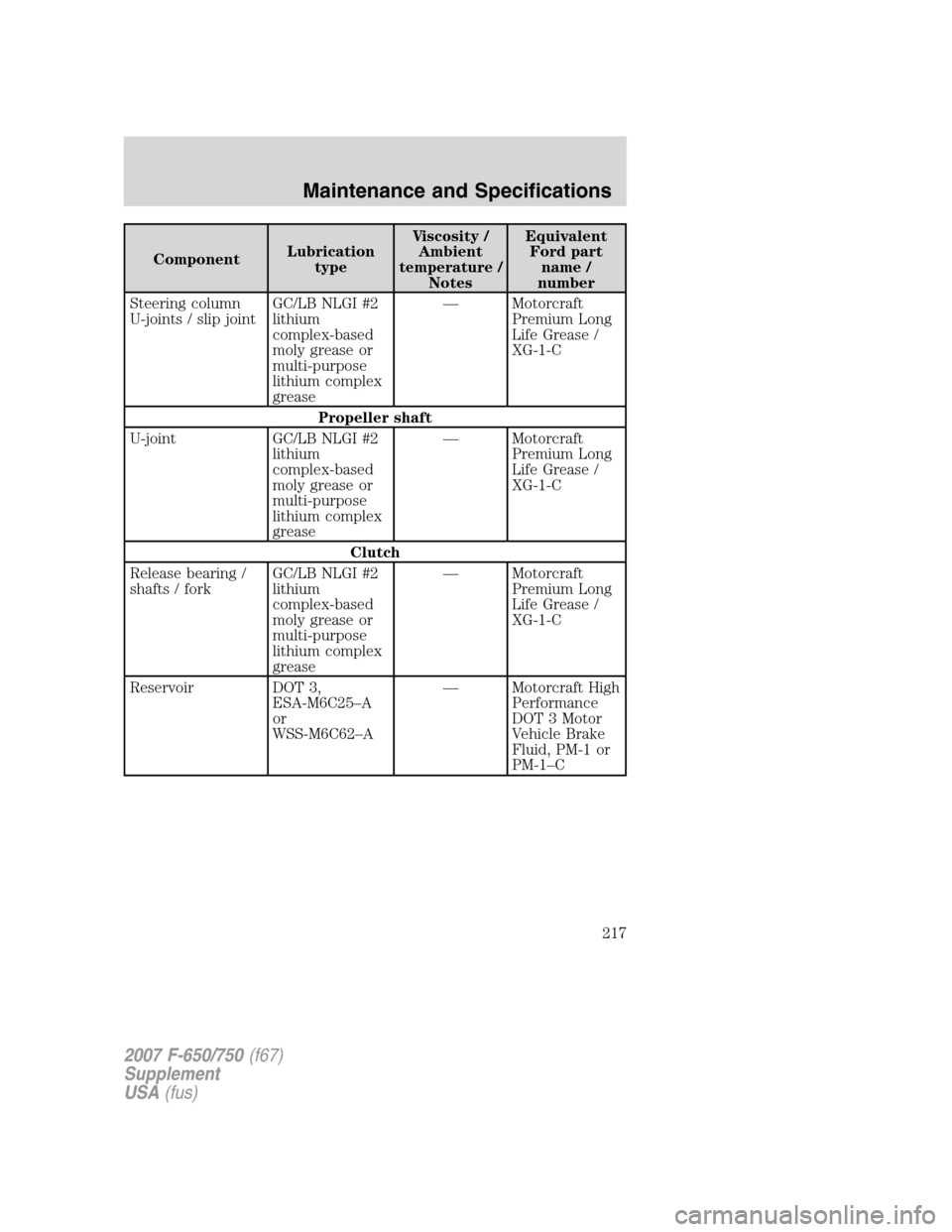
ComponentLubrication
typeViscosity /
Ambient
temperature /
NotesEquivalent
Ford part
name /
number
Steering column
U-joints / slip jointGC/LB NLGI #2
lithium
complex-based
moly grease or
multi-purpose
lithium complex
grease— Motorcraft
Premium Long
Life Grease /
XG-1-C
Propeller shaft
U-joint GC/LB NLGI #2
lithium
complex-based
moly grease or
multi-purpose
lithium complex
grease— Motorcraft
Premium Long
Life Grease /
XG-1-C
Clutch
Release bearing /
shafts / forkGC/LB NLGI #2
lithium
complex-based
moly grease or
multi-purpose
lithium complex
grease— Motorcraft
Premium Long
Life Grease /
XG-1-C
Reservoir DOT 3,
ESA-M6C25–A
or
WSS-M6C62–A— Motorcraft High
Performance
DOT 3 Motor
Vehicle Brake
Fluid, PM-1 or
PM-1–C
2007 F-650/750(f67)
Supplement
USA(fus)
Maintenance and Specifications
217
Page 235 of 280
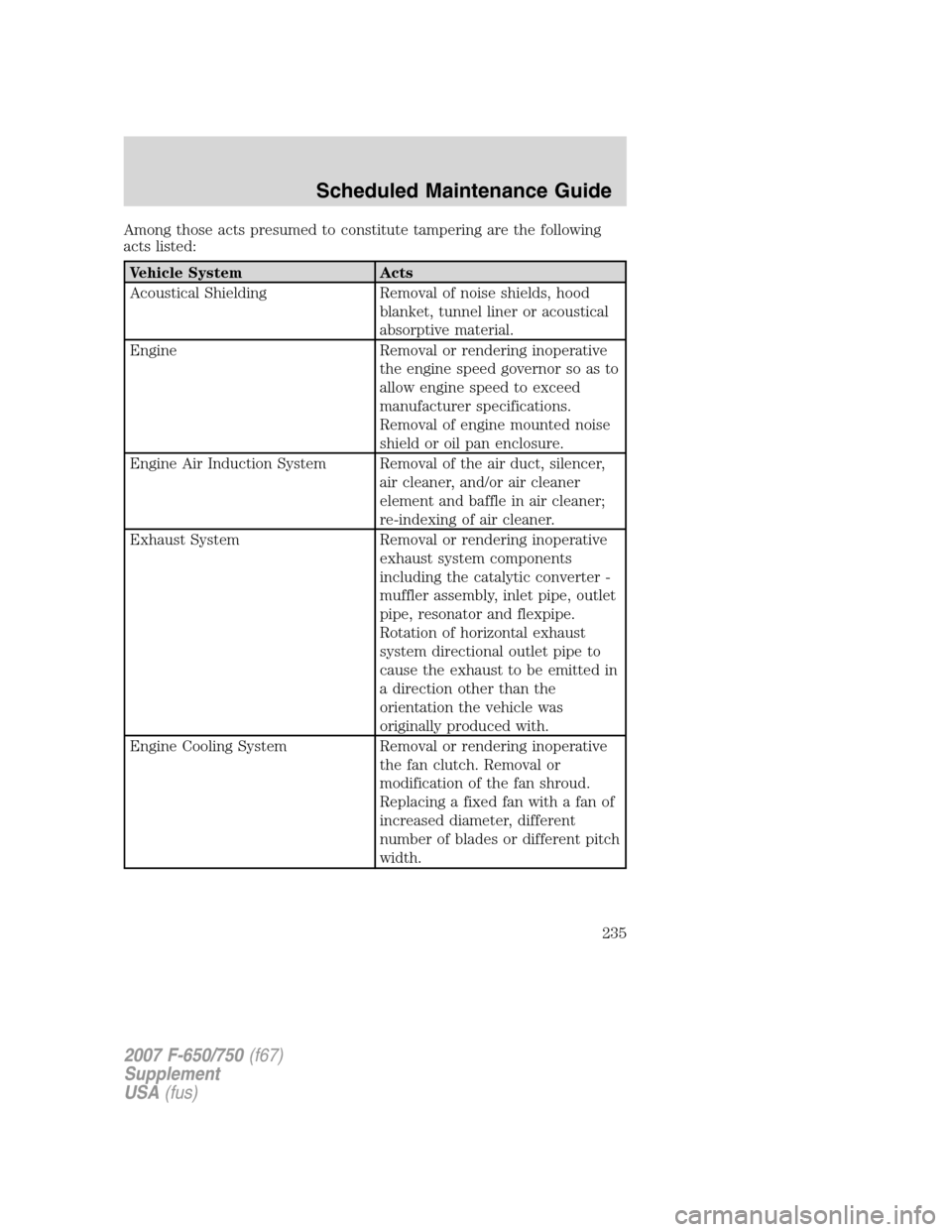
Among those acts presumed to constitute tampering are the following
acts listed:
Vehicle System Acts
Acoustical Shielding Removal of noise shields, hood
blanket, tunnel liner or acoustical
absorptive material.
Engine Removal or rendering inoperative
the engine speed governor so as to
allow engine speed to exceed
manufacturer specifications.
Removal of engine mounted noise
shield or oil pan enclosure.
Engine Air Induction System Removal of the air duct, silencer,
air cleaner, and/or air cleaner
element and baffle in air cleaner;
re-indexing of air cleaner.
Exhaust System Removal or rendering inoperative
exhaust system components
including the catalytic converter -
muffler assembly, inlet pipe, outlet
pipe, resonator and flexpipe.
Rotation of horizontal exhaust
system directional outlet pipe to
cause the exhaust to be emitted in
a direction other than the
orientation the vehicle was
originally produced with.
Engine Cooling System Removal or rendering inoperative
the fan clutch. Removal or
modification of the fan shroud.
Replacing a fixed fan with a fan of
increased diameter, different
number of blades or different pitch
width.
2007 F-650/750(f67)
Supplement
USA(fus)
Scheduled Maintenance Guide
235
Page 240 of 280
![FORD F650 2007 11.G Owners Manual Check every oil change (Oil change interval for the 6.0L Power
Stroke engine is 10,000 miles [16,000 km]; (refer to the
Caterpillar and Cummins service manuals for instructions and
information)
Engine](/img/11/5073/w960_5073-239.png "FORD F650 2007 11.G Owners Manual Check every oil change (Oil change interval for the 6.0L Power
Stroke engine is 10,000 miles [16,000 km]; (refer to the
Caterpillar and Cummins service manuals for instructions and
information)
Engine")
Check every oil change (Oil change interval for the 6.0L Power
Stroke engine is 10,000 miles [16,000 km]; (refer to the
Caterpillar and Cummins service manuals for instructions and
information)
Engine systemCheck the engine cooling system -
hoses, clamps and protection*.
Inspect the drive belts.
Exhaust systemInspect the entire exhaust system
(including the inlet pipe(s),
muffler(s), outlet pipe(s), clamps and
fasteners) for holes, leakage,
breakage, corrosive damage and
separation from other components.
Adjust, service or replace with the
same or the equivalent part. (Also a
noise emission control service).
Suspension systemTighten the front and rear spring
U-bolts to the specified torque.
Driveline and rear axle
systemLubricate the U-joints and the slip
yoke.
Brake systemLube the air brake foot control valve,
hinge and roller.
Inspect the drum brake linings
through the inspection holes.
Lubricate the brake camshafts (air
brakes only).
Lubricate the brake slack adjuster (air
brakes only).
Lubricate rear caliper slide rails.
Inspect the disc brake pads and the
piston boots (hydraulic brakes only).
Clutch systemLubricate the clutch release cross
shaft and all linkages.
Check the clutch fluid.
2007 F-650/750(f67)
Supplement
USA(fus)
Scheduled Maintenance Guide
240
Page 242 of 280
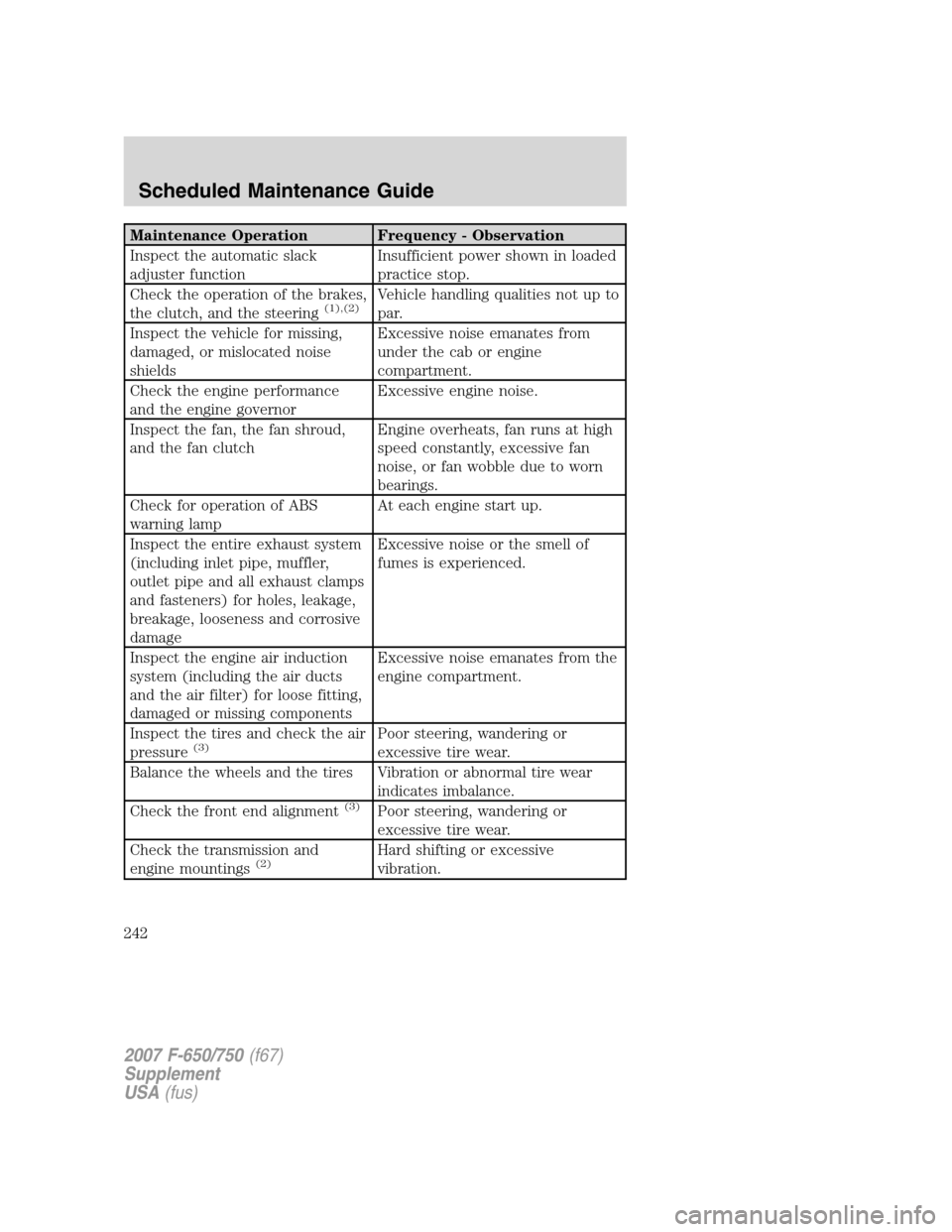
Maintenance Operation Frequency - Observation
Inspect the automatic slack
adjuster functionInsufficient power shown in loaded
practice stop.
Check the operation of the brakes,
the clutch, and the steering
(1),(2)Vehicle handling qualities not up to
par.
Inspect the vehicle for missing,
damaged, or mislocated noise
shieldsExcessive noise emanates from
under the cab or engine
compartment.
Check the engine performance
and the engine governorExcessive engine noise.
Inspect the fan, the fan shroud,
and the fan clutchEngine overheats, fan runs at high
speed constantly, excessive fan
noise, or fan wobble due to worn
bearings.
Check for operation of ABS
warning lampAt each engine start up.
Inspect the entire exhaust system
(including inlet pipe, muffler,
outlet pipe and all exhaust clamps
and fasteners) for holes, leakage,
breakage, looseness and corrosive
damageExcessive noise or the smell of
fumes is experienced.
Inspect the engine air induction
system (including the air ducts
and the air filter) for loose fitting,
damaged or missing componentsExcessive noise emanates from the
engine compartment.
Inspect the tires and check the air
pressure
(3)Poor steering, wandering or
excessive tire wear.
Balance the wheels and the tires Vibration or abnormal tire wear
indicates imbalance.
Check the front end alignment
(3)Poor steering, wandering or
excessive tire wear.
Check the transmission and
engine mountings
(2)Hard shifting or excessive
vibration.
2007 F-650/750(f67)
Supplement
USA(fus)
Scheduled Maintenance Guide
242
Page 245 of 280
![FORD F650 2007 11.G Owners Manual ComponentOn-Highway(Continued)
(60,000 miles [96,000 km] or more annually) - Miles, kilometers or months -
whichever occurs first
Miles (x 1000) 15 30 45 60 75 90 105 120 135 150
Kilometers (x 1000) 2](/img/11/5073/w960_5073-244.png "FORD F650 2007 11.G Owners Manual ComponentOn-Highway(Continued)
(60,000 miles [96,000 km] or more annually) - Miles, kilometers or months -
whichever occurs first
Miles (x 1000) 15 30 45 60 75 90 105 120 135 150
Kilometers (x 1000) 2")
ComponentOn-Highway(Continued)
(60,000 miles [96,000 km] or more annually) - Miles, kilometers or months -
whichever occurs first
Miles (x 1000) 15 30 45 60 75 90 105 120 135 150
Kilometers (x 1000) 24 48 72 96 120 144 168 192 216 240
Months 3 6 9 12 15 18 21 24 27 30
Propeller shaft SPL
U-joint - lubricate•••••
Propeller shaft non-SPL
U-joint and slip joint - lubricate••••••••••
Clutch
Release bearing / shafts / forks - lubricate••••••••••
Cooling system
Coolant - check level••••••••••
Coolant - check freeze protection••••••••••
Extended life coolant - add extender See engine manufacturer’s recommendation
Extended life coolant - replace See engine manufacturer’s recommendation
Engine - Refer to engine manual for Caterpillar and Cummins. 6.0L Power Stroke - see 6.0L Engine section
at end of chart
Transmission
Automatic and Auto-shift transmissions Refer to transmission operator’s manual
Manual transmission - check fluid level••••••••••
Eaton-Fuller manual transmission - petroleum oil
change••
2007 F-650/750(f67)
Supplement
USA(fus)
Scheduled Maintenance Guide
245
Page 248 of 280
![FORD F650 2007 11.G Owners Manual ComponentOn-Highway(Continued)
(60,000 Miles [96,000 km] or more annually) - Miles, kilometers or months -
whichever occurs first
Miles (x 1000) 165 180 195 210 225 240 255 270 285 300
Kilometers (x 1](/img/11/5073/w960_5073-247.png "FORD F650 2007 11.G Owners Manual ComponentOn-Highway(Continued)
(60,000 Miles [96,000 km] or more annually) - Miles, kilometers or months -
whichever occurs first
Miles (x 1000) 165 180 195 210 225 240 255 270 285 300
Kilometers (x 1")
ComponentOn-Highway(Continued)
(60,000 Miles [96,000 km] or more annually) - Miles, kilometers or months -
whichever occurs first
Miles (x 1000) 165 180 195 210 225 240 255 270 285 300
Kilometers (x 1000) 264 288 312 336 360 384 408 432 456 480
Months 33 36 39 42 45 48 51 54 57 60
Propeller shaft SPL
U-joint - lubricate•••••
Propeller shaft non-SPL
U-joint and slip joint - lubricate••••••••••
Clutch
Release bearing / shafts / fork - lubricate••••••••••
Cooling system
Coolant - check level••••••••••
Coolant - check freeze protection••••••••••
Extended life coolant - add extender See engine manufacturer’s recommendation
Extended life coolant - replace See engine manufacturer’s recommendation
Engine - Refer to engine manual for Caterpillar and Cummins. 6.0L Power Stroke - see 6.0L Engine section
at end of chart
Transmission
Automatic and Auto-shift transmissions Refer to transmission operator’s manual
Manual transmission - check fluid level••••••••••
Eaton-Fuller manual transmission - petroleum oil
change•••
2007 F-650/750(f67)
Supplement
USA(fus)
Scheduled Maintenance Guide
248