steering FORD F650 2007 11.G Owners Manual
[x] Cancel search | Manufacturer: FORD, Model Year: 2007, Model line: F650, Model: FORD F650 2007 11.GPages: 280, PDF Size: 1.93 MB
Page 1 of 280
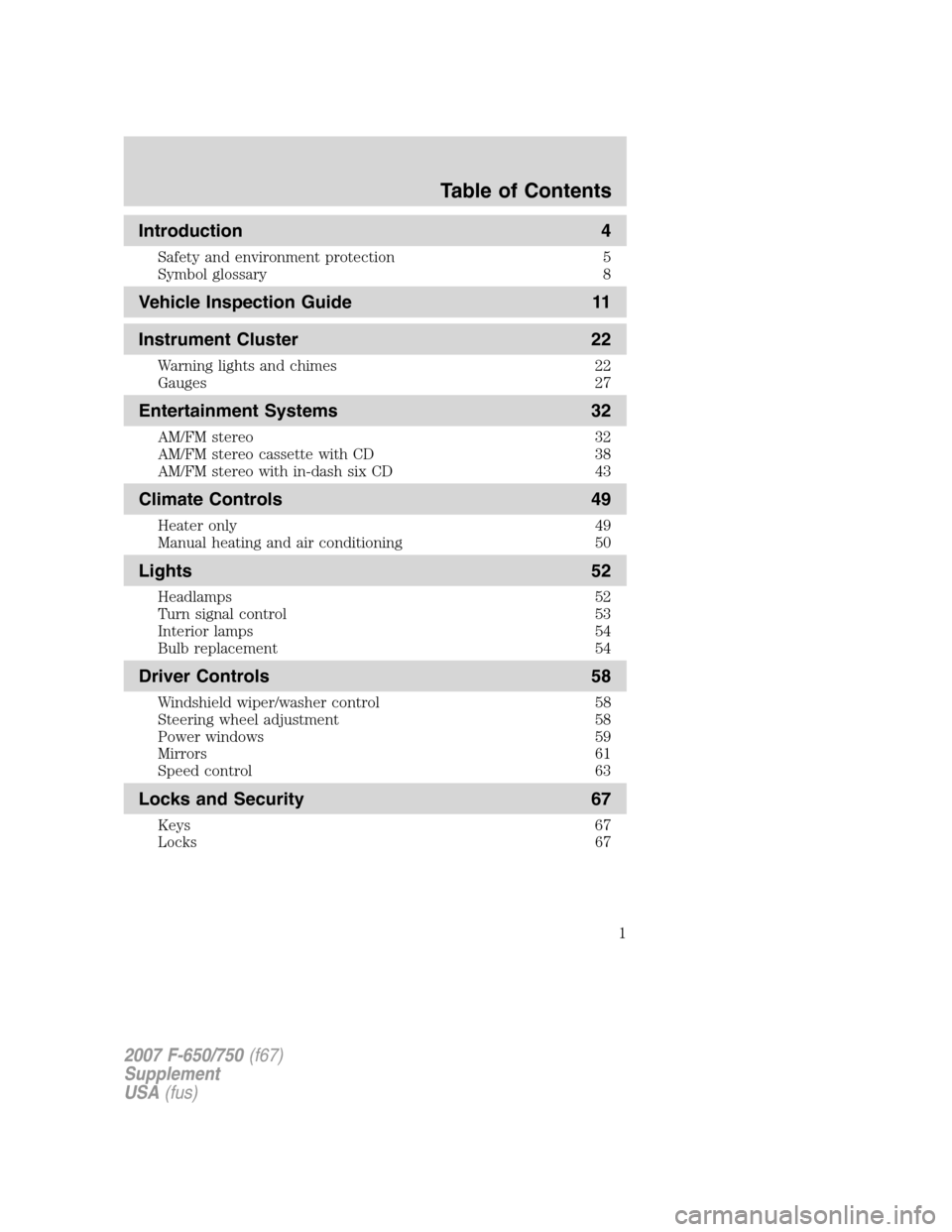
Introduction 4
Safety and environment protection 5
Symbol glossary 8
Vehicle Inspection Guide 11
Instrument Cluster 22
Warning lights and chimes 22
Gauges 27
Entertainment Systems 32
AM/FM stereo 32
AM/FM stereo cassette with CD 38
AM/FM stereo with in-dash six CD 43
Climate Controls 49
Heater only 49
Manual heating and air conditioning 50
Lights 52
Headlamps 52
Turn signal control 53
Interior lamps 54
Bulb replacement 54
Driver Controls 58
Windshield wiper/washer control 58
Steering wheel adjustment 58
Power windows 59
Mirrors 61
Speed control 63
Locks and Security 67
Keys 67
Locks 67
Table of Contents
1
2007 F-650/750(f67)
Supplement
USA(fus)
Page 6 of 280
SPECIAL NOTICES
Emission warranty
The New Truck Limited Warranty includes Basic Coverage, Corrosion
Coverage, Frame Coverage, Federal Emissions Defect Warranty and
California Defects Warranty. For a detailed description of what is covered
and what is not covered, refer to theWarranty Guidethat is provided
to you along with yourOwner’s Guide.
Special instructions
For your added safety, your vehicle is fitted with sophisticated electronic
controls.
Service Data Recording
Service data recorders in your vehicle are capable of collecting and
storing diagnostic information about your vehicle. This potentially
includes information about the performance or status of various systems
and modules in the vehicle, such as engine, throttle, steering or brake
systems. In order to properly diagnose and service your vehicle, Ford
Motor Company, Ford of Canada, and service and repair facilities may
access vehicle diagnostic information through a direct connection to your
vehicle when diagnosing or servicing your vehicle.
2007 F-650/750(f67)
Supplement
USA(fus)
Introduction
6
Page 7 of 280
Event Data Recording
Other modules in your vehicle - event data recorders - are capable of
collecting and storing data during a crash or near crash event. The
recorded information may assist in the investigation of such an event.
The modules may record information about both the vehicle and the
occupants, potentially including information such as:
•how various systems in your vehicle were operating;
•whether or not the driver and passenger seatbelts were buckled;
•how far (if at all) the driver was depressing the accelerator and/or the
brake pedal;
•how fast the vehicle was traveling; and
•where the driver was positioning the steering wheel.
To access this information, special equipment must be directly connected
to the recording modules. Ford Motor Company and Ford of Canada do
not access event data recorder information without obtaining consent,
unless pursuant to court order or where required by law enforcement,
other government authorities or other third parties acting with lawful
authority. Other parties may seek to access the information
independently of Ford Motor Company and Ford of Canada.
Cell phone use
The use of Mobile Communications Equipment has become increasingly
important in the conduct of business and personal affairs. However,
drivers must not compromise their own or others’ safety when using
such equipment. Mobile Communications can enhance personal safety
and security when appropriately used, particularly in emergency
situations. Safety must be paramount when using mobile communications
equipment to avoid negating these benefits.
Mobile Communication Equipment includes, but is not limited to cellular
phones, pagers, portable email devices, in-vehicle communications
systems, telematics devices and portable two-way radios.
A driver’s first responsibility is the safe operation of the vehicle.
The most important thing you can do to prevent a crash is to
avoid distractions and pay attention to the road. Wait until it is safe to
operate Mobile Communications Equipment.
2007 F-650/750(f67)
Supplement
USA(fus)
Introduction
7
Page 9 of 280
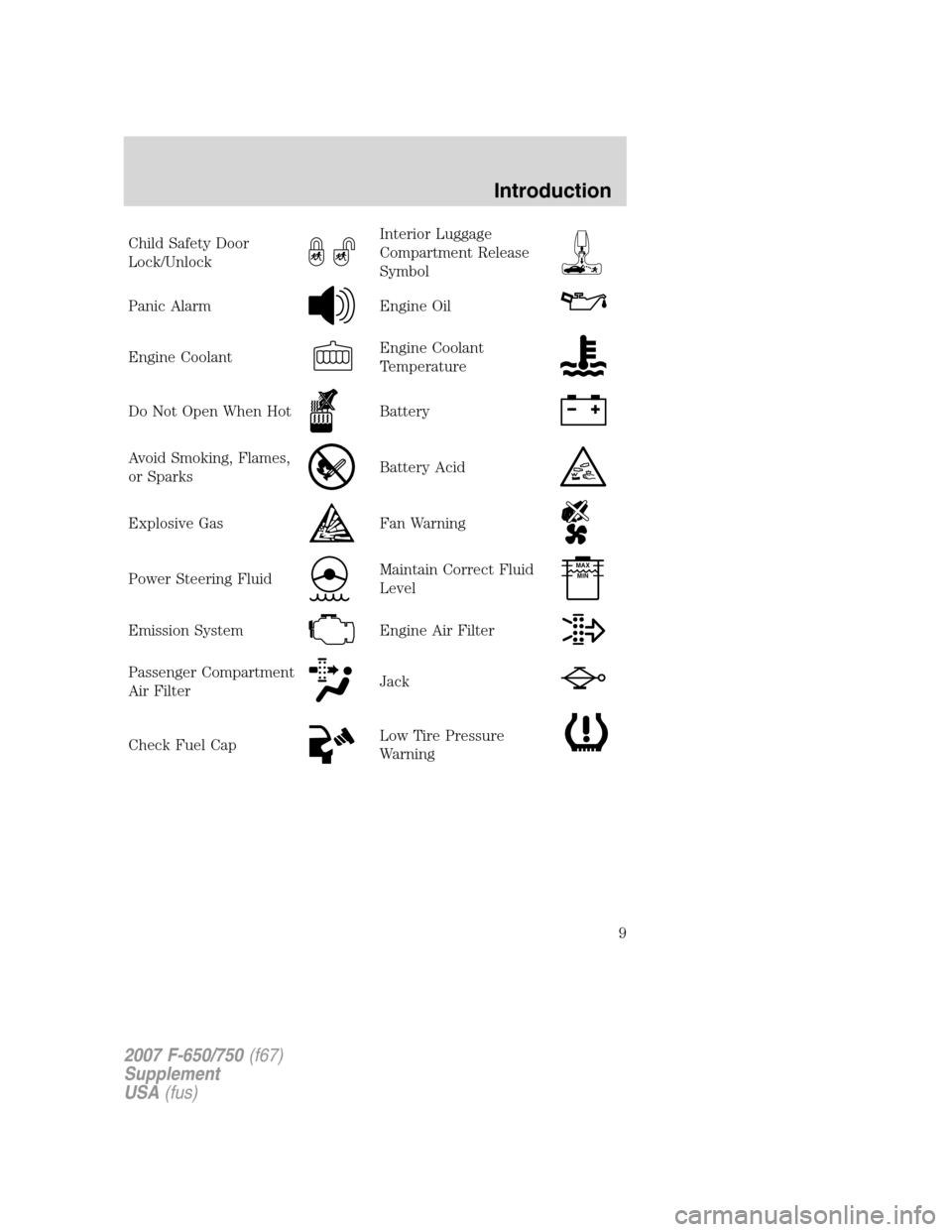
Child Safety Door
Lock/UnlockInterior Luggage
Compartment Release
Symbol
Panic AlarmEngine Oil
Engine CoolantEngine Coolant
Temperature
Do Not Open When HotBattery
Avoid Smoking, Flames,
or SparksBattery Acid
Explosive GasFan Warning
Power Steering FluidMaintain Correct Fluid
LevelMAX
MIN
Emission SystemEngine Air Filter
Passenger Compartment
Air FilterJack
Check Fuel CapLow Tire Pressure
Warning
2007 F-650/750(f67)
Supplement
USA(fus)
Introduction
9
Page 11 of 280
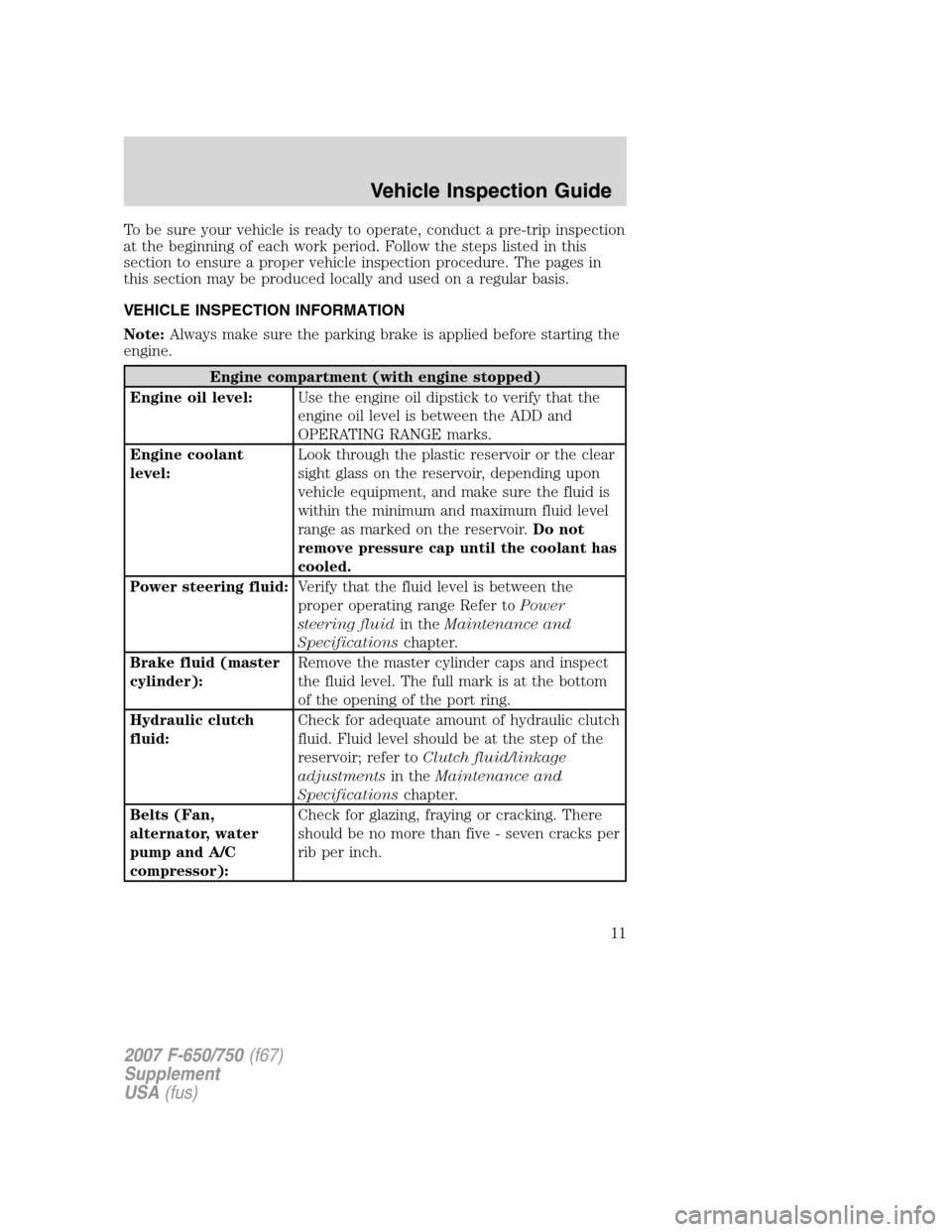
To be sure your vehicle is ready to operate, conduct a pre-trip inspection
at the beginning of each work period. Follow the steps listed in this
section to ensure a proper vehicle inspection procedure. The pages in
this section may be produced locally and used on a regular basis.
VEHICLE INSPECTION INFORMATION
Note:Always make sure the parking brake is applied before starting the
engine.
Engine compartment (with engine stopped)
Engine oil level:Use the engine oil dipstick to verify that the
engine oil level is between the ADD and
OPERATING RANGE marks.
Engine coolant
level:Look through the plastic reservoir or the clear
sight glass on the reservoir, depending upon
vehicle equipment, and make sure the fluid is
within the minimum and maximum fluid level
range as marked on the reservoir.Do not
remove pressure cap until the coolant has
cooled.
Power steering fluid:Verify that the fluid level is between the
proper operating range Refer toPower
steering fluidin theMaintenance and
Specificationschapter.
Brake fluid (master
cylinder):Remove the master cylinder caps and inspect
the fluid level. The full mark is at the bottom
of the opening of the port ring.
Hydraulic clutch
fluid:Check for adequate amount of hydraulic clutch
fluid. Fluid level should be at the step of the
reservoir; refer toClutch fluid/linkage
adjustmentsin theMaintenance and
Specificationschapter.
Belts (Fan,
alternator, water
pump and A/C
compressor):Check for glazing, fraying or cracking. There
should be no more than five - seven cracks per
rib per inch.
2007 F-650/750(f67)
Supplement
USA(fus)
Vehicle Inspection Guide
11
Page 14 of 280
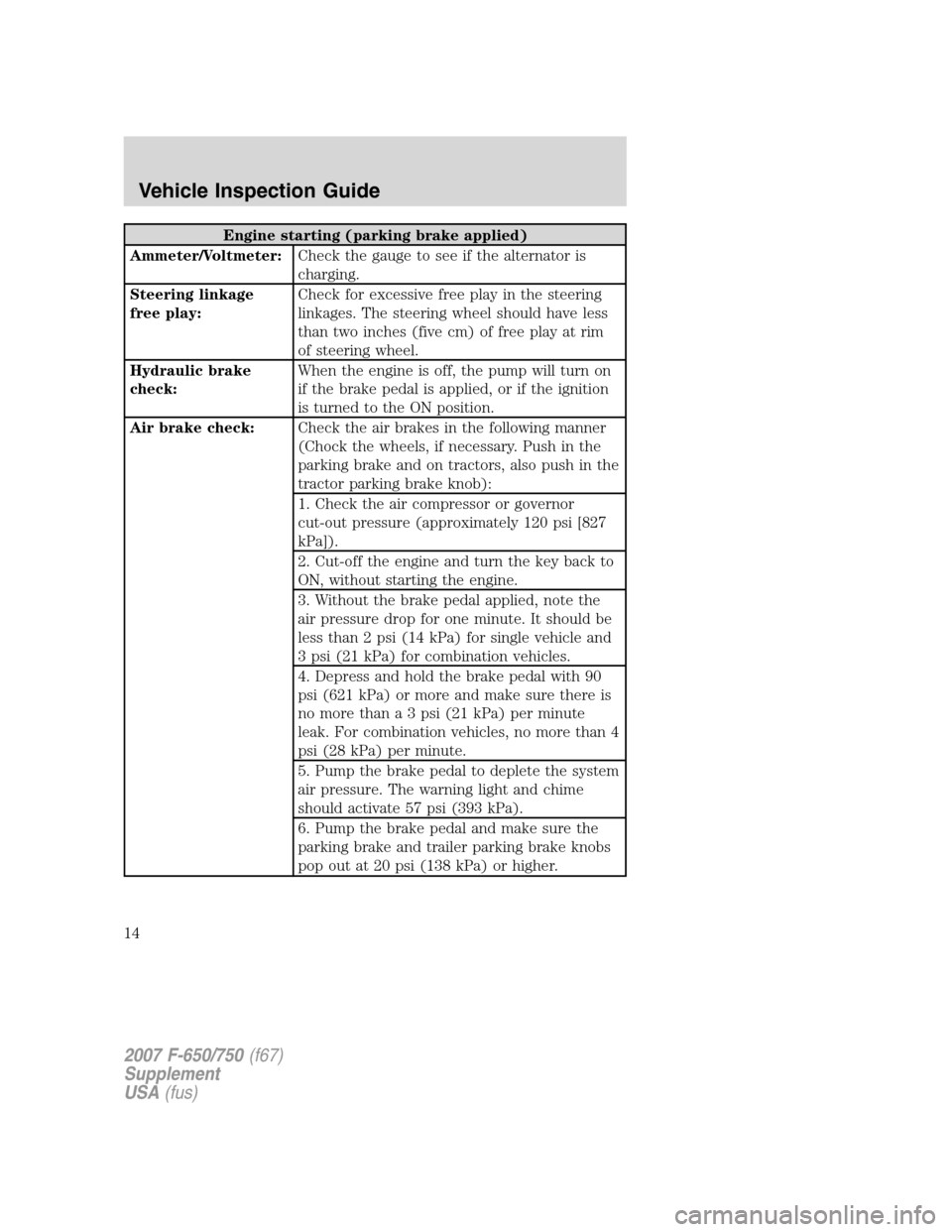
Engine starting (parking brake applied)
Ammeter/Voltmeter:Check the gauge to see if the alternator is
charging.
Steering linkage
free play:Check for excessive free play in the steering
linkages. The steering wheel should have less
than two inches (five cm) of free play at rim
of steering wheel.
Hydraulic brake
check:When the engine is off, the pump will turn on
if the brake pedal is applied, or if the ignition
is turned to the ON position.
Air brake check:Check the air brakes in the following manner
(Chock the wheels, if necessary. Push in the
parking brake and on tractors, also push in the
tractor parking brake knob):
1. Check the air compressor or governor
cut-out pressure (approximately 120 psi [827
kPa]).
2. Cut-off the engine and turn the key back to
ON, without starting the engine.
3. Without the brake pedal applied, note the
air pressure drop for one minute. It should be
less than 2 psi (14 kPa) for single vehicle and
3 psi (21 kPa) for combination vehicles.
4. Depress and hold the brake pedal with 90
psi (621 kPa) or more and make sure there is
no more than a 3 psi (21 kPa) per minute
leak. For combination vehicles, no more than 4
psi (28 kPa) per minute.
5. Pump the brake pedal to deplete the system
air pressure. The warning light and chime
should activate 57 psi (393 kPa).
6. Pump the brake pedal and make sure the
parking brake and trailer parking brake knobs
pop out at 20 psi (138 kPa) or higher.
2007 F-650/750(f67)
Supplement
USA(fus)
Vehicle Inspection Guide
14
Page 15 of 280
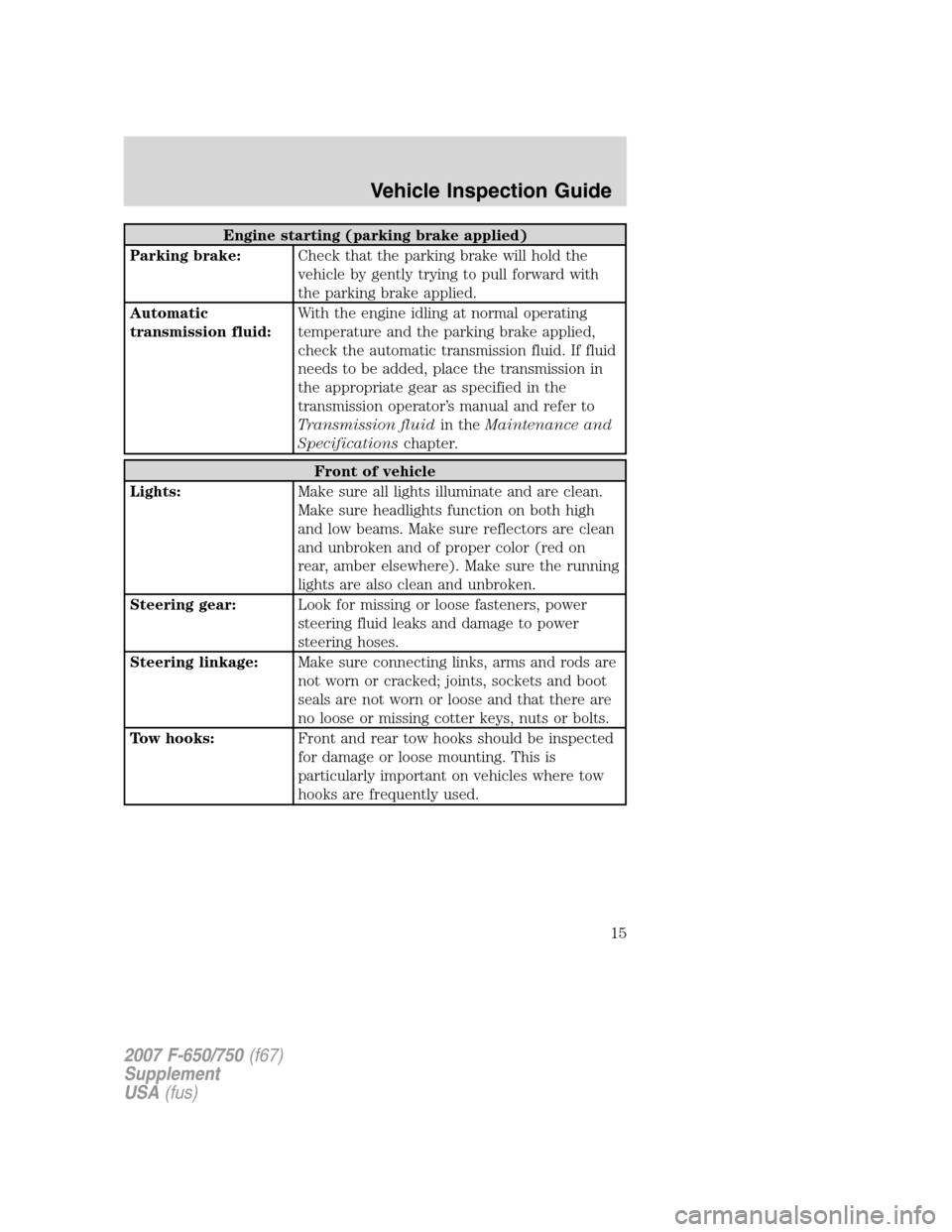
Engine starting (parking brake applied)
Parking brake:Check that the parking brake will hold the
vehicle by gently trying to pull forward with
the parking brake applied.
Automatic
transmission fluid:With the engine idling at normal operating
temperature and the parking brake applied,
check the automatic transmission fluid. If fluid
needs to be added, place the transmission in
the appropriate gear as specified in the
transmission operator’s manual and refer to
Transmission fluidin theMaintenance and
Specificationschapter.
Front of vehicle
Lights:Make sure all lights illuminate and are clean.
Make sure headlights function on both high
and low beams. Make sure reflectors are clean
and unbroken and of proper color (red on
rear, amber elsewhere). Make sure the running
lights are also clean and unbroken.
Steering gear:Look for missing or loose fasteners, power
steering fluid leaks and damage to power
steering hoses.
Steering linkage:Make sure connecting links, arms and rods are
not worn or cracked; joints, sockets and boot
seals are not worn or loose and that there are
no loose or missing cotter keys, nuts or bolts.
Tow hooks:Front and rear tow hooks should be inspected
for damage or loose mounting. This is
particularly important on vehicles where tow
hooks are frequently used.
2007 F-650/750(f67)
Supplement
USA(fus)
Vehicle Inspection Guide
15
Page 16 of 280
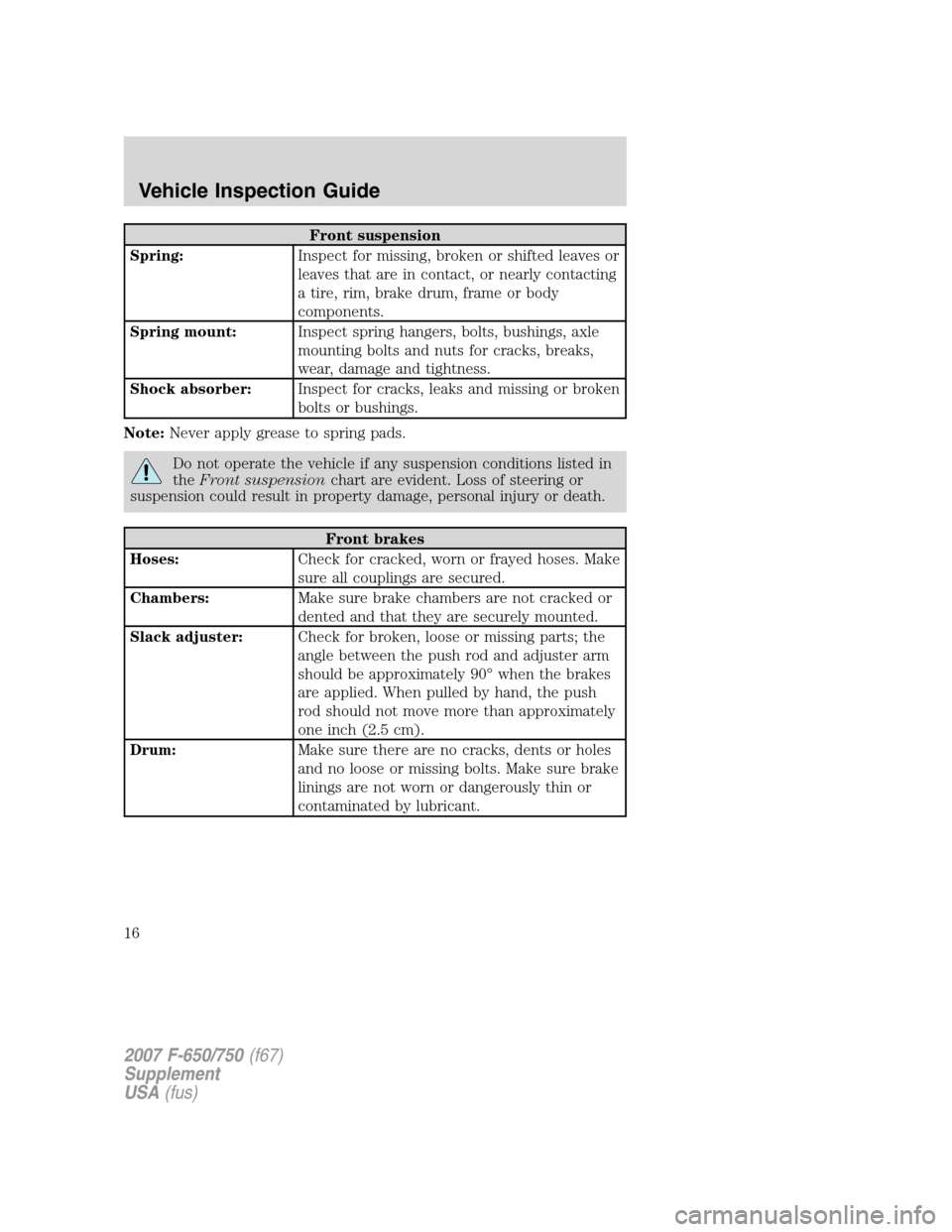
Front suspension
Spring:Inspect for missing, broken or shifted leaves or
leaves that are in contact, or nearly contacting
a tire, rim, brake drum, frame or body
components.
Spring mount:Inspect spring hangers, bolts, bushings, axle
mounting bolts and nuts for cracks, breaks,
wear, damage and tightness.
Shock absorber:Inspect for cracks, leaks and missing or broken
bolts or bushings.
Note:Never apply grease to spring pads.
Do not operate the vehicle if any suspension conditions listed in
theFront suspensionchart are evident. Loss of steering or
suspension could result in property damage, personal injury or death.
Front brakes
Hoses:Check for cracked, worn or frayed hoses. Make
sure all couplings are secured.
Chambers:Make sure brake chambers are not cracked or
dented and that they are securely mounted.
Slack adjuster:Check for broken, loose or missing parts; the
angle between the push rod and adjuster arm
should be approximately 90° when the brakes
are applied. When pulled by hand, the push
rod should not move more than approximately
one inch (2.5 cm).
Drum:Make sure there are no cracks, dents or holes
and no loose or missing bolts. Make sure brake
linings are not worn or dangerously thin or
contaminated by lubricant.
2007 F-650/750(f67)
Supplement
USA(fus)
Vehicle Inspection Guide
16
Page 18 of 280

Underbody of vehicle
Frame:Check for cracks or bends in longitudinal
frame members. Make sure there are no loose,
cracked, bent, broken or missing
crossmembers or crossmember fasteners.
Maintain adequate clearance between all parts of the exhaust
system and all hoses, wires and lines for engine cooling, brake
system, fuel system, power steering system and electrical system, Heat
damage to hoses, wires or lines may cause vehicle malfunction that
could result in property damage, personal injury or death.
Rear of vehicle
Air/Electric lines:Make sure that air hoses are not cut, cracked,
chafed or worn. Listen for audible air leaks,
Make sure air and electrical lines are not
tangled, crimped or pinched or being dragged
against any truck parts. Electrical line
insulation should not be cut, cracked, chafed
or worn. None of the air or electrical line
should be spliced or taped. Check for
corrosion on pins and in electrical sockets to
ensure continuity and reduced heat build-up
potential.
Deck plate:Make sure deck plate is clean, securely bolted
to the frame and clear of loose objects.
Signal/Brake lights:Make sure both brake lights illuminate when
the brake pedal is applied. Also, make sure
each signal flashes. Make sure that four-way
flashers work properly.
2007 F-650/750(f67)
Supplement
USA(fus)
Vehicle Inspection Guide
18
Page 23 of 280
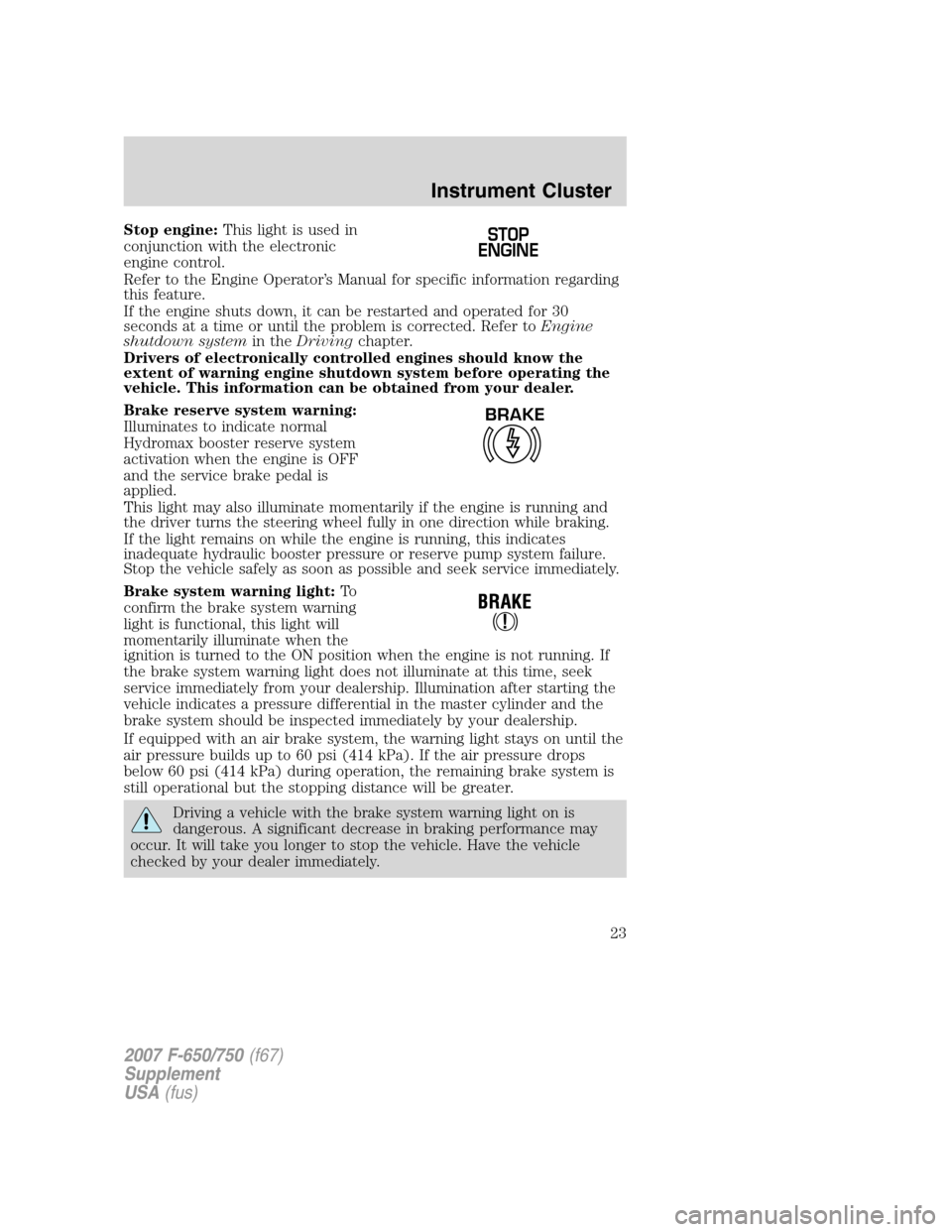
Stop engine:This light is used in
conjunction with the electronic
engine control.
Refer to the Engine Operator’s Manual for specific information regarding
this feature.
If the engine shuts down, it can be restarted and operated for 30
seconds at a time or until the problem is corrected. Refer toEngine
shutdown systemin theDrivingchapter.
Drivers of electronically controlled engines should know the
extent of warning engine shutdown system before operating the
vehicle. This information can be obtained from your dealer.
Brake reserve system warning:
Illuminates to indicate normal
Hydromax booster reserve system
activation when the engine is OFF
and the service brake pedal is
applied.
This light may also illuminate momentarily if the engine is running and
the driver turns the steering wheel fully in one direction while braking.
If the light remains on while the engine is running, this indicates
inadequate hydraulic booster pressure or reserve pump system failure.
Stop the vehicle safely as soon as possible and seek service immediately.
Brake system warning light:To
confirm the brake system warning
light is functional, this light will
momentarily illuminate when the
ignition is turned to the ON position when the engine is not running. If
the brake system warning light does not illuminate at this time, seek
service immediately from your dealership. Illumination after starting the
vehicle indicates a pressure differential in the master cylinder and the
brake system should be inspected immediately by your dealership.
If equipped with an air brake system, the warning light stays on until the
air pressure builds up to 60 psi (414 kPa). If the air pressure drops
below 60 psi (414 kPa) during operation, the remaining brake system is
still operational but the stopping distance will be greater.
Driving a vehicle with the brake system warning light on is
dangerous. A significant decrease in braking performance may
occur. It will take you longer to stop the vehicle. Have the vehicle
checked by your dealer immediately.
STOP
ENGINE
BRAKE
2007 F-650/750(f67)
Supplement
USA(fus)
Instrument Cluster
23