fuel FORD F650 2008 11.G User Guide
[x] Cancel search | Manufacturer: FORD, Model Year: 2008, Model line: F650, Model: FORD F650 2008 11.GPages: 273, PDF Size: 1.71 MB
Page 95 of 273
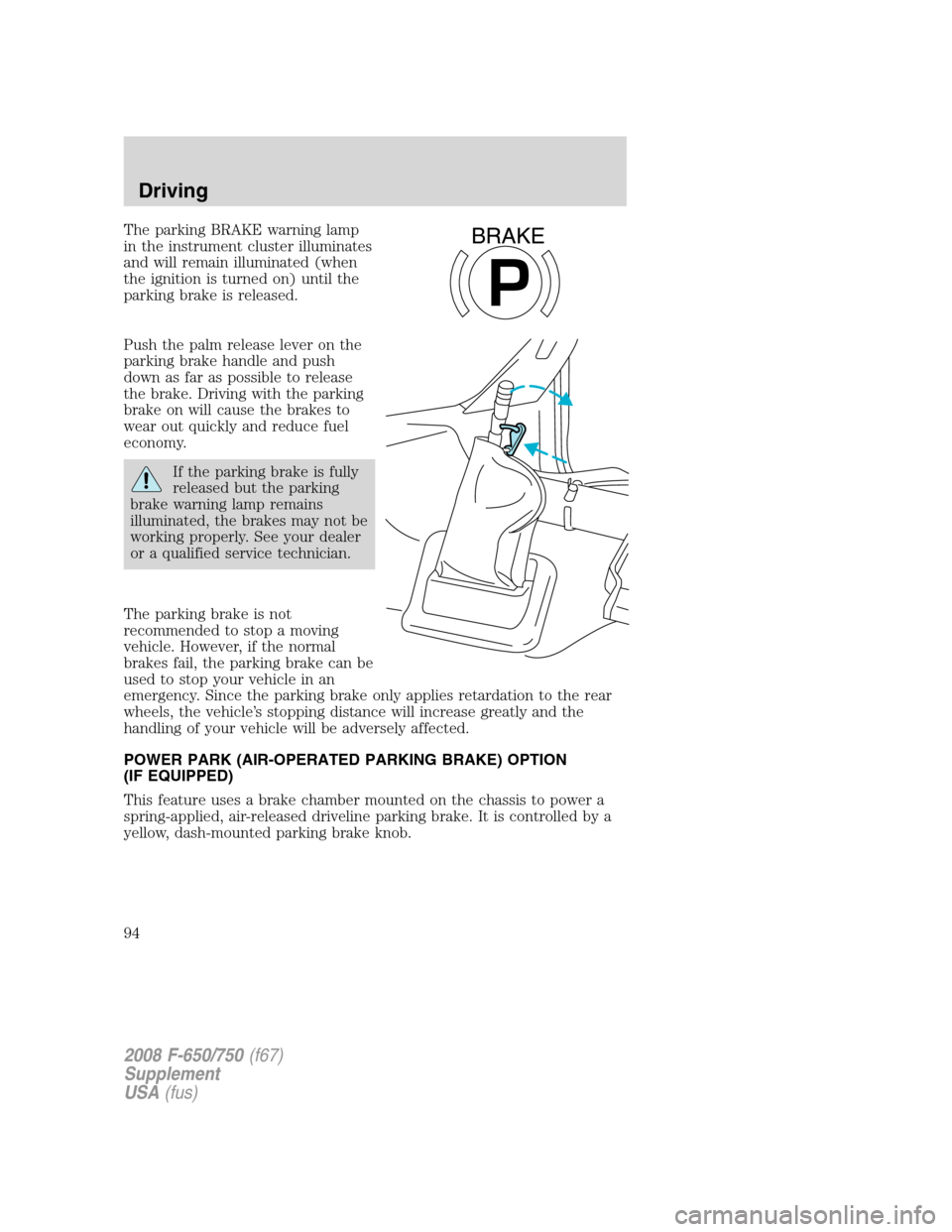
The parking BRAKE warning lamp
in the instrument cluster illuminates
and will remain illuminated (when
the ignition is turned on) until the
parking brake is released.
Push the palm release lever on the
parking brake handle and push
down as far as possible to release
the brake. Driving with the parking
brake on will cause the brakes to
wear out quickly and reduce fuel
economy.
If the parking brake is fully
released but the parking
brake warning lamp remains
illuminated, the brakes may not be
working properly. See your dealer
or a qualified service technician.
The parking brake is not
recommended to stop a moving
vehicle. However, if the normal
brakes fail, the parking brake can be
used to stop your vehicle in an
emergency. Since the parking brake only applies retardation to the rear
wheels, the vehicle’s stopping distance will increase greatly and the
handling of your vehicle will be adversely affected.
POWER PARK (AIR-OPERATED PARKING BRAKE) OPTION
(IF EQUIPPED)
This feature uses a brake chamber mounted on the chassis to power a
spring-applied, air-released driveline parking brake. It is controlled by a
yellow, dash-mounted parking brake knob.
P
BRAKE
2008 F-650/750(f67)
Supplement
USA(fus)
Driving
94
Page 126 of 273
Some Dana/Spicer drive axles have a driver-controlled differential lock.
The differential lock can lock or unlock the differential when the vehicle
is moving or stopped. When extra traction is required, the differential
lock will provide full power to both axles.
When the differential is locked, the vehicle’s turning radius will increase
(vehicle will “under-steer”)
The differential can be locked or unlocked when the vehicle is moving at
a constant speed of less than 25 mph (40 km/h) and while the wheels
are not slipping. The differential must not be locked when the vehicle is
traveling down steep grades and traction is minimal.
Note:Never use the differential lock at vehicle speeds above 25 mph
(40 km/h).
Note:The driver-controlled differential lock function will vary with some
transmissions.
•Vehicles equipped with an Allison 3000 Series transmission:The
differential lock and differential lock light will automatically disengage
at speeds above 25 mph (40 km/h). The differential lock will remain
off until either the vehicle is restarted or the differential lock switch is
turned off then back on.
•Vehicles equipped with a 5–speed, 6–speed or 7–speed manual:
The differential lock and differential lock light will automatically
disengage at speeds above 25 mph (40 km/h). The differential lock
will remain off until either the vehicle is restarted or the differential
lock switch is turned off then back on.
Axle conversions
It is not recommended, or approved, for axle conversions to be
performed. However, it is understood that, on occasion, aftermarket
add-on axles are installed by others on the truck chassis which allow
operator control for weight transfer from other axles (i.e., air lift axles).
When operating a loaded vehicle, the driver must keep all
adjustable axles on the ground at all times, supporting their
share of the vehicle’s load. Failure to do so can overload other axles,
tires, wheels, springs, steering components, brakes and frames,
resulting in early component failure, loss of vehicle control, possible
property damage and personal injury.
TWO-SPEED REAR AXLE (IF EQUIPPED)
A two-speed rear axle allows the driver to select a LO range for greater
pulling power and a HI range for greater road speed and fuel economy.
2008 F-650/750(f67)
Supplement
USA(fus)
Driving
125
Page 127 of 273
These ranges can also be used to provide additional steps between
transmission shifts when driving on steep grades and/or fuel economy
may be factors.
Note:Do not shift between ranges when the speed control is on.
Never shift a two-speed axle when descending a steep grade as
this may cause loss of vehicle control and result in personal injury.
Axle shifting
Manual transmissions:
•To downshift,select the next lower gear, release and depress the
accelerator pedal rapidly, or while holding the accelerator pedal down,
release and engage the clutch rapidly.Note:The clutch method is
recommended when driving at slower speeds.
•To upshift,keep the accelerator pedal down, select the next higher
gear, release the accelerator and pause until the axle upshifts.Note:
De-clutch for smoother axle upshifts when driving at slower speeds.
Automatic transmissions:
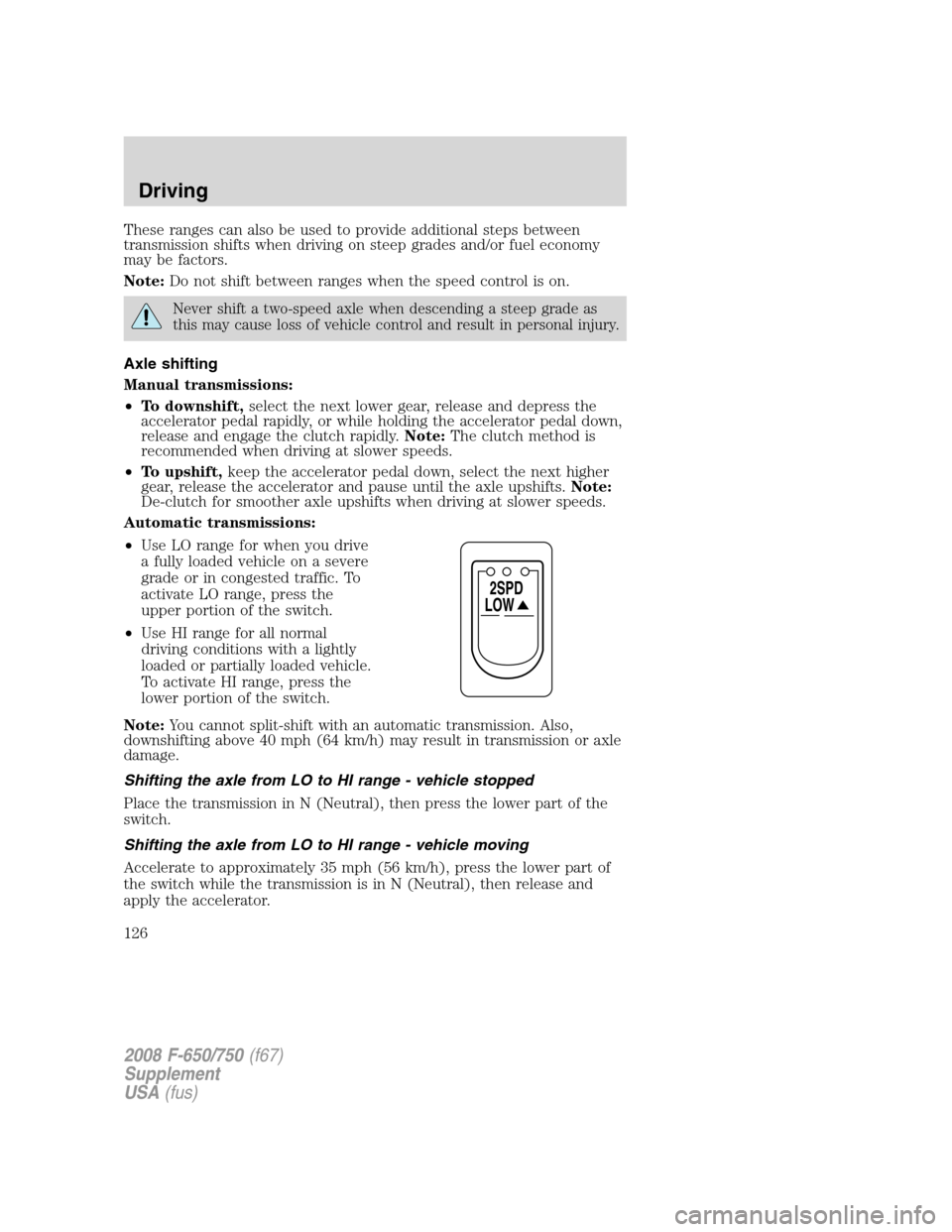
•Use LO range for when you drive
a fully loaded vehicle on a severe
grade or in congested traffic. To
activate LO range, press the
upper portion of the switch.
•Use HI range for all normal
driving conditions with a lightly
loaded or partially loaded vehicle.
To activate HI range, press the
lower portion of the switch.
Note:You cannot split-shift with an automatic transmission. Also,
downshifting above 40 mph (64 km/h) may result in transmission or axle
damage.
Shifting the axle from LO to HI range - vehicle stopped
Place the transmission in N (Neutral), then press the lower part of the
switch.
Shifting the axle from LO to HI range - vehicle moving
Accelerate to approximately 35 mph (56 km/h), press the lower part of
the switch while the transmission is in N (Neutral), then release and
apply the accelerator.
LOW
2SPD
2008 F-650/750(f67)
Supplement
USA(fus)
Driving
126
Page 138 of 273
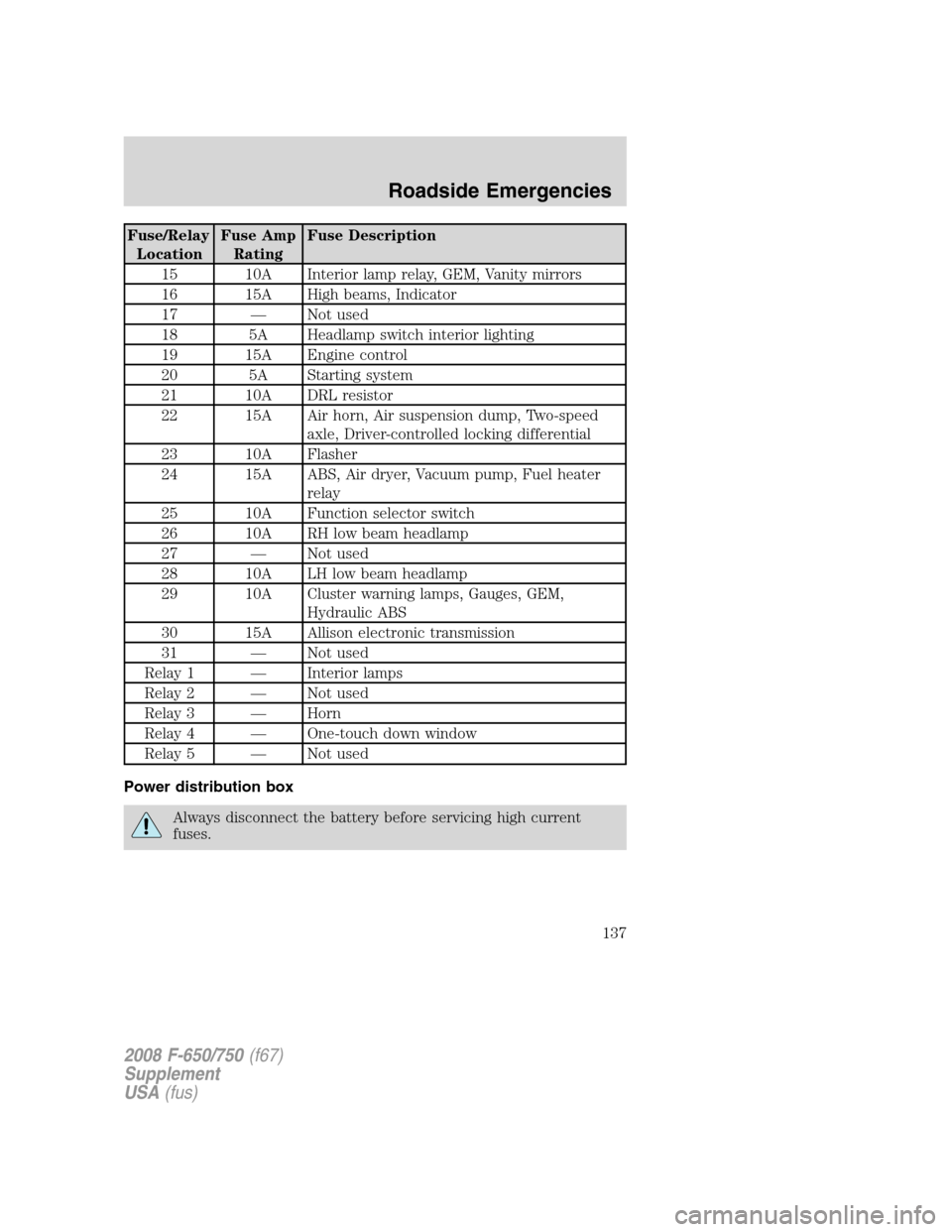
Fuse/Relay
LocationFuse Amp
RatingFuse Description
15 10A Interior lamp relay, GEM, Vanity mirrors
16 15A High beams, Indicator
17 — Not used
18 5A Headlamp switch interior lighting
19 15A Engine control
20 5A Starting system
21 10A DRL resistor
22 15A Air horn, Air suspension dump, Two-speed
axle, Driver-controlled locking differential
23 10A Flasher
24 15A ABS, Air dryer, Vacuum pump, Fuel heater
relay
25 10A Function selector switch
26 10A RH low beam headlamp
27 — Not used
28 10A LH low beam headlamp
29 10A Cluster warning lamps, Gauges, GEM,
Hydraulic ABS
30 15A Allison electronic transmission
31 — Not used
Relay 1 — Interior lamps
Relay 2 — Not used
Relay 3 — Horn
Relay 4 — One-touch down window
Relay 5 — Not used
Power distribution box
Always disconnect the battery before servicing high current
fuses.
2008 F-650/750(f67)
Supplement
USA(fus)
Roadside Emergencies
137
Page 139 of 273
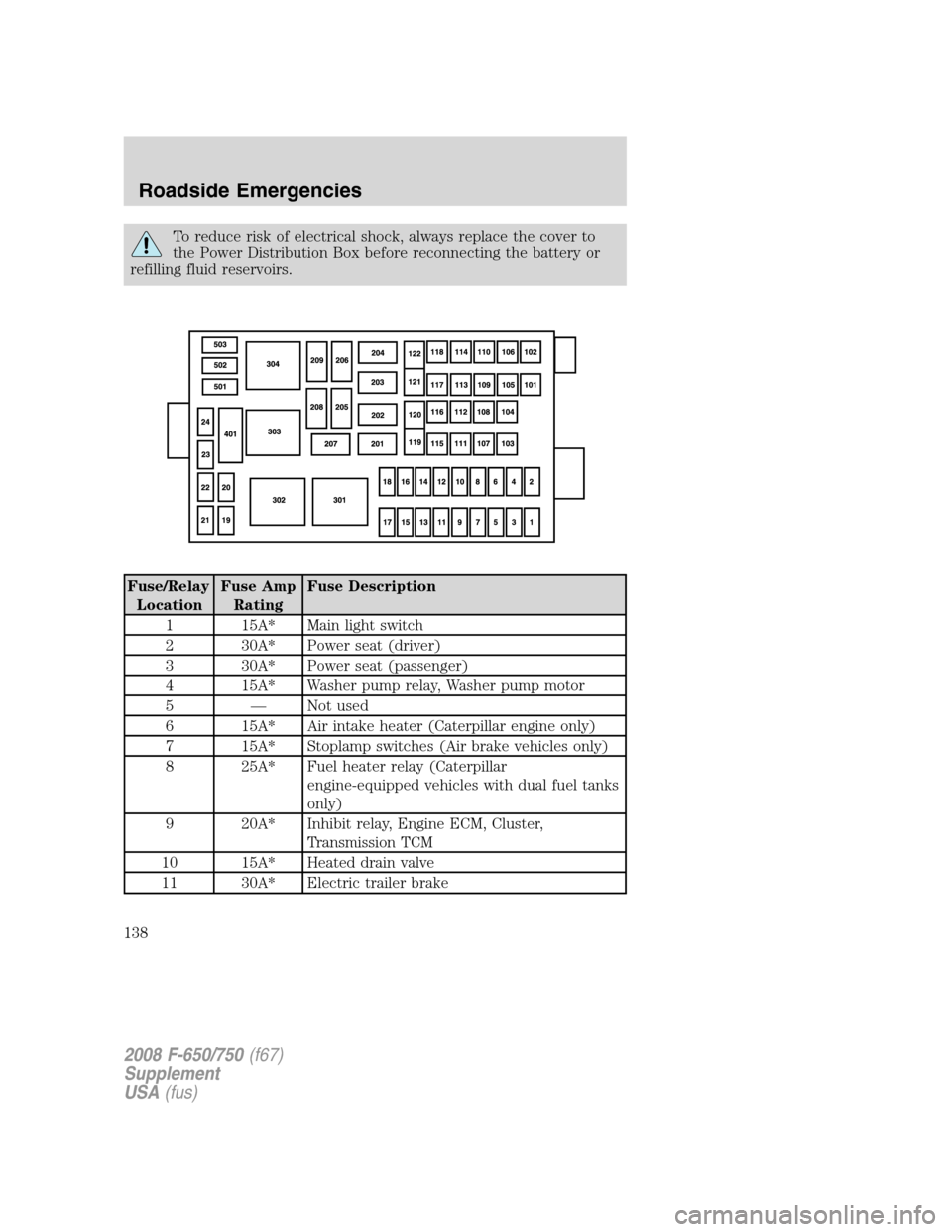
To reduce risk of electrical shock, always replace the cover to
the Power Distribution Box before reconnecting the battery or
refilling fluid reservoirs.
Fuse/Relay
LocationFuse Amp
RatingFuse Description
1 15A* Main light switch
2 30A* Power seat (driver)
3 30A* Power seat (passenger)
4 15A* Washer pump relay, Washer pump motor
5 — Not used
6 15A* Air intake heater (Caterpillar engine only)
7 15A* Stoplamp switches (Air brake vehicles only)
8 25A* Fuel heater relay (Caterpillar
engine-equipped vehicles with dual fuel tanks
only)
9 20A* Inhibit relay, Engine ECM, Cluster,
Transmission TCM
10 15A* Heated drain valve
11 30A* Electric trailer brake
2008 F-650/750(f67)
Supplement
USA(fus)
Roadside Emergencies
138
Page 140 of 273
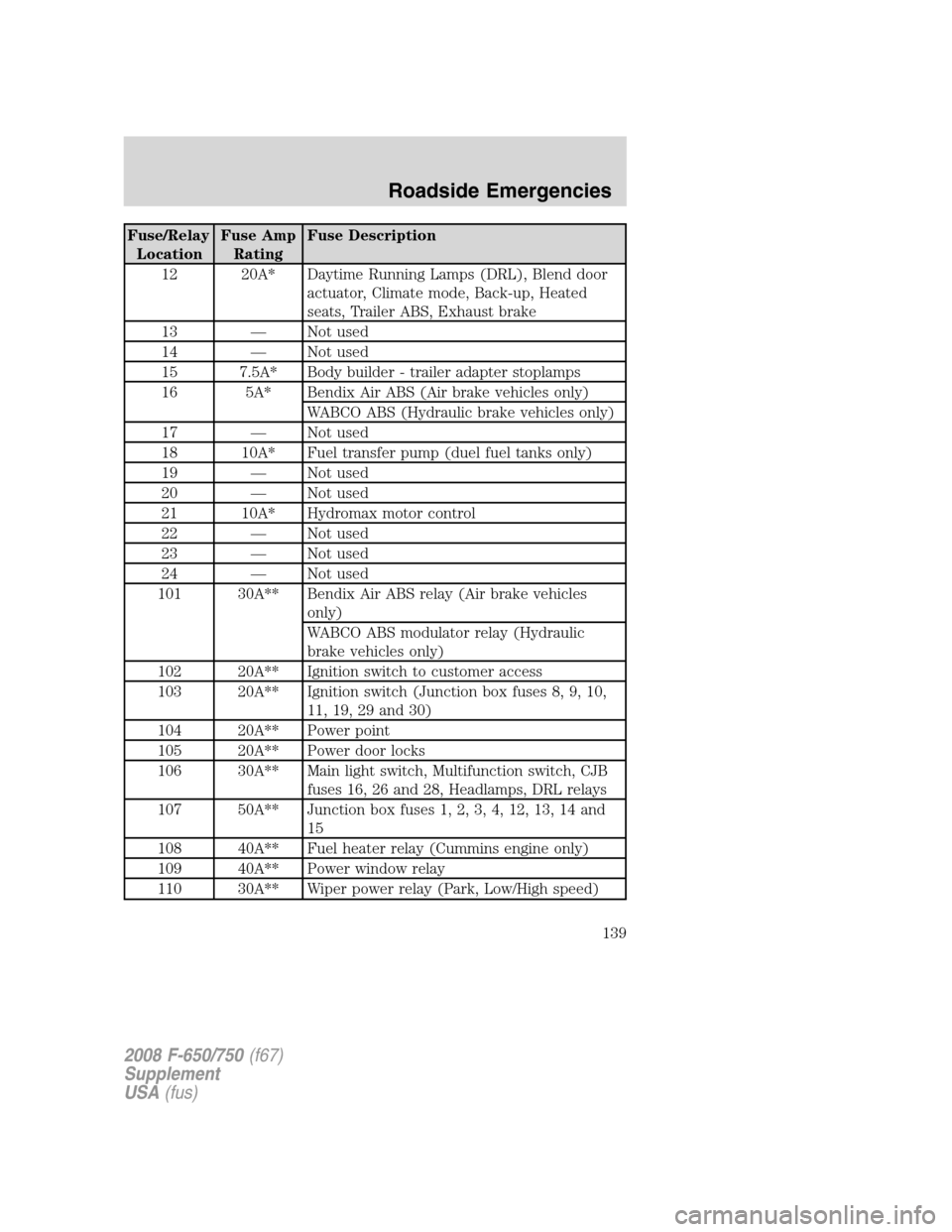
Fuse/Relay
LocationFuse Amp
RatingFuse Description
12 20A* Daytime Running Lamps (DRL), Blend door
actuator, Climate mode, Back-up, Heated
seats, Trailer ABS, Exhaust brake
13 — Not used
14 — Not used
15 7.5A* Body builder - trailer adapter stoplamps
16 5A* Bendix Air ABS (Air brake vehicles only)
WABCO ABS (Hydraulic brake vehicles only)
17 — Not used
18 10A* Fuel transfer pump (duel fuel tanks only)
19 — Not used
20 — Not used
21 10A* Hydromax motor control
22 — Not used
23 — Not used
24 — Not used
101 30A** Bendix Air ABS relay (Air brake vehicles
only)
WABCO ABS modulator relay (Hydraulic
brake vehicles only)
102 20A** Ignition switch to customer access
103 20A** Ignition switch (Junction box fuses 8, 9, 10,
11, 19, 29 and 30)
104 20A** Power point
105 20A** Power door locks
106 30A** Main light switch, Multifunction switch, CJB
fuses 16, 26 and 28, Headlamps, DRL relays
107 50A** Junction box fuses 1, 2, 3, 4, 12, 13, 14 and
15
108 40A** Fuel heater relay (Cummins engine only)
109 40A** Power window relay
110 30A** Wiper power relay (Park, Low/High speed)
2008 F-650/750(f67)
Supplement
USA(fus)
Roadside Emergencies
139
Page 141 of 273
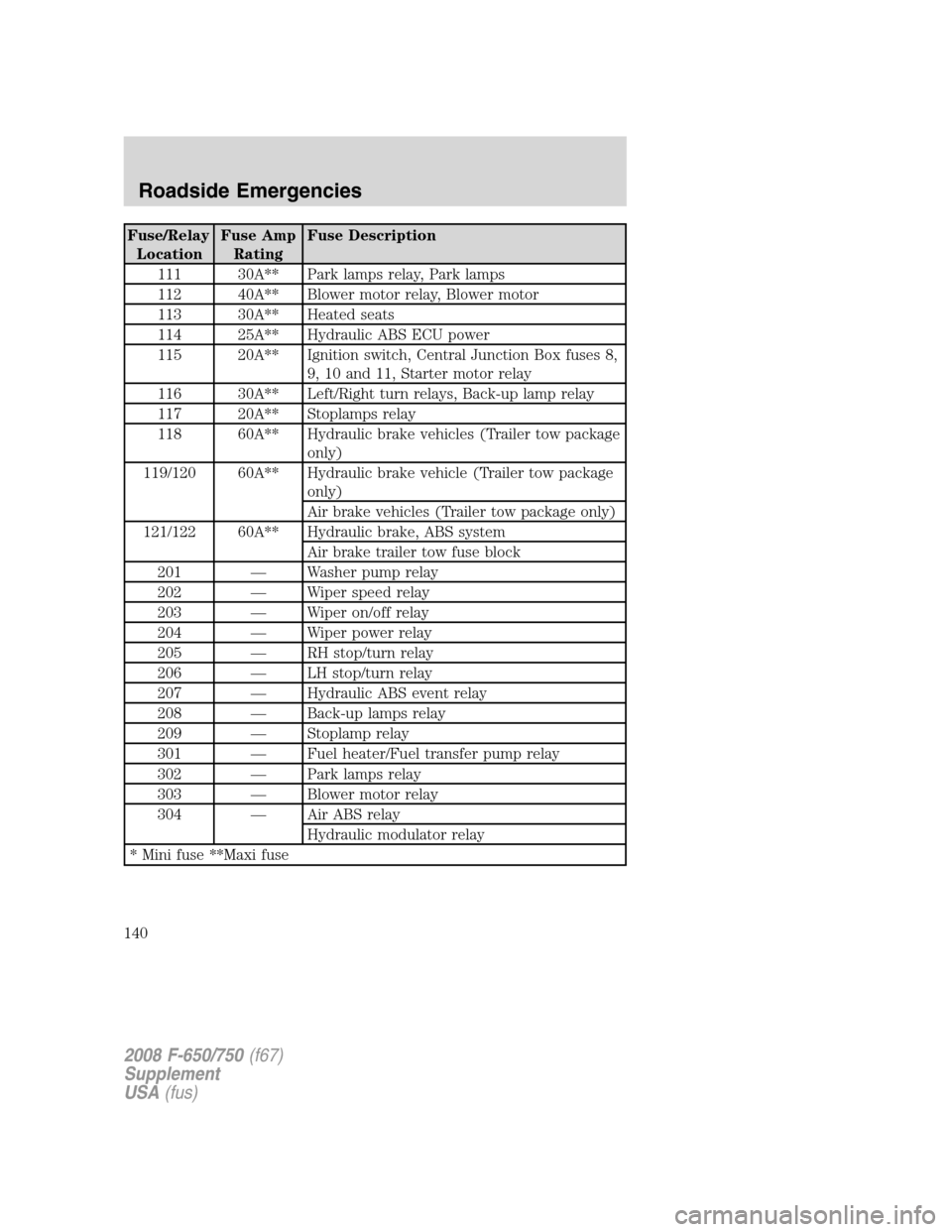
Fuse/Relay
LocationFuse Amp
RatingFuse Description
111 30A** Park lamps relay, Park lamps
112 40A** Blower motor relay, Blower motor
113 30A** Heated seats
114 25A** Hydraulic ABS ECU power
115 20A** Ignition switch, Central Junction Box fuses 8,
9, 10 and 11, Starter motor relay
116 30A** Left/Right turn relays, Back-up lamp relay
117 20A** Stoplamps relay
118 60A** Hydraulic brake vehicles (Trailer tow package
only)
119/120 60A** Hydraulic brake vehicle (Trailer tow package
only)
Air brake vehicles (Trailer tow package only)
121/122 60A** Hydraulic brake, ABS system
Air brake trailer tow fuse block
201 — Washer pump relay
202 — Wiper speed relay
203 — Wiper on/off relay
204 — Wiper power relay
205 — RH stop/turn relay
206 — LH stop/turn relay
207 — Hydraulic ABS event relay
208 — Back-up lamps relay
209 — Stoplamp relay
301 — Fuel heater/Fuel transfer pump relay
302 — Park lamps relay
303 — Blower motor relay
304 — Air ABS relay
Hydraulic modulator relay
* Mini fuse **Maxi fuse
2008 F-650/750(f67)
Supplement
USA(fus)
Roadside Emergencies
140
Page 145 of 273
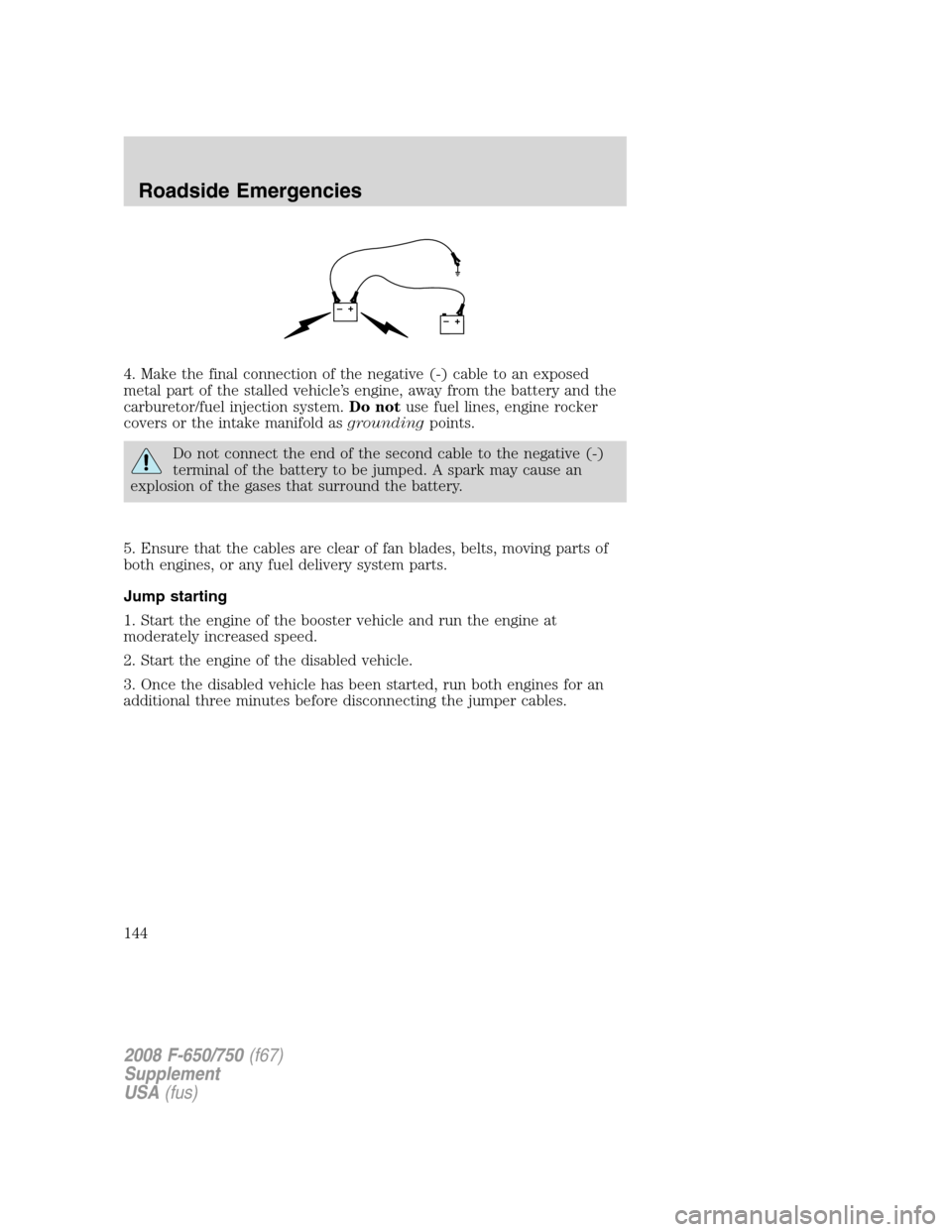
4. Make the final connection of the negative (-) cable to an exposed
metal part of the stalled vehicle’s engine, away from the battery and the
carburetor/fuel injection system.Do notuse fuel lines, engine rocker
covers or the intake manifold asgroundingpoints.
Do not connect the end of the second cable to the negative (-)
terminal of the battery to be jumped. A spark may cause an
explosion of the gases that surround the battery.
5. Ensure that the cables are clear of fan blades, belts, moving parts of
both engines, or any fuel delivery system parts.
Jump starting
1. Start the engine of the booster vehicle and run the engine at
moderately increased speed.
2. Start the engine of the disabled vehicle.
3. Once the disabled vehicle has been started, run both engines for an
additional three minutes before disconnecting the jumper cables.
+–+–
2008 F-650/750(f67)
Supplement
USA(fus)
Roadside Emergencies
144
Page 153 of 273
In the case of 1 or 2 above, the consumer must also notify the
manufacturer of the need for the repair of the nonconformity at the
following address:
Ford Motor Company
16800 Executive Plaza Drive
Mail Drop 3NE-B
Dearborn, MI 48126
GETTING ASSISTANCE OUTSIDE THE U.S AND CANADA
Before exporting your vehicle to a foreign country, contact the
appropriate foreign embassy or consulate. These officials can inform you
of local vehicle registration regulations and where to find diesel fuel.
If you cannot find diesel fuel or can only get fuel with an anti-knock
index lower than is recommended for your vehicle, contact a regional
office or owner relations/customer relationship office.
The use of low quality diesel fuel may affect your emissions control
system and may cause engine damage. Ford Motor Company/Ford of
Canada is not responsible for any damage caused by use of improper
fuel. In the United States, using leaded fuel may also result in difficulty
importing your vehicle back into the U.S.
Ford dealerships outside of the US & Canada may be unable to support
the F–650/750 due to the specialized training and servicing requirements
of these vehicles. If your vehicle must be serviced while you are traveling
or living in Central or South America, the Caribbean, or the Middle East,
contact the nearest Ford dealership. If the dealership cannot help you,
write or call:
FORD MOTOR COMPANY
FORD EXPORT OPERATIONS
1555 Fairlane Drive
Fairlane Business Park #3
Allen Park, Michigan 48101
U.S.A.
Telephone: (313) 594-4857
FAX: (313) 390-0804
If you are in another foreign country, contact the nearest Ford
dealership. If the dealership employees cannot help you, they can direct
you to the nearest Ford affiliate office.
If you buy your vehicle in North America and then relocate outside of
the U.S. or Canada, register your vehicle identification number (VIN) and
new address with Ford Motor Company Export Operations.
2008 F-650/750(f67)
Supplement
USA(fus)
Customer Assistance
152
Page 156 of 273
WASHING THE EXTERIOR
Wash your vehicle regularly with cool or lukewarm water and a neutral
pH shampoo, such as Motorcraft Detail Wash (ZC-3–A), which is
available from your dealer.
•Never use strong household detergents or soap, such as dish washing
or laundry liquid. These products can discolor and spot painted
surfaces.
•Never wash a vehicle that is “hot to the touch” or during exposure to
strong, direct sunlight.
•Always use a clean sponge or car wash mitt with plenty of water for
best results.
•Dry the vehicle with a chamois or soft terry cloth towel in order to
eliminate water spotting.
•It is especially important to wash the vehicle regularly during the
winter months, as dirt and road salt are difficult to remove and cause
damage to the vehicle.
•Immediately remove items such as gasoline, diesel fuel, bird droppings
and insect deposits because they can cause damage to the vehicle’s
paintwork and trim over time.
•Remove any exterior accessories, such as antennas, before entering a
car wash.
•Suntan lotions and insect repellents can damage any painted
surface; if these substances come in contact with your vehicle,
wash off as soon as possible.
WAXING
Applying a polymer paint sealant to your vehicle every six months will
assist in reducing minor scratches and paint damage.
•Wash the vehicle first.
•Do not use waxes that contain abrasives.
•Do not allow paint sealant to come in contact with any non-body
(low-gloss black) colored trim, such as grained door handles, roof
racks, bumpers, side moldings, mirror housings or the windshield cowl
area. The paint sealant will “gray” or stain the parts over time.
2008 F-650/750(f67)
Supplement
USA(fus)
Cleaning
155