power steering FORD F650 2008 11.G Owners Manual
[x] Cancel search | Manufacturer: FORD, Model Year: 2008, Model line: F650, Model: FORD F650 2008 11.GPages: 273, PDF Size: 1.71 MB
Page 2 of 273
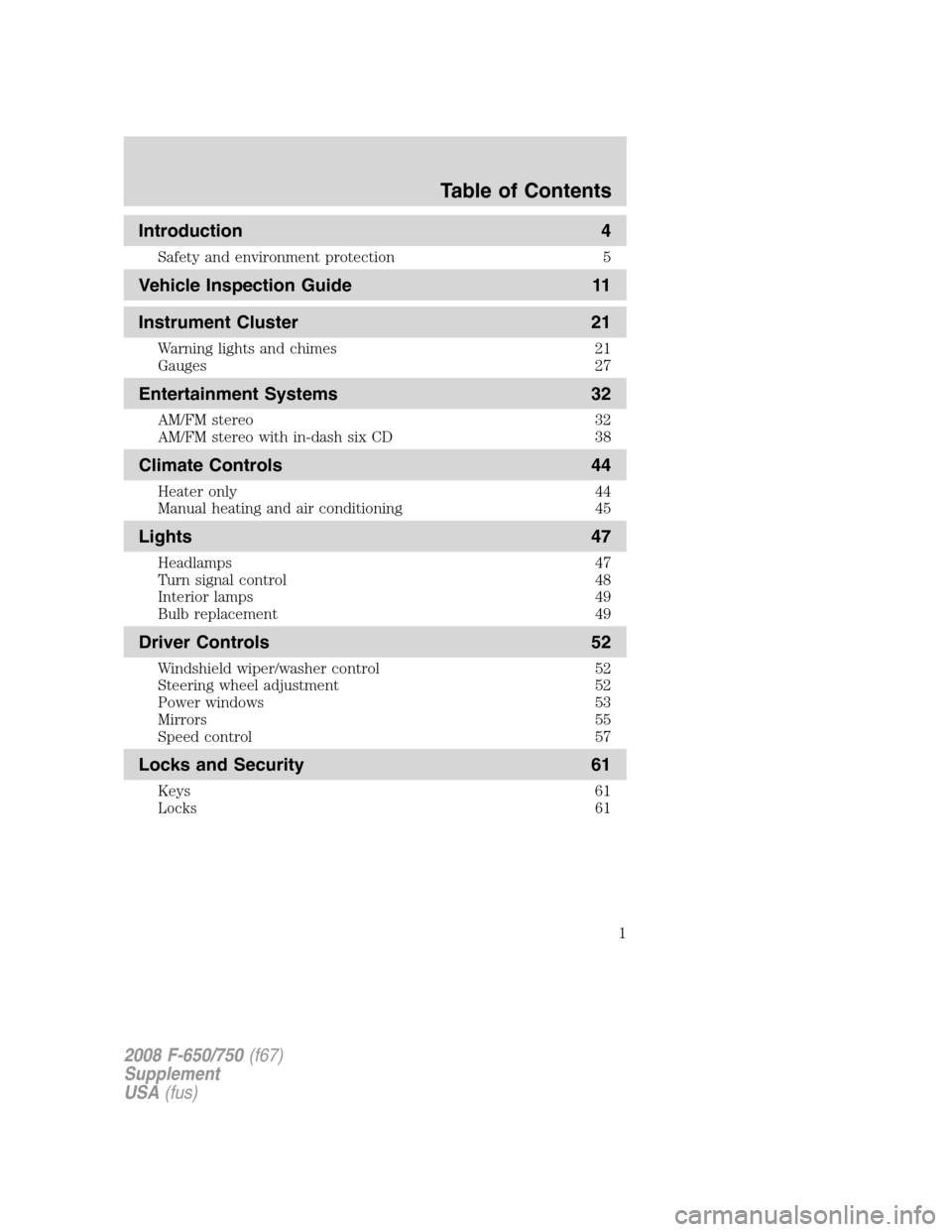
Introduction 4
Safety and environment protection 5
Vehicle Inspection Guide 11
Instrument Cluster 21
Warning lights and chimes 21
Gauges 27
Entertainment Systems 32
AM/FM stereo 32
AM/FM stereo with in-dash six CD 38
Climate Controls 44
Heater only 44
Manual heating and air conditioning 45
Lights 47
Headlamps 47
Turn signal control 48
Interior lamps 49
Bulb replacement 49
Driver Controls 52
Windshield wiper/washer control 52
Steering wheel adjustment 52
Power windows 53
Mirrors 55
Speed control 57
Locks and Security 61
Keys 61
Locks 61
Table of Contents
1
2008 F-650/750(f67)
Supplement
USA(fus)
Page 10 of 273
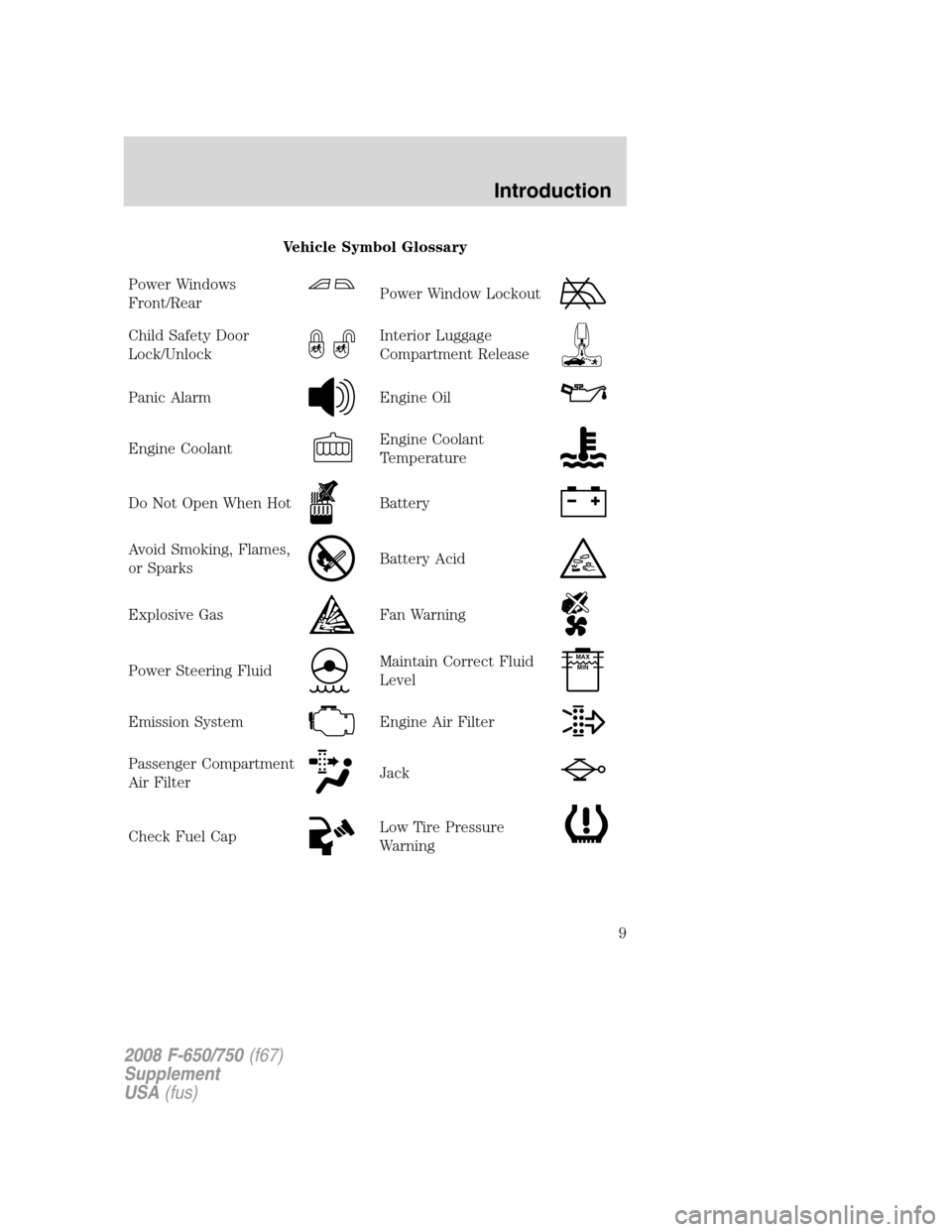
Vehicle Symbol Glossary
Power Windows
Front/Rear
Power Window Lockout
Child Safety Door
Lock/UnlockInterior Luggage
Compartment Release
Panic AlarmEngine Oil
Engine CoolantEngine Coolant
Temperature
Do Not Open When HotBattery
Avoid Smoking, Flames,
or SparksBattery Acid
Explosive GasFan Warning
Power Steering FluidMaintain Correct Fluid
LevelMAX
MIN
Emission SystemEngine Air Filter
Passenger Compartment
Air FilterJack
Check Fuel CapLow Tire Pressure
Warning
2008 F-650/750(f67)
Supplement
USA(fus)
Introduction
9
Page 12 of 273
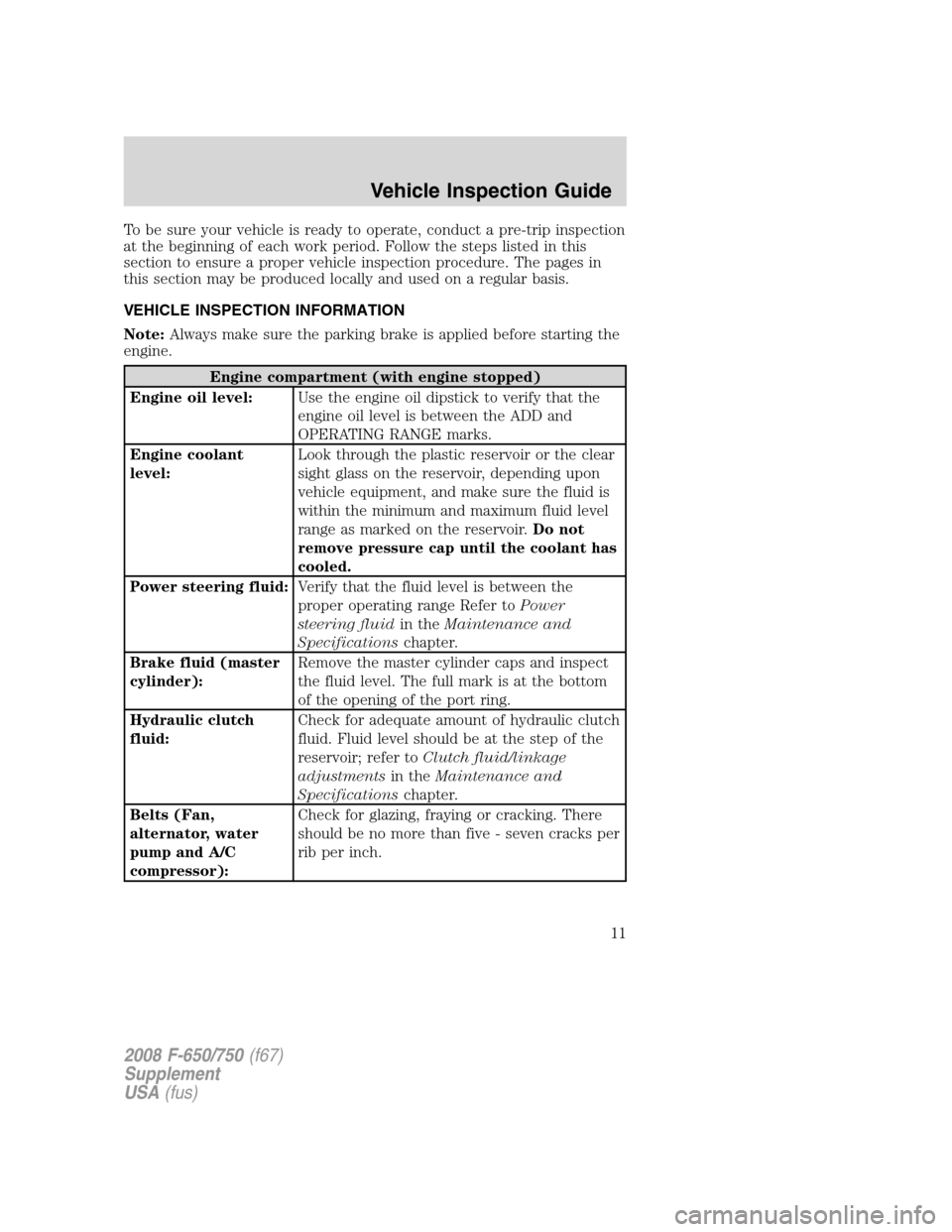
To be sure your vehicle is ready to operate, conduct a pre-trip inspection
at the beginning of each work period. Follow the steps listed in this
section to ensure a proper vehicle inspection procedure. The pages in
this section may be produced locally and used on a regular basis.
VEHICLE INSPECTION INFORMATION
Note:Always make sure the parking brake is applied before starting the
engine.
Engine compartment (with engine stopped)
Engine oil level:Use the engine oil dipstick to verify that the
engine oil level is between the ADD and
OPERATING RANGE marks.
Engine coolant
level:Look through the plastic reservoir or the clear
sight glass on the reservoir, depending upon
vehicle equipment, and make sure the fluid is
within the minimum and maximum fluid level
range as marked on the reservoir.Do not
remove pressure cap until the coolant has
cooled.
Power steering fluid:Verify that the fluid level is between the
proper operating range Refer toPower
steering fluidin theMaintenance and
Specificationschapter.
Brake fluid (master
cylinder):Remove the master cylinder caps and inspect
the fluid level. The full mark is at the bottom
of the opening of the port ring.
Hydraulic clutch
fluid:Check for adequate amount of hydraulic clutch
fluid. Fluid level should be at the step of the
reservoir; refer toClutch fluid/linkage
adjustmentsin theMaintenance and
Specificationschapter.
Belts (Fan,
alternator, water
pump and A/C
compressor):Check for glazing, fraying or cracking. There
should be no more than five - seven cracks per
rib per inch.
2008 F-650/750(f67)
Supplement
USA(fus)
Vehicle Inspection Guide
11
Page 16 of 273
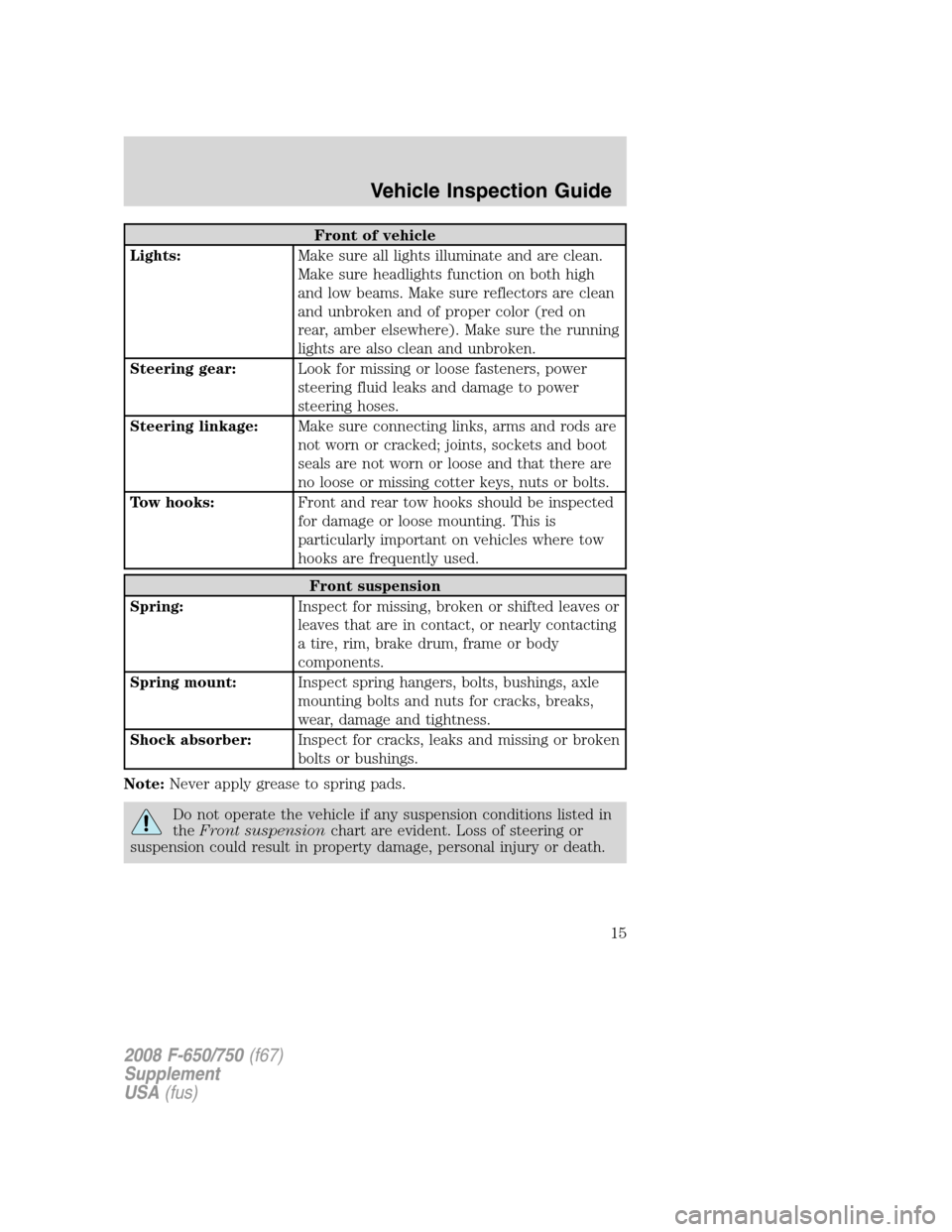
Front of vehicle
Lights:Make sure all lights illuminate and are clean.
Make sure headlights function on both high
and low beams. Make sure reflectors are clean
and unbroken and of proper color (red on
rear, amber elsewhere). Make sure the running
lights are also clean and unbroken.
Steering gear:Look for missing or loose fasteners, power
steering fluid leaks and damage to power
steering hoses.
Steering linkage:Make sure connecting links, arms and rods are
not worn or cracked; joints, sockets and boot
seals are not worn or loose and that there are
no loose or missing cotter keys, nuts or bolts.
Tow hooks:Front and rear tow hooks should be inspected
for damage or loose mounting. This is
particularly important on vehicles where tow
hooks are frequently used.
Front suspension
Spring:Inspect for missing, broken or shifted leaves or
leaves that are in contact, or nearly contacting
a tire, rim, brake drum, frame or body
components.
Spring mount:Inspect spring hangers, bolts, bushings, axle
mounting bolts and nuts for cracks, breaks,
wear, damage and tightness.
Shock absorber:Inspect for cracks, leaks and missing or broken
bolts or bushings.
Note:Never apply grease to spring pads.
Do not operate the vehicle if any suspension conditions listed in
theFront suspensionchart are evident. Loss of steering or
suspension could result in property damage, personal injury or death.
2008 F-650/750(f67)
Supplement
USA(fus)
Vehicle Inspection Guide
15
Page 18 of 273
If a wheel must be changed, obtain expert tire service help.
Mounting and un-mounting of tires should only be performed by
a qualified technician using necessary safety procedures and
equipment, otherwise the result could be property damage, personal
injury or death.
Driver/Fuel area
Fuel tank:Make sure the fuel tank and caps are secure.
Make sure there is no damage to the tank.
Leaks:Check for any leaks from the fuel tanks.
Underbody of vehicle
Driveshaft:Make sure that the driveshaft is not bent or
cracked. Ensure all driveshaft couplings are
secure.
Exhaust system:Make sure the outside visible parts are
securely mounted. Make sure there are no
cracks, holes or severe dents.
Frame:Check for cracks or bends in longitudinal
frame members. Make sure there are no loose,
cracked, bent, broken or missing
crossmembers or crossmember fasteners.
Maintain adequate clearance between all parts of the exhaust
system and all hoses, wires and lines for engine cooling, brake
system, fuel system, power steering system and electrical system, Heat
damage to hoses, wires or lines may cause vehicle malfunction that
could result in property damage, personal injury or death.
2008 F-650/750(f67)
Supplement
USA(fus)
Vehicle Inspection Guide
17
Page 54 of 273
Never adjust the steering wheel when the vehicle is moving.
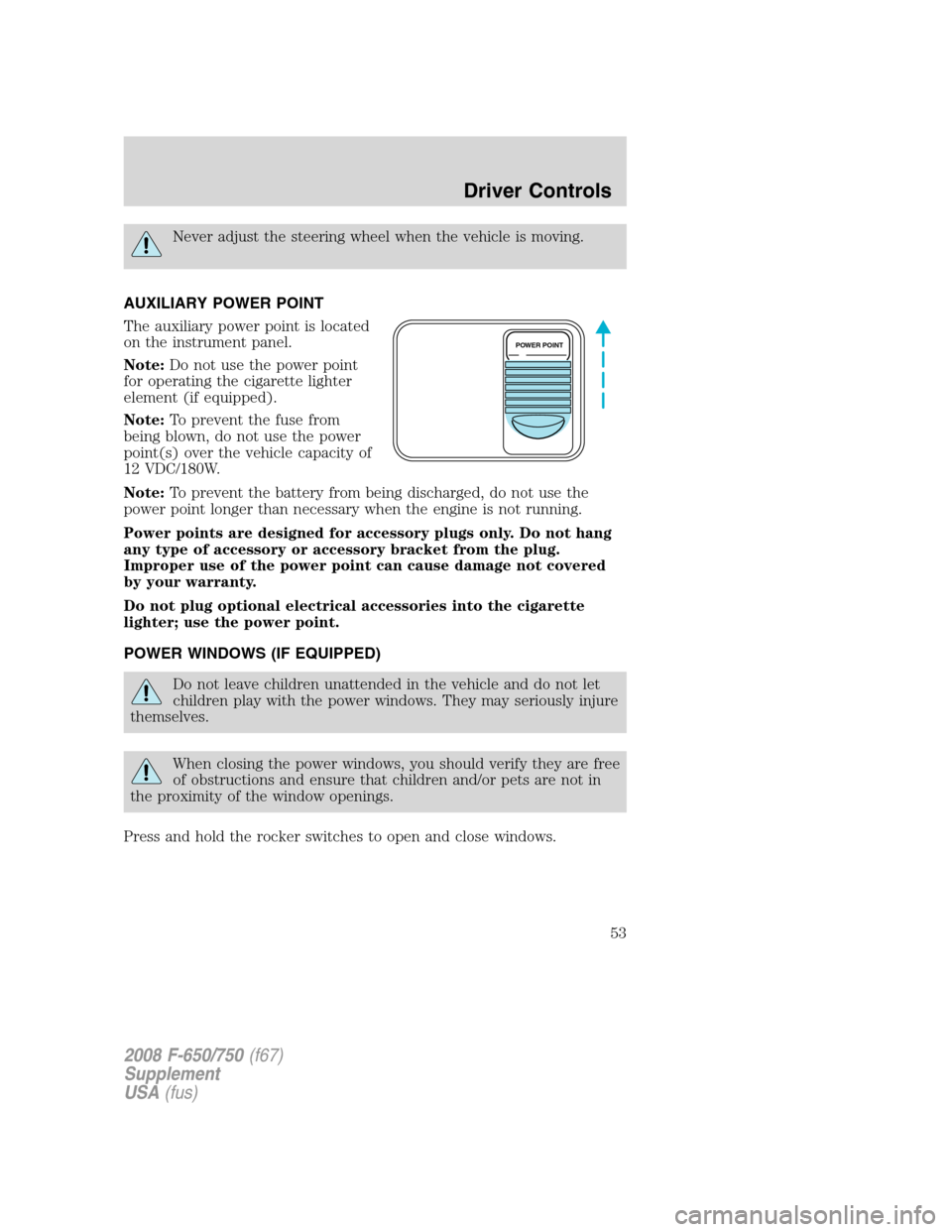
AUXILIARY POWER POINT
The auxiliary power point is located
on the instrument panel.
Note:Do not use the power point
for operating the cigarette lighter
element (if equipped).
Note:To prevent the fuse from
being blown, do not use the power
point(s) over the vehicle capacity of
12 VDC/180W.
Note:To prevent the battery from being discharged, do not use the
power point longer than necessary when the engine is not running.
Power points are designed for accessory plugs only. Do not hang
any type of accessory or accessory bracket from the plug.
Improper use of the power point can cause damage not covered
by your warranty.
Do not plug optional electrical accessories into the cigarette
lighter; use the power point.
POWER WINDOWS (IF EQUIPPED)
Do not leave children unattended in the vehicle and do not let
children play with the power windows. They may seriously injure
themselves.
When closing the power windows, you should verify they are free
of obstructions and ensure that children and/or pets are not in
the proximity of the window openings.
Press and hold the rocker switches to open and close windows.
POWER POINT
2008 F-650/750(f67)
Supplement
USA(fus)
Driver Controls
53
Page 93 of 273
If brakes do not grip well
•If you have been driving through deep water, gently apply the brakes
several times while the vehicle is moving slowly.
•Let the brakes cool if you have been using them excessively, as in
mountain driving or after several fast, high speed stops.
•Check brake adjustment.
•Check brake linings for excessive wear.
•Check system air pressure. (Air brakes only)
HYDRAULIC BRAKES (IF EQUIPPED)
HydroMax brake booster system
The HydroMax systems receive fluid pressure from the power steering
pump to provide power assist during braking.
The HydroMax booster receives back-up pressure from the reserve
system electric pump whenever the fluid in the power steering system is
not flowing. When the engine is off, the pump will turn on if the brake
pedal is applied, or if the ignition is turned to the ON position.
The sound of the pump operating or fluid flowing through the booster
may be heard; this is a normal characteristic of the system and should be
no reason for concern.
The reserve system provides reduced braking power, so the vehicle
should be operated under these conditions with caution, and only to seek
service repair and remove the vehicle from the roadway.
If braking performance or pedal response becomes very poor, even when
the pedal is strongly applied, this may indicate the presence of air in the
hydraulic system or fluid leakage. Stop the vehicle safely as soon as
possible and seek service immediately.
If the red BRAKE warning lamp in
the instrument cluster remains
illuminated after engine start up,
this indicates a system failure in the
master cylinder of the brake system. Stop the vehicle safely as soon as
possible and seek service immediately.
2008 F-650/750(f67)
Supplement
USA(fus)
Driving
92
Page 126 of 273
Some Dana/Spicer drive axles have a driver-controlled differential lock.
The differential lock can lock or unlock the differential when the vehicle
is moving or stopped. When extra traction is required, the differential
lock will provide full power to both axles.
When the differential is locked, the vehicle’s turning radius will increase
(vehicle will “under-steer”)
The differential can be locked or unlocked when the vehicle is moving at
a constant speed of less than 25 mph (40 km/h) and while the wheels
are not slipping. The differential must not be locked when the vehicle is
traveling down steep grades and traction is minimal.
Note:Never use the differential lock at vehicle speeds above 25 mph
(40 km/h).
Note:The driver-controlled differential lock function will vary with some
transmissions.
•Vehicles equipped with an Allison 3000 Series transmission:The
differential lock and differential lock light will automatically disengage
at speeds above 25 mph (40 km/h). The differential lock will remain
off until either the vehicle is restarted or the differential lock switch is
turned off then back on.
•Vehicles equipped with a 5–speed, 6–speed or 7–speed manual:
The differential lock and differential lock light will automatically
disengage at speeds above 25 mph (40 km/h). The differential lock
will remain off until either the vehicle is restarted or the differential
lock switch is turned off then back on.
Axle conversions
It is not recommended, or approved, for axle conversions to be
performed. However, it is understood that, on occasion, aftermarket
add-on axles are installed by others on the truck chassis which allow
operator control for weight transfer from other axles (i.e., air lift axles).
When operating a loaded vehicle, the driver must keep all
adjustable axles on the ground at all times, supporting their
share of the vehicle’s load. Failure to do so can overload other axles,
tires, wheels, springs, steering components, brakes and frames,
resulting in early component failure, loss of vehicle control, possible
property damage and personal injury.
TWO-SPEED REAR AXLE (IF EQUIPPED)
A two-speed rear axle allows the driver to select a LO range for greater
pulling power and a HI range for greater road speed and fuel economy.
2008 F-650/750(f67)
Supplement
USA(fus)
Driving
125
Page 167 of 273
Note:If brake fluid requires attention to maintain a proper master
cylinder level, this is an indication of either severe operation (pad wear)
or fluid system leakage. A more frequent and thorough brake inspection
will be required.
Hydraulic brakes - fluid precautions
The HydroMax brake system consists of two completely separate
hydraulic systems operating with two different and incompatible fluids;
power steering fluid and hydraulic brake fluid. Failure to observe
precautions preventing the contamination of either system with fluid
from the other will result in swelling and deterioration of rubber parts
leading to reduced brake performance and eventual brake failure.
To avoid fluid contamination, the following should always be observed:
1. Use only fluids specified (or equivalent) and properly identified.
2. Add fluids only to the following locations:
•Power steering fluid to the power steering fluid pump reservoir
•Brake fluid to the brake master cylinder
Hydraulic brakes - brake lines, hoses and fittings
Inspect these components every 4,000 miles (6,400 km).
•Check lines for kinks, dents, corrosion or rupture.
•Check hoses for abrasions, kinks, soft spots or rupture, collapse,
cracks, twists or loose frame supports. When replacing a hose, be sure
there is adequate clearance to the hose to avoid an abrasion to the
new hose.
•Examine all connections for leaks.
•Repair or replace brake line tubes, hoses or fittings as required.
Driveline parking brake
Parking brake adjustment should only be performed by a qualified
technician, and in accordance with the instructions in the service
manual.
Use wheel chocks and exercise caution when inspecting under
the vehicle. A vehicle roll-away could result in property damage,
personal injury or death.
Catalytic converter
If your diesel engine is equipped with a catalytic converter, it is
important to review the maintenance schedule to ensure proper
2008 F-650/750(f67)
Supplement
USA(fus)
Maintenance and Specifications
166
Page 169 of 273
•Maintain proper steering gear and power steering pump lubricant
levels.
•Regularly inspect steering column joint bolts and steering linkage,
particularly for body-to-chassis clearance.
Note:Have any steering problems corrected at once by a qualified
service technician.
Failure to maintain the steering system in proper condition can
cause reduced steering ability resulting in property damage,
personal injury or death.
Tightening steering column joint bolts
As a good maintenance practice, it is recommended that steering column
joint bolts be checked for tightness every 60,000 miles (96,000 km) or
annually, whichever occurs first. DO NOT OVERTIGHTEN.
Power steering
Whenever the power steering’s hydraulic system has been drained and
refilled for any reason, air must be bled from the system before returning
the vehicle to service. Failure to properly bleed the hydraulic system can
result in degradation of power system performance.
Consult your dealer who is aware of the proper procedures for filling and
bleeding the system.
OPENING THE HOOD
The hood and fenders are held in position by a latch located on each
fender.
The parking brake must be fully set before opening the hood or
possible personal injury may occur.
To reduce the risk of the possibility of personal injury, never
stand beneath the hood when it is being raised or lowered.
If you must leave the engine running while checking under the
hood, do not allow any loose clothing, jewelry, hair or other
items to get near moving engine components or possible personal
injury may occur.
2008 F-650/750(f67)
Supplement
USA(fus)
Maintenance and Specifications
168