weight FORD F650 2010 12.G User Guide
[x] Cancel search | Manufacturer: FORD, Model Year: 2010, Model line: F650, Model: FORD F650 2010 12.GPages: 274, PDF Size: 1.51 MB
Page 136 of 274
MAXIMUM VEHICLE LOADING
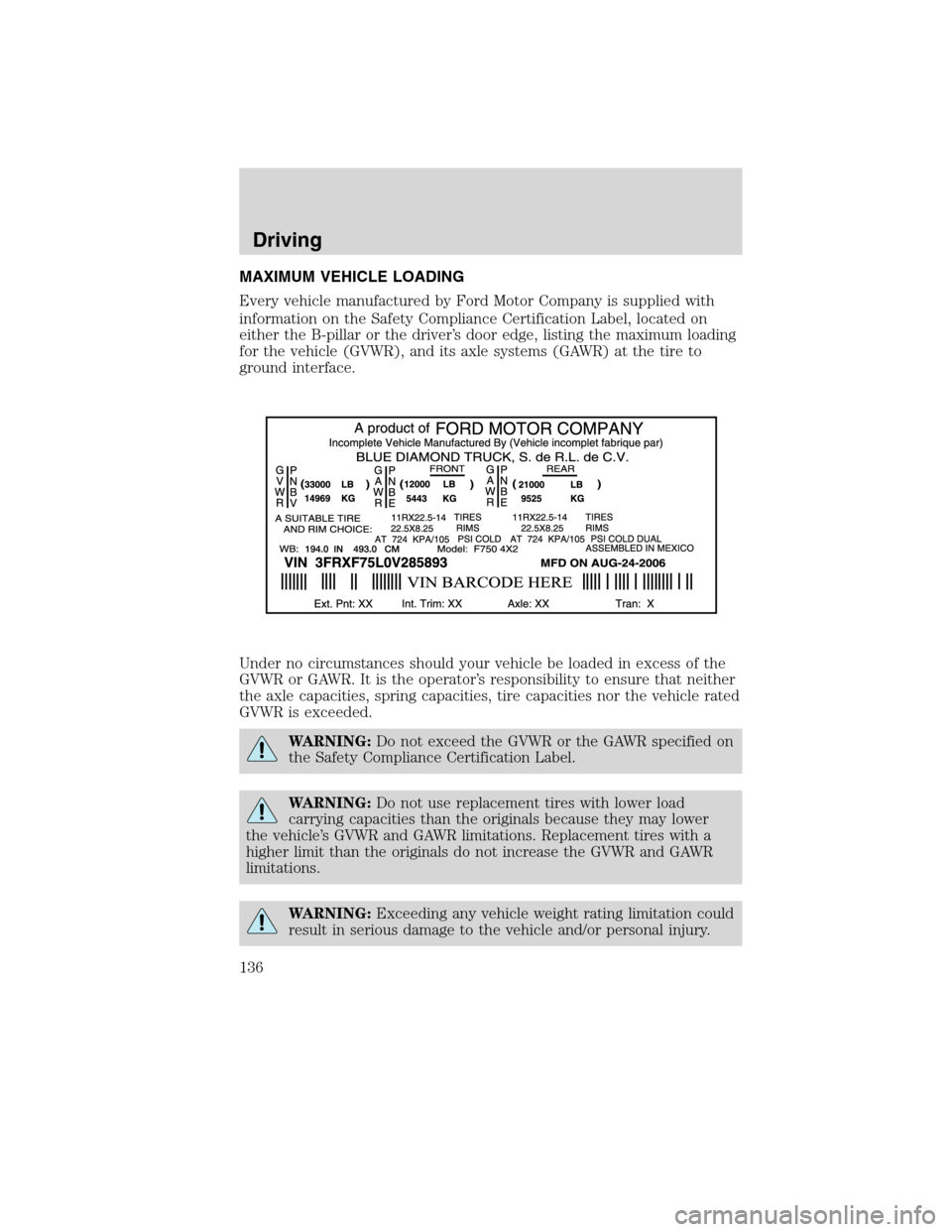
Every vehicle manufactured by Ford Motor Company is supplied with
information on the Safety Compliance Certification Label, located on
either the B-pillar or the driver’s door edge, listing the maximum loading
for the vehicle (GVWR), and its axle systems (GAWR) at the tire to
ground interface.
Under no circumstances should your vehicle be loaded in excess of the
GVWR or GAWR. It is the operator’s responsibility to ensure that neither
the axle capacities, spring capacities, tire capacities nor the vehicle rated
GVWR is exceeded.
WARNING:Do not exceed the GVWR or the GAWR specified on
the Safety Compliance Certification Label.
WARNING:Do not use replacement tires with lower load
carrying capacities than the originals because they may lower
the vehicle’s GVWR and GAWR limitations. Replacement tires with a
higher limit than the originals do not increase the GVWR and GAWR
limitations.
WARNING:Exceeding any vehicle weight rating limitation could
result in serious damage to the vehicle and/or personal injury.
Driving
136
2010 F-650/750(f67)
Supplement(supplement), 1st Printing
USA(fus)
Page 137 of 274
Unloaded or lightly loaded vehicles
The braking system has been designed to safely stop your vehicle when
fully loaded to its GVWR.
WARNING:When operating empty or lightly loaded, sudden or
hard braking may induce wheel lockup with loss of vehicle
control and the possibility of accident and serious injury, especially on
wet or slippery road surfaces.
TRAILER TOWING
Towing a trailer places an additional load on your vehicle’s engine,
transmission, axle, brakes, tires and suspension. Inspect these
components carefully prior to and after any towing operation.
Your vehicle’s load capacity is designated by weight, not by volume, so
you cannot necessarily use all available space when loading a vehicle.
2nd unit bodies are not included in maximum trailer weight ratings. The
weight of the additional “body” must be subtracted from the maximum
trailer weight.
Note:Do not exceed the GVWR or the GAWR specified on the
certification label.
WARNING:Towing trailers beyond the maximum recommended
gross trailer weight exceeds the limit of the vehicle and could
result in engine damage, transmission damage, structural damage, loss
of vehicle control, vehicle rollover and personal injury.
Model Maximum
GVWR - lb.
(kg)Maximum
GCWR - lb.
(kg)*
F-650 Regular/Super/Crew Cab 26000 (11793) 40000 (18143)
F-750 Regular/Super/Crew Cab 30000 (13608) 45000 (20412)
F-750 Regular/Super/Crew Cab 33000 (14969) 60000 (27216)
* Figures shown are the maximum available for each model. Actual
ratings may be less, depending on your transmission. Check with your
sales consultant for the exact rating on your vehicle.
Preparing to tow
Use the proper equipment for towing a trailer and make sure it is
properly attached to your vehicle. See your dealer or a reliable trailer
dealer if you require assistance.
Driving
137
2010 F-650/750(f67)
Supplement(supplement), 1st Printing
USA(fus)
Page 138 of 274
Hitches
Do not use hitches that clamp onto the vehicle’s bumper or attach to the
axle. You must distribute the load in your trailer so that 10–15% of the
total weight of the trailer is on the tongue.
Safety chains
Always connect the trailer’s safety chains to the frame or hook retainers
of the vehicle hitch. To connect the trailer’s safety chains, cross the
chains under the trailer tongue and allow slack for turning corners.
If you use a rental trailer, follow the instructions that the rental agency
gives to you.
Do not attach safety chains to the bumper.
Trailer brakes
Electric brakes and manual, automatic or surge-type trailer brakes are
safe if installed properly and adjusted to the manufacturer’s
specifications. The trailer brakes must meet local and Federal
regulations.
WARNING:Do not connect a trailer’s hydraulic brake system
directly to your vehicle’s brake system. Your vehicle may not
have enough braking power and your chances of having a collision
greatly increase.
Trailer lamps
Trailer lamps are required on most towed vehicles. Your vehicle may be
equipped with one of two possible trailer wiring designs. Make sure all
running lights, brake lights, turn signals and hazard lights are working.
See your dealer or trailer rental agency for proper instructions and
equipment for hooking up trailer lamps.
Driving while you tow
When towing a trailer:
•Keep your speed no faster than 70 mph (112 km/h) during the first
500 miles (800 km) of towing a trailer, and don’t make full throttle
starts.
•Turn off the speed control. The speed control may shut off
automatically when you are towing on long, steep grades.
•Consult your local motor vehicle speed regulations for towing a trailer.
Driving
138
2010 F-650/750(f67)
Supplement(supplement), 1st Printing
USA(fus)
Page 139 of 274
•To eliminate excessive transmission shifting, use a lower gear. This will
also assist in transmission cooling.
•Anticipate stops and brake gradually.
•Do not exceed the GCWR rating or transmission damage may occur.
Servicing after towing
If you tow a trailer for long distances, your vehicle will require more
frequent service intervals. Refer to yourScheduled Maintenance Guide
for more information.
Trailer towing tips
•Practice turning, stopping and backing up before starting on a trip to
get the feel of the vehicle trailer combination. When turning, make
wider turns so the trailer wheels will clear curbs and other obstacles.
•Allow more distance for stopping with a trailer attached.
•If you are driving down a long or steep hill, shift to a lower gear. Do
not apply the brakes continuously, as they may overheat and become
less effective.
•The trailer tongue weight should be 10–15% of the loaded trailer
weight.
•If you will be towing a trailer frequently in hot weather, hilly
conditions, at GCW, or any combination of these factors, consider
refilling your rear axle with synthetic gear lube if not already so
equipped. Refer toLubricant specificationsin theMaintenance and
Specificationschapter for the lubricant specification. Remember that
regardless of the rear axle lube used, do not tow a trailer for the first
500 miles (800 km) of a new vehicle, and that the first 500 miles
(800 km) of towing be done at no faster than 70 mph (112 km/h) with
no full throttle starts.
•After you have traveled 50 miles (80 km), thoroughly check your
hitch, electrical connections and trailer wheel lug nuts.
•To aid in engine/transmission cooling and A/C efficiency during hot
weather while stopped in traffic, place the gearshift lever in P (Park)
(if available on your automatic transmission) or N (Neutral) (manual
transmissions and automatic transmissions withoutaP[Park]
position).
•Vehicles with trailers should not be parked on a grade. If you must
park on a grade, place wheel chocks under the trailer’s wheels.
Driving
139
2010 F-650/750(f67)
Supplement(supplement), 1st Printing
USA(fus)
Page 141 of 274

6. Set the tractor parking brakes and fully raise the trailer landing gear.
Refer toBrakesin this chapter for proper operation of the parking brake
and trailer brakes.
7. Check the operation of all trailer lights and correct any lights that may
be faulty.
Un-hook
1. Try to keep the tractor and trailer in a straight line.
2. Apply the parking brakes.
3. Lower the trailer landing gear, making sure it is on solid, level ground.
The weight of the trailer is to be on the landing gear.
4. Block the trailer wheels.
5. Disconnect the brake hoses and light cords. Be sure hoses and cords
are clear.
6. Pull coupler release lever to disengage the fifth wheel jaws.
7. Release the tractor parking brakes.
8. Pull out from the trailer slowly, allowing the landing gear to take the
load gradually.
Driving
141
2010 F-650/750(f67)
Supplement(supplement), 1st Printing
USA(fus)
Page 190 of 274
Habits
•Smooth, moderate operation can yield up to 10% savings in fuel.
•Steady speeds without stopping will usually give the best fuel
economy.
•Anticipate stopping; slowing down may eliminate the need to stop.
•Sudden or hard accelerations may reduce fuel economy.
•Slow down gradually.
•Driving at reasonable speeds (traveling at 55 mph [88 km/h] uses 15%
less fuel than traveling at 65 mph [105 km/h]).
•Using the air conditioner or defroster may reduce fuel economy.
•Resting your foot on the brake pedal while driving may reduce fuel
economy.
Conditions
•Carrying unnecessary weight may reduce fuel economy.
•Fuel economy may decrease with lower temperatures during the first
8–10 miles (12–16 km) of driving.
•Flat terrain driving improves fuel economy over hilly roads.
•Transmissions give their best fuel economy when operated in the top
cruise gear and with steady pressure on the accelerator.
•Close windows for highway driving.
DIESEL PARTICULATE FILTER (DPF)
Your vehicle is equipped with a diesel particulate filter (DPF), as part of
the after-treatment exhaust system, to trap soot and other large particles
produced by the engine combustion process. The soot that accumulates
in the filter must be periodically reduced to ash to prevent excessive
exhaust restriction. The soot reduction process, also known as “filter
regeneration,” is generally performed automatically by your engine and
after-treatment system.
WARNING:The normal operating temperature of the exhaust
system is very high. Never work around, or attempt to repair,
any part of the exhaust system until it has cooled. Use special care
when working around the diesel particulate filter. The DPF heats up to
a high temperature after only a short period of engine operation, and
can remain hot even after the engine is turned off. Failure to follow
these instructions may result in serious personal injury.
Maintenance and Specifications
190
2010 F-650/750(f67)
Supplement(supplement), 1st Printing
USA(fus)
Page 205 of 274
5. The lubricant level should be up to the bottom of the filler plug
opening.
6. If necessary, add enough lubricant through the filler plug opening so
that the lubricant level is at the bottom of the opening.
7. Clean and install the filler plug securely.
Draining and refilling the rear axle lubricant
1. Drain the rear axle while the lubricant is warm.
2. Park the vehicle on level ground.
3. Set the parking brake and shift into N (Neutral) (automatic
transmission) or 1 (First) (manual transmission) and turn the engine off.
4. Clean any dirt from around the rear axle filler and drain plugs.
5. Remove the filler and drain plugs and drain the lubricant into a
suitable container. Dispose of all used automotive fluids in a responsible
manner following your local authorized standards.
6. Clean and install the drain plug securely.
7. Add enough lubricant through the filler plug opening so that the
lubricant level is up to the bottom of the opening.
8. Clean and install the filler plug securely.
WHEELS
General
Wheel bearings should be inspected, lubricated and adjusted at regular
intervals. This is especially important if operating in deep sand, mud, or
water. Refer toLubricant specificationsin this chapter.
When installing wheel balance weights, they must be mounted on the
dome-side of the wheel only. Failure to do so may result in loss of wheel
weight and/or damage to brakes or wheels.
Important:Remember to replace the wheel air valves when the road
tires are replaced at the end of their useful life.
Maintenance and Specifications
205
2010 F-650/750(f67)
Supplement(supplement), 1st Printing
USA(fus)
Page 225 of 274
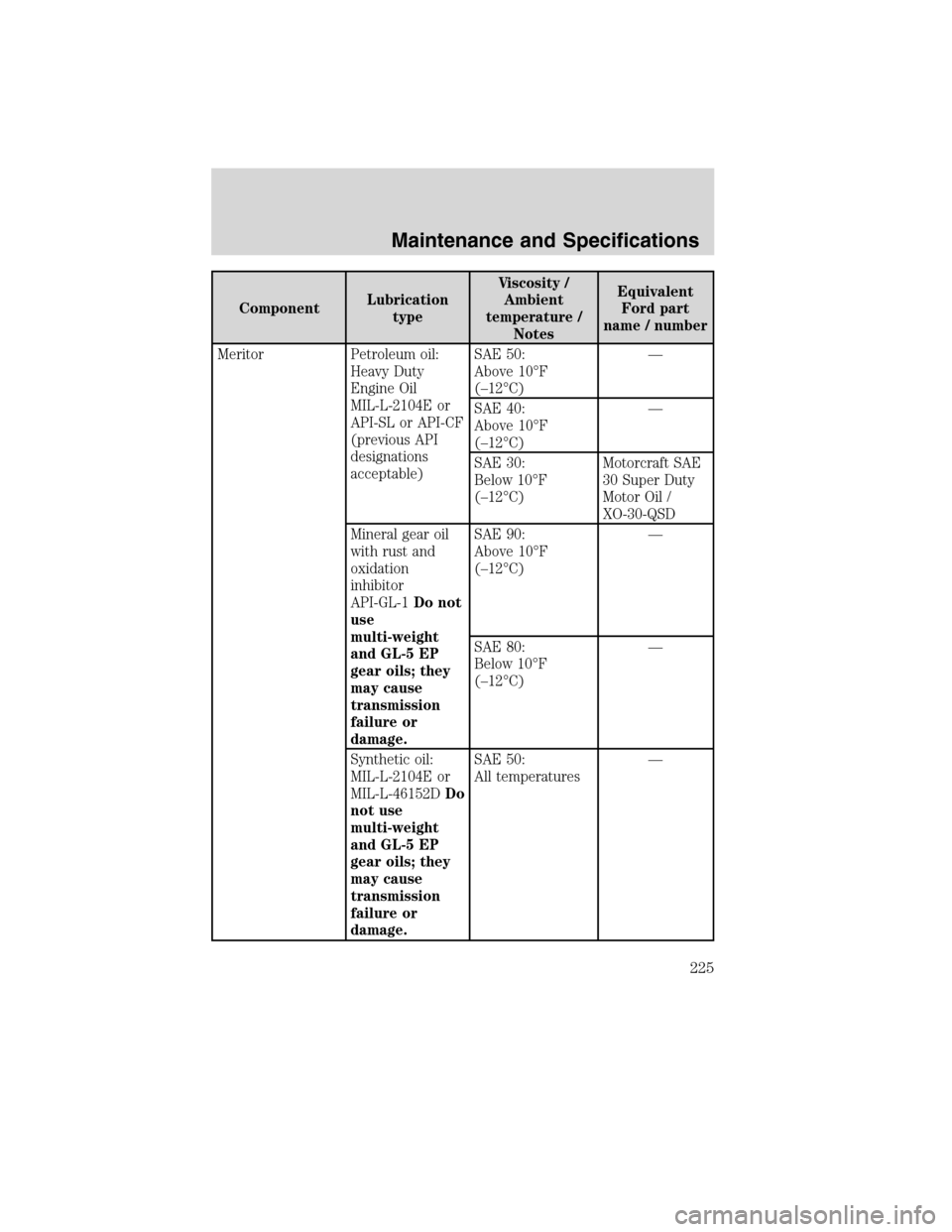
ComponentLubrication
typeViscosity /
Ambient
temperature /
NotesEquivalent
Ford part
name / number
Meritor Petroleum oil:
Heavy Duty
Engine Oil
MIL-L-2104E or
API-SL or API-CF
(previous API
designations
acceptable)SAE 50:
Above 10°F
(–12°C)—
SAE 40:
Above 10°F
(–12°C)—
SAE 30:
Below 10°F
(–12°C)Motorcraft SAE
30 Super Duty
Motor Oil /
XO-30-QSD
Mineral gear oil
with rust and
oxidation
inhibitor
API-GL-1Do not
use
multi-weight
and GL-5 EP
gear oils; they
may cause
transmission
failure or
damage.SAE 90:
Above 10°F
(–12°C)—
SAE 80:
Below 10°F
(–12°C)—
Synthetic oil:
MIL-L-2104E or
MIL-L-46152DDo
not use
multi-weight
and GL-5 EP
gear oils; they
may cause
transmission
failure or
damage.SAE 50:
All temperatures—
Maintenance and Specifications
225
2010 F-650/750(f67)
Supplement(supplement), 1st Printing
USA(fus)
Page 230 of 274
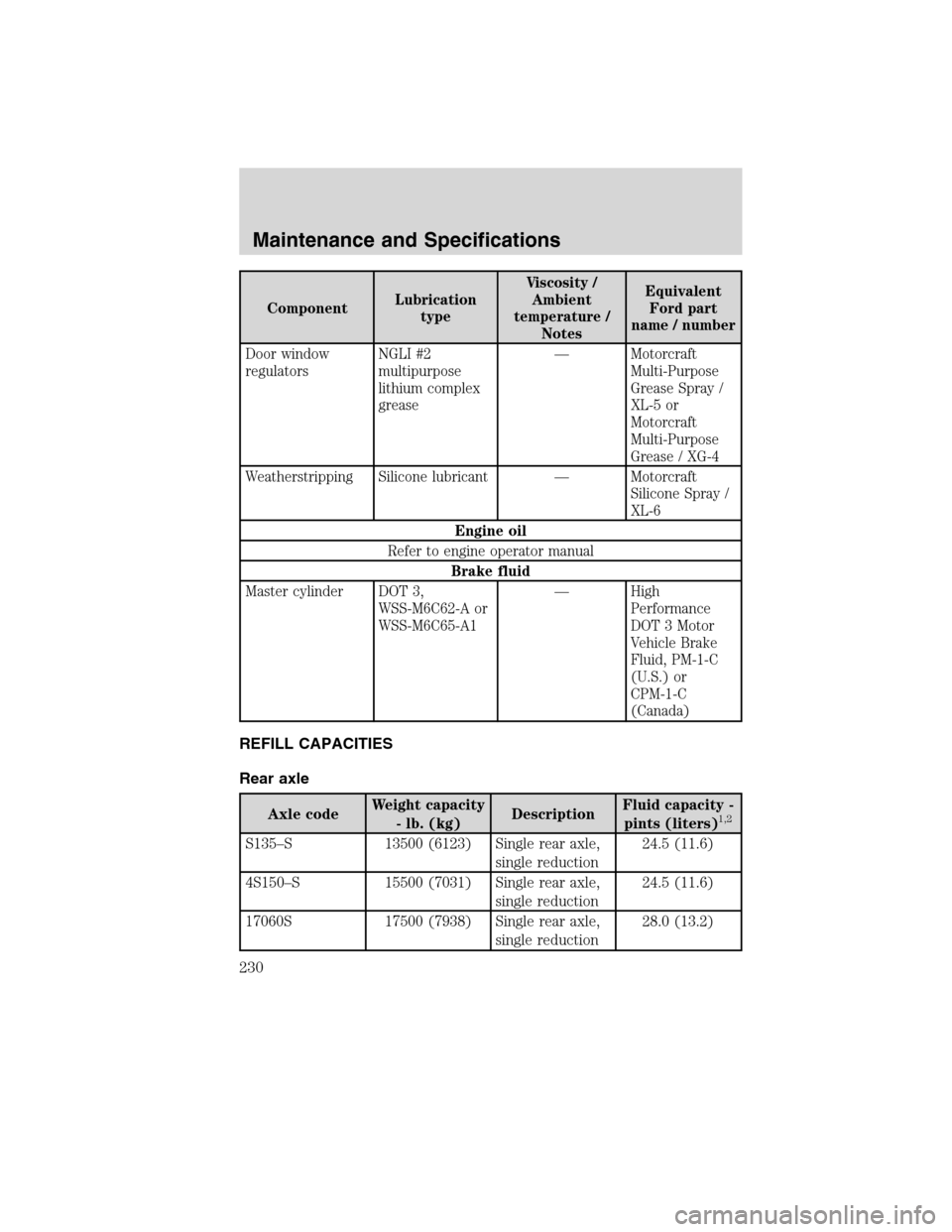
ComponentLubrication
typeViscosity /
Ambient
temperature /
NotesEquivalent
Ford part
name / number
Door window
regulatorsNGLI #2
multipurpose
lithium complex
grease— Motorcraft
Multi-Purpose
Grease Spray /
XL-5 or
Motorcraft
Multi-Purpose
Grease / XG-4
Weatherstripping Silicone lubricant — Motorcraft
Silicone Spray /
XL-6
Engine oil
Refer to engine operator manual
Brake fluid
Master cylinder DOT 3,
WSS-M6C62-A or
WSS-M6C65-A1— High
Performance
DOT 3 Motor
Vehicle Brake
Fluid, PM-1-C
(U.S.) or
CPM-1-C
(Canada)
REFILL CAPACITIES
Rear axle
Axle codeWeight capacity
- lb. (kg)DescriptionFluid capacity -
pints (liters)1,2
S135–S 13500 (6123) Single rear axle,
single reduction24.5 (11.6)
4S150–S 15500 (7031) Single rear axle,
single reduction24.5 (11.6)
17060S 17500 (7938) Single rear axle,
single reduction28.0 (13.2)
Maintenance and Specifications
230
2010 F-650/750(f67)
Supplement(supplement), 1st Printing
USA(fus)
Page 231 of 274
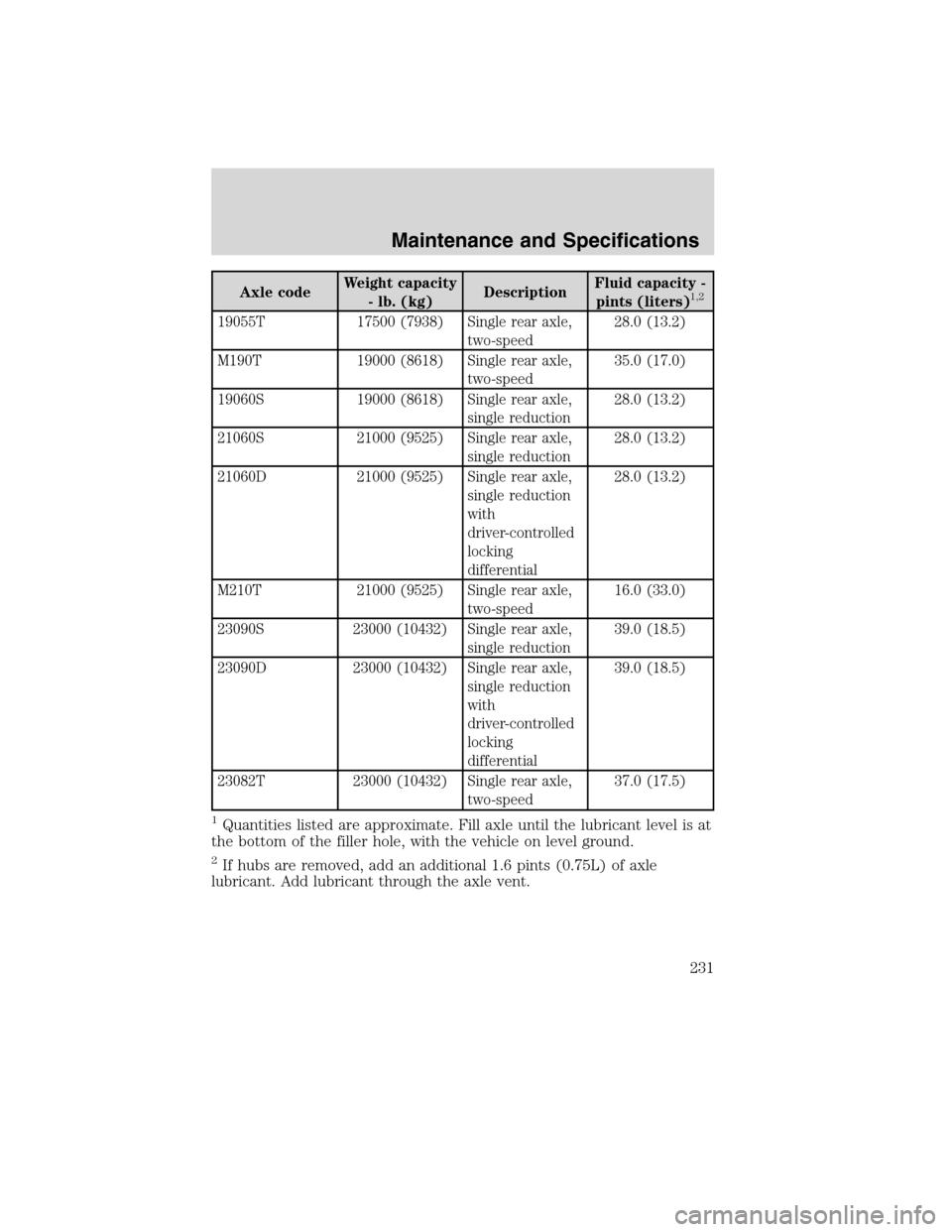
Axle codeWeight capacity
- lb. (kg)DescriptionFluid capacity -
pints (liters)1,2
19055T 17500 (7938) Single rear axle,
two-speed28.0 (13.2)
M190T 19000 (8618) Single rear axle,
two-speed35.0 (17.0)
19060S 19000 (8618) Single rear axle,
single reduction28.0 (13.2)
21060S 21000 (9525) Single rear axle,
single reduction28.0 (13.2)
21060D 21000 (9525) Single rear axle,
single reduction
with
driver-controlled
locking
differential28.0 (13.2)
M210T 21000 (9525) Single rear axle,
two-speed16.0 (33.0)
23090S 23000 (10432) Single rear axle,
single reduction39.0 (18.5)
23090D 23000 (10432) Single rear axle,
single reduction
with
driver-controlled
locking
differential39.0 (18.5)
23082T 23000 (10432) Single rear axle,
two-speed37.0 (17.5)
1Quantities listed are approximate. Fill axle until the lubricant level is at
the bottom of the filler hole, with the vehicle on level ground.
2If hubs are removed, add an additional 1.6 pints (0.75L) of axle
lubricant. Add lubricant through the axle vent.
Maintenance and Specifications
231
2010 F-650/750(f67)
Supplement(supplement), 1st Printing
USA(fus)