engine oil FORD F650 2011 12.G Owners Manual
[x] Cancel search | Manufacturer: FORD, Model Year: 2011, Model line: F650, Model: FORD F650 2011 12.GPages: 290, PDF Size: 1.96 MB
Page 2 of 290
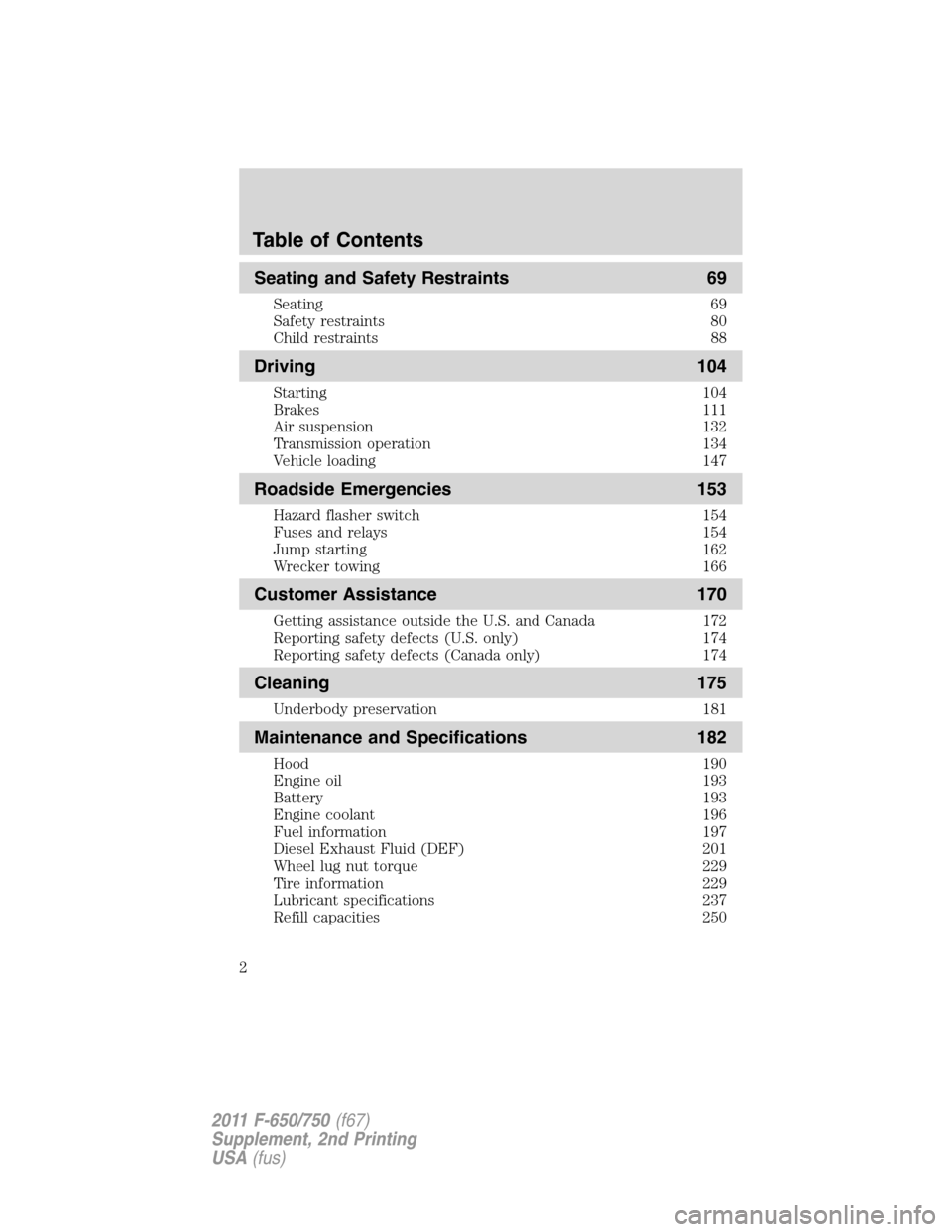
Seating and Safety Restraints 69
Seating 69
Safety restraints 80
Child restraints 88
Driving 104
Starting 104
Brakes 111
Air suspension 132
Transmission operation 134
Vehicle loading 147
Roadside Emergencies 153
Hazard flasher switch 154
Fuses and relays 154
Jump starting 162
Wrecker towing 166
Customer Assistance 170
Getting assistance outside the U.S. and Canada 172
Reporting safety defects (U.S. only) 174
Reporting safety defects (Canada only) 174
Cleaning 175
Underbody preservation 181
Maintenance and Specifications 182
Hood 190
Engine oil 193
Battery 193
Engine coolant 196
Fuel information 197
Diesel Exhaust Fluid (DEF) 201
Wheel lug nut torque 229
Tire information 229
Lubricant specifications 237
Refill capacities 250
Table of Contents
2
2011 F-650/750(f67)
Supplement, 2nd Printing
USA(fus)
Page 11 of 290
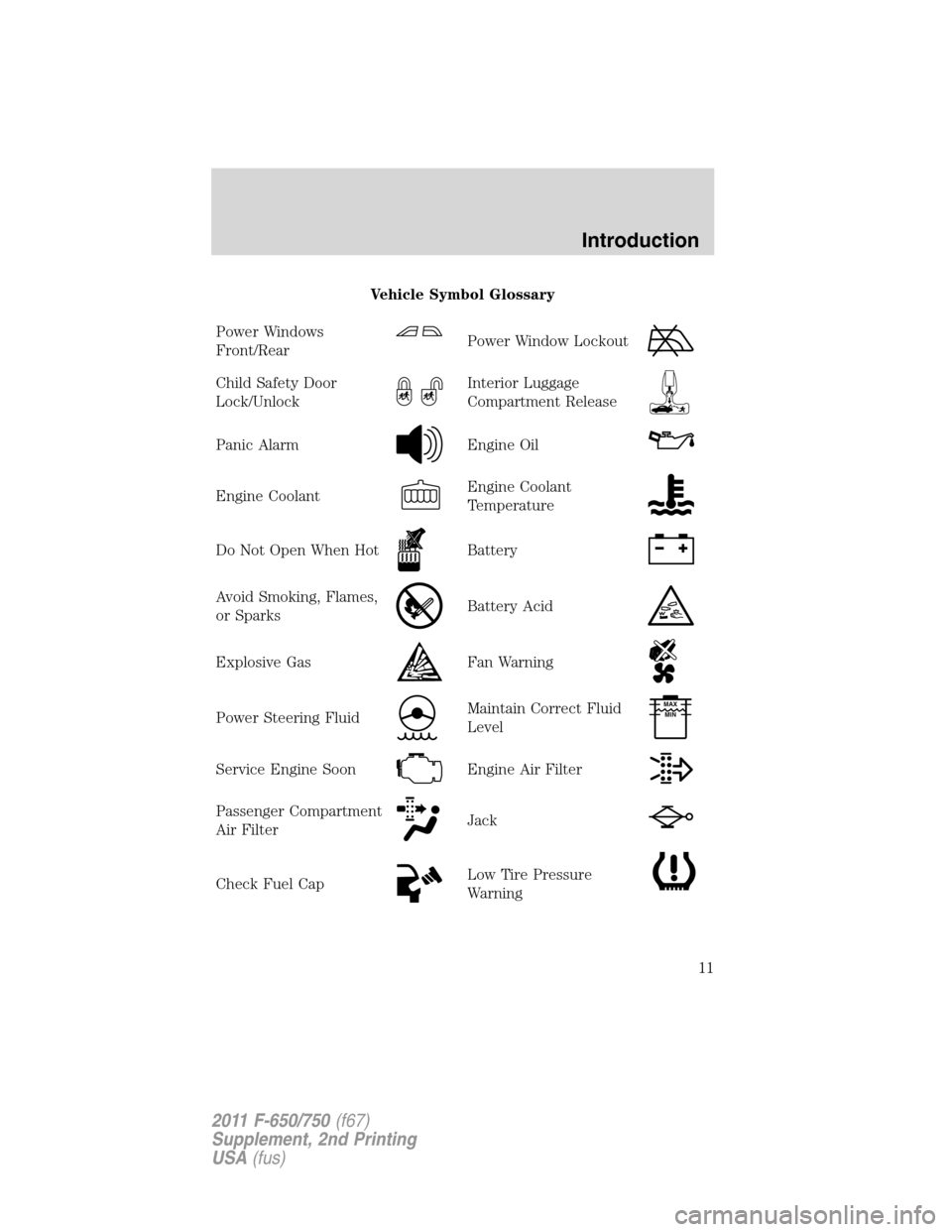
Vehicle Symbol Glossary
Power Windows
Front/Rear
Power Window Lockout
Child Safety Door
Lock/UnlockInterior Luggage
Compartment Release
Panic AlarmEngine Oil
Engine CoolantEngine Coolant
Temperature
Do Not Open When HotBattery
Avoid Smoking, Flames,
or SparksBattery Acid
Explosive GasFan Warning
Power Steering FluidMaintain Correct Fluid
LevelMAX
MIN
Service Engine SoonEngine Air Filter
Passenger Compartment
Air FilterJack
Check Fuel CapLow Tire Pressure
Warning
Introduction
11
2011 F-650/750(f67)
Supplement, 2nd Printing
USA(fus)
Page 12 of 290
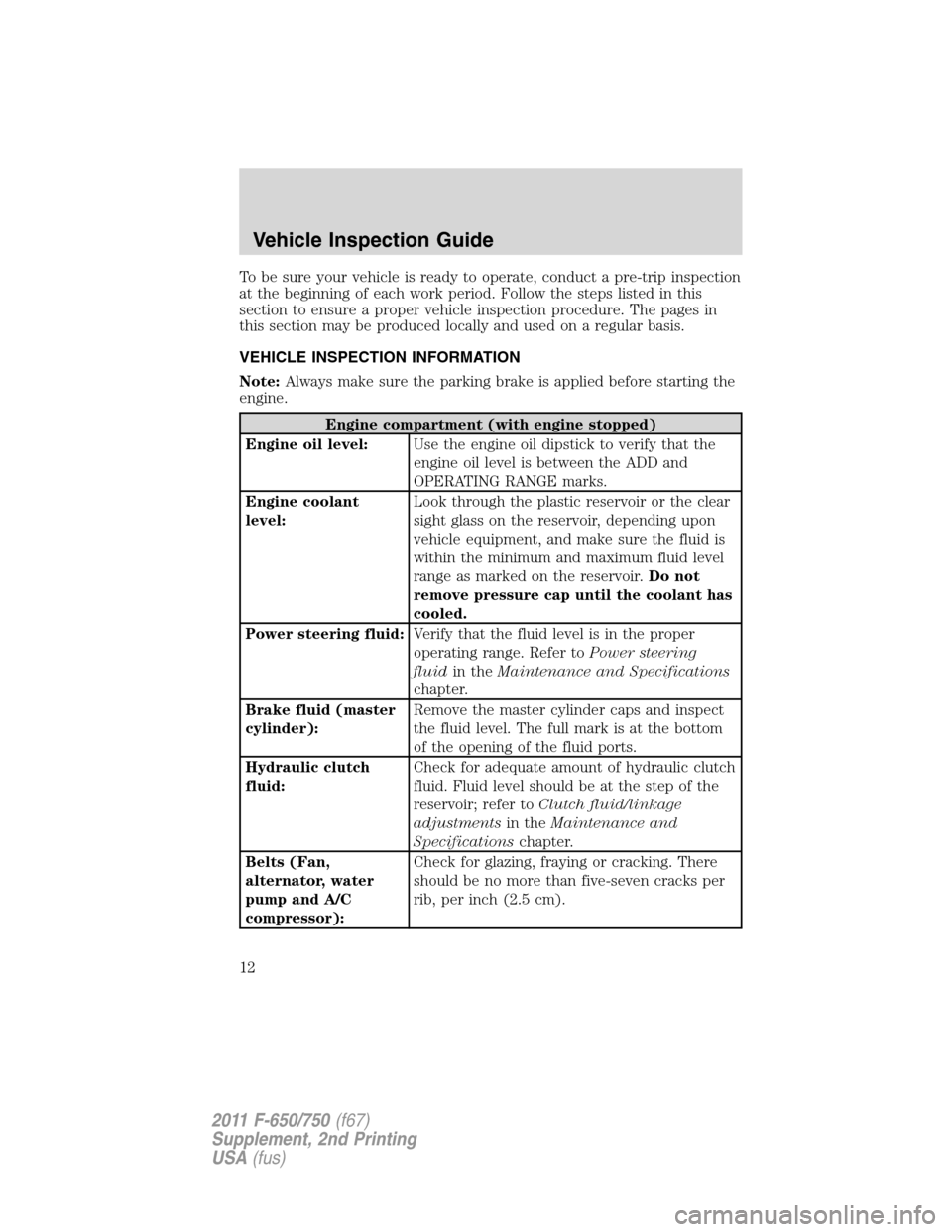
To be sure your vehicle is ready to operate, conduct a pre-trip inspection
at the beginning of each work period. Follow the steps listed in this
section to ensure a proper vehicle inspection procedure. The pages in
this section may be produced locally and used on a regular basis.
VEHICLE INSPECTION INFORMATION
Note:Always make sure the parking brake is applied before starting the
engine.
Engine compartment (with engine stopped)
Engine oil level:Use the engine oil dipstick to verify that the
engine oil level is between the ADD and
OPERATING RANGE marks.
Engine coolant
level:Look through the plastic reservoir or the clear
sight glass on the reservoir, depending upon
vehicle equipment, and make sure the fluid is
within the minimum and maximum fluid level
range as marked on the reservoir.Do not
remove pressure cap until the coolant has
cooled.
Power steering fluid:Verify that the fluid level is in the proper
operating range. Refer toPower steering
fluidin theMaintenance and Specifications
chapter.
Brake fluid (master
cylinder):Remove the master cylinder caps and inspect
the fluid level. The full mark is at the bottom
of the opening of the fluid ports.
Hydraulic clutch
fluid:Check for adequate amount of hydraulic clutch
fluid. Fluid level should be at the step of the
reservoir; refer toClutch fluid/linkage
adjustmentsin theMaintenance and
Specificationschapter.
Belts (Fan,
alternator, water
pump and A/C
compressor):Check for glazing, fraying or cracking. There
should be no more than five-seven cracks per
rib, per inch (2.5 cm).
Vehicle Inspection Guide
12
2011 F-650/750(f67)
Supplement, 2nd Printing
USA(fus)
Page 14 of 290
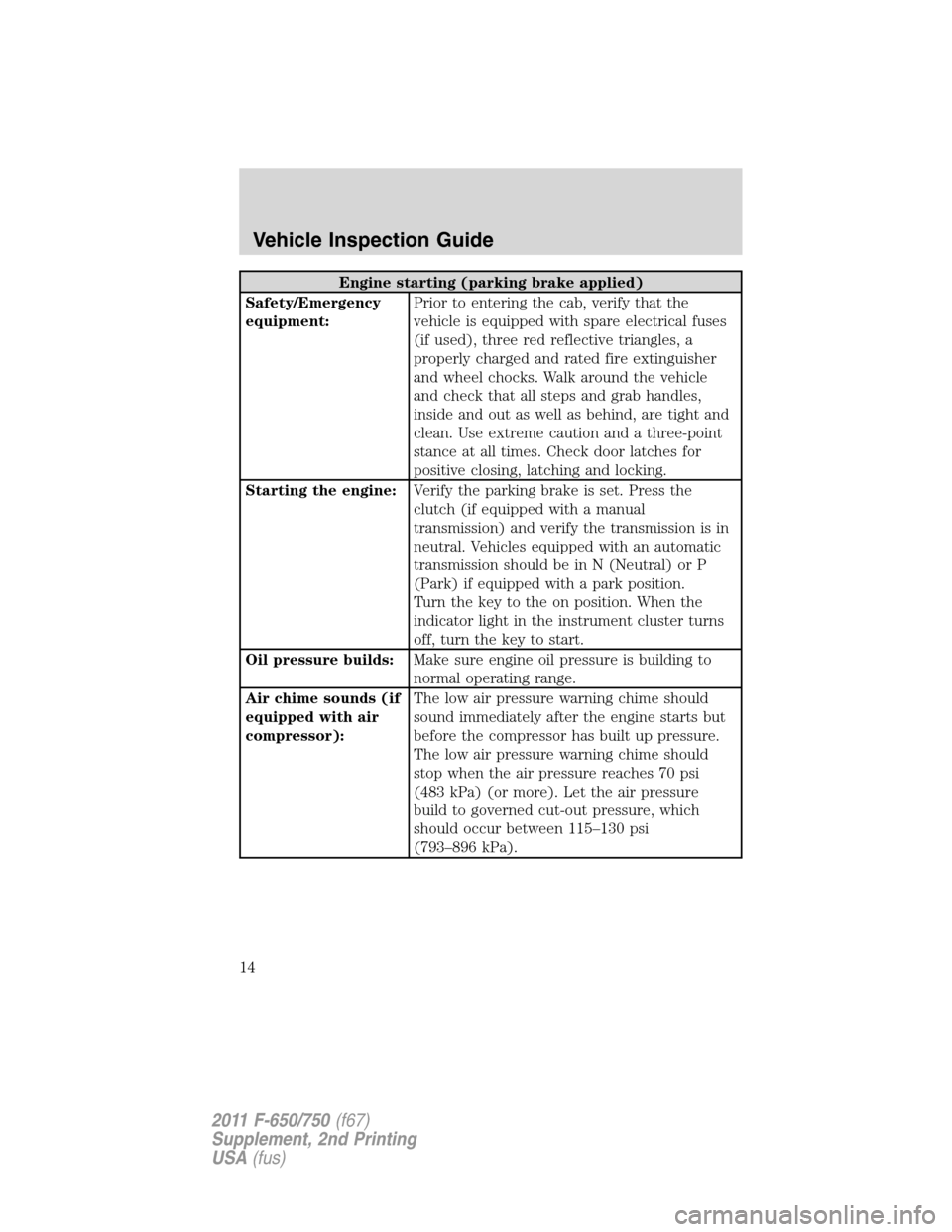
Engine starting (parking brake applied)
Safety/Emergency
equipment:Prior to entering the cab, verify that the
vehicle is equipped with spare electrical fuses
(if used), three red reflective triangles, a
properly charged and rated fire extinguisher
and wheel chocks. Walk around the vehicle
and check that all steps and grab handles,
inside and out as well as behind, are tight and
clean. Use extreme caution and a three-point
stance at all times. Check door latches for
positive closing, latching and locking.
Starting the engine:Verify the parking brake is set. Press the
clutch (if equipped with a manual
transmission) and verify the transmission is in
neutral. Vehicles equipped with an automatic
transmission should be in N (Neutral) or P
(Park) if equipped with a park position.
Turn the key to the on position. When the
indicator light in the instrument cluster turns
off, turn the key to start.
Oil pressure builds:Make sure engine oil pressure is building to
normal operating range.
Air chime sounds (if
equipped with air
compressor):The low air pressure warning chime should
sound immediately after the engine starts but
before the compressor has built up pressure.
The low air pressure warning chime should
stop when the air pressure reaches 70 psi
(483 kPa) (or more). Let the air pressure
build to governed cut-out pressure, which
should occur between 115–130 psi
(793–896 kPa).
Vehicle Inspection Guide
14
2011 F-650/750(f67)
Supplement, 2nd Printing
USA(fus)
Page 31 of 290
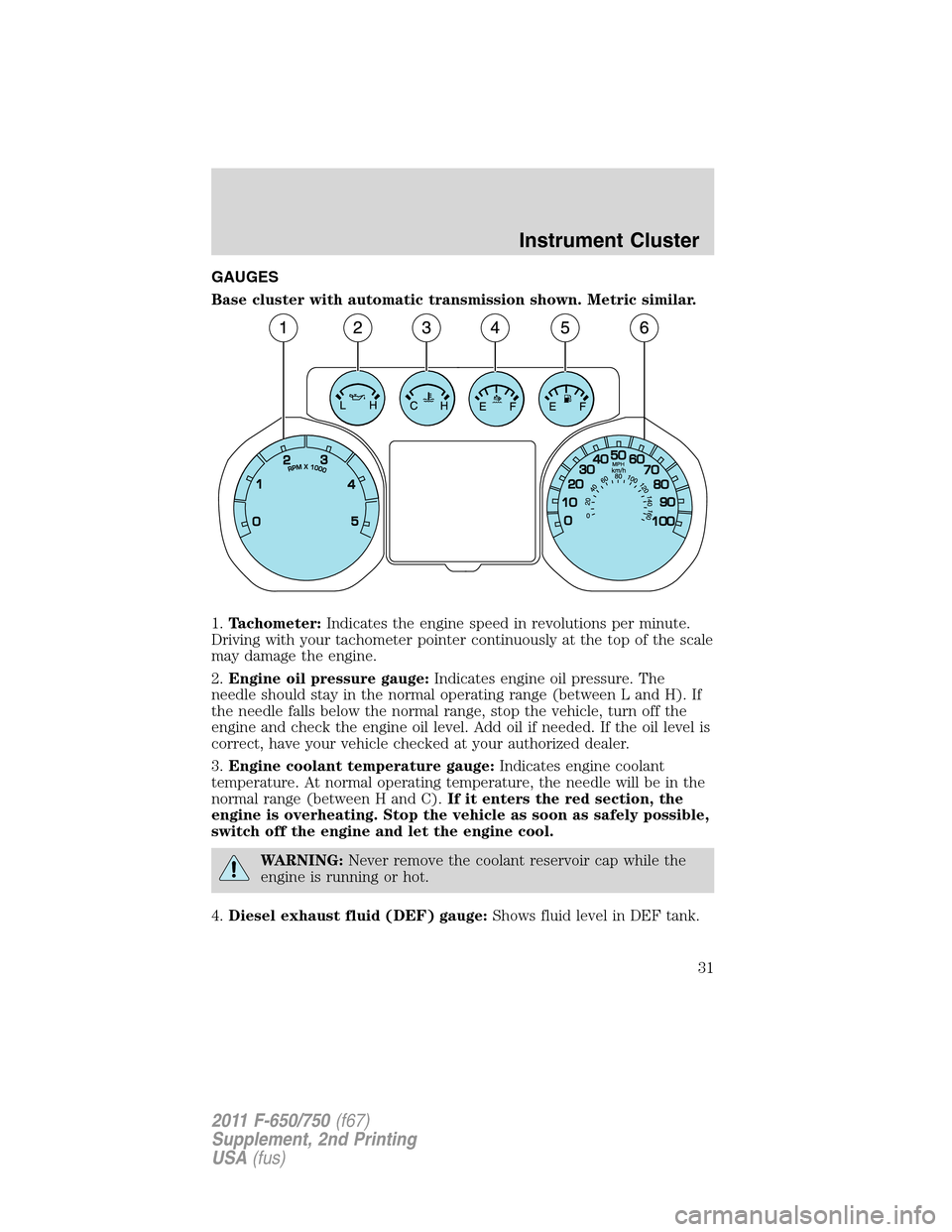
GAUGES
Base cluster with automatic transmission shown. Metric similar.
1.Tachometer:Indicates the engine speed in revolutions per minute.
Driving with your tachometer pointer continuously at the top of the scale
may damage the engine.
2.Engine oil pressure gauge:Indicates engine oil pressure. The
needle should stay in the normal operating range (between L and H). If
the needle falls below the normal range, stop the vehicle, turn off the
engine and check the engine oil level. Add oil if needed. If the oil level is
correct, have your vehicle checked at your authorized dealer.
3.Engine coolant temperature gauge:Indicates engine coolant
temperature. At normal operating temperature, the needle will be in the
normal range (between H and C).If it enters the red section, the
engine is overheating. Stop the vehicle as soon as safely possible,
switch off the engine and let the engine cool.
WARNING:Never remove the coolant reservoir cap while the
engine is running or hot.
4.Diesel exhaust fluid (DEF) gauge:Shows fluid level in DEF tank.
Instrument Cluster
31
2011 F-650/750(f67)
Supplement, 2nd Printing
USA(fus)
Page 105 of 290
Note:When starting the engine, do not press the accelerator as engine
damage may result.
1. Ensure headlamps and all accessories are turned off, the parking
brake is applied and the transmission is in the neutral position (or P
[Park] for Allison 2200 transmissions).
2. Turn the key to the on position, but do not start the engine.
In cooler weather, the air intake
heater may activate the WAIT TO
START light in the instrument
cluster. If the WAIT TO START light
illuminates,do notcrank the engine until the light goes off.
WARNING:If equipped with an air intake heater, DO NOT use
ether or any other starting fluids. The use of starting fluids
(ether) in an engine equipped with an air intake heater could cause an
explosion and result in property damage and/or personal injury.
3. When the WAIT TO START light turns off, turn the key to the start
position; when the engine starts, release the key.
If the engine does not start after 30 seconds of cranking, allow two
minutes for the starter to cool before trying again. Excessive cranking
may damage the starter.
After the engine starts:
•On some engines, the WAIT TO
START light should illuminate
after the engine starts. Allow the
engine to idle about three
minutes or until the engine coolant temperature gauge begins to rise.
Maintain idle speed until the WAIT TO START light cycles off to
indicate the air intake heater has shut off (approximately six
minutes). Operating the engine at higher speeds will reduce the
effectiveness of the air inlet heater.
•Do not increase engine speed until the oil pressure gauge indicates
normal pressure (as indicated by the arrows); this should be indicated
on the gauge within 15 seconds after starting.
•Idle the engine for three to five minutes before operating with a full
load.
•Try to limit engine idle to 10 minutes. Excessive idling reduces fuel
economy.
Driving
105
2011 F-650/750(f67)
Supplement, 2nd Printing
USA(fus)
Page 106 of 290
•When starting a cold engine, increase the engine RPM slowly to make
sure adequate lubrication is available to the bearings.
Cold weather operation
WARNING:Do not use volatile starting aids such as ether,
propane or gasoline in the engine air intake system. Glow plugs
may ignite vapors which can cause engine damage or personal injury.
In order to operate the engine in temperatures of 32°F (0°C) or lower,
read the following instructions:
•Make sure that the batteries are of sufficient size and are fully
charged. Check other electrical components to make sure they’re in
optimum condition.
•Use a permanent-type engine coolant solution to protect the engine
against damage from freezing.
•If your vehicle is equipped with a water-fuel separator, drain it daily.
Fill the fuel tank at the end of daily operation to prevent condensation
in the fuel system.
•Make sure you use proper cold weather engine oil and that it is at its
proper level.
•At temperatures of –4°F (–20°C) or below, it is recommended that you
use a crankcase-mounted coolant heater to improve cold engine
starting.
•If operating in arctic temperatures of –20°F (–29°C) or lower, consult
your truck dealer for information about special cold weather
equipment and precautions.
Note:Idling in cold weather will not heat the engine to its normal
operating temperature. Long periods of idling in cold weather can cause
a build-up of heavy deposits of carbon and rust on valve stems causing
them to stick which, in turn, can cause valvetrain damage.
Winter fronts
The use of winter fronts, or other air-restrictive devices mounted in front
of the radiator on vehicles with chassis-mounted charge air coolers, are
not recommended unless extremely cold weather conditions exist. Air
flow restriction can cause high exhaust temperatures, power loss,
excessive fan usage and a reduction in fuel economy. If you must use a
winter front, the device should have a permanent opening of at least 120
sq in. (774 sq. cm) directly in line with the fan hub.
Driving
106
2011 F-650/750(f67)
Supplement, 2nd Printing
USA(fus)
Page 110 of 290
ENGINE AUTOMATIC SHUTDOWN WARNING LIGHT OR CHIME
(IF EQUIPPED)
Your vehicle may be equipped with an automatic shutdown feature that
stops the engine in the event of high coolant temperature, low engine oil
pressure, high diesel particulate filter soot loading or low engine coolant
level. A warning light in the instrument cluster and a warning chime will
indicate high engine coolant temperature, low engine oil pressure or the
need to have the diesel particulate filter cleaned or serviced. If the
engine coolant temperature becomes too high, engine oil pressure too
low or the diesel particulate filter too restricted, the engine will
automatically shut down.
If the engine shuts down, it can be restarted and operated for
30 seconds at a time or until the problem is corrected. Do not attempt to
use this restarting feature to drive the vehicle very far as serious engine
damage could result.
WARNING:In the event of engine shutdown, make sure the
vehicle is safely off the road and the problem is remedied prior
to returning to the road. Failure to remove the vehicle from the road
could result in an accident, causing serious injury or death.
GENERAL BRAKE INFORMATION
All standard equipment brakes are designed to be self-adjusting.
Automatic adjustment, when required, occurs whenever the brakes are
applied and released during forward or reverse operation. Refer to the
Scheduled Maintenance Guidechapter for scheduled maintenance.
Occasional brake noise is normal and often does not indicate a
performance concern with the vehicle’s brake system. In normal
operation, automotive brake systems may emit occasional or intermittent
squeal or groan noises when the brakes are applied. Such noises are
usually heard during the first few brake applications in the morning;
however, they may be heard at any time while braking and can be
aggravated by environmental conditions such as cold, heat, moisture,
road dust, salt or mud. If a “metal-to-metal,” “continuous grinding” or
“continuous squeal” sound is present while braking, the brake linings
may be worn-out and should be inspected by a qualified service
technician.
Know the required stopping distances for all driving conditions that may
be encountered. For longer brake lining life, take full advantage of engine
braking power when coming to a stop.
Driving
110
2011 F-650/750(f67)
Supplement, 2nd Printing
USA(fus)
Page 188 of 290
This inspection should be performed by a qualified technician and must
be in accordance with instructions provided by the service manual.
Note:Hydraulic brake systems are power assisted. Braking capabilities
will be greatly reduced without engine assist.
Fluid level
Fluid level should be at the bottom edge of the ring on each reservoir fill
port. Do not fill the master cylinder to the top of the reservoir.
Note:If brake fluid requires attention to maintain a proper master
cylinder level, this is an indication of either severe operation (pad wear)
or fluid system leakage. A more frequent and thorough brake inspection
will be required.
Brake lines, hoses and fittings
Inspect these components every 4,000 miles (6,000 km).
•Check lines for kinks, dents, corrosion or rupture.
•Check hoses for abrasions, kinks, soft spots or rupture, collapse,
cracks, twists or loose frame supports. When replacing a hose, be sure
there is adequate clearance to the hose to avoid an abrasion to the
new hose.
•Examine all connections for leaks.
•Repair or replace brake line tubes, hoses or fittings as required.
Driveline parking brake
Parking brake adjustment should only be performed by a qualified
technician, and in accordance with the instructions in the service
manual.
WARNING:Use wheel chocks and exercise caution when
inspecting under the vehicle. A vehicle roll-away could result in
property damage, personal injury or death.
Catalytic converter
If your diesel engine is equipped with a catalytic converter, it is
important to review the maintenance schedule to ensure proper
functioning of the catalytic converter. Also, take precautions not to
damage the catalytic converter when servicing your engine or storing
your vehicle.
Note:If your vehicle is equipped with a catalytic converter/muffler,do
notblend waste oil with Diesel fuel. Operate only on ultra low sulfur
(less than 15 parts per million sulfur) diesel fuel with a cetane value of
45 or higher.
Maintenance and Specifications
188
2011 F-650/750(f67)
Supplement, 2nd Printing
USA(fus)
Page 193 of 290
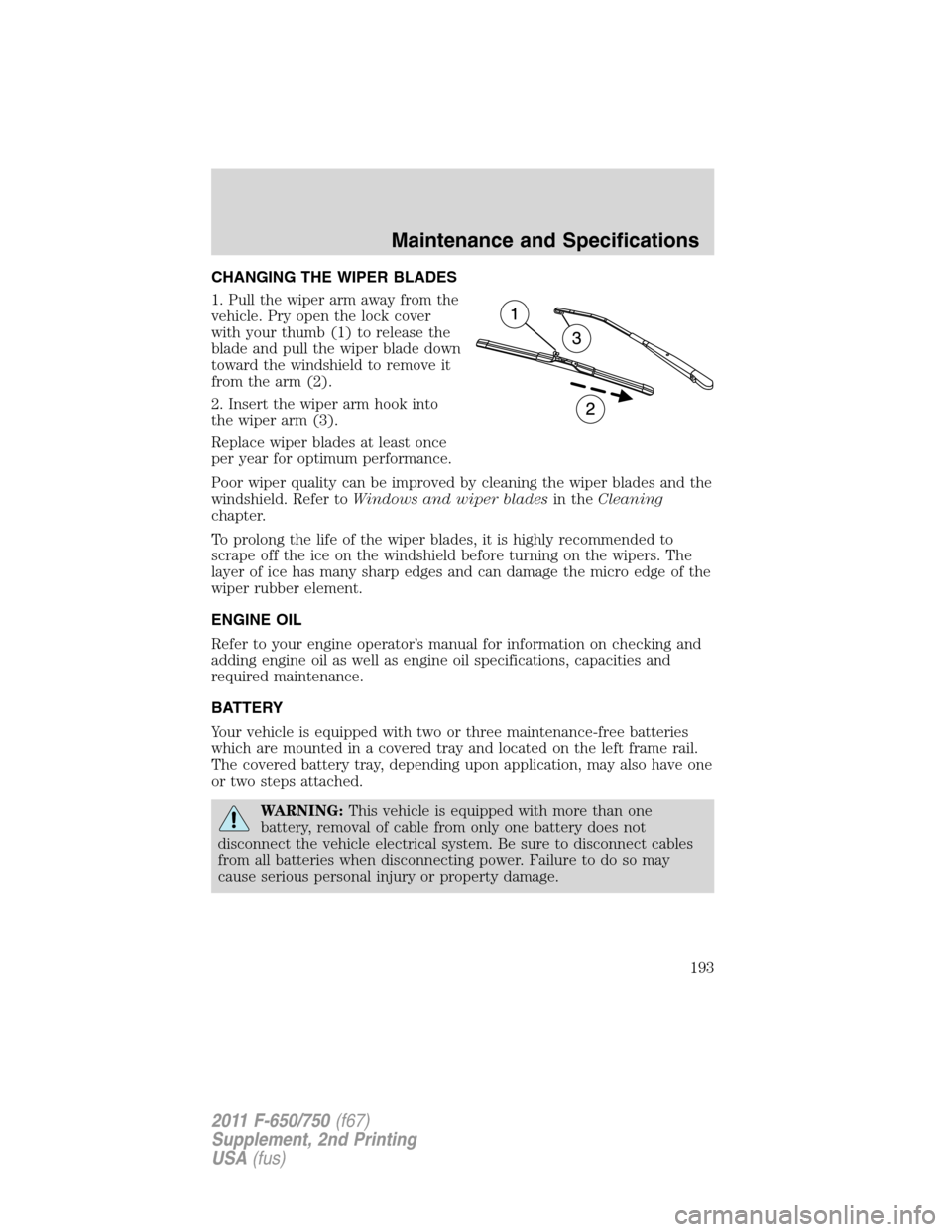
CHANGING THE WIPER BLADES
1. Pull the wiper arm away from the
vehicle. Pry open the lock cover
with your thumb (1) to release the
blade and pull the wiper blade down
toward the windshield to remove it
from the arm (2).
2. Insert the wiper arm hook into
the wiper arm (3).
Replace wiper blades at least once
per year for optimum performance.
Poor wiper quality can be improved by cleaning the wiper blades and the
windshield. Refer toWindows and wiper bladesin theCleaning
chapter.
To prolong the life of the wiper blades, it is highly recommended to
scrape off the ice on the windshield before turning on the wipers. The
layer of ice has many sharp edges and can damage the micro edge of the
wiper rubber element.
ENGINE OIL
Refer to your engine operator’s manual for information on checking and
adding engine oil as well as engine oil specifications, capacities and
required maintenance.
BATTERY
Your vehicle is equipped with two or three maintenance-free batteries
which are mounted in a covered tray and located on the left frame rail.
The covered battery tray, depending upon application, may also have one
or two steps attached.
WARNING:This vehicle is equipped with more than one
battery, removal of cable from only one battery does not
disconnect the vehicle electrical system. Be sure to disconnect cables
from all batteries when disconnecting power. Failure to do so may
cause serious personal injury or property damage.
Maintenance and Specifications
193
2011 F-650/750(f67)
Supplement, 2nd Printing
USA(fus)