maintenance FORD F650 2011 12.G Owners Manual
[x] Cancel search | Manufacturer: FORD, Model Year: 2011, Model line: F650, Model: FORD F650 2011 12.GPages: 290, PDF Size: 1.96 MB
Page 2 of 290
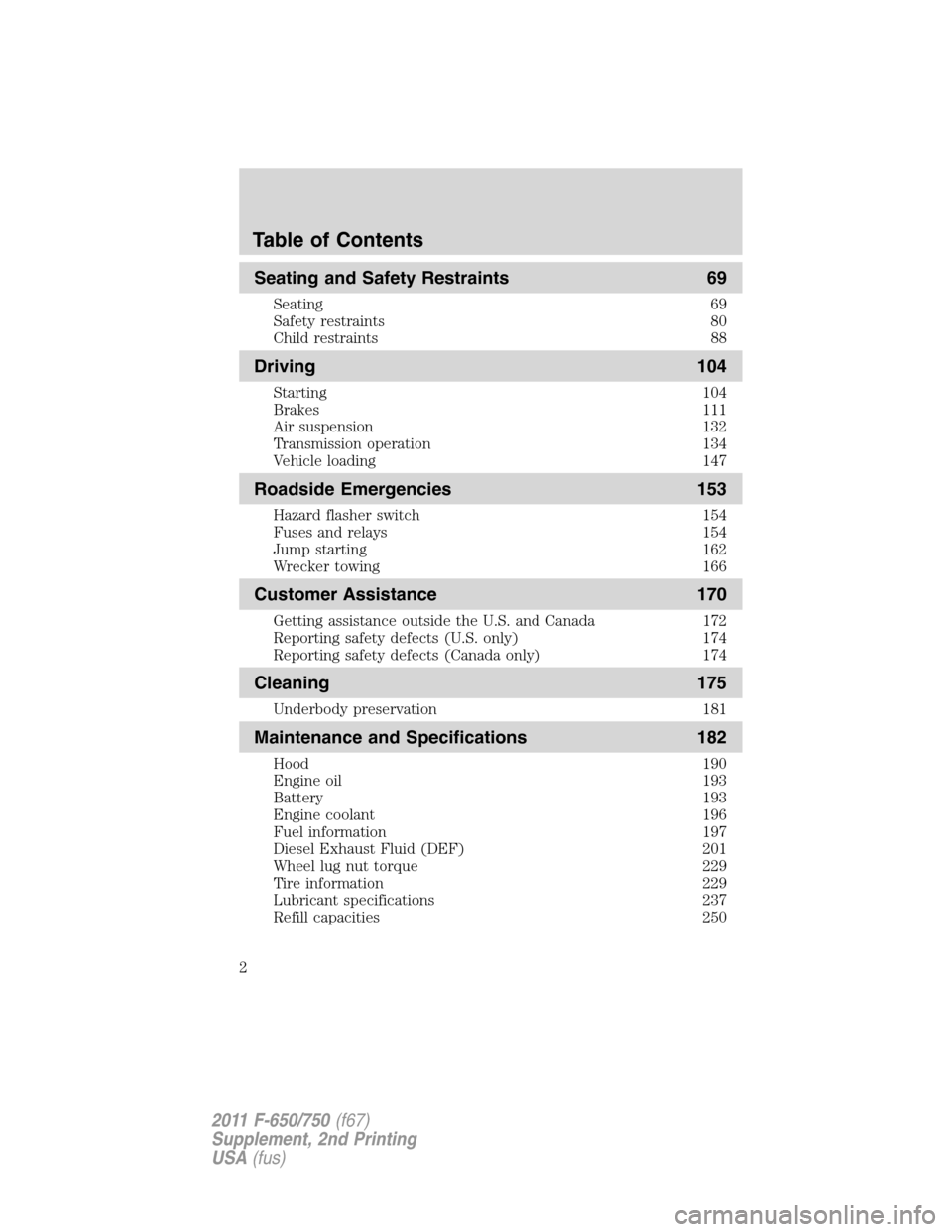
Seating and Safety Restraints 69
Seating 69
Safety restraints 80
Child restraints 88
Driving 104
Starting 104
Brakes 111
Air suspension 132
Transmission operation 134
Vehicle loading 147
Roadside Emergencies 153
Hazard flasher switch 154
Fuses and relays 154
Jump starting 162
Wrecker towing 166
Customer Assistance 170
Getting assistance outside the U.S. and Canada 172
Reporting safety defects (U.S. only) 174
Reporting safety defects (Canada only) 174
Cleaning 175
Underbody preservation 181
Maintenance and Specifications 182
Hood 190
Engine oil 193
Battery 193
Engine coolant 196
Fuel information 197
Diesel Exhaust Fluid (DEF) 201
Wheel lug nut torque 229
Tire information 229
Lubricant specifications 237
Refill capacities 250
Table of Contents
2
2011 F-650/750(f67)
Supplement, 2nd Printing
USA(fus)
Page 3 of 290
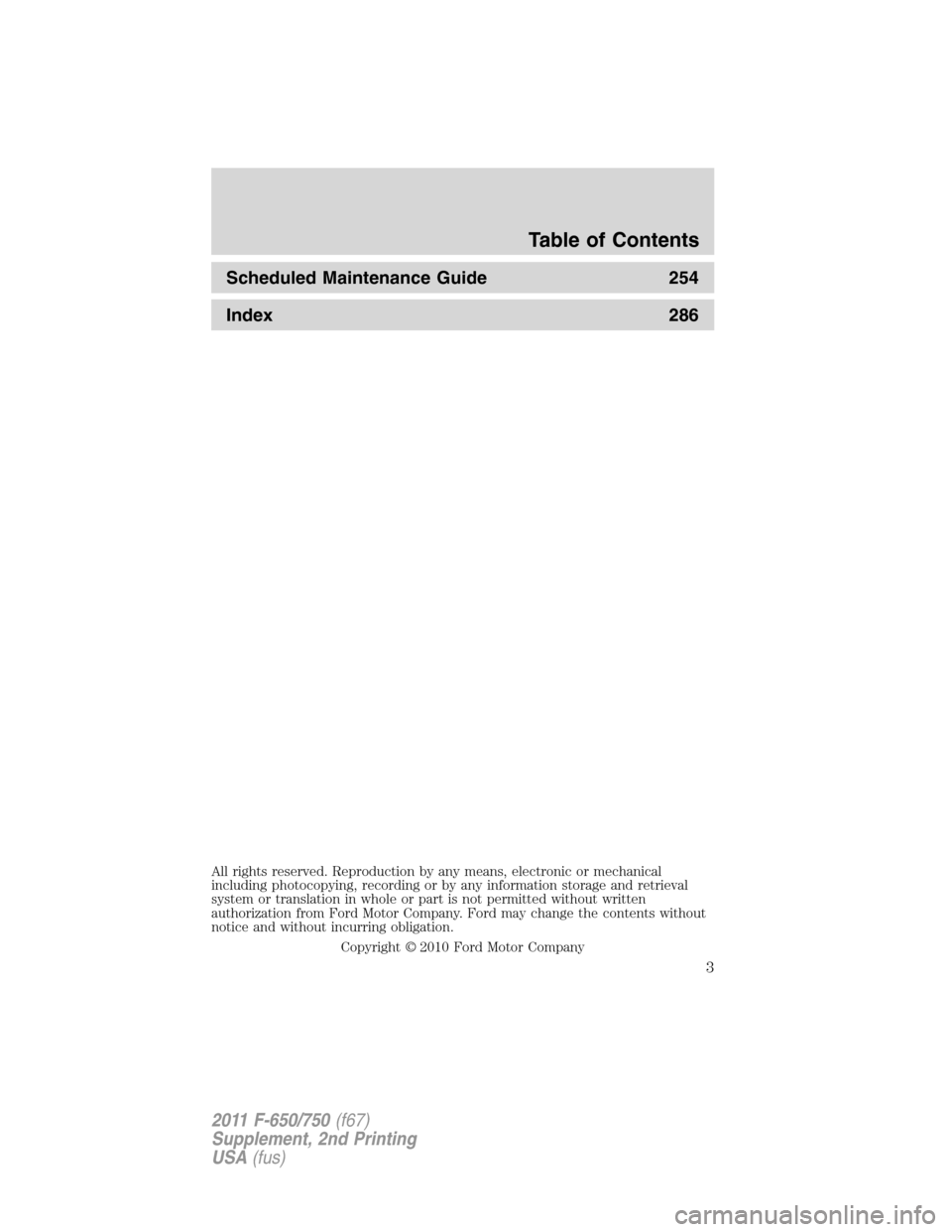
Scheduled Maintenance Guide 254
Index 286
All rights reserved. Reproduction by any means, electronic or mechanical
including photocopying, recording or by any information storage and retrieval
system or translation in whole or part is not permitted without written
authorization from Ford Motor Company. Ford may change the contents without
notice and without incurring obligation.
Copyright © 2010 Ford Motor Company
Table of Contents
3
2011 F-650/750(f67)
Supplement, 2nd Printing
USA(fus)
Page 12 of 290
To be sure your vehicle is ready to operate, conduct a pre-trip inspection
at the beginning of each work period. Follow the steps listed in this
section to ensure a proper vehicle inspection procedure. The pages in
this section may be produced locally and used on a regular basis.
VEHICLE INSPECTION INFORMATION
Note:Always make sure the parking brake is applied before starting the
engine.
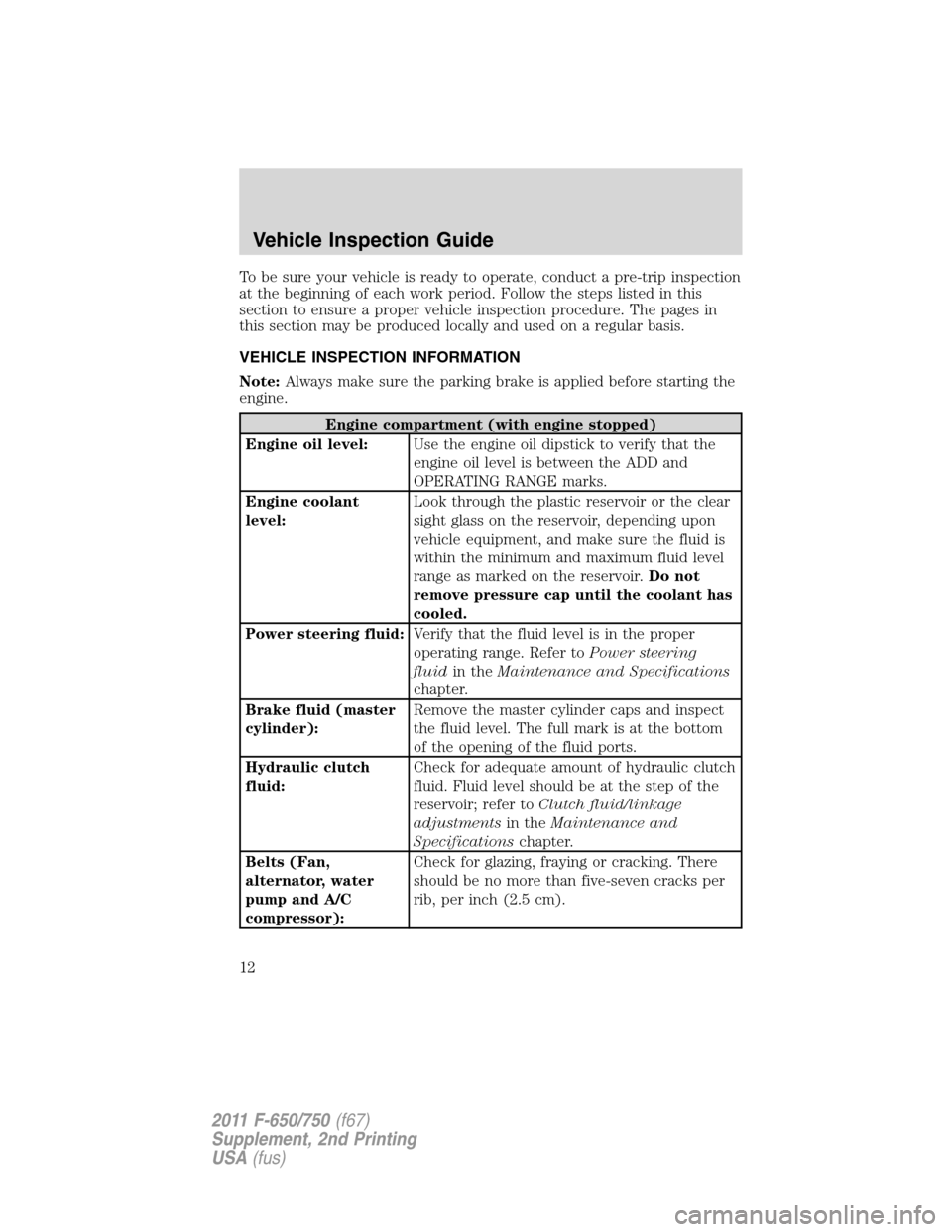
Engine compartment (with engine stopped)
Engine oil level:Use the engine oil dipstick to verify that the
engine oil level is between the ADD and
OPERATING RANGE marks.
Engine coolant
level:Look through the plastic reservoir or the clear
sight glass on the reservoir, depending upon
vehicle equipment, and make sure the fluid is
within the minimum and maximum fluid level
range as marked on the reservoir.Do not
remove pressure cap until the coolant has
cooled.
Power steering fluid:Verify that the fluid level is in the proper
operating range. Refer toPower steering
fluidin theMaintenance and Specifications
chapter.
Brake fluid (master
cylinder):Remove the master cylinder caps and inspect
the fluid level. The full mark is at the bottom
of the opening of the fluid ports.
Hydraulic clutch
fluid:Check for adequate amount of hydraulic clutch
fluid. Fluid level should be at the step of the
reservoir; refer toClutch fluid/linkage
adjustmentsin theMaintenance and
Specificationschapter.
Belts (Fan,
alternator, water
pump and A/C
compressor):Check for glazing, fraying or cracking. There
should be no more than five-seven cracks per
rib, per inch (2.5 cm).
Vehicle Inspection Guide
12
2011 F-650/750(f67)
Supplement, 2nd Printing
USA(fus)
Page 16 of 290
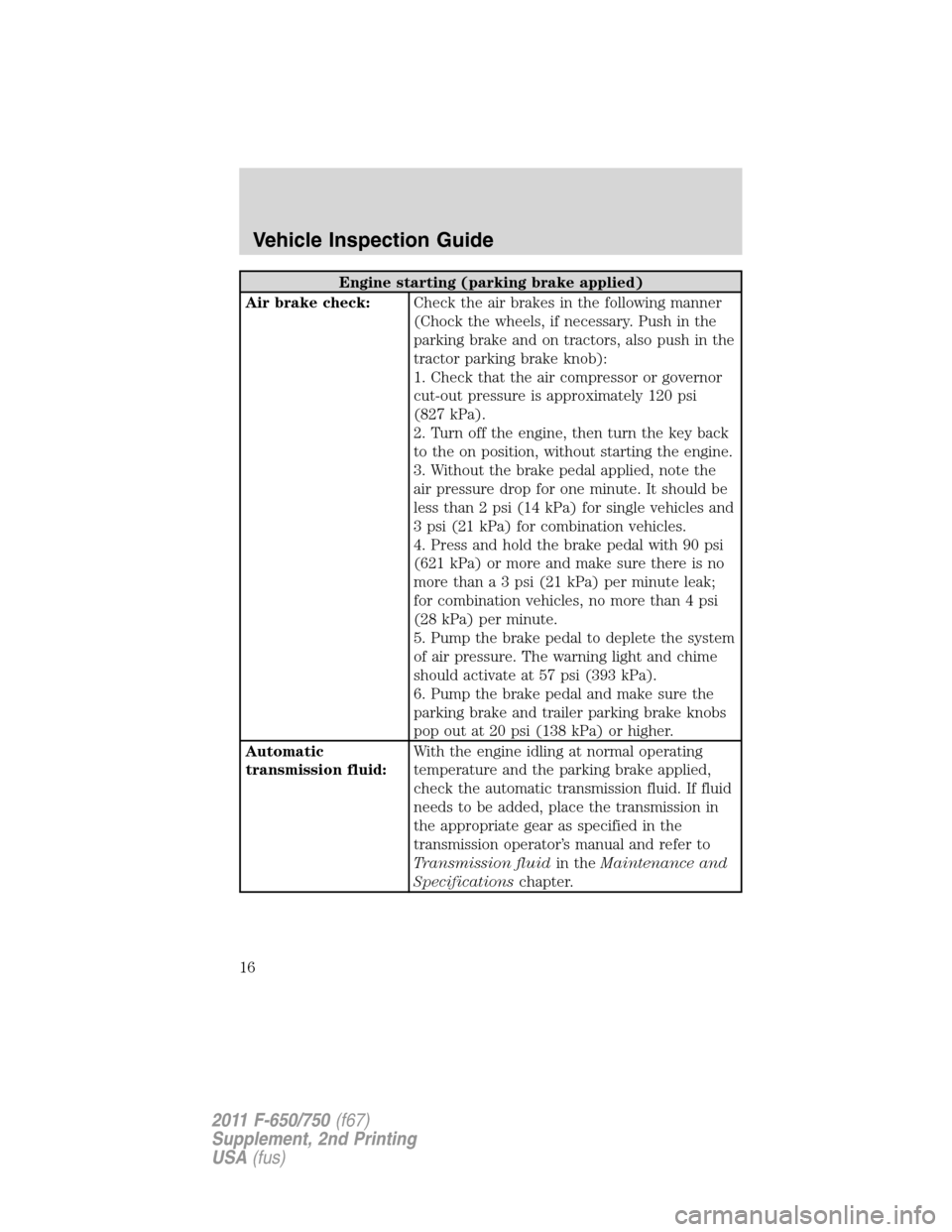
Engine starting (parking brake applied)
Air brake check:Check the air brakes in the following manner
(Chock the wheels, if necessary. Push in the
parking brake and on tractors, also push in the
tractor parking brake knob):
1. Check that the air compressor or governor
cut-out pressure is approximately 120 psi
(827 kPa).
2. Turn off the engine, then turn the key back
to the on position, without starting the engine.
3. Without the brake pedal applied, note the
air pressure drop for one minute. It should be
less than 2 psi (14 kPa) for single vehicles and
3 psi (21 kPa) for combination vehicles.
4. Press and hold the brake pedal with 90 psi
(621 kPa) or more and make sure there is no
more than a 3 psi (21 kPa) per minute leak;
for combination vehicles, no more than 4 psi
(28 kPa) per minute.
5. Pump the brake pedal to deplete the system
of air pressure. The warning light and chime
should activate at 57 psi (393 kPa).
6. Pump the brake pedal and make sure the
parking brake and trailer parking brake knobs
pop out at 20 psi (138 kPa) or higher.
Automatic
transmission fluid:With the engine idling at normal operating
temperature and the parking brake applied,
check the automatic transmission fluid. If fluid
needs to be added, place the transmission in
the appropriate gear as specified in the
transmission operator’s manual and refer to
Transmission fluidin theMaintenance and
Specificationschapter.
Vehicle Inspection Guide
16
2011 F-650/750(f67)
Supplement, 2nd Printing
USA(fus)
Page 24 of 290
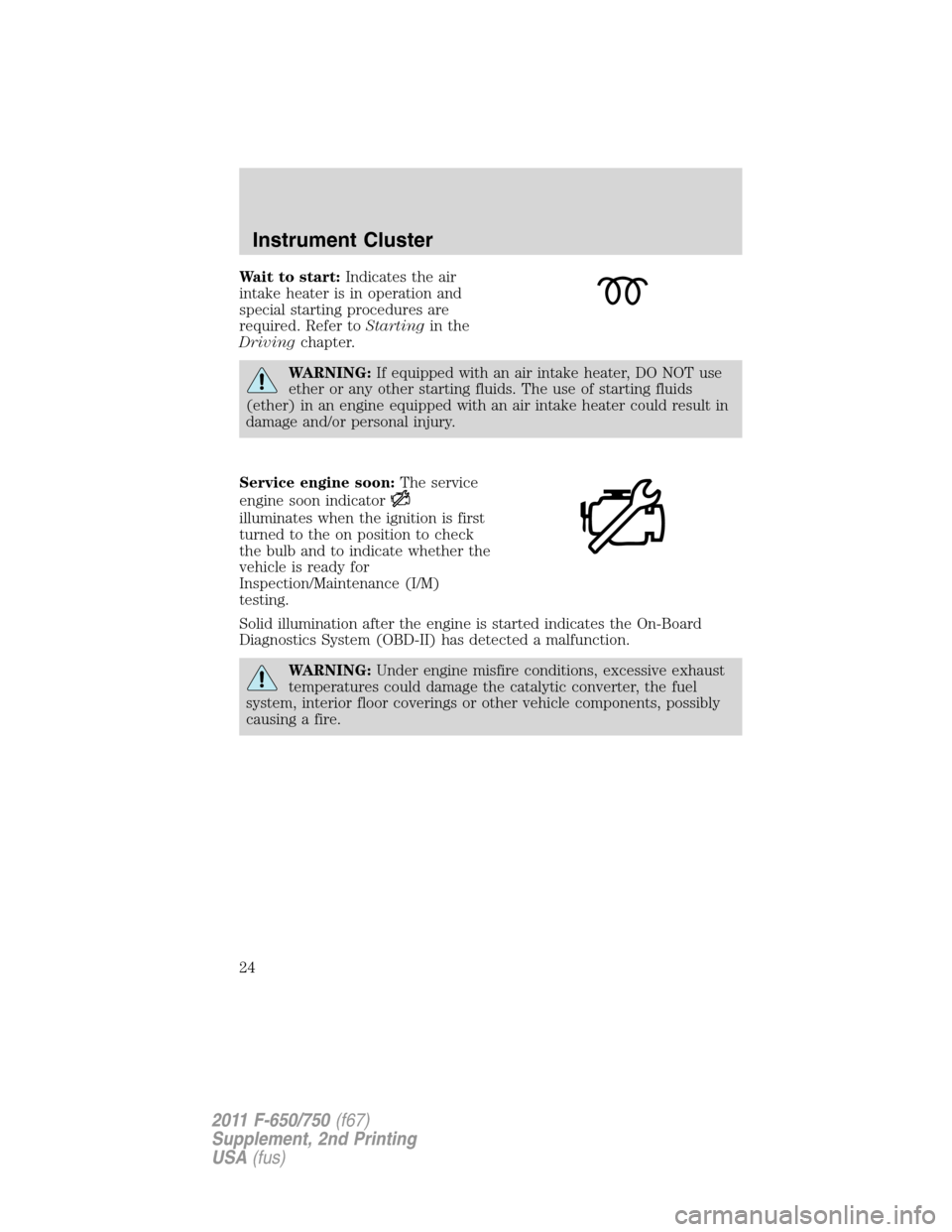
Wait to start:Indicates the air
intake heater is in operation and
special starting procedures are
required. Refer toStartingin the
Drivingchapter.
WARNING:If equipped with an air intake heater, DO NOT use
ether or any other starting fluids. The use of starting fluids
(ether) in an engine equipped with an air intake heater could result in
damage and/or personal injury.
Service engine soon:The service
engine soon indicator
illuminates when the ignition is first
turned to the on position to check
the bulb and to indicate whether the
vehicle is ready for
Inspection/Maintenance (I/M)
testing.
Solid illumination after the engine is started indicates the On-Board
Diagnostics System (OBD-II) has detected a malfunction.
WARNING:Under engine misfire conditions, excessive exhaust
temperatures could damage the catalytic converter, the fuel
system, interior floor coverings or other vehicle components, possibly
causing a fire.
Instrument Cluster
24
2011 F-650/750(f67)
Supplement, 2nd Printing
USA(fus)
Page 26 of 290
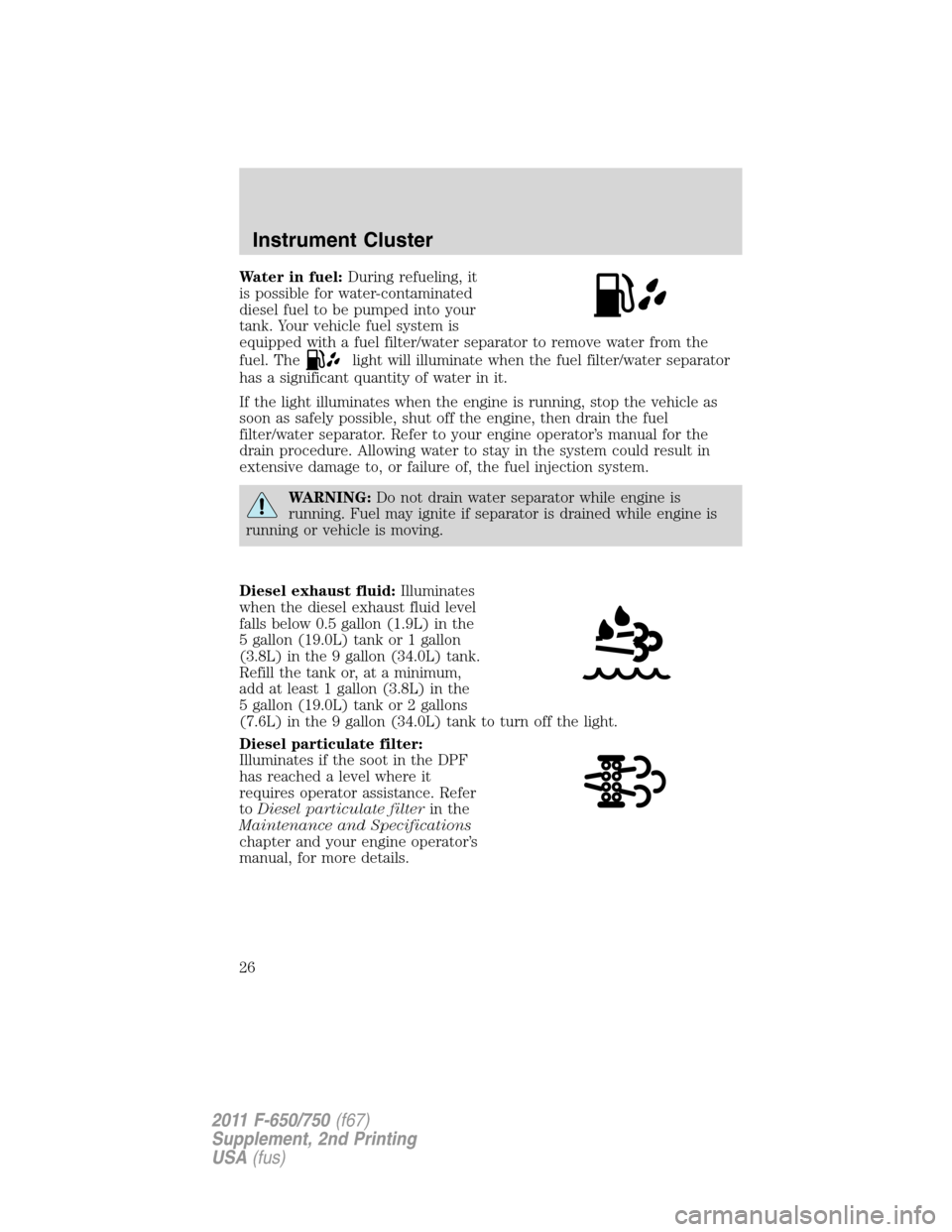
Water in fuel:During refueling, it
is possible for water-contaminated
diesel fuel to be pumped into your
tank. Your vehicle fuel system is
equipped with a fuel filter/water separator to remove water from the
fuel. The
light will illuminate when the fuel filter/water separator
has a significant quantity of water in it.
If the light illuminates when the engine is running, stop the vehicle as
soon as safely possible, shut off the engine, then drain the fuel
filter/water separator. Refer to your engine operator’s manual for the
drain procedure. Allowing water to stay in the system could result in
extensive damage to, or failure of, the fuel injection system.
WARNING:Do not drain water separator while engine is
running. Fuel may ignite if separator is drained while engine is
running or vehicle is moving.
Diesel exhaust fluid:Illuminates
when the diesel exhaust fluid level
falls below 0.5 gallon (1.9L) in the
5 gallon (19.0L) tank or 1 gallon
(3.8L) in the 9 gallon (34.0L) tank.
Refill the tank or, at a minimum,
add at least 1 gallon (3.8L) in the
5 gallon (19.0L) tank or 2 gallons
(7.6L) in the 9 gallon (34.0L) tank to turn off the light.
Diesel particulate filter:
Illuminates if the soot in the DPF
has reached a level where it
requires operator assistance. Refer
toDiesel particulate filterin the
Maintenance and Specifications
chapter and your engine operator’s
manual, for more details.
Instrument Cluster
26
2011 F-650/750(f67)
Supplement, 2nd Printing
USA(fus)
Page 32 of 290
5.Fuel gauge:Indicates approximately how much fuel is left in the fuel
tank (when the ignition is in the on position). The fuel gauge may vary
slightly when the vehicle is in motion or on a grade. Refer toFilling the
tankin theMaintenance and Specificationschapter for more
information.
6.Speedometer:Indicates the current vehicle speed.
Odometer and trip odometer:The odometer is displayed on the lower
line in the message center and registers the total accumulated distance
the vehicle has traveled. For trip odometer information, refer toMessage
centerin this chapter.
MESSAGE CENTER
Your vehicle’s message center is capable of monitoring many vehicle
systems and will alert you to potential vehicle problems and various
conditions with an informational message followed by a long indicator
chime.
The message center display is located in the instrument cluster and the
controls are located on the instrument panel.
Selectable features
Info (information menu)
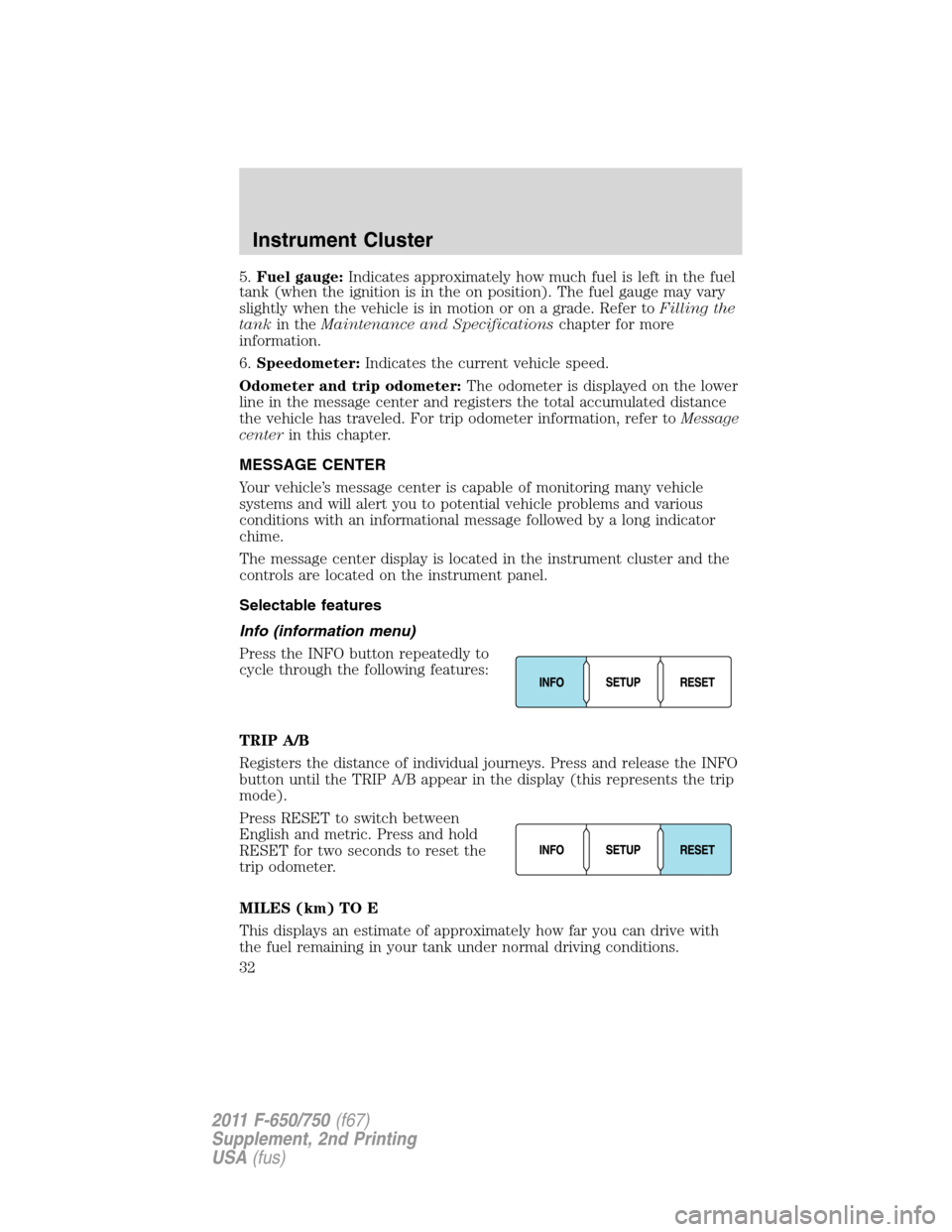
Press the INFO button repeatedly to
cycle through the following features:
TRIP A/B
Registers the distance of individual journeys. Press and release the INFO
button until the TRIP A/B appear in the display (this represents the trip
mode).
Press RESET to switch between
English and metric. Press and hold
RESET for two seconds to reset the
trip odometer.
MILES (km) TO E
This displays an estimate of approximately how far you can drive with
the fuel remaining in your tank under normal driving conditions.
Instrument Cluster
32
2011 F-650/750(f67)
Supplement, 2nd Printing
USA(fus)
Page 35 of 290
•Some messages can be acknowledged and reset by pressing RESET.
This allows you to use the full message center functionality by clearing
the message.
PARK BRAKE ENGAGED— Displayed when the parking brake is set,
the engine is running and the vehicle is driven more than 3 mph
(5 km/h). If the warning stays on after the parking brake is released,
contact your authorized dealer as soon as possible.
CHECK BRAKE SYSTEM— Displayed when a fault has been detected
by the ABS module.
CHECK CHARGING SYSTEM— Displayed when the electrical system
is not maintaining proper voltage. If you are operating electrical
accessories when the engine is idling at a low speed, turn off as many of
the electrical loads as soon as possible. If the warning stays on or comes
on when the engine is operating at normal speeds, contact your
authorized dealer as soon as possible.
BRAKE FLUID LEVEL LOW— Indicates the brake fluid level is low
and the brake system should be inspected immediately. Refer toBrake
fluidin theMaintenance and Specificationschapter.
Instrument Cluster
35
2011 F-650/750(f67)
Supplement, 2nd Printing
USA(fus)
Page 102 of 290
If the booster seat slides on the vehicle seat, placing a rubberized mesh
sold as shelf or carpet liner under the booster seat may improve this
condition. Do not introduce any item thicker than this under the booster
seat. Check with the booster seat manufacturer’s instructions.
The importance of shoulder belts
Using a booster without a shoulder belt increases the risk of a child’s
head hitting a hard surface in a collision. For this reason, you should
never use a booster seat with a lap belt only. It is generally best to use a
booster seat with lap/shoulder belts in the back seat.
Move a child to a different seating location if the shoulder belt does not
stay positioned on the shoulder during use.
Follow all instructions provided by the manufacturer of the booster seat.
WARNING:Never place, or allow a child to place, the shoulder
belt under a child’s arm or behind the back because it reduces
the protection for the upper part of the body and may increase the risk
of injury or death in a collision.
Safety belt maintenance
Inspect the vehicle safety belts and child safety seat systems periodically
to make sure they work properly and are not damaged. Inspect the
vehicle and child seat safety belts to make sure there are no nicks, tears
or cuts. Replace if necessary. All vehicle safety belt assemblies, including
retractors, buckles, front safety belt buckle assemblies, buckle support
assemblies (slide bar-if equipped), shoulder belt height adjusters (if
equipped), shoulder belt guide on seatback (if equipped), child safety
seat LATCH and tether anchors, and attaching hardware, should be
inspected after a collision. Refer to the child restraint manufacturer’s
instructions for additional inspection and maintenance information
specific to the child restraint. Ford Motor Company recommends that all
safety belt assemblies in use in vehicles involved in a collision be
replaced. However, if the collision was minor and an authorized dealer
finds that the belts do not show damage and continue to operate
properly, they do not need to be replaced. Safety belt assemblies not in
use during a collision should also be inspected and replaced if either
damage or improper operation is noted.
For proper care of soiled safety belts, refer toInteriorin theCleaning
chapter.
Seating and Safety Restraints
102
2011 F-650/750(f67)
Supplement, 2nd Printing
USA(fus)
Page 107 of 290
Hot weather operation
•Keep the engine cooling system filled with a clean, permanent coolant
solution to protect against damage from overheating.
•Fill the fuel tank at the end of daily operation to prevent condensation
in the fuel system.
•Keep external surfaces of the engine, radiator, charge air cooler, A/C
condenser and accessories clean to avoid dirt build-up.
Above normal coolant temperatures could be experienced while driving
in a transmission gear ratio which lugs the engine. To correct this
problem, engine speed should be increased by downshifting in to the
next lower gear to increase engine RPM.
Starting a turbocharged engine with the vehicle on a steep grade
When starting a diesel engine when the loaded vehicle is on a grade, the
engine RPM will start to fall slightly when the clutch is engaged; do not
disengage the clutch and try to increase engine RPM as this may damage
driveline components. The engine will recover as the vehicle begins
moving.
Engine shutdown
Allow the engine to idle for three to five minutes before shutting it
down. The larger the engine, the greater the need for this idling period.
However, do not let the engine idle for more than 10 minutes.
Restarting after running out of fuel
The fuel system may need to be purged of air, refer toRunning out of
fuelin theMaintenance and Specificationschapter.
GENERAL OPERATING INSTRUCTIONS
•Avoid extended (more than 10 minutes) and unnecessary idling.
•Start the vehicle in motion by using the highest gear speed in the
transmission that will let the engine easily start the load without
slipping the clutch.
•Accelerate smoothly and evenly; rapid acceleration increases fuel
consumption without increasing engine performance.
•When approaching a hill, press the accelerator smoothly to start the
incline at full power, then shift down as needed to maintain vehicle
speed.
•When going down a hill, or long steep grades, prevent over-speeding
of the engine. The engine governor has no control over engine speed
when it is being pushed by a loaded vehicle.
Driving
107
2011 F-650/750(f67)
Supplement, 2nd Printing
USA(fus)