air filter FORD F650 2012 12.G Owners Manual
[x] Cancel search | Manufacturer: FORD, Model Year: 2012, Model line: F650, Model: FORD F650 2012 12.GPages: 306, PDF Size: 1.74 MB
Page 9 of 306
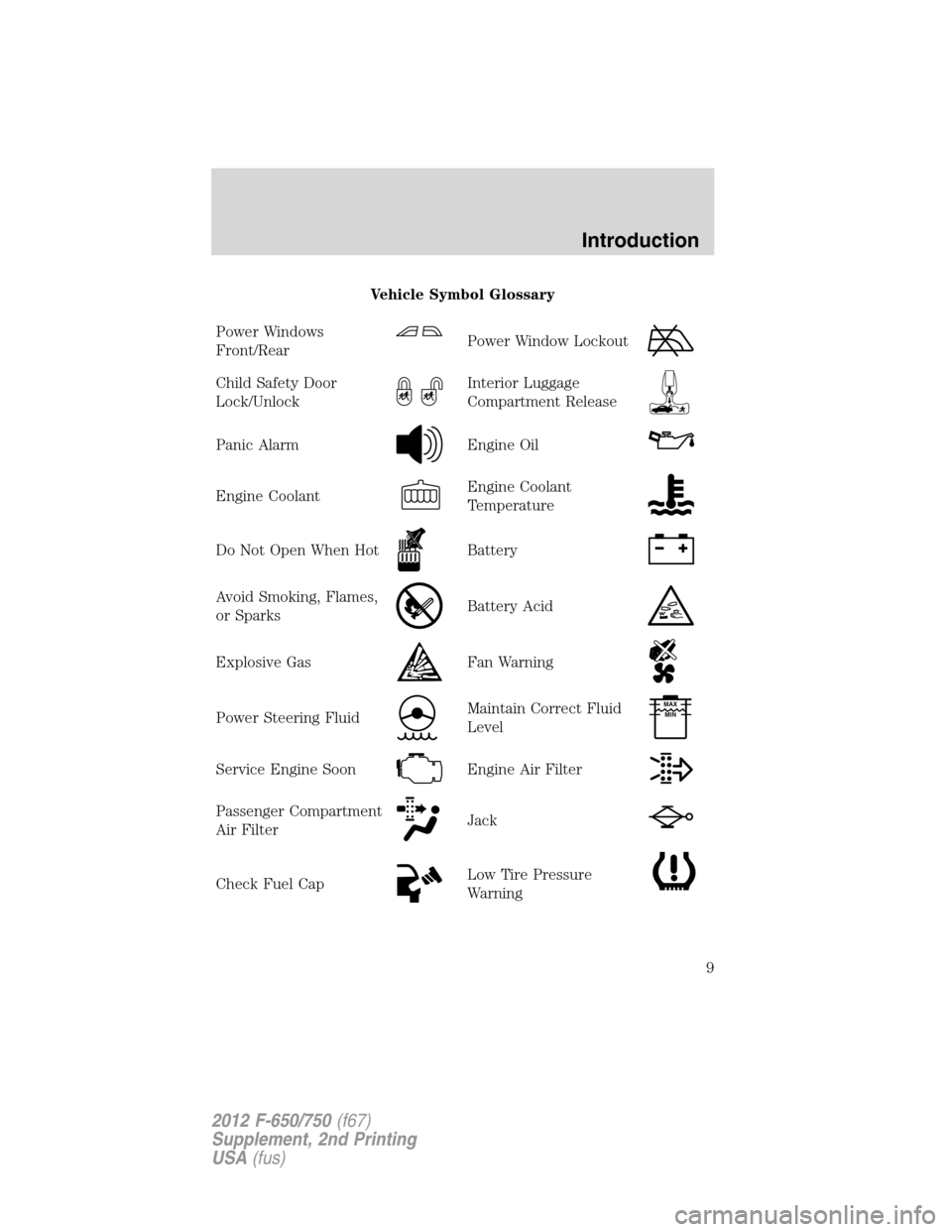
Vehicle Symbol Glossary
Power Windows
Front/Rear
Power Window Lockout
Child Safety Door
Lock/UnlockInterior Luggage
Compartment Release
Panic AlarmEngine Oil
Engine CoolantEngine Coolant
Temperature
Do Not Open When HotBattery
Avoid Smoking, Flames,
or SparksBattery Acid
Explosive GasFan Warning
Power Steering FluidMaintain Correct Fluid
LevelMAX
MIN
Service Engine SoonEngine Air Filter
Passenger Compartment
Air FilterJack
Check Fuel CapLow Tire Pressure
Warning
Introduction
9
2012 F-650/750(f67)
Supplement, 2nd Printing
USA(fus)
Page 109 of 306
may be limited and your vehicle may stall. Water may also enter your
engine’s air intake and severely damage your engine, drive axles or the
transmission (through the breather ports).
Once through the water, always dry the brakes by moving your vehicle
slowly while applying light pressure on the brake pedal. Wet brakes do
not stop the vehicle as quickly as dry brakes.
ENGINE AUTOMATIC SHUTDOWN WARNING LIGHT OR CHIME
(IF EQUIPPED)
This feature illuminates a light in the instrument cluster and/or sounds a
chime indicating that the engine is being shut down in the event of high
coolant temperature, low engine oil pressure, high diesel particulate filter
soot loading or low engine coolant level. In the event any of these
conditions exist, the engine automatically shuts down.
If the engine shuts down, it can be restarted and operated for
30 seconds at a time or until the problem is corrected. Do not attempt to
use this restarting feature to drive the vehicle very far as serious engine
damage could result.
WARNING:In the event of engine shutdown, make sure the
vehicle is safely off the road and the problem is remedied prior
to returning to the road. Failure to remove the vehicle from the road
could result in an accident, causing serious injury or death.
GENERAL BRAKE INFORMATION
All standard equipment brakes are designed to be self-adjusting.
Automatic adjustment, when required, occurs whenever the brakes are
applied and released during forward or reverse operation. Refer to the
Scheduled Maintenance Guidechapter for scheduled maintenance.
Occasional brake noise is normal and often does not indicate a performance
concern with the vehicle’s brake system. In normal operation, automotive
brake systems may emit occasional or intermittent squeal or groan noises
when the brakes are applied. Such noises are usually heard during the first
few brake applications in the morning; however, they may be heard at any
time while braking and can be aggravated by environmental conditions
such as cold, heat, moisture, road dust, salt or mud. If a “metal-to-metal,”
“continuous grinding” or “continuous squeal” sound is present while
braking, the brake linings may be worn-out and should be inspected by a
qualified service technician.
Know the required stopping distances for all driving conditions that may
be encountered. For longer brake lining life, take full advantage of engine
braking power when coming to a stop.
Driving
109
2012 F-650/750(f67)
Supplement, 2nd Printing
USA(fus)
Page 182 of 306
Follow the checks and services in theScheduled Maintenance Guide
chapter. Have your dealer or service center inspect your vehicle at least
once a year; remember that regular maintenance and inspections usually
prevent serious problems from developing later.
WARNING:Making modifications to various parts, components
and systems of the vehicle, such as brake and steering systems
can adversely affect the quality, reliability and operation of your vehicle
and could result in property damage, personal injury or death. Such
modifications must be avoided.
WARNING:Failure to properly perform maintenance and
servicing procedures could result in vehicle damage, personal
injury or death.
If the owner/operator of the vehicle is a skilled technician and intends on
performing the vehicle maintenance and service, he is strongly urged to
purchase a service manual.
WARNING:Take care when performing any maintenance,
system check or service on your vehicle. Some of the materials
may also be hazardous if used, serviced or handled improperly and
could result in property damage, personal injury or death.
Air conditioning system checks
Have the air conditioning system checked each spring. The refrigerant
charge, cleanliness of the condenser-evaporator cores and belt condition
are essential to system performance.
When the air conditioning system is being used daily, remove the fresh
air filter (if equipped) once each season and check for dirt, lint, etc.
Replace the filter if necessary. Vehicles operating in unusually dusty
conditions may require more frequent filter inspection and replacement.
Front axle - general service information
Maintaining the front axle alignment to specifications is very important
and should only be performed by a qualified technician. Toe-in
adjustment is particularly important with radial tires.
Make sure the axle mounting U-bolt nuts, attaching or mounting bolts
and nuts are securely tightened. Regularly check front axle for damage,
binding, worn parts and adequate lubrication.
Maintenance and Specifications
182
2012 F-650/750(f67)
Supplement, 2nd Printing
USA(fus)
Page 184 of 306
Brake system - general inspection
Your vehicle is equipped with non-asbestos brake linings. However,
exposure to excessive amounts of brake material (whether asbestos or
non-asbestos, fiberglass, mineral wool, aramid or carbon) may be a
serious health hazard.
Note:Persons handling brake linings should follow all precautions listed
below:
WARNING:
1. Always wear a respirator approved by the National Institute of
Occupational Studies of Health (NIOSH) or Mine Safety and Appliance
(MSA) during all brake service procedures. Wear the respirator from
removal of the wheels through assembly.
2.Neveruse compressed air or dry brushing to clean brake parts or
assemblies.
3. Clean brake parts and assemblies in open air. During assembly,
carefully place all parts on the floor to avoid getting dust in the air. Use
an industrial vacuum cleaner with a HEPA filter system to clean dust
from the brake drums, backing plates and other brake parts. After using
the vacuum, remove any remaining dust with a rag soaked in water and
wrung until nearly dry.
4.Neveruse compressed air or dry sweeping to clean the work area.
Use an industrial vacuum cleaner with a HEPA filter system and rags
soaked in water until wrung until nearly dry. Dispose of used rags with
care to avoid getting dust in the air. Use an approved respirator when
emptying vacuum cleaners and handling used rags.
5.Worker clean-up:Wash your hands before eating, drinking or
smoking. Vacuum your work clothes after use and then launder them
separately, without shaking them, to prevent fiber dust getting into the
air.
Air brakes
Inspection and adjustment:Establish a regular schedule for periodic
cleaning, lubrication and adjustment inspection based on vehicle use.
Exact maintenance intervals are difficult to predetermine since vehicles
are used in a wide variety of applications and conditions; if you are
uncertain of the proper schedule for your vehicle, contact your dealer.
Maintenance and Specifications
184
2012 F-650/750(f67)
Supplement, 2nd Printing
USA(fus)
Page 187 of 306
Brake lines, hoses and fittings:Inspect these components every
4,000 miles (6,000 km):
•Lines for kinks, dents, corrosion or rupture.
•Hoses for abrasions, kinks, soft spots or rupture, collapse, cracks,
twists or loose frame supports. When replacing a hose, be sure there
is adequate clearance to the hose to avoid an abrasion to the new
hose.
•All connections for leaks.
•Repair or replace brake line tubes, hoses or fittings as required.
Driveline parking brake
Parking brake adjustment should only be performed by a qualified
technician, and in accordance with the instructions in the service
manual.
WARNING:Use wheel chocks and exercise caution when
inspecting under the vehicle. A vehicle roll-away could result in
property damage, personal injury or death.
Catalytic converter (diesel engine)
If your diesel engine is equipped with a catalytic converter, it is
important to review the maintenance schedule to ensure proper
functioning of the catalytic converter. Also, take precautions not to
damage the catalytic converter when servicing your engine or storing
your vehicle.
Note:If your vehicle is equipped with a catalytic converter/muffler,do
notblend waste oil with diesel fuel. Operate only on ultra low sulfur
(less than 15 parts per million sulfur) diesel fuel with a cetane value of
45 or higher.
Diesel exhaust fluid (DEF), Diesel particulate filter (DPF) and Select
catalyst reduction (SCR) system
Refer to your engine operator’s manual for information regarding DEF,
DPF and SCR system service.
Air induction system
Once each year, perform a complete inspection of the air induction
system. In areas where road salt is used, the inspection consists of
disassembling the joints of each aluminum component and inspecting for
salt build-up, presence of chlorine that can cause aluminum particles to
flake off and enter the engine combustion chambers.
Maintenance and Specifications
187
2012 F-650/750(f67)
Supplement, 2nd Printing
USA(fus)
Page 218 of 306
Keep a record for at least one month and record the type of driving (city
or highway). This provides an accurate estimate of the vehicle’s fuel
economy under current driving conditions. Additionally, keeping records
during summer and winter shows how temperature impacts fuel
economy. In general, lower temperatures give lower fuel economy.
Driving style - good driving and fuel economy habits
Give consideration to the lists that follow and you may be able to change
a number of variables and improve your fuel economy.
Habits
•Smooth, moderate operation can yield up to 10% savings in fuel.
•Steady speeds without stopping usually give the best fuel economy.
•Anticipate stopping; slowing down may eliminate the need to stop.
•Sudden or hard accelerations may reduce fuel economy.
•Slow down gradually.
•Driving at reasonable speeds (traveling at 55 mph [88 km/h] uses 15%
less fuel than traveling at 65 mph [105 km/h]).
•Using the air conditioner or defroster may reduce fuel economy.
•Resting your foot on the brake pedal while driving may reduce fuel
economy.
Conditions
•Carrying unnecessary weight may reduce fuel economy.
•Fuel economy may decrease with lower temperatures during the first
8–10 miles (12–16 km) of driving.
•Flat terrain driving improves fuel economy over hilly roads.
•Transmissions give their best fuel economy when operated in the top
cruise gear and with steady pressure on the accelerator.
•Close windows for highway driving.
DIESEL PARTICULATE FILTER (DPF)
Your vehicle is equipped with a diesel particulate filter (DPF), as part of
the after-treatment exhaust system, to trap soot and other large particles
produced by the engine combustion process. The soot that accumulates
in the filter must be periodically reduced to ash to prevent excessive
exhaust restriction. The soot reduction process, also known as “filter
regeneration,” is generally performed automatically by your engine and
after-treatment system.
Maintenance and Specifications
218
2012 F-650/750(f67)
Supplement, 2nd Printing
USA(fus)
Page 219 of 306
WARNING:The normal operating temperature of the exhaust
system is very high. Never work around, or attempt to repair,
any part of the exhaust system until it has cooled. Use special care
when working around the diesel particulate filter. The DPF heats up to
a high temperature after only a short period of engine operation, and
can remain hot even after the engine is turned off. Failure to follow
these instructions may result in serious personal injury.
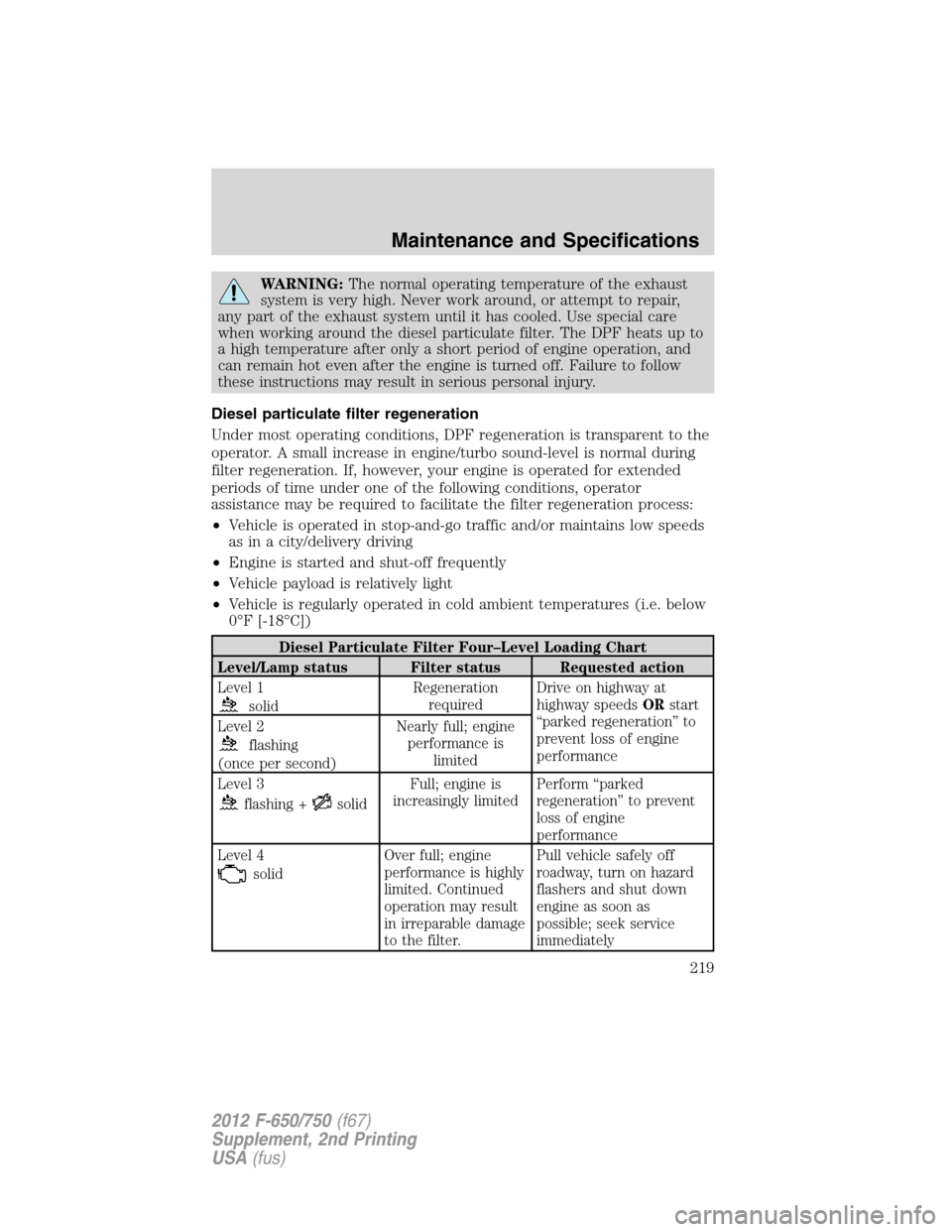
Diesel particulate filter regeneration
Under most operating conditions, DPF regeneration is transparent to the
operator. A small increase in engine/turbo sound-level is normal during
filter regeneration. If, however, your engine is operated for extended
periods of time under one of the following conditions, operator
assistance may be required to facilitate the filter regeneration process:
•Vehicle is operated in stop-and-go traffic and/or maintains low speeds
as in a city/delivery driving
•Engine is started and shut-off frequently
•Vehicle payload is relatively light
•Vehicle is regularly operated in cold ambient temperatures (i.e. below
0°F [-18°C])
Diesel Particulate Filter Four–Level Loading Chart
Level/Lamp status Filter status Requested action
Level 1
solidRegeneration
requiredDrive on highway at
highway speedsORstart
“parked regeneration” to
prevent loss of engine
performance Level 2
flashing
(once per second)Nearly full; engine
performance is
limited
Level 3
flashing +solidFull; engine is
increasingly limitedPerform “parked
regeneration” to prevent
loss of engine
performance
Level 4
solidOver full; engine
performance is highly
limited. Continued
operation may result
in irreparable damage
to the filter.Pull vehicle safely off
roadway, turn on hazard
flashers and shut down
engine as soon as
possible; seek service
immediately
Maintenance and Specifications
219
2012 F-650/750(f67)
Supplement, 2nd Printing
USA(fus)
Page 221 of 306
The engine speed may increase slightly. To allow parked regeneration to
continue uninterrupted:
1. The vehicle must remain parked
2. The transmission must remain in P (Park) or N (Neutral) (as
previously described in Step 2).
3. The accelerator pedal, service brake pedal, and clutch pedal (if
equipped) must not be pressed
4. The parking brake must remain set
On average (depending on filter level and other factors), the process takes
20–30 minutes to complete. The DPF lamp turns off when the process is
complete. Repeat Steps 1–5, if parked regeneration is interrupted.
To discontinue parked regeneration
Press any of the floor pedals to discontinue parked regeneration.
Diesel particulate filter maintenance and service
The DPF is designed to retain a relatively large amount of residual ash
and provide many miles and hours of maintenance-free operation. At
some point, generally beyond 150,000 miles (240,000 km) or 5,000 hours
of operation (whichever comes first), the DPF requires professional
cleaning to remove the accumulated ash.
The exact number of miles or hours of operation varies greatly depending
upon vehicle/engine loading and operating conditions, ash content of the
engine oil, and quality of the diesel fuel used in your truck. Adhering to
your engine manufacturer’s recommended oil and fuel specifications
maximizes the miles and hours of operation before a DPF professional
cleaning is required. Refer to your engine manufacturer’s owner’s manual for
more details regarding recommended maintenance and service of your DPF.
Exhaust outlet assembly
WARNING:The normal operating temperature of the exhaust
system is very high. Never work around or attempt to repair any
part of the exhaust system until it has cooled. Failure to follow these
instructions may result in serious personal injury.
The exhaust outlet assembly on your vehicle is a uniquely functioning
device that accompanies the DPF assembly. It is designed to help control
the temperature of the exhaust during the DPF regeneration process.Do
not modify or remove this device. Modification of the system
Maintenance and Specifications
221
2012 F-650/750(f67)
Supplement, 2nd Printing
USA(fus)
Page 265 of 306
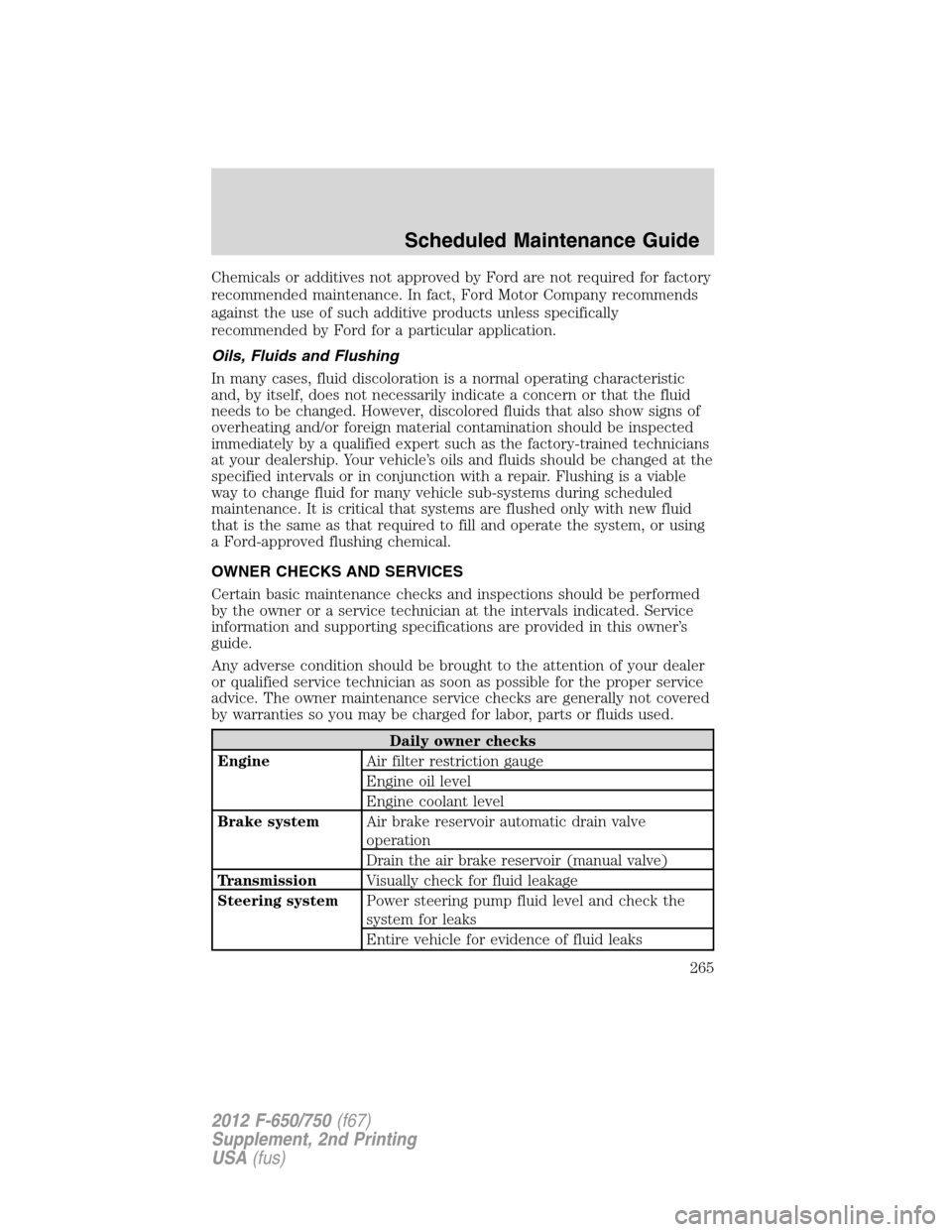
Chemicals or additives not approved by Ford are not required for factory
recommended maintenance. In fact, Ford Motor Company recommends
against the use of such additive products unless specifically
recommended by Ford for a particular application.
Oils, Fluids and Flushing
In many cases, fluid discoloration is a normal operating characteristic
and, by itself, does not necessarily indicate a concern or that the fluid
needs to be changed. However, discolored fluids that also show signs of
overheating and/or foreign material contamination should be inspected
immediately by a qualified expert such as the factory-trained technicians
at your dealership. Your vehicle’s oils and fluids should be changed at the
specified intervals or in conjunction with a repair. Flushing is a viable
way to change fluid for many vehicle sub-systems during scheduled
maintenance. It is critical that systems are flushed only with new fluid
that is the same as that required to fill and operate the system, or using
a Ford-approved flushing chemical.
OWNER CHECKS AND SERVICES
Certain basic maintenance checks and inspections should be performed
by the owner or a service technician at the intervals indicated. Service
information and supporting specifications are provided in this owner’s
guide.
Any adverse condition should be brought to the attention of your dealer
or qualified service technician as soon as possible for the proper service
advice. The owner maintenance service checks are generally not covered
by warranties so you may be charged for labor, parts or fluids used.
Daily owner checks
EngineAir filter restriction gauge
Engine oil level
Engine coolant level
Brake systemAir brake reservoir automatic drain valve
operation
Drain the air brake reservoir (manual valve)
TransmissionVisually check for fluid leakage
Steering systemPower steering pump fluid level and check the
system for leaks
Entire vehicle for evidence of fluid leaks
Scheduled Maintenance Guide
265
2012 F-650/750(f67)
Supplement, 2nd Printing
USA(fus)
Page 269 of 306
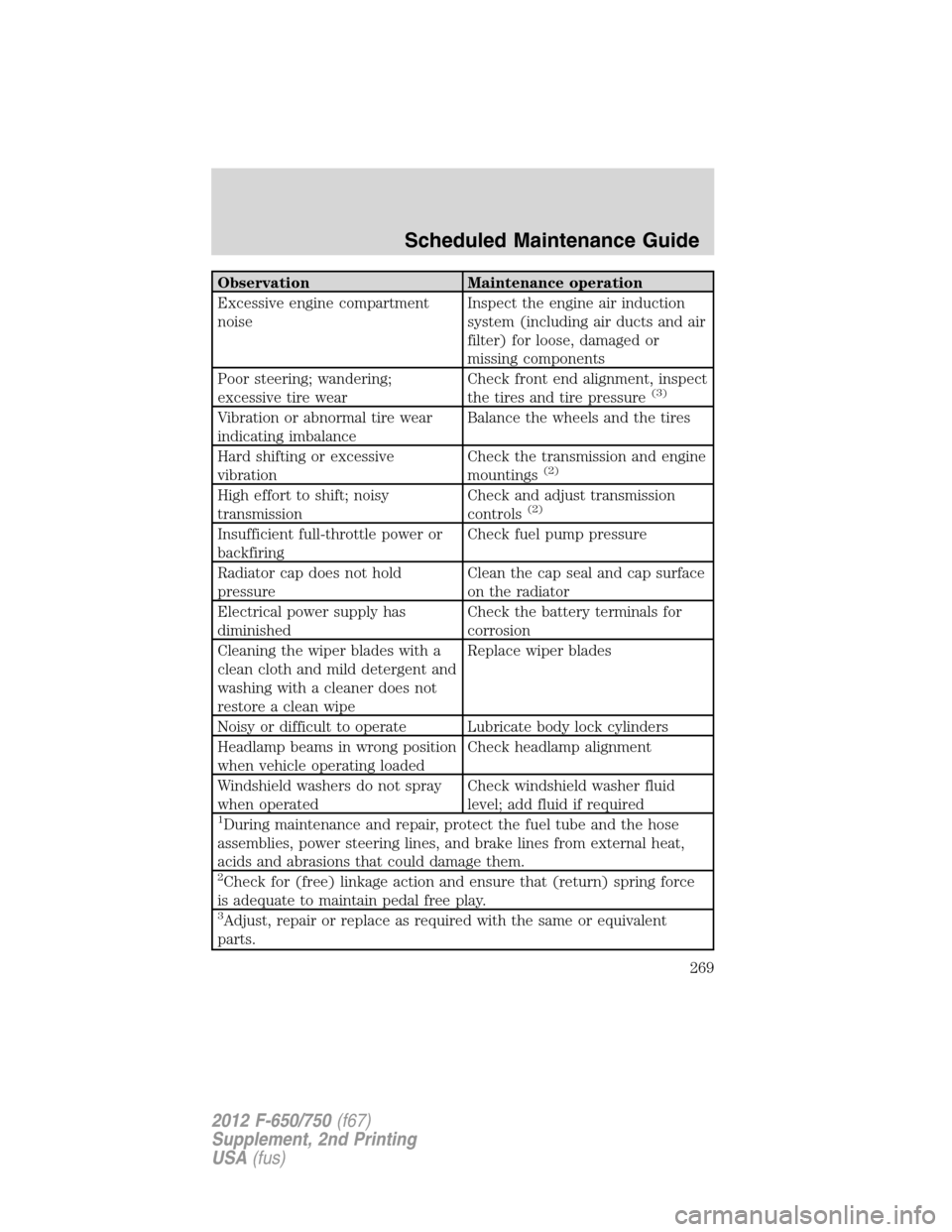
Observation Maintenance operation
Excessive engine compartment
noiseInspect the engine air induction
system (including air ducts and air
filter) for loose, damaged or
missing components
Poor steering; wandering;
excessive tire wearCheck front end alignment, inspect
the tires and tire pressure
(3)
Vibration or abnormal tire wear
indicating imbalanceBalance the wheels and the tires
Hard shifting or excessive
vibrationCheck the transmission and engine
mountings
(2)
High effort to shift; noisy
transmissionCheck and adjust transmission
controls(2)
Insufficient full-throttle power or
backfiringCheck fuel pump pressure
Radiator cap does not hold
pressureClean the cap seal and cap surface
on the radiator
Electrical power supply has
diminishedCheck the battery terminals for
corrosion
Cleaning the wiper blades with a
clean cloth and mild detergent and
washing with a cleaner does not
restore a clean wipeReplace wiper blades
Noisy or difficult to operate Lubricate body lock cylinders
Headlamp beams in wrong position
when vehicle operating loadedCheck headlamp alignment
Windshield washers do not spray
when operatedCheck windshield washer fluid
level; add fluid if required
1During maintenance and repair, protect the fuel tube and the hose
assemblies, power steering lines, and brake lines from external heat,
acids and abrasions that could damage them.
2Check for (free) linkage action and ensure that (return) spring force
is adequate to maintain pedal free play.
3Adjust, repair or replace as required with the same or equivalent
parts.
Scheduled Maintenance Guide
269
2012 F-650/750(f67)
Supplement, 2nd Printing
USA(fus)