engine FORD F650 2013 12.G Owners Manual
[x] Cancel search | Manufacturer: FORD, Model Year: 2013, Model line: F650, Model: FORD F650 2013 12.GPages: 378, PDF Size: 3.82 MB
Page 201 of 378
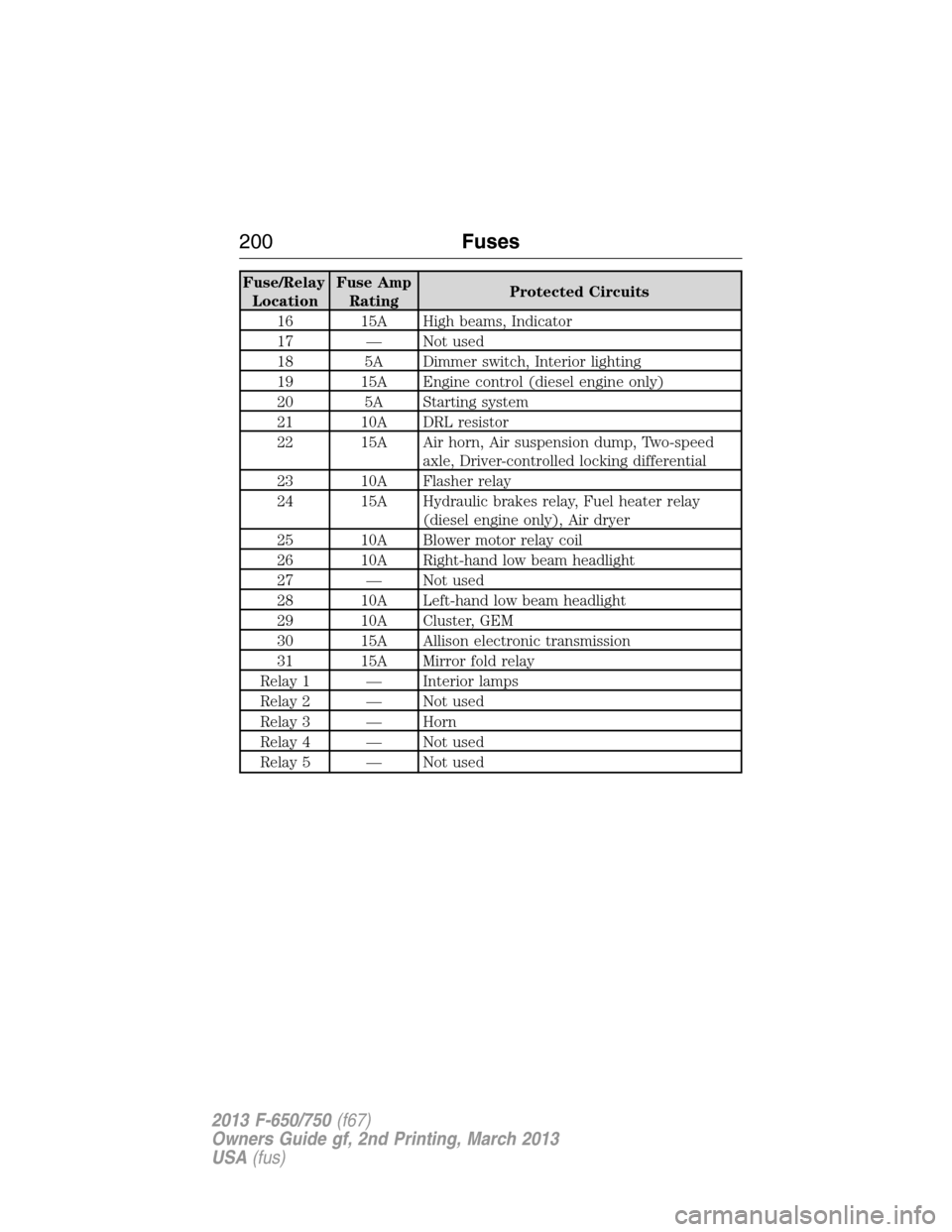
Fuse/Relay
LocationFuse Amp
RatingProtected Circuits
16 15A High beams, Indicator
17 — Not used
18 5A Dimmer switch, Interior lighting
19 15A Engine control (diesel engine only)
20 5A Starting system
21 10A DRL resistor
22 15A Air horn, Air suspension dump, Two-speed
axle, Driver-controlled locking differential
23 10A Flasher relay
24 15A Hydraulic brakes relay, Fuel heater relay
(diesel engine only), Air dryer
25 10A Blower motor relay coil
26 10A Right-hand low beam headlight
27 — Not used
28 10A Left-hand low beam headlight
29 10A Cluster, GEM
30 15A Allison electronic transmission
31 15A Mirror fold relay
Relay 1 — Interior lamps
Relay 2 — Not used
Relay 3 — Horn
Relay 4 — Not used
Relay 5 — Not used
200Fuses
2013 F-650/750(f67)
Owners Guide gf, 2nd Printing, March 2013
USA(fus)
Page 202 of 378
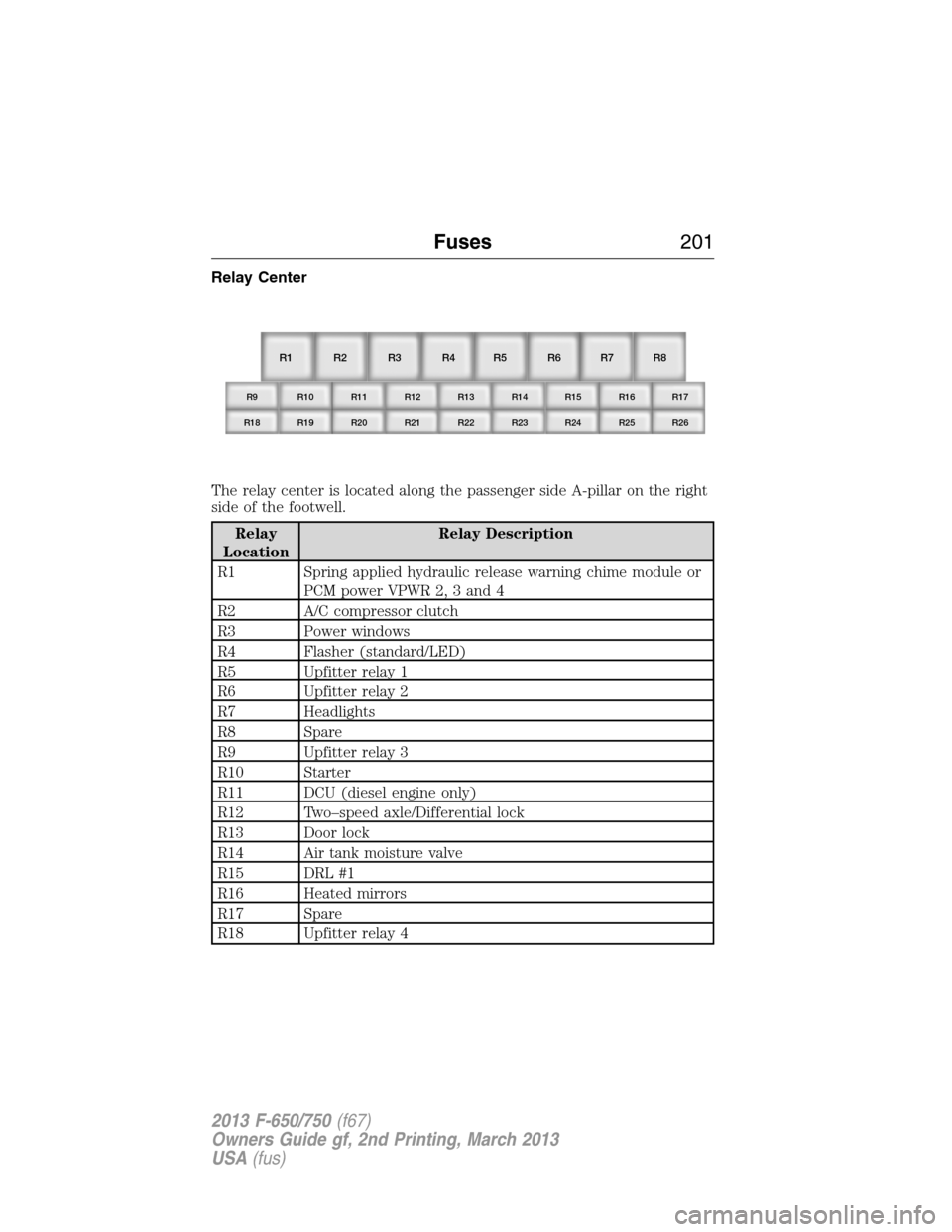
Relay Center
The relay center is located along the passenger side A-pillar on the right
side of the footwell.
Relay
LocationRelay Description
R1 Spring applied hydraulic release warning chime module or
PCM power VPWR 2, 3 and 4
R2 A/C compressor clutch
R3 Power windows
R4 Flasher (standard/LED)
R5 Upfitter relay 1
R6 Upfitter relay 2
R7 Headlights
R8 Spare
R9 Upfitter relay 3
R10 Starter
R11 DCU (diesel engine only)
R12 Two–speed axle/Differential lock
R13 Door lock
R14 Air tank moisture valve
R15 DRL #1
R16 Heated mirrors
R17 Spare
R18 Upfitter relay 4
R1
R9 R10 R11 R12 R13 R14 R15 R16 R17
R18 R19 R20 R21 R22 R23 R24 R25 R26
R2 R3 R4 R5 R6 R7 R8
Fuses201
2013 F-650/750(f67)
Owners Guide gf, 2nd Printing, March 2013
USA(fus)
Page 203 of 378
Relay
LocationRelay Description
R19 Shift interlock/EPRNDL display
R20 Selective Catalyst Reduction (SCR) system (NOx) (diesel
engine only)
R21 Run
R22 Door unlock
R23 ABS warning indicator
R24 DRL #2
R25 Park lights
R26 Spare
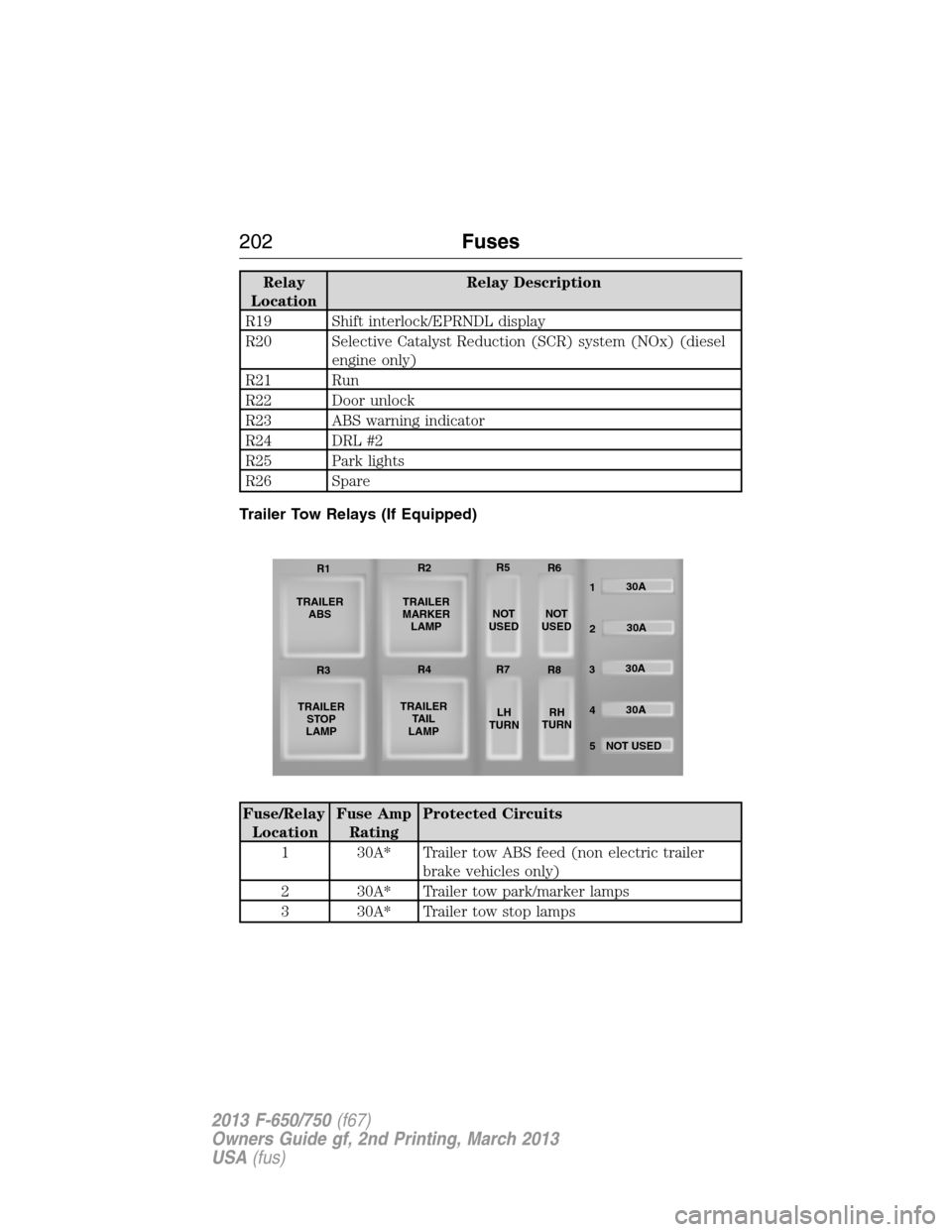
Trailer Tow Relays (If Equipped)
Fuse/Relay
LocationFuse Amp
RatingProtected Circuits
1 30A* Trailer tow ABS feed (non electric trailer
brake vehicles only)
2 30A* Trailer tow park/marker lamps
3 30A* Trailer tow stop lamps
TRAILER
ABS
TRAILER
STOP
LAMPTRAILER
MARKER
LAMP
TRAILER
TA I L
LAMPNOT
USEDNOT
USED
LH
TURNRH
TURN30A
30A
30A
30A
NOT USED
5 4 32 1 R1R2R5
R6
R3R4R7
R8
202Fuses
2013 F-650/750(f67)
Owners Guide gf, 2nd Printing, March 2013
USA(fus)
Page 204 of 378
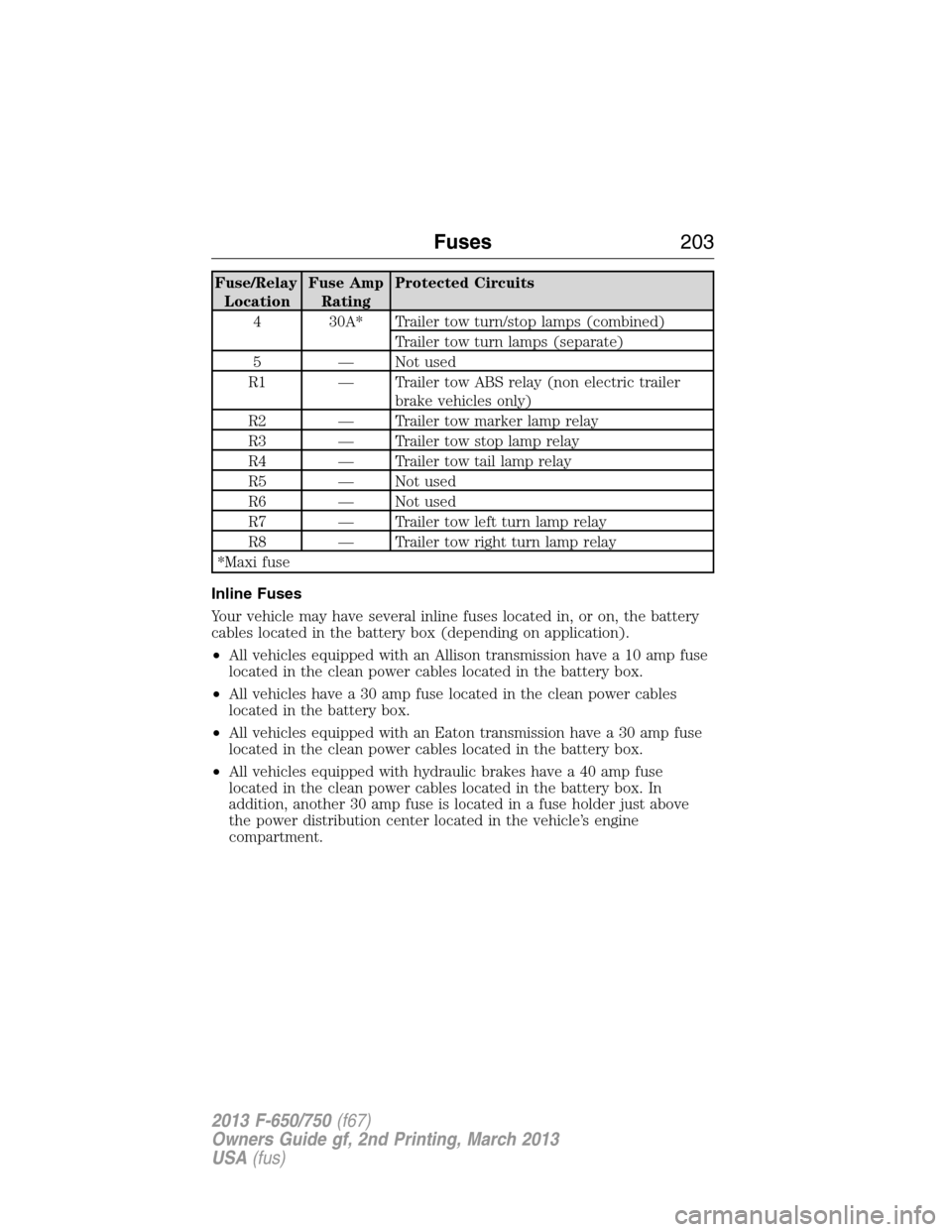
Fuse/Relay
LocationFuse Amp
RatingProtected Circuits
4 30A* Trailer tow turn/stop lamps (combined)
Trailer tow turn lamps (separate)
5 — Not used
R1 — Trailer tow ABS relay (non electric trailer
brake vehicles only)
R2 — Trailer tow marker lamp relay
R3 — Trailer tow stop lamp relay
R4 — Trailer tow tail lamp relay
R5 — Not used
R6 — Not used
R7 — Trailer tow left turn lamp relay
R8 — Trailer tow right turn lamp relay
*Maxi fuse
Inline Fuses
Your vehicle may have several inline fuses located in, or on, the battery
cables located in the battery box (depending on application).
•All vehicles equipped with an Allison transmission have a 10 amp fuse
located in the clean power cables located in the battery box.
•All vehicles have a 30 amp fuse located in the clean power cables
located in the battery box.
•All vehicles equipped with an Eaton transmission have a 30 amp fuse
located in the clean power cables located in the battery box.
•All vehicles equipped with hydraulic brakes have a 40 amp fuse
located in the clean power cables located in the battery box. In
addition, another 30 amp fuse is located in a fuse holder just above
the power distribution center located in the vehicle’s engine
compartment.
Fuses203
2013 F-650/750(f67)
Owners Guide gf, 2nd Printing, March 2013
USA(fus)
Page 205 of 378
GENERAL INFORMATION
WARNING:Making modifications to various parts, components
and systems of the vehicle, such as brake and steering systems,
can adversely affect the quality, reliability and operation of your vehicle
and could result in property damage, personal injury or death. Such
modifications must be avoided.
WARNING:Failure to properly perform maintenance and
servicing procedures could result in vehicle damage, personal
injury or death.
WARNING:Take care when performing any maintenance,
system check or service on your vehicle. Some of the materials
may also be hazardous if used, serviced or handled improperly and
could result in property damage, personal injury or death.
Always use care when performing vehicle maintenance, repairs or system
checks. Improper or incomplete service could result in the vehicle not
working properly which may result in personal injury or damage to the
vehicle or equipment. It is the operator’s responsibility to see that the
vehicle receives proper care and maintenance. If you have any questions
about performing service, have the service done by a qualified technician.
Servicing Guidelines
When servicing your vehicle:
•always wear safety glasses for eye protection.
•always set the parking brake or chock the wheels.
•always use support stands, not a jack, when working under a raised
vehicle.
•always turn off the ignition unless a procedure requires the engine to
be running.
•always avoid contact with hot metal parts. Allow the components to
cool before working with, or around, them.
•always operate the engine in a well-ventilated area.
•do not wear loose-fitting clothing, hanging jewelry, watches or rings.
•do not smoke.
•do not work on the brakes or the clutch unless the proper
precautions are taken to avoid inhaling friction material dust.
Quality service parts are available through your dealer. If dealer parts are
not used, make sure the replacement parts are of equivalent quality.
204Maintenance
2013 F-650/750(f67)
Owners Guide gf, 2nd Printing, March 2013
USA(fus)
Page 206 of 378
WARNING:The use of inferior parts can adversely affect the
quality and reliability of your vehicle which, in turn, can result in
property damage, personal injury or death.
To avoid damage to the vehicle’s electrical components prior to electric
welding:
•disconnect both battery cables.
•attach the welder ground cable as close as possible to the part being
welded.
•it is recommended that the component be temporarily removed if
welding close to an electrical component.
Follow the checks and services in theScheduled Maintenancechapter.
Have your dealer or service center inspect your vehicle at least once a
year. Remember that regular maintenance and inspections usually
prevent serious problems from developing later.
If the owner or operator of the vehicle is a skilled technician and intends
on performing the vehicle maintenance and service, he is strongly urged
to purchase a service manual.
Electrical System
Periodically inspect electrical connectors on the outside of the cab and
on the engine and frame for corrosion and tightness. Exposed terminals,
such as the fuel sender, cranking motor, alternator and feed-through
studs, should be cleaned and re-coated with a lubricant sealing grease
such as Motorcraft® Silicone Brake Caliper Grease and Dielectic
Compound XG-3, or equivalent. This should include the ground cable
connector for batteries, engine and cab as well as the jump starting stud.
Accessory Feed Connections
Vehicle electrical systems are complex and often include powertrain
components, such as engine and transmission controls, instrument
panels, ABS, etc. While most systems operate on battery voltage
(12 volts), some systems can be as high as 90 volts or as low as five
volts. See theElectrical Circuit Diagram Manuals,available from your
vehicle’s manufacturer, to make sure that any additional body lights and
accessories are connected to circuits that are both appropriate and not
overloaded. No modification should be made to any vehicle control
system without first contacting your dealer.
Maintenance205
2013 F-650/750(f67)
Owners Guide gf, 2nd Printing, March 2013
USA(fus)
Page 212 of 378
Hydraulic Brakes
Establish a regular schedule for periodic cleaning, lubrication and
adjustment inspection based on vehicle use. Exact maintenance intervals
are difficult to predetermine since vehicles are used in a wide variety of
applications and conditions. If you are uncertain of the proper schedule
for your vehicle, contact your dealer.
Regular inspections should include:
•checking the brake lining (every service interval). Establish
inspection intervals that provide for lining replacement before damage
to the disc occurs. Excessive lining wear may expose the backing
plate to the disc causing scoring of the disc faces. This inspection
should be performed by a qualified technician and must be in
accordance with instructions provided by the service manual.
Hydraulic brake systems are power-assisted. Braking capabilities are
greatly reduced without engine assist.
•proper fluid level. The level should be at the bottom edge of the ring
on each reservoir fill port. Do not fill the master cylinder to the top of
the reservoir. If fluid level requires attention to maintain a proper
master cylinder level, this is an indication of either severe operation
(pad wear) or fluid leakage. A more frequent and thorough brake
inspection is required.
•brake lines, hoses and fittings. Repair or replace brake line tubes,
hoses or fittings as required. Inspect these components every
4000 miles (6000 kilometers):
•Lines for kinks, dents, corrosion or rupture.
•Hoses for abrasions, kinks, soft spots or rupture, collapse, cracks,
twists or loose frame supports. When replacing a hose, be sure
there is adequate clearance to the hose to avoid an abrasion to the
new hose.
•All connections for leaks.
Driveline Parking Brake
WARNING:Use wheel chocks and exercise caution when
inspecting under the vehicle. A vehicle roll-away could result in
property damage, personal injury or death.
Parking brake adjustment should only be performed by a qualified
technician, and in accordance with the instructions in the service
manual.
Maintenance211
2013 F-650/750(f67)
Owners Guide gf, 2nd Printing, March 2013
USA(fus)
Page 214 of 378
Catalytic Converter (Diesel Engine)
Note:If your vehicle is equipped with a catalytic converter/muffler,do
notblend waste oil with diesel fuel. Operate only on ultra low sulfur
(less than 15 parts per million sulfur) diesel fuel with a cetane value of
45 or higher.
If your diesel engine is equipped with a catalytic converter, it is
important to review the maintenance schedule to make sure proper
functioning of the catalytic converter. Also, take precautions not to
damage the catalytic converter when servicing your engine or storing
your vehicle.
Diesel Exhaust Fluid (DEF), Diesel Particulate Filter (DPF) and
Select Catalyst Reduction (SCR) System
See your engine operator’s manual for information regarding DEF, DPF
and SCR system service.
Air Induction System
WARNING:When performing maintenance to any turbocharged
engine with engine air inlet piping disconnected, keep loose
clothing, jewelry and long hair away from the engine air inlet piping.
A turbocharger compressor air inlet protective shield should be
installed over the turbocharger air inlet to reduce the risk of personal
injury or death.
Perform a complete inspection of the air induction system annually.
In areas where road salt is used, disassemble the joints of each aluminum
component and inspect for salt build-up and presence of chlorine that
can cause aluminum particles to flake off and enter the engine
combustion chambers. If evidence of corrosion is found (usually at the
pipe connections), use a wire brush to clean the inside of the pipes and
inside the rubber hoses.
If the intake pipes are pitted at the joint ends, use Motorcraft® Silicone
Gasket and Sealant TA-30 to seal the joints. Make sure no excess
material is on the inside of the pipes that can be pulled into the engine.
If the service condition of the pipes, hoses or clamps is questionable,
replace the defective part(s).
Make sure all dust and debris has been cleaned out of the pipes and
couplings with a clean, damp rag prior to reassembly.
Maintenance213
2013 F-650/750(f67)
Owners Guide gf, 2nd Printing, March 2013
USA(fus)
Page 215 of 378
Chassis-mounted Charge Air Cooler
Visually inspect the core assembly for debris and clogging of external fins
with the engine off. Prior to engine operation, remove any debris
blocking the core.
•Turbocharger-to-charge air cooler
•Charge air cooler-to-intake manifold pipe
•Mounting bracket
•Chassis-mounted charge air cooler core
Inspect air intake piping:
•Check for accumulation of salt deposits (where applicable).
If present, disassemble and clean the complete air intake piping
system. If the intake piping is pitted, use Motorcraft® Silicone Gasket
and Sealant TA-30 to seal joints against leakage.
•Check for loose hoses and clamps.
•Check for ruptured or collapsed hoses.
•Check air cleaner housing for cracks.
Suspension Inspection
Note:Do not adjust air suspension height to any setting other than the
specified setting. Altering the height setting changes the driveline angle
and may result in unwarrantable component damage, such as
transmission component damage.
Verify drive axle air suspension height and height control valve
performance at engine oil change intervals.
Periodically check:
•Condition of spring leaves for evidence of fatigue, bending or
breakage.
•Condition of suspension mounting brackets and bushings.
•Torque rod mounting fasteners for tightness.
•For proper suspension alignment. This must be maintained at all
times.
•U-bolts. After the chassis has been operating under load for
1000 miles (1600 kilometers) or six months (whichever comes first),
the U-bolt nuts must be re-torqued. The U-bolt nuts must be
re-torqued every 36000 miles (60000 kilometers) thereafter. The
U-bolt and nut threads and seats should be cleaned and lubricated to
make sure a like new condition when re-torquing.
Note:SeeSpring U-bolt checklater in this chapter.
214Maintenance
2013 F-650/750(f67)
Owners Guide gf, 2nd Printing, March 2013
USA(fus)
Page 216 of 378
Supporting Your Vehicle for Service
WARNING:Do not use a jack when working under a vehicle. It
may give way, causing the vehicle to fall and result in property
damage, personal injury or death. Always use floor stands to support
the vehicle.
Prepare the vehicle for service repairs by doing the following:
1. Park the vehicle on a level, concrete floor.
2. Set the parking brake and block the wheels to prevent the vehicle
from moving.
3. Select a jack with a rated capacity sufficient to lift and hold up the
vehicle.
4. Raise the vehicle with the jack applied to the axle(s). DO NOT use
the bumper as a lifting point.
5. Support the vehicle with floor stands under the axle(s). If the axle or
the suspension is being serviced, support the vehicle with floor
stands under the frame side-members, preferably between the axles.
Frame and Tow Hooks
Your vehicle’s chassis is manufactured with frame rails of either HSLA
steel or heat-treated steel. Each must be handled in a specific manner to
make sure maximum service life. Consult the service manual or your
dealer before attempting frame repair or modification.
It is important, particularly on vehicles where the tow hooks are used
frequently, to inspect the front and rear tow hooks for damage or a loose
mounting.
OPENING AND CLOSING THE HOOD
WARNING:The parking brake must be fully set before opening
the hood or possible personal injury may occur.
WARNING:To reduce the risk of the possibility of personal
injury, never stand beneath the hood when it is being raised or
lowered.
WARNING:If you must leave the engine running while checking
under the hood, do not allow any loose clothing, jewelry, hair or
other items to get near moving engine components or possible personal
injury may occur.
Maintenance215
2013 F-650/750(f67)
Owners Guide gf, 2nd Printing, March 2013
USA(fus)