ABS FORD F650 2013 12.G User Guide
[x] Cancel search | Manufacturer: FORD, Model Year: 2013, Model line: F650, Model: FORD F650 2013 12.GPages: 378, PDF Size: 3.82 MB
Page 197 of 378
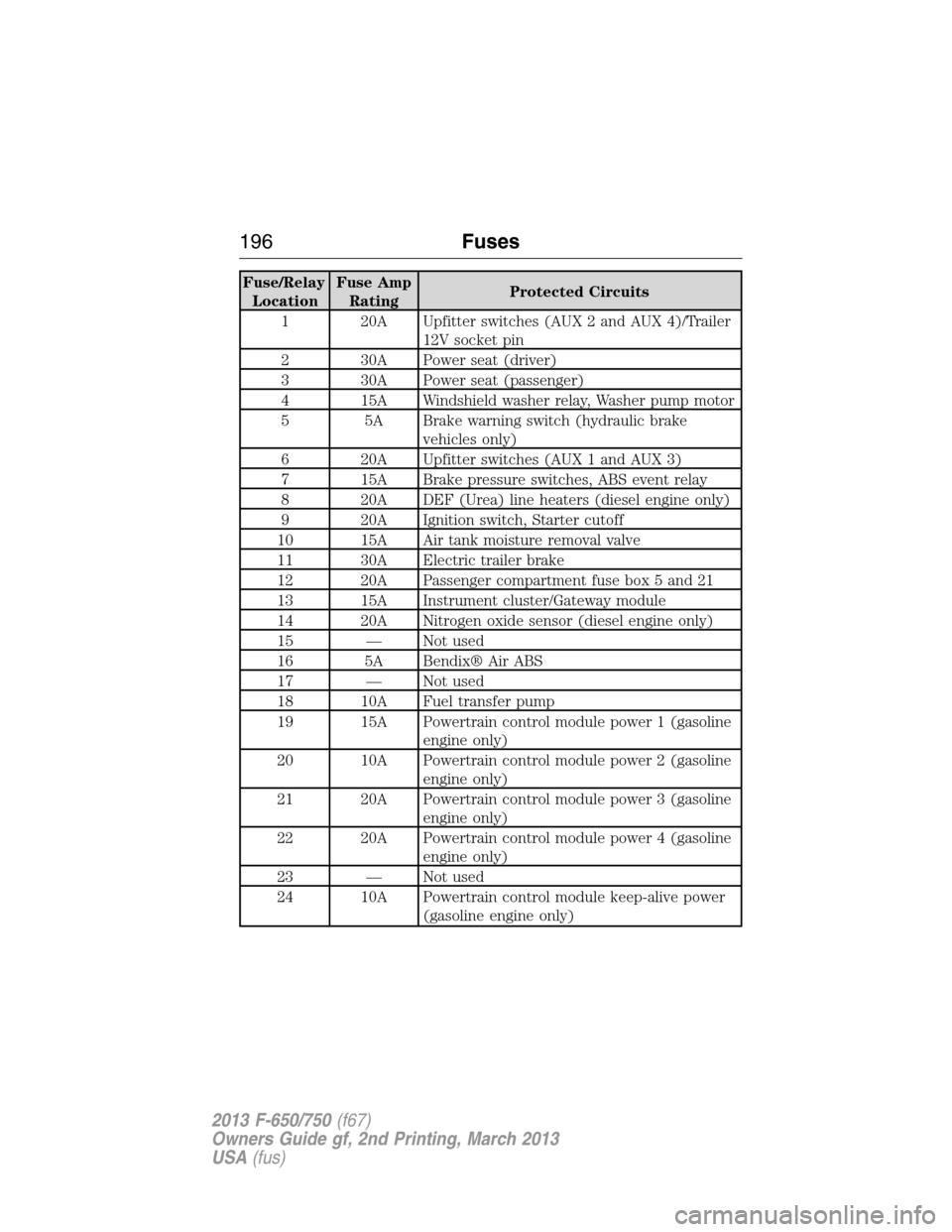
Fuse/Relay
LocationFuse Amp
RatingProtected Circuits
1 20A Upfitter switches (AUX 2 and AUX 4)/Trailer
12V socket pin
2 30A Power seat (driver)
3 30A Power seat (passenger)
4 15A Windshield washer relay, Washer pump motor
5 5A Brake warning switch (hydraulic brake
vehicles only)
6 20A Upfitter switches (AUX 1 and AUX 3)
7 15A Brake pressure switches, ABS event relay
8 20A DEF (Urea) line heaters (diesel engine only)
9 20A Ignition switch, Starter cutoff
10 15A Air tank moisture removal valve
11 30A Electric trailer brake
12 20A Passenger compartment fuse box 5 and 21
13 15A Instrument cluster/Gateway module
14 20A Nitrogen oxide sensor (diesel engine only)
15 — Not used
16 5A Bendix® Air ABS
17 — Not used
18 10A Fuel transfer pump
19 15A Powertrain control module power 1 (gasoline
engine only)
20 10A Powertrain control module power 2 (gasoline
engine only)
21 20A Powertrain control module power 3 (gasoline
engine only)
22 20A Powertrain control module power 4 (gasoline
engine only)
23 — Not used
24 10A Powertrain control module keep-alive power
(gasoline engine only)
196Fuses
2013 F-650/750(f67)
Owners Guide gf, 2nd Printing, March 2013
USA(fus)
Page 198 of 378
Fuse/Relay
LocationFuse Amp
RatingProtected Circuits
101 30A Bendix Air ABS relay (Air brake vehicles
only)
Hydraulic brakes module (hydraulic brake
vehicles only)
102 20A Ignition switch
103 20A Ignition switch, Passenger compartment fuse
box fuses 19, 29 and 30
104 20A Power point
105 20A Power door lock switches
106 30A Main light switch, Multi-function switch
107 50A Passenger compartment fuse box fuses 1, 2,
3, 4, 12, 13, 14 and 15
108 40A Fuel heater (diesel engine only)
20A Fuel pump module (gasoline engine only)
109 40A Power window
110 30A Windshield wiper
111 30A Body builder relay, Parking lamps
112 40A Blower motor
113 30A Heated seats, Air-Ride seat
114 20A Aftertreatment DCU
115 20A Ignition switch, Passenger compartment fuse
box fuses 8, 9, 10 and 11
116 30A Left/Right turn relays, Back up lamp relay
117 20A Stop lamps
118 60A Hydraulic brake vehicles (trailer tow package
only)
601 60A Trailer socket
602 60A Air brake trailer tow fuse block
30A Hydraulic brakes pump motor 2
201 — Windshield washer relay
202 — Wiper high/low relay
203 — Wiper run/park relay
Fuses197
2013 F-650/750(f67)
Owners Guide gf, 2nd Printing, March 2013
USA(fus)
Page 199 of 378
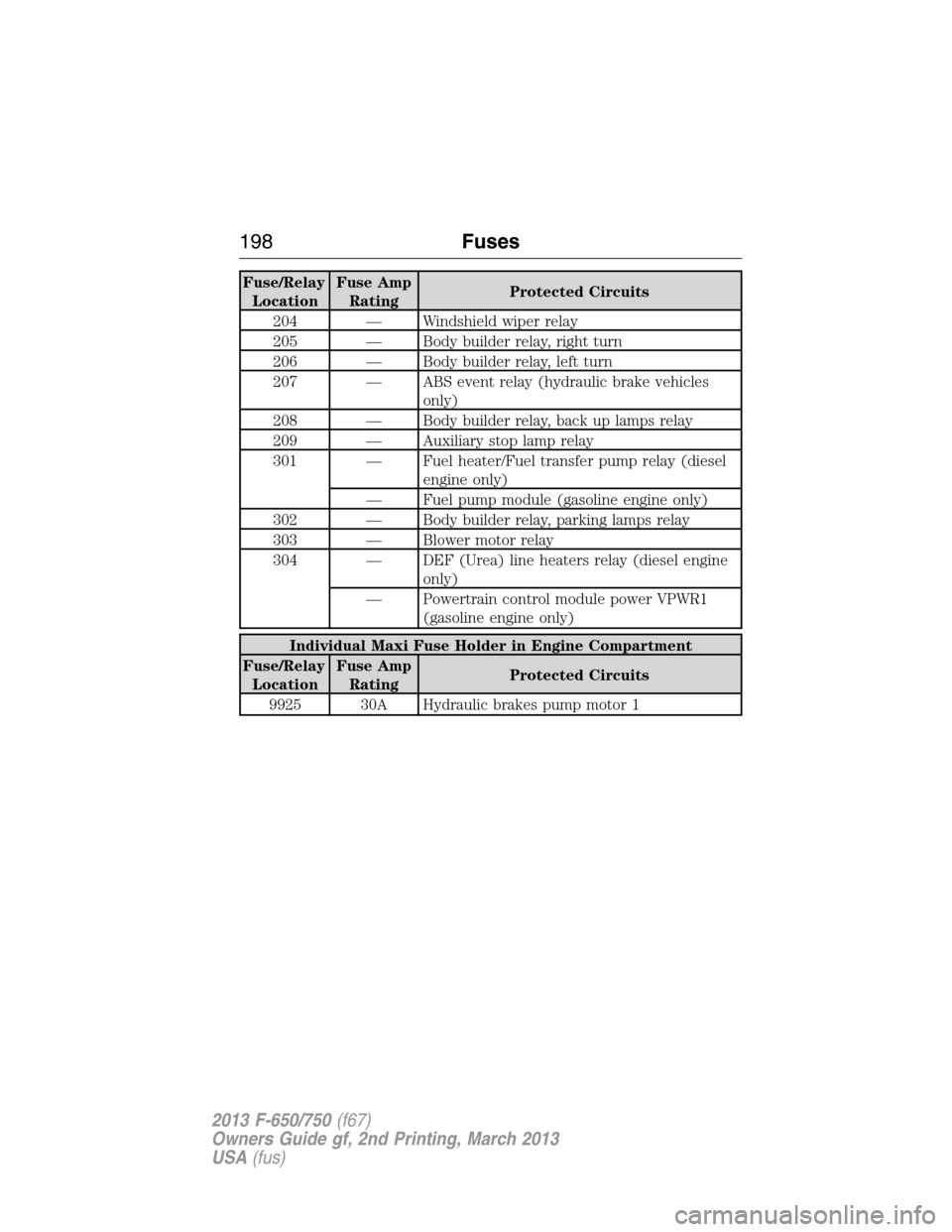
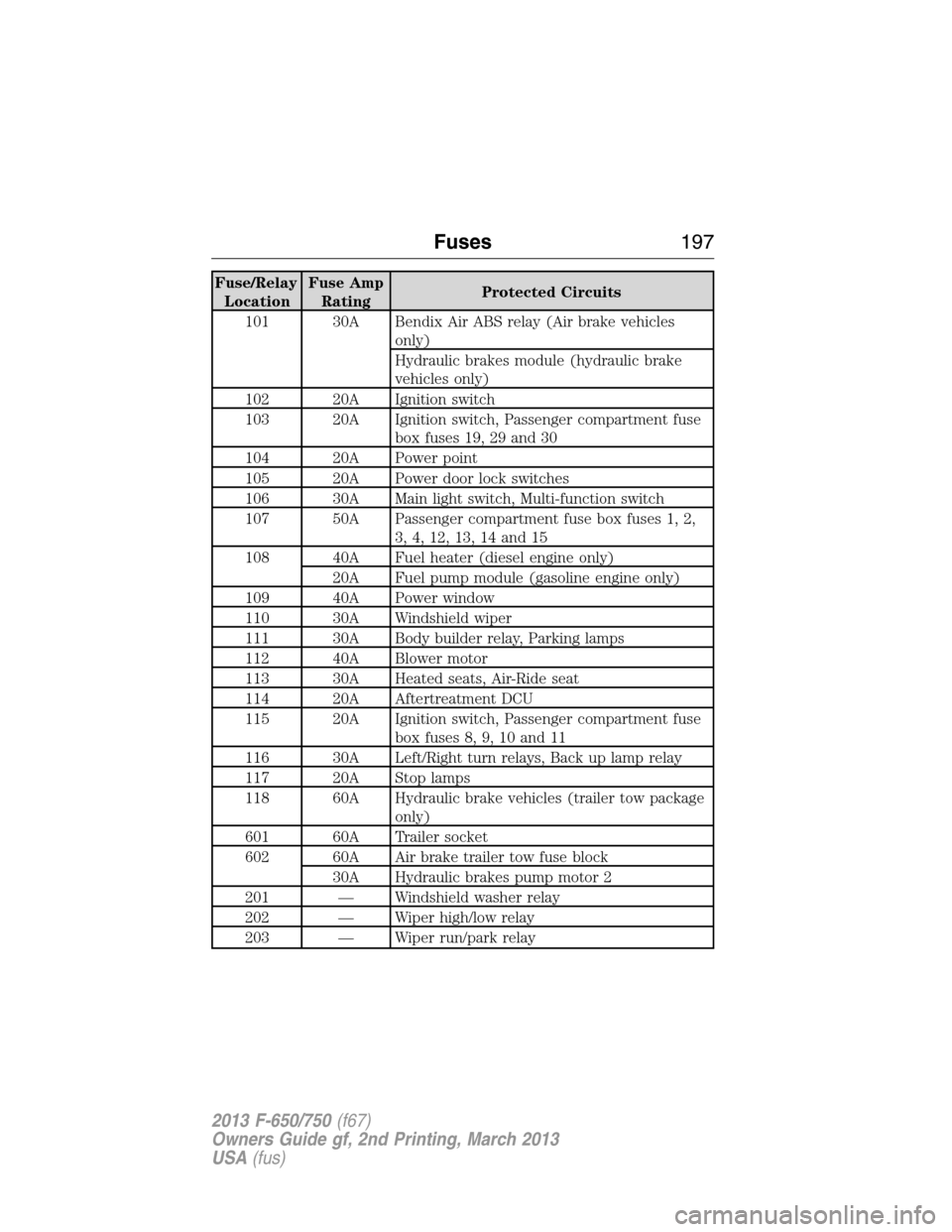
Fuse/Relay
LocationFuse Amp
RatingProtected Circuits
204 — Windshield wiper relay
205 — Body builder relay, right turn
206 — Body builder relay, left turn
207 — ABS event relay (hydraulic brake vehicles
only)
208 — Body builder relay, back up lamps relay
209 — Auxiliary stop lamp relay
301 — Fuel heater/Fuel transfer pump relay (diesel
engine only)
— Fuel pump module (gasoline engine only)
302 — Body builder relay, parking lamps relay
303 — Blower motor relay
304 — DEF (Urea) line heaters relay (diesel engine
only)
— Powertrain control module power VPWR1
(gasoline engine only)
Individual Maxi Fuse Holder in Engine Compartment
Fuse/Relay
LocationFuse Amp
RatingProtected Circuits
9925 30A Hydraulic brakes pump motor 1
198Fuses
2013 F-650/750(f67)
Owners Guide gf, 2nd Printing, March 2013
USA(fus)
Page 203 of 378
Relay
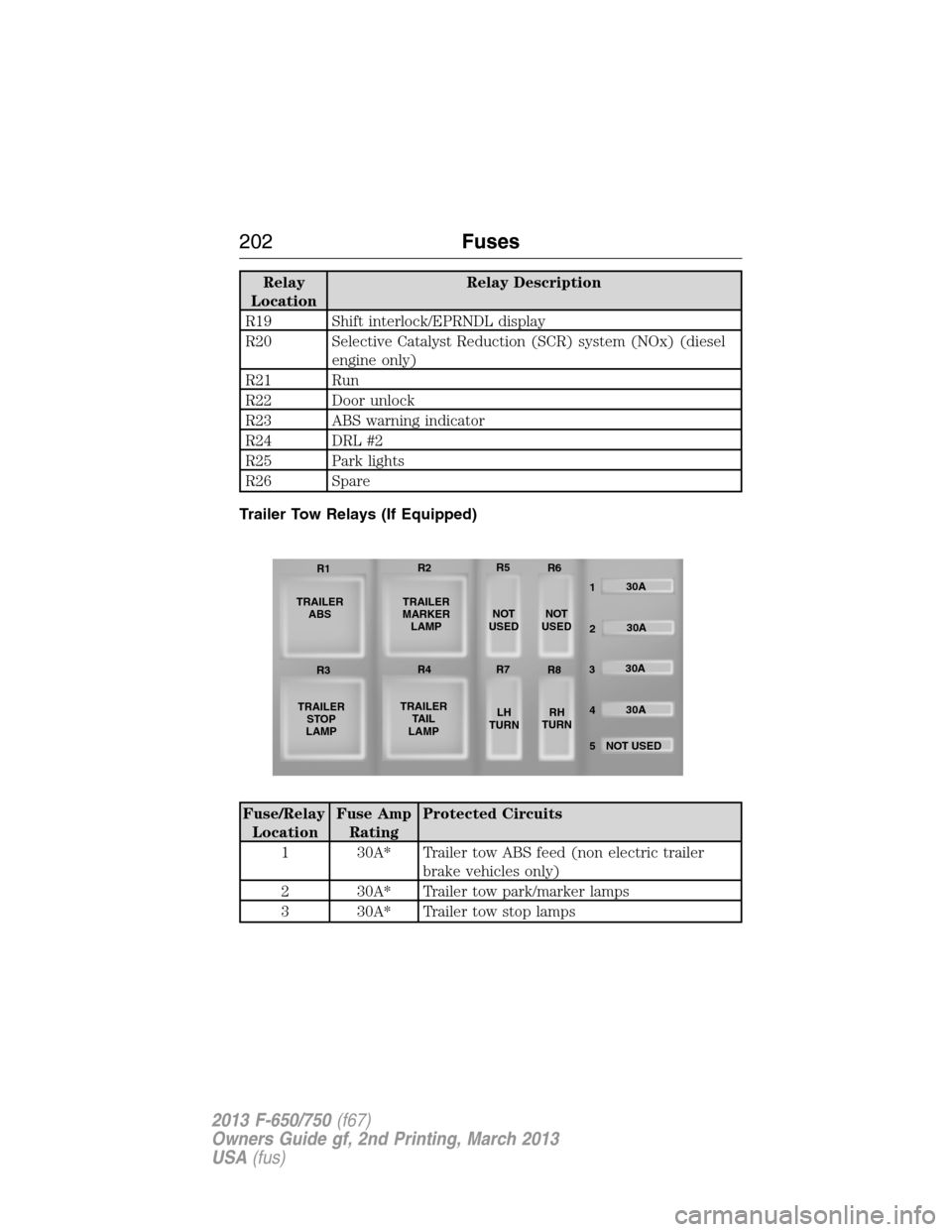
LocationRelay Description
R19 Shift interlock/EPRNDL display
R20 Selective Catalyst Reduction (SCR) system (NOx) (diesel
engine only)
R21 Run
R22 Door unlock
R23 ABS warning indicator
R24 DRL #2
R25 Park lights
R26 Spare
Trailer Tow Relays (If Equipped)
Fuse/Relay
LocationFuse Amp
RatingProtected Circuits
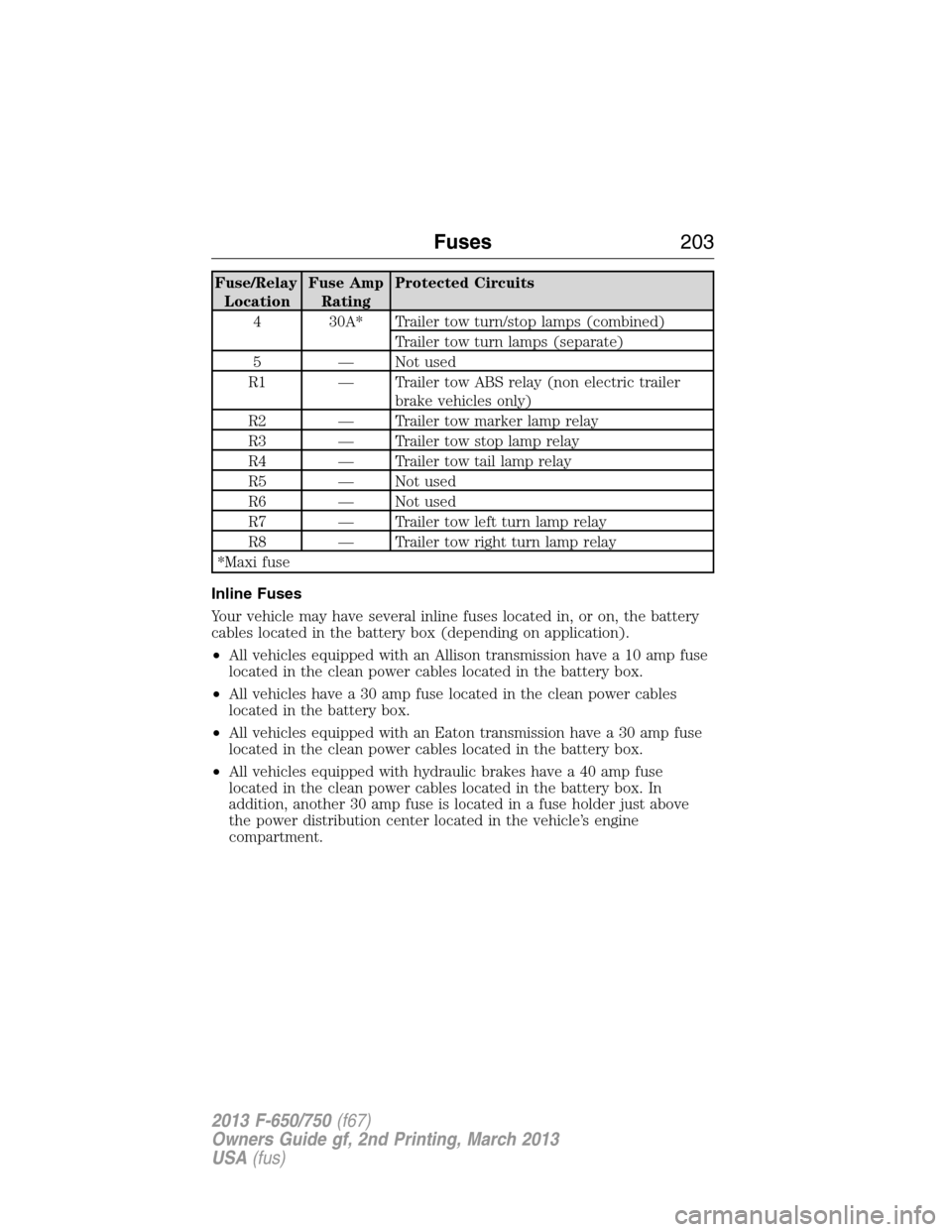
1 30A* Trailer tow ABS feed (non electric trailer
brake vehicles only)
2 30A* Trailer tow park/marker lamps
3 30A* Trailer tow stop lamps
TRAILER
ABS
TRAILER
STOP
LAMPTRAILER
MARKER
LAMP
TRAILER
TA I L
LAMPNOT
USEDNOT
USED
LH
TURNRH
TURN30A
30A
30A
30A
NOT USED
5 4 32 1 R1R2R5
R6
R3R4R7
R8
202Fuses
2013 F-650/750(f67)
Owners Guide gf, 2nd Printing, March 2013
USA(fus)
Page 204 of 378
Fuse/Relay
LocationFuse Amp
RatingProtected Circuits
4 30A* Trailer tow turn/stop lamps (combined)
Trailer tow turn lamps (separate)
5 — Not used
R1 — Trailer tow ABS relay (non electric trailer
brake vehicles only)
R2 — Trailer tow marker lamp relay
R3 — Trailer tow stop lamp relay
R4 — Trailer tow tail lamp relay
R5 — Not used
R6 — Not used
R7 — Trailer tow left turn lamp relay
R8 — Trailer tow right turn lamp relay
*Maxi fuse
Inline Fuses
Your vehicle may have several inline fuses located in, or on, the battery
cables located in the battery box (depending on application).
•All vehicles equipped with an Allison transmission have a 10 amp fuse
located in the clean power cables located in the battery box.
•All vehicles have a 30 amp fuse located in the clean power cables
located in the battery box.
•All vehicles equipped with an Eaton transmission have a 30 amp fuse
located in the clean power cables located in the battery box.
•All vehicles equipped with hydraulic brakes have a 40 amp fuse
located in the clean power cables located in the battery box. In
addition, another 30 amp fuse is located in a fuse holder just above
the power distribution center located in the vehicle’s engine
compartment.
Fuses203
2013 F-650/750(f67)
Owners Guide gf, 2nd Printing, March 2013
USA(fus)
Page 206 of 378
WARNING:The use of inferior parts can adversely affect the
quality and reliability of your vehicle which, in turn, can result in
property damage, personal injury or death.
To avoid damage to the vehicle’s electrical components prior to electric
welding:
•disconnect both battery cables.
•attach the welder ground cable as close as possible to the part being
welded.
•it is recommended that the component be temporarily removed if
welding close to an electrical component.
Follow the checks and services in theScheduled Maintenancechapter.
Have your dealer or service center inspect your vehicle at least once a
year. Remember that regular maintenance and inspections usually
prevent serious problems from developing later.
If the owner or operator of the vehicle is a skilled technician and intends
on performing the vehicle maintenance and service, he is strongly urged
to purchase a service manual.
Electrical System
Periodically inspect electrical connectors on the outside of the cab and
on the engine and frame for corrosion and tightness. Exposed terminals,
such as the fuel sender, cranking motor, alternator and feed-through
studs, should be cleaned and re-coated with a lubricant sealing grease
such as Motorcraft® Silicone Brake Caliper Grease and Dielectic
Compound XG-3, or equivalent. This should include the ground cable
connector for batteries, engine and cab as well as the jump starting stud.
Accessory Feed Connections
Vehicle electrical systems are complex and often include powertrain
components, such as engine and transmission controls, instrument
panels, ABS, etc. While most systems operate on battery voltage
(12 volts), some systems can be as high as 90 volts or as low as five
volts. See theElectrical Circuit Diagram Manuals,available from your
vehicle’s manufacturer, to make sure that any additional body lights and
accessories are connected to circuits that are both appropriate and not
overloaded. No modification should be made to any vehicle control
system without first contacting your dealer.
Maintenance205
2013 F-650/750(f67)
Owners Guide gf, 2nd Printing, March 2013
USA(fus)
Page 211 of 378
Some parts such as air brake chamber diaphragm, air compressor and air
cleaner should be inspected periodically and replaced if considered
unserviceable.
Air dryer:Climactic conditions affect performance of desiccant or
after-cooler type air dryers. Maintenance schedules must be established
for each specific operation.
The use of an air dryer on a vehicle does not eliminate the need to
periodically drain the air reservoirs.
Desiccant air dryer:Inspect for moisture in the air system by opening
reservoirs, draincocks or valves and checking for presence of water. The
presence of small amounts of water due to condensation is normal and
should not be considered as an indication that the dryer is not
functioning properly.
The desiccant cartridge should be replaced or rebuilt when it has been
determined that the desiccant is contaminated and does not have
adequate water absorption capacity. The desiccant change interval may
vary. It is generally recommended that the desiccant be replaced every
12 months (yearly). If experience has shown that extended or shortened
life has resulted for a particular installation, then the yearly interval can
be increased or decreased accordingly.
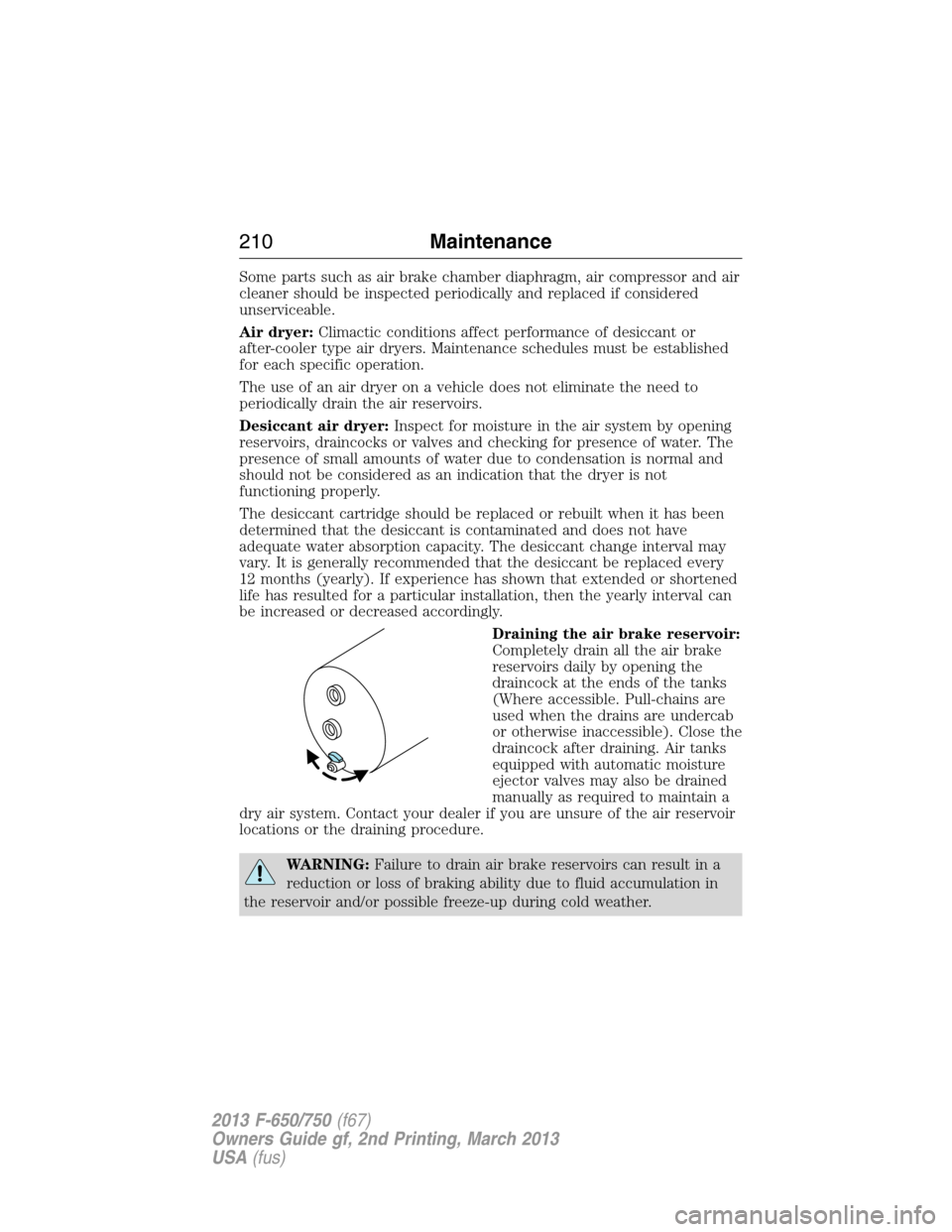
Draining the air brake reservoir:
Completely drain all the air brake
reservoirs daily by opening the
draincock at the ends of the tanks
(Where accessible. Pull-chains are
used when the drains are undercab
or otherwise inaccessible). Close the
draincock after draining. Air tanks
equipped with automatic moisture
ejector valves may also be drained
manually as required to maintain a
dry air system. Contact your dealer if you are unsure of the air reservoir
locations or the draining procedure.
WARNING:Failure to drain air brake reservoirs can result in a
reduction or loss of braking ability due to fluid accumulation in
the reservoir and/or possible freeze-up during cold weather.
210Maintenance
2013 F-650/750(f67)
Owners Guide gf, 2nd Printing, March 2013
USA(fus)
Page 239 of 378
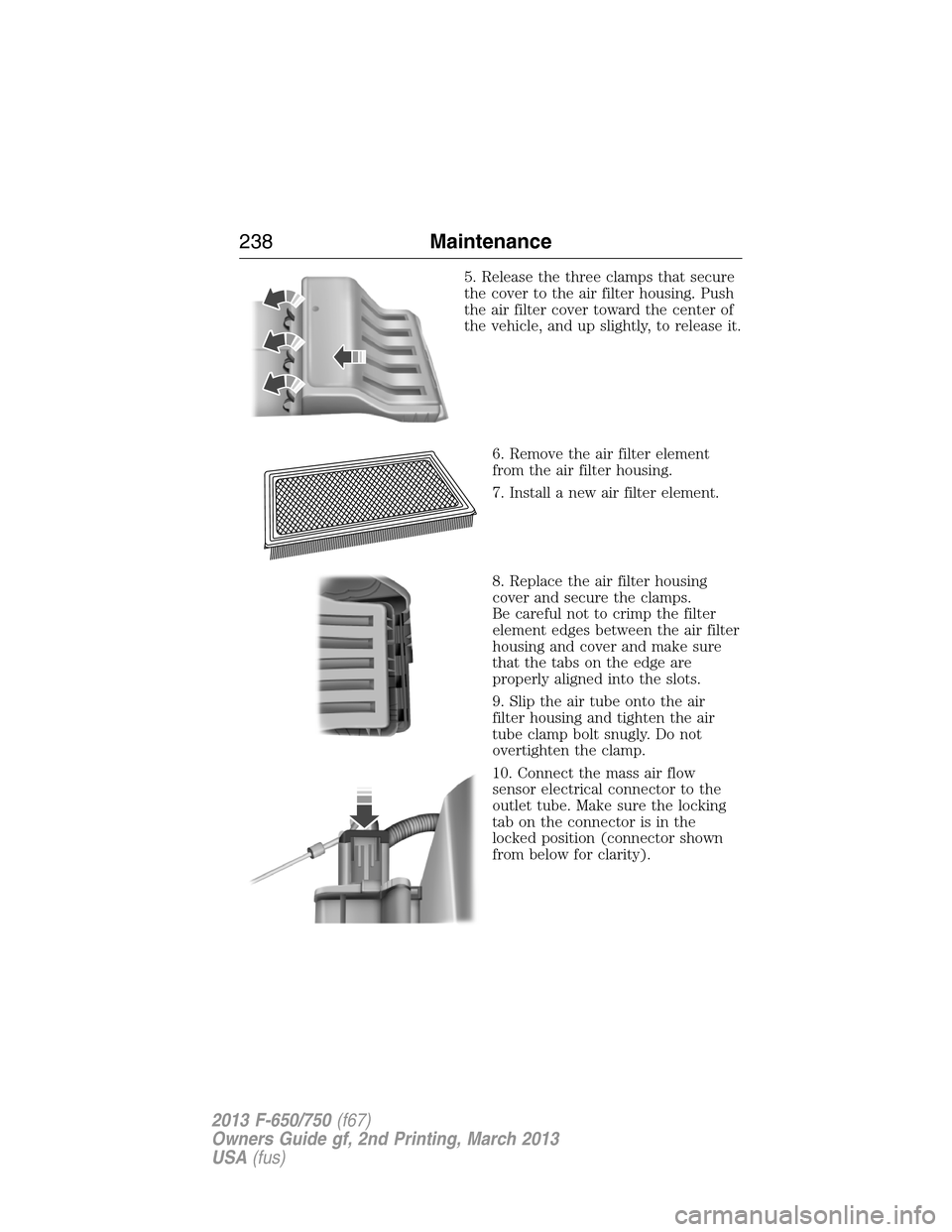
5. Release the three clamps that secure
the cover to the air filter housing. Push
the air filter cover toward the center of
the vehicle, and up slightly, to release it.
6. Remove the air filter element
from the air filter housing.
7. Install a new air filter element.
8. Replace the air filter housing
cover and secure the clamps.
Be careful not to crimp the filter
element edges between the air filter
housing and cover and make sure
that the tabs on the edge are
properly aligned into the slots.
9. Slip the air tube onto the air
filter housing and tighten the air
tube clamp bolt snugly. Do not
overtighten the clamp.
10. Connect the mass air flow
sensor electrical connector to the
outlet tube. Make sure the locking
tab on the connector is in the
locked position (connector shown
from below for clarity).
238Maintenance
2013 F-650/750(f67)
Owners Guide gf, 2nd Printing, March 2013
USA(fus)
Page 259 of 378
Rotating tires from one wheel position to another is a way often used to
even out many types of irregular wear or to avoid it altogether. Some of
the more effective tire rotation programs are:
•Steer tires that have developed some type of irregular wear pattern
can be rotated to drive axles if rib tires are being used on all wheel
positions. Applying steer tires to a drive position often cleans them
and they can be moved back to the steer axles or run out to re-tread
stage on the rear axle.
•Another rotation possibility for fleets with rib tires in all wheel
positions is to break in the new steer tires in the drive axle positions,
then move them to steer axles. This wears away tread rubber
relatively quickly in the early life of a tire when it is most likely to
develop an unusual wear pattern.
•Drive axle tires may be placed on the other end of the same axle so
that direction of rotation is reversed. This is often helpful if a heel
and toe or alternate lug wear pattern has developed.
Irregular wear can be minimized by:
•Using the right inflation pressure for the load being carried.
•Maintaining proper front wheel alignment, especially toe-in, to
specifications.
•Maintaining proper tire and wheel balance.
•Maintaining shock absorbers and suspension components.
Use of Tire Chains
See the chain manufacturer’s recommendation for correct tire chain
usage, installation and removal.
WHEELS
General Information
Note:Remember to replace the wheel air valves when the road tires are
replaced at the end of their useful lives.
Wheel bearings should be inspected, lubricated and adjusted at regular
intervals. This is especially important if operating in deep sand, mud or
water. See theCapacities and Specificationschapter.
Mount wheel balance weights on the dome-side of the wheel only. Failure
to do so may result in loss of wheel weight or damage to brakes or
wheels.
258Wheels and Tires
2013 F-650/750(f67)
Owners Guide gf, 2nd Printing, March 2013
USA(fus)
Page 287 of 378
Every Oil Change
ClutchLubricate the clutch release cross shaft and all
linkages.
Check the clutch fluid level.
Fuel SystemDrain the accumulated water or sediment from
the fuel tank(s).
Steering SystemLubricate the steering shaft(s), U-joints and
splines if equipped with grease fittings.
Lubricate the front axle spindle pins.
Lubricate the steering linkage when equipped
with grease fittings.
Lubricate the power steering gear output shaft.
*Coolant protection checks should be made just prior to the onset of
freezing weather, where applicable. If coolant is dirty or rusty in
appearance, the system should be drained, flushed and refilled with the
prescribed solution of cooling system fluid and distilled water. Use only
permanent type coolant that meets specifications as listed in your engine
operator’s manual. See the engine manufacturer’s operating guide for
supplemental corrosion inhibitor specifications.
Periodic Component/System Checks
The following are vehicle checks that should be made periodically either
by the owner or a qualified technician. It is recommended that
deficiencies be brought to the attention of your dealer or another
qualified service outlet as soon as possible so advice regarding the need
for service or replacement can be obtained.
Frequency Recommended Action
At every engine start up. Check ABS lamp operation.
After first 500 and 1000 miles (800
and 1600 km), then every 500 and
1000 mile (800 and 1600 km)
interval after tire removal or
replacement.Tighten the wheel mounting nuts
to the specified torque. See
Technical specificationsin the
Wheels and Tireschapter.
At least twice annually. Clean body and door drain holes.
As required. Clean windshield wiper blades.
286Scheduled Maintenance
2013 F-650/750(f67)
Owners Guide gf, 2nd Printing, March 2013
USA(fus)