torque FORD F650 2013 12.G User Guide
[x] Cancel search | Manufacturer: FORD, Model Year: 2013, Model line: F650, Model: FORD F650 2013 12.GPages: 378, PDF Size: 3.82 MB
Page 215 of 378
Chassis-mounted Charge Air Cooler
Visually inspect the core assembly for debris and clogging of external fins
with the engine off. Prior to engine operation, remove any debris
blocking the core.
•Turbocharger-to-charge air cooler
•Charge air cooler-to-intake manifold pipe
•Mounting bracket
•Chassis-mounted charge air cooler core
Inspect air intake piping:
•Check for accumulation of salt deposits (where applicable).
If present, disassemble and clean the complete air intake piping
system. If the intake piping is pitted, use Motorcraft® Silicone Gasket
and Sealant TA-30 to seal joints against leakage.
•Check for loose hoses and clamps.
•Check for ruptured or collapsed hoses.
•Check air cleaner housing for cracks.
Suspension Inspection
Note:Do not adjust air suspension height to any setting other than the
specified setting. Altering the height setting changes the driveline angle
and may result in unwarrantable component damage, such as
transmission component damage.
Verify drive axle air suspension height and height control valve
performance at engine oil change intervals.
Periodically check:
•Condition of spring leaves for evidence of fatigue, bending or
breakage.
•Condition of suspension mounting brackets and bushings.
•Torque rod mounting fasteners for tightness.
•For proper suspension alignment. This must be maintained at all
times.
•U-bolts. After the chassis has been operating under load for
1000 miles (1600 kilometers) or six months (whichever comes first),
the U-bolt nuts must be re-torqued. The U-bolt nuts must be
re-torqued every 36000 miles (60000 kilometers) thereafter. The
U-bolt and nut threads and seats should be cleaned and lubricated to
make sure a like new condition when re-torquing.
Note:SeeSpring U-bolt checklater in this chapter.
214Maintenance
2013 F-650/750(f67)
Owners Guide gf, 2nd Printing, March 2013
USA(fus)
Page 229 of 378
SPRING U-BOLT CHECKS
Check U-bolt nuts and re-torque every 36000 miles (60000 kilometers)
after initial 1000 mile (1600 kilometer) re-torque. The U-bolt and nut
threads and seats should be cleaned and lubricated to make sure peak
condition when re-torqued.
U-bolt Nut Torque
Suspension ft-lb N•m
Front axle – 8500 lb (3856 kg) 180-200 244-271
Front axle – 10000 lb (4536 kg) and higher 260-300 353-407
Rear axle with multi-leaf 260-300 353-407
Rear axle with IROS air suspension 370-400 502-542
Rear axle with Hendrickson air suspension 400–450 542–610
See air suspension U-bolt re-torquing and installation information below.
Air Suspension U-bolt Checks and Re-torquing Procedures
1. Inspect the threads of the U-bolt and nut for rust and debris. Clean
the threads if contaminated.
2. Using a torque wrench, determine if any nuts can be turned with a
force below the specified torque.
3. Using the lowest discovered torqued nut as a starting point,
re-tighten the nuts using the sequence listed underAir suspension
U-bolt and U-bolt nut installation.
Air Suspension U-bolt and U-bolt Nut Installation
1. Inspect the threads of the U-bolt and nut for rust and debris. Clean
the threads if contaminated.
2. Install the U-bolts and nuts and torque the nuts to seat the cap flat
which is about 18 ft-lb (25 N•m) using a diagonal pattern. Use the
same diagonal pattern for each of the following U-bolt nut re-torque
steps.
3. Tighten U-bolt nuts in increments of 74 ft-lb (100 N•m) until
tightened to final torque for the particular suspension.
228Maintenance
2013 F-650/750(f67)
Owners Guide gf, 2nd Printing, March 2013
USA(fus)
Page 260 of 378
Oil-lubricated Front Wheel Bearings
During normal vehicle duty cycle, the lubricant and air inside the
hub/wheel cavity expands and, if not vented, causes pressure build-up
that could cause accelerated seal wear. There are two venting methods
that can be used to prevent pressure build-up:
•a slit or small hole in the rubber check vent
•the window.
Over a period of time, if not routinely cleaned, a slight film of oil can
collect dirt around the rubber fill plug and face, which could appear to
be a leak. Routine cleaning makes sure that the lubricant level can be
easily observed through the window as intended. In situations where the
window is clean on the outside but discolored on the inside, the
lubricant level may be checked by inserting a finger through the rubber
check vent hole.
The specified lubricant level for a window-type hubcap is from the
minimum line to 5/16 inch (8 millimeters) above the minimum line. If the
lubricant level should suddenly drop dramatically below the minimum
level, see theWorkshop Manualfor diagnostic procedure.
Installation, Tightening and Alignment
Make sure the threads on the studs and nuts are clean to permit correct
torque when installing wheels. The mounting surfaces of rims, wheels,
spacer rings and clamps must be free of dirt, rust, lubricants or damage.
Use a wire brush to clean the mounting contact surfaces. Do not use
lubricant on threads.
Check the rim or wheel for proper alignment after it has been properly
tightened. Rotate the wheel with a piece of chalk attached to a steady,
firm surface, and placed to just barely clear the outside surface of the
tire bead seat; this procedure points out the high spot. A high spot does
not necessarily mean that the lug nuts have been unevenly tightened,
but could be the result of a bent wheel.
Use the following installation procedure:
1. Slide inner rear or front tire and wheel in position over studs and push
it back as far as possible. Use care so that the threads on the studs are
not damaged.
Wheels and Tires259
2013 F-650/750(f67)
Owners Guide gf, 2nd Printing, March 2013
USA(fus)
Page 262 of 378
Note for aluminum wheels:Clean each wheel locator pad on the hub
from all dirt, rust and foreign material prior to re-installing rear
aluminum hub-piloted wheels. Apply a light coat of chassis grease,
never-seize or disc brake corrosion control grease, only to the wheel
locator pad.
3. Run the nuts on the studs until they contact the wheel(s). Rotate the
wheel assembly a half-turn to permit the parts to seat.
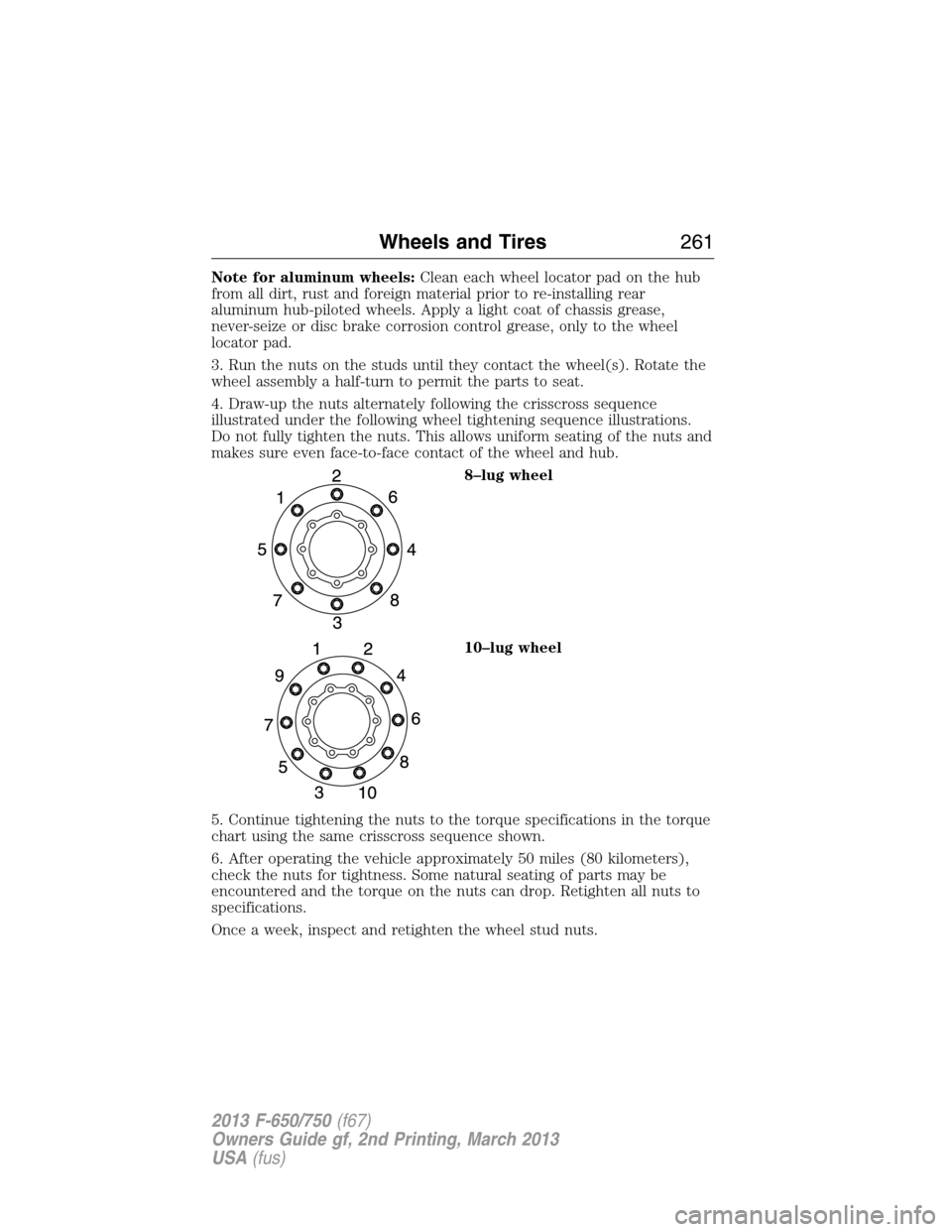
4. Draw-up the nuts alternately following the crisscross sequence
illustrated under the following wheel tightening sequence illustrations.
Do not fully tighten the nuts. This allows uniform seating of the nuts and
makes sure even face-to-face contact of the wheel and hub.
8–lug wheel
10–lug wheel
5. Continue tightening the nuts to the torque specifications in the torque
chart using the same crisscross sequence shown.
6. After operating the vehicle approximately 50 miles (80 kilometers),
check the nuts for tightness. Some natural seating of parts may be
encountered and the torque on the nuts can drop. Retighten all nuts to
specifications.
Once a week, inspect and retighten the wheel stud nuts.
Wheels and Tires261
2013 F-650/750(f67)
Owners Guide gf, 2nd Printing, March 2013
USA(fus)
Page 263 of 378
Note:Make sure the tire valve stem clears the brake caliper when
installing the tire and rim assembly on disc-brake equipped axles. The
use of a tire manufacturer’s stem forming tool is the only acceptable
method of obtaining clearance when necessary.
Proper Torque
It is important to tighten and maintain wheel and rim mounting nuts to
the proper torque. Loose nuts or over-tightened nuts can lead to
premature wear and possible failure of the wheel or mounting hardware.
Changing Wheel Types
WARNING:Use only the same type and style wheels and
mounting hardware to replace original parts. Failure to do so may
result in an assembly that looks fine, but does not fit together properly.
This could possibly cause wheel or fastener failures which could result
in property damage, personal injury or death.
Note:Do not attempt to mix stud-piloted wheels or fasteners with
hub-piloted wheels or fasteners.
Note:Do not change from aluminum wheels to steel wheels or
vice-versa without changing the mounting hardware required or, with
flange nut mounting systems, changing the hub and stud assembly.
Consult your dealer or wheel or rim distributor before attempting any
wheel or fastener changes.
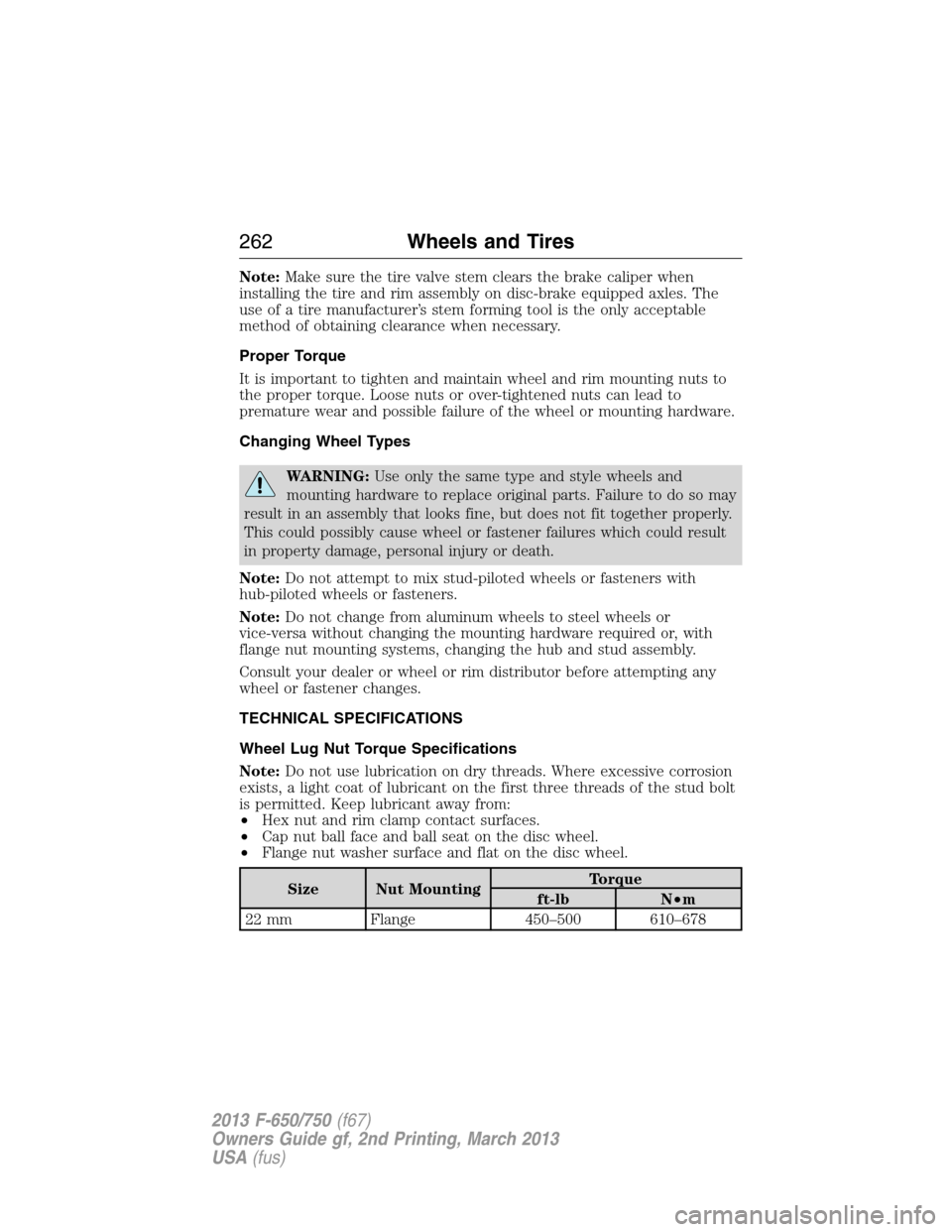
TECHNICAL SPECIFICATIONS
Wheel Lug Nut Torque Specifications
Note:Do not use lubrication on dry threads. Where excessive corrosion
exists, a light coat of lubricant on the first three threads of the stud bolt
is permitted. Keep lubricant away from:
•Hex nut and rim clamp contact surfaces.
•Cap nut ball face and ball seat on the disc wheel.
•Flange nut washer surface and flat on the disc wheel.
Size Nut MountingTorque
ft-lb N•m
22 mm Flange 450–500 610–678
262Wheels and Tires
2013 F-650/750(f67)
Owners Guide gf, 2nd Printing, March 2013
USA(fus)
Page 278 of 378
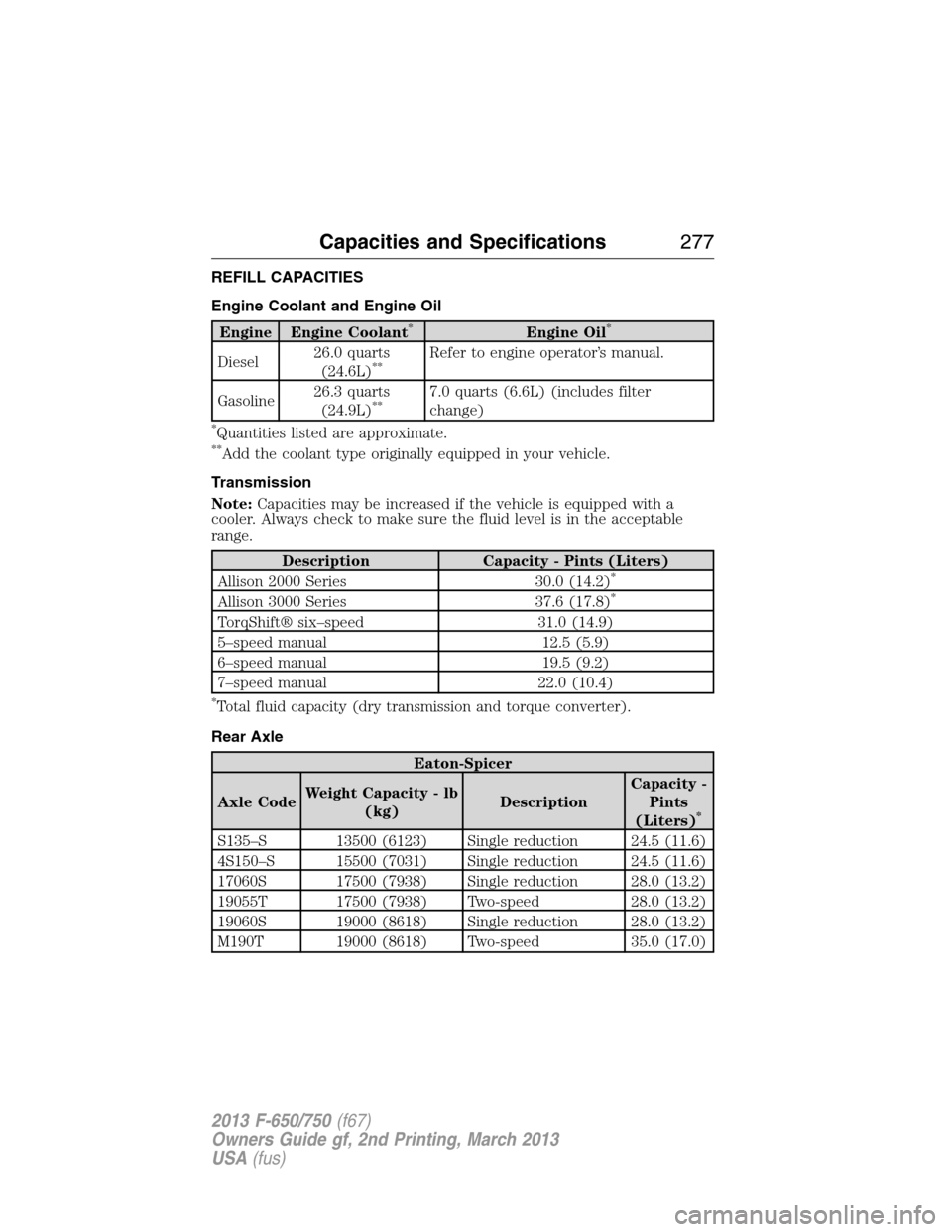
REFILL CAPACITIES
Engine Coolant and Engine Oil
Engine Engine Coolant*Engine Oil*
Diesel26.0 quarts
(24.6L)**Refer to engine operator’s manual.
Gasoline26.3 quarts
(24.9L)
**7.0 quarts (6.6L) (includes filter
change)
*Quantities listed are approximate.**Add the coolant type originally equipped in your vehicle.
Transmission
Note:Capacities may be increased if the vehicle is equipped with a
cooler. Always check to make sure the fluid level is in the acceptable
range.
Description Capacity - Pints (Liters)
Allison 2000 Series 30.0 (14.2)*
Allison 3000 Series 37.6 (17.8)*
TorqShift® six–speed 31.0 (14.9)
5–speed manual 12.5 (5.9)
6–speed manual 19.5 (9.2)
7–speed manual 22.0 (10.4)
*Total fluid capacity (dry transmission and torque converter).
Rear Axle
Eaton-Spicer
Axle CodeWeight Capacity - lb
(kg)DescriptionCapacity -
Pints
(Liters)
*
S135–S 13500 (6123) Single reduction 24.5 (11.6)
4S150–S 15500 (7031) Single reduction 24.5 (11.6)
17060S 17500 (7938) Single reduction 28.0 (13.2)
19055T 17500 (7938) Two-speed 28.0 (13.2)
19060S 19000 (8618) Single reduction 28.0 (13.2)
M190T 19000 (8618) Two-speed 35.0 (17.0)
Capacities and Specifications277
2013 F-650/750(f67)
Owners Guide gf, 2nd Printing, March 2013
USA(fus)
Page 280 of 378
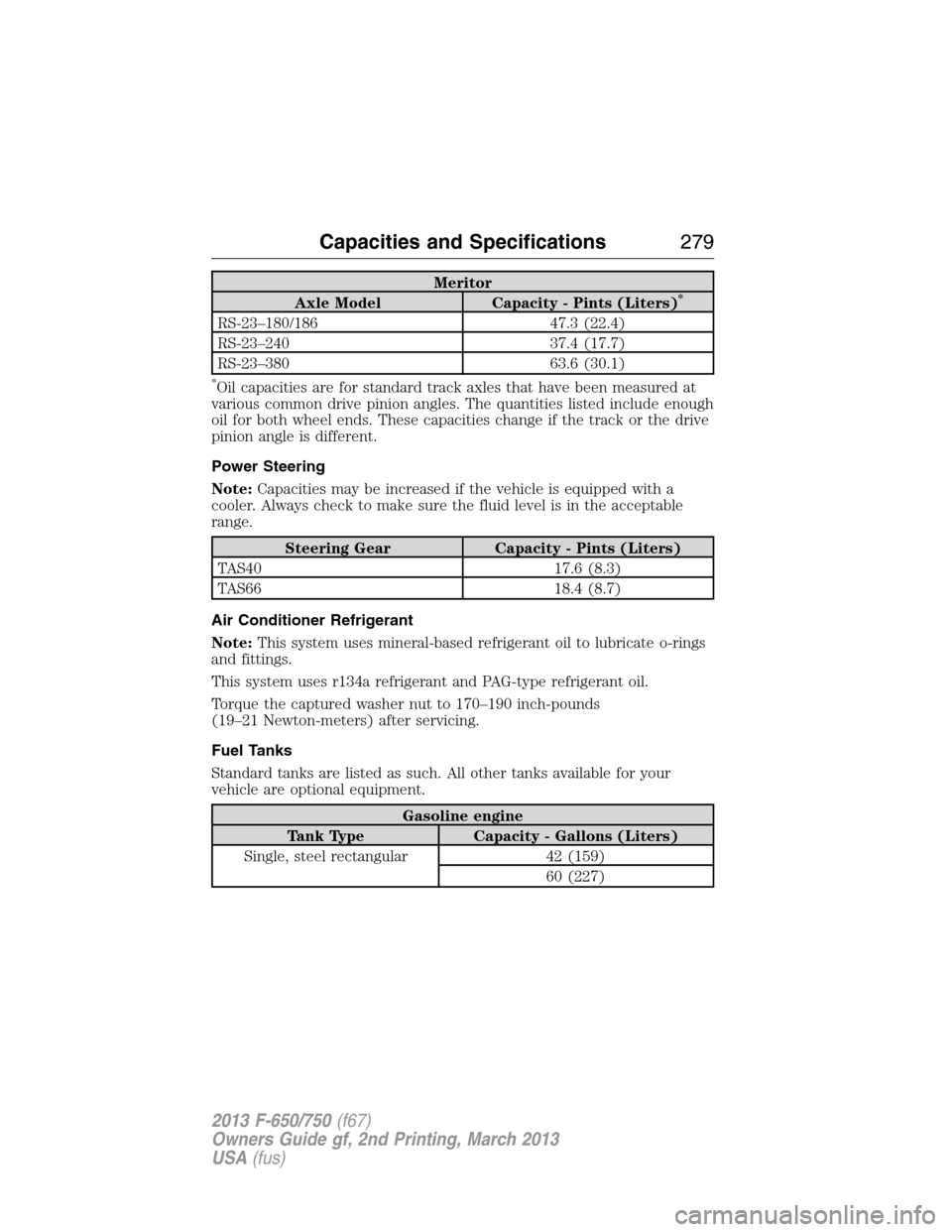
Meritor
Axle Model Capacity - Pints (Liters)*
RS-23–180/186 47.3 (22.4)
RS-23–240 37.4 (17.7)
RS-23–380 63.6 (30.1)
*Oil capacities are for standard track axles that have been measured at
various common drive pinion angles. The quantities listed include enough
oil for both wheel ends. These capacities change if the track or the drive
pinion angle is different.
Power Steering
Note:Capacities may be increased if the vehicle is equipped with a
cooler. Always check to make sure the fluid level is in the acceptable
range.
Steering Gear Capacity - Pints (Liters)
TAS40 17.6 (8.3)
TAS66 18.4 (8.7)
Air Conditioner Refrigerant
Note:This system uses mineral-based refrigerant oil to lubricate o-rings
and fittings.
This system uses r134a refrigerant and PAG-type refrigerant oil.
Torque the captured washer nut to 170–190 inch-pounds
(19–21 Newton-meters) after servicing.
Fuel Tanks
Standard tanks are listed as such. All other tanks available for your
vehicle are optional equipment.
Gasoline engine
Tank Type Capacity - Gallons (Liters)
Single, steel rectangular 42 (159)
60 (227)
Capacities and Specifications279
2013 F-650/750(f67)
Owners Guide gf, 2nd Printing, March 2013
USA(fus)
Page 286 of 378
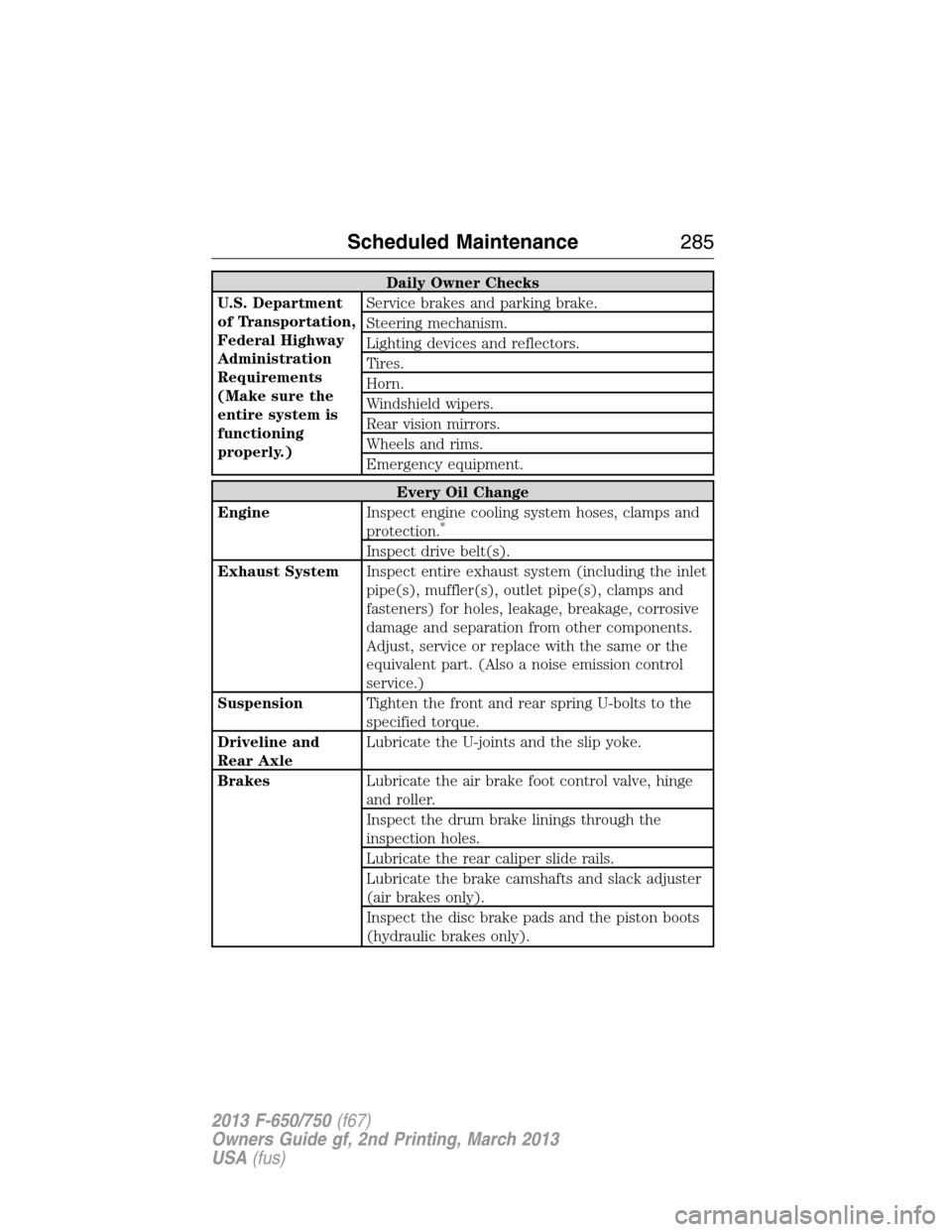
Daily Owner Checks
U.S. Department
of Transportation,
Federal Highway
Administration
Requirements
(Make sure the
entire system is
functioning
properly.)Service brakes and parking brake.
Steering mechanism.
Lighting devices and reflectors.
Tires.
Horn.
Windshield wipers.
Rear vision mirrors.
Wheels and rims.
Emergency equipment.
Every Oil Change
EngineInspect engine cooling system hoses, clamps and
protection.
*
Inspect drive belt(s).
Exhaust SystemInspect entire exhaust system (including the inlet
pipe(s), muffler(s), outlet pipe(s), clamps and
fasteners) for holes, leakage, breakage, corrosive
damage and separation from other components.
Adjust, service or replace with the same or the
equivalent part. (Also a noise emission control
service.)
SuspensionTighten the front and rear spring U-bolts to the
specified torque.
Driveline and
Rear AxleLubricate the U-joints and the slip yoke.
BrakesLubricate the air brake foot control valve, hinge
and roller.
Inspect the drum brake linings through the
inspection holes.
Lubricate the rear caliper slide rails.
Lubricate the brake camshafts and slack adjuster
(air brakes only).
Inspect the disc brake pads and the piston boots
(hydraulic brakes only).
Scheduled Maintenance285
2013 F-650/750(f67)
Owners Guide gf, 2nd Printing, March 2013
USA(fus)
Page 287 of 378
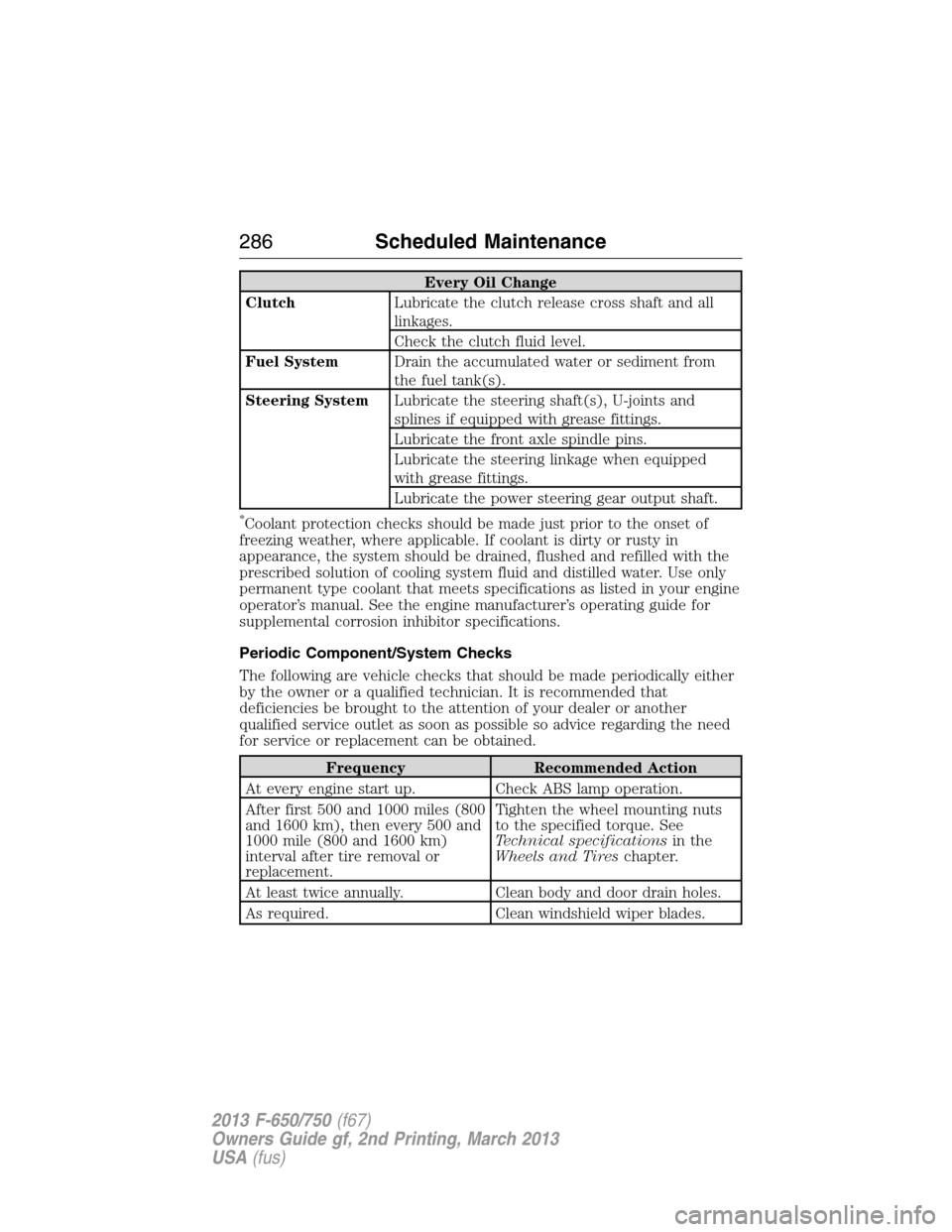
Every Oil Change
ClutchLubricate the clutch release cross shaft and all
linkages.
Check the clutch fluid level.
Fuel SystemDrain the accumulated water or sediment from
the fuel tank(s).
Steering SystemLubricate the steering shaft(s), U-joints and
splines if equipped with grease fittings.
Lubricate the front axle spindle pins.
Lubricate the steering linkage when equipped
with grease fittings.
Lubricate the power steering gear output shaft.
*Coolant protection checks should be made just prior to the onset of
freezing weather, where applicable. If coolant is dirty or rusty in
appearance, the system should be drained, flushed and refilled with the
prescribed solution of cooling system fluid and distilled water. Use only
permanent type coolant that meets specifications as listed in your engine
operator’s manual. See the engine manufacturer’s operating guide for
supplemental corrosion inhibitor specifications.
Periodic Component/System Checks
The following are vehicle checks that should be made periodically either
by the owner or a qualified technician. It is recommended that
deficiencies be brought to the attention of your dealer or another
qualified service outlet as soon as possible so advice regarding the need
for service or replacement can be obtained.
Frequency Recommended Action
At every engine start up. Check ABS lamp operation.
After first 500 and 1000 miles (800
and 1600 km), then every 500 and
1000 mile (800 and 1600 km)
interval after tire removal or
replacement.Tighten the wheel mounting nuts
to the specified torque. See
Technical specificationsin the
Wheels and Tireschapter.
At least twice annually. Clean body and door drain holes.
As required. Clean windshield wiper blades.
286Scheduled Maintenance
2013 F-650/750(f67)
Owners Guide gf, 2nd Printing, March 2013
USA(fus)