recommended oil FORD F650 2013 12.G Owners Manual
[x] Cancel search | Manufacturer: FORD, Model Year: 2013, Model line: F650, Model: FORD F650 2013 12.GPages: 378, PDF Size: 3.82 MB
Page 110 of 378
3. The accelerator pedal, service brake pedal, and clutch pedal
(if equipped) must not be pressed.
4. The parking brake must remain set.
On average (depending on filter level and other factors), the process
takes 20–30 minutes to complete. The DPF lamp turns off when the
process is complete. Repeat Steps 1–5, if parked regeneration is
interrupted.
To Discontinue Parked Regeneration
Press any of the floor pedals to discontinue parked regeneration.
Maintenance and Service
The DPF is designed to retain a relatively large amount of residual ash
and provide many miles and hours of maintenance-free operation. At
some point, generally beyond 150000 miles (240000 kilometers) or
5000 hours of operation (whichever comes first), the DPF requires
professional cleaning to remove the accumulated ash.
The exact number of miles or hours of operation varies greatly
depending upon vehicle and engine loading and operating conditions, ash
content of the engine oil, and quality of the diesel fuel used in your
truck. Adhering to your engine manufacturer’s recommended oil and fuel
specifications maximizes the miles and hours of operation before a DPF
professional cleaning is required. See your engine manufacturer’s owner’s
manual for more details regarding recommended maintenance and
service of your DPF.
Exhaust Outlet Assembly
WARNING:The normal operating temperature of the exhaust
system is very high. Never work around or attempt to repair any
part of the exhaust system until it has cooled. Failure to follow these
instructions may result in serious personal injury.
Note:Do not modify or remove this device. Modification of the system
or additions of aftermarket devices can reduce the effectiveness of the
system, as well as cause damage to the exhaust system or engine. Any
modifications may also invalidate the vehicle and/or engine warranties.
See your warranty information.
Note:Blocked or plugged holes or modification to, or removal of, the
outlet assembly could result in elevated exhaust temperatures which may
result in vehicle or property damage or personal injury.
Starting and Stopping the Engine109
2013 F-650/750(f67)
Owners Guide gf, 2nd Printing, March 2013
USA(fus)
Page 115 of 378
•Avoid getting fuel liquid in your eyes. If fuel is splashed in the eyes,
remove contact lenses (if worn), flush with water for 15 minutes and
seek medical attention. Failure to seek proper medical attention could
lead to permanent injury.
•Fuels can also be harmful if absorbed through the skin. If fuel is
splashed on the skin or clothing, promptly remove contaminated
clothing and wash skin thoroughly with soap and water. Repeated or
prolonged skin contact with fuel liquid or vapor causes skin irritation.
•Be particularly careful if you are taking Antabuse or other forms of
disulfiram for the treatment of alcoholism. Breathing gasoline vapors,
or skin contact could cause an adverse reaction. In sensitive
individuals, serious personal injury or sickness may result. If fuel is
splashed on the skin, promptly wash skin thoroughly with soap and
water. Consult a physician immediately if you experience an adverse
reaction.
CHOOSING THE RIGHT FUEL
Note:Use of any fuel other than those recommended may cause
powertrain damage, a loss of vehicle performance, and repairs may not
be covered under warranty.
Gasoline Engine
Use only UNLEADED fuel or UNLEADED fuel blended with a maximum
of 15% ethanol. Do not use fuel ethanol (E85), diesel fuel, fuel-methanol,
leaded fuel or any other fuel because it could damage or impair the
emission control system. The use of leaded fuel is prohibited by law.
Diesel Engine
WARNING:Using low sulfur (16-500 ppm) or high sulfur
(greater than 500 ppm) diesel fuel in a diesel engine designed to
use only Ultra Low Sulfur Diesel fuel increases the likelihood of engine
oil dilution with fuel which may lead to major engine damage.
WARNING:Using low sulfur (16-500 ppm) or high sulfur
(greater than 500 ppm) diesel fuel in a diesel engine designed to
use only Ultra Low Sulfur Diesel fuel causes certain emission
components to malfunction which may also cause the Service Engine
Soon light to illuminate indicating an emissions-related concern.
11 4Fuel and Refueling
2013 F-650/750(f67)
Owners Guide gf, 2nd Printing, March 2013
USA(fus)
Page 116 of 378
WARNING:Do not mix diesel fuel with gasoline, gasohol or
alcohol. This could cause an explosion resulting in personal
injury.
WARNING:Do not use starting fluid such as ether or gasoline.
Such fluids can cause immediate explosive damage to the engine
and possible personal injury.
WARNING:Do not use home heating oil or any diesel fuel not
intended for highway use. Red dye is used to identify fuels
intended for agricultural and non-highway use. Damage to the fuel
injection system, engine and exhaust catalyst can occur if an improper
fuel is used. Do not add gasoline, gasohol or alcohol to diesel fuel. This
practice creates a serious fire hazard and engine performance problems.
Note:Use of any fuel other than those recommended may cause
powertrain damage, a loss of vehicle performance, and repairs may not
be covered under warranty.
Use only Ultra Low Sulfur (15 ppm Sulfur Maximum) number 1-D or 2-D
diesel fuel in your diesel engine. The engine and exhaust system were
designed to only use this fuel. Look for the ULTRA-LOW SULFUR
HIGHWAY DIESEL FUEL (15 ppm Sulfur Maximum) label on fuel pumps
when purchasing your fuel.
Number 1-D or winter blend number 2-D fuel is recommended at
temperatures below 20°F (-7°C). Diesel fuel containing no more than
20% biodiesel may be used. Biodiesel fuel is a product that has been
converted from renewable fuel sources, including vegetable oil, animal fat
and cooking oil. Raw or refined vegetable oil, animal fat, cooking oil or
recycled greases should not be used. All biodiesel up to B20 must
comply with ASTM D7467 standards.
See your engine operator’s manual for additional information and
restrictions regarding use of biodiesel fuel.
Fuel and Refueling11 5
2013 F-650/750(f67)
Owners Guide gf, 2nd Printing, March 2013
USA(fus)
Page 132 of 378
Cooling System:
•Inspect the fan for blade damage. If damage is found, replace with
the recommended parts. Inspect for fan-to-shroud interference and
any damage to shroud, such as cracks and holes.
•Do not change fan ratio or alter fan spacer dimensions and positions.
•Inspect fan clutch for proper operation. Make sure the fan is
disengaged when cooling of the engine is not required.
•Inspect radiator shutters (if equipped) for proper operation. The
shutters should be open during normal operating temperatures.
Engine:Valve covers and block covers are made to damp-out engine
mechanical noise and, if needed, should be replaced with recommended
parts. Check for mechanical isolations.
Transmission Enclosure:Inspect for cracks, holes and tears. Clean any
deposits, such as oil, dirt and stones.
Exhaust System:
•Inspect for leaks at various joint connections and loose clamps.
•Perform a visual inspection for cracks or holes in the muffler and tail
pipe.
•Always use the recommended parts when items need to be replaced.
•Do not change the tail pipe elbow or offset tail pipe orientation from
the standard position as originally received.
•To avoid abnormal changes in vehicle sound levels, it is necessary for
the owner to perform inspections and necessary maintenance at the
intervals shown in theScheduled Maintenancechapter.
Fuel and Refueling131
2013 F-650/750(f67)
Owners Guide gf, 2nd Printing, March 2013
USA(fus)
Page 170 of 378
Parking
WARNING:When parking your vehicle, do not leave the
transmission in gear; if the key is in the on position and the
vehicle rolls, the engine could start. Failure to follow these instructions
could result in an unattended vehicle moving, possibly causing personal
injury or property damage.
Always use the parking brake. When parking on a grade, block the
wheels and turn the front wheels to one side so that if the vehicle rolls,
the front tires act against the curb to stop the vehicle. The front wheels
are more effective at stopping a rolling vehicle than the rear wheels.
Cold Weather
Note:Idling in cold weather does not heat the engine to its normal
operating temperature. Long periods of idling in cold weather can cause
a build-up of heavy deposits of carbon and rust on valve stems causing
them to stick which, in turn, can cause valvetrain damage.
Note:The use of winter fronts, or other air-restrictive devices mounted
in front of the radiator on vehicles with chassis-mounted charge air
coolers, are not recommended unless extremely cold weather conditions
exist. Airflow restriction can cause high exhaust temperatures, power
loss, excessive fan usage and a reduction in fuel economy. If you must
use a winter front, the device should have a permanent opening of at
least 120 square inches (774 square centimeters) directly in line with the
fan hub.
For best engine operation in temperatures of 32°F (0°C) or lower:
•Make sure the batteries are the correct type and are fully charged.
Check other electrical components to make sure they are in optimum
condition.
•Use a permanent-type engine coolant to protect the engine against
damage from freezing.
•If your vehicle is equipped with a water-fuel separator, drain it daily.
Fill the fuel tank at the end of daily operation to prevent
condensation in the fuel system.
•Use the proper engine oil and maintain it at its proper level.
•At temperatures of –4°F (–20°C) or below, it is recommended that
you use a crankcase-mounted coolant heater to improve cold engine
starting.
•If operating in arctic temperatures of –20°F (–29°C) or lower, consult
your truck dealer for information about special cold weather
equipment and precautions.
Driving Aids169
2013 F-650/750(f67)
Owners Guide gf, 2nd Printing, March 2013
USA(fus)
Page 183 of 378
BREAKING-IN
You need to break in new tires for approximately 300 miles
(480 kilometers). During this time, your vehicle may exhibit some unique
driving characteristics. Avoid driving too fast during the first 1000 miles
(1600 kilometers). Vary your speed frequently and change up through
the gears early. Do not labor the engine.
ECONOMICAL DRIVING
Fuel economy is affected by several things such as how you drive, the
conditions you drive under and how you maintain your vehicle.
There are some things to keep in mind that may improve your fuel
economy:
•Accelerate and slow down in a smooth, moderate fashion.
•Drive at steady speeds without stopping.
•Anticipate stops; slowing down may eliminate the need to stop.
•Close the windows for high-speed driving.
•Drive at reasonable speeds (traveling at 55 mph [88 km/h] uses 15%
less fuel than traveling at 65 mph [105 km/h]).
•Keep the tires properly inflated and use only the recommended size.
•Use the recommended engine oil.
•Perform all regularly scheduled maintenance.
There are also some things you may not want to do because they may
reduce your fuel economy:
•Sudden or hard accelerations.
•Warm up your vehicle on cold mornings.
•Use the air conditioner or front defroster.
•Use the speed control in hilly terrain.
•Rest your foot on the brake pedal while driving.
•Carry unnecessary weight (approximately 1 mpg [0.4 km/L] is lost for
every 400 pounds [180 kilograms] of weight carried).
•Add particular accessories to your vehicle (e.g., bug deflectors,
rollbars and light bars, running boards, ski racks).
•Drive with the wheels out of alignment.
182Driving Hints
2013 F-650/750(f67)
Owners Guide gf, 2nd Printing, March 2013
USA(fus)
Page 252 of 378
Removing Your Vehicle from Storage
When your vehicle is ready to come out of storage, do the following:
•Wash your vehicle to remove any dirt or grease film build-up on
window surfaces.
•Check windshield wipers for any deterioration.
•Check under the hood for any foreign material that may have
collected during storage (mice or squirrel nests).
•Check the exhaust for any foreign material that may have collected
during storage.
•Check tire pressures and set tire inflation per the Tire Label.
•Check brake pedal operation. Drive the vehicle 15 feet (4.5 meters)
back and forth to remove rust build-up.
•Check fluid levels (including engine coolant, engine oil and fuel) to
make sure there are no leaks and fluids are at recommended levels.
•If the battery was removed, clean the battery cable ends and inspect.
Contact your authorized dealer if you have any concerns or issues.
Vehicle Care251
2013 F-650/750(f67)
Owners Guide gf, 2nd Printing, March 2013
USA(fus)
Page 284 of 378
GENERAL MAINTENANCE INFORMATION
Why Maintain Your Vehicle?
Carefully following the maintenance schedule helps protect against major
repair expenses resulting from neglect or inadequate maintenance and
may help to increase the value of your vehicle when you sell or trade it.
Keep all receipts for completed maintenance with your vehicle.
We have established regular maintenance intervals for your vehicle based
upon rigorous testing. It is important that you have your vehicle serviced
at the proper times. These intervals serve two purposes; one is to
maintain the reliability of your vehicle and the second is to keep your
cost of owning your vehicle down.
It is your responsibility to have all scheduled maintenance performed and
to make sure that the materials used meet the specifications identified in
theCapacities and Specificationschapter of this owner’s manual.
Failure to perform scheduled maintenance invalidates warranty coverage
on parts affected by the lack of maintenance.
Protecting Your Investment
Maintenance is an investment that pays dividends in the form of
improved reliability, durability and resale value. To maintain the proper
performance of your vehicle and its emission control systems, make sure
you have scheduled maintenance performed at the designated intervals.
Your vehicle is very sophisticated and built with multiple, complex,
performance systems. Every manufacturer develops these systems using
different specifications and performance features. That is why it is
important to rely upon your dealership to properly diagnose and repair
your vehicle.
Ford Motor Company has recommended maintenance intervals for
various parts and component systems based upon engineering testing.
Ford Motor Company relies upon this testing to determine the most
appropriate mileage for replacement of oils and fluids to protect your
vehicle at the lowest overall cost to you and recommends against
maintenance schedules that deviate from the scheduled maintenance
information.
We strongly recommend the use of only genuine Ford, Motorcraft or
Ford-authorized re-manufactured replacement parts engineered for your
vehicle.
Scheduled Maintenance283
2013 F-650/750(f67)
Owners Guide gf, 2nd Printing, March 2013
USA(fus)
Page 285 of 378
Additives and Chemicals
This owner’s manual and the Ford Workshop Manual list the
recommended additives and chemicals for your vehicle. We do not
recommend using chemicals or additives not approved by us as part of
your vehicle’s normal maintenance. Please consult your warranty
information.
Oils, Fluids and Flushing
In many cases, fluid discoloration is a normal operating characteristic
and, by itself, does not necessarily indicate a concern or that the fluid
needs to be changed. However, a qualified expert, such as the
factory-trained technicians at your dealership, should inspect discolored
fluids that also show signs of overheating or foreign material
contamination immediately.
Make sure to change your vehicle’s oils and fluids at the specified
intervals or in conjunction with a repair. Flushing is a viable way to
change fluid for many vehicle sub-systems during scheduled
maintenance. It is critical that systems are flushed only with new fluid
that is the same as that required to fill and operate the system or using a
Ford-approved flushing chemical.
Owner Checks and Services
Certain basic maintenance checks and inspections should be performed
monthly or at six month intervals.
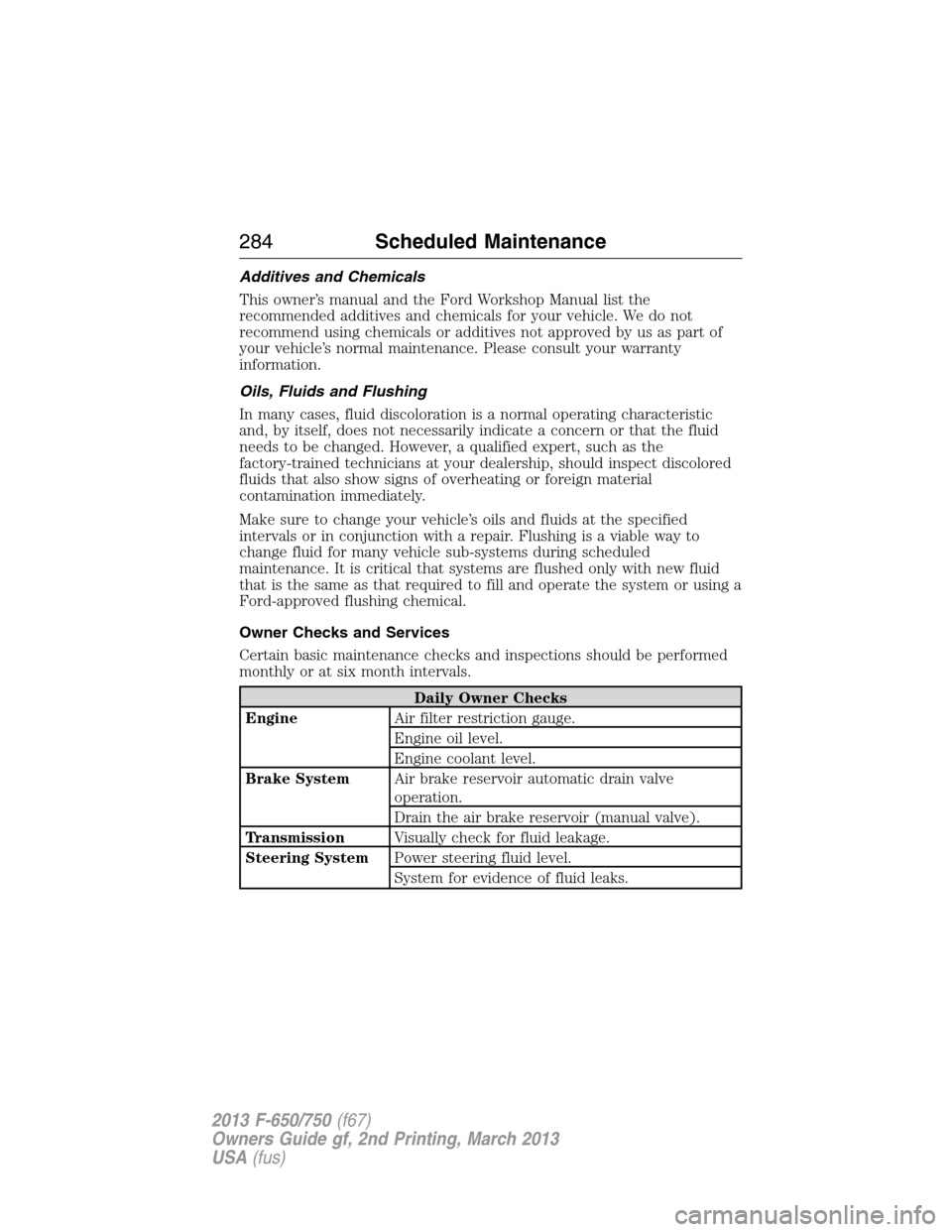
Daily Owner Checks
EngineAir filter restriction gauge.
Engine oil level.
Engine coolant level.
Brake SystemAir brake reservoir automatic drain valve
operation.
Drain the air brake reservoir (manual valve).
TransmissionVisually check for fluid leakage.
Steering SystemPower steering fluid level.
System for evidence of fluid leaks.
284Scheduled Maintenance
2013 F-650/750(f67)
Owners Guide gf, 2nd Printing, March 2013
USA(fus)
Page 287 of 378
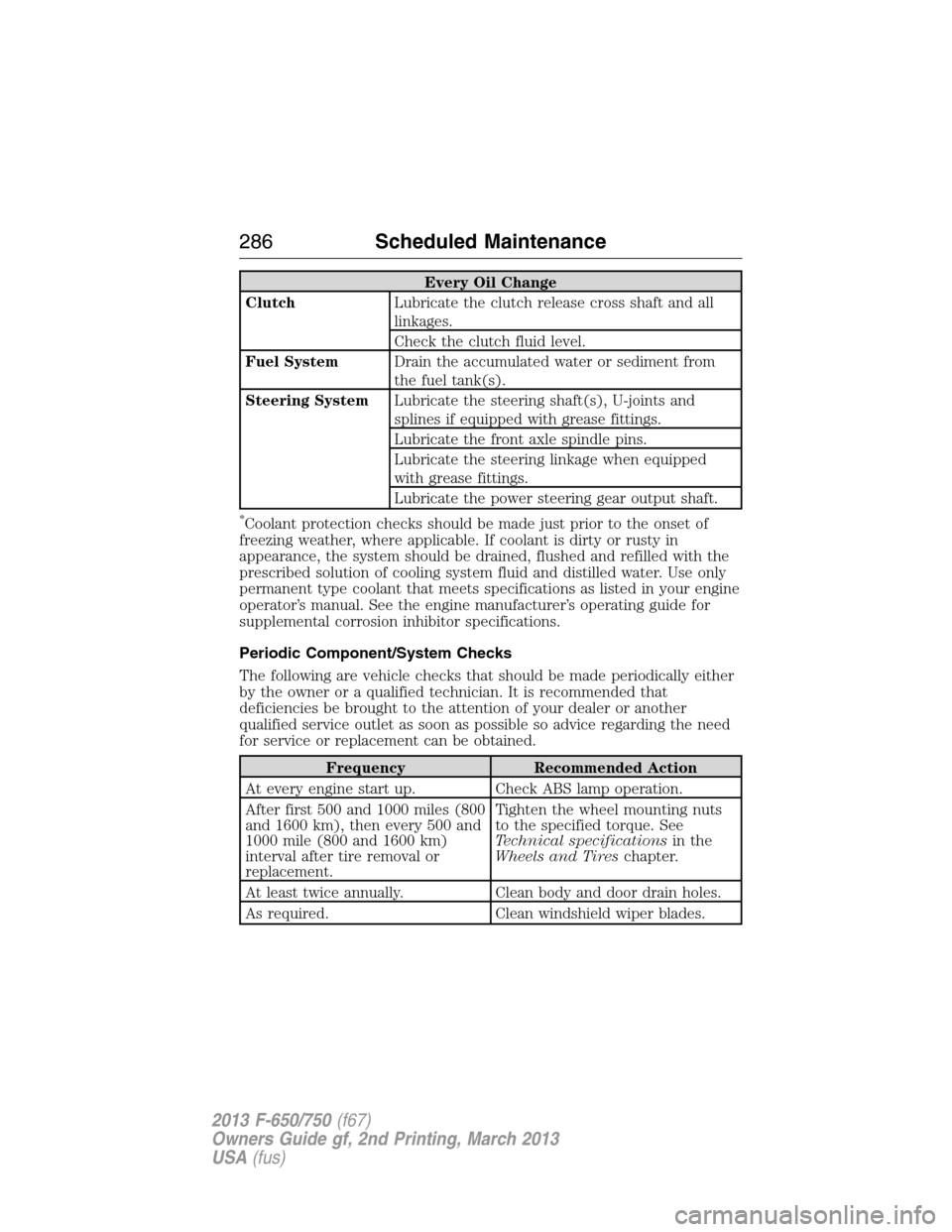
Every Oil Change
ClutchLubricate the clutch release cross shaft and all
linkages.
Check the clutch fluid level.
Fuel SystemDrain the accumulated water or sediment from
the fuel tank(s).
Steering SystemLubricate the steering shaft(s), U-joints and
splines if equipped with grease fittings.
Lubricate the front axle spindle pins.
Lubricate the steering linkage when equipped
with grease fittings.
Lubricate the power steering gear output shaft.
*Coolant protection checks should be made just prior to the onset of
freezing weather, where applicable. If coolant is dirty or rusty in
appearance, the system should be drained, flushed and refilled with the
prescribed solution of cooling system fluid and distilled water. Use only
permanent type coolant that meets specifications as listed in your engine
operator’s manual. See the engine manufacturer’s operating guide for
supplemental corrosion inhibitor specifications.
Periodic Component/System Checks
The following are vehicle checks that should be made periodically either
by the owner or a qualified technician. It is recommended that
deficiencies be brought to the attention of your dealer or another
qualified service outlet as soon as possible so advice regarding the need
for service or replacement can be obtained.
Frequency Recommended Action
At every engine start up. Check ABS lamp operation.
After first 500 and 1000 miles (800
and 1600 km), then every 500 and
1000 mile (800 and 1600 km)
interval after tire removal or
replacement.Tighten the wheel mounting nuts
to the specified torque. See
Technical specificationsin the
Wheels and Tireschapter.
At least twice annually. Clean body and door drain holes.
As required. Clean windshield wiper blades.
286Scheduled Maintenance
2013 F-650/750(f67)
Owners Guide gf, 2nd Printing, March 2013
USA(fus)