heating FORD F650 2016 13.G User Guide
[x] Cancel search | Manufacturer: FORD, Model Year: 2016, Model line: F650, Model: FORD F650 2016 13.GPages: 379, PDF Size: 4.8 MB
Page 199 of 379
•
Do not mix different colors or types of
coolant in your vehicle. Make sure the
correct coolant is used. Mixing of
engine coolants may harm your
engine ’s cooling system. The use of an
improper coolant may harm engine and
cooling system components and may
void the warranty. Use prediluted
engine coolant meeting the Ford
specification. See Capacities and
Specifications (page 251).
• In case of emergency, a large amount
of water without engine coolant may
be added in order to reach a vehicle
service location. In this instance, the
cooling system must be drained,
chemically cleaned with Motorcraft
Premium Cooling System Flush, and
refilled with engine coolant as soon as
possible. Water alone (without engine
coolant) can cause engine damage
from corrosion, overheating or freezing.
• Do not use alcohol, methanol, brine or
any engine coolants mixed with alcohol
or methanol antifreeze (coolant).
Alcohol and other liquids can cause
engine damage from overheating or
freezing.
• Do not add extra inhibitors or additives
to the coolant. These can be harmful
and compromise the corrosion
protection of the engine coolant.
Add prediluted engine coolant meeting the
Ford specification (Motorcraft Orange
Antifreeze/Coolant Prediluted). See
Capacities and Specifications
(page
251).
Note: Generic coolants marketed for all
makes and models may not meet the Ford
specification and may cause damage to the
cooling system. This damage may void the
warranty. For vehicles with overflow coolant systems
with a non-pressurized cap on the coolant
recovery system, add coolant to the
coolant recovery reservoir when the engine
is cool. Add prediluted engine coolant
(Motorcraft Orange Antifreeze/Coolant
Prediluted) to the FULL COLD level. For all
other vehicles which have a coolant degas
system with a pressurized cap, or if it is
necessary to remove the coolant pressure
relief cap on the radiator of a vehicle with
an overflow system, follow these steps to
add engine coolant.
1. Turn the engine off and let it cool.
2. When the engine is cool, wrap a thick
cloth around the coolant pressure relief
cap on the coolant reservoir (a
translucent plastic bottle). Slowly turn
cap counterclockwise until pressure
begins to release. When you are sure
that all the pressure has been released,
use the cloth to turn it
counterclockwise and remove the cap.
3. Fill the coolant reservoir slowly with prediluted engine coolant to within the
FULL COLD level, or between the MIN
and MAX marks (within the COLD FILL
RANGE), as listed on the engine
coolant reservoir. If you removed the
radiator cap in an overflow system, fill
the radiator until the coolant is visible
and radiator is almost full. If coolant is
added to bring the level within the
COLD FILL RANGE when the engine is
not cold, the system may remain under
filled.
4. Replace the cap. Turn until tightly installed. Cap must be tightly installed
to prevent coolant loss.
Whenever coolant has been added, the
coolant level in the coolant reservoir
should be checked the next few times you
drive the vehicle. If necessary, add enough
prediluted engine coolant to bring the
coolant level to the proper level.
196
F650750 (TBC), enUSA, First Printing Maintenance
Page 200 of 379
If you have to add more than 1.0 quart (1.0
liter) of engine coolant per month, have
your authorized dealer check the engine
cooling system. Your cooling system may
have a leak. Operating an engine with a
low level of coolant can result in engine
overheating and possible engine damage.
Engine and Secondary Cooling
System Refill Procedure
The following procedure should be used
when refilling the engine or secondary
cooling systems after it has been drained
or become extremely low.
1. Before you remove the cap, turn the
engine off and let it cool.
2. When the engine is cool, wrap a thick cloth around the cap. Slowly turn cap
counterclockwise until pressure begins
to release.
3. Step back while the pressure releases.
4. When you are sure that all the pressure
has been released, use the cloth to turn
it counterclockwise and remove the
cap.
5. Slowly add prediluted engine coolant to the coolant reservoir until the
coolant level is within the COLD FILL
RANGE as listed on the reservoir.
6. Reinstall the pressure relief cap.
7. Start and run the engine at 2000 rpm for 2 minutes.
8. Shut engine off, and remove the pressure relief cap as previously
outlined.
9. If required, add prediluted engine coolant to the coolant reservoir until
the coolant level is within the COLD
FILL RANGE as listed on the reservoir. 10.
Engine cooling system: Repeat
Step 5 until the coolant level has
stabilized (is no longer dropping after
each step) AND the upper radiator
hose at the radiator is warm to the
touch (indicating that the engine
thermostat is open and coolant is
flowing through the radiator).
Secondary cooling system: Repeat
Step 5 until the coolant level has
stabilized (is no longer dropping after
each step) AND the lower passenger
side of the secondary radiator is
warm to the touch (indicating
secondary thermostat is open and
coolant is flowing through the entire
system).
11. Reinstall the pressure relief cap. Shut
the engine off and let it cool.
12. Check the coolant level in the reservoir before you drive your vehicle
the next few times (with the engine
cool).
13. If necessary, add prediluted engine coolant to the coolant reservoir until
the coolant level is within the COLD
FILL RANGE as listed on the reservoir.
After any coolant has been added,
check the coolant concentration. See
Adding Engine Coolant
earlier in
the chapter for more information.
Whenever coolant has been added, the
coolant level in the reservoir should be
checked the next few times you drive the
vehicle. If needed, add prediluted engine
coolant to bring the coolant level to the
proper level on the reservoir.
Recycled Engine Coolant
Ford Motor Company does not recommend
the use of recycled engine coolant since a
Ford-approved recycling process is not yet
available.
197
F650750 (TBC), enUSA, First Printing Maintenance
Page 204 of 379
Check the fluid at the normal operating
temperature of 196°F (91°C) to 215°F
(102°C) on a level surface. The normal
operating temperature can be reached
after approximately
20 mi (30 km).
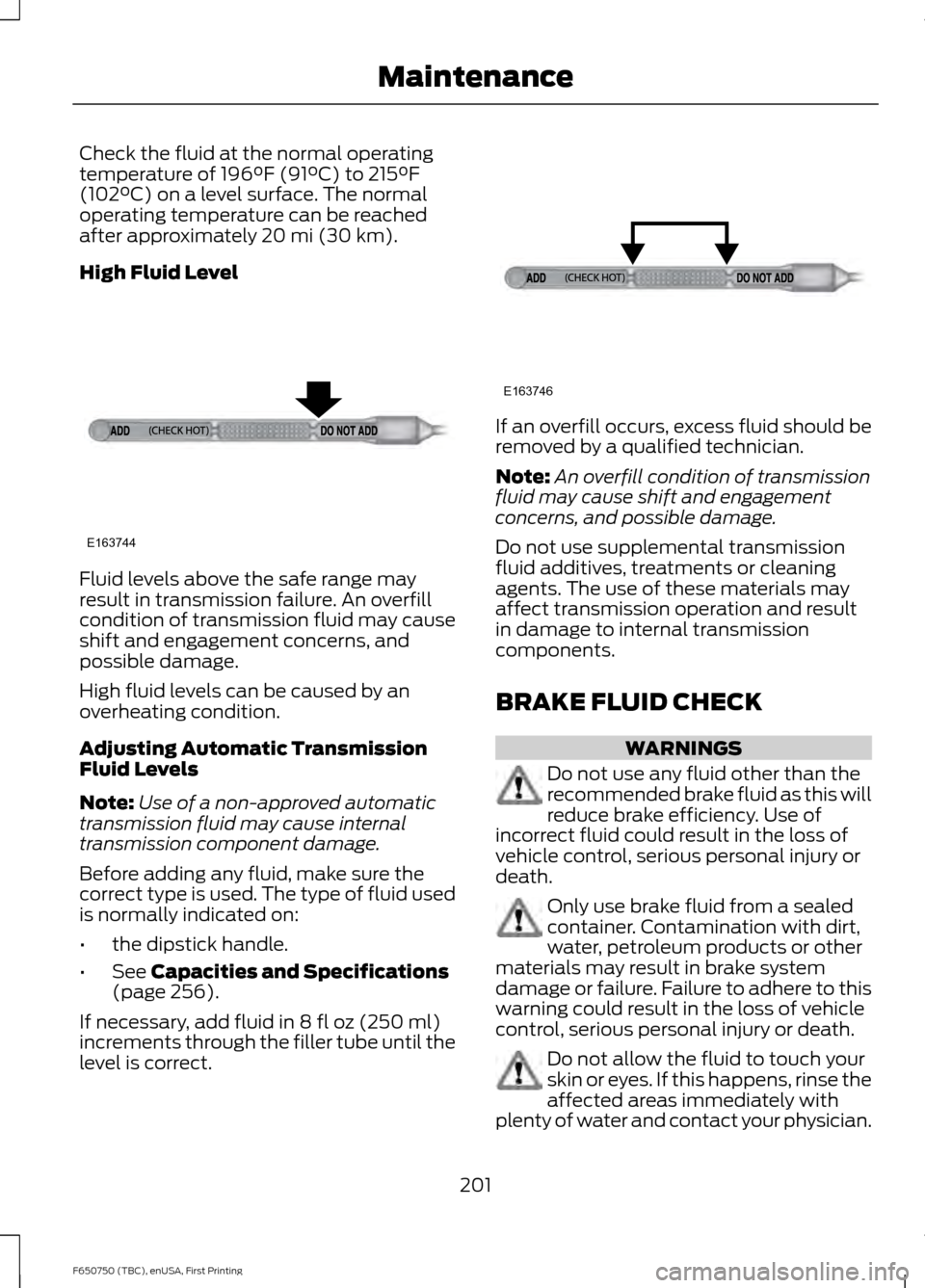
High Fluid Level Fluid levels above the safe range may
result in transmission failure. An overfill
condition of transmission fluid may cause
shift and engagement concerns, and
possible damage.
High fluid levels can be caused by an
overheating condition.
Adjusting Automatic Transmission
Fluid Levels
Note:
Use of a non-approved automatic
transmission fluid may cause internal
transmission component damage.
Before adding any fluid, make sure the
correct type is used. The type of fluid used
is normally indicated on:
• the dipstick handle.
• See
Capacities and Specifications
(page 256).
If necessary, add fluid in
8 fl oz (250 ml)
increments through the filler tube until the
level is correct. If an overfill occurs, excess fluid should be
removed by a qualified technician.
Note:
An overfill condition of transmission
fluid may cause shift and engagement
concerns, and possible damage.
Do not use supplemental transmission
fluid additives, treatments or cleaning
agents. The use of these materials may
affect transmission operation and result
in damage to internal transmission
components.
BRAKE FLUID CHECK WARNINGS
Do not use any fluid other than the
recommended brake fluid as this will
reduce brake efficiency. Use of
incorrect fluid could result in the loss of
vehicle control, serious personal injury or
death. Only use brake fluid from a sealed
container. Contamination with dirt,
water, petroleum products or other
materials may result in brake system
damage or failure. Failure to adhere to this
warning could result in the loss of vehicle
control, serious personal injury or death. Do not allow the fluid to touch your
skin or eyes. If this happens, rinse the
affected areas immediately with
plenty of water and contact your physician.
201
F650750 (TBC), enUSA, First Printing MaintenanceE163744 E163746
Page 318 of 379
A message appears in the information
display when it is time for an oil change.
Make sure you perform the oil change
within two weeks or 500 miles (800
kilometers) of the message appearing.
Make sure you reset the Intelligent Oil-Life
Monitor after each oil change. See
Instrument Cluster (page 54).
If your information display resets
prematurely or becomes inoperative, you
should perform the oil change interval at
six months or 5000 miles (8000
kilometers) from your last oil change.
Never exceed one year or 10000 miles
(16000 kilometers) between oil change
intervals.
All Vehicles
Your vehicle is very sophisticated and built
with multiple, complex, performance
systems. Every manufacturer develops
these systems using different
specifications and performance features.
That is why it is important to rely upon your
dealership to properly diagnose and repair
your vehicle.
Ford Motor Company has recommended
maintenance intervals for various parts
and component systems based upon
engineering testing. Ford Motor Company
relies upon this testing to determine the
most appropriate mileage for replacement
of oils and fluids to protect your vehicle at
the lowest overall cost to you and
recommends against maintenance
schedules that deviate from the scheduled
maintenance information.
We strongly recommend the use of only
genuine Ford, Motorcraft or
Ford-authorized re-manufactured
replacement parts engineered for your
vehicle. Additives and Chemicals
This owner's manual and the Ford
Workshop Manual list the recommended
additives and chemicals for your vehicle.
We do not recommend using chemicals or
additives not approved by us as part of
your vehicle
’s normal maintenance. Please
consult your warranty information.
Oils, Fluids and Flushing
In many cases, fluid discoloration is a
normal operating characteristic and, by
itself, does not necessarily indicate a
concern or that the fluid needs to be
changed. However, a qualified expert, such
as the factory-trained technicians at your
dealership, should inspect discolored fluids
that also show signs of overheating or
foreign material contamination
immediately.
Make sure to change your vehicle ’s oils and
fluids at the specified intervals or in
conjunction with a repair. Flushing is a
viable way to change fluid for many vehicle
sub-systems during scheduled
maintenance. It is critical that systems are
flushed only with new fluid that is the same
as that required to fill and operate the
system or using a Ford-approved flushing
chemical.
Emissions Control System WARNING
Because of high engine
compartment and exhaust system
temperatures resulting from
emissions equipment, do not park, idle or
operate your vehicle in dry grass or other
dry ground cover where the possibility of
ground fire exists. 315
F650750 (TBC), enUSA, First Printing Scheduled Maintenance
Page 332 of 379
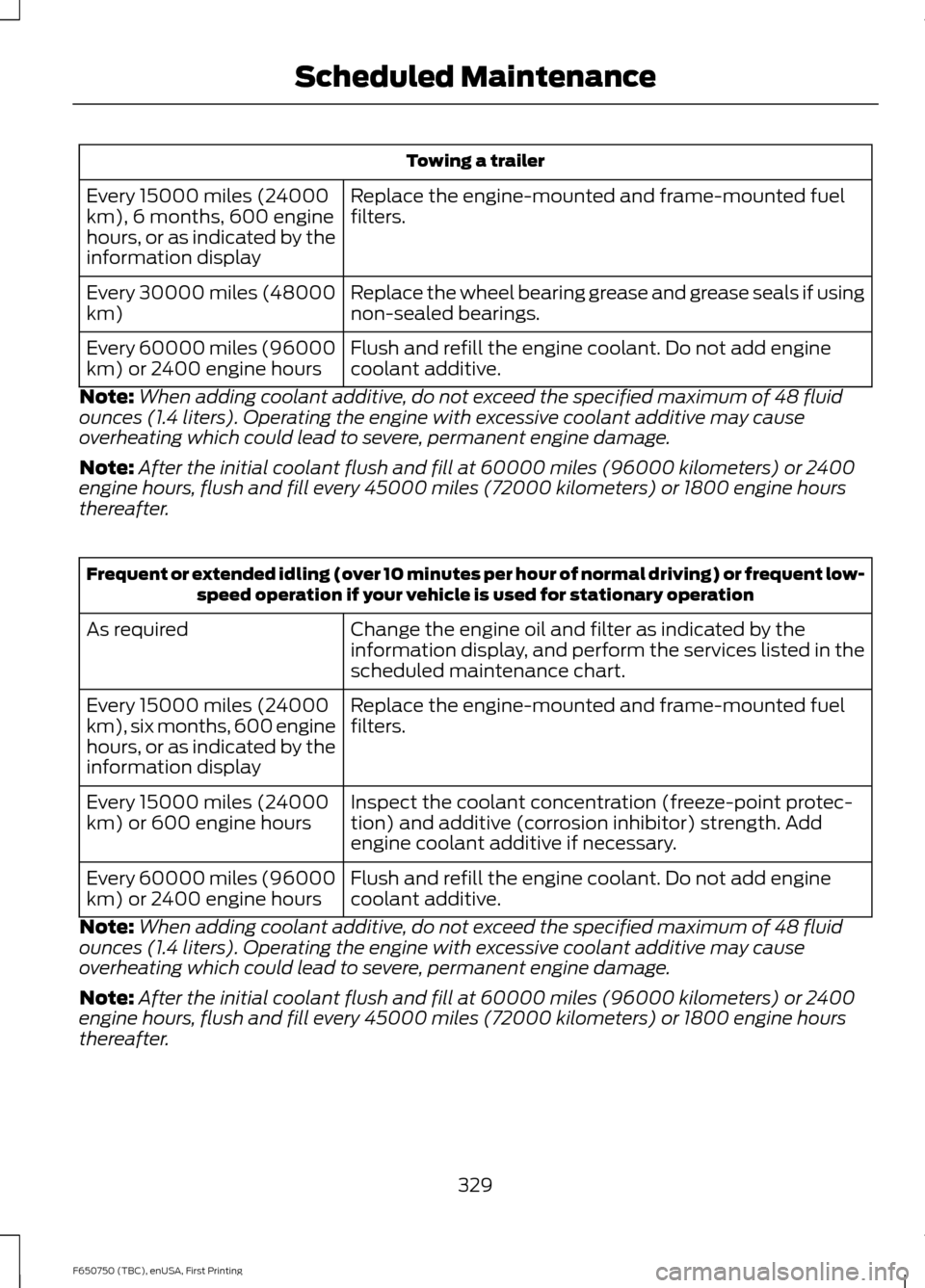
Towing a trailer
Replace the engine-mounted and frame-mounted fuel
filters.
Every 15000 miles (24000
km), 6 months, 600 engine
hours, or as indicated by the
information display
Replace the wheel bearing grease and grease seals if using
non-sealed bearings.
Every 30000 miles (48000
km)
Flush and refill the engine coolant. Do not add engine
coolant additive.
Every 60000 miles (96000
km) or 2400 engine hours
Note: When adding coolant additive, do not exceed the specified maximum of 48 fluid
ounces (1.4 liters). Operating the engine with excessive coolant additive may cause
overheating which could lead to severe, permanent engine damage.
Note: After the initial coolant flush and fill at 60000 miles (96000 kilometers) or 2400
engine hours, flush and fill every 45000 miles (72000 kilometers) or 1800 engine hours
thereafter. Frequent or extended idling (over 10 minutes per hour of normal driving) or frequent low-
speed operation if your vehicle is used for stationary operation
Change the engine oil and filter as indicated by the
information display, and perform the services listed in the
scheduled maintenance chart.
As required
Replace the engine-mounted and frame-mounted fuel
filters.
Every 15000 miles (24000
km), six months, 600 engine
hours, or as indicated by the
information display
Inspect the coolant concentration (freeze-point protec-
tion) and additive (corrosion inhibitor) strength. Add
engine coolant additive if necessary.
Every 15000 miles (24000
km) or 600 engine hours
Flush and refill the engine coolant. Do not add engine
coolant additive.
Every 60000 miles (96000
km) or 2400 engine hours
Note: When adding coolant additive, do not exceed the specified maximum of 48 fluid
ounces (1.4 liters). Operating the engine with excessive coolant additive may cause
overheating which could lead to severe, permanent engine damage.
Note: After the initial coolant flush and fill at 60000 miles (96000 kilometers) or 2400
engine hours, flush and fill every 45000 miles (72000 kilometers) or 1800 engine hours
thereafter.
329
F650750 (TBC), enUSA, First Printing Scheduled Maintenance
Page 333 of 379

Frequent low-speed operation, consistent heavy traffic under 25 mph (40 km/h) or long
rush-hour traffic
Change the engine oil and filter as indicated by the
information display, and perform the services listed in the
scheduled maintenance chart.
As required
Replace the engine-mounted and frame-mounted fuel
filters.
Every 15000 miles (24000
km), six months, 600 engine
hours, or as indicated by the
information display
Inspect the coolant concentration (freeze-point protec-
tion) and additive (corrosion inhibitor) strength. Add
engine coolant additive if necessary.
Every 15000 miles (24000
km) or 600 engine hours
Flush and refill the engine coolant. Do not add engine
coolant additive.
Every 60000 miles (96000
km) or 2400 engine hours
Note: When adding coolant additive, do not exceed the specified maximum of 48 fluid
ounces (1.4 liters). Operating the engine with excessive coolant additive may cause
overheating which could lead to severe, permanent engine damage.
Note: After the initial coolant flush and fill at 60000 miles (96000 kilometers) or 2400
engine hours, flush and fill every 45000 miles (72000 kilometers) or 1800 engine hours
thereafter. Sustained high-speed driving at gross vehicle weight rating (maximum loaded weight
for vehicle operation)
Change the engine oil and filter as indicated by the
information display, and perform the services listed in the
scheduled maintenance chart.
As required
Replace the engine-mounted and frame-mounted fuel
filters.
Every 15000 miles (24000
km), six months, 600 engine
hours, or as indicated by the
information display
Inspect the coolant concentration (freeze-point protec-
tion) and additive (corrosion inhibitor) strength. Add
engine coolant additive if necessary.
Every 15000 miles (24000
km) or 600 engine hours
330
F650750 (TBC), enUSA, First Printing Scheduled Maintenance
Page 334 of 379
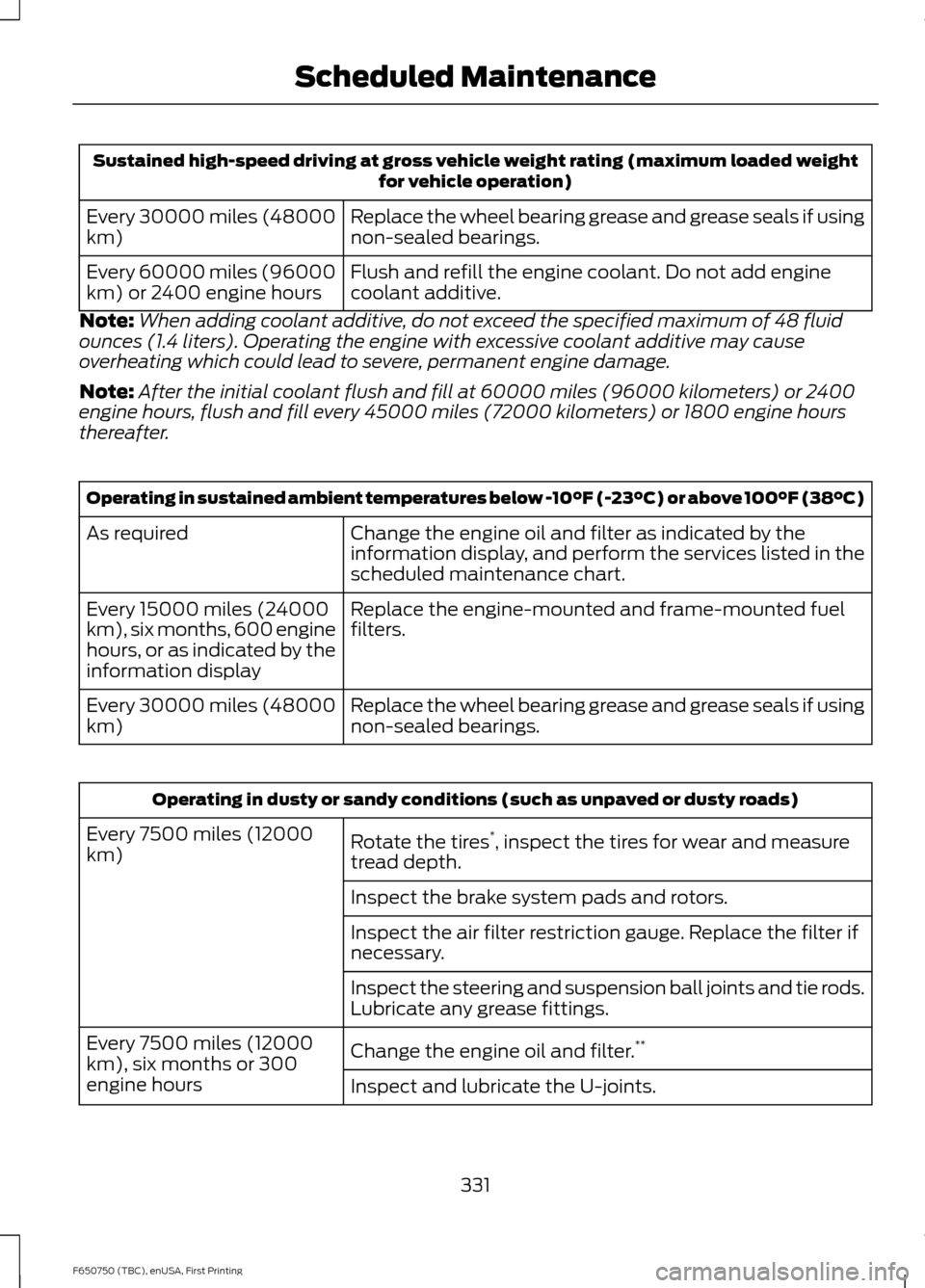
Sustained high-speed driving at gross vehicle weight rating (maximum loaded weight
for vehicle operation)
Replace the wheel bearing grease and grease seals if using
non-sealed bearings.
Every 30000 miles (48000
km)
Flush and refill the engine coolant. Do not add engine
coolant additive.
Every 60000 miles (96000
km) or 2400 engine hours
Note: When adding coolant additive, do not exceed the specified maximum of 48 fluid
ounces (1.4 liters). Operating the engine with excessive coolant additive may cause
overheating which could lead to severe, permanent engine damage.
Note: After the initial coolant flush and fill at 60000 miles (96000 kilometers) or 2400
engine hours, flush and fill every 45000 miles (72000 kilometers) or 1800 engine hours
thereafter. Operating in sustained ambient temperatures below -10°F (-23°C) or above 100°F (38°C)
Change the engine oil and filter as indicated by the
information display, and perform the services listed in the
scheduled maintenance chart.
As required
Replace the engine-mounted and frame-mounted fuel
filters.
Every 15000 miles (24000
km), six months, 600 engine
hours, or as indicated by the
information display
Replace the wheel bearing grease and grease seals if using
non-sealed bearings.
Every 30000 miles (48000
km) Operating in dusty or sandy conditions (such as unpaved or dusty roads)
Rotate the tires*
, inspect the tires for wear and measure
tread depth.
Every 7500 miles (12000
km)
Inspect the brake system pads and rotors.
Inspect the air filter restriction gauge. Replace the filter if
necessary.
Inspect the steering and suspension ball joints and tie rods.
Lubricate any grease fittings.
Change the engine oil and filter. **
Every 7500 miles (12000
km), six months or 300
engine hours Inspect and lubricate the U-joints.
331
F650750 (TBC), enUSA, First Printing Scheduled Maintenance
Page 372 of 379
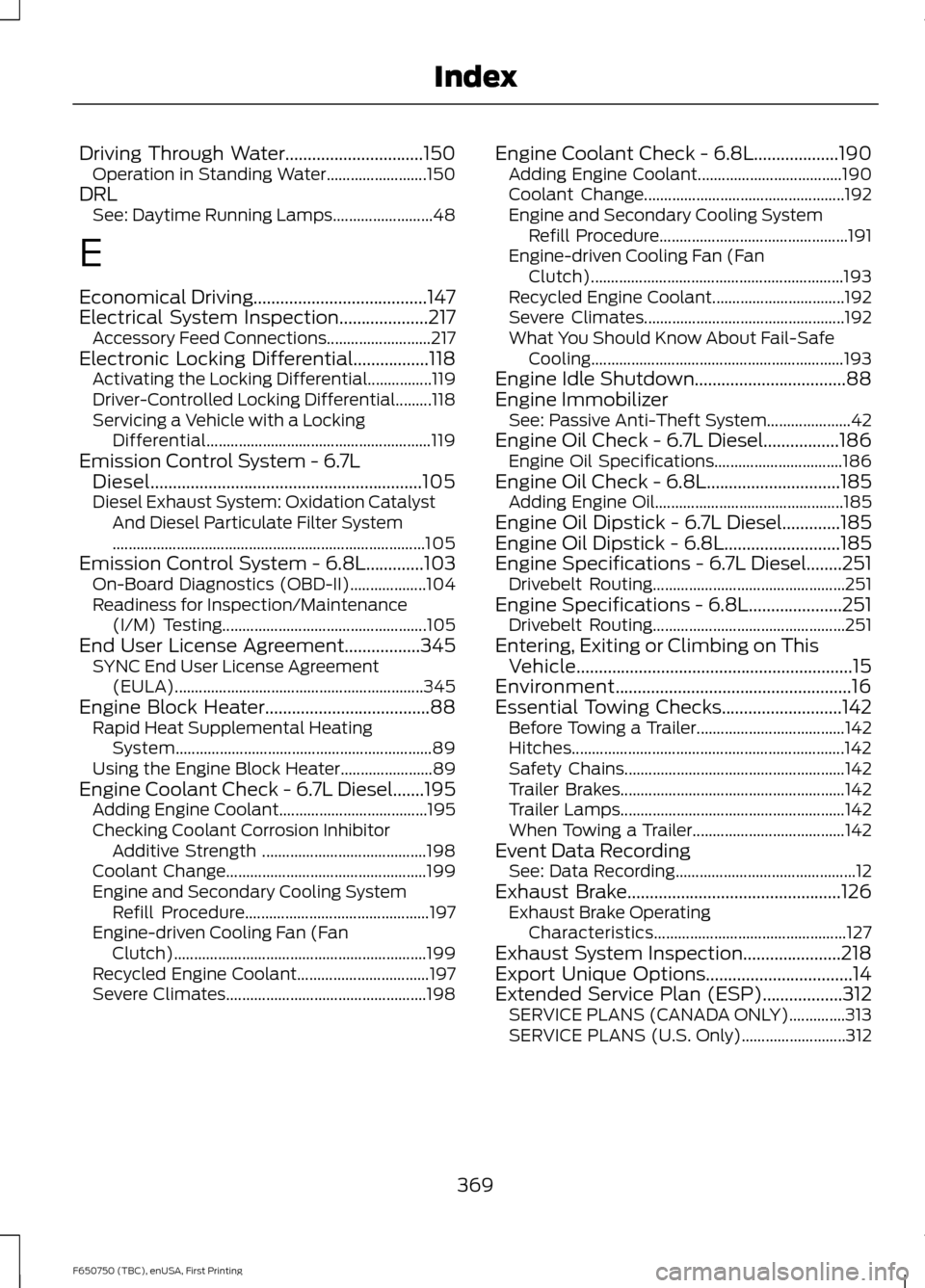
Driving Through Water...............................150
Operation in Standing Water......................... 150
DRL See: Daytime Running Lamps......................... 48
E
Economical Driving.......................................147
Electrical System Inspection....................217
Accessory Feed Connections.......................... 217
Electronic Locking Differential.................118 Activating the Locking Differential................119
Driver-Controlled Locking Differential.........118
Servicing a Vehicle with a Locking
Differential........................................................ 119
Emission Control System - 6.7L Diesel.............................................................105
Diesel Exhaust System: Oxidation Catalyst And Diesel Particulate Filter System
........................................................................\
...... 105
Emission Control System - 6.8L.............103 On-Board Diagnostics (OBD-II)................... 104
Readiness for Inspection/Maintenance (I/M) Testing................................................... 105
End User License Agreement
.................345
SYNC End User License Agreement
(EULA).............................................................. 345
Engine Block Heater
.....................................88
Rapid Heat Supplemental Heating
System................................................................ 89
Using the Engine Block Heater....................... 89
Engine Coolant Check - 6.7L Diesel.......195 Adding Engine Coolant..................................... 195
Checking Coolant Corrosion Inhibitor Additive Strength ......................................... 198
Coolant Change.................................................. 199
Engine and Secondary Cooling System Refill Procedure.............................................. 197
Engine-driven Cooling Fan (Fan Clutch) ............................................................... 199
Recycled Engine Coolant................................. 197
Severe Climates.................................................. 198Engine Coolant Check - 6.8L...................190
Adding Engine Coolant.................................... 190
Coolant Change.................................................. 192
Engine and Secondary Cooling System Refill Procedure............................................... 191
Engine-driven Cooling Fan (Fan Clutch)............................................................... 193
Recycled Engine Coolant................................. 192
Severe Climates.................................................. 192
What You Should Know About Fail-Safe Cooling............................................................... 193
Engine Idle Shutdown..................................88
Engine Immobilizer See: Passive Anti-Theft System..................... 42
Engine Oil Check - 6.7L Diesel.................186 Engine Oil Specifications................................ 186
Engine Oil Check - 6.8L
..............................185
Adding Engine Oil............................................... 185
Engine Oil Dipstick - 6.7L Diesel.............185
Engine Oil Dipstick - 6.8L..........................185
Engine Specifications - 6.7L Diesel........251 Drivebelt Routing................................................ 251
Engine Specifications - 6.8L.....................251 Drivebelt Routing................................................ 251
Entering, Exiting or Climbing on This Vehicle..............................................................15
Environment.....................................................16
Essential Towing Checks...........................142 Before Towing a Trailer..................................... 142
Hitches.................................................................... 142
Safety Chains....................................................... 142
Trailer Brakes........................................................ 142
Trailer Lamps........................................................ 142
When Towing a Trailer...................................... 142
Event Data Recording See: Data Recording............................................. 12
Exhaust Brake................................................126 Exhaust Brake Operating
Characteristics................................................ 127
Exhaust System Inspection......................218
Export Unique Options.................................14
Extended Service Plan (ESP)
..................312
SERVICE PLANS (CANADA ONLY)..............313
SERVICE PLANS (U.S. Only).......................... 312
369
F650750 (TBC), enUSA, First Printing Index
Page 374 of 379
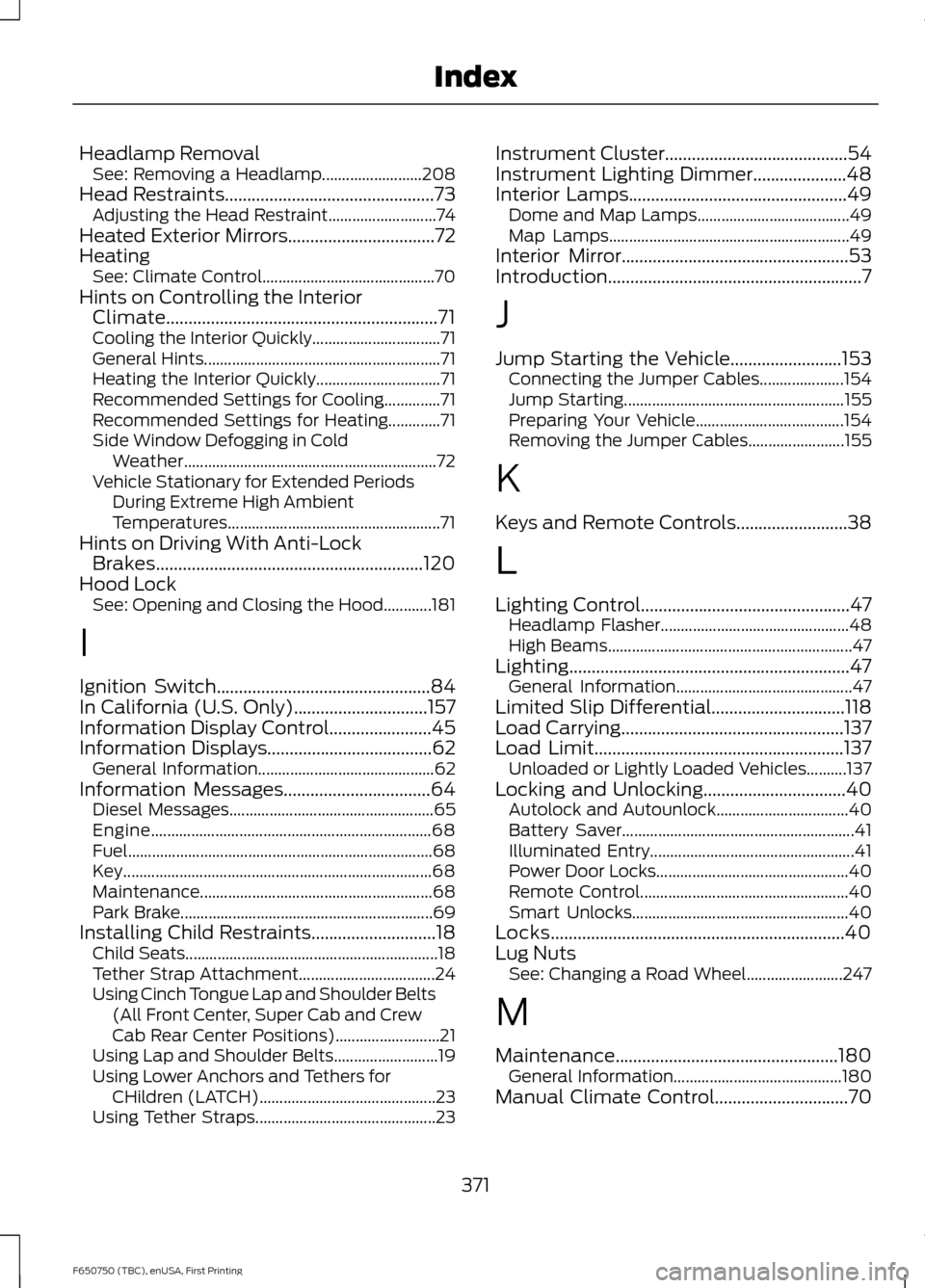
Headlamp Removal
See: Removing a Headlamp......................... 208
Head Restraints...............................................73 Adjusting the Head Restraint........................... 74
Heated Exterior Mirrors.................................72
Heating See: Climate Control........................................... 70
Hints on Controlling the Interior Climate.............................................................71
Cooling the Interior Quickly................................ 71
General Hints........................................................... 71
Heating the Interior Quickly............................... 71
Recommended Settings for Cooling..............71
Recommended Settings for Heating.............71
Side Window Defogging in Cold Weather............................................................... 72
Vehicle Stationary for Extended Periods During Extreme High Ambient
Temperatures..................................................... 71
Hints on Driving With Anti-Lock Brakes
............................................................120
Hood Lock See: Opening and Closing the Hood............181
I
Ignition Switch
................................................84
In California (U.S. Only)..............................157
Information Display Control.......................45
Information Displays.....................................62 General Information............................................ 62
Information Messages
.................................64
Diesel Messages................................................... 65
Engine...................................................................... 68
Fuel........................................................................\
.... 68
Key........................................................................\
..... 68
Maintenance.......................................................... 68
Park Brake............................................................... 69
Installing Child Restraints
............................18
Child Seats............................................................... 18
Tether Strap Attachment.................................. 24
Using Cinch Tongue Lap and Shoulder Belts (All Front Center, Super Cab and Crew
Cab Rear Center Positions).......................... 21
Using Lap and Shoulder Belts.......................... 19
Using Lower Anchors and Tethers for CHildren (LATCH)............................................ 23
Using Tether Straps............................................. 23Instrument Cluster
.........................................54
Instrument Lighting Dimmer.....................48
Interior Lamps.................................................49 Dome and Map Lamps...................................... 49
Map Lamps............................................................ 49
Interior Mirror
...................................................53
Introduction.........................................................7
J
Jump Starting the Vehicle
.........................153
Connecting the Jumper Cables..................... 154
Jump Starting....................................................... 155
Preparing Your Vehicle..................................... 154
Removing the Jumper Cables........................ 155
K
Keys and Remote Controls.........................38
L
Lighting Control
...............................................47
Headlamp Flasher............................................... 48
High Beams............................................................. 47
Lighting...............................................................47 General Information............................................ 47
Limited Slip Differential..............................118
Load Carrying
..................................................137
Load Limit........................................................137 Unloaded or Lightly Loaded Vehicles..........137
Locking and Unlocking
................................40
Autolock and Autounlock................................. 40
Battery Saver.......................................................... 41
Illuminated Entry................................................... 41
Power Door Locks................................................ 40
Remote Control.................................................... 40
Smart Unlocks...................................................... 40
Locks..................................................................40
Lug Nuts See: Changing a Road Wheel........................ 247
M
Maintenance..................................................180 General Information.......................................... 180
Manual Climate Control..............................70
371
F650750 (TBC), enUSA, First Printing Index