air filter FORD F650 2016 13.G Owners Manual
[x] Cancel search | Manufacturer: FORD, Model Year: 2016, Model line: F650, Model: FORD F650 2016 13.GPages: 379, PDF Size: 4.8 MB
Page 5 of 379
Warning Lamps and Indicators................58
Audible Warnings and Indicators..............61
Information Displays
General Information......................................62
Information Messages.................................64
Climate Control
Manual Climate Control
..............................70
Hints on Controlling the Interior Climate............................................................71
Heated Exterior Mirrors
.................................72
Seats
Sitting in the Correct Position....................73
Head Restraints
...............................................73
Manual Seats
...................................................75
Power Seats
.....................................................76
Rear Seats
.........................................................78
Front Seat Armrest........................................79
Rear Seat Armrest.........................................80
Auxiliary Power Points
Auxiliary Power Points..................................81
Storage Compartments
Overhead Console
.........................................83
Starting and Stopping the Engine
General Information
.....................................84
Ignition Switch
................................................84
Starting a Gasoline Engine.........................85
Starting a Diesel Engine..............................86
Diesel Particulate Filter................................87
Switching Off the Engine............................88
Engine Idle Shutdown..................................88
Engine Block Heater
.....................................88 Fuel and Refueling
Safety Precautions
........................................90
Fuel Quality - Gasoline.................................91
Fuel Quality - Diesel......................................92
Running Out of Fuel - 6.8L.........................95
Running Out of Fuel - 6.7L Diesel............95
Selective Catalytic Reduction System...........................................................95
Refueling - 6.8L
............................................100
Refueling - 6.7L Diesel
.................................101
Fuel Consumption.......................................102
Emission Control System - 6.8L.............103
Emission Control System - 6.7L Diesel............................................................105
Fuel Tank Selector Switch..........................112
Transmission
Automatic Transmission.............................113
Power Take-Off
...............................................117
Rear Axle
General Information
.....................................118
Limited Slip Differential..............................118
Electronic Locking Differential.................118
2-Speed Rear Axle........................................119
Brakes
General Information
....................................120
Hints on Driving With Anti-Lock Brakes...........................................................120
Parking Brake
...................................................121
Full Power Brake...........................................124
Air Brakes.........................................................125
Exhaust Brake................................................126
Trailer Brakes..................................................128
Traction Control
Principle of Operation.................................132
Using Traction Control - Vehicles With: Air Brakes
.....................................................132
2
F650750 (TBC), enUSA, First Printing Table of Contents
Page 6 of 379
Using Traction Control - Vehicles With:
Hydraulic Brakes.......................................132
Cruise Control
Principle of Operation.................................134
Using Cruise Control
....................................134
Driving Aids
Steering............................................................136
Load Carrying
Load Limit........................................................137
Air Suspension
...............................................138
Towing
Towing a Trailer.............................................140
Recommended Towing Weights.............141
Essential Towing Checks...........................142
Transporting the Vehicle............................143
Fifth Wheel Operation
................................144
Driving Hints
Breaking-In.....................................................146
General Driving Points................................146
Economical Driving
......................................147
Cold Weather Precautions
........................148
Driving Through Water...............................150
Roadside Emergencies
Roadside Assistance
....................................151
Hazard Warning Flashers...........................152
Fuel Shutoff....................................................152
Jump Starting the Vehicle
.........................153
Customer Assistance
Getting the Services You Need
...............156
In California (U.S. Only)
..............................157
The Better Business Bureau (BBB) Auto Line Program (U.S. Only)......................158 Utilizing the Mediation/Arbitration
Program (Canada Only)
........................158
Getting Assistance Outside the U.S. and Canada.........................................................159
Ordering Additional Owner's Literature.....................................................160
Reporting Safety Defects (U.S. Only).............................................................160
Reporting Safety Defects (Canada Only)..............................................................161
Fuses
Fuse Specification Chart...........................162
Changing a Fuse...........................................170
Vehicle Inspection Guide
Vehicle Inspection Information.................171
Maintenance
General Information....................................180
Opening and Closing the Hood................181
Under Hood Overview - 6.8L...................183
Under Hood Overview - 6.7L Diesel......184
Engine Oil Dipstick - 6.8L..........................185
Engine Oil Dipstick - 6.7L Diesel.............185
Engine Oil Check - 6.8L
..............................185
Engine Oil Check - 6.7L Diesel.................186
Changing the Engine Oil and Oil Filter..............................................................188
Changing the Coalescer Filter Element.......................................................189
Oil Change Indicator Reset.......................190
Engine Coolant Check - 6.8L
...................190
Engine Coolant Check - 6.7L Diesel.......195
Automatic Transmission Fluid Check...........................................................200
Brake Fluid Check.........................................201
Power Steering Fluid Check.....................202
Washer Fluid Check....................................202
Draining the Fuel Filter Water Trap - 6.7L Diesel
...........................................................203
3
F650750 (TBC), enUSA, First Printing Table of Contents
Page 7 of 379
Fuel Filter - 6.8L...........................................204
Changing the 12V Battery.........................204
Checking the Wiper Blades.....................206
Changing the Wiper Blades....................206
Adjusting the Headlamps........................206
Removing a Headlamp
.............................208
Changing a Bulb..........................................208
Bulb Specification Chart..........................209
Changing the Engine Air Filter - 6.8L.....210
Changing the Engine Air Filter - 6.7L Diesel
..............................................................211
Changing the Engine-Mounted and Diesel Fuel Conditioner Module Fuel
Filters - 6.7L Diesel...................................215
Electrical System Inspection....................217
Air Induction System Inspection.............217
Exhaust System Inspection......................218
Brake System Inspection...........................218
Axle Inspection
..............................................221
Steering System Inspection
.....................222
Suspension System Inspection
..............222
Frame and Tow Hook Inspection
...........223
Rear Axle Fluid Check
.................................223
Spring U-Bolt Check...................................223
Vehicle Care
General Information...................................225
Cleaning Products.......................................225
Cleaning the Exterior..................................225
Waxing.............................................................226
Cleaning the Engine....................................226
Cleaning the Windows and Wiper Blades...........................................................227
Cleaning the Interior....................................227
Cleaning the Instrument Panel and Instrument Cluster Lens
.......................228
Repairing Minor Paint Damage
..............228
Cleaning the Alloy Wheels.......................229
Vehicle Storage
.............................................229 Wheels and Tires
Tire Care
..........................................................232
Using Snow Chains
.....................................246
Changing a Road Wheel............................247
Technical Specifications
...........................249
Capacities and Specific- ations
Engine Specifications - 6.8L.....................251
Engine Specifications - 6.7L Diesel........251
Motorcraft Parts - 6.8L..............................252
Motorcraft Parts - 6.7L Diesel.................253
Vehicle Identification Number................254
Vehicle Certification Label.......................255
Transmission Code Designation............255
Capacities and Specifications - 6.8L...............................................................256
Capacities and Specifications - 6.7L Diesel............................................................261
Audio System
General Information...................................270
Audio Unit - Vehicles With: AM/FM........271
Audio Unit - Vehicles With: AM/FM/CD/ SYNC.............................................................272
Satellite Radio...............................................275
Audio Input Jack............................................277
USB Port
..........................................................277
SYNC™
General Information
...................................279
Using Voice Recognition............................281
Using SYNC™ With Your Phone............283
Using SYNC™ With Your Media Player...........................................................295
SYNC™ Troubleshooting
.........................304
Accessories
Auxiliary Switches........................................310
4
F650750 (TBC), enUSA, First Printing Table of Contents
Page 12 of 379
If these modified engine performance
characteristics persist for an extended
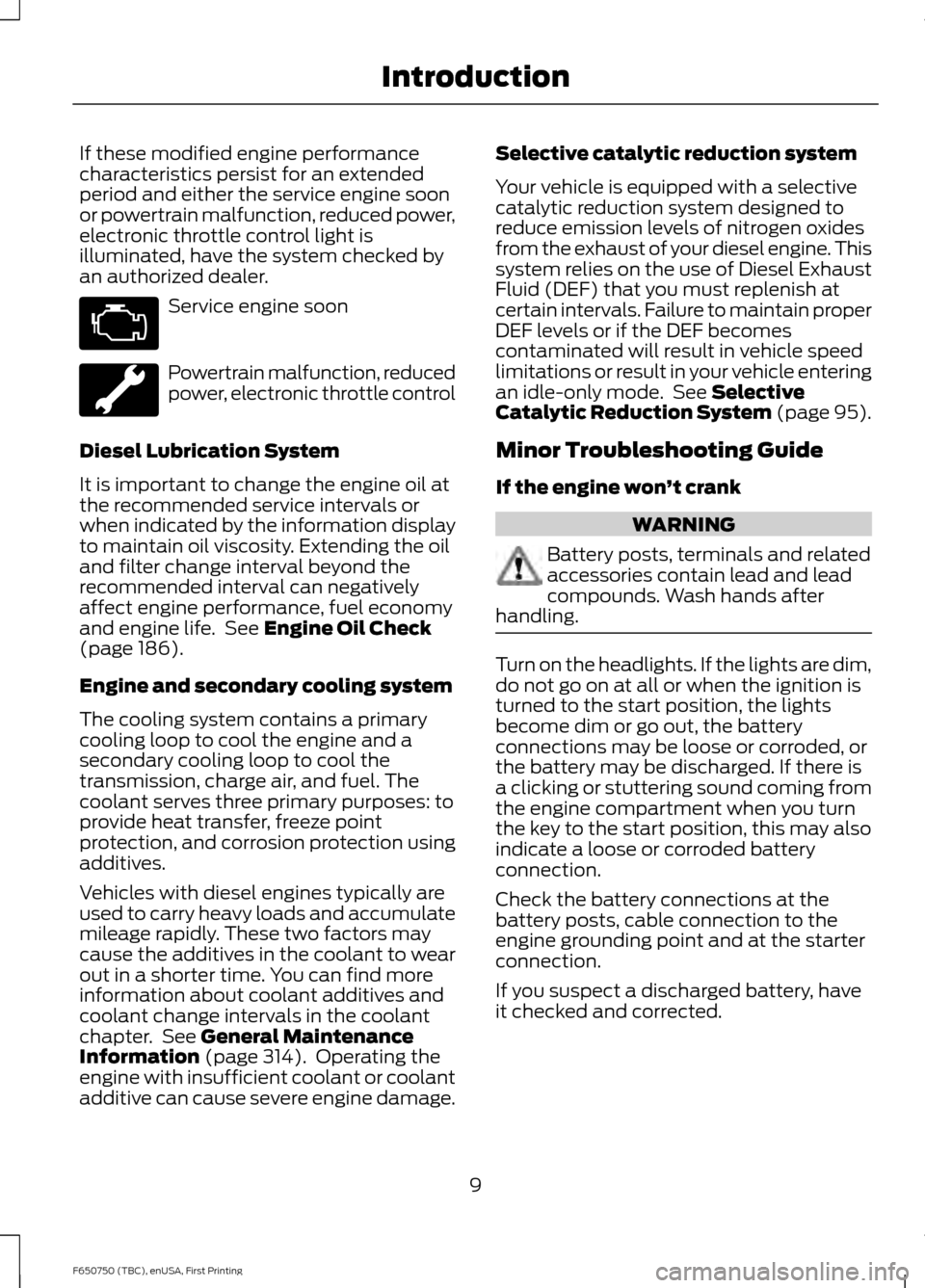
period and either the service engine soon
or powertrain malfunction, reduced power,
electronic throttle control light is
illuminated, have the system checked by
an authorized dealer.
Service engine soon
Powertrain malfunction, reduced
power, electronic throttle control
Diesel Lubrication System
It is important to change the engine oil at
the recommended service intervals or
when indicated by the information display
to maintain oil viscosity. Extending the oil
and filter change interval beyond the
recommended interval can negatively
affect engine performance, fuel economy
and engine life. See Engine Oil Check
(page 186).
Engine and secondary cooling system
The cooling system contains a primary
cooling loop to cool the engine and a
secondary cooling loop to cool the
transmission, charge air, and fuel. The
coolant serves three primary purposes: to
provide heat transfer, freeze point
protection, and corrosion protection using
additives.
Vehicles with diesel engines typically are
used to carry heavy loads and accumulate
mileage rapidly. These two factors may
cause the additives in the coolant to wear
out in a shorter time. You can find more
information about coolant additives and
coolant change intervals in the coolant
chapter. See
General Maintenance
Information (page 314). Operating the
engine with insufficient coolant or coolant
additive can cause severe engine damage. Selective catalytic reduction system
Your vehicle is equipped with a selective
catalytic reduction system designed to
reduce emission levels of nitrogen oxides
from the exhaust of your diesel engine. This
system relies on the use of Diesel Exhaust
Fluid (DEF) that you must replenish at
certain intervals. Failure to maintain proper
DEF levels or if the DEF becomes
contaminated will result in vehicle speed
limitations or result in your vehicle entering
an idle-only mode. See
Selective
Catalytic Reduction System (page 95).
Minor Troubleshooting Guide
If the engine won ’t crank WARNING
Battery posts, terminals and related
accessories contain lead and lead
compounds. Wash hands after
handling. Turn on the headlights. If the lights are dim,
do not go on at all or when the ignition is
turned to the start position, the lights
become dim or go out, the battery
connections may be loose or corroded, or
the battery may be discharged. If there is
a clicking or stuttering sound coming from
the engine compartment when you turn
the key to the start position, this may also
indicate a loose or corroded battery
connection.
Check the battery connections at the
battery posts, cable connection to the
engine grounding point and at the starter
connection.
If you suspect a discharged battery, have
it checked and corrected.
9
F650750 (TBC), enUSA, First Printing Introduction
Page 13 of 379
•
The gearshift lever must be in P (Park)
or N (Neutral) in order for the starter
to operate.
• Try operating the starter switch several
times. This operation may clean
potentially corroded contacts or make
the switch temporarily operable until
you can reach the dealer.
• If all electrical connections are tight
and you need assistance to start, See
Jump Starting the Vehicle (page 153).
If engine cranks but won ’t start
Prolonged starter cranking (in excess of 10
seconds) could cause damage to the
starter motor or the high-pressure fuel
pump.
• Check the fuel gauge. You may be out
of fuel. If the gauge shows that there
is fuel in the tank, the trouble may be
in the electrical system or the fuel
system. If equipped with an auxiliary
tank, be sure that the tank control
switch is set for the tank with fuel and
not on an empty tank.
• Leaving your ignition key turned to on
for over two minutes without starting
may make starting difficult because
the glow plugs will cease activation.
Reset the system by turning the ignition
key to off and then back to on again.
Note: If the system is out of fuel and the
engine will not start, do not continue
cranking the engine. Continued cranking can
damage the high-pressure fuel pump.
If the engine runs hot
The following could cause the engine to
overheat:
• Lack of coolant
• Dirty cooling system.
• Plugged radiator fins, A/C condenser
and/or oil cooler
• Malfunctioning fan drive •
Driving with frozen coolant
• Sticking thermostat
• Overloading or pulling heavy trailers
during hot weather
• Grill or radiator air blockage
• Slipping or missing drive belt
• Plugged or very dirty air filter
If fuses burn out WARNING
Replacement fuses and circuit
breakers must always be the same
rating as the original equipment
shown. Never replace a fuse or circuit
breaker with one of a higher rating. Higher
rated fuses or circuit breakers could allow
circuit overloading in the event of a circuit
malfunction, resulting in severe vehicle
damage or personal injury due to fire. Burned-out or blown fuses usually indicate
an electrical short-circuit, although a fuse
may occasionally burn out from vibration.
Insert a second fuse. If this fuse
immediately burns out and you cannot
locate the cause, return your vehicle to
your dealer for a circuit check. See
Changing a Fuse
(page 170).
Selective catalytic reduction system
speed limit and Idle-only modes
If the vehicle ’s speed is limited or in an
idle-only mode, the selective catalytic
reduction system may be limiting the
vehicle ’s functions due to low or
contaminated DEF. Check the DEF. See
Selective Catalytic Reduction System
(page
95).
SYMBOLS GLOSSARY
These are some of the symbols you may
see on your vehicle.
10
F650750 (TBC), enUSA, First Printing Introduction
Page 14 of 379
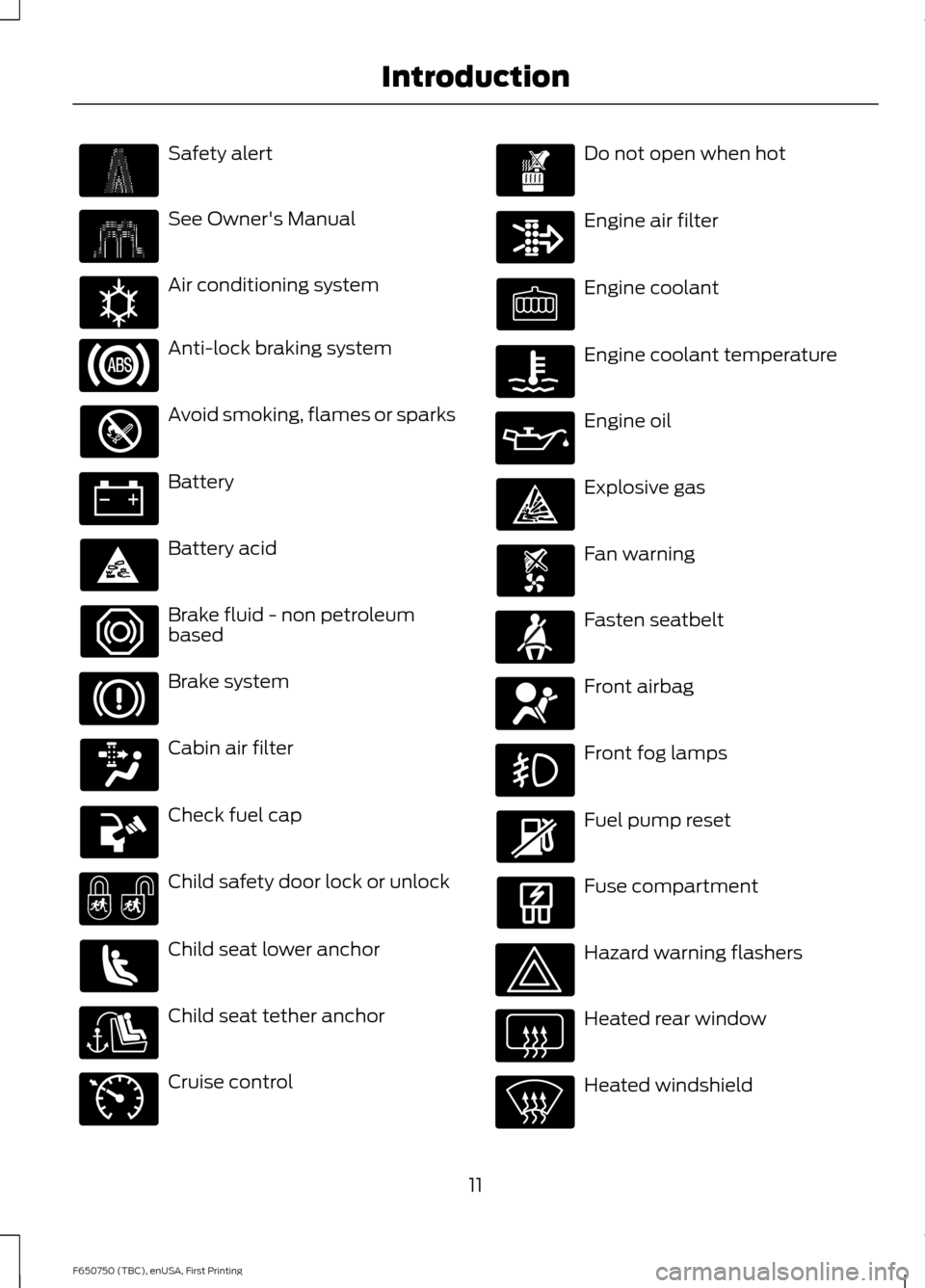
Safety alert
See Owner's Manual
Air conditioning system
Anti-lock braking system
Avoid smoking, flames or sparks
Battery
Battery acid
Brake fluid - non petroleum
based
Brake system
Cabin air filter
Check fuel cap
Child safety door lock or unlock
Child seat lower anchor
Child seat tether anchor
Cruise control Do not open when hot
Engine air filter
Engine coolant
Engine coolant temperature
Engine oil
Explosive gas
Fan warning
Fasten seatbelt
Front airbag
Front fog lamps
Fuel pump reset
Fuse compartment
Hazard warning flashers
Heated rear window
Heated windshield
11
F650750 (TBC), enUSA, First Printing Introduction E162384 E71340
Page 64 of 379
WARNING
If equipped with an air intake heater,
DO NOT use ether or any other
starting fluids. The use of starting
fluids (ether) in an engine equipped with
an air intake heater could result in damage
and/or personal injury. Water in Fuel (Diesel Engine Only)
Illuminates when the fuel
filter/water separator has a
significant quantity of water in
it.
If the light illuminates when the engine is
running, stop the vehicle as soon as safely
possible, shut off the engine, then drain the
fuel filter/water separator.
Allowing water to stay in the system could
result in extensive damage to, or failure of,
the fuel injection system. WARNING
Do not drain the water separator
while the engine is running. Fuel may
ignite if the separator is drained while
the engine is running or the vehicle is
moving. AUDIBLE WARNINGS AND
INDICATORS
Headlamps On Warning Chime
Sounds when you remove the key from the
ignition and open the driver's door and you
have left the headlamps or parking lamps
on.
Key in Ignition Warning Chime
Sounds when you open the driver's door
and you have left the key in the ignition
with it in the off or accessory position.
61
F650750 (TBC), enUSA, First Printing Instrument Cluster
Page 89 of 379
•
Open the windows at least 1 in (3 cm).
• Set your climate control to outside air.
STARTING A DIESEL ENGINE WARNING
Operation of a diesel engine near
flammable vapors in the air may
cause the engine speed to increase
uncontrollably and over speed. If this
situation occurs, mechanical damage, fire,
explosion, personal injury or death could
result. Turning off the ignition key does not
slow or stop the engine due to
uncontrollable fueling of the engine
through flammable vapors being drawn
into the engine air inlet. Operation of
components, for example starter,
alternator, electric motors and static
electricity could also ignite flammable
vapors. Do not operate your vehicle in the
possible presence of flammable vapors
unless both a complete hazard analysis is
carried out and necessary additional safety
processes and/or equipment, for example
vapor testing, air intake shutoff devices
and ventilation are utilized. You are
responsible for using those processes
and/or equipment to make sure that the
diesel engine and all other components on
your vehicle can be operated safely under
the specific conditions and hazards that
may be encountered. Read all starting instructions carefully
before you start your vehicle.
Diesel Engine Fast Start Glow Plug
System
The diesel engine glow system consists of:
•
Eight glow plugs (one per cylinder)
• Glow Plug Control Module
• Engine Coolant Temperature sensor •
Barometric pressure sensor
• Environmental temperature sensor
The powertrain and glow plug control
modules electronically control the glow
plug system. After you switch the ignition
on the glow plug control module
immediately energizes the glow plugs. The
glow plug control module using the engine
coolant temperature, barometric pressure
sensor and environmental temperature
sensor will determine how long the glow
plugs stay energized. The required time for
the glow plugs to be energized decreases
as the coolant temperature, barometric
pressure and environmental temperature
increase.
Before starting the engine, check the
following:
• Make sure all occupants have fastened
their safety belts.
• Make sure the headlamps and
electrical accessories are off.
• Make sure the parking brake is on.
• Make sure the transmission is in park
(P) or neutral (N).
• Turn the ignition key to the on position.
Note: Do not press the accelerator during
starting.
Cold Weather Starting WARNINGS
Do not use starting fluid, for example
ether, in the air intake system (see
air filter decal). Such fluid could
cause immediate explosive damage to the
engine and possible personal injury. Do not add gasoline, gasohol, alcohol
or Kerosene to diesel fuel. This
practice creates a serious fire hazard
and causes engine performance problems. 86
F650750 (TBC), enUSA, First Printing Starting and Stopping the Engine
Page 108 of 379
If the service engine soon indicator remains
on, have your vehicle serviced at the first
available opportunity. Although some
malfunctions detected by the OBD-II may
not have symptoms that are apparent,
continued driving with the service engine
soon indicator on can result in increased
emissions, lower fuel economy, reduced
engine and transmission smoothness, and
lead to more costly repairs.
Readiness for
Inspection/Maintenance (I/M)
Testing
Some state/provincial and local
governments may have
Inspection/Maintenance (I/M) programs
to inspect the emission control equipment
on your vehicle. Failure to pass this
inspection could prevent you from getting
a vehicle registration.
If the service engine soon
indicator is on or the bulb does
not work, you may need to have
the vehicle serviced. See On-Board
Diagnostics (OBD-II).
Your vehicle may not pass the I/M test if
the service engine soon indicator is on or
not working properly (bulb is burned out),
or if the OBD-II system has determined
that some of the emission control systems
have not been properly checked. In this
case, your vehicle is not ready for I/M
testing.
If the vehicle ’s engine or transmission has
just been serviced, or the battery has
recently run down or been replaced, the
OBD-II system may indicate that the
vehicle is not ready for I/M testing. To
determine if the vehicle is ready for I/M
testing, turn the ignition key to the on
position for 15 seconds without cranking the engine. If the service engine soon
indicator blinks eight times, it means that
the vehicle is not ready for I/M testing; if
the service engine soon indicator stays on
solid, it means that the vehicle is ready for
I/M testing.
The OBD-II system monitors the emission
control system during normal driving. A
complete check may take several days. If
the vehicle is not ready for I/M testing, you
may need to perform the following driving
cycle consisting of mixed city and highway
driving:
Drive on an expressway or highway for a
steady 15 minutes, followed by 20 minutes
of stop-and-go driving with at least four
30-second idle periods.
Allow the vehicle to sit for at least eight
hours without starting the engine. Then,
start the engine and complete the above
driving cycle. The engine must warm up to
its normal operating temperature. Once
started, do not turn off the engine until the
above driving cycle is complete. If the
vehicle is still not ready for I/M testing, you
will have to repeat the above driving cycle.
EMISSION CONTROL SYSTEM
- 6.7L DIESEL
Diesel Exhaust System: Oxidation
Catalyst And Diesel Particulate
Filter System (If Equipped)
Your vehicle is equipped with a diesel
particulate filter. The diesel particulate
filter is an inline filter in the exhaust system
that reduces carbon emissions by trapping
exhaust particles before they reach the
tailpipe. The diesel particulate filter looks
similar to a traditional exhaust catalyst,
except larger, and is part of the exhaust
system under your vehicle. The filter
couples to a diesel oxidation catalyst that
reduces the amount of harmful exhaust
emitted from the tailpipe. As soot gathers
105
F650750 (TBC), enUSA, First Printing Fuel and Refueling
Page 109 of 379
in the system, it begins to restrict the filter.
You need to periodically clean the soot
that gathers inside the filter. You can clean
the soot in two different ways, passive
regeneration and active regeneration. Both
methods occur automatically and require
no actions from the driver. During either
one of these regeneration methods, you
may notice a change in exhaust tone. At
certain times, the information display
shows various messages related to the
diesel particulate filter. See Information
Displays (page 62). Passive Regeneration
In passive regeneration, the exhaust
system temperature and constituents
automatically clean the filter, or reduce
the soot level, by burning (oxidizing) the
soot. Cleaning occurs naturally because of
normal engine operating conditions (at
varying levels, due to driving patterns).
Diesel Particulate Filter Maintenance
You must properly maintain your vehicle's
diesel particulate filter in order for it to
function properly.
Do not disregard the following maintenance messages: Action and Description
Message
This may degrade vehicle performance and could lead to
engine damage that may not be covered by the vehicle
Warranty.
Exhaust filter overloaded
Drive to clean
Exhaust filter at limit
Clean now
Failure to perform active or Operator
Commanded Regeneration when
instructed could result in a clogged diesel
particulate filter. If your diesel particulate
filter fills beyond the regeneration
threshold, your vehicle disables the ability
for active and Operator Commanded
Regeneration. This could result in
irreversible damage to the filter requiring
replacement that your warranty may not
cover. If your vehicle is not equipped with
Operator Commanded Regeneration,
check with your dealer for availability. Once the diesel particulate filter is full of
exhaust particles, the engine control
module commands the exhaust system to
clean the filter through a process called
active regeneration. Active regeneration
requires the engine computer to raise the
exhaust temperature to eliminate the
particles. During cleaning, the particles
convert to harmless gasses. Once cleaned
the diesel particulate filter continues
trapping exhaust particles.
The regeneration process operates more
efficiently when you safely operate your
vehicle at least 30 mph (48 km/h) with a
steady pedal for approximately 20 minutes
to complete the process. The frequency
and duration of regeneration fluctuates by
how you drive your vehicle, outside air
temperature, and altitude. For most driving,
106
F650750 (TBC), enUSA, First Printing Fuel and Refueling