coolant reservoir FORD F650 2017 13.G User Guide
[x] Cancel search | Manufacturer: FORD, Model Year: 2017, Model line: F650, Model: FORD F650 2017 13.GPages: 382, PDF Size: 5.18 MB
Page 199 of 382
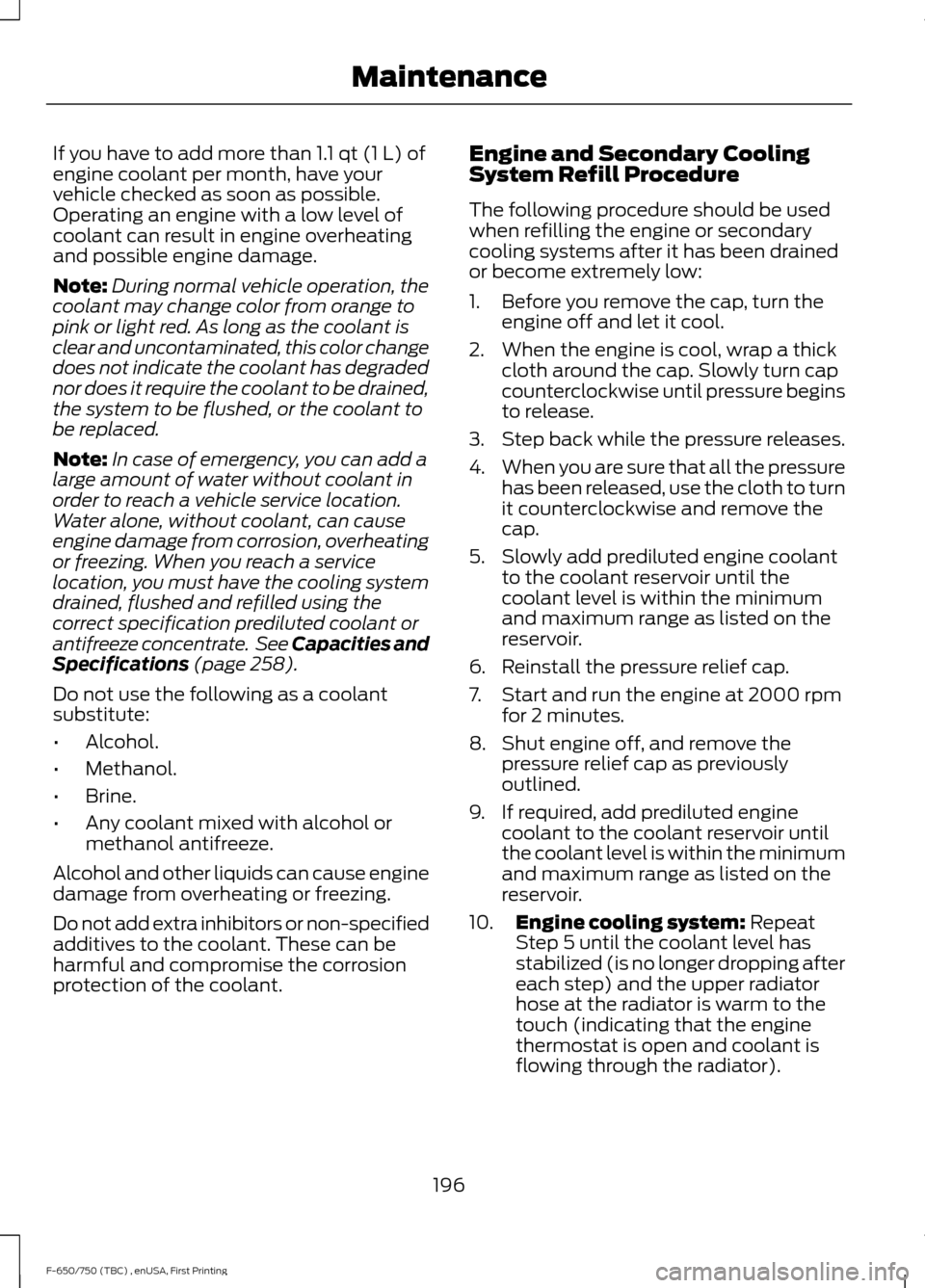
If you have to add more than 1.1 qt (1 L) of
engine coolant per month, have your
vehicle checked as soon as possible.
Operating an engine with a low level of
coolant can result in engine overheating
and possible engine damage.
Note: During normal vehicle operation, the
coolant may change color from orange to
pink or light red. As long as the coolant is
clear and uncontaminated, this color change
does not indicate the coolant has degraded
nor does it require the coolant to be drained,
the system to be flushed, or the coolant to
be replaced.
Note: In case of emergency, you can add a
large amount of water without coolant in
order to reach a vehicle service location.
Water alone, without coolant, can cause
engine damage from corrosion, overheating
or freezing. When you reach a service
location, you must have the cooling system
drained, flushed and refilled using the
correct specification prediluted coolant or
antifreeze concentrate. See
Capacities and
Specifications (page 258).
Do not use the following as a coolant
substitute:
• Alcohol.
• Methanol.
• Brine.
• Any coolant mixed with alcohol or
methanol antifreeze.
Alcohol and other liquids can cause engine
damage from overheating or freezing.
Do not add extra inhibitors or non-specified
additives to the coolant. These can be
harmful and compromise the corrosion
protection of the coolant. Engine and Secondary Cooling
System Refill Procedure
The following procedure should be used
when refilling the engine or secondary
cooling systems after it has been drained
or become extremely low:
1. Before you remove the cap, turn the
engine off and let it cool.
2. When the engine is cool, wrap a thick cloth around the cap. Slowly turn cap
counterclockwise until pressure begins
to release.
3. Step back while the pressure releases.
4. When you are sure that all the pressure
has been released, use the cloth to turn
it counterclockwise and remove the
cap.
5. Slowly add prediluted engine coolant to the coolant reservoir until the
coolant level is within the minimum
and maximum range as listed on the
reservoir.
6. Reinstall the pressure relief cap.
7. Start and run the engine at 2000 rpm for 2 minutes.
8. Shut engine off, and remove the pressure relief cap as previously
outlined.
9. If required, add prediluted engine coolant to the coolant reservoir until
the coolant level is within the minimum
and maximum range as listed on the
reservoir.
10. Engine cooling system:
Repeat
Step 5 until the coolant level has
stabilized (is no longer dropping after
each step) and the upper radiator
hose at the radiator is warm to the
touch (indicating that the engine
thermostat is open and coolant is
flowing through the radiator).
196
F-650/750 (TBC) , enUSA, First Printing Maintenance
Page 200 of 382
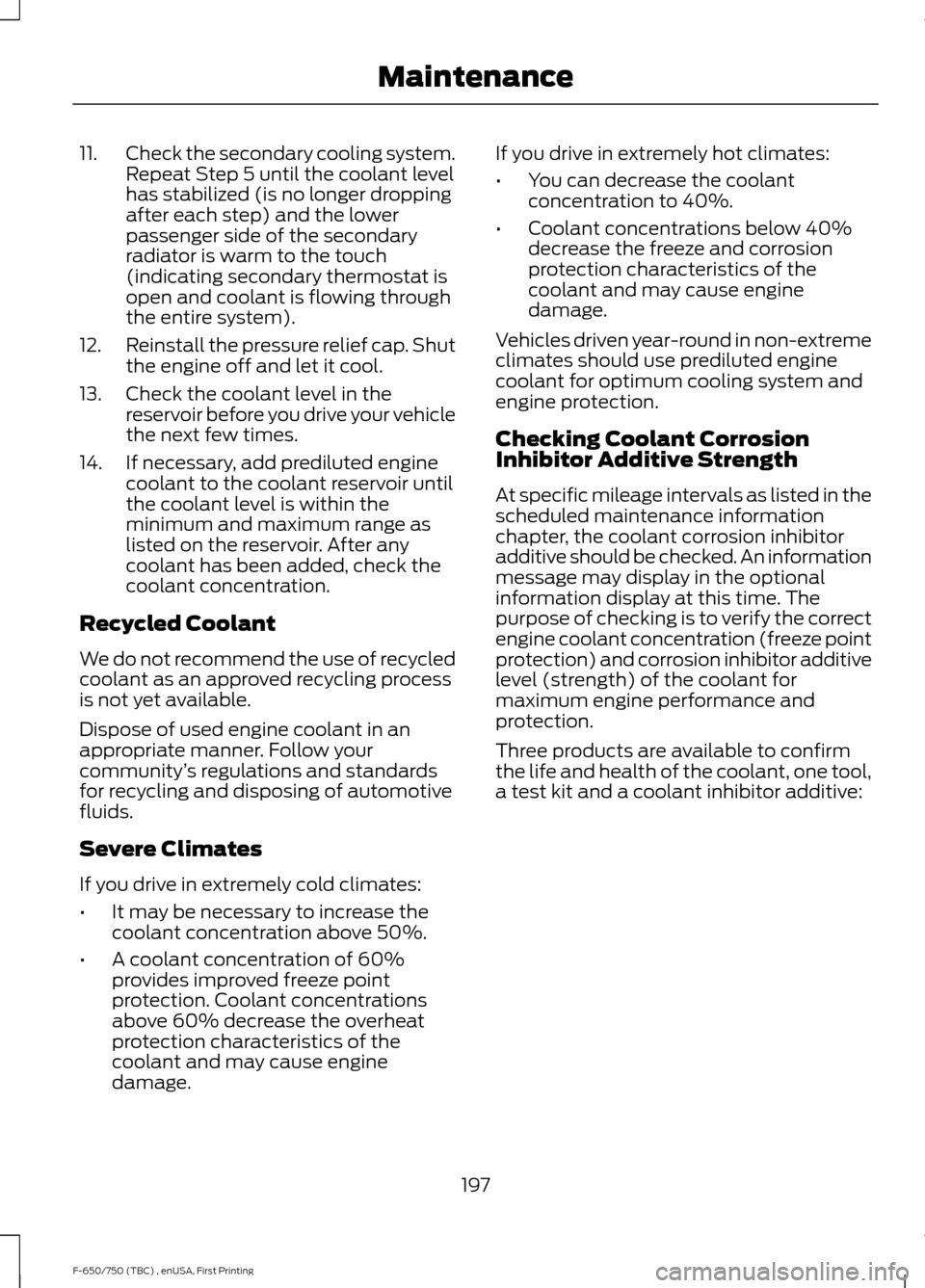
11.
Check the secondary cooling system.
Repeat Step 5 until the coolant level
has stabilized (is no longer dropping
after each step) and the lower
passenger side of the secondary
radiator is warm to the touch
(indicating secondary thermostat is
open and coolant is flowing through
the entire system).
12. Reinstall the pressure relief cap. Shut
the engine off and let it cool.
13. Check the coolant level in the reservoir before you drive your vehicle
the next few times.
14. If necessary, add prediluted engine coolant to the coolant reservoir until
the coolant level is within the
minimum and maximum range as
listed on the reservoir. After any
coolant has been added, check the
coolant concentration.
Recycled Coolant
We do not recommend the use of recycled
coolant as an approved recycling process
is not yet available.
Dispose of used engine coolant in an
appropriate manner. Follow your
community ’s regulations and standards
for recycling and disposing of automotive
fluids.
Severe Climates
If you drive in extremely cold climates:
• It may be necessary to increase the
coolant concentration above 50%.
• A coolant concentration of 60%
provides improved freeze point
protection. Coolant concentrations
above 60% decrease the overheat
protection characteristics of the
coolant and may cause engine
damage. If you drive in extremely hot climates:
•
You can decrease the coolant
concentration to 40%.
• Coolant concentrations below 40%
decrease the freeze and corrosion
protection characteristics of the
coolant and may cause engine
damage.
Vehicles driven year-round in non-extreme
climates should use prediluted engine
coolant for optimum cooling system and
engine protection.
Checking Coolant Corrosion
Inhibitor Additive Strength
At specific mileage intervals as listed in the
scheduled maintenance information
chapter, the coolant corrosion inhibitor
additive should be checked. An information
message may display in the optional
information display at this time. The
purpose of checking is to verify the correct
engine coolant concentration (freeze point
protection) and corrosion inhibitor additive
level (strength) of the coolant for
maximum engine performance and
protection.
Three products are available to confirm
the life and health of the coolant, one tool,
a test kit and a coolant inhibitor additive:
197
F-650/750 (TBC) , enUSA, First Printing Maintenance
Page 261 of 382
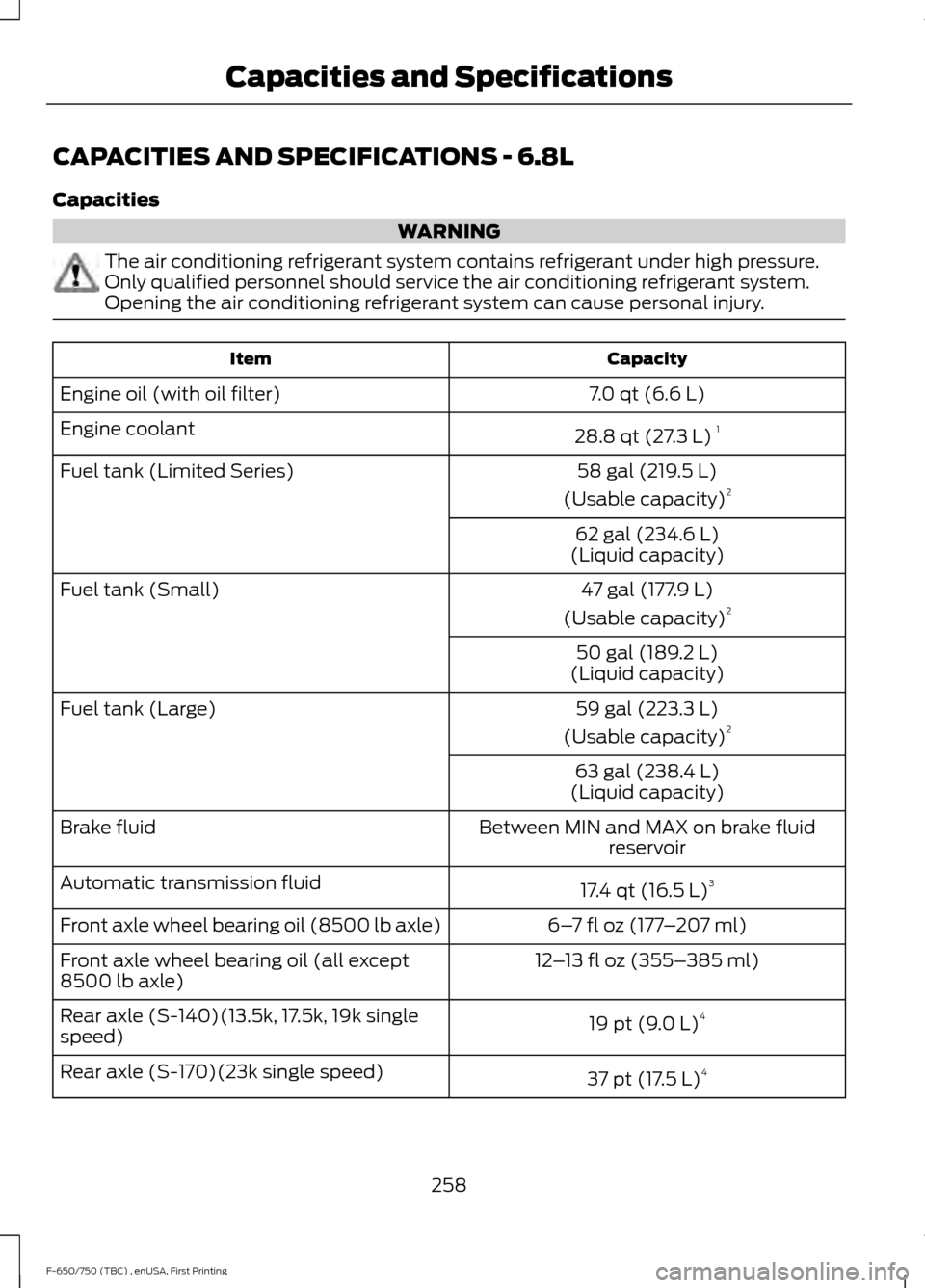
CAPACITIES AND SPECIFICATIONS - 6.8L
Capacities
WARNING
The air conditioning refrigerant system contains refrigerant under high pressure.
Only qualified personnel should service the air conditioning refrigerant system.
Opening the air conditioning refrigerant system can cause personal injury.
Capacity
Item
7.0 qt (6.6 L)
Engine oil (with oil filter)
28.8 qt (27.3 L)1
Engine coolant
58 gal (219.5 L)
Fuel tank (Limited Series)
(Usable capacity)2
62 gal (234.6 L)
(Liquid capacity)
47 gal (177.9 L)
Fuel tank (Small)
(Usable capacity)2
50 gal (189.2 L)
(Liquid capacity)
59 gal (223.3 L)
Fuel tank (Large)
(Usable capacity)2
63 gal (238.4 L)
(Liquid capacity)
Between MIN and MAX on brake fluid reservoir
Brake fluid
17.4 qt (16.5 L)3
Automatic transmission fluid
6–7 fl oz (177 –207 ml)
Front axle wheel bearing oil (8500 lb axle)
12–13 fl oz (355– 385 ml)
Front axle wheel bearing oil (all except
8500 lb axle)
19 pt (9.0 L)4
Rear axle (S-140)(13.5k, 17.5k, 19k single
speed)
37 pt (17.5 L)4
Rear axle (S-170)(23k single speed)
258
F-650/750 (TBC) , enUSA, First Printing Capacities and Specifications
Page 267 of 382
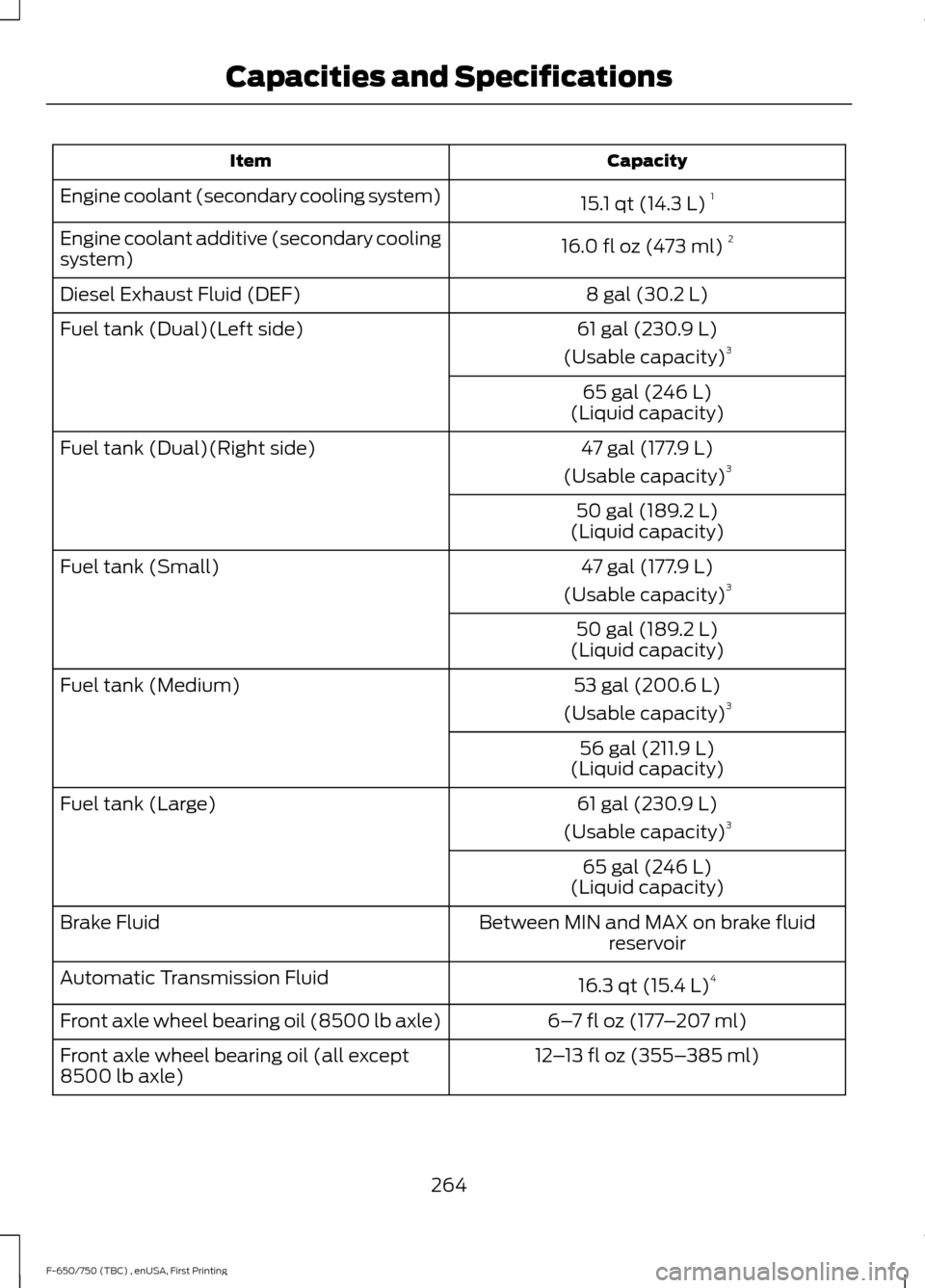
Capacity
Item
15.1 qt (14.3 L)1
Engine coolant (secondary cooling system)
16.0 fl oz (473 ml)2
Engine coolant additive (secondary cooling
system)
8 gal (30.2 L)
Diesel Exhaust Fluid (DEF)
61 gal (230.9 L)
Fuel tank (Dual)(Left side)
(Usable capacity)3
65 gal (246 L)
(Liquid capacity)
47 gal (177.9 L)
Fuel tank (Dual)(Right side)
(Usable capacity)3
50 gal (189.2 L)
(Liquid capacity)
47 gal (177.9 L)
Fuel tank (Small)
(Usable capacity)3
50 gal (189.2 L)
(Liquid capacity)
53 gal (200.6 L)
Fuel tank (Medium)
(Usable capacity)3
56 gal (211.9 L)
(Liquid capacity)
61 gal (230.9 L)
Fuel tank (Large)
(Usable capacity)3
65 gal (246 L)
(Liquid capacity)
Between MIN and MAX on brake fluid reservoir
Brake Fluid
16.3 qt (15.4 L)4
Automatic Transmission Fluid
6–7 fl oz (177 –207 ml)
Front axle wheel bearing oil (8500 lb axle)
12–13 fl oz (355– 385 ml)
Front axle wheel bearing oil (all except
8500 lb axle)
264
F-650/750 (TBC) , enUSA, First Printing Capacities and Specifications
Page 326 of 382
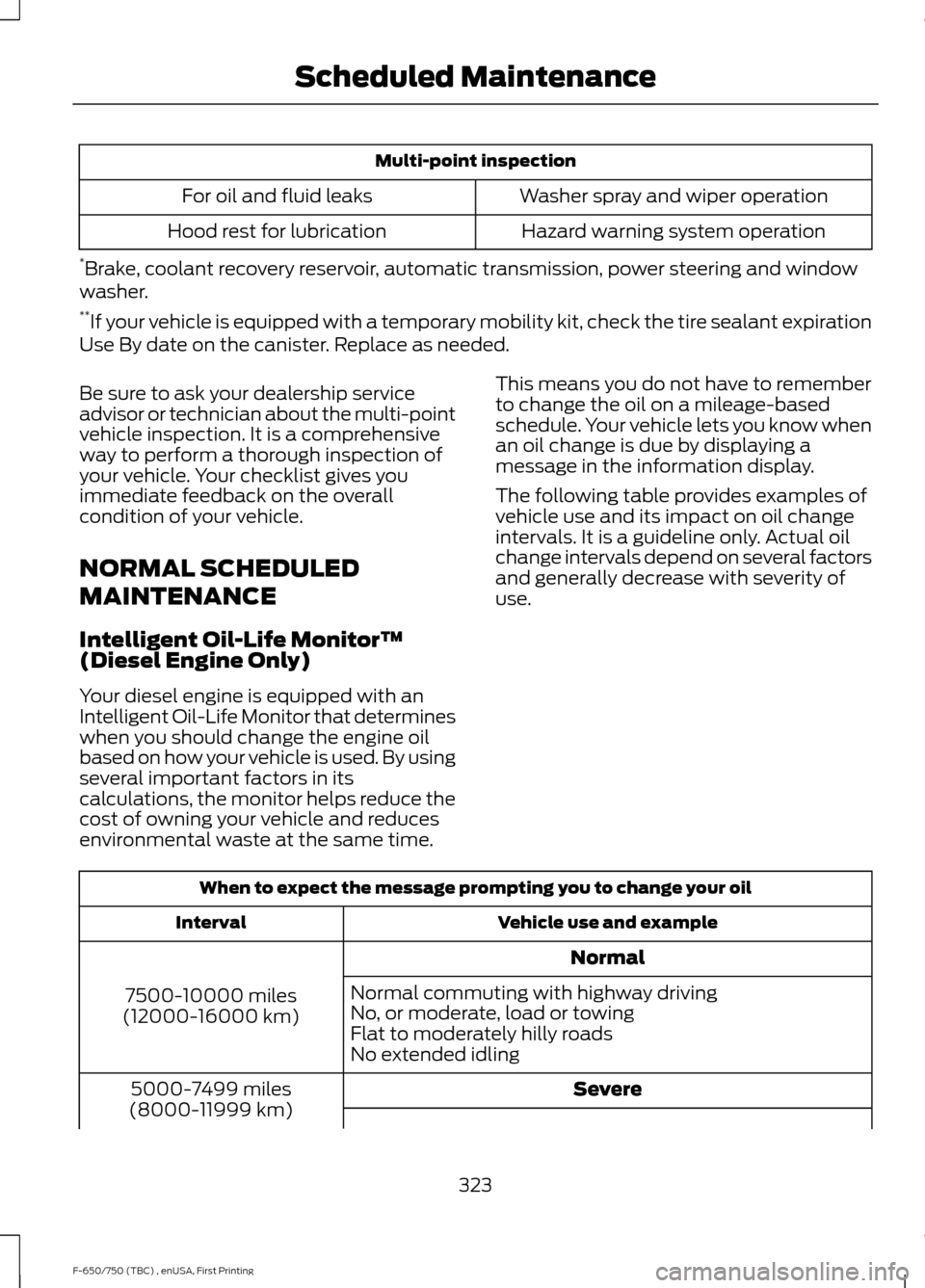
Multi-point inspection
Washer spray and wiper operation
For oil and fluid leaks
Hazard warning system operation
Hood rest for lubrication
* Brake, coolant recovery reservoir, automatic transmission, power steering and window
washer.
** If your vehicle is equipped with a temporary mobility kit, check the tire sealant expiration
Use By date on the canister. Replace as needed.
Be sure to ask your dealership service
advisor or technician about the multi-point
vehicle inspection. It is a comprehensive
way to perform a thorough inspection of
your vehicle. Your checklist gives you
immediate feedback on the overall
condition of your vehicle.
NORMAL SCHEDULED
MAINTENANCE
Intelligent Oil-Life Monitor™
(Diesel Engine Only)
Your diesel engine is equipped with an
Intelligent Oil-Life Monitor that determines
when you should change the engine oil
based on how your vehicle is used. By using
several important factors in its
calculations, the monitor helps reduce the
cost of owning your vehicle and reduces
environmental waste at the same time. This means you do not have to remember
to change the oil on a mileage-based
schedule. Your vehicle lets you know when
an oil change is due by displaying a
message in the information display.
The following table provides examples of
vehicle use and its impact on oil change
intervals. It is a guideline only. Actual oil
change intervals depend on several factors
and generally decrease with severity of
use.
When to expect the message prompting you to change your oil
Vehicle use and example
Interval
Normal
7500-10000 miles
(12000-16000 km) Normal commuting with highway driving
No, or moderate, load or towing
Flat to moderately hilly roads
No extended idling
Severe
5000-7499 miles
(8000-11999 km)
323
F-650/750 (TBC) , enUSA, First Printing Scheduled Maintenance