cooling FORD F650 2017 13.G Owner's Manual
[x] Cancel search | Manufacturer: FORD, Model Year: 2017, Model line: F650, Model: FORD F650 2017 13.GPages: 382, PDF Size: 5.18 MB
Page 234 of 382
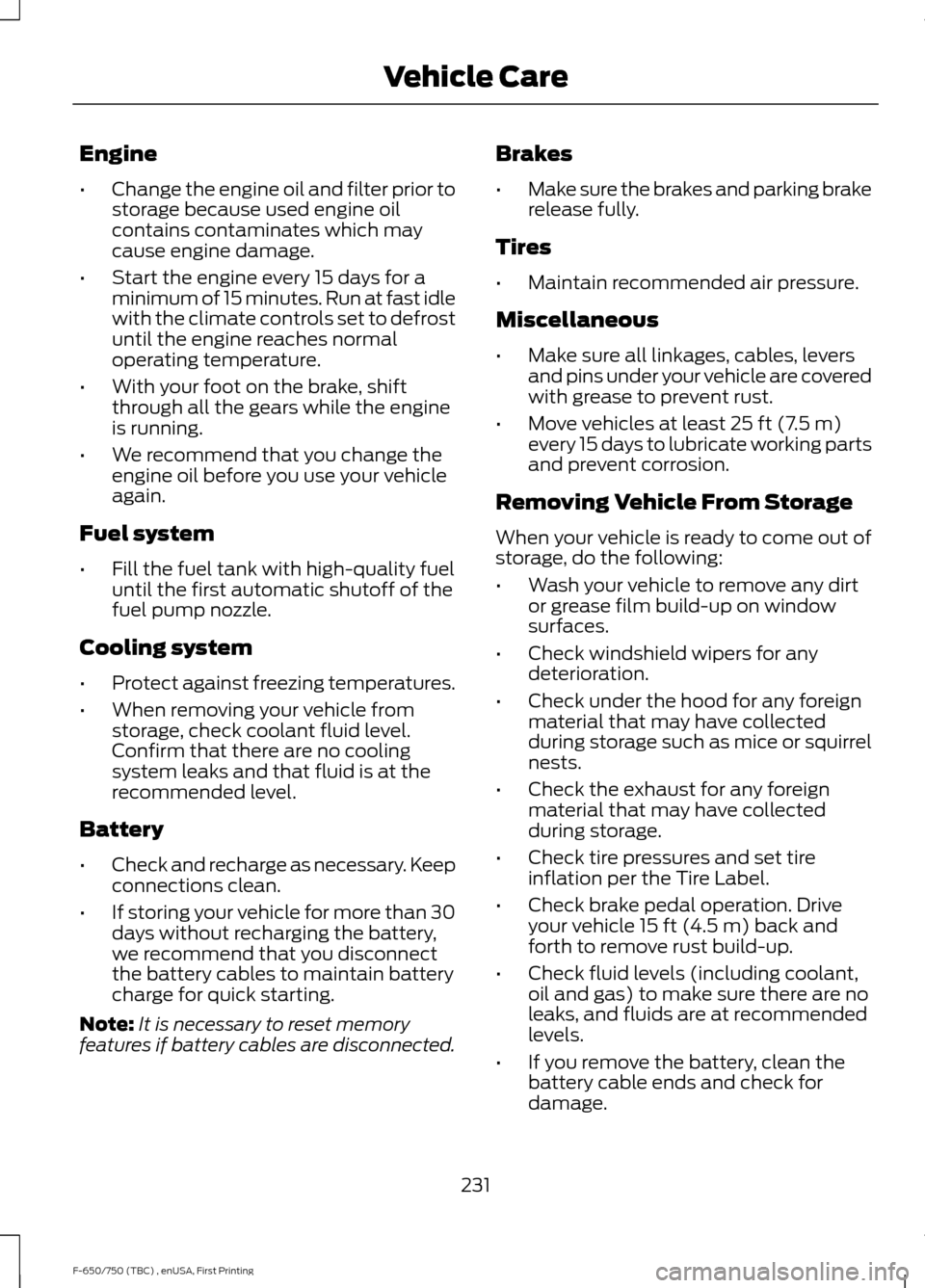
Engine
•
Change the engine oil and filter prior to
storage because used engine oil
contains contaminates which may
cause engine damage.
• Start the engine every 15 days for a
minimum of 15 minutes. Run at fast idle
with the climate controls set to defrost
until the engine reaches normal
operating temperature.
• With your foot on the brake, shift
through all the gears while the engine
is running.
• We recommend that you change the
engine oil before you use your vehicle
again.
Fuel system
• Fill the fuel tank with high-quality fuel
until the first automatic shutoff of the
fuel pump nozzle.
Cooling system
• Protect against freezing temperatures.
• When removing your vehicle from
storage, check coolant fluid level.
Confirm that there are no cooling
system leaks and that fluid is at the
recommended level.
Battery
• Check and recharge as necessary. Keep
connections clean.
• If storing your vehicle for more than 30
days without recharging the battery,
we recommend that you disconnect
the battery cables to maintain battery
charge for quick starting.
Note: It is necessary to reset memory
features if battery cables are disconnected. Brakes
•
Make sure the brakes and parking brake
release fully.
Tires
• Maintain recommended air pressure.
Miscellaneous
• Make sure all linkages, cables, levers
and pins under your vehicle are covered
with grease to prevent rust.
• Move vehicles at least 25 ft (7.5 m)
every 15 days to lubricate working parts
and prevent corrosion.
Removing Vehicle From Storage
When your vehicle is ready to come out of
storage, do the following:
• Wash your vehicle to remove any dirt
or grease film build-up on window
surfaces.
• Check windshield wipers for any
deterioration.
• Check under the hood for any foreign
material that may have collected
during storage such as mice or squirrel
nests.
• Check the exhaust for any foreign
material that may have collected
during storage.
• Check tire pressures and set tire
inflation per the Tire Label.
• Check brake pedal operation. Drive
your vehicle
15 ft (4.5 m) back and
forth to remove rust build-up.
• Check fluid levels (including coolant,
oil and gas) to make sure there are no
leaks, and fluids are at recommended
levels.
• If you remove the battery, clean the
battery cable ends and check for
damage.
231
F-650/750 (TBC) , enUSA, First Printing Vehicle Care
Page 266 of 382

•
Increased emission levels.
• Reduced engine performance.
• Reduced fuel economy.
• Degraded brake performance.
We recommend Motorcraft® motor oil for
your vehicle. If Motorcraft® oil is not
available, use motor oils of the
recommended viscosity grade that meet
API SN requirements and display the API
Certification Mark for gasoline engines. Do
not use oil labeled with API SN service
category unless the label also displays the
API certification mark. An oil that displays this symbol conforms
to current engine, emission system and
fuel economy performance standards of
the International Lubricants Specification
Advisory Committee (ILSAC).
Do not use supplemental engine oil
additives because they are unnecessary
and could lead to engine damage that may
not be covered by your vehicle warranty.
Note:
Ford recommends using DOT 4 Low
Viscosity (LV) High Performance Brake Fluid
or equivalent meeting WSS-M6C65-A2. Use
of any fluid other than the recommended
fluid may cause degraded brake
performance and not meet the Ford
performance standards. Keep brake fluid
clean and dry. Contamination with dirt,
water, petroleum products or other
materials may result in brake system
damage and possible failure.
Note: Automatic transmissions that require
MERCON LV transmission fluid should only
use MERCON LV transmission fluid. The
use of any other fluid may cause
transmission damage.
CAPACITIES AND SPECIFICATIONS - 6.7L DIESEL
Capacities WARNING
The air conditioning refrigerant system contains refrigerant under high pressure.
Only qualified personnel should service the air conditioning refrigerant system.
Opening the air conditioning refrigerant system can cause personal injury.
Capacity
Item
15.0 qt (14.2 L)
Engine oil (with oil filter)
35.1 qt (33.2 L)1
Engine coolant (primary high-temperature
cooling system loop)
48 fl oz (1.41 L)2
Engine coolant additive (primary high-
temperature cooling system loop)
263
F-650/750 (TBC) , enUSA, First Printing Capacities and SpecificationsE142732
Page 267 of 382
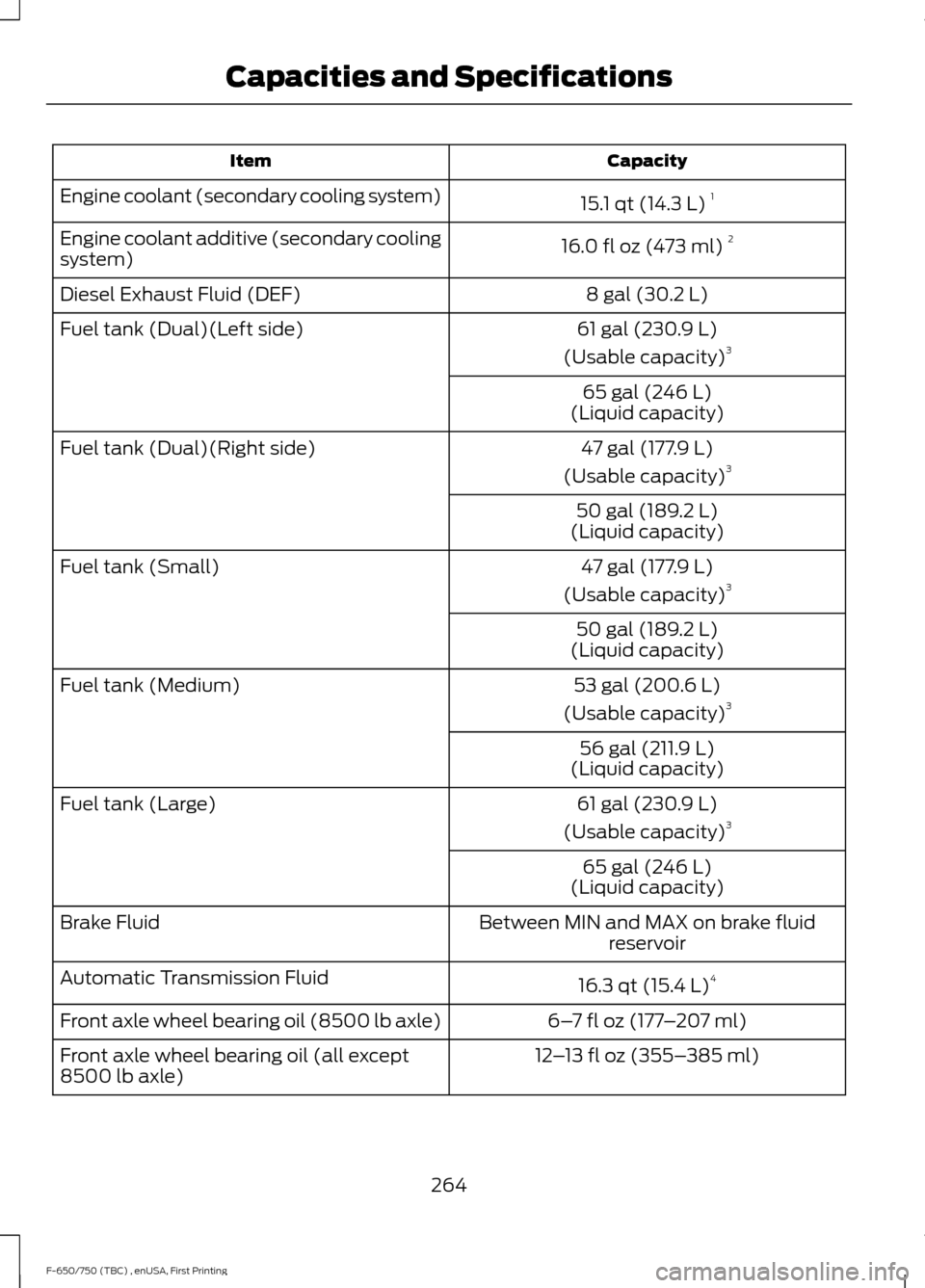
Capacity
Item
15.1 qt (14.3 L)1
Engine coolant (secondary cooling system)
16.0 fl oz (473 ml)2
Engine coolant additive (secondary cooling
system)
8 gal (30.2 L)
Diesel Exhaust Fluid (DEF)
61 gal (230.9 L)
Fuel tank (Dual)(Left side)
(Usable capacity)3
65 gal (246 L)
(Liquid capacity)
47 gal (177.9 L)
Fuel tank (Dual)(Right side)
(Usable capacity)3
50 gal (189.2 L)
(Liquid capacity)
47 gal (177.9 L)
Fuel tank (Small)
(Usable capacity)3
50 gal (189.2 L)
(Liquid capacity)
53 gal (200.6 L)
Fuel tank (Medium)
(Usable capacity)3
56 gal (211.9 L)
(Liquid capacity)
61 gal (230.9 L)
Fuel tank (Large)
(Usable capacity)3
65 gal (246 L)
(Liquid capacity)
Between MIN and MAX on brake fluid reservoir
Brake Fluid
16.3 qt (15.4 L)4
Automatic Transmission Fluid
6–7 fl oz (177 –207 ml)
Front axle wheel bearing oil (8500 lb axle)
12–13 fl oz (355– 385 ml)
Front axle wheel bearing oil (all except
8500 lb axle)
264
F-650/750 (TBC) , enUSA, First Printing Capacities and Specifications
Page 269 of 382

Specifications
Materials
Specification
Name
WSS-M2C171-E*
Recommended motor oil (U.S.):
Motorcraft® SAE 10W-30 Super Duty Diesel Motor Oil
XO-10W30-QSD
WSS-M2C171-E*
Recommended motor oil (Canada):
Motorcraft® SAE 10W-30 Super Duty Diesel Motor Oil
CXO-10W30-LSD12
WSS-M2C171-E*
Recommended motor oil (U.S.):
Motorcraft® SAE 15W-40 Super Duty Diesel Motor Oil
XO-15W40-QSD
WSS-M2C171-E*
Recommended motor oil (Canada):
Motorcraft® SAE 15W-40 Super Duty Diesel Motor Oil
CXO-15W40-LSD12
WSS-M2C171-E*
Recommended motor oil (U.S.):
Motorcraft® SAE 5W-40 Full Synthetic Diesel Motor Oil
XO-5W40-5QSD
WSS-M2C171-E*
Recommended motor oil (U.S.):
Motorcraft® SAE 0W-40 Full Synthetic Diesel Motor Oil
XO-0W40-DAS
WSS-M97B44-D2
Engine and secondary cooling system coolant (U.S.):
Motorcraft® Orange Prediluted Antifreeze/Coolant
VC-3DIL-B
WSS-M97B44-D2
Engine and secondary cooling system coolant (Canada):
Motorcraft® Orange Prediluted Antifreeze/Coolant
CVC-3DIL-B
--
Engine and secondary cooling system coolant additive:
Motorcraft® Specialty Orange Engine Coolant Revitalizer
VC-12
WSS-M99C130-A
Diesel Exhaust Fluid (DEF):
Motorcraft® Diesel Exhaust Fluid
PM-27-Gal / PM-27-Jug
--
Cetane Booster & Performance Improver (U.S.):
Motorcraft® Cetane Booster & Performance Improver
PM-22-A
--
Cetane Booster & Performance Improver (Canada):
266
F-650/750 (TBC) , enUSA, First Printing Capacities and Specifications
Page 322 of 382
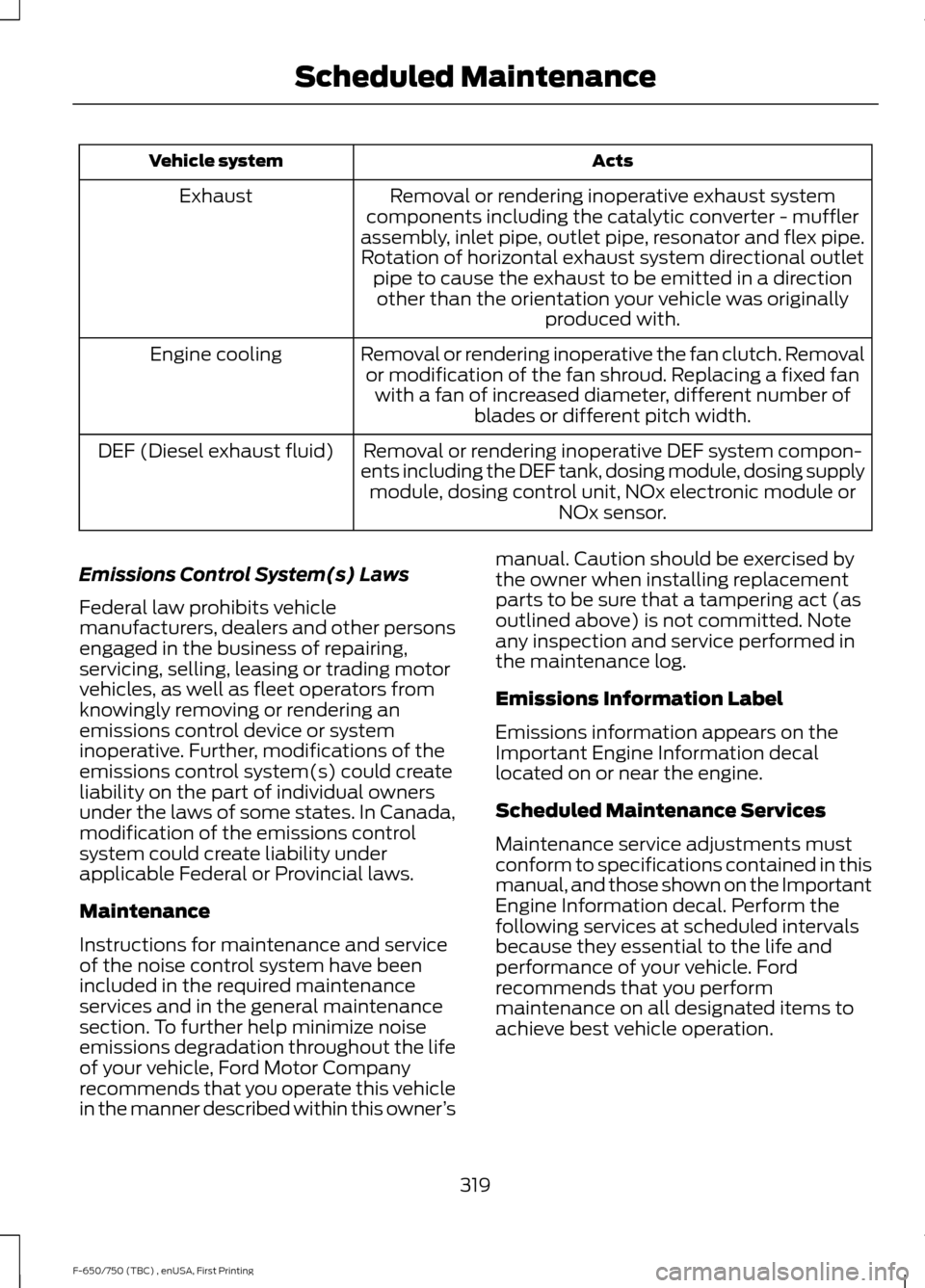
Acts
Vehicle system
Removal or rendering inoperative exhaust system
components including the catalytic converter - muffler
assembly, inlet pipe, outlet pipe, resonator and flex pipe. Rotation of horizontal exhaust system directional outlet pipe to cause the exhaust to be emitted in a directionother than the orientation your vehicle was originally produced with.
Exhaust
Removal or rendering inoperative the fan clutch. Removalor modification of the fan shroud. Replacing a fixed fan with a fan of increased diameter, different number of blades or different pitch width.
Engine cooling
Removal or rendering inoperative DEF system compon-
ents including the DEF tank, dosing module, dosing supply module, dosing control unit, NOx electronic module or NOx sensor.
DEF (Diesel exhaust fluid)
Emissions Control System(s) Laws
Federal law prohibits vehicle
manufacturers, dealers and other persons
engaged in the business of repairing,
servicing, selling, leasing or trading motor
vehicles, as well as fleet operators from
knowingly removing or rendering an
emissions control device or system
inoperative. Further, modifications of the
emissions control system(s) could create
liability on the part of individual owners
under the laws of some states. In Canada,
modification of the emissions control
system could create liability under
applicable Federal or Provincial laws.
Maintenance
Instructions for maintenance and service
of the noise control system have been
included in the required maintenance
services and in the general maintenance
section. To further help minimize noise
emissions degradation throughout the life
of your vehicle, Ford Motor Company
recommends that you operate this vehicle
in the manner described within this owner ’s manual. Caution should be exercised by
the owner when installing replacement
parts to be sure that a tampering act (as
outlined above) is not committed. Note
any inspection and service performed in
the maintenance log.
Emissions Information Label
Emissions information appears on the
Important Engine Information decal
located on or near the engine.
Scheduled Maintenance Services
Maintenance service adjustments must
conform to specifications contained in this
manual, and those shown on the Important
Engine Information decal. Perform the
following services at scheduled intervals
because they essential to the life and
performance of your vehicle. Ford
recommends that you perform
maintenance on all designated items to
achieve best vehicle operation.
319
F-650/750 (TBC) , enUSA, First Printing Scheduled Maintenance
Page 324 of 382
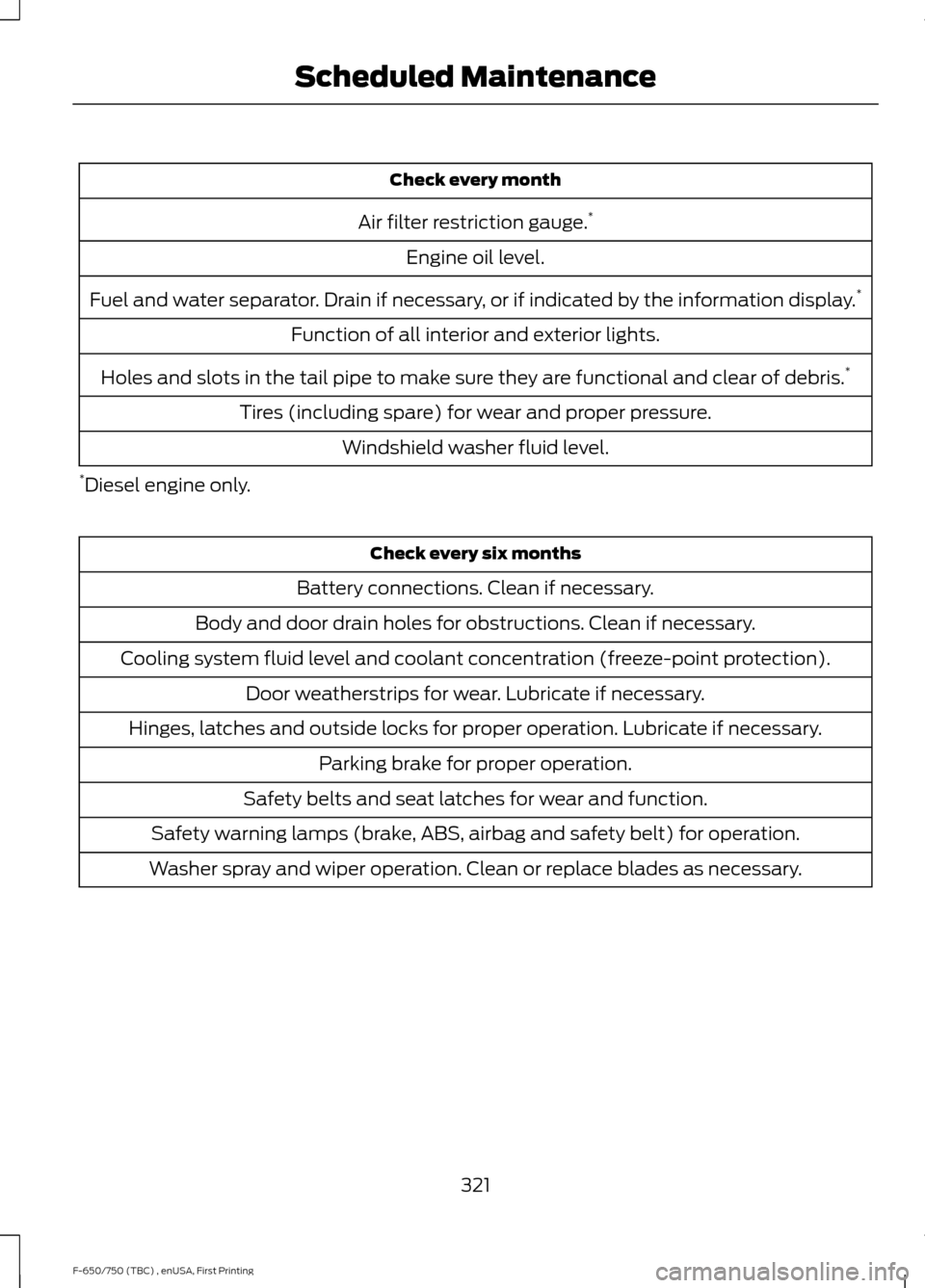
Check every month
Air filter restriction gauge. *
Engine oil level.
Fuel and water separator. Drain if necessary, or if indicated by the information display. *
Function of all interior and exterior lights.
Holes and slots in the tail pipe to make sure they are functional and clear of debris. *
Tires (including spare) for wear and proper pressure. Windshield washer fluid level.
* Diesel engine only. Check every six months
Battery connections. Clean if necessary.
Body and door drain holes for obstructions. Clean if necessary.
Cooling system fluid level and coolant concentration (freeze-point protection). Door weatherstrips for wear. Lubricate if necessary.
Hinges, latches and outside locks for proper operation. Lubricate if necessary. Parking brake for proper operation.
Safety belts and seat latches for wear and function.
Safety warning lamps (brake, ABS, airbag and safety belt) for operation.
Washer spray and wiper operation. Clean or replace blades as necessary.
321
F-650/750 (TBC) , enUSA, First Printing Scheduled Maintenance
Page 328 of 382
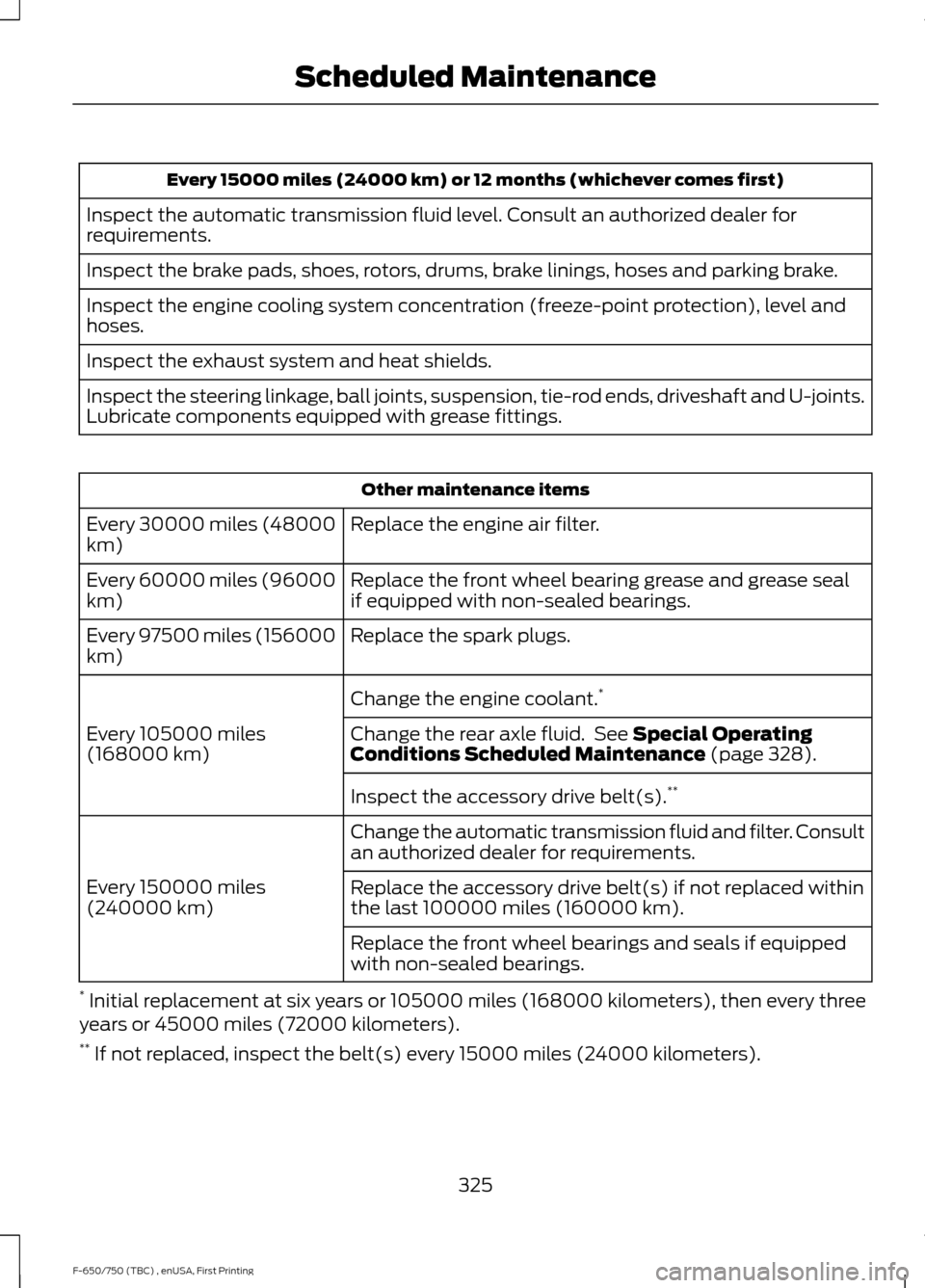
Every 15000 miles (24000 km) or 12 months (whichever comes first)
Inspect the automatic transmission fluid level. Consult an authorized dealer for
requirements.
Inspect the brake pads, shoes, rotors, drums, brake linings, hoses and parking brake.
Inspect the engine cooling system concentration (freeze-point protection), level and
hoses.
Inspect the exhaust system and heat shields.
Inspect the steering linkage, ball joints, suspension, tie-rod ends, driveshaft and U-joints.
Lubricate components equipped with grease fittings. Other maintenance items
Replace the engine air filter.
Every 30000 miles (48000
km)
Replace the front wheel bearing grease and grease seal
if equipped with non-sealed bearings.
Every 60000 miles (96000
km)
Replace the spark plugs.
Every 97500 miles (156000
km)
Change the engine coolant.*
Every 105000 miles
(168000 km) Change the rear axle fluid. See Special Operating
Conditions Scheduled Maintenance (page 328).
Inspect the accessory drive belt(s). **
Change the automatic transmission fluid and filter. Consult
an authorized dealer for requirements.
Every 150000 miles
(240000 km) Replace the accessory drive belt(s) if not replaced within
the last 100000 miles (160000 km).
Replace the front wheel bearings and seals if equipped
with non-sealed bearings.
* Initial replacement at six years or 105000 miles (168000 kilometers), then every three
years or 45000 miles (72000 kilometers).
** If not replaced, inspect the belt(s) every 15000 miles (24000 kilometers).
325
F-650/750 (TBC) , enUSA, First Printing Scheduled Maintenance
Page 330 of 382
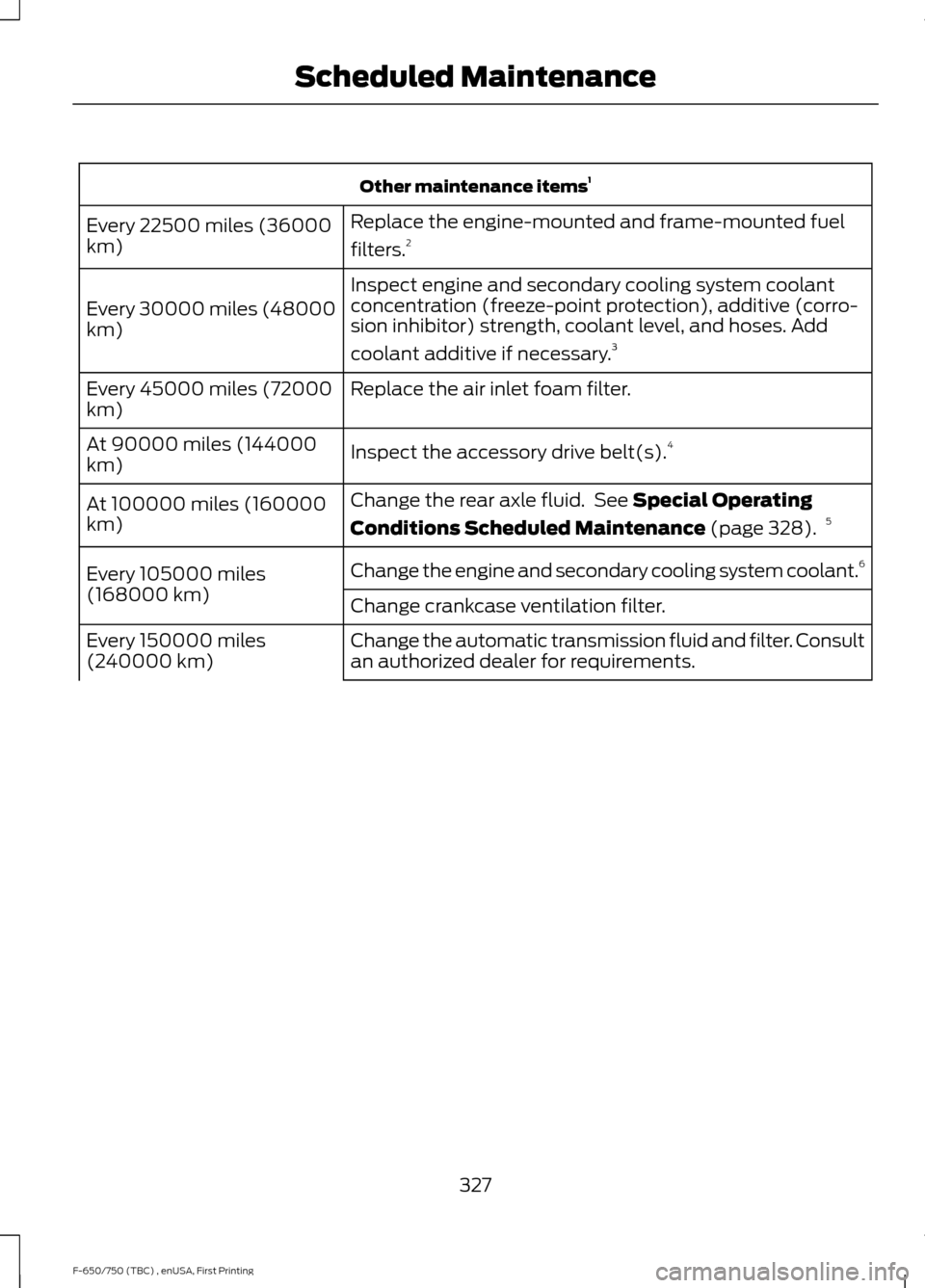
Other maintenance items
1
Replace the engine-mounted and frame-mounted fuel
filters. 2
Every 22500 miles (36000
km)
Inspect engine and secondary cooling system coolant
concentration (freeze-point protection), additive (corro-
sion inhibitor) strength, coolant level, and hoses. Add
coolant additive if necessary.3
Every 30000 miles (48000
km)
Replace the air inlet foam filter.
Every 45000 miles (72000
km)
Inspect the accessory drive belt(s). 4
At 90000 miles (144000
km)
Change the rear axle fluid. See Special Operating
Conditions Scheduled Maintenance
(page 328). 5
At 100000 miles (160000
km)
Change the engine and secondary cooling system coolant. 6
Every 105000 miles
(168000 km) Change crankcase ventilation filter.
Change the automatic transmission fluid and filter. Consult
an authorized dealer for requirements.
Every 150000 miles
(240000 km)
327
F-650/750 (TBC) , enUSA, First Printing Scheduled Maintenance
Page 331 of 382
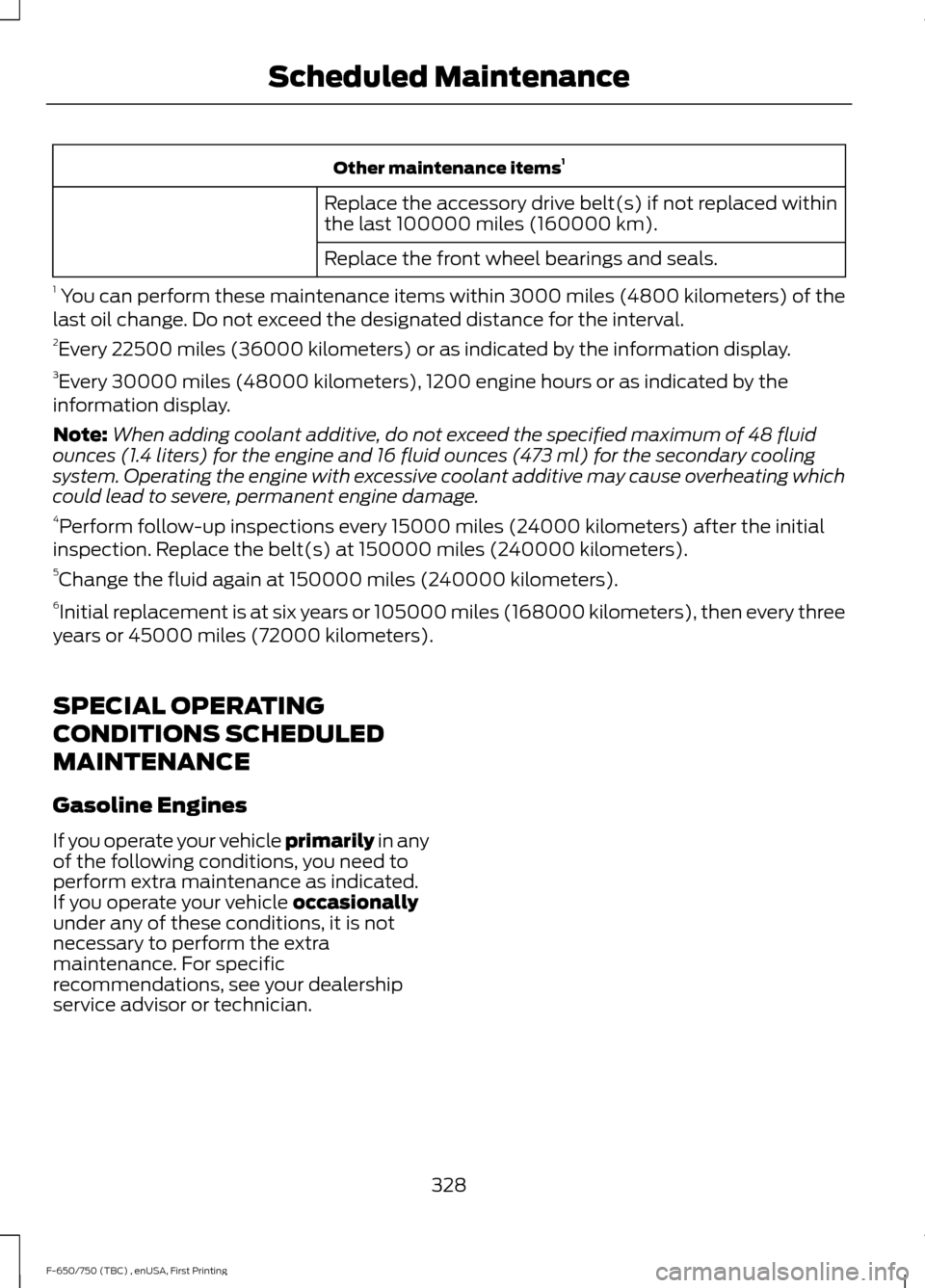
Other maintenance items
1
Replace the accessory drive belt(s) if not replaced within
the last 100000 miles (160000 km).
Replace the front wheel bearings and seals.
1 You can perform these maintenance items within 3000 miles (4800 kilometers) of the
last oil change. Do not exceed the designated distance for the interval.
2 Every 22500 miles (36000 kilometers) or as indicated by the information display.
3 Every 30000 miles (48000 kilometers), 1200 engine hours or as indicated by the
information display.
Note: When adding coolant additive, do not exceed the specified maximum of 48 fluid
ounces (1.4 liters) for the engine and 16 fluid ounces (473 ml) for the secondary cooling
system. Operating the engine with excessive coolant additive may cause overheating which
could lead to severe, permanent engine damage.
4 Perform follow-up inspections every 15000 miles (24000 kilometers) after the initial
inspection. Replace the belt(s) at 150000 miles (240000 kilometers).
5 Change the fluid again at 150000 miles (240000 kilometers).
6 Initial replacement is at six years or 105000 miles (168000 kilometers), then every three
years or 45000 miles (72000 kilometers).
SPECIAL OPERATING
CONDITIONS SCHEDULED
MAINTENANCE
Gasoline Engines
If you operate your vehicle primarily in any
of the following conditions, you need to
perform extra maintenance as indicated.
If you operate your vehicle
occasionally
under any of these conditions, it is not
necessary to perform the extra
maintenance. For specific
recommendations, see your dealership
service advisor or technician.
328
F-650/750 (TBC) , enUSA, First Printing Scheduled Maintenance
Page 334 of 382
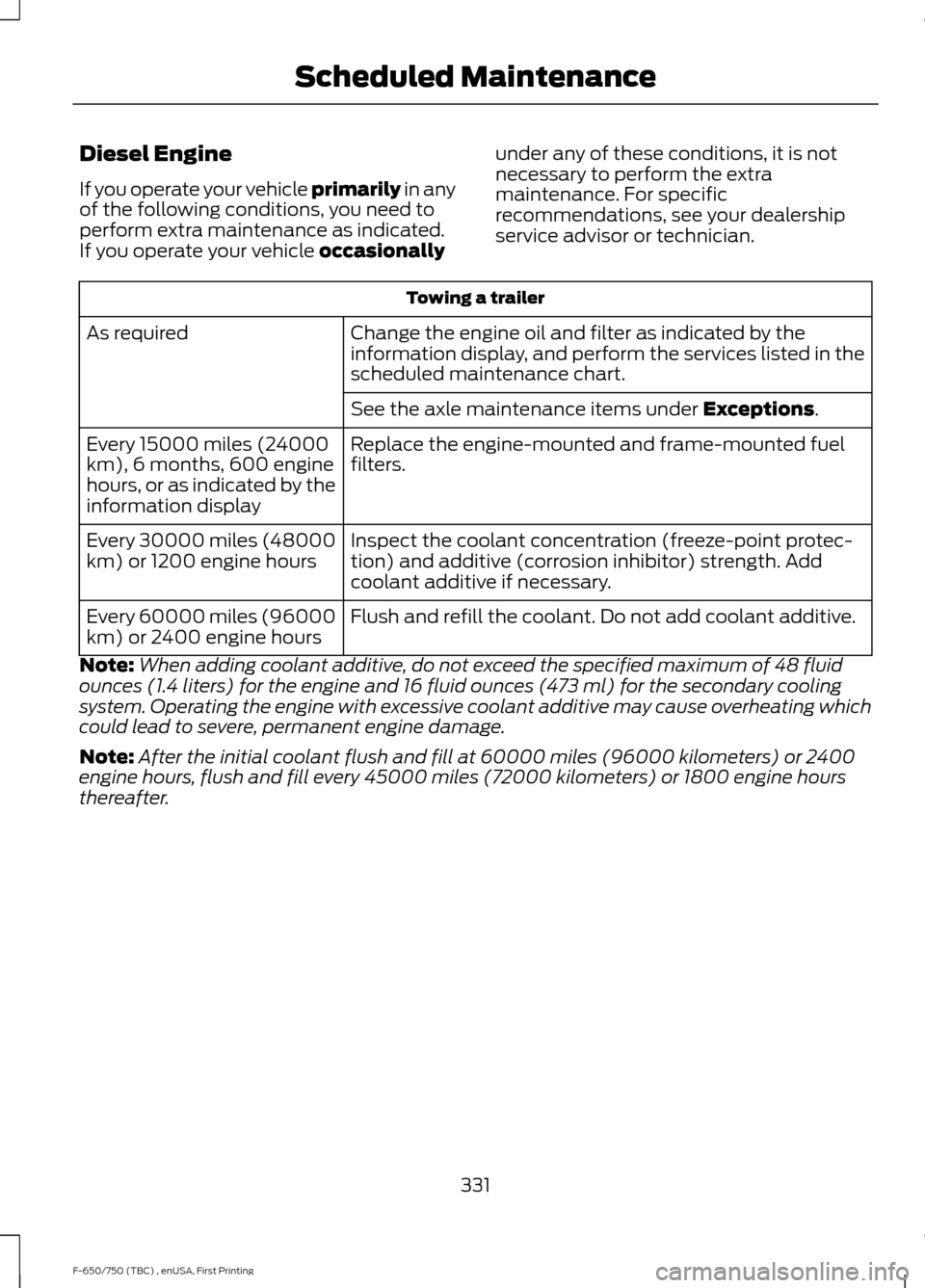
Diesel Engine
If you operate your vehicle primarily in any
of the following conditions, you need to
perform extra maintenance as indicated.
If you operate your vehicle
occasionally under any of these conditions, it is not
necessary to perform the extra
maintenance. For specific
recommendations, see your dealership
service advisor or technician. Towing a trailer
Change the engine oil and filter as indicated by the
information display, and perform the services listed in the
scheduled maintenance chart.
As required
See the axle maintenance items under
Exceptions.
Replace the engine-mounted and frame-mounted fuel
filters.
Every 15000 miles (24000
km), 6 months, 600 engine
hours, or as indicated by the
information display
Inspect the coolant concentration (freeze-point protec-
tion) and additive (corrosion inhibitor) strength. Add
coolant additive if necessary.
Every 30000 miles (48000
km) or 1200 engine hours
Flush and refill the coolant. Do not add coolant additive.
Every 60000 miles (96000
km) or 2400 engine hours
Note: When adding coolant additive, do not exceed the specified maximum of 48 fluid
ounces (1.4 liters) for the engine and 16 fluid ounces (473 ml) for the secondary cooling
system. Operating the engine with excessive coolant additive may cause overheating which
could lead to severe, permanent engine damage.
Note: After the initial coolant flush and fill at 60000 miles (96000 kilometers) or 2400
engine hours, flush and fill every 45000 miles (72000 kilometers) or 1800 engine hours
thereafter.
331
F-650/750 (TBC) , enUSA, First Printing Scheduled Maintenance