cooling FORD F650/750 2024 Owner's Manual
[x] Cancel search | Manufacturer: FORD, Model Year: 2024, Model line: F650/750, Model: FORD F650/750 2024Pages: 386, PDF Size: 8.7 MB
Page 246 of 386
If the engine reaches a presetover-temperature condition, the engineswitches to alternating cylinder operation.Each disabled cylinder acts as an air pumpand cools the engine.
When this occurs, your vehicle stilloperates, however:
•Engine power is limited.
•The air conditioning system turns off.
Continued operation increases the enginetemperature, causing the engine tocompletely shut down. Your steering andbraking effort increases in this situation.
When the engine temperature cools, youcan re-start the engine. Have your vehiclechecked as soon as possible to minimizeengine damage.
When Fail-Safe Mode Is Activated
WARNING: Fail-safe mode is foruse during emergencies only. Operateyour vehicle in fail-safe mode only aslong as necessary to bring your vehicleto rest in a safe location and seekimmediate repairs. When in fail-safemode, your vehicle will have limitedpower, will not be able to maintainhigh-speed operation, and maycompletely shut down without warning,potentially losing engine power, powersteering assist, and power brake assist,which may increase the possibility of acrash resulting in serious injury.
WARNING: Do not remove thecoolant reservoir cap when the engine ison or the cooling system is hot. Wait 10minutes for the cooling system to cooldown. Cover the coolant reservoir capwith a thick cloth to prevent thepossibility of scalding and slowly removethe cap. Failure to follow this instructioncould result in personal injury.
Your vehicle has limited engine powerwhen in the fail-safe mode, drive yourvehicle with caution. Your vehicle does notmaintain high-speed operation and theengine may operate poorly.
Remember that the engine is capable ofshutting down to prevent engine damage.In this situation:
1.Pull off the road as soon as safelypossible and switch the engine off.
2.If you are a member of a roadsideassistance program, we recommendthat you contact your roadsideassistance service provider.
3.If this is not possible, wait a shortperiod for the engine to cool.
4.Check the coolant level. If the coolantlevel is at or below the minimum mark,add prediluted coolant immediately.
5.When the engine temperature cools,you can re-start the engine. Have yourvehicle checked as soon as possible tominimize engine damage.
Note: Driving your vehicle without repairincreases the chance of engine damage.
Engine Coolant TemperatureManagement (If Equipped)
WARNING: To reduce the risk ofcrash and injury, be prepared that thevehicle speed may reduce and thevehicle may not be able to acceleratewith full power until the coolanttemperature reduces.
If you tow a trailer with your vehicle, theengine may temporarily reach a highertemperature during severe operatingconditions, for example ascending a longor steep grade in high ambienttemperatures.
242
2024 F-650/750 (TBC) , enUSA, Edition date: 202210, First-PrintingMaintenance
Page 272 of 386
Cooling system
•Protect against freezing temperatures.
•When removing your vehicle fromstorage, check coolant fluid level.Confirm that there are no coolingsystem leaks and that fluid is at therecommended level.
Disconnecting Your 12 Volt Battery
•Check and recharge as necessary. Keepconnections clean.
•If storing your vehicle for more than 30days without recharging the battery,we recommend that you disconnectthe battery cables to maintain batterycharge for quick starting.
Note:It is necessary to reset memoryfeatures if you disconnect the batterycables.
Brakes
•Make sure the brakes and parking brakerelease fully.
Tires
•Maintain recommended air pressure.
Miscellaneous
•Make sure all linkages, cables, leversand pins under your vehicle are coveredwith grease to prevent rust.
•Move vehicles at least 25 ft (7.5 m)every 15 days to lubricate working partsand prevent corrosion.
Removing Vehicle From Storage
When your vehicle is ready to come out ofstorage, do the following:
•Wash your vehicle to remove any dirtor grease film build-up on windowsurfaces.
•Check windshield wipers for anydeterioration.
•Check under the hood for any foreignmaterial that may have collectedduring storage such as mice or squirrelnests.
•Check the exhaust for any foreignmaterial that may have collectedduring storage.
•Check tire pressures and set tireinflation per the Tire Label.
•Check brake pedal operation. Driveyour vehicle 15 ft (4.5 m) back andforth to remove rust build-up.
•Check fluid levels (including coolant,oil and gas) to make sure there are noleaks, and fluids are at recommendedlevels.
•If you remove the battery, clean thebattery cable ends and check fordamage.
Contact an authorized dealer if you haveany concerns or issues.
268
2024 F-650/750 (TBC) , enUSA, Edition date: 202210, First-PrintingVehicle Care
Page 305 of 386
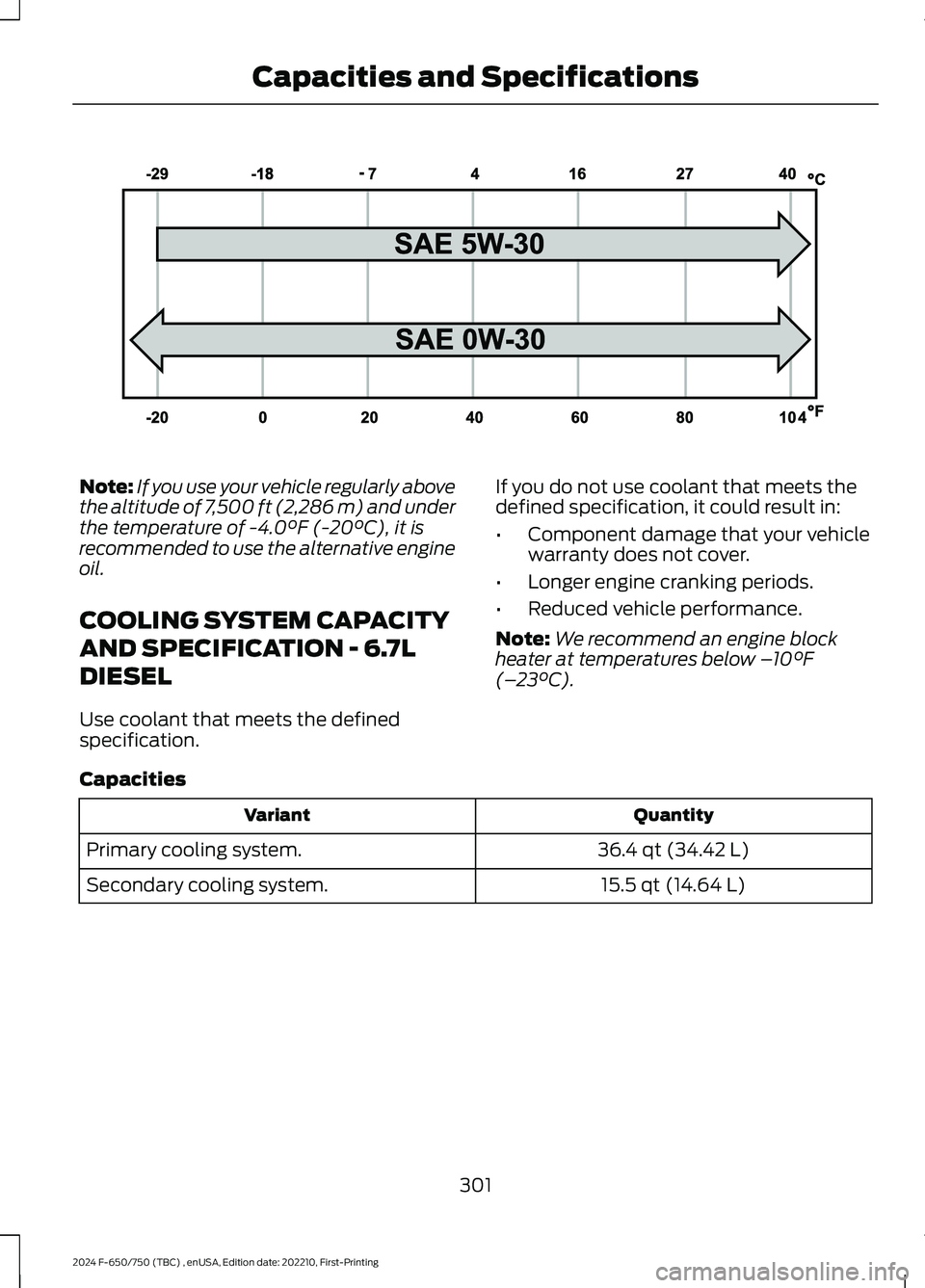
Note:If you use your vehicle regularly abovethe altitude of 7,500 ft (2,286 m) and underthe temperature of -4.0°F (-20°C), it isrecommended to use the alternative engineoil.
COOLING SYSTEM CAPACITY
AND SPECIFICATION - 6.7L
DIESEL
Use coolant that meets the definedspecification.
If you do not use coolant that meets thedefined specification, it could result in:
•Component damage that your vehiclewarranty does not cover.
•Longer engine cranking periods.
•Reduced vehicle performance.
Note:We recommend an engine blockheater at temperatures below –10°F(–23°C).
Capacities
QuantityVariant
36.4 qt (34.42 L)Primary cooling system.
15.5 qt (14.64 L)Secondary cooling system.
301
2024 F-650/750 (TBC) , enUSA, Edition date: 202210, First-PrintingCapacities and SpecificationsE240523
Page 306 of 386
Materials
SpecificationName
WSS-M97B57-A2Motorcraft® Yellow Prediluted Antifreeze/Coolant(U.S.)Motorcraft® Yellow Prediluted Antifreeze/Coolant/ Antigel/liquide de refroidissement prédilué jauneMotorcraft®(Canada)VC-13DL-G(U.S.)CVC-13DL-G(Canada)
COOLING SYSTEM CAPACITY
AND SPECIFICATION - 7.3L
Use coolant that meets the definedspecification.
If you do not use coolant that meets thedefined specification, it could result in:
•Component damage that your vehiclewarranty does not cover.
•Longer engine cranking periods.
•Reduced vehicle performance.
Capacities
QuantityVariant
23.4 qt (22.13 L)All.
Materials
SpecificationName
WSS-M97B57-A2Motorcraft® Yellow Prediluted Antifreeze/Coolant(U.S.)Motorcraft® Yellow Prediluted Antifreeze/Coolant/ Antigel/liquide de refroidissement prédilué jauneMotorcraft®(Canada)VC-13DL-G(U.S.)CVC-13DL-G(Canada)
302
2024 F-650/750 (TBC) , enUSA, Edition date: 202210, First-PrintingCapacities and Specifications
Page 332 of 386
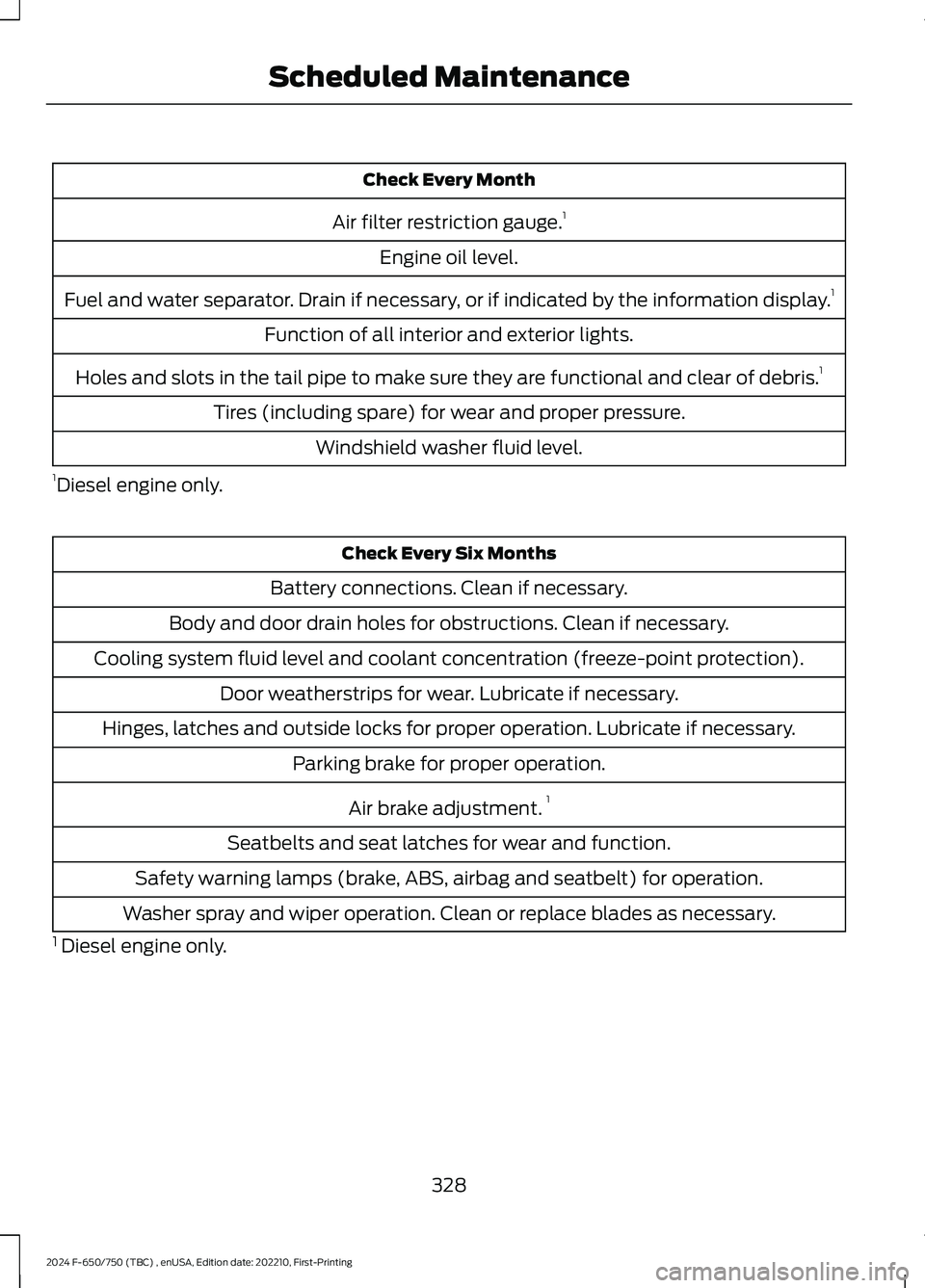
Check Every Month
Air filter restriction gauge.1
Engine oil level.
Fuel and water separator. Drain if necessary, or if indicated by the information display.1
Function of all interior and exterior lights.
Holes and slots in the tail pipe to make sure they are functional and clear of debris.1
Tires (including spare) for wear and proper pressure.
Windshield washer fluid level.
1Diesel engine only.
Check Every Six Months
Battery connections. Clean if necessary.
Body and door drain holes for obstructions. Clean if necessary.
Cooling system fluid level and coolant concentration (freeze-point protection).
Door weatherstrips for wear. Lubricate if necessary.
Hinges, latches and outside locks for proper operation. Lubricate if necessary.
Parking brake for proper operation.
Air brake adjustment.1
Seatbelts and seat latches for wear and function.
Safety warning lamps (brake, ABS, airbag and seatbelt) for operation.
Washer spray and wiper operation. Clean or replace blades as necessary.
1 Diesel engine only.
328
2024 F-650/750 (TBC) , enUSA, Edition date: 202210, First-PrintingScheduled Maintenance
Page 336 of 386
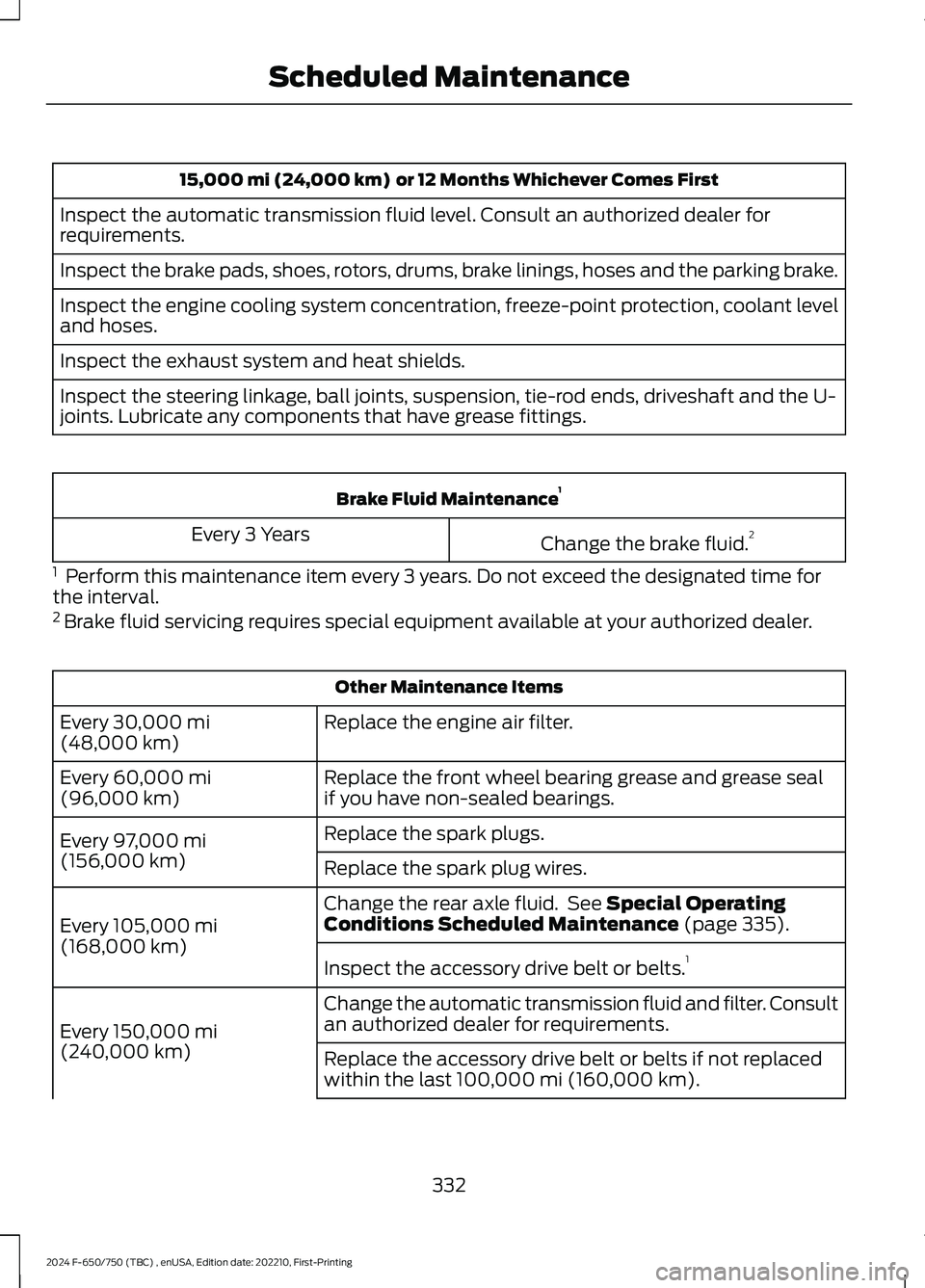
15,000 mi (24,000 km) or 12 Months Whichever Comes First
Inspect the automatic transmission fluid level. Consult an authorized dealer forrequirements.
Inspect the brake pads, shoes, rotors, drums, brake linings, hoses and the parking brake.
Inspect the engine cooling system concentration, freeze-point protection, coolant leveland hoses.
Inspect the exhaust system and heat shields.
Inspect the steering linkage, ball joints, suspension, tie-rod ends, driveshaft and the U-joints. Lubricate any components that have grease fittings.
Brake Fluid Maintenance1
Change the brake fluid.2Every 3 Years
1 Perform this maintenance item every 3 years. Do not exceed the designated time forthe interval.2 Brake fluid servicing requires special equipment available at your authorized dealer.
Other Maintenance Items
Replace the engine air filter.Every 30,000 mi(48,000 km)
Replace the front wheel bearing grease and grease sealif you have non-sealed bearings.Every 60,000 mi(96,000 km)
Replace the spark plugs.Every 97,000 mi(156,000 km)Replace the spark plug wires.
Change the rear axle fluid. See Special OperatingConditions Scheduled Maintenance (page 335).Every 105,000 mi(168,000 km)Inspect the accessory drive belt or belts.1
Change the automatic transmission fluid and filter. Consultan authorized dealer for requirements.Every 150,000 mi(240,000 km)Replace the accessory drive belt or belts if not replacedwithin the last 100,000 mi (160,000 km).
332
2024 F-650/750 (TBC) , enUSA, Edition date: 202210, First-PrintingScheduled Maintenance
Page 338 of 386
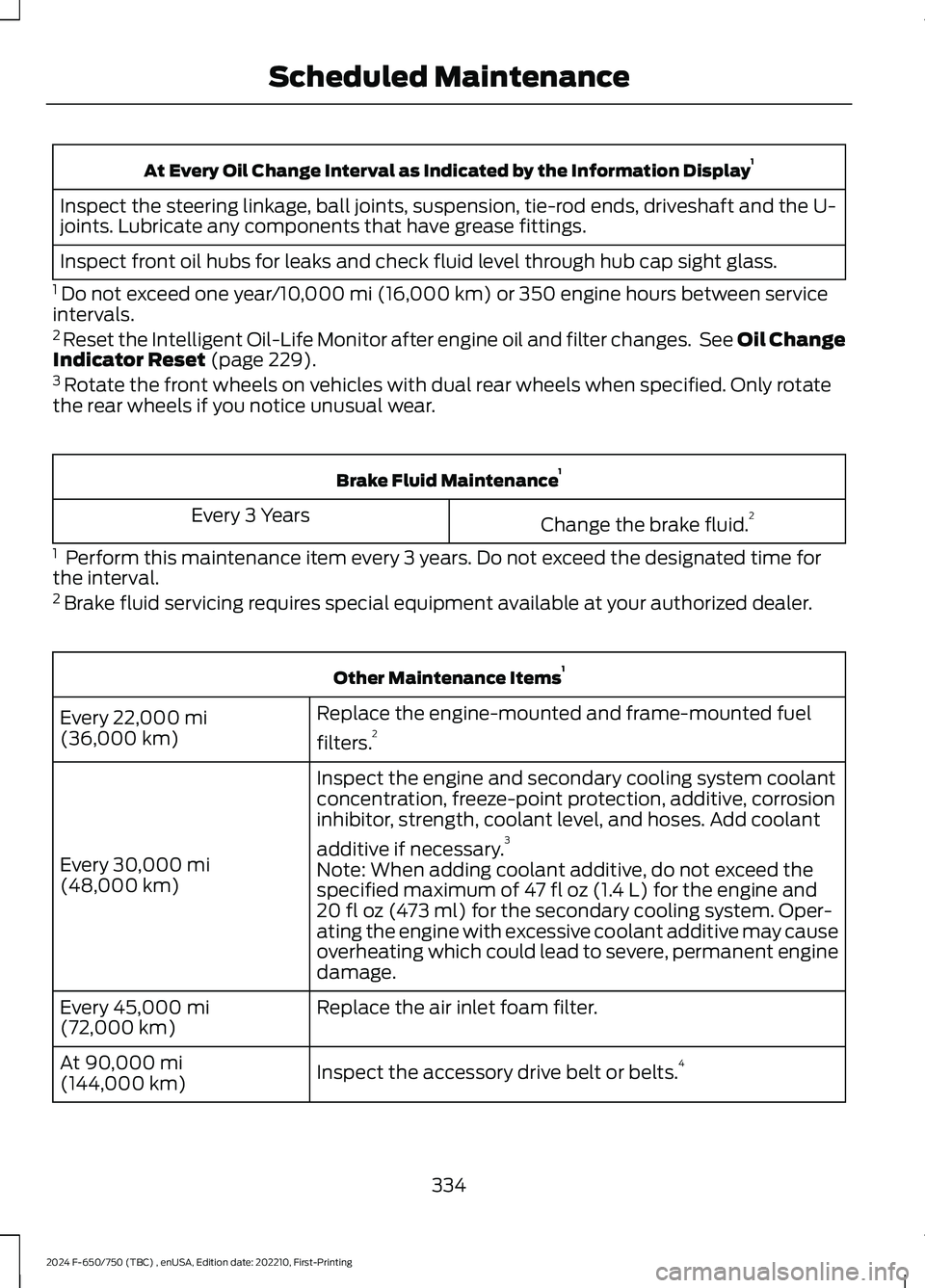
At Every Oil Change Interval as Indicated by the Information Display1
Inspect the steering linkage, ball joints, suspension, tie-rod ends, driveshaft and the U-joints. Lubricate any components that have grease fittings.
Inspect front oil hubs for leaks and check fluid level through hub cap sight glass.
1 Do not exceed one year/10,000 mi (16,000 km) or 350 engine hours between serviceintervals.2 Reset the Intelligent Oil-Life Monitor after engine oil and filter changes. See Oil ChangeIndicator Reset (page 229).3 Rotate the front wheels on vehicles with dual rear wheels when specified. Only rotatethe rear wheels if you notice unusual wear.
Brake Fluid Maintenance1
Change the brake fluid.2Every 3 Years
1 Perform this maintenance item every 3 years. Do not exceed the designated time forthe interval.2 Brake fluid servicing requires special equipment available at your authorized dealer.
Other Maintenance Items1
Replace the engine-mounted and frame-mounted fuel
filters.2Every 22,000 mi(36,000 km)
Inspect the engine and secondary cooling system coolantconcentration, freeze-point protection, additive, corrosioninhibitor, strength, coolant level, and hoses. Add coolant
additive if necessary.3
Every 30,000 mi(48,000 km)Note: When adding coolant additive, do not exceed thespecified maximum of 47 fl oz (1.4 L) for the engine and20 fl oz (473 ml) for the secondary cooling system. Oper-ating the engine with excessive coolant additive may causeoverheating which could lead to severe, permanent enginedamage.
Replace the air inlet foam filter.Every 45,000 mi(72,000 km)
Inspect the accessory drive belt or belts.4At 90,000 mi(144,000 km)
334
2024 F-650/750 (TBC) , enUSA, Edition date: 202210, First-PrintingScheduled Maintenance
Page 339 of 386
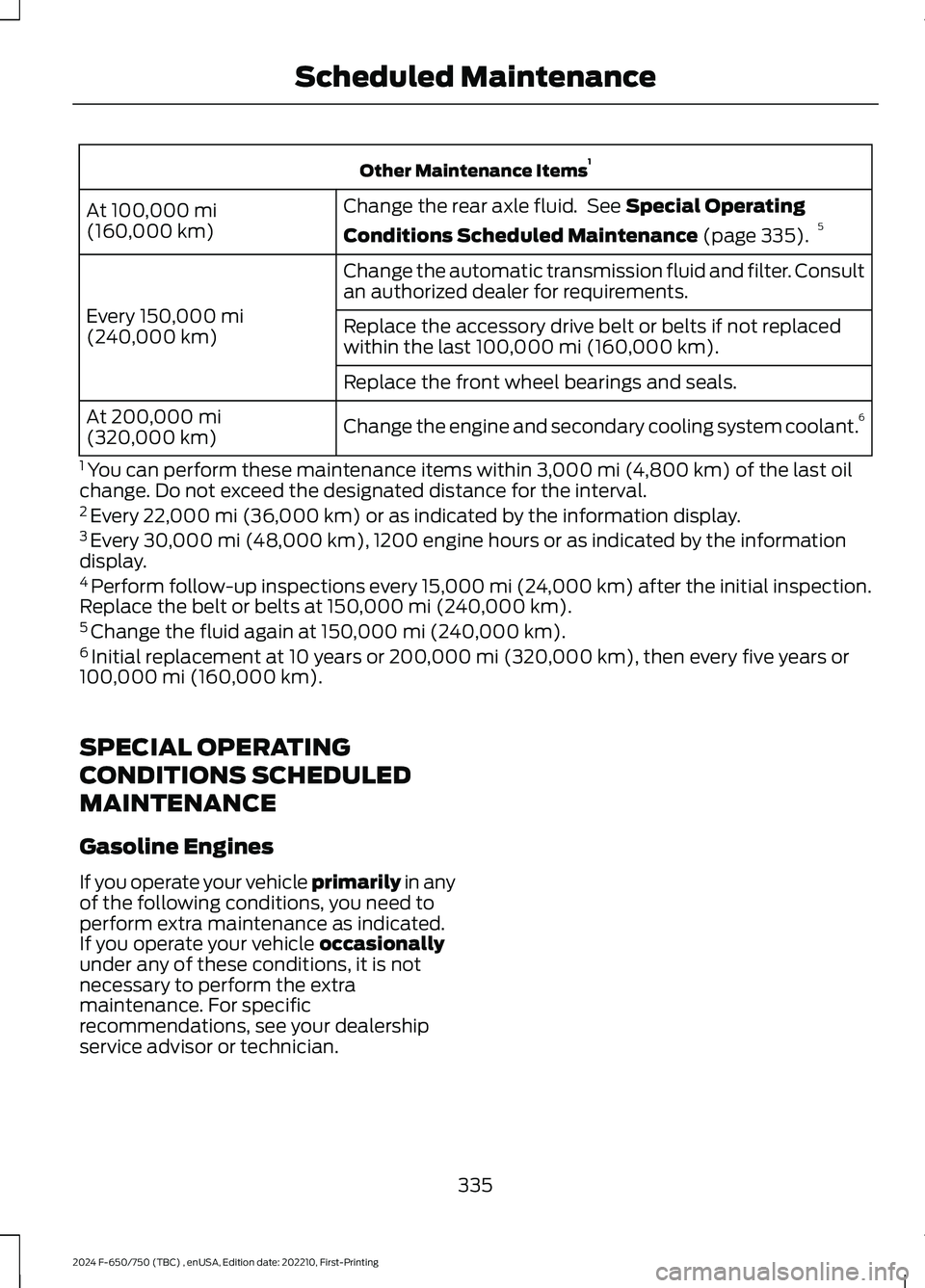
Other Maintenance Items1
Change the rear axle fluid. See Special Operating
Conditions Scheduled Maintenance (page 335).5At 100,000 mi(160,000 km)
Change the automatic transmission fluid and filter. Consultan authorized dealer for requirements.
Every 150,000 mi(240,000 km)Replace the accessory drive belt or belts if not replacedwithin the last 100,000 mi (160,000 km).
Replace the front wheel bearings and seals.
Change the engine and secondary cooling system coolant.6At 200,000 mi(320,000 km)
1 You can perform these maintenance items within 3,000 mi (4,800 km) of the last oilchange. Do not exceed the designated distance for the interval.2 Every 22,000 mi (36,000 km) or as indicated by the information display.3 Every 30,000 mi (48,000 km), 1200 engine hours or as indicated by the informationdisplay.4 Perform follow-up inspections every 15,000 mi (24,000 km) after the initial inspection.Replace the belt or belts at 150,000 mi (240,000 km).5 Change the fluid again at 150,000 mi (240,000 km).6 Initial replacement at 10 years or 200,000 mi (320,000 km), then every five years or100,000 mi (160,000 km).
SPECIAL OPERATING
CONDITIONS SCHEDULED
MAINTENANCE
Gasoline Engines
If you operate your vehicle primarily in anyof the following conditions, you need toperform extra maintenance as indicated.If you operate your vehicle occasionallyunder any of these conditions, it is notnecessary to perform the extramaintenance. For specificrecommendations, see your dealershipservice advisor or technician.
335
2024 F-650/750 (TBC) , enUSA, Edition date: 202210, First-PrintingScheduled Maintenance
Page 343 of 386
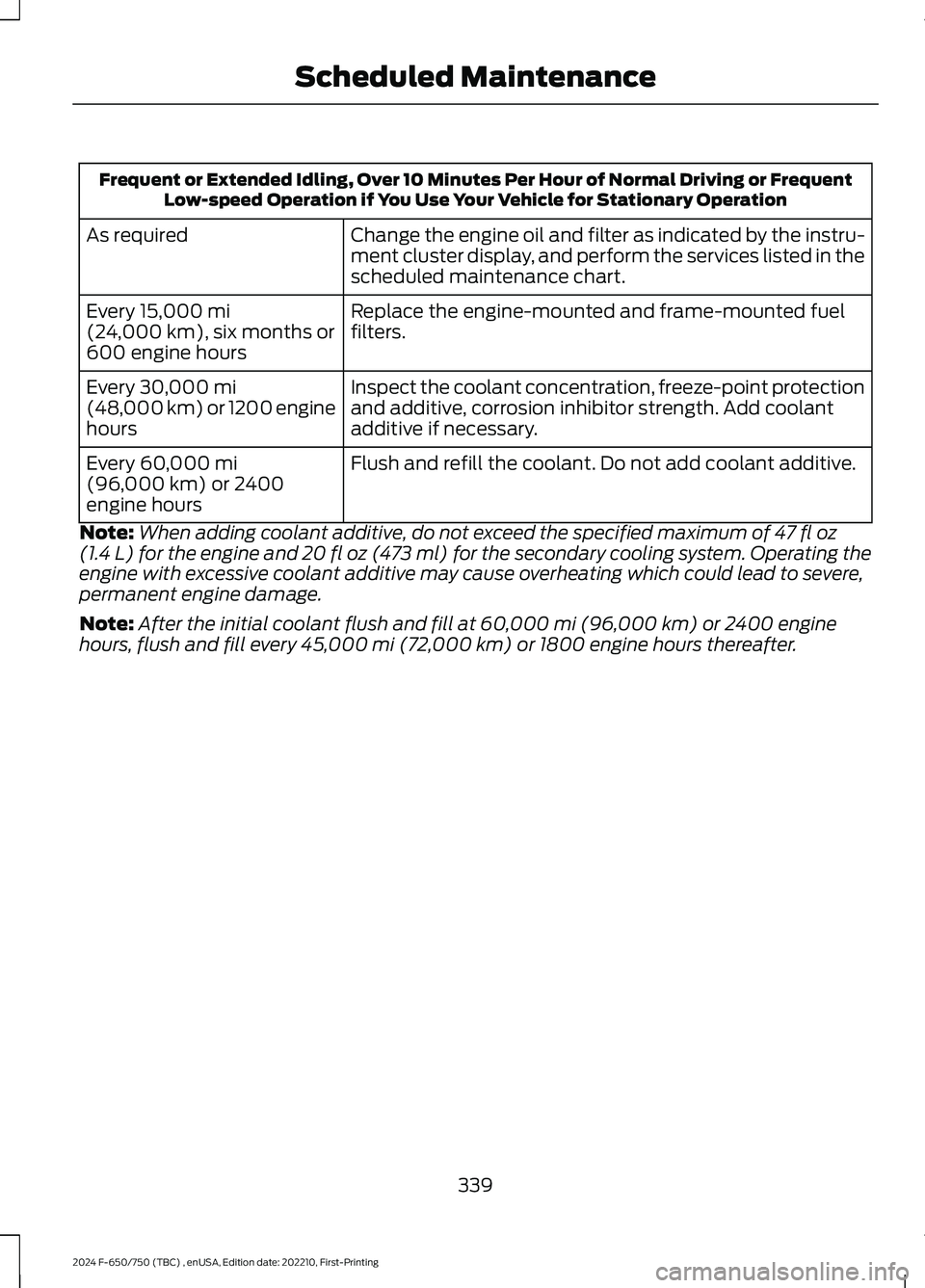
Frequent or Extended Idling, Over 10 Minutes Per Hour of Normal Driving or FrequentLow-speed Operation if You Use Your Vehicle for Stationary Operation
Change the engine oil and filter as indicated by the instru-ment cluster display, and perform the services listed in thescheduled maintenance chart.
As required
Replace the engine-mounted and frame-mounted fuelfilters.Every 15,000 mi(24,000 km), six months or600 engine hours
Inspect the coolant concentration, freeze-point protectionand additive, corrosion inhibitor strength. Add coolantadditive if necessary.
Every 30,000 mi(48,000 km) or 1200 enginehours
Flush and refill the coolant. Do not add coolant additive.Every 60,000 mi(96,000 km) or 2400engine hours
Note:When adding coolant additive, do not exceed the specified maximum of 47 fl oz(1.4 L) for the engine and 20 fl oz (473 ml) for the secondary cooling system. Operating theengine with excessive coolant additive may cause overheating which could lead to severe,permanent engine damage.
Note:After the initial coolant flush and fill at 60,000 mi (96,000 km) or 2400 enginehours, flush and fill every 45,000 mi (72,000 km) or 1800 engine hours thereafter.
339
2024 F-650/750 (TBC) , enUSA, Edition date: 202210, First-PrintingScheduled Maintenance
Page 344 of 386
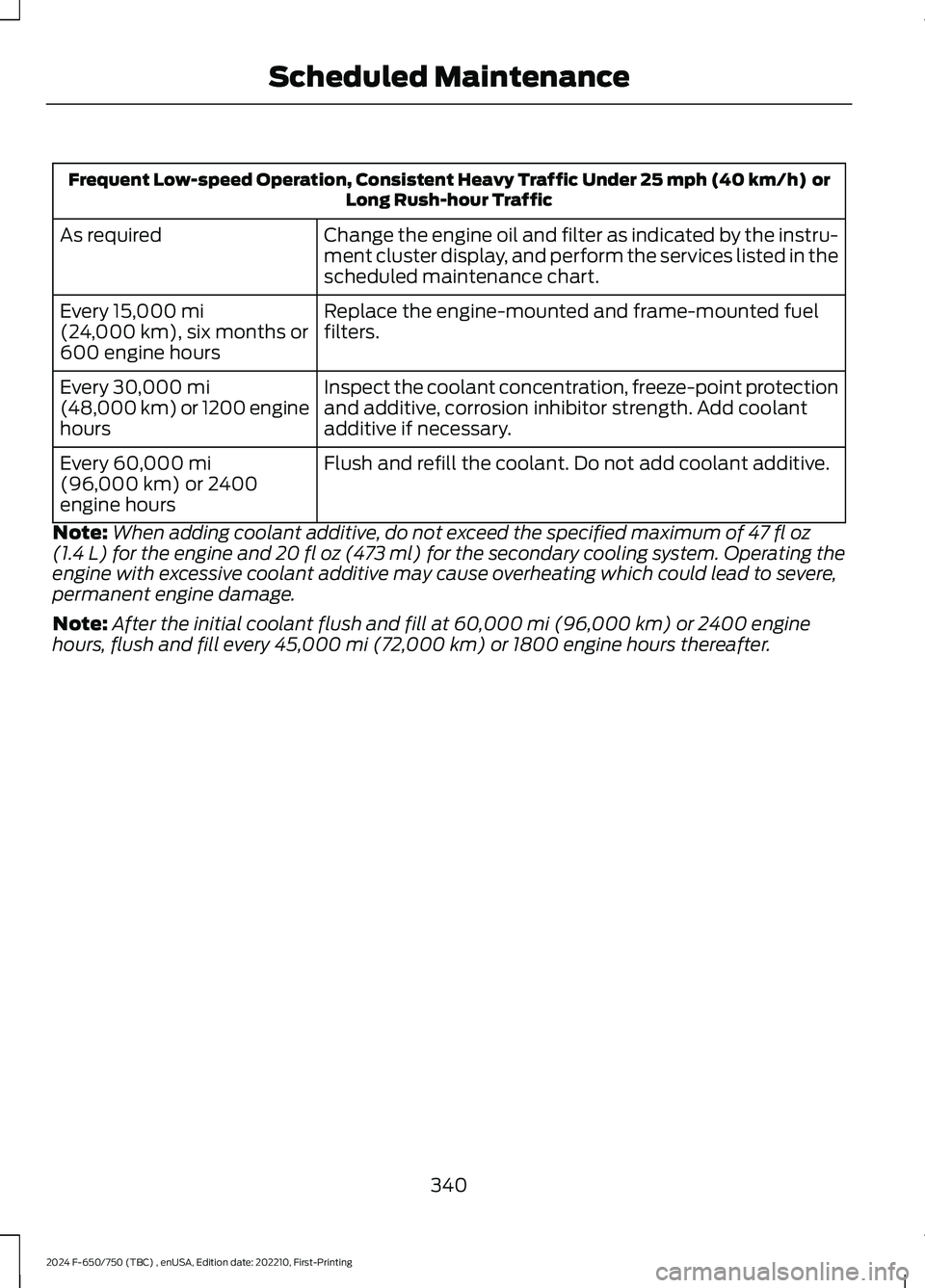
Frequent Low-speed Operation, Consistent Heavy Traffic Under 25 mph (40 km/h) orLong Rush-hour Traffic
Change the engine oil and filter as indicated by the instru-ment cluster display, and perform the services listed in thescheduled maintenance chart.
As required
Replace the engine-mounted and frame-mounted fuelfilters.Every 15,000 mi(24,000 km), six months or600 engine hours
Inspect the coolant concentration, freeze-point protectionand additive, corrosion inhibitor strength. Add coolantadditive if necessary.
Every 30,000 mi(48,000 km) or 1200 enginehours
Flush and refill the coolant. Do not add coolant additive.Every 60,000 mi(96,000 km) or 2400engine hours
Note:When adding coolant additive, do not exceed the specified maximum of 47 fl oz(1.4 L) for the engine and 20 fl oz (473 ml) for the secondary cooling system. Operating theengine with excessive coolant additive may cause overheating which could lead to severe,permanent engine damage.
Note:After the initial coolant flush and fill at 60,000 mi (96,000 km) or 2400 enginehours, flush and fill every 45,000 mi (72,000 km) or 1800 engine hours thereafter.
340
2024 F-650/750 (TBC) , enUSA, Edition date: 202210, First-PrintingScheduled Maintenance