Wheel FORD F750 2000 10.G Owner's Manual
[x] Cancel search | Manufacturer: FORD, Model Year: 2000, Model line: F750, Model: FORD F750 2000 10.GPages: 208, PDF Size: 1.08 MB
Page 148 of 208
Tires are one of the weaker weight carrying components of the
vehicle. Do not overload the vehicle beyond safe load carrying
capacity.
Avoid hammering rim with steel hammers.
Never run the engine with one wheel off the ground.
Failure to retighten wheel lug nuts as required could allow the
wheel to come off while the vehicle is in motion, possibly causing
loss of vehicle control and collision. Loose wheel studs may also cause
shimmy and vibration.
Use of aftermarket wheel assemblies is not recommended; they
may be incompatible with your vehicle and may result in
equipment failure and possible injury. Replacement with used wheels is
not advised; they may have been treated harshly or have high mileage
and could fail without warning.
A wheel or tire of the wrong size or type may adversely affect
such things as load carrying capacity, wheel and bearing life,
brake cooling, speedometer/odometer calibration, stopping ability,
headlight aim, bumper height, vehicle ground clearance and tire or tire
chain clearance to the body and chassis.
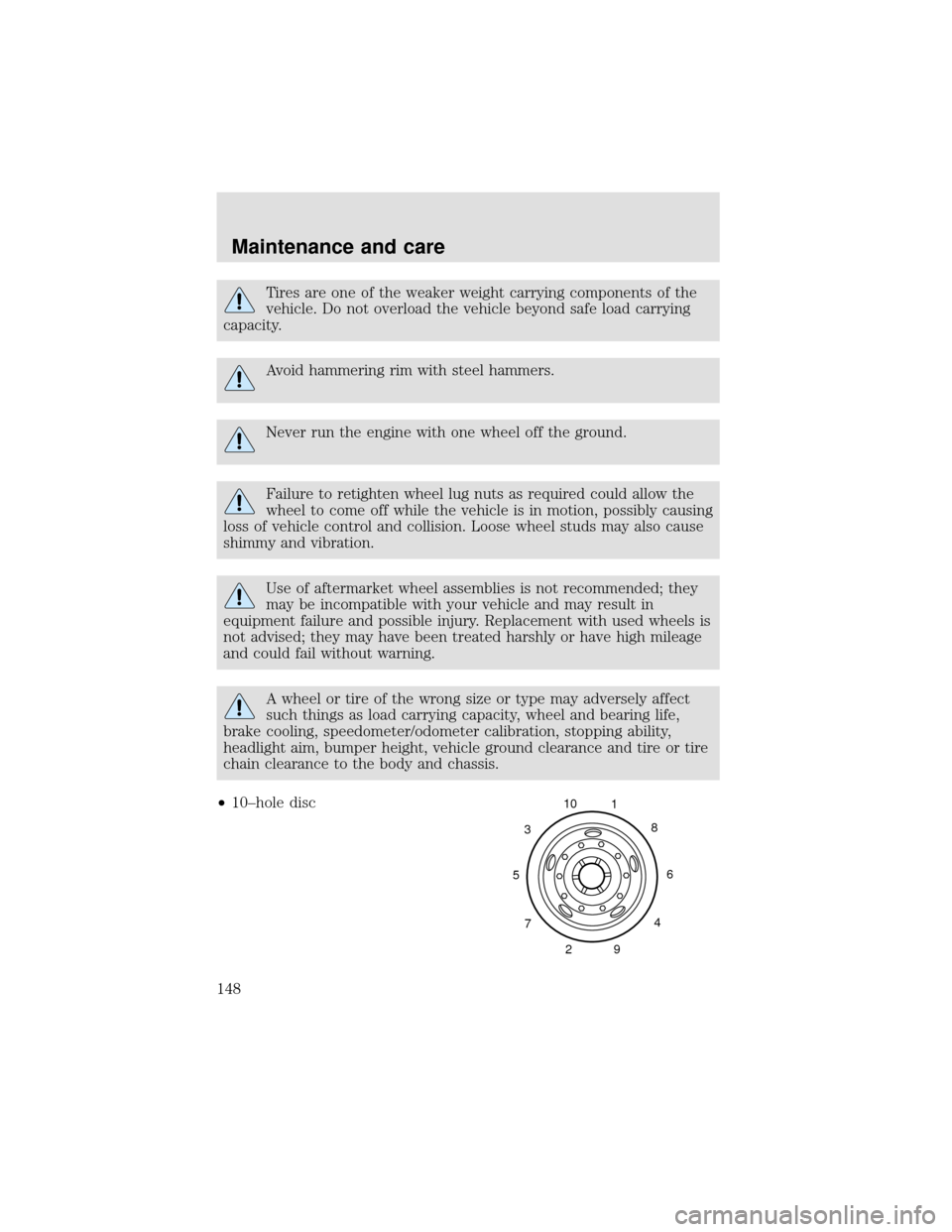
•10–hole disc
5310
1
8
6
4
9 2 7
Maintenance and care
148
Page 149 of 208
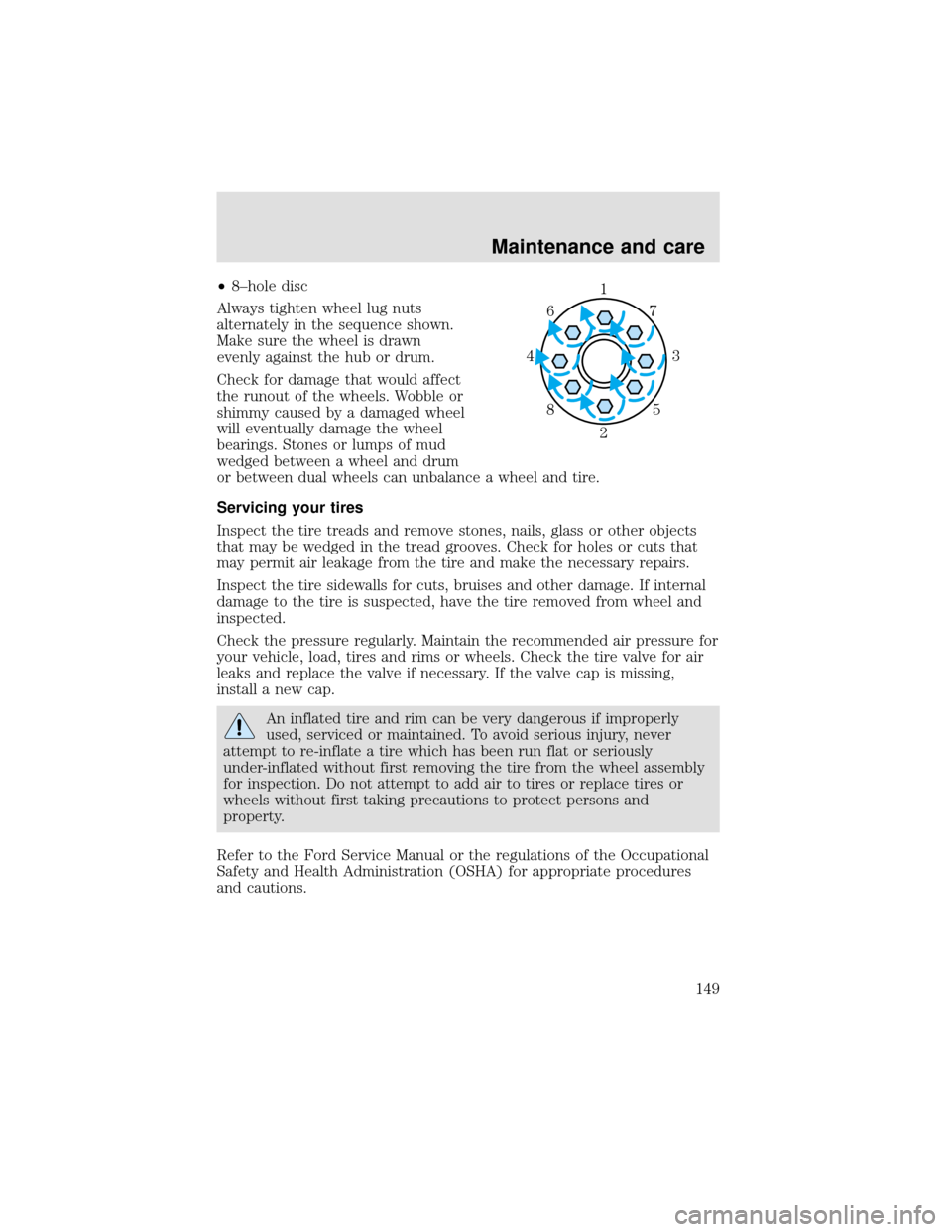
•8–hole disc
Always tighten wheel lug nuts
alternately in the sequence shown.
Make sure the wheel is drawn
evenly against the hub or drum.
Check for damage that would affect
the runout of the wheels. Wobble or
shimmy caused by a damaged wheel
will eventually damage the wheel
bearings. Stones or lumps of mud
wedged between a wheel and drum
or between dual wheels can unbalance a wheel and tire.
Servicing your tires
Inspect the tire treads and remove stones, nails, glass or other objects
that may be wedged in the tread grooves. Check for holes or cuts that
may permit air leakage from the tire and make the necessary repairs.
Inspect the tire sidewalls for cuts, bruises and other damage. If internal
damage to the tire is suspected, have the tire removed from wheel and
inspected.
Check the pressure regularly. Maintain the recommended air pressure for
your vehicle, load, tires and rims or wheels. Check the tire valve for air
leaks and replace the valve if necessary. If the valve cap is missing,
install a new cap.
An inflated tire and rim can be very dangerous if improperly
used, serviced or maintained. To avoid serious injury, never
attempt to re-inflate a tire which has been run flat or seriously
under-inflated without first removing the tire from the wheel assembly
for inspection. Do not attempt to add air to tires or replace tires or
wheels without first taking precautions to protect persons and
property.
Refer to the Ford Service Manual or the regulations of the Occupational
Safety and Health Administration (OSHA) for appropriate procedures
and cautions.
1
3 4
27 6
5 8
Maintenance and care
149
Page 150 of 208
Tire inflation pressure must not exceed the recommendations of
the axle, tire and/or wheel rim manufacturer for the specific
load, speed and application. The inflation pressures on the tire sidewall
do not take the wheel rim capabilities into consideration.
Never use a rim of different manufacture or any different size or
type than original rims.
Try to replace tires in pairs on the same axle shaft. Tires larger or
smaller than originally installed may affect the accuracy of the
speedometer. Consult your dealer about the need to change the switch
setting on the back of the speedometer.
Front wheel alignment
If abnormal tire wear or ride and handling characteristics such as vehicle
lead or wander are experienced with properly inflated tires, the front
end alignment should be checked.
Wheel bearing care
Front and rear wheel bearings are adjustable to correct for bearing and
spindle wear. Long bearing life depends upon proper adjustment and
correct lubrication. If bearings are adjusted too tightly (preloaded) they
will overheat and wear rapidly. Loose adjustment will cause pounding
and will contribute to uneven tire wear, steering difficulties and
inefficient brake operation.
Refer to the Ford Service Manual applicable to your vehicle for proper
tightening procedures and torque specifications.
Periodically check the oil level on oil filled front bearing hubs. If
necessary, add oil through the filler plug so the oil level is between the
ADD and FULL marks indicated on the hub. Do not overfill. Overfilling
can result in oil on brake linings.
Refer to your Scheduled Maintenance Guide for fluid level checks and
change intervals for the front hubs.
Your front hubs may be filled with an optional synthetic fluid which
allows use of the extended service intervals. A blue colored filler plug
identifies use of the synthetic fluid.
Maintenance and care
150
Page 151 of 208
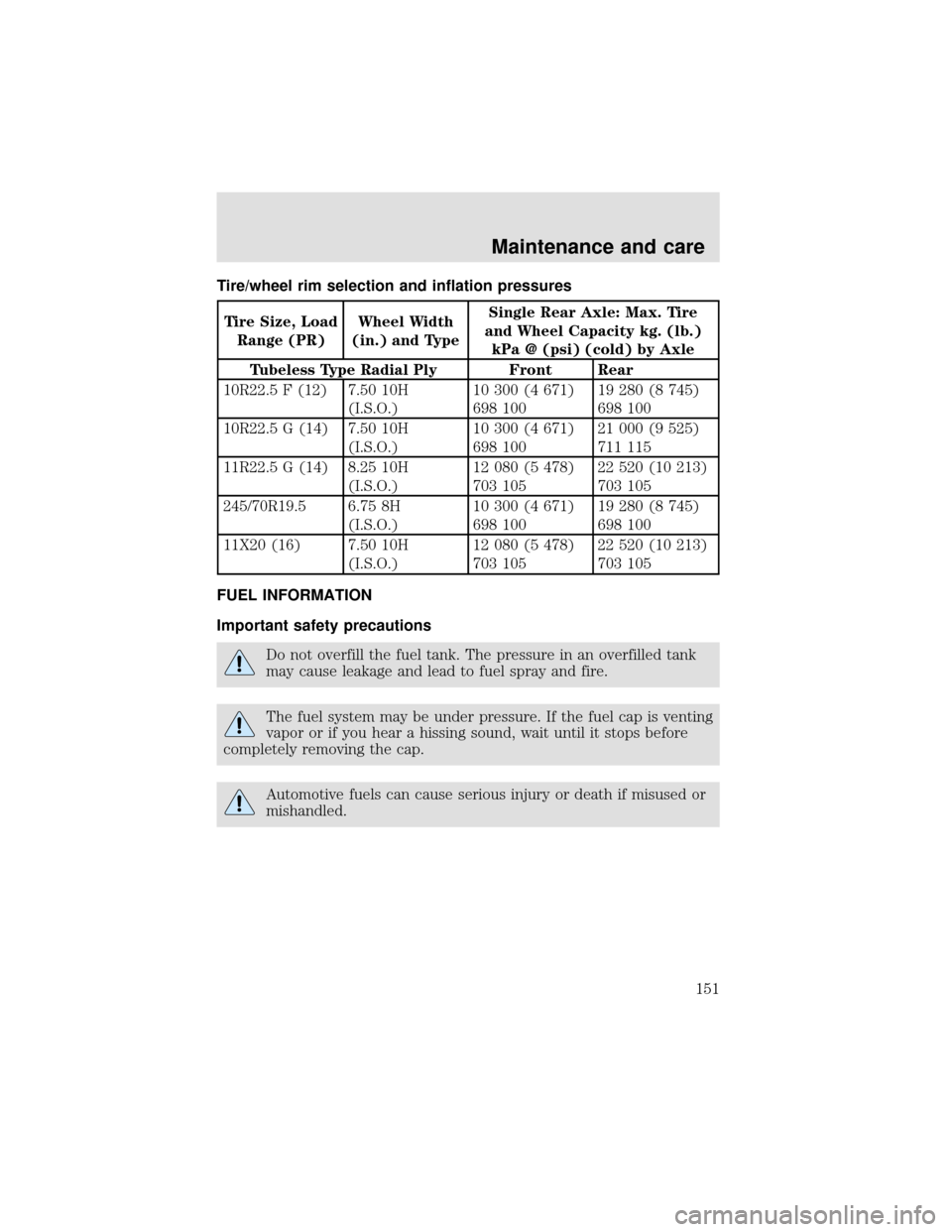
Tire/wheel rim selection and inflation pressures
Tire Size, Load
Range (PR)Wheel Width
(in.) and TypeSingle Rear Axle: Max. Tire
and Wheel Capacity kg. (lb.)
kPa @ (psi) (cold) by Axle
Tubeless Type Radial Ply Front Rear
10R22.5 F (12) 7.50 10H
(I.S.O.)10 300 (4 671)
698 10019 280 (8 745)
698 100
10R22.5 G (14) 7.50 10H
(I.S.O.)10 300 (4 671)
698 10021 000 (9 525)
711 115
11R22.5 G (14) 8.25 10H
(I.S.O.)12 080 (5 478)
703 10522 520 (10 213)
703 105
245/70R19.5 6.75 8H
(I.S.O.)10 300 (4 671)
698 10019 280 (8 745)
698 100
11X20 (16) 7.50 10H
(I.S.O.)12 080 (5 478)
703 10522 520 (10 213)
703 105
FUEL INFORMATION
Important safety precautions
Do not overfill the fuel tank. The pressure in an overfilled tank
may cause leakage and lead to fuel spray and fire.
The fuel system may be under pressure. If the fuel cap is venting
vapor or if you hear a hissing sound, wait until it stops before
completely removing the cap.
Automotive fuels can cause serious injury or death if misused or
mishandled.
Maintenance and care
151
Page 165 of 208

recommended that you clean the wiper blades and windshield as
described inCleaning the wiper blades and windshield.
Repairing paint chips
Minor scratches or paint damage from road debris may be repaired with
the Ultra Touch Prep and Finishing Kit (#F7AZ-19K507–BA), Lacquer
Touch-up Paint (#ALBZ-19500–XXXXA), or Exterior Acrylic Spray
Lacquer (#ALAZ-19500–XXXXA) from the Ford Car Care Chemicals line.
Please note that the part numbers (shown as XXXX above) will vary with
your vehicle’s specific coloring. Observe the application instructions on
the products.
Remove particles such as bird droppings, tree sap, insect remains, tar
spots, road salt and industrial fallout immediately.
Cleaning the wheels
Wash with the same detergent as the body of your vehicle. Do not use
acid-based or alcohol-based wheel cleaners, steel wool, fuel or strong
detergents. Never use abrasives that will damage the finish of special
wheel surfaces. Use a tar remover to remove grease and tar.
The brushes used in some automatic car washes may damage the finish
on your wheels. Before going to a car wash, find out if the brushes are
abrasive.
Cleaning the engine
Cover the underhood electrical connections and terminals of your vehicle
when cleaning the engine compartment. Avoid spraying or splashing
cleaning solvents or detergent solutions on the terminals and
connections. After the cleaning is completed and with the engine not
running, remove the protective cleaning coverings. Exposing electrical
connections and terminals to cleaning solvents and detergent solutions
over a period of time can corrode them and result in electrical system
damage and malfunctions.
Underbody
Flush the complete underside of vehicle frequently. Keep body drain
holes unplugged. Inspect for road damage.
Maintenance and care
165
Page 166 of 208
Cleaning non-painted plastic exterior parts
Use vinyl cleaner for routine cleaning. Clean with a tar remover if
necessary. Do not clean plastic parts with thinners, solvents or
petroleum-based cleaners.
Cleaning the exterior lamps
Wash with the same detergent as the exterior of your vehicle. If
necessary, use a tar remover such as Ford Extra Strength Tar and Road
Oil Remover (B7A-19520–AA).
To avoid scratching the lamps, do not use a dry paper towel, chemical
solvents or abrasive cleaners.
Cleaning the wiper blades, windshield and rear window
If the wiper blades do not wipe properly, clean the wiper blade rubber
element with undiluted windshield washer solution or a mild detergent.
To avoid damaging the blades, do not use fuel, kerosene, paint thinner or
other solvents.
If the wiper still does not wipe properly, this could be caused by
substances on the windshield or rear window such as tree sap and some
hot wax treatments used by commercial car washes. Clean the outside of
the windshield or rear window with a non-abrasive cleaner such as Ford
Ultra-Clear Spray Glass Cleaner, (E4AZ-19C507–AA), available from your
Ford Dealer.Do notuse abrasive cleansers on glass as they may cause
scratches. The windshield or rear window is clean if beads do not form
when you rinse it with water. The windshield, rear window and wiper
blades should be cleaned on a regular basis, and blades or rubber
elements replaced when worn.
Cleaning the instrument panel
Clean with a damp cloth, then dry with a dry cloth.
Avoid cleaner or polish that increases the gloss of the upper portion of
the instrument panel. The dull finish in this area helps protect the driver
from undesirable windshield reflection.
Do not use chemical solvents or strong detergents when cleaning
the steering wheel or instrument panel to avoid contamination of
the air bag system.
Maintenance and care
166
Page 170 of 208

Item Ford Part NameFord Part
NumberFord
Specification
Front axle
spindle pins,
steering linkage,
front and rear
spring shackle
pins, steering
column U-joints,
steering shaft
slip yoke and
universal joint,
steering shaft
pillow block
bearing, clutch
linkage fittings.Premium Long
Life GreaseXG-1-C or
XG-1-KESA-M1C75-B
Bushings, front
wheel bearings
(grease packed
type)and seals,
fuel shut-off
solenoid linkage,
air brake control
valve, linkage,
treadle hinge and
roller,
transmission and
transmission
cables, clutch
release bearing
hub,
transmission
shift lever pivot.Premium Long
Life GreaseXG-1-C or
XG-1-KESA-M1C75-B
Door
weatherstripsSilicone Lubricant F7AZ-19G208-
BA and
F5AZ-19553-AAESR-M13P4-A
Driveshaft
U-joints and slip
splines, power
steering gear
output shaft.High Temperature
4 x 4 Front Axle
and Wheel
Bearing GreaseE8TZ-19590-A ESA-M1C198-A
Capacities and specifications
170
Page 171 of 208

Item Ford Part NameFord Part
NumberFord
Specification
Spring leaves,
transmission
linkage pivots,
brake and clutch
pedal pivots and
clevises,
transmatic
detent stop,
starter motor.Motorcraft SAE
10W30 Super
Duty Motor OilXO-10W30-QSD WSS-
M2C171-B
Automatic
transmissionRefer to the Allison Automatic Transmission
Operator’s manual.
Rear axle and
front wheel
bearings (oil
filled)
1
SAE 80W-90
Premium Rear
Axle LubricantXY-80W90-QL WSP-
M2C197-A
SAE 75W-140
High Performance
Rear Axle
Lubricant
(synthetic)F1TZ-19580-B WSL-
M2C192-A
Manual
transmission
1Motor oil SAE 50
(above -18°C
[0°F])2N/A
Motorcraft SAE 30
Super Duty Motor
oil (below -18°C
[0°F])XO-30-QSD
3WSS-
M2C171-B
Engine oil-
7.3L Power
Stroke engine
1, 4
Motorcraft Super
Duty Motor oilXO-15W40-
QSD3
XO-10W30-
QSD3
WSS-
M2C171-B
Motorcraft SAE
0W-30 Super All
Season Motor oil
(synthetic)XO-0W30-LAS
Engine oil-
Cummins B and
Caterpillar 3126
B enginesRefer to the appropriate engine operator’s manual.
Capacities and specifications
171
Page 182 of 208

Daily Owner Checks Engine system
Check the air filter restriction indicator
Check the engine oil
Inspect the coolant level - for Powerstroke
engine (for Caterpillar and Cummins engines,
refer to the Owner’s Manual)
Brake system
Drain the air brake system reservoir - manual
valve
Check the air brake system reservoir automatic
drain valve operation
Transmission system
Visually check the automatic transmission for
fluid leakage
Steering system
Check the power steering pump fluid level and
check the system for leaks
Check the entire vehicle for evidence of fluid
leaks
U.S. Department of Transportation,
Federal Highway Administration
requirements (ensure that the entire
system is functioning properly)
Check the service brakes
Check the parking brake
Check the steering mechanism
Check the lighting devices and reflectors
Check the tires
Check the horn
Check the windshield wipers
Check the rear vision mirrors
Check the wheels and rims
Check the emergency equipment
General maintenance information
182
Page 184 of 208

Check every oil
changeOil change
intervals are as
follows: Powerstroke -
10 000 ; Caterpillar -
10 000 ; Cummins -
15 000 (refer to the
Caterpillar and
Cummins service
manuals for further
instructions and
information)Steering system
Lubricate the steering shaft(s), U-joints and
splines when equipped with grease fittings
Lubricate the front axle spindle pins
Lubricate the steering linkage when equipped
with grease fittings
Grease the power steering gear output shaft
* Coolant protection checks should be made just prior to the onset of
freezing weather, where applicable. If coolant is dirty or rusty in
appearance, the system should be drained, flushed and refilled with the
prescribed solution of cooling system fluid and water. Use only
permanent type coolant that meets Ford specifications ESE-M97B18-C.
See the engine manufacturer’s operating guide for supplimental
corrosion inhibitor specifications.
In addition to the items to be performed daily or at each oil change, the
following need to be completed as specified:
5 000 MILES
•Initial change—change the lubricant in the manual shift transmission
–5 speed and 6 speed Eaton manual transmission. (Not required
when equipped with optional synthetic lubricant.)
20 000 MILES
•Replace the fuel filter.*
30 000 MILES
•Replace the engine spin-on coolant filter.*
•Repack and adjust the front wheel bearings—grease-filled hubs.
40 000 MILES
•Replace the fuel filter.*
General maintenance information
184