oil FORD F750 2002 10.G User Guide
[x] Cancel search | Manufacturer: FORD, Model Year: 2002, Model line: F750, Model: FORD F750 2002 10.GPages: 256, PDF Size: 1.75 MB
Page 177 of 256
WASHING THE EXTERIOR LAMPS
In order to avoid scratching the plastic lamps, do not use dry
paper towels, non-approved chemical solvents or abrasive
cleaners.
Use a soft cloth and a solution of Triple Clean (EOAZ-19526±AA), mixed
properly with water, in order to remove bug residue. If tar or grease
spots are present, clean with Extra Strength Tar and Road Oil Removal
(B7A-19520±AA).
CLEANING THE WINDSHIELD, WIPER BLADES AND REAR
WINDOW
If the wiper does not wipe properly, substances on the windshield, rear
window or the wiper blades may be the cause. These may include hot
wax treatments used by commercial car washes, tree sap, or other
organic contamination.
Do not clean the windshield or rear window glass with abrasives,
as they may cause scratches.
Do not use fuel, kerosene, or paint thinner to clean the
windshield, rear window or the wiper blades as damage may
occur.
Clean the outside of the windshield or rear window with a non-abrasive
cleaner such as Ultra Clear Spray Glass Cleaner (E4AZ-19C507±AA),
available from your authorized Ford, Lincoln or Mercury dealer. If after
cleaning the glass surface, the water sheets from the glass (e.g., does not
bead), then the window is clean.
The windshield, rear window and wiper blades should be cleaned
regularly. Wiper blades can be cleaned with isopropyl (rubbing) alcohol
or windshield washer solution. Be sure to replace wiper blades when
they appear worn or do not function properly.
CLEANING THE INSTRUMENT PANEL
Clean the instrument panel with a damp cloth, then dry with a dry cloth.
Avoid cleaners or polish that increase the gloss of the upper portion of
the instrument panel. The dull finish in this area helps protect the driver
from undesirable windshield reflection.
Cleaning
177
Page 178 of 256
Do not use chemical solvents or strong detergents when cleaning
the steering wheel or instrument panel to avoid contamination of
the air bag system.
Cleaning the instrument cluster lens
Wipe the cluster area with a soft, damp cotton towel. Dry the area with a
clean, dry towel.
CLEANING THE INTERIOR FABRIC, CARPETS AND CLOTH SEATS
Remove dust and loose dirt with a vacuum cleaner. Remove light stains
and soil with Extra Strength Upholstery Cleaner (E8AZ-19523±AA).
Never saturate the seat covers with cleaning solution.
Do not use household cleaning products or glass cleaners, which
can stain and discolor the fabric and affect the flame retardent
abilities of the seat materials.
If grease or tar is present on the material, spot-clean the area first with
Spot and Stain Remover (F3AZ-19521±WA). Follow up by recleaning the
area with Extra Strength Upholstery Cleaner (E8AZ-19523±AA).
CLEANING LEATHER SEATS (IF EQUIPPED)
All Ford, Lincoln and Mercury vehicles with leather seating surfaces have
a clear, protective coating over the leather.
To clean the leather seats, simply use a soft cloth with Deluxe Leather
and Vinyl Cleaner (F2AZ-19521±WA). Dry the area with a soft cloth.
It is recommended that you use the Deluxe Leather Care Kit
(F8AZ-19G253±AA), available from your authorized Ford, Lincoln or
Mercury dealer. The mild cleaner and special pad available in the kit
cleans the leather and maintains its natural beauty. For best results,
follow the instructions printed on the cleaner label. Regular cleaning of
your leather upholstery helps maintain its resiliency and color.
Do not use household cleaning products, alcohol solutions,
solvents or cleaners intended for rubber, vinyl and plastics, or
oil/petroleum-based leather conditioners. These products may
cause premature wearing of the clear, protective coating.
Cleaning
178
Page 180 of 256

FORD, LINCOLN AND MERCURY CAR CARE PRODUCTS
Your Ford, Lincoln or Mercury dealer has many quality products available
to clean your vehicle and protect its finishes. These quality products
have been specifically engineered to fulfill your automotive needs; they
are custom designed to complement the style and appearance of your
vehicle. Each product is made from high quality materials that meet or
exceed rigid specifications. For best results, use the following or
products of equivalent quality:
Ford Custom Clearcoat Polish*
Ford Custom Silicone Gloss Polish
Ford Custom Vinyl Protectant* (not available in Canada)
Motorcraft Vinyl Conditioner (Canada only)
Ford Deluxe Leather and Vinyl Cleaner (not available in Canada)
Motorcraft Vinyl Cleaner (Canada only)
Ford Extra Strength Tar and Road Oil Remover* (not available in
Canada)
Ford Extra Strength Upholstery Cleaner (not available in Canada)
Ford Custom Bright Metal Cleaner
Motorcraft Premium Car Wash Concentrate
Motorcraft Carlite Glass Cleaner (Canada only)
Ford Spot and Stain Remover*
Ford Super Premium Tire and Trim Dressing
Ford Triple Clean
Ford Ultra-Clear Spray Glass Cleaner (not available in Canada)
Ford Engine Shampoo and Degreaser
* May be sold with the Motorcraft name
Cleaning
180
Page 183 of 256
WINDSHIELD WASHER FLUID
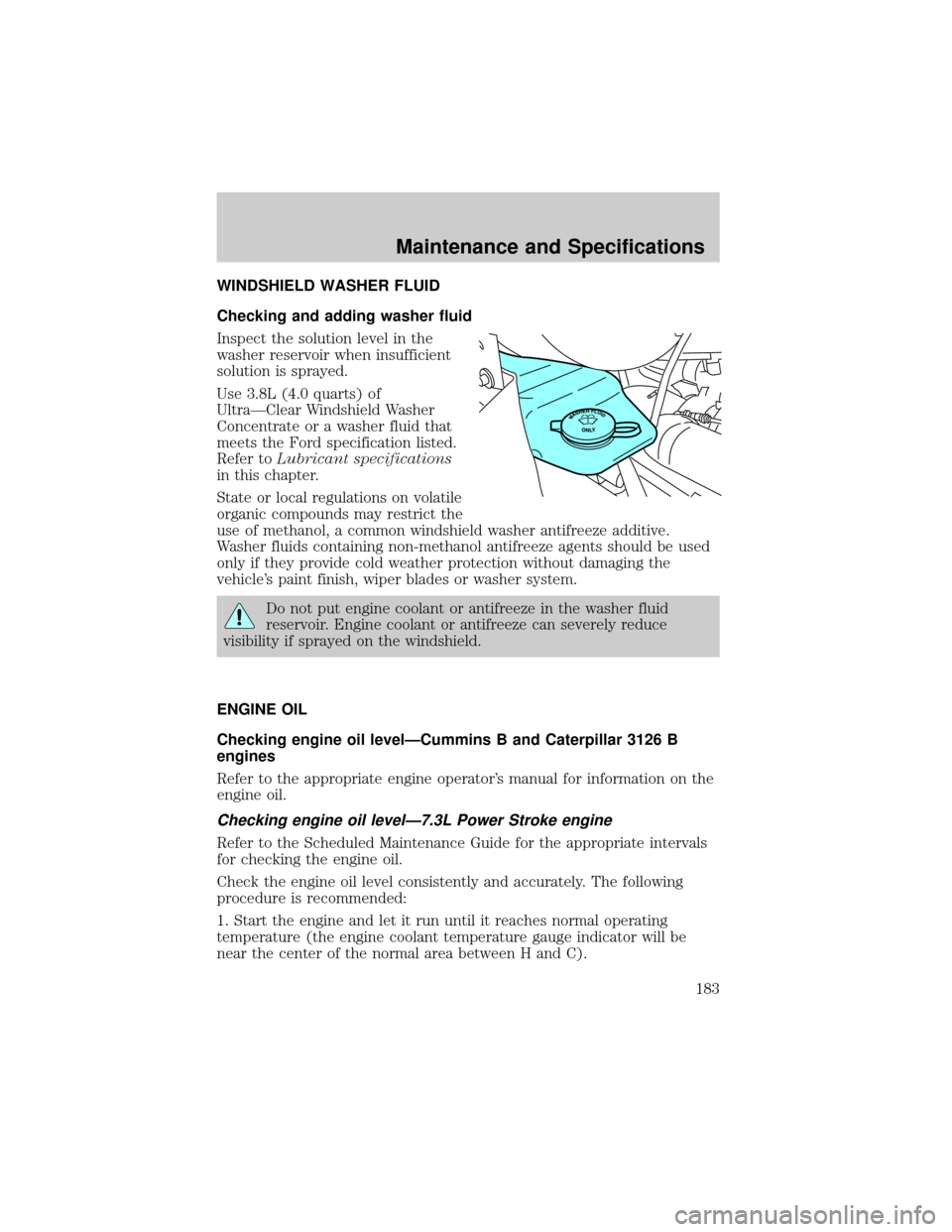
Checking and adding washer fluid
Inspect the solution level in the
washer reservoir when insufficient
solution is sprayed.
Use 3.8L (4.0 quarts) of
UltraÐClear Windshield Washer
Concentrate or a washer fluid that
meets the Ford specification listed.
Refer toLubricant specifications
in this chapter.
State or local regulations on volatile
organic compounds may restrict the
use of methanol, a common windshield washer antifreeze additive.
Washer fluids containing non-methanol antifreeze agents should be used
only if they provide cold weather protection without damaging the
vehicle's paint finish, wiper blades or washer system.
Do not put engine coolant or antifreeze in the washer fluid
reservoir. Engine coolant or antifreeze can severely reduce
visibility if sprayed on the windshield.
ENGINE OIL
Checking engine oil levelÐCummins B and Caterpillar 3126 B
engines
Refer to the appropriate engine operator's manual for information on the
engine oil.
Checking engine oil levelÐ7.3L Power Stroke engine
Refer to the Scheduled Maintenance Guide for the appropriate intervals
for checking the engine oil.
Check the engine oil level consistently and accurately. The following
procedure is recommended:
1. Start the engine and let it run until it reaches normal operating
temperature (the engine coolant temperature gauge indicator will be
near the center of the normal area between H and C).
Maintenance and Specifications
183
Page 184 of 256

2. Park the vehicle on level ground.
3. Set the parking brake and shift into N (Neutral) (automatic
transmission) or 1 (First) (manual transmission).
4. Turn off the engine and wait a few minutes for the oil to drain
completely into the oil pan.
5. Open the hood. Protect yourself from engine heat.
6. Locate and carefully remove the
engine oil level indicator (dipstick).
7. Wipe the indicator clean. Insert the indicator fully, then remove it
again.
²If the oil level isbetween FULL and OPERATING RANGE,the oil
level is acceptable.DO NOT ADD OIL.
²Maintain the oil level between ADD and OPERATING RANGE on the
dipstick by adding oil as required.
²The distance from ADD to OPERATING RANGE on the dipstick
represents 1.9L (2 quarts).
²Oil levels above OPERATING RANGE may cause engine damage. Some
oil must be removed from the engine by a qualified service technician.
8. Put the indicator back into the engine and ensure it is fully seated.
Engine oil and filter recommendationsÐCummins B and Caterpillar
3126 B engines
Refer to the appropriate engine operator's manual for information on the
engine oil.
Maintenance and Specifications
184
Page 185 of 256
Engine oil and filter recommendationsÐ7.3L Power Stroke engine
To help achieve proper engine performance and durability, it is important
that you:
²Use only engine lubricating oils and oil filters of the proper quality.
²Change the engine oil and filterno laterthan the recommended
service interval. Refer to the Scheduled Maintenance Guide for the
appropriate intervals for changing the engine oil and filter.
²Change your engine oil and filter more frequently if your vehicle
operation includes extended periods of idling or low-speed operation,
driving for a long time in cold temperatures or short driving distances.
Diesel engines require specially formulated oil to resist contamination.
Proper quality oils also provide maximum efficiency of the crankcase
ventilation system which reduces air pollution.
For normal or severe service, use Motorcraft oil or an equivalent oil
conforming to Ford Specification WSS-M2C171±C or API Service
categories CH-4, CH-4/SJ or CH-4/SL. If CH-4 oil is not available, CG-4 is
acceptable.
Diesel engine oils with improved fuel economy properties (energy
conserving) are currently available. If you use an energy conserving oil,
be sure it meets Ford specification WSS-M2C171±C or API service
category designation CH-4/SJ and is of the proper viscosity grade for the
temperature range in which you expect to operate your vehicle. Some
energy conserving oils do not meet the requirements necessary for your
diesel engine.
Maintenance and Specifications
185
Page 186 of 256
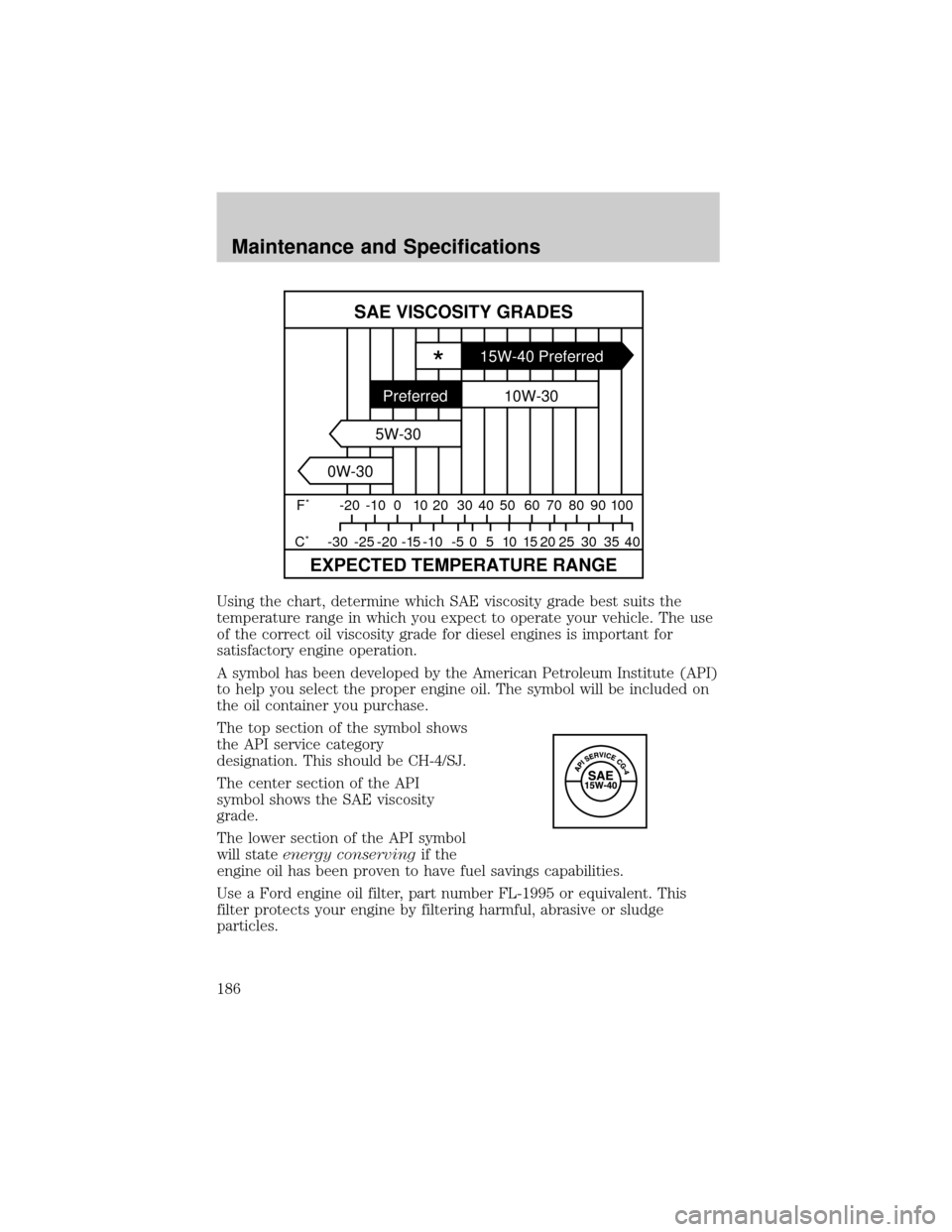
Using the chart, determine which SAE viscosity grade best suits the
temperature range in which you expect to operate your vehicle. The use
of the correct oil viscosity grade for diesel engines is important for
satisfactory engine operation.
A symbol has been developed by the American Petroleum Institute (API)
to help you select the proper engine oil. The symbol will be included on
the oil container you purchase.
The top section of the symbol shows
the API service category
designation. This should be CH-4/SJ.
The center section of the API
symbol shows the SAE viscosity
grade.
The lower section of the API symbol
will stateenergy conservingif the
engine oil has been proven to have fuel savings capabilities.
Use a Ford engine oil filter, part number FL-1995 or equivalent. This
filter protects your engine by filtering harmful, abrasive or sludge
particles.
SAE VISCOSITY GRADES
EXPECTED TEMPERATURE RANGE
F˚ -20 -10 0 10 20 30 40
40 35 30 25 20 15 10 5 0 -5 -10 -15 -20 -25 -30 C˚50 60 70 80 90 100
*15W-40 Preferred
10W-30
5W-30
0W-30Preferred
Maintenance and Specifications
186
Page 189 of 256
Keep batteries out of reach of children. Batteries contain sulfuric
acid. Avoid contact with skin, eyes or clothing. Shield your eyes
when working near the battery to protect against possible splashing of
acid solution. In case of acid contact with skin or eyes, flush
immediately with water for a minimum of 15 minutes and get prompt
medical attention. If acid is swallowed, call a physician immediately.
Battery posts, terminals and related accessories contain lead and
lead compounds. Wash hands after handling.
ENGINE COOLANT
Checking engine coolant
The concentration and level of engine coolant should be checked at the
mileage intervals listed in the scheduled maintenance guide. The coolant
concentration should be maintained at 50/50 coolant and water, which
equates to a freeze point of -36É C (-34É F). Coolant concentration
testing is possible with a hydrometer or antifreeze tester (such as the
Rotunda Battery and Antifreeze Tester, 014±R1060). The level of coolant
should be maintained at the ªcold fullº of ªcold fill rangeº level in the
coolant reservoir. If the level falls below, add coolant per the instructions
in theAdding Engine Coolantsection.
Your vehicle was factory-filled with a 50/50 engine coolant and water
concentration. If the concentration of coolant falls below 40% or above
60%, the engine parts could become damaged or not work properly.A
50±50 mixture of coolant and water provides the following:
²freeze protection down to -36É C (-34É F).
²boiling protection up to 129É C (265É F).
²protection against rust and other forms of corrosion.
²enables calibrated guages to work properly.
When the engine is cold, check the level of the engine coolant in the
reservoir.
Maintenance and Specifications
189
Page 193 of 256
necessary, add enough 50/50 concentration of engine coolant and
distilled water to bring the liquid level to the proper level.
If you have to add more than 1.0 liter (1.0 quart) of engine coolant per
month, have your dealer check the engine cooling system. Your cooling
system may have a leak. Operating an engine with a low level of coolant
can result in engine overheating and possible engine damage.
Replacing coolant
A coolant mixture of 50% coolant concentrate and 50% water is
recommended to maintain best overall performance. To avoid damaging
the engine and radiator, the coolant concentrate should not exceed 60%.
When refilling the coolant system either as part of the regular
maintenance (refer to the scheduled maintenance guide), or due to
service performed, adhere to the following instructions:
1. Drain and flush the cooling system to remove dirt deposits, oil, rust
particles.
Note:When filling the system with Motorcraft Premium Engine Coolant
(green-colored) or equivalent meeting Ford specification
ESE-M97B44±A, a supplemental coolant additive is required. Refer to
Adding Coolantsection to determine the coolant type in your vehicle.
Add 1.89L (4 pints) of Motorcraft Heavy Duty Cooling System Additive
FW-16 or equivalent meeting Ford specification ESN-M99B169±A,
directly to the cooling system. An additional 237±295 ml (8±10 oz.) of
supplemental coolant additive FW-16 should be added at 24 000 km (15
000 mile) intervals to maintain proper concentration.Do not use this
additive with yellow-colored coolant meeting Ford specification
WSS-M97B51±A1.
2. Fill the coolant reservoir with the specified coolant/water mixture until
the level stabilizes at the top hose fitting. Replace and tighten cap. Fill
the coolant bottle to the cold fill mark.
3. Reinstall the coolant bottle cap.
4. Start and idle engine until the radiator upper hose is warm
(approximately 10±15 minutes). If the hose does not get warm then
repeat at a higher engine speed.
5. Immediately shut off engine. Cautiously remove coolant bottle cap and
add coolant to Cold Fill mark.
Maintenance and Specifications
193
Page 197 of 256
²Fuels can also be harmful if absorbed through the skin. If fuel is
splashed on the skin and/or clothing, promptly remove contaminated
clothing and wash skin thoroughly with soap and water. Repeated or
prolonged skin contact with fuel liquid or vapor causes skin irritation.
If you must replace the fuel filler cap, replace it with a genuine
Ford or Motorcraft part. The customer warranty may be void for
any damage to the fuel tank or fuel system if a genuine Ford or
Motorcraft fuel filler cap is not used.
If you do not use the proper fuel filler cap, excessive pressure or
vacuum in the fuel tank may damage the fuel system or cause
the fuel system to work improperly in a collision, which may result in
possible personal injury.
Choosing the right fuel
At operating temperatures below 0ÉC (32ÉF), use a blend of No. 1D and
No. 2D Diesel fuels, also known as winterized No. 2D.
Do not use diesel fuel blended with waste oil in engines equipped with a
catalytic converter-muffler. Blending waste oil in with the fuel will plug
the catalytic converter-muffler, resulting in a significant loss of engine
power. Your emissions warranty will be voided if blending waste oil with
diesel fuel is practiced.
Use low sulfur (less than 0.05% by weight) fuel as required by the EPA
for emission compliance.
Do not mix diesel fuel with gasoline, gasohol or alcohol. This
could cause an explosion resulting in personal injury.
Do not use starting fluid such as ether or gasoline. Such fluids
can cause immediate explosive damage to the engine and
possible personal injury.
Maintenance and Specifications
197