steering wheel FORD F750 2008 11.G Owners Manual
[x] Cancel search | Manufacturer: FORD, Model Year: 2008, Model line: F750, Model: FORD F750 2008 11.GPages: 273, PDF Size: 1.71 MB
Page 2 of 273
Introduction 4
Safety and environment protection 5
Vehicle Inspection Guide 11
Instrument Cluster 21
Warning lights and chimes 21
Gauges 27
Entertainment Systems 32
AM/FM stereo 32
AM/FM stereo with in-dash six CD 38
Climate Controls 44
Heater only 44
Manual heating and air conditioning 45
Lights 47
Headlamps 47
Turn signal control 48
Interior lamps 49
Bulb replacement 49
Driver Controls 52
Windshield wiper/washer control 52
Steering wheel adjustment 52
Power windows 53
Mirrors 55
Speed control 57
Locks and Security 61
Keys 61
Locks 61
Table of Contents
1
2008 F-650/750(f67)
Supplement
USA(fus)
Page 7 of 273
SPECIAL NOTICES
Emission warranty
The New Truck Limited Warranty includes Basic Coverage, Corrosion
Coverage, Frame Coverage, Federal Emissions Defect Warranty and
California Defects Warranty. For a detailed description of what is covered
and what is not covered, refer to theWarranty Guidethat is provided
to you along with yourOwner’s Guide.
Special instructions
For your added safety, your vehicle is fitted with sophisticated electronic
controls.
Service Data Recording
Service data recorders in your vehicle are capable of collecting and
storing diagnostic information about your vehicle. This potentially
includes information about the performance or status of various systems
and modules in the vehicle, such as engine, throttle, steering or brake
systems. In order to properly diagnose and service your vehicle, Ford
Motor Company, Ford of Canada, and service and repair facilities may
access vehicle diagnostic information through a direct connection to your
vehicle when diagnosing or servicing your vehicle.
Event Data Recording
Other modules in your vehicle - event data recorders - are capable of
collecting and storing data during a crash or near crash event. The
recorded information may assist in the investigation of such an event.
The modules may record information about both the vehicle and the
occupants, potentially including information such as:
•how various systems in your vehicle were operating;
•whether or not the driver and passenger seatbelts were buckled;
•how far (if at all) the driver was depressing the accelerator and/or the
brake pedal;
•how fast the vehicle was traveling; and
•where the driver was positioning the steering wheel.
2008 F-650/750(f67)
Supplement
USA(fus)
Introduction
6
Page 14 of 273
Engine starting (parking brake applied)
Starting the engine:Verify the parking brake is set. Depress the
clutch (if equipped with a manual
transmission) and verify the transmission is in
neutral. Vehicles equipped with an automatic
transmission should be in N (Neutral) or P
(Park) if equipped with a Park position.
When the WAIT TO START indicator light in
the instrument cluster turns off, turn the key
to START.
Oil pressure builds:Make sure engine oil pressure is building to
normal operating range.
Air chime sounds (if
equipped with air
compressor):The low air pressure warning chime should
sound immediately after the engine starts but
before the compressor has built up pressure.
The low air pressure warning chime should
stop when the air pressure reaches 70 psi
(483 kPa) (or more). Let the air pressure
build to governed cut-out pressure, which
should occur between 115–130 psi
(793–896 kPa).
Accelerator:Depress the accelerator and verify that it
operates smoothly without any binding or
irregular feel. Remove your foot from the
pedal and make sure the engine returns to idle
speed immediately.
Ammeter/Voltmeter:Check the gauge to see if the alternator is
charging.
Steering linkage
free play:Check for excessive free play in the steering
linkages. The steering wheel should have less
than two inches (five cm) of free play at rim
of steering wheel.
Hydraulic brake
check:When the engine is off, the pump will turn on
if the brake pedal is applied, or if the ignition
is turned to the ON position.
2008 F-650/750(f67)
Supplement
USA(fus)
Vehicle Inspection Guide
13
Page 18 of 273
If a wheel must be changed, obtain expert tire service help.
Mounting and un-mounting of tires should only be performed by
a qualified technician using necessary safety procedures and
equipment, otherwise the result could be property damage, personal
injury or death.
Driver/Fuel area
Fuel tank:Make sure the fuel tank and caps are secure.
Make sure there is no damage to the tank.
Leaks:Check for any leaks from the fuel tanks.
Underbody of vehicle
Driveshaft:Make sure that the driveshaft is not bent or
cracked. Ensure all driveshaft couplings are
secure.
Exhaust system:Make sure the outside visible parts are
securely mounted. Make sure there are no
cracks, holes or severe dents.
Frame:Check for cracks or bends in longitudinal
frame members. Make sure there are no loose,
cracked, bent, broken or missing
crossmembers or crossmember fasteners.
Maintain adequate clearance between all parts of the exhaust
system and all hoses, wires and lines for engine cooling, brake
system, fuel system, power steering system and electrical system, Heat
damage to hoses, wires or lines may cause vehicle malfunction that
could result in property damage, personal injury or death.
2008 F-650/750(f67)
Supplement
USA(fus)
Vehicle Inspection Guide
17
Page 23 of 273
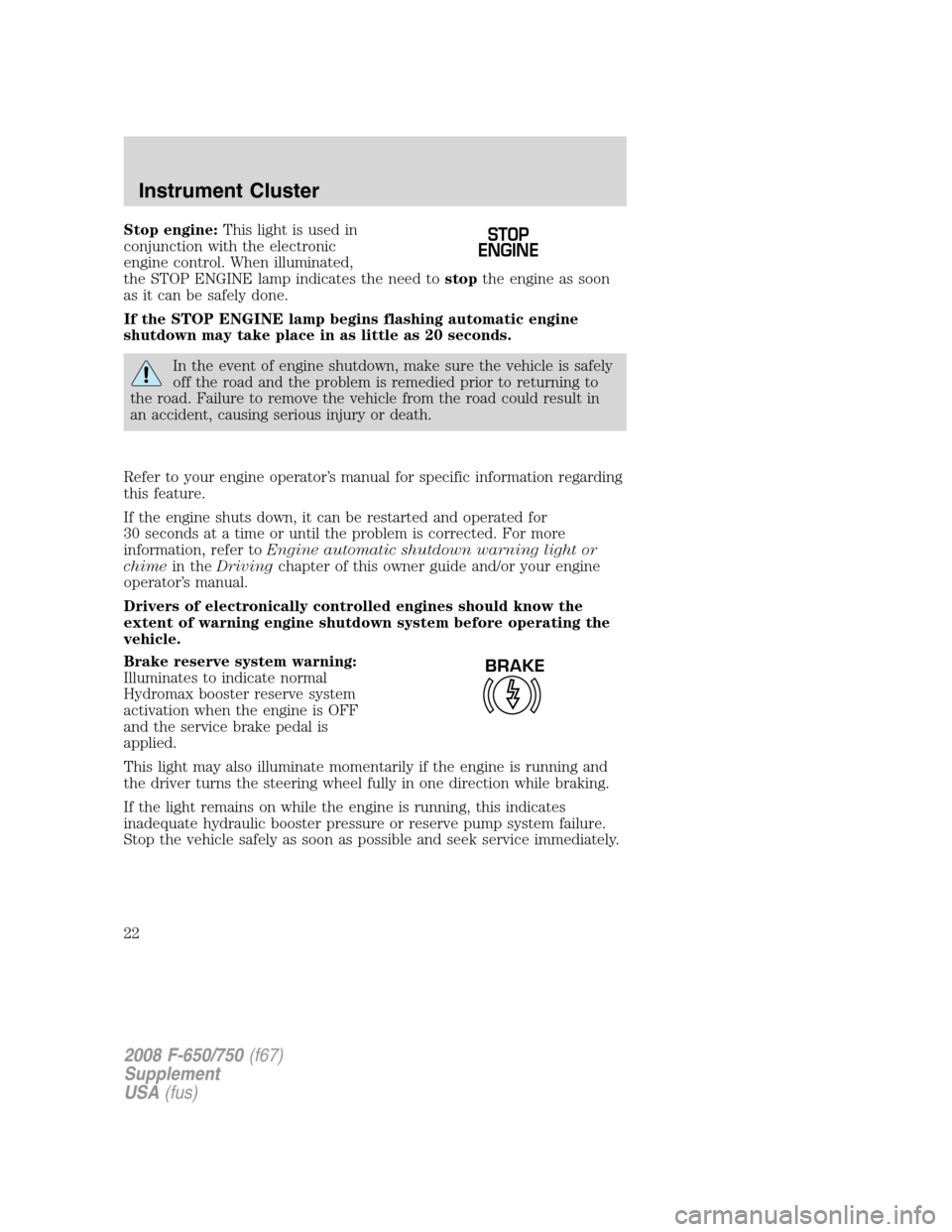
Stop engine:This light is used in
conjunction with the electronic
engine control. When illuminated,
the STOP ENGINE lamp indicates the need tostopthe engine as soon
as it can be safely done.
If the STOP ENGINE lamp begins flashing automatic engine
shutdown may take place in as little as 20 seconds.
In the event of engine shutdown, make sure the vehicle is safely
off the road and the problem is remedied prior to returning to
the road. Failure to remove the vehicle from the road could result in
an accident, causing serious injury or death.
Refer to your engine operator’s manual for specific information regarding
this feature.
If the engine shuts down, it can be restarted and operated for
30 seconds at a time or until the problem is corrected. For more
information, refer toEngine automatic shutdown warning light or
chimein theDrivingchapter of this owner guide and/or your engine
operator’s manual.
Drivers of electronically controlled engines should know the
extent of warning engine shutdown system before operating the
vehicle.
Brake reserve system warning:
Illuminates to indicate normal
Hydromax booster reserve system
activation when the engine is OFF
and the service brake pedal is
applied.
This light may also illuminate momentarily if the engine is running and
the driver turns the steering wheel fully in one direction while braking.
If the light remains on while the engine is running, this indicates
inadequate hydraulic booster pressure or reserve pump system failure.
Stop the vehicle safely as soon as possible and seek service immediately.
STOP
ENGINE
BRAKE
2008 F-650/750(f67)
Supplement
USA(fus)
Instrument Cluster
22
Page 53 of 273
MULTI-FUNCTION LEVER
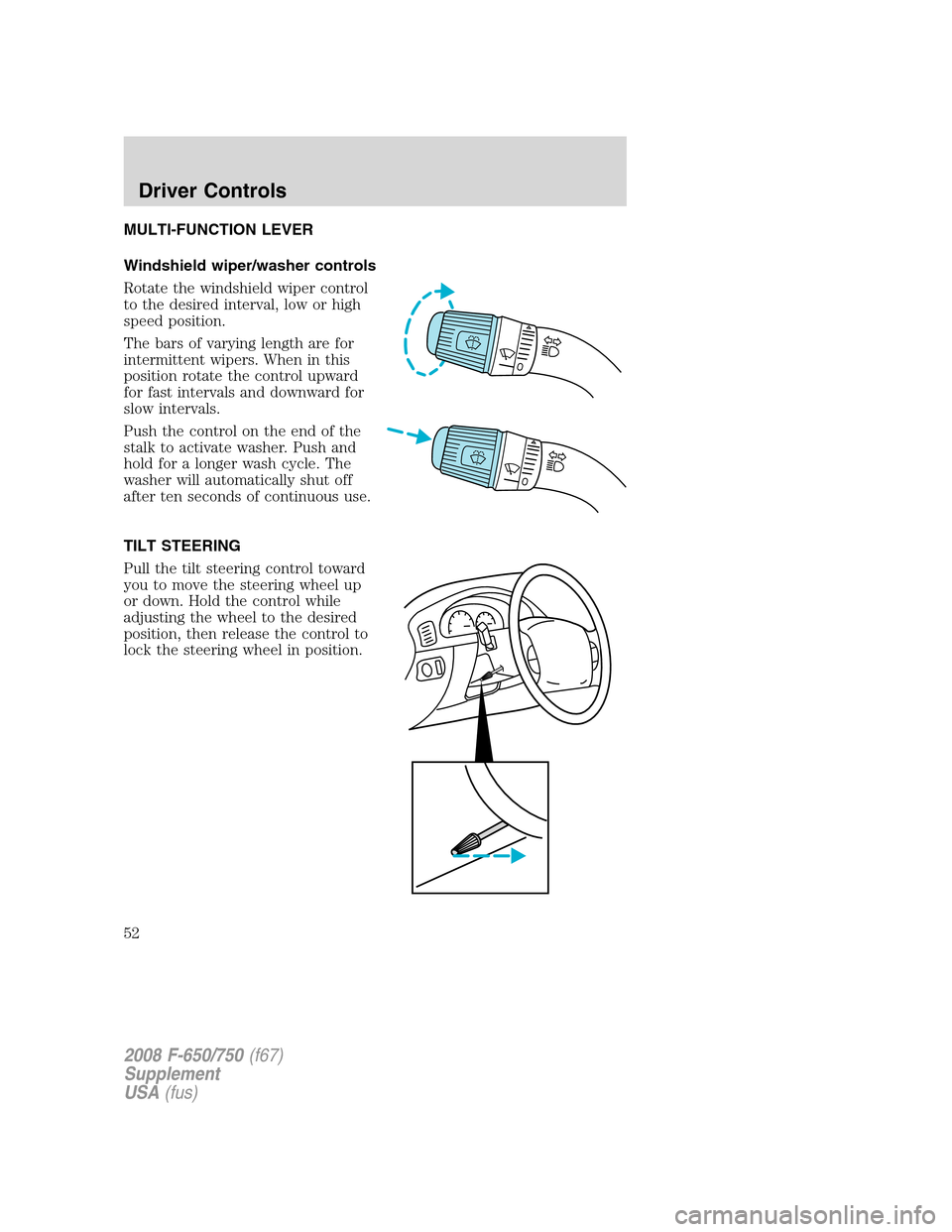
Windshield wiper/washer controls
Rotate the windshield wiper control
to the desired interval, low or high
speed position.
The bars of varying length are for
intermittent wipers. When in this
position rotate the control upward
for fast intervals and downward for
slow intervals.
Push the control on the end of the
stalk to activate washer. Push and
hold for a longer wash cycle. The
washer will automatically shut off
after ten seconds of continuous use.
TILT STEERING
Pull the tilt steering control toward
you to move the steering wheel up
or down. Hold the control while
adjusting the wheel to the desired
position, then release the control to
lock the steering wheel in position.
2008 F-650/750(f67)
Supplement
USA(fus)
Driver Controls
52
Page 54 of 273
Never adjust the steering wheel when the vehicle is moving.
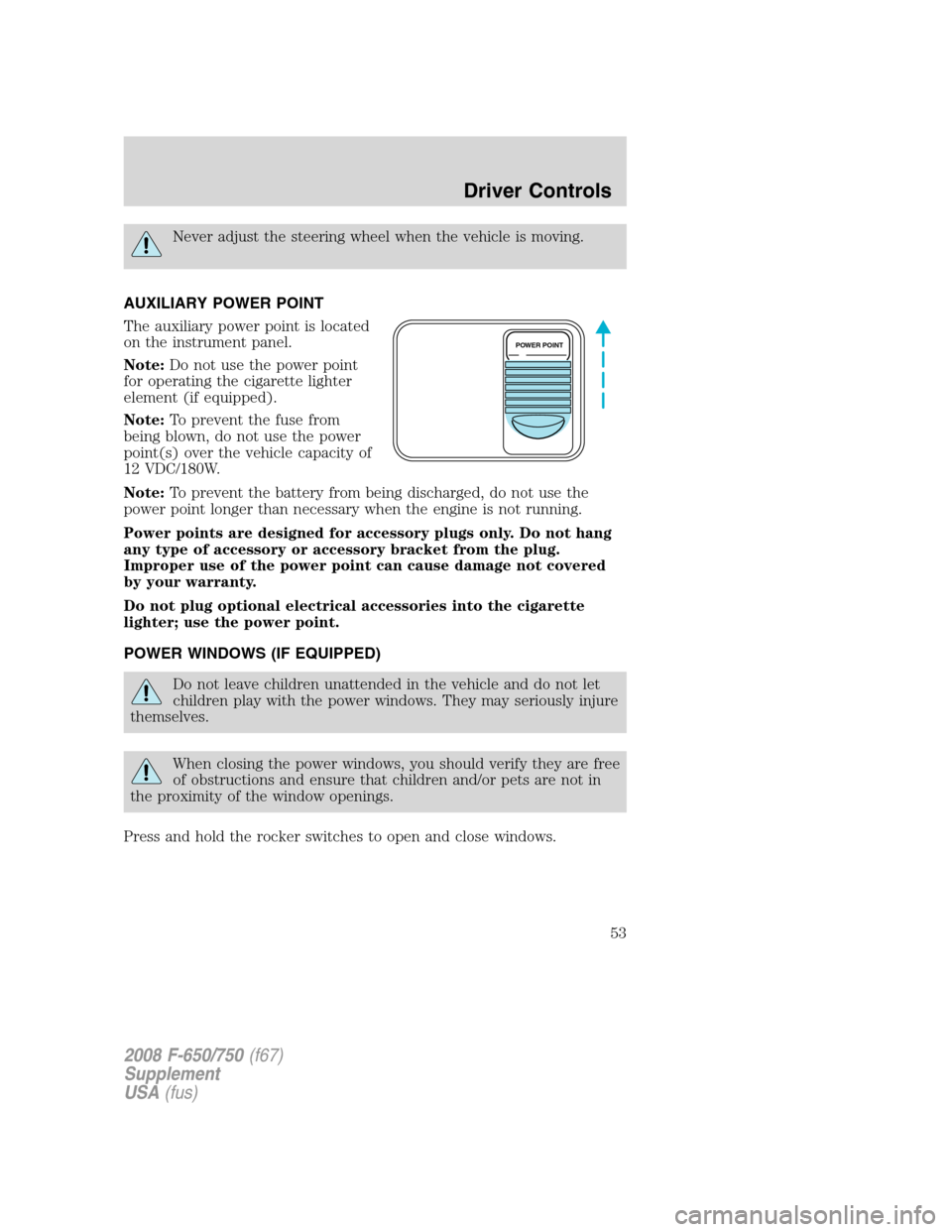
AUXILIARY POWER POINT
The auxiliary power point is located
on the instrument panel.
Note:Do not use the power point
for operating the cigarette lighter
element (if equipped).
Note:To prevent the fuse from
being blown, do not use the power
point(s) over the vehicle capacity of
12 VDC/180W.
Note:To prevent the battery from being discharged, do not use the
power point longer than necessary when the engine is not running.
Power points are designed for accessory plugs only. Do not hang
any type of accessory or accessory bracket from the plug.
Improper use of the power point can cause damage not covered
by your warranty.
Do not plug optional electrical accessories into the cigarette
lighter; use the power point.
POWER WINDOWS (IF EQUIPPED)
Do not leave children unattended in the vehicle and do not let
children play with the power windows. They may seriously injure
themselves.
When closing the power windows, you should verify they are free
of obstructions and ensure that children and/or pets are not in
the proximity of the window openings.
Press and hold the rocker switches to open and close windows.
POWER POINT
2008 F-650/750(f67)
Supplement
USA(fus)
Driver Controls
53
Page 86 of 273
STARTING
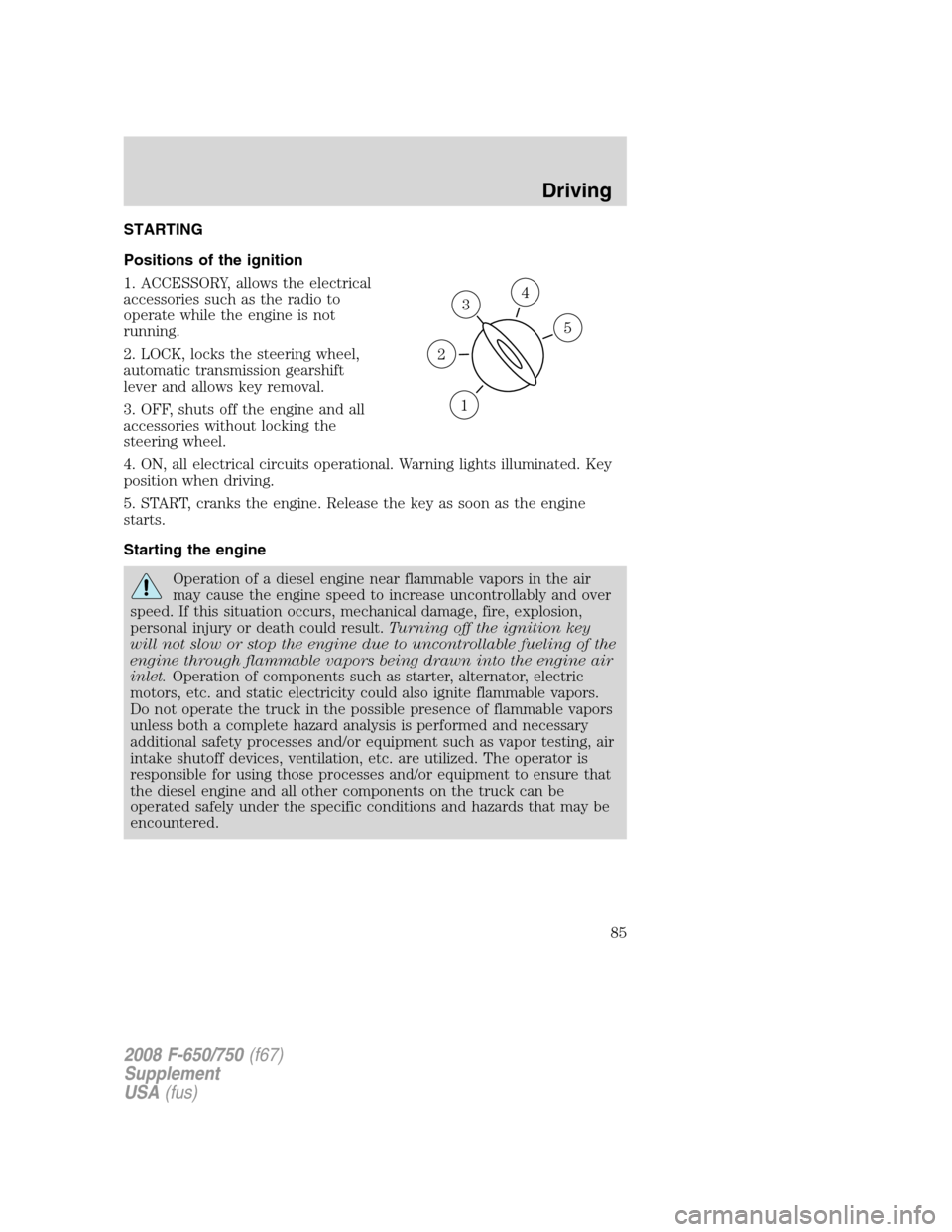
Positions of the ignition
1. ACCESSORY, allows the electrical
accessories such as the radio to
operate while the engine is not
running.
2. LOCK, locks the steering wheel,
automatic transmission gearshift
lever and allows key removal.
3. OFF, shuts off the engine and all
accessories without locking the
steering wheel.
4. ON, all electrical circuits operational. Warning lights illuminated. Key
position when driving.
5. START, cranks the engine. Release the key as soon as the engine
starts.
Starting the engine
Operation of a diesel engine near flammable vapors in the air
may cause the engine speed to increase uncontrollably and over
speed. If this situation occurs, mechanical damage, fire, explosion,
personal injury or death could result.Turning off the ignition key
will not slow or stop the engine due to uncontrollable fueling of the
engine through flammable vapors being drawn into the engine air
inlet.Operation of components such as starter, alternator, electric
motors, etc. and static electricity could also ignite flammable vapors.
Do not operate the truck in the possible presence of flammable vapors
unless both a complete hazard analysis is performed and necessary
additional safety processes and/or equipment such as vapor testing, air
intake shutoff devices, ventilation, etc. are utilized. The operator is
responsible for using those processes and/or equipment to ensure that
the diesel engine and all other components on the truck can be
operated safely under the specific conditions and hazards that may be
encountered.
3
1
2
5
4
2008 F-650/750(f67)
Supplement
USA(fus)
Driving
85
Page 112 of 273
ANTI-LOCK BRAKE SYSTEM (ABS)
A noise from the hydraulic pump motor and pulsation in the pedal may
be observed during ABS braking events. Pedal pulsation coupled with
noise while braking under panic conditions or on loose gravel, bumps,
wet or snowy roads is normal and indicates proper functioning of the
vehicle’s ABS. If the vehicle has continuous vibration or shudder in the
steering wheel while braking, the vehicle should be inspected by a
qualified service technician.
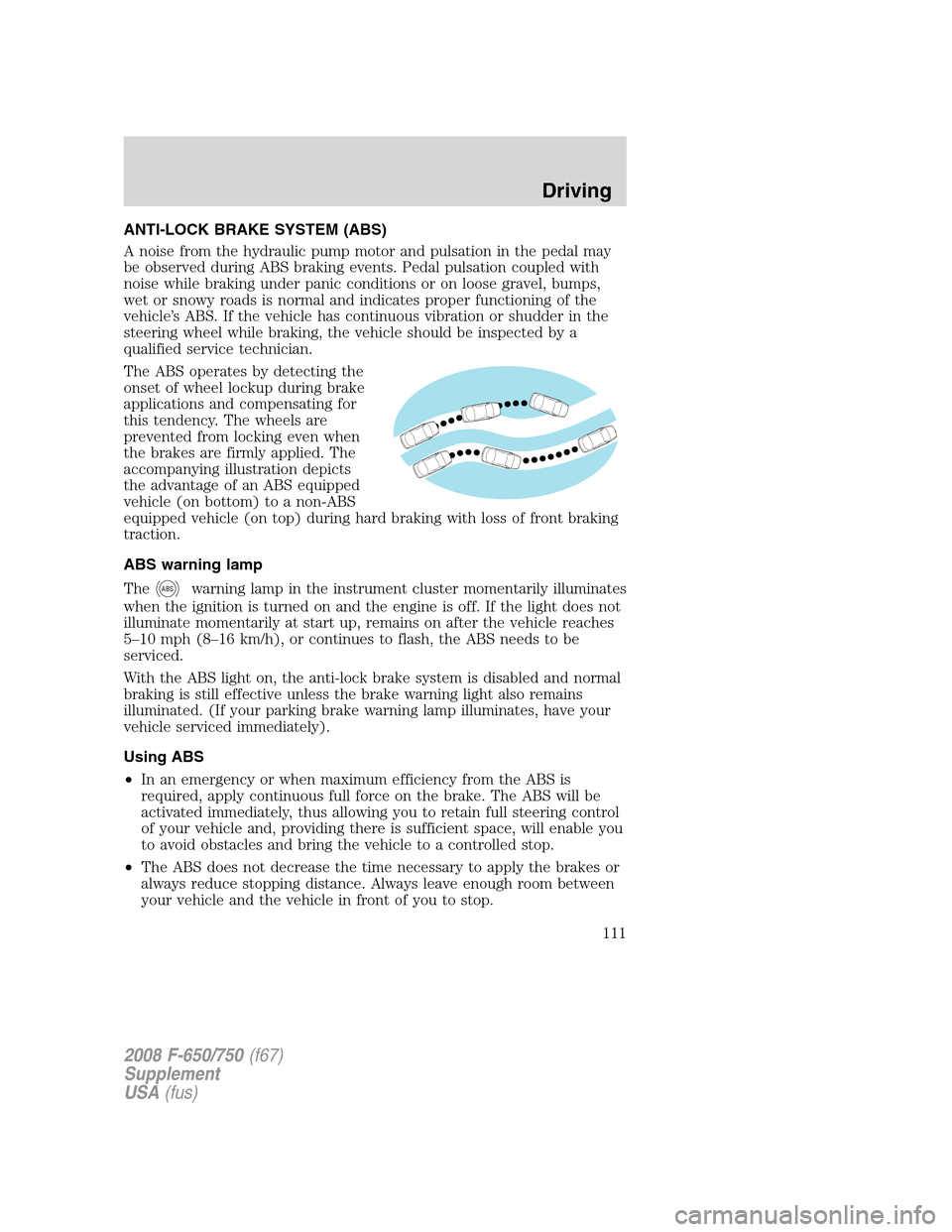
The ABS operates by detecting the
onset of wheel lockup during brake
applications and compensating for
this tendency. The wheels are
prevented from locking even when
the brakes are firmly applied. The
accompanying illustration depicts
the advantage of an ABS equipped
vehicle (on bottom) to a non-ABS
equipped vehicle (on top) during hard braking with loss of front braking
traction.
ABS warning lamp
The
ABSwarning lamp in the instrument cluster momentarily illuminates
when the ignition is turned on and the engine is off. If the light does not
illuminate momentarily at start up, remains on after the vehicle reaches
5–10 mph (8–16 km/h), or continues to flash, the ABS needs to be
serviced.
With the ABS light on, the anti-lock brake system is disabled and normal
braking is still effective unless the brake warning light also remains
illuminated. (If your parking brake warning lamp illuminates, have your
vehicle serviced immediately).
Using ABS
•In an emergency or when maximum efficiency from the ABS is
required, apply continuous full force on the brake. The ABS will be
activated immediately, thus allowing you to retain full steering control
of your vehicle and, providing there is sufficient space, will enable you
to avoid obstacles and bring the vehicle to a controlled stop.
•The ABS does not decrease the time necessary to apply the brakes or
always reduce stopping distance. Always leave enough room between
your vehicle and the vehicle in front of you to stop.
2008 F-650/750(f67)
Supplement
USA(fus)
Driving
111
Page 115 of 273
Tractor-trailer connections
To reduce the risk of personal injury, use extreme caution when
making brake and light connections. Inclement weather and
accumulated road contamination deposits on handhold and stepping
surfaces require extra care to avoid slip and falls. Provide adequate
lighting of working areas.
Do not climb on the back of the tractor unless it has been
provided with a deck plate and handholds. Use a three-point
stance when climbing up and down from a deck plate. Do not jump
from the vehicle. Whenever possible, make all connections while
standing on the ground.
Connecting and disconnecting a trailer with air suspension
When connecting to a trailer:
•Press the lower portion of the switch and air will exhaust from the air
suspension system.
•After making the connection to the trailer, press the upper portion of
the switch, then raise the landing gear.
When disconnecting the trailer:
•Lower the landing gear, then press the lower portion of the switch.
•Disconnect the brake hoses, trailer-side and rear light connectors,
then pull the release lever on the fifth wheel.
The upper portion of the switch must be pressed before operating with a
trailer or operating in the bobtail mode.
Suspension conversions
It is not recommended, or approved, that suspension conversions be
performed. However, it is understood that, on occasion, aftermarket
add-on suspensions are installed by others on the truck chassis which
allow operator control for weight transfer from other axles (i.e., air lift
axles).
When operating a loaded vehicle, the driver must keep all
adjustable axles on the ground at all times, supporting their
share of the vehicle’s load. Failure to do so can overload other axles,
tires, wheels, springs, steering components, brakes and frames,
resulting in early component failure, loss of vehicle control, possible
property damage and personal injury.
2008 F-650/750(f67)
Supplement
USA(fus)
Driving
114