tire pressure FORD F750 2011 12.G User Guide
[x] Cancel search | Manufacturer: FORD, Model Year: 2011, Model line: F750, Model: FORD F750 2011 12.GPages: 290, PDF Size: 1.96 MB
Page 235 of 290
Wear
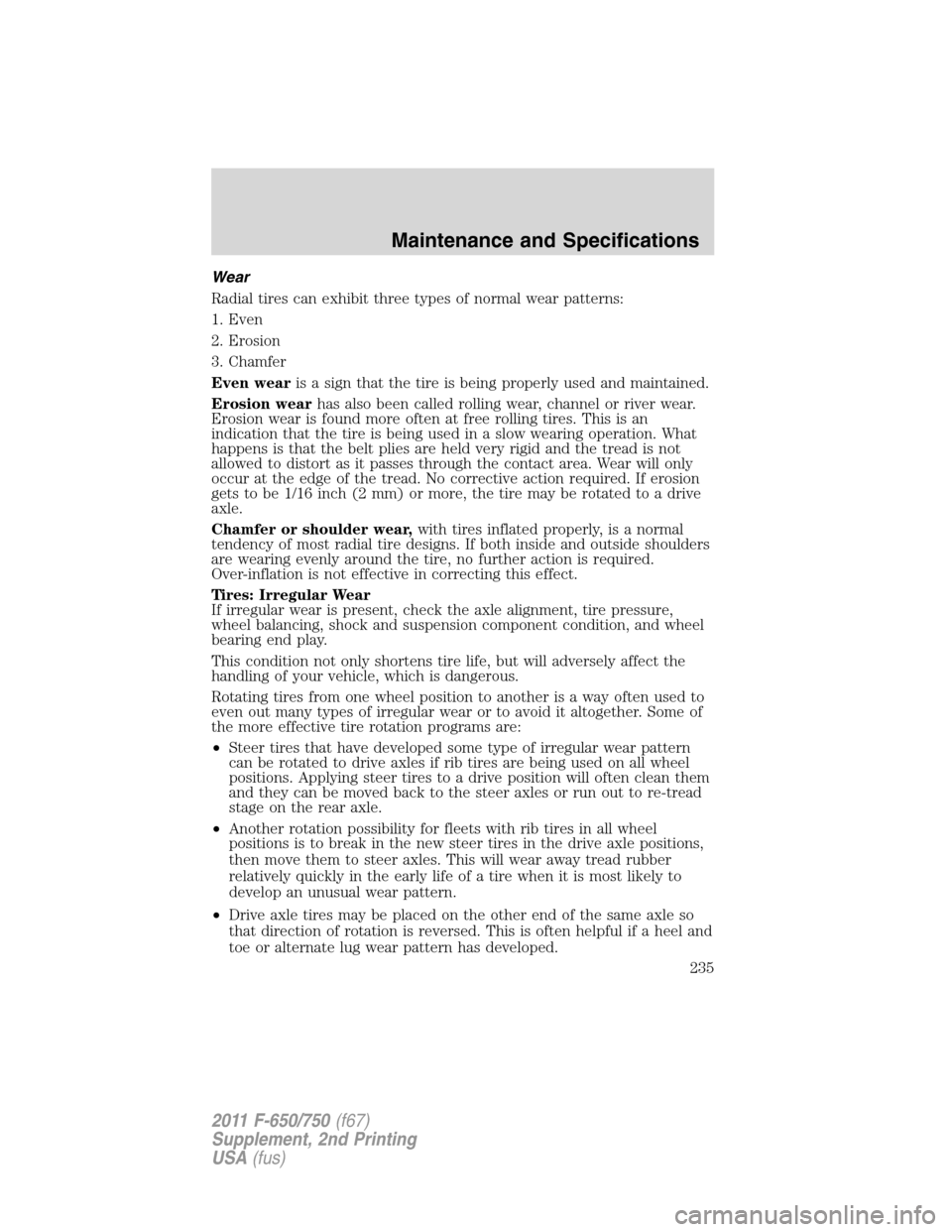
Radial tires can exhibit three types of normal wear patterns:
1. Even
2. Erosion
3. Chamfer
Even wearis a sign that the tire is being properly used and maintained.
Erosion wearhas also been called rolling wear, channel or river wear.
Erosion wear is found more often at free rolling tires. This is an
indication that the tire is being used in a slow wearing operation. What
happens is that the belt plies are held very rigid and the tread is not
allowed to distort as it passes through the contact area. Wear will only
occur at the edge of the tread. No corrective action required. If erosion
gets to be 1/16 inch (2 mm) or more, the tire may be rotated to a drive
axle.
Chamfer or shoulder wear,with tires inflated properly, is a normal
tendency of most radial tire designs. If both inside and outside shoulders
are wearing evenly around the tire, no further action is required.
Over-inflation is not effective in correcting this effect.
Tires: Irregular Wear
If irregular wear is present, check the axle alignment, tire pressure,
wheel balancing, shock and suspension component condition, and wheel
bearing end play.
This condition not only shortens tire life, but will adversely affect the
handling of your vehicle, which is dangerous.
Rotating tires from one wheel position to another is a way often used to
even out many types of irregular wear or to avoid it altogether. Some of
the more effective tire rotation programs are:
•Steer tires that have developed some type of irregular wear pattern
can be rotated to drive axles if rib tires are being used on all wheel
positions. Applying steer tires to a drive position will often clean them
and they can be moved back to the steer axles or run out to re-tread
stage on the rear axle.
•Another rotation possibility for fleets with rib tires in all wheel
positions is to break in the new steer tires in the drive axle positions,
then move them to steer axles. This will wear away tread rubber
relatively quickly in the early life of a tire when it is most likely to
develop an unusual wear pattern.
•Drive axle tires may be placed on the other end of the same axle so
that direction of rotation is reversed. This is often helpful if a heel and
toe or alternate lug wear pattern has developed.
Maintenance and Specifications
235
2011 F-650/750(f67)
Supplement, 2nd Printing
USA(fus)
Page 236 of 290
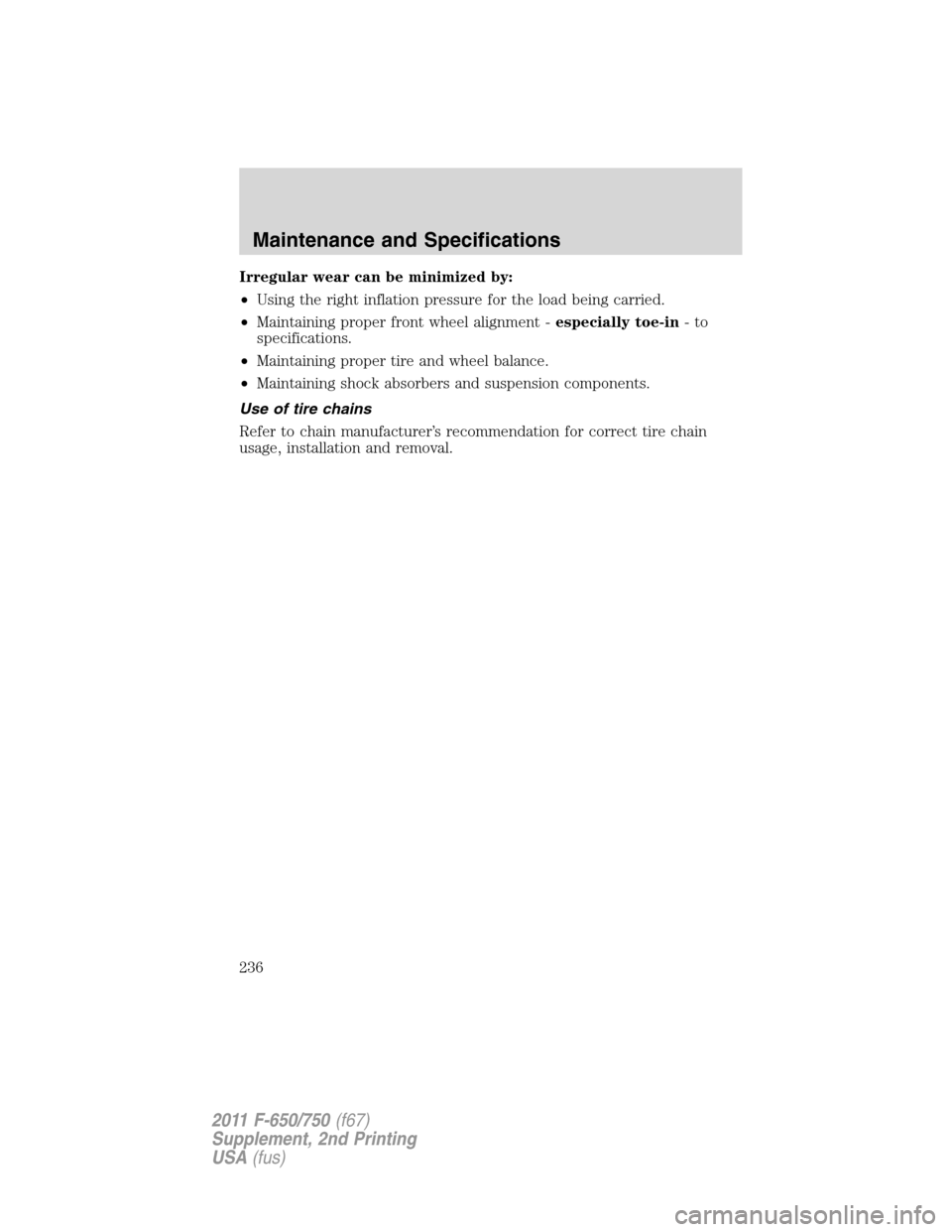
Irregular wear can be minimized by:
•Using the right inflation pressure for the load being carried.
•Maintaining proper front wheel alignment -especially toe-in-to
specifications.
•Maintaining proper tire and wheel balance.
•Maintaining shock absorbers and suspension components.
Use of tire chains
Refer to chain manufacturer’s recommendation for correct tire chain
usage, installation and removal.
Maintenance and Specifications
236
2011 F-650/750(f67)
Supplement, 2nd Printing
USA(fus)
Page 258 of 290
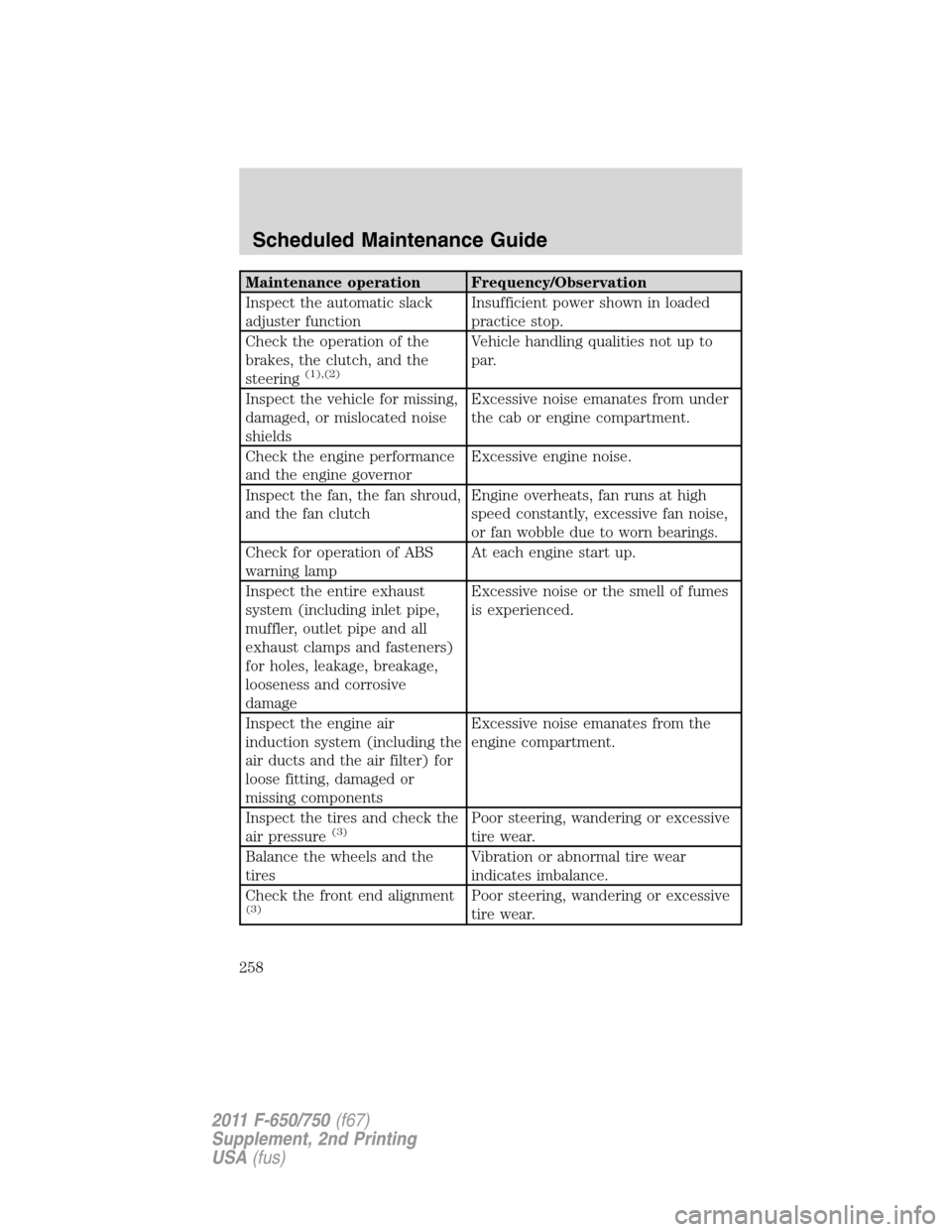
Maintenance operation Frequency/Observation
Inspect the automatic slack
adjuster functionInsufficient power shown in loaded
practice stop.
Check the operation of the
brakes, the clutch, and the
steering
(1),(2)
Vehicle handling qualities not up to
par.
Inspect the vehicle for missing,
damaged, or mislocated noise
shieldsExcessive noise emanates from under
the cab or engine compartment.
Check the engine performance
and the engine governorExcessive engine noise.
Inspect the fan, the fan shroud,
and the fan clutchEngine overheats, fan runs at high
speed constantly, excessive fan noise,
or fan wobble due to worn bearings.
Check for operation of ABS
warning lampAt each engine start up.
Inspect the entire exhaust
system (including inlet pipe,
muffler, outlet pipe and all
exhaust clamps and fasteners)
for holes, leakage, breakage,
looseness and corrosive
damageExcessive noise or the smell of fumes
is experienced.
Inspect the engine air
induction system (including the
air ducts and the air filter) for
loose fitting, damaged or
missing componentsExcessive noise emanates from the
engine compartment.
Inspect the tires and check the
air pressure
(3)Poor steering, wandering or excessive
tire wear.
Balance the wheels and the
tiresVibration or abnormal tire wear
indicates imbalance.
Check the front end alignment
(3)Poor steering, wandering or excessive
tire wear.
Scheduled Maintenance Guide
258
2011 F-650/750(f67)
Supplement, 2nd Printing
USA(fus)
Page 259 of 290
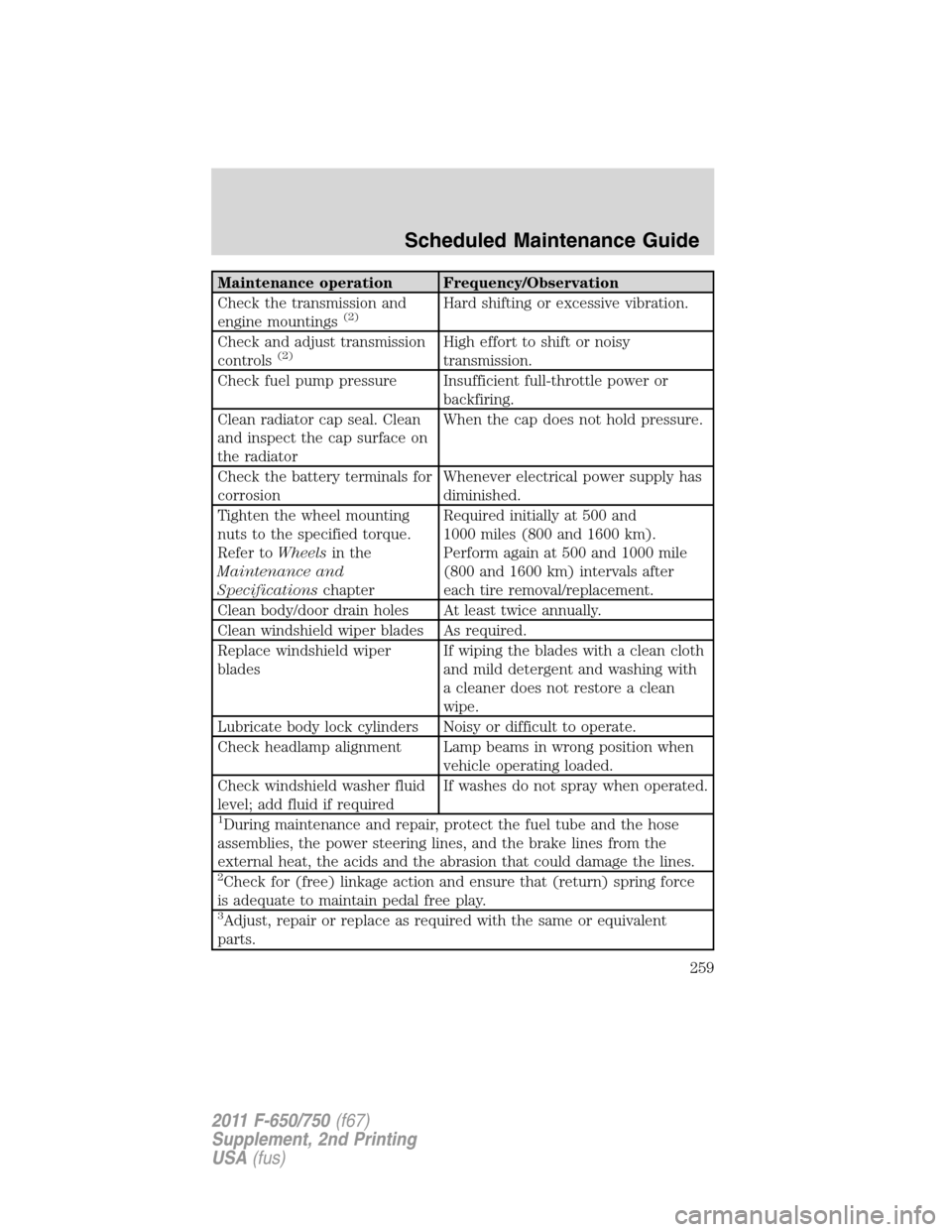
Maintenance operation Frequency/Observation
Check the transmission and
engine mountings
(2)Hard shifting or excessive vibration.
Check and adjust transmission
controls
(2)High effort to shift or noisy
transmission.
Check fuel pump pressure Insufficient full-throttle power or
backfiring.
Clean radiator cap seal. Clean
and inspect the cap surface on
the radiatorWhen the cap does not hold pressure.
Check the battery terminals for
corrosionWhenever electrical power supply has
diminished.
Tighten the wheel mounting
nuts to the specified torque.
Refer toWheelsin the
Maintenance and
SpecificationschapterRequired initially at 500 and
1000 miles (800 and 1600 km).
Perform again at 500 and 1000 mile
(800 and 1600 km) intervals after
each tire removal/replacement.
Clean body/door drain holes At least twice annually.
Clean windshield wiper blades As required.
Replace windshield wiper
bladesIf wiping the blades with a clean cloth
and mild detergent and washing with
a cleaner does not restore a clean
wipe.
Lubricate body lock cylinders Noisy or difficult to operate.
Check headlamp alignment Lamp beams in wrong position when
vehicle operating loaded.
Check windshield washer fluid
level; add fluid if requiredIf washes do not spray when operated.
1During maintenance and repair, protect the fuel tube and the hose
assemblies, the power steering lines, and the brake lines from the
external heat, the acids and the abrasion that could damage the lines.
2Check for (free) linkage action and ensure that (return) spring force
is adequate to maintain pedal free play.
3Adjust, repair or replace as required with the same or equivalent
parts.
Scheduled Maintenance Guide
259
2011 F-650/750(f67)
Supplement, 2nd Printing
USA(fus)