lock FORD F750 2012 12.G Owner's Manual
[x] Cancel search | Manufacturer: FORD, Model Year: 2012, Model line: F750, Model: FORD F750 2012 12.GPages: 306, PDF Size: 1.74 MB
Page 77 of 306
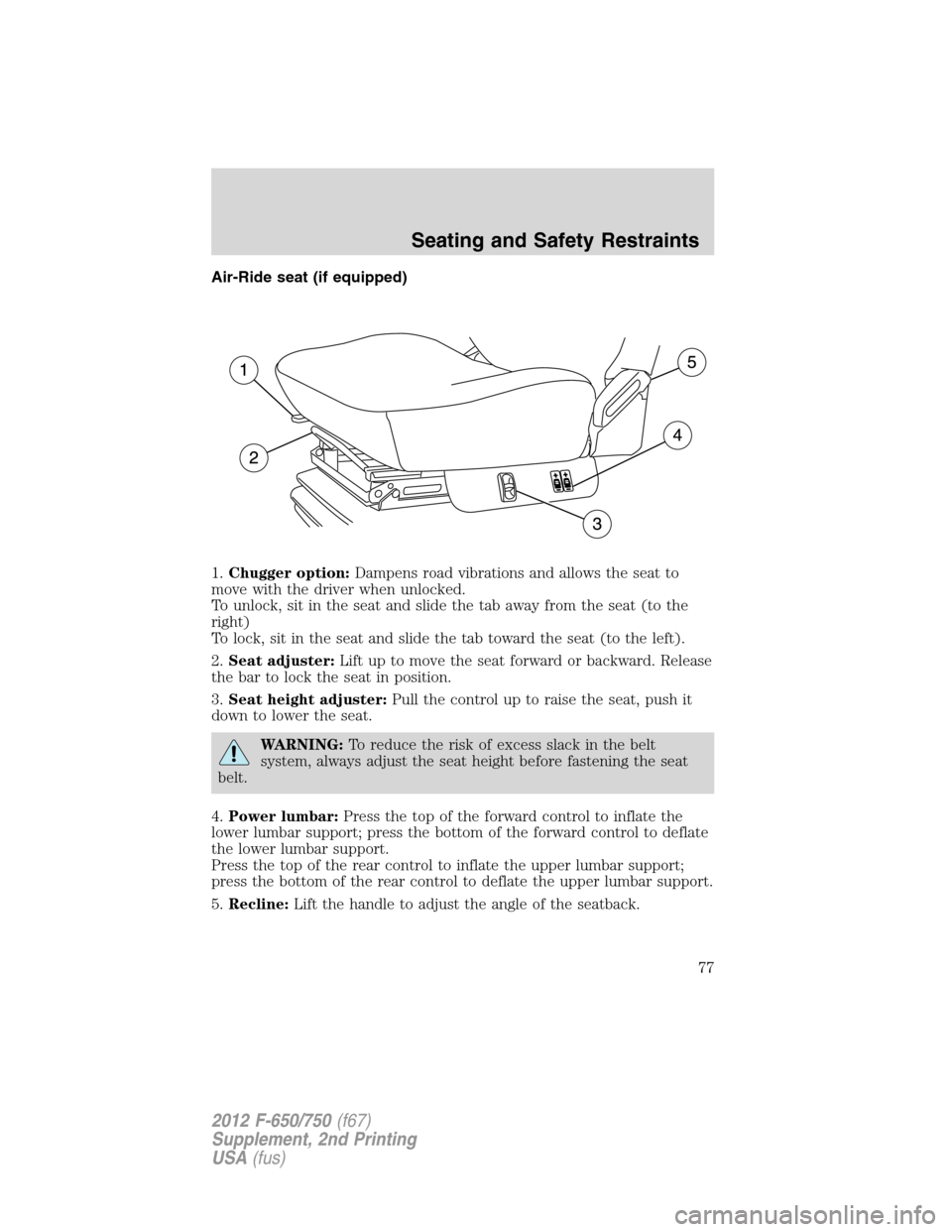
Air-Ride seat (if equipped)
1.Chugger option:Dampens road vibrations and allows the seat to
move with the driver when unlocked.
To unlock, sit in the seat and slide the tab away from the seat (to the
right)
To lock, sit in the seat and slide the tab toward the seat (to the left).
2.Seat adjuster:Lift up to move the seat forward or backward. Release
the bar to lock the seat in position.
3.Seat height adjuster:Pull the control up to raise the seat, push it
down to lower the seat.
WARNING:To reduce the risk of excess slack in the belt
system, always adjust the seat height before fastening the seat
belt.
4.Power lumbar:Press the top of the forward control to inflate the
lower lumbar support; press the bottom of the forward control to deflate
the lower lumbar support.
Press the top of the rear control to inflate the upper lumbar support;
press the bottom of the rear control to deflate the upper lumbar support.
5.Recline:Lift the handle to adjust the angle of the seatback.
Seating and Safety Restraints
77
2012 F-650/750(f67)
Supplement, 2nd Printing
USA(fus)
Page 78 of 306
REAR SEATS
Non-adjustable second-row head restraints
Your vehicle is equipped with second row outboard head restraints that
are non-adjustable.
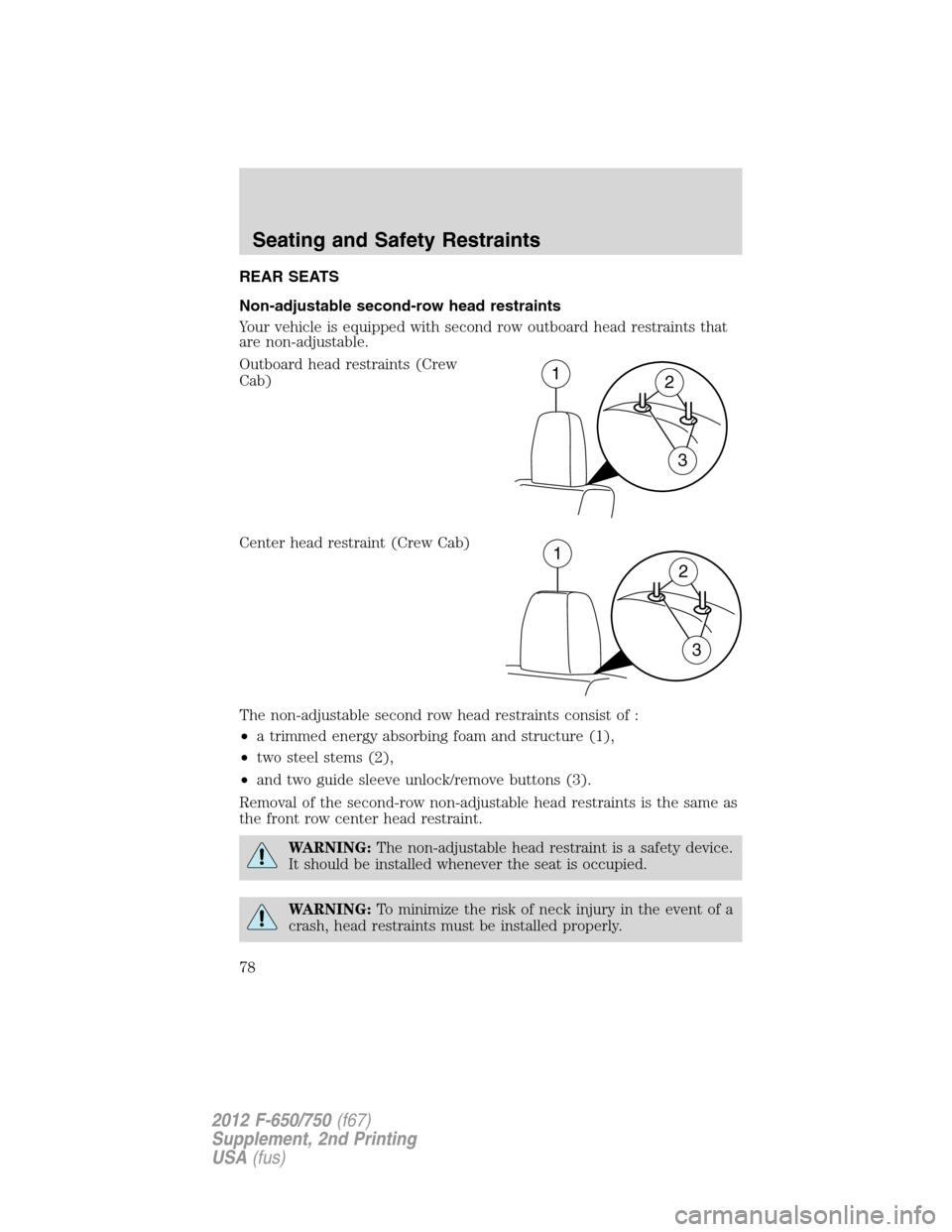
Outboard head restraints (Crew
Cab)
Center head restraint (Crew Cab)
The non-adjustable second row head restraints consist of :
•a trimmed energy absorbing foam and structure (1),
•two steel stems (2),
•and two guide sleeve unlock/remove buttons (3).
Removal of the second-row non-adjustable head restraints is the same as
the front row center head restraint.
WARNING:The non-adjustable head restraint is a safety device.
It should be installed whenever the seat is occupied.
WARNING:To minimize the risk of neck injury in the event of a
crash, head restraints must be installed properly.
12
3
1
2
3
Seating and Safety Restraints
78
2012 F-650/750(f67)
Supplement, 2nd Printing
USA(fus)
Page 79 of 306
Note:The SuperCab has rear outboard head restraints that are not
removable and are bolted to the back wall.
Rear flip-up seat (if equipped)
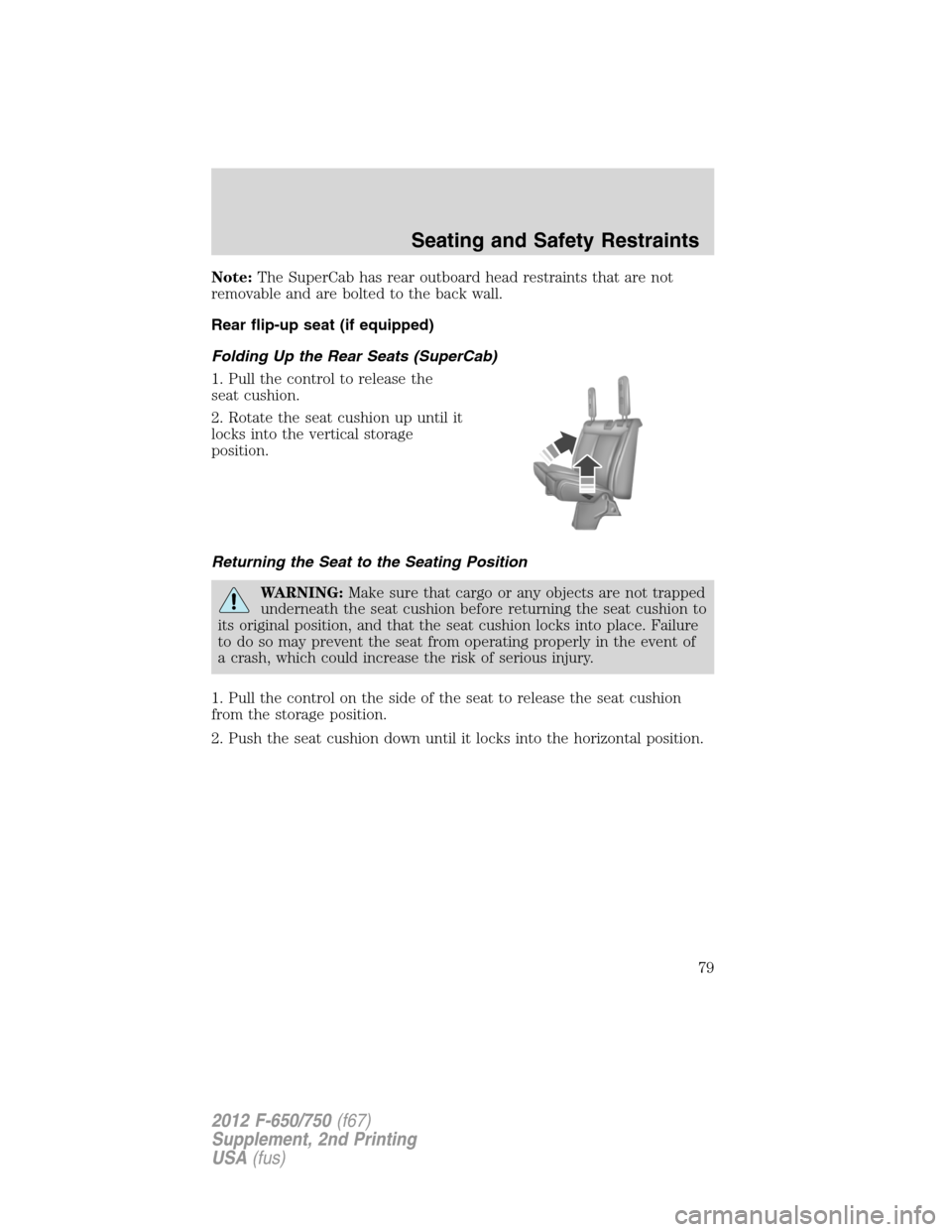
Folding Up the Rear Seats (SuperCab)
1. Pull the control to release the
seat cushion.
2. Rotate the seat cushion up until it
locks into the vertical storage
position.
Returning the Seat to the Seating Position
WARNING:Make sure that cargo or any objects are not trapped
underneath the seat cushion before returning the seat cushion to
its original position, and that the seat cushion locks into place. Failure
to do so may prevent the seat from operating properly in the event of
a crash, which could increase the risk of serious injury.
1. Pull the control on the side of the seat to release the seat cushion
from the storage position.
2. Push the seat cushion down until it locks into the horizontal position.
Seating and Safety Restraints
79
2012 F-650/750(f67)
Supplement, 2nd Printing
USA(fus)
Page 82 of 306
2. To unfasten, press the release
button and remove the tongue from
the buckle.
The front and rear outboard safety restraints in the vehicle are
combination lap and shoulder belts. The front and rear seat passenger
outboard safety belts have vehicle sensitive emergency locking retractors.
Restraint of pregnant women
WARNING:Always ride and drive with your seatback upright
and the safety belt properly fastened. The lap portion of the
safety belt should fit snug and be positioned low across the hips. The
shoulder portion of the safety belt should be positioned across the
chest. Pregnant women should also follow this practice. See figure
below.
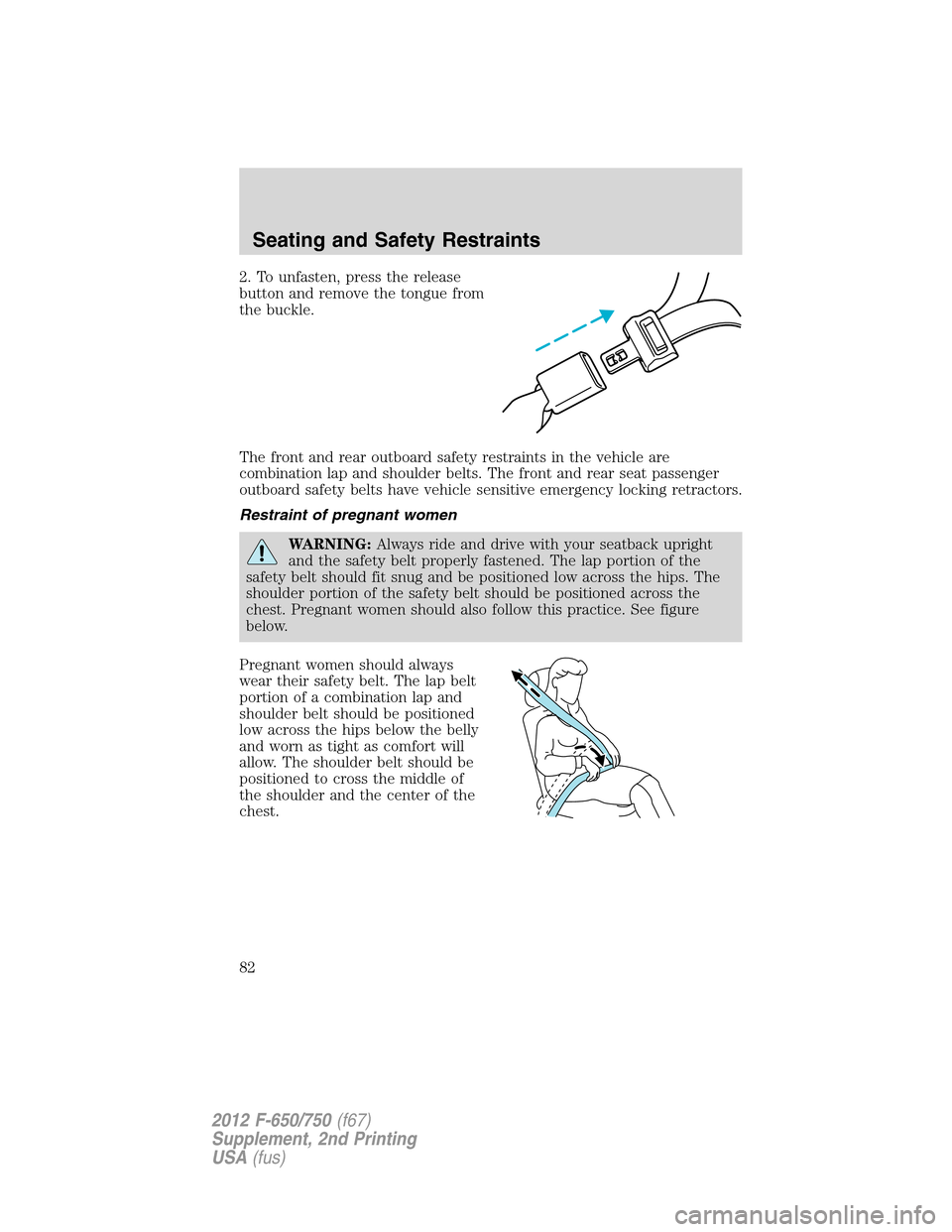
Pregnant women should always
wear their safety belt. The lap belt
portion of a combination lap and
shoulder belt should be positioned
low across the hips below the belly
and worn as tight as comfort will
allow. The shoulder belt should be
positioned to cross the middle of
the shoulder and the center of the
chest.
Seating and Safety Restraints
82
2012 F-650/750(f67)
Supplement, 2nd Printing
USA(fus)
Page 83 of 306
Lap belts
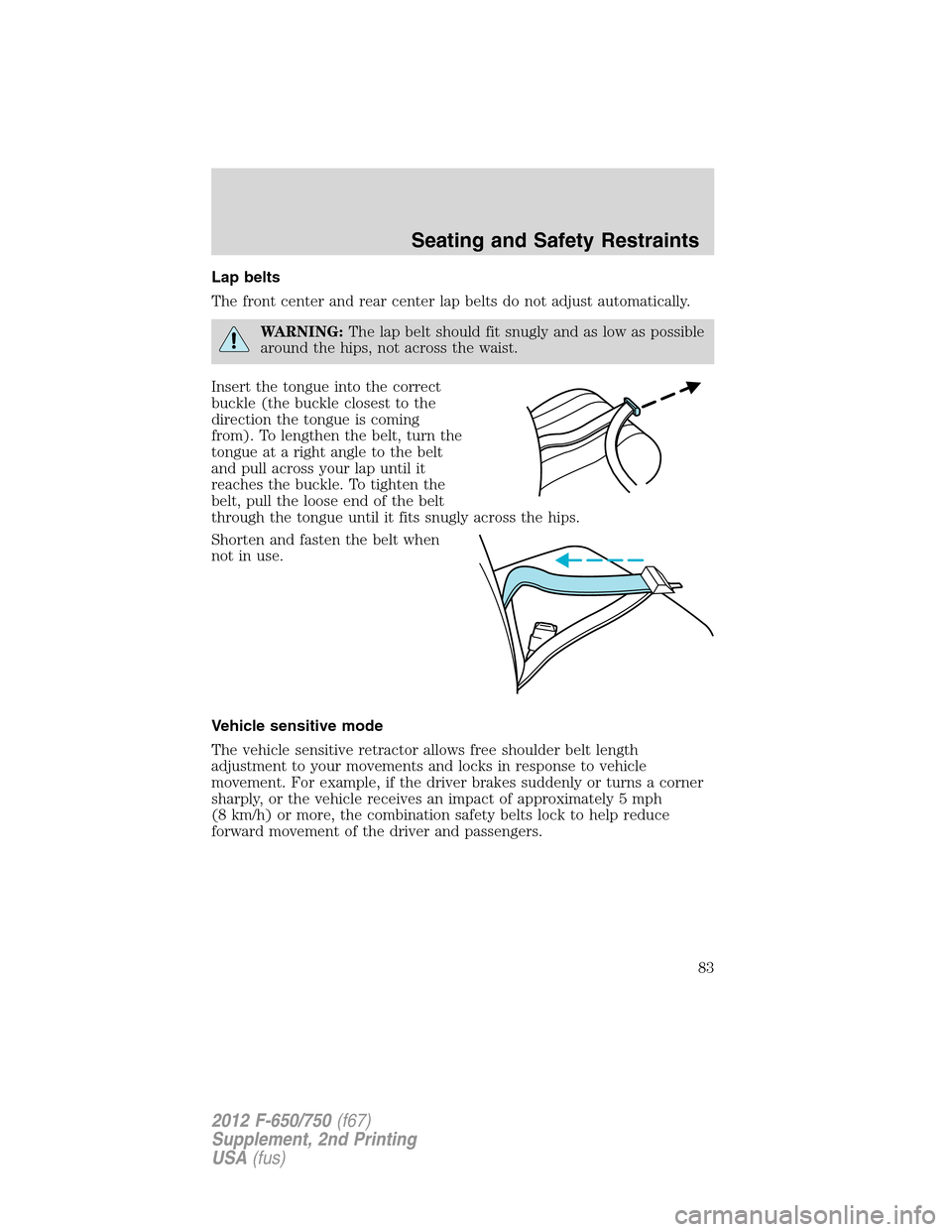
The front center and rear center lap belts do not adjust automatically.
WARNING:The lap belt should fit snugly and as low as possible
around the hips, not across the waist.
Insert the tongue into the correct
buckle (the buckle closest to the
direction the tongue is coming
from). To lengthen the belt, turn the
tongue at a right angle to the belt
and pull across your lap until it
reaches the buckle. To tighten the
belt, pull the loose end of the belt
through the tongue until it fits snugly across the hips.
Shorten and fasten the belt when
not in use.
Vehicle sensitive mode
The vehicle sensitive retractor allows free shoulder belt length
adjustment to your movements and locks in response to vehicle
movement. For example, if the driver brakes suddenly or turns a corner
sharply, or the vehicle receives an impact of approximately 5 mph
(8 km/h) or more, the combination safety belts lock to help reduce
forward movement of the driver and passengers.
Seating and Safety Restraints
83
2012 F-650/750(f67)
Supplement, 2nd Printing
USA(fus)
Page 84 of 306
Front safety belt height adjustment
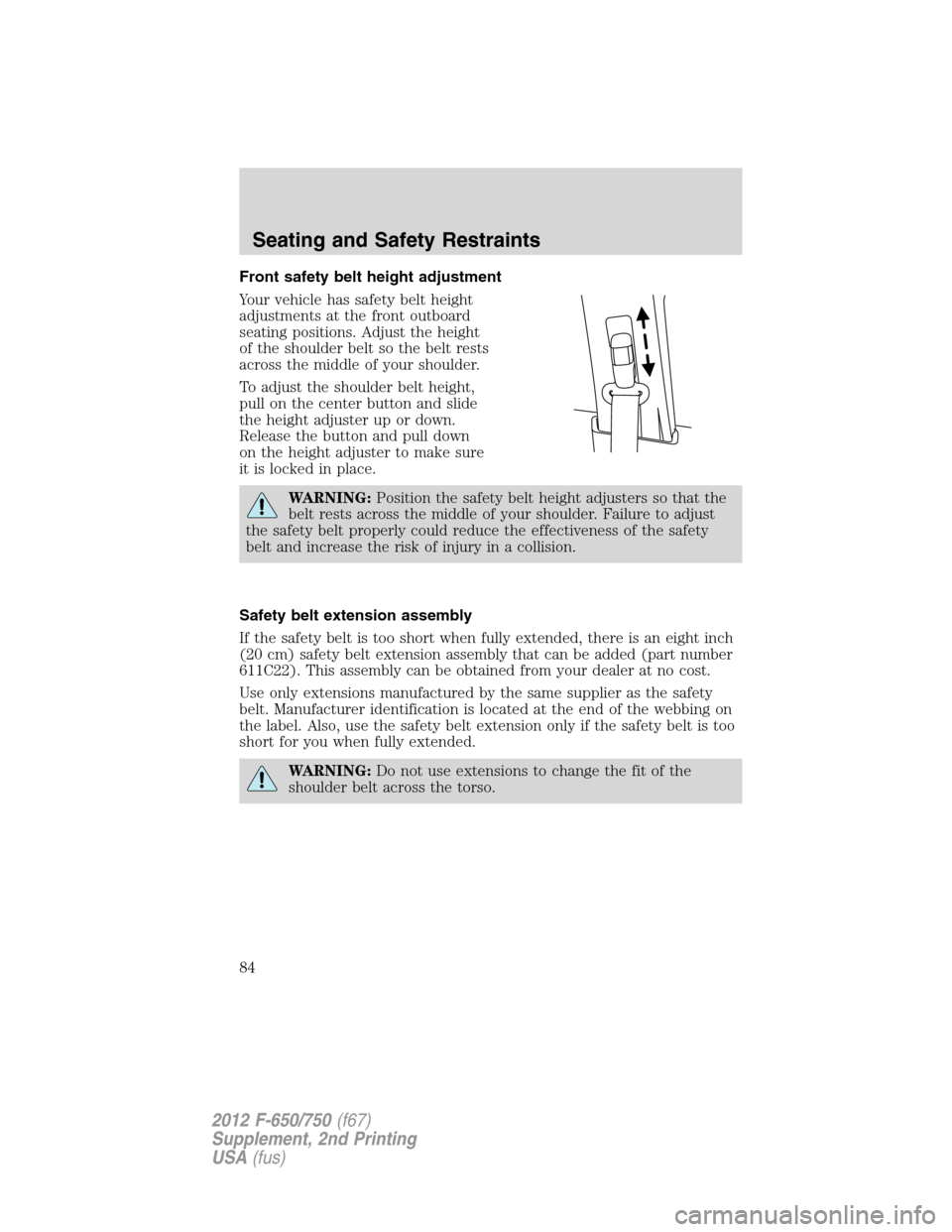
Your vehicle has safety belt height
adjustments at the front outboard
seating positions. Adjust the height
of the shoulder belt so the belt rests
across the middle of your shoulder.
To adjust the shoulder belt height,
pull on the center button and slide
the height adjuster up or down.
Release the button and pull down
on the height adjuster to make sure
it is locked in place.
WARNING:Position the safety belt height adjusters so that the
belt rests across the middle of your shoulder. Failure to adjust
the safety belt properly could reduce the effectiveness of the safety
belt and increase the risk of injury in a collision.
Safety belt extension assembly
If the safety belt is too short when fully extended, there is an eight inch
(20 cm) safety belt extension assembly that can be added (part number
611C22). This assembly can be obtained from your dealer at no cost.
Use only extensions manufactured by the same supplier as the safety
belt. Manufacturer identification is located at the end of the webbing on
the label. Also, use the safety belt extension only if the safety belt is too
short for you when fully extended.
WARNING:Do not use extensions to change the fit of the
shoulder belt across the torso.
Seating and Safety Restraints
84
2012 F-650/750(f67)
Supplement, 2nd Printing
USA(fus)
Page 94 of 306
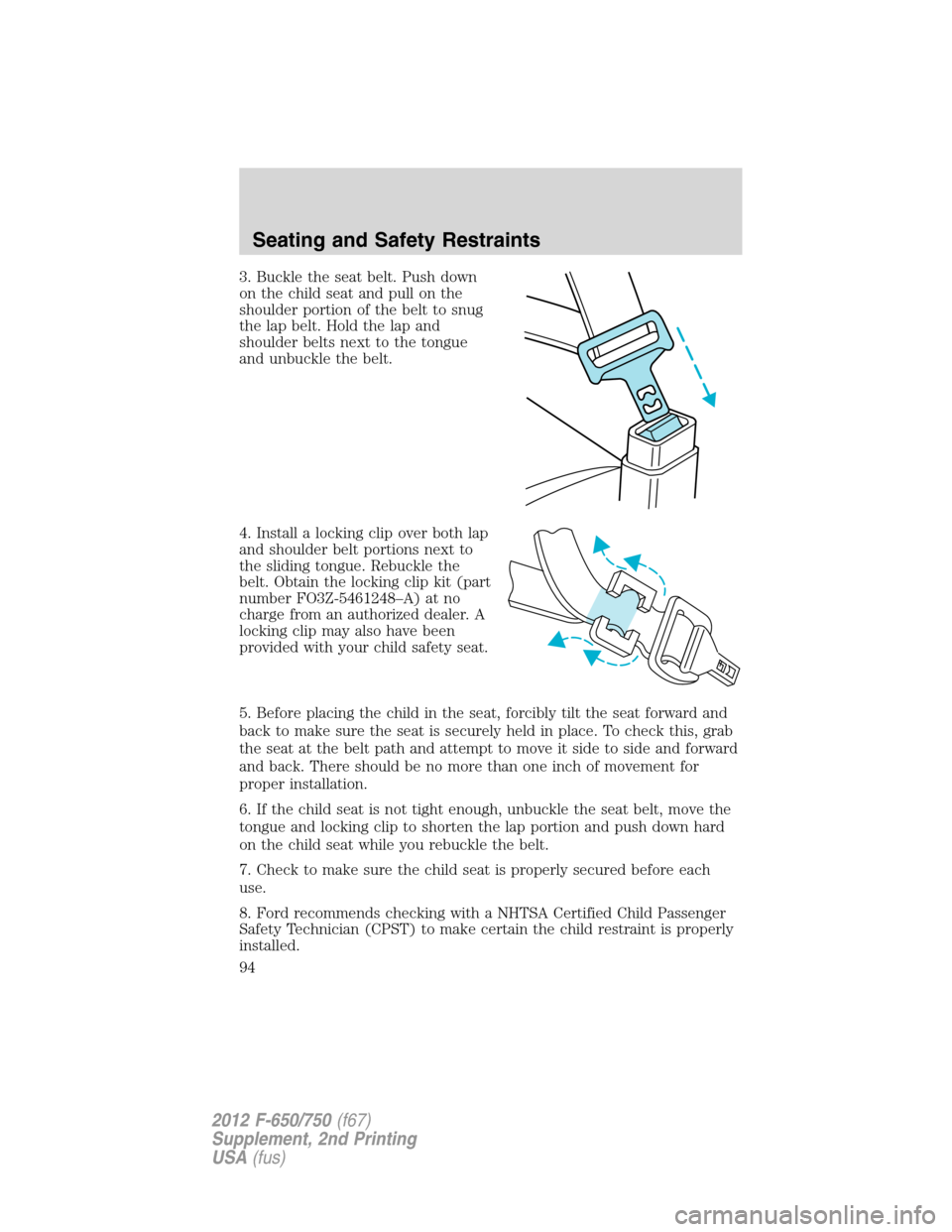
3. Buckle the seat belt. Push down
on the child seat and pull on the
shoulder portion of the belt to snug
the lap belt. Hold the lap and
shoulder belts next to the tongue
and unbuckle the belt.
4. Install a locking clip over both lap
and shoulder belt portions next to
the sliding tongue. Rebuckle the
belt. Obtain the locking clip kit (part
number FO3Z-5461248–A) at no
charge from an authorized dealer. A
locking clip may also have been
provided with your child safety seat.
5. Before placing the child in the seat, forcibly tilt the seat forward and
back to make sure the seat is securely held in place. To check this, grab
the seat at the belt path and attempt to move it side to side and forward
and back. There should be no more than one inch of movement for
proper installation.
6. If the child seat is not tight enough, unbuckle the seat belt, move the
tongue and locking clip to shorten the lap portion and push down hard
on the child seat while you rebuckle the belt.
7. Check to make sure the child seat is properly secured before each
use.
8. Ford recommends checking with a NHTSA Certified Child Passenger
Safety Technician (CPST) to make certain the child restraint is properly
installed.
Seating and Safety Restraints
94
2012 F-650/750(f67)
Supplement, 2nd Printing
USA(fus)
Page 98 of 306
3. You may need to pull the seatback forward to access the tether anchors.
Make sure the seat is locked in the upright position before installing the
child seat. Refer to theFolding the rear seat back (Crew Cab)section in
this chapter for information on how to operate the rear seats.
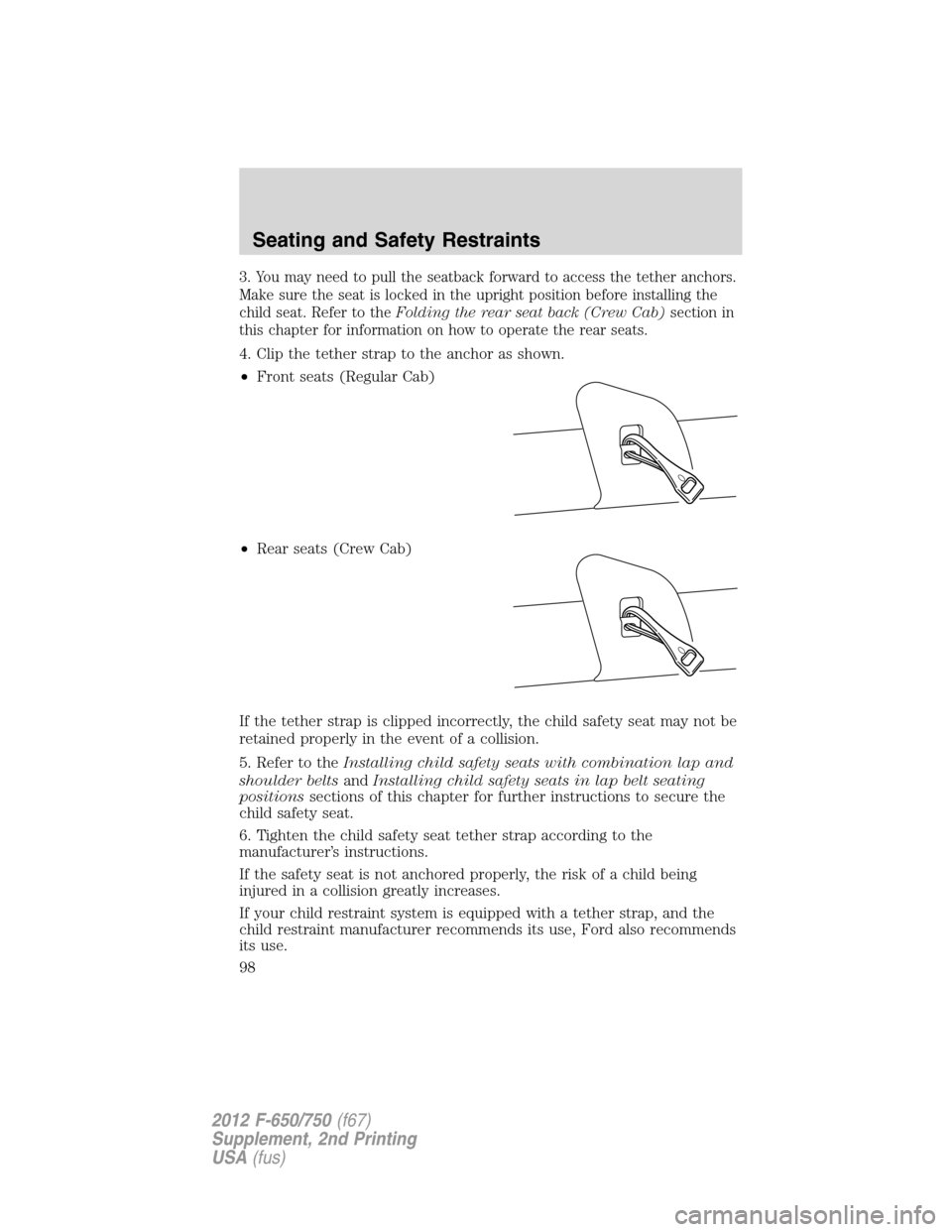
4. Clip the tether strap to the anchor as shown.
•Front seats (Regular Cab)
•Rear seats (Crew Cab)
If the tether strap is clipped incorrectly, the child safety seat may not be
retained properly in the event of a collision.
5. Refer to theInstalling child safety seats with combination lap and
shoulder beltsandInstalling child safety seats in lap belt seating
positionssections of this chapter for further instructions to secure the
child safety seat.
6. Tighten the child safety seat tether strap according to the
manufacturer’s instructions.
If the safety seat is not anchored properly, the risk of a child being
injured in a collision greatly increases.
If your child restraint system is equipped with a tether strap, and the
child restraint manufacturer recommends its use, Ford also recommends
its use.
Seating and Safety Restraints
98
2012 F-650/750(f67)
Supplement, 2nd Printing
USA(fus)
Page 103 of 306
STARTING
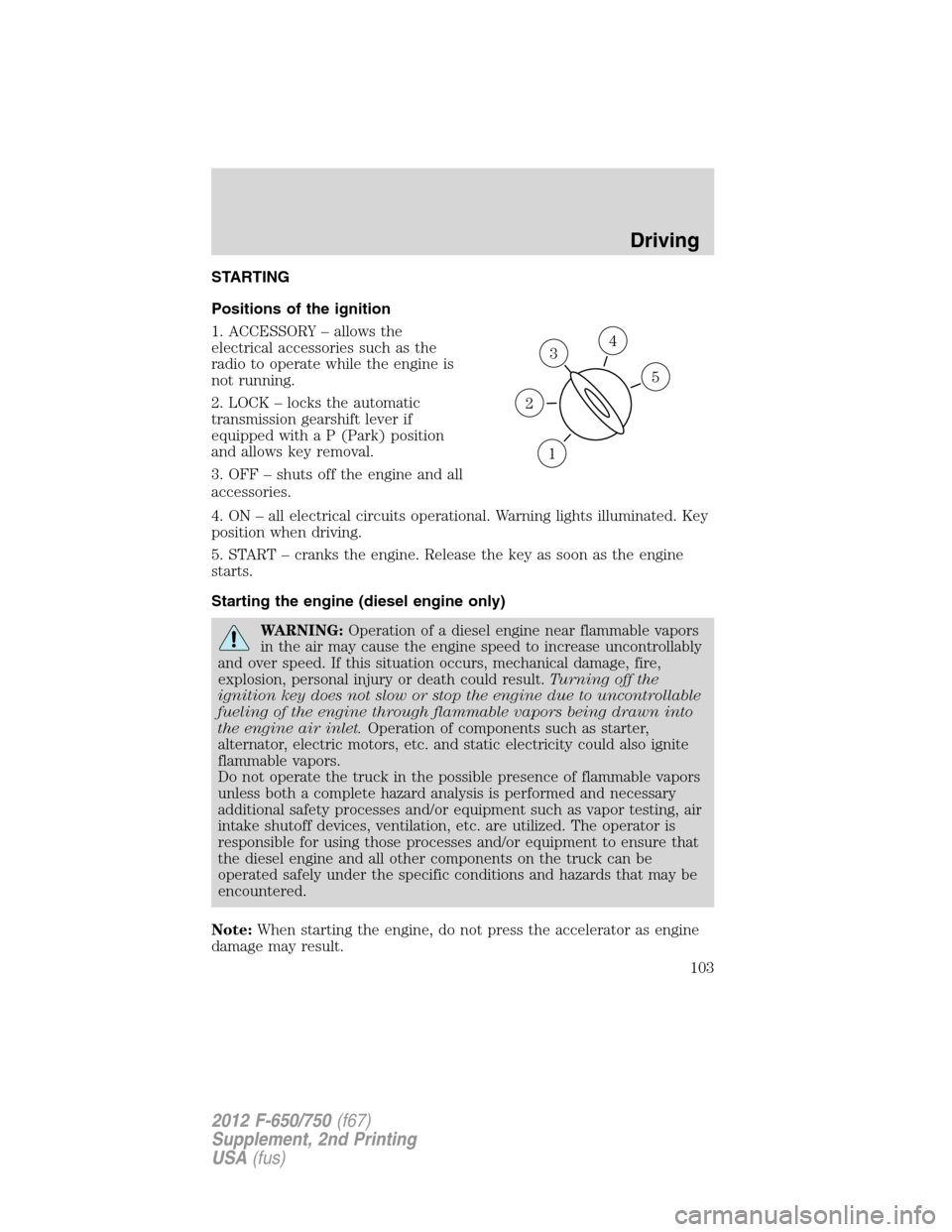
Positions of the ignition
1. ACCESSORY – allows the
electrical accessories such as the
radio to operate while the engine is
not running.
2. LOCK – locks the automatic
transmission gearshift lever if
equipped with a P (Park) position
and allows key removal.
3. OFF – shuts off the engine and all
accessories.
4. ON – all electrical circuits operational. Warning lights illuminated. Key
position when driving.
5. START – cranks the engine. Release the key as soon as the engine
starts.
Starting the engine (diesel engine only)
WARNING:Operation of a diesel engine near flammable vapors
in the air may cause the engine speed to increase uncontrollably
and over speed. If this situation occurs, mechanical damage, fire,
explosion, personal injury or death could result.Turning off the
ignition key does not slow or stop the engine due to uncontrollable
fueling of the engine through flammable vapors being drawn into
the engine air inlet.Operation of components such as starter,
alternator, electric motors, etc. and static electricity could also ignite
flammable vapors.
Do not operate the truck in the possible presence of flammable vapors
unless both a complete hazard analysis is performed and necessary
additional safety processes and/or equipment such as vapor testing, air
intake shutoff devices, ventilation, etc. are utilized. The operator is
responsible for using those processes and/or equipment to ensure that
the diesel engine and all other components on the truck can be
operated safely under the specific conditions and hazards that may be
encountered.
Note:When starting the engine, do not press the accelerator as engine
damage may result.
3
1
2
5
4
Driving
103
2012 F-650/750(f67)
Supplement, 2nd Printing
USA(fus)
Page 108 of 306
WARNING:All vehicles have blind spots. To reduce the risk of
severe injury or property damage, never move your vehicle to
the side or rear or change lanes without being sure your way is clear
on both sides and to your rear.
Backing up
WARNING:To reduce the risk of the possibility of personal
injury while backing the vehicle, always be sure your vehicle’s
path is clear.
Before backing your vehicle, be sure you can do so safely. If anything
behind the cab limits your view, do not rely on mirrors alone to ensure
that your intended path is clear. If other people are in the vicinity, have
someone standing well behind your vehicle and outside of your intended
path (visible through an exterior mirror) guide you as you back up.
Although OSHA or some governmental regulations may require the use
of an electrical or mechanical back-up alarm to warn bystanders, such an
alarm does not ensure that the intended path is clear. When in doubt,
get out of the vehicle and visually check the intended path is clear;
back-up slowly as to allow others time to move, if necessary.
If an electrical back-up alarm is installed, it should be connected to the
back-up lamp circuit.
Parking your vehicle
Always use the parking brake. When parking on a grade, block the
wheels and turn the front wheels to one side so that if the vehicle rolls,
the front tires act against the curb to stop the vehicle. The front wheels
are more effective at stopping a rolling vehicle than the rear wheels.
WARNING:When parking your vehicle, do not leave the
transmission in gear; if the key is in the on position and the
vehicle rolls, the engine could start. Failure to follow these instructions
could result in an unattended vehicle moving, possibly causing personal
injury or property damage.
Driving through water
If driving through deep or standing water is unavoidable, proceed very
slowly especially if the depth is not known. Never drive through water
that is higher than the bottom of the hubs. Traction or brake capability
Driving
108
2012 F-650/750(f67)
Supplement, 2nd Printing
USA(fus)