check engine FORD F750 2013 12.G Owner's Manual
[x] Cancel search | Manufacturer: FORD, Model Year: 2013, Model line: F750, Model: FORD F750 2013 12.GPages: 378, PDF Size: 3.82 MB
Page 150 of 378
AIR BRAKES
After starting the engine, give the air compressor time to build up the air
pressure to 60 psi (414 kPa) before moving the vehicle.
WARNING:Do not drive or continue to drive if the low air
pressure buzzer is sounding or the brake warning light is lit.
These warnings indicate that air pressure is not to normal operating
level. Continued use of the vehicle could result in loss of braking ability.
WARNING:Avoid repeated light application of the brake pedal.
This depletes air pressure faster and could result in loss of
braking capability.
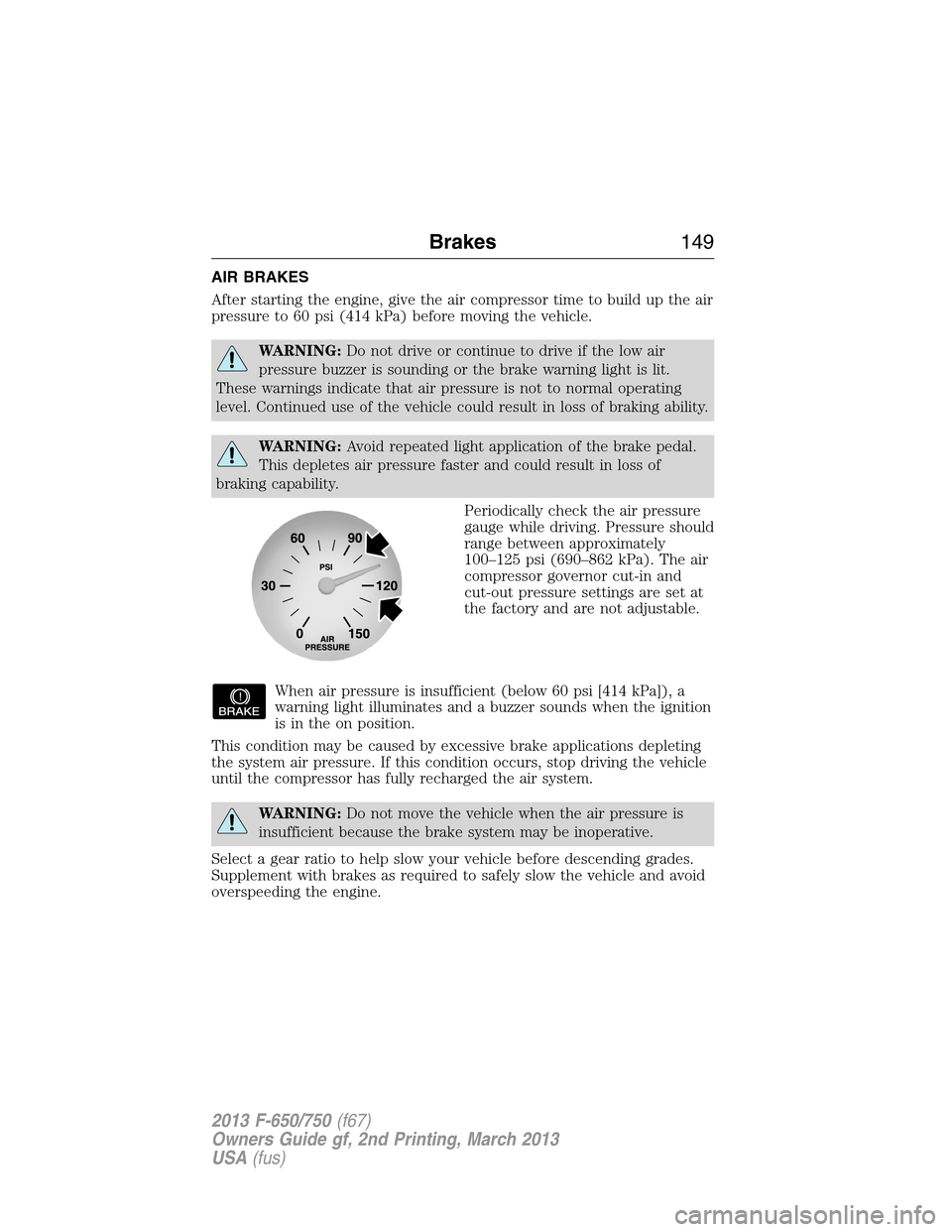
Periodically check the air pressure
gauge while driving. Pressure should
range between approximately
100–125 psi (690–862 kPa). The air
compressor governor cut-in and
cut-out pressure settings are set at
the factory and are not adjustable.
When air pressure is insufficient (below 60 psi [414 kPa]), a
warning light illuminates and a buzzer sounds when the ignition
is in the on position.
This condition may be caused by excessive brake applications depleting
the system air pressure. If this condition occurs, stop driving the vehicle
until the compressor has fully recharged the air system.
WARNING:Do not move the vehicle when the air pressure is
insufficient because the brake system may be inoperative.
Select a gear ratio to help slow your vehicle before descending grades.
Supplement with brakes as required to safely slow the vehicle and avoid
overspeeding the engine.
Brakes149
2013 F-650/750(f67)
Owners Guide gf, 2nd Printing, March 2013
USA(fus)
Page 160 of 378
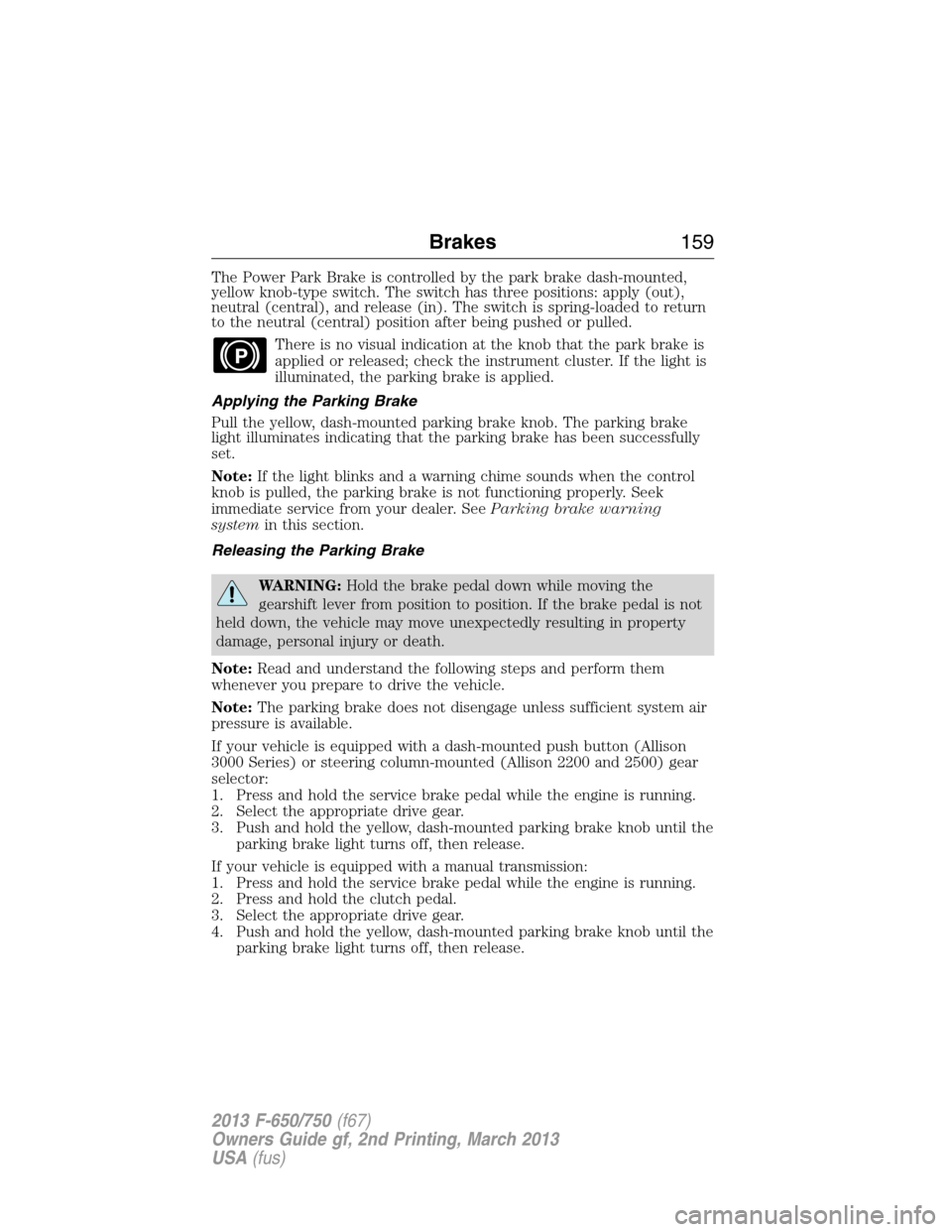
The Power Park Brake is controlled by the park brake dash-mounted,
yellow knob-type switch. The switch has three positions: apply (out),
neutral (central), and release (in). The switch is spring-loaded to return
to the neutral (central) position after being pushed or pulled.
There is no visual indication at the knob that the park brake is
applied or released; check the instrument cluster. If the light is
illuminated, the parking brake is applied.
Applying the Parking Brake
Pull the yellow, dash-mounted parking brake knob. The parking brake
light illuminates indicating that the parking brake has been successfully
set.
Note:If the light blinks and a warning chime sounds when the control
knob is pulled, the parking brake is not functioning properly. Seek
immediate service from your dealer. SeeParking brake warning
systemin this section.
Releasing the Parking Brake
WARNING:Hold the brake pedal down while moving the
gearshift lever from position to position. If the brake pedal is not
held down, the vehicle may move unexpectedly resulting in property
damage, personal injury or death.
Note:Read and understand the following steps and perform them
whenever you prepare to drive the vehicle.
Note:The parking brake does not disengage unless sufficient system air
pressure is available.
If your vehicle is equipped with a dash-mounted push button (Allison
3000 Series) or steering column-mounted (Allison 2200 and 2500) gear
selector:
1. Press and hold the service brake pedal while the engine is running.
2. Select the appropriate drive gear.
3. Push and hold the yellow, dash-mounted parking brake knob until the
parking brake light turns off, then release.
If your vehicle is equipped with a manual transmission:
1. Press and hold the service brake pedal while the engine is running.
2. Press and hold the clutch pedal.
3. Select the appropriate drive gear.
4. Push and hold the yellow, dash-mounted parking brake knob until the
parking brake light turns off, then release.
P
Brakes159
2013 F-650/750(f67)
Owners Guide gf, 2nd Printing, March 2013
USA(fus)
Page 169 of 378
OPERATING YOUR VEHICLE
General Information
•Start the vehicle in motion by using the highest gear speed in the
transmission that lets the engine easily start the load without slipping
the clutch.
•Accelerate smoothly and evenly. Rapid acceleration increases fuel
consumption without increasing engine performance.
•When approaching a hill, press the accelerator smoothly to start the
incline at full power, then shift down as needed to maintain vehicle
speed.
•When going down a hill, or long steep grades, prevent overspeeding
of the engine. Normally, choose the same gear to descend the hill that
you use to ascend the hill. The engine governor has no control over
engine speed when it is being pushed by a loaded vehicle.
•Operate in a gear that permits an engine speed not in excess of the
maximum governed speed or high-idle RPM (no load).
•
Always shift to a lower gear at high altitudes to prevent engine smoking.
Backing Up
WARNING:All vehicles have blind spots. To reduce the risk of
severe injury or property damage, never move your vehicle to the
side or rear or change lanes without being sure your way is clear on
both sides and to your rear.
WARNING:To reduce the risk of the possibility of personal
injury while backing up the vehicle, always be sure your vehicle’s
path is clear.
Before backing up your vehicle, be sure you can do so safely. If anything
behind the cab limits your view, do not rely on mirrors alone to ensure
that your intended path is clear. If other people are in the vicinity, have
someone standing well behind your vehicle and outside of your intended
path (visible through an exterior mirror) guide you as you back up.
Although OSHA or some governmental regulations may require the use
of an electrical or mechanical back up alarm to warn bystanders, such an
alarm does not guarantee that the intended path is clear. When in doubt,
get out of the vehicle and visually check the intended path is clear. Back
up slowly as to allow others time to move, if necessary.
If an electrical back up alarm is installed, it should be connected to the
back up lamp circuit.
168Driving Aids
2013 F-650/750(f67)
Owners Guide gf, 2nd Printing, March 2013
USA(fus)
Page 170 of 378
Parking
WARNING:When parking your vehicle, do not leave the
transmission in gear; if the key is in the on position and the
vehicle rolls, the engine could start. Failure to follow these instructions
could result in an unattended vehicle moving, possibly causing personal
injury or property damage.
Always use the parking brake. When parking on a grade, block the
wheels and turn the front wheels to one side so that if the vehicle rolls,
the front tires act against the curb to stop the vehicle. The front wheels
are more effective at stopping a rolling vehicle than the rear wheels.
Cold Weather
Note:Idling in cold weather does not heat the engine to its normal
operating temperature. Long periods of idling in cold weather can cause
a build-up of heavy deposits of carbon and rust on valve stems causing
them to stick which, in turn, can cause valvetrain damage.
Note:The use of winter fronts, or other air-restrictive devices mounted
in front of the radiator on vehicles with chassis-mounted charge air
coolers, are not recommended unless extremely cold weather conditions
exist. Airflow restriction can cause high exhaust temperatures, power
loss, excessive fan usage and a reduction in fuel economy. If you must
use a winter front, the device should have a permanent opening of at
least 120 square inches (774 square centimeters) directly in line with the
fan hub.
For best engine operation in temperatures of 32°F (0°C) or lower:
•Make sure the batteries are the correct type and are fully charged.
Check other electrical components to make sure they are in optimum
condition.
•Use a permanent-type engine coolant to protect the engine against
damage from freezing.
•If your vehicle is equipped with a water-fuel separator, drain it daily.
Fill the fuel tank at the end of daily operation to prevent
condensation in the fuel system.
•Use the proper engine oil and maintain it at its proper level.
•At temperatures of –4°F (–20°C) or below, it is recommended that
you use a crankcase-mounted coolant heater to improve cold engine
starting.
•If operating in arctic temperatures of –20°F (–29°C) or lower, consult
your truck dealer for information about special cold weather
equipment and precautions.
Driving Aids169
2013 F-650/750(f67)
Owners Guide gf, 2nd Printing, March 2013
USA(fus)
Page 171 of 378
Hot Weather
•Use a permanent-type engine coolant to protect the engine against
damage from overheating.
•Fill the fuel tank at the end of daily operation to prevent
condensation in the fuel system.
•Keep external surfaces of the engine, radiator, charge air cooler, A/C
condenser and accessories clean to avoid dirt build-up.
•Above normal coolant temperatures could be experienced while
driving in a transmission gear ratio which lugs the engine. To correct
this problem, engine speed should be increased by downshifting into
the next lower gear.
STEERING
Your vehicle is equipped with power steering. Power steering uses energy
from the engine to decrease the driver’s effort in steering the vehicle.
To help prevent damage to the power steering pump:
•Never hold the steering wheel to the extreme right or the extreme
left for more than a few seconds when the engine is running.
•Do not operate the vehicle with the power steering pump fluid level
below the ADD mark on the MAX. COLD side of the power steering
reservoir dipstick.
•Some noise is normal during operation. If the noise is excessive,
check for low power steering pump fluid level before seeking service
by your authorized dealer.
•Heavy or uneven steering efforts may be caused by low power
steering pump fluid level. Check for low power steering pump fluid
level before seeking service by your authorized dealer.
•Do not fill the power steering pump reservoir above the FULL mark
on the MAX. HOT side of the power steering reservoir dipstick, as
this may result in leaks from the reservoir.
If the power steering system breaks down (or if the engine is turned
off), you can steer the vehicle manually, but it takes more effort.
If the steering wanders or pulls, check for:
•underinflated tire(s) on any wheel(s)
•uneven vehicle loading
•high crown in center of road
•high crosswinds
•wheels out of alignment
•loose or worn suspension components.
170Driving Aids
2013 F-650/750(f67)
Owners Guide gf, 2nd Printing, March 2013
USA(fus)
Page 178 of 378
Trailer Lamps
WARNING:Never connect any trailer lamp wiring to the
vehicle’s tail lamp wiring; this may damage the electrical system
resulting in a fire. Contact an authorized dealer as soon as possible for
assistance in proper trailer tow wiring installation. Additional electrical
equipment may be required.
Trailer lamps are required on most towed vehicles. Make sure all running
lights, brake lights, turn signals and hazard lights are working.
Before Towing a Trailer
Practice turning, stopping and backing up to get the feel of your
vehicle-trailer combination before starting on a trip. When turning, make
wider turns so the trailer wheels clear curbs and other obstacles.
When Towing a Trailer
•Check your hitch, electrical connections and trailer wheel lug nuts
thoroughly after you have traveled 50 miles (80 kilometers).
•Place the gearshift lever in positionP(if equipped) or neutral to aid
in engine and transmission cooling and A/C efficiency during hot
weather while stopped in traffic.
•Turn off the speed control. The speed control may turn off
automatically when you are towing on long, steep grades.
•Shift to a lower gear when driving down a long or steep hill. Do not
apply the brakes continuously, as they may overheat and become less
effective.
•Allow more distance for stopping with a trailer attached. Anticipate
stops and brake gradually.
FIFTH-WHEEL OPERATION
WARNING:Failure to follow the fifth-wheel manufacturer’s
instructions for hooking and unhooking as well as sliding the
fifth-wheel could result in an accident, personal injury or death.
WARNING:When the tractor and trailer are parked unattended,
the trailer brake hand control should never be used to apply the
brake, since air may leak from the system, allowing vehicle movement,
resulting in possible property damage, personal injury or death.
Towing177
2013 F-650/750(f67)
Owners Guide gf, 2nd Printing, March 2013
USA(fus)
Page 187 of 378
Do not attempt to push-start your automatic transmission vehicle.
Automatic transmissions do not have push-start capability. Attempting to
push-start a vehicle with an automatic transmission may cause
transmission damage.
Six-speed TorqShift® transmissions have an adaptive shift strategy.
When the battery is disconnected or a new battery is installed, the
automatic transmission must relearn its shift strategy. As a result, the
transmission may have firm soft shifts, firm shifts or both. This operation
is considered normal and does not affect function or durability of the
transmission. Over time, the adaptive learning process fully updates
transmission operation.
Preparing Your Vehicle
Note:Use only a 12–volt supply to start your vehicle.
Note:Do not disconnect the battery of the disabled vehicle as this could
damage the vehicle’s electrical system.
1. Park the booster vehicle close to the hood of the disabled vehicle
making sure the two vehicles do not touch. Set the parking brake on
both vehicles and stay clear of the engine cooling fan and other
moving parts.
2. Check all battery terminals and remove any excessive corrosion
before you attach the battery cables. Make sure that vent caps are
tight and level.
3. Turn the heater fan on in both vehicles to protect from any electrical
surges. Turn all other accessories off.
Connecting the Jumper Cables
WARNING:Do not connect the end of the second cable to the
negative (-) terminal of the battery to be jumped. A spark may
cause an explosion of the gases that surround the battery.
Note:Do not attach the negative (-) cable to fuel lines, engine rocker
covers, the intake manifold or electrical components as grounding points.
Note:In the illustration, the vehicle on the bottom is used to designate
the assisting (boosting) battery.
186Roadside Emergencies
2013 F-650/750(f67)
Owners Guide gf, 2nd Printing, March 2013
USA(fus)
Page 205 of 378
GENERAL INFORMATION
WARNING:Making modifications to various parts, components
and systems of the vehicle, such as brake and steering systems,
can adversely affect the quality, reliability and operation of your vehicle
and could result in property damage, personal injury or death. Such
modifications must be avoided.
WARNING:Failure to properly perform maintenance and
servicing procedures could result in vehicle damage, personal
injury or death.
WARNING:Take care when performing any maintenance,
system check or service on your vehicle. Some of the materials
may also be hazardous if used, serviced or handled improperly and
could result in property damage, personal injury or death.
Always use care when performing vehicle maintenance, repairs or system
checks. Improper or incomplete service could result in the vehicle not
working properly which may result in personal injury or damage to the
vehicle or equipment. It is the operator’s responsibility to see that the
vehicle receives proper care and maintenance. If you have any questions
about performing service, have the service done by a qualified technician.
Servicing Guidelines
When servicing your vehicle:
•always wear safety glasses for eye protection.
•always set the parking brake or chock the wheels.
•always use support stands, not a jack, when working under a raised
vehicle.
•always turn off the ignition unless a procedure requires the engine to
be running.
•always avoid contact with hot metal parts. Allow the components to
cool before working with, or around, them.
•always operate the engine in a well-ventilated area.
•do not wear loose-fitting clothing, hanging jewelry, watches or rings.
•do not smoke.
•do not work on the brakes or the clutch unless the proper
precautions are taken to avoid inhaling friction material dust.
Quality service parts are available through your dealer. If dealer parts are
not used, make sure the replacement parts are of equivalent quality.
204Maintenance
2013 F-650/750(f67)
Owners Guide gf, 2nd Printing, March 2013
USA(fus)
Page 206 of 378
WARNING:The use of inferior parts can adversely affect the
quality and reliability of your vehicle which, in turn, can result in
property damage, personal injury or death.
To avoid damage to the vehicle’s electrical components prior to electric
welding:
•disconnect both battery cables.
•attach the welder ground cable as close as possible to the part being
welded.
•it is recommended that the component be temporarily removed if
welding close to an electrical component.
Follow the checks and services in theScheduled Maintenancechapter.
Have your dealer or service center inspect your vehicle at least once a
year. Remember that regular maintenance and inspections usually
prevent serious problems from developing later.
If the owner or operator of the vehicle is a skilled technician and intends
on performing the vehicle maintenance and service, he is strongly urged
to purchase a service manual.
Electrical System
Periodically inspect electrical connectors on the outside of the cab and
on the engine and frame for corrosion and tightness. Exposed terminals,
such as the fuel sender, cranking motor, alternator and feed-through
studs, should be cleaned and re-coated with a lubricant sealing grease
such as Motorcraft® Silicone Brake Caliper Grease and Dielectic
Compound XG-3, or equivalent. This should include the ground cable
connector for batteries, engine and cab as well as the jump starting stud.
Accessory Feed Connections
Vehicle electrical systems are complex and often include powertrain
components, such as engine and transmission controls, instrument
panels, ABS, etc. While most systems operate on battery voltage
(12 volts), some systems can be as high as 90 volts or as low as five
volts. See theElectrical Circuit Diagram Manuals,available from your
vehicle’s manufacturer, to make sure that any additional body lights and
accessories are connected to circuits that are both appropriate and not
overloaded. No modification should be made to any vehicle control
system without first contacting your dealer.
Maintenance205
2013 F-650/750(f67)
Owners Guide gf, 2nd Printing, March 2013
USA(fus)
Page 212 of 378
Hydraulic Brakes
Establish a regular schedule for periodic cleaning, lubrication and
adjustment inspection based on vehicle use. Exact maintenance intervals
are difficult to predetermine since vehicles are used in a wide variety of
applications and conditions. If you are uncertain of the proper schedule
for your vehicle, contact your dealer.
Regular inspections should include:
•checking the brake lining (every service interval). Establish
inspection intervals that provide for lining replacement before damage
to the disc occurs. Excessive lining wear may expose the backing
plate to the disc causing scoring of the disc faces. This inspection
should be performed by a qualified technician and must be in
accordance with instructions provided by the service manual.
Hydraulic brake systems are power-assisted. Braking capabilities are
greatly reduced without engine assist.
•proper fluid level. The level should be at the bottom edge of the ring
on each reservoir fill port. Do not fill the master cylinder to the top of
the reservoir. If fluid level requires attention to maintain a proper
master cylinder level, this is an indication of either severe operation
(pad wear) or fluid leakage. A more frequent and thorough brake
inspection is required.
•brake lines, hoses and fittings. Repair or replace brake line tubes,
hoses or fittings as required. Inspect these components every
4000 miles (6000 kilometers):
•Lines for kinks, dents, corrosion or rupture.
•Hoses for abrasions, kinks, soft spots or rupture, collapse, cracks,
twists or loose frame supports. When replacing a hose, be sure
there is adequate clearance to the hose to avoid an abrasion to the
new hose.
•All connections for leaks.
Driveline Parking Brake
WARNING:Use wheel chocks and exercise caution when
inspecting under the vehicle. A vehicle roll-away could result in
property damage, personal injury or death.
Parking brake adjustment should only be performed by a qualified
technician, and in accordance with the instructions in the service
manual.
Maintenance211
2013 F-650/750(f67)
Owners Guide gf, 2nd Printing, March 2013
USA(fus)