ECU FORD F750 2013 12.G Owners Manual
[x] Cancel search | Manufacturer: FORD, Model Year: 2013, Model line: F750, Model: FORD F750 2013 12.GPages: 378, PDF Size: 3.82 MB
Page 13 of 378
SPECIAL NOTICES
New Vehicle Limited Warranty
For a detailed description of what is covered and what is not covered by
your vehicle’s New Vehicle Limited Warranty, see the warranty
information that is provided to you along with your owner’s manual.
Special Instructions
For your added safety, your vehicle is fitted with sophisticated electronic
controls.
MOBILE COMMUNICATIONS EQUIPMENT
Using mobile communications equipment is becoming increasingly
important in the conduct of business and personal affairs. However, you
must not compromise your own or others’ safety when using such
equipment. Mobile communications can enhance personal safety and
security when appropriately used, particularly in emergency situations.
Safety must be paramount when using mobile communications
equipment to avoid negating these benefits.
Mobile communication equipment includes, but is not limited to, cellular
phones, pagers, portable email devices, text messaging devices and
portable two-way radios.
WARNING:Driving while distracted can result in loss of vehicle
control, crash and injury. We strongly recommend that you use
extreme caution when using any device that may take your focus off
the road. Your primary responsibility is the safe operation of your
vehicle. We recommend against the use of any handheld device while
driving and encourage the use of voice-operated systems when possible.
Make sure you are aware of all applicable local laws that may affect the
use of electronic devices while driving.
12Introduction
2013 F-650/750(f67)
Owners Guide gf, 2nd Printing, March 2013
USA(fus)
Page 21 of 378
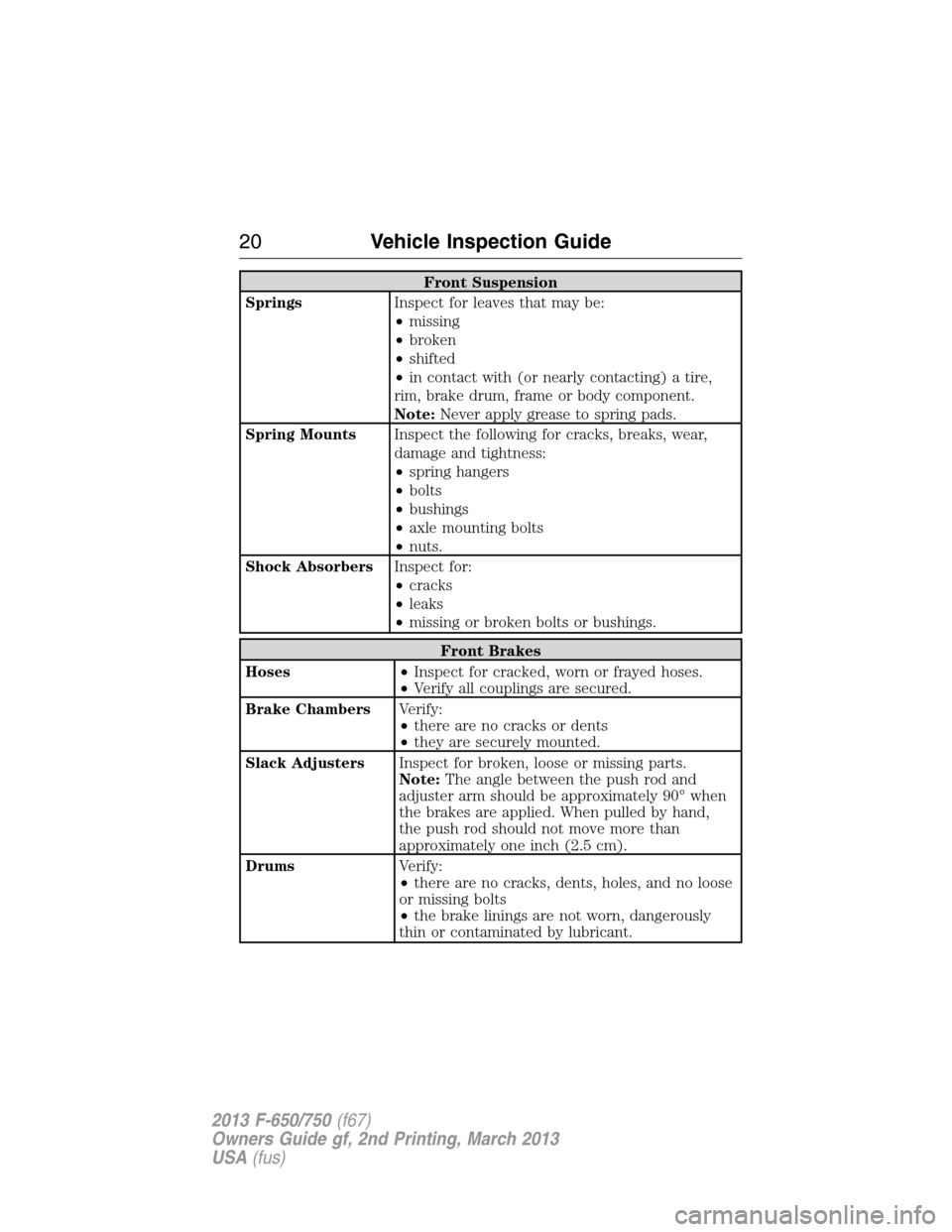
Front Suspension
SpringsInspect for leaves that may be:
•missing
•broken
•shifted
•in contact with (or nearly contacting) a tire,
rim, brake drum, frame or body component.
Note:Never apply grease to spring pads.
Spring MountsInspect the following for cracks, breaks, wear,
damage and tightness:
•spring hangers
•bolts
•bushings
•axle mounting bolts
•nuts.
Shock AbsorbersInspect for:
•cracks
•leaks
•missing or broken bolts or bushings.
Front Brakes
Hoses•Inspect for cracked, worn or frayed hoses.
•Verify all couplings are secured.
Brake ChambersVerify:
•there are no cracks or dents
•they are securely mounted.
Slack AdjustersInspect for broken, loose or missing parts.
Note:The angle between the push rod and
adjuster arm should be approximately 90° when
the brakes are applied. When pulled by hand,
the push rod should not move more than
approximately one inch (2.5 cm).
DrumsVerify:
•there are no cracks, dents, holes, and no loose
or missing bolts
•the brake linings are not worn, dangerously
thin or contaminated by lubricant.
20Vehicle Inspection Guide
2013 F-650/750(f67)
Owners Guide gf, 2nd Printing, March 2013
USA(fus)
Page 22 of 378
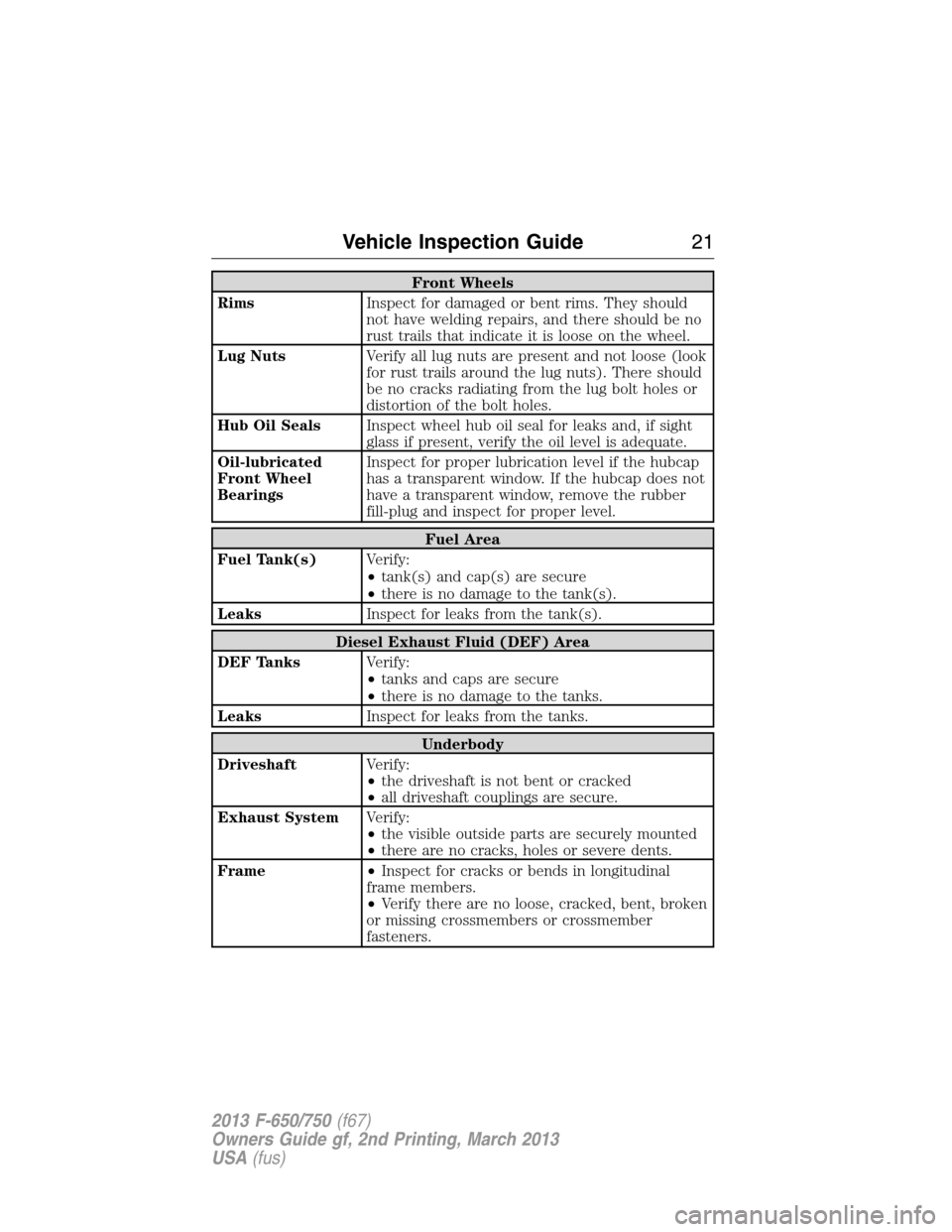
Front Wheels
RimsInspect for damaged or bent rims. They should
not have welding repairs, and there should be no
rust trails that indicate it is loose on the wheel.
Lug NutsVerify all lug nuts are present and not loose (look
for rust trails around the lug nuts). There should
be no cracks radiating from the lug bolt holes or
distortion of the bolt holes.
Hub Oil SealsInspect wheel hub oil seal for leaks and, if sight
glass if present, verify the oil level is adequate.
Oil-lubricated
Front Wheel
BearingsInspect for proper lubrication level if the hubcap
has a transparent window. If the hubcap does not
have a transparent window, remove the rubber
fill-plug and inspect for proper level.
Fuel Area
Fuel Tank(s)Verify:
•tank(s) and cap(s) are secure
•there is no damage to the tank(s).
LeaksInspect for leaks from the tank(s).
Diesel Exhaust Fluid (DEF) Area
DEF TanksVerify:
•tanks and caps are secure
•there is no damage to the tanks.
LeaksInspect for leaks from the tanks.
Underbody
DriveshaftVerify:
•the driveshaft is not bent or cracked
•all driveshaft couplings are secure.
Exhaust SystemVerify:
•the visible outside parts are securely mounted
•there are no cracks, holes or severe dents.
Frame•Inspect for cracks or bends in longitudinal
frame members.
•Verify there are no loose, cracked, bent, broken
or missing crossmembers or crossmember
fasteners.
Vehicle Inspection Guide21
2013 F-650/750(f67)
Owners Guide gf, 2nd Printing, March 2013
USA(fus)
Page 23 of 378
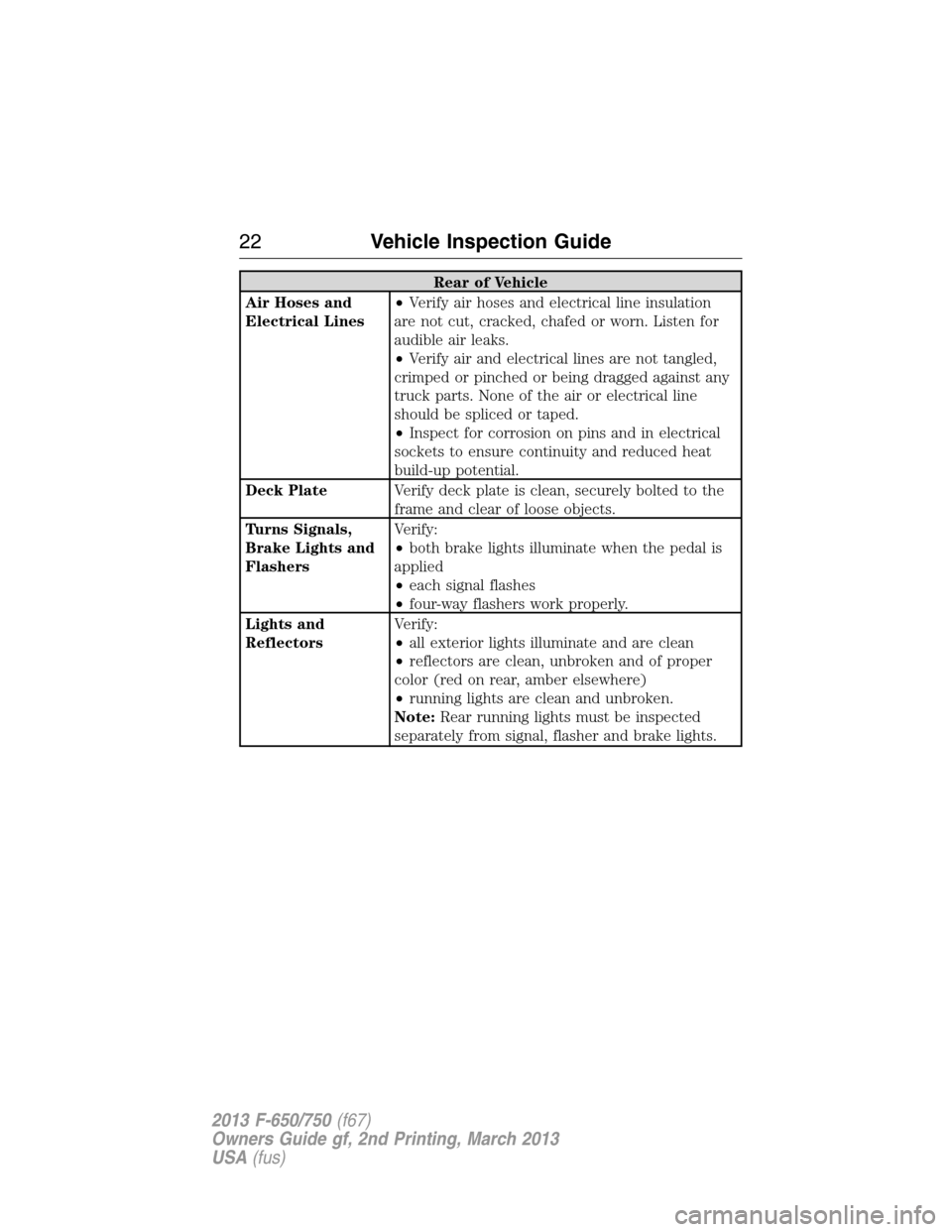
Rear of Vehicle
Air Hoses and
Electrical Lines•Verify air hoses and electrical line insulation
are not cut, cracked, chafed or worn. Listen for
audible air leaks.
•Verify air and electrical lines are not tangled,
crimped or pinched or being dragged against any
truck parts. None of the air or electrical line
should be spliced or taped.
•Inspect for corrosion on pins and in electrical
sockets to ensure continuity and reduced heat
build-up potential.
Deck PlateVerify deck plate is clean, securely bolted to the
frame and clear of loose objects.
Turns Signals,
Brake Lights and
FlashersVerify:
•both brake lights illuminate when the pedal is
applied
•each signal flashes
•four-way flashers work properly.
Lights and
ReflectorsVerify:
•all exterior lights illuminate and are clean
•reflectors are clean, unbroken and of proper
color (red on rear, amber elsewhere)
•running lights are clean and unbroken.
Note:Rear running lights must be inspected
separately from signal, flasher and brake lights.
22Vehicle Inspection Guide
2013 F-650/750(f67)
Owners Guide gf, 2nd Printing, March 2013
USA(fus)
Page 25 of 378
Rear Brakes
Hoses•Inspect for cracked, worn or frayed hoses.
•Verify all couplings are secured.
Brake ChambersVerify:
•there are no cracks or dents
•they are securely mounted.
Slack AdjusterInspect for broken, loose or missing parts.
Note:The angle between the push rod and
adjuster arm should be approximately 90° when
the brakes are applied. When pulled by hand, the
push rod should not move more than
approximately one inch (2.5 cm).
DrumVerify:
•there are no cracks, dents, holes and no loose
or missing bolts
•the brake linings are not worn, dangerously
thin or contaminated by lubricant.
Rear Wheels
SpacersVerify:
•dual wheels are evenly separated
•the tires are not touching one another.
RimsInspect for damaged or bent rims. Rims should
not have welding repairs, and no rust trails that
indicate it is loose on the wheel.
Lug NutsVerify all lug nuts are present and not loose (look
for rust trails around the lug nuts). There should
be no cracks radiating from the lug bolt holes or
distortion of the bolt holes.
24Vehicle Inspection Guide
2013 F-650/750(f67)
Owners Guide gf, 2nd Printing, March 2013
USA(fus)
Page 27 of 378
GENERAL INFORMATION
See the following sections for directions on how to properly use safety
restraints for children.
WARNING:Always make sure your child is secured properly in a
device that is appropriate for their height, age and weight. Child
safety restraints must be bought separately from your vehicle. Failure
to follow these instructions and guidelines may result in an increased
risk of serious injury or death to your child.
WARNING:All children are shaped differently. The
recommendations for safety restraints are based on probable
child height, age and weight thresholds from NHTSA and other safety
organizations, or are the minimum requirements of law. Ford
recommends checking with a NHTSA Certified Child Passenger Safety
Technician (CPST) and consulting your pediatrician to make sure your
child seat is appropriate for your child, and is compatible with and
properly installed in your vehicle. To locate a child seat fitting station
and CPST, contact the NHTSA toll free at 1-888-327-4236 or on the
internet at http://www.nhtsa.dot.gov. In Canada, check with your local
St. John Ambulance office for referral to a CPST or for further
information, contact your provincial ministry of transportation, or locate
your local St. John Ambulance office by searching for St. John
Ambulance on the internet, or Transport Canada at 1–800–333–0371
(http://www.tc.gc.ca). Failure to properly restrain children in safety
seats made especially for their height, age, and weight may result in an
increased risk of serious injury or death to your child.
26Child Safety
2013 F-650/750(f67)
Owners Guide gf, 2nd Printing, March 2013
USA(fus)
Page 34 of 378
INSTALLING CHILD SAFETY SEATS
Using Automatic Locking Mode Combination Lap and Shoulder
Belts (Front Passenger and Rear Outboard Seating Positions)
WARNING:Children 12 and under should be properly restrained
in the rear seat whenever possible.
WARNING:Depending on where you secure a child restraint,
and depending on the child restraint design, you may block
access to certain safety belt buckle assemblies and/or LATCH lower
anchors, rendering those features potentially unusable. To avoid risk of
injury, occupants should only use seating positions where they are able
to be properly restrained.
When installing a child safety seat with combination lap/shoulder belts:
•Use the correct safety belt buckle for that seating position.
•Insert the belt tongue into the proper buckle until you hear a snap
and feel it latch. Make sure the tongue is securely fastened in the
buckle.
•Keep the buckle release button pointing up and away from the safety
seat, with the tongue between the child seat and the release button,
to prevent accidental unbuckling.
•Place the vehicle seat back in the upright position.
•This vehicle does not require the use of a locking clip.
Perform the following steps when installing the child seat with
combination lap/shoulder belts:
Note:Although the child seat illustrated is a forward-facing child seat,
the steps are the same for installing a rear-facing child seat.
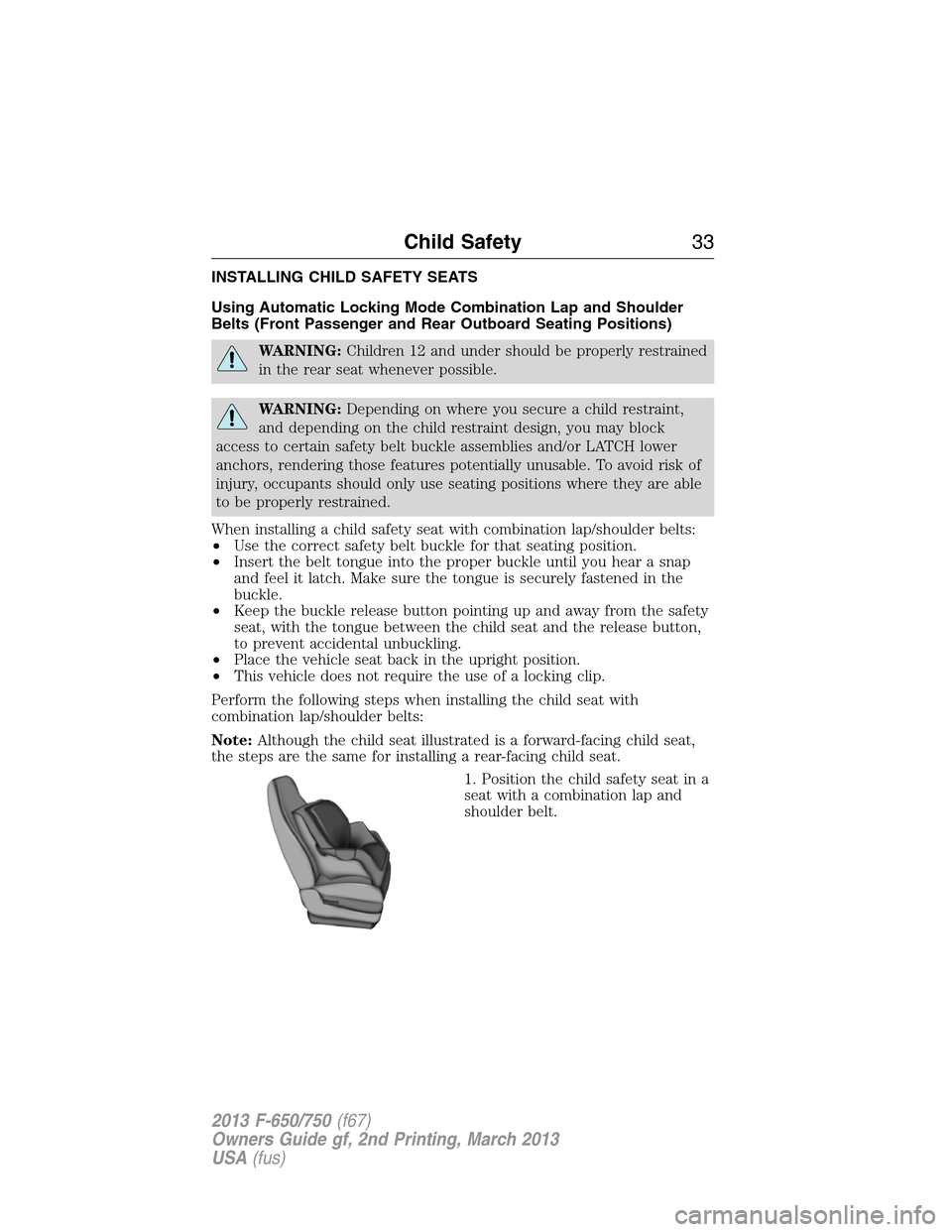
1. Position the child safety seat in a
seat with a combination lap and
shoulder belt.
Child Safety33
2013 F-650/750(f67)
Owners Guide gf, 2nd Printing, March 2013
USA(fus)
Page 35 of 378
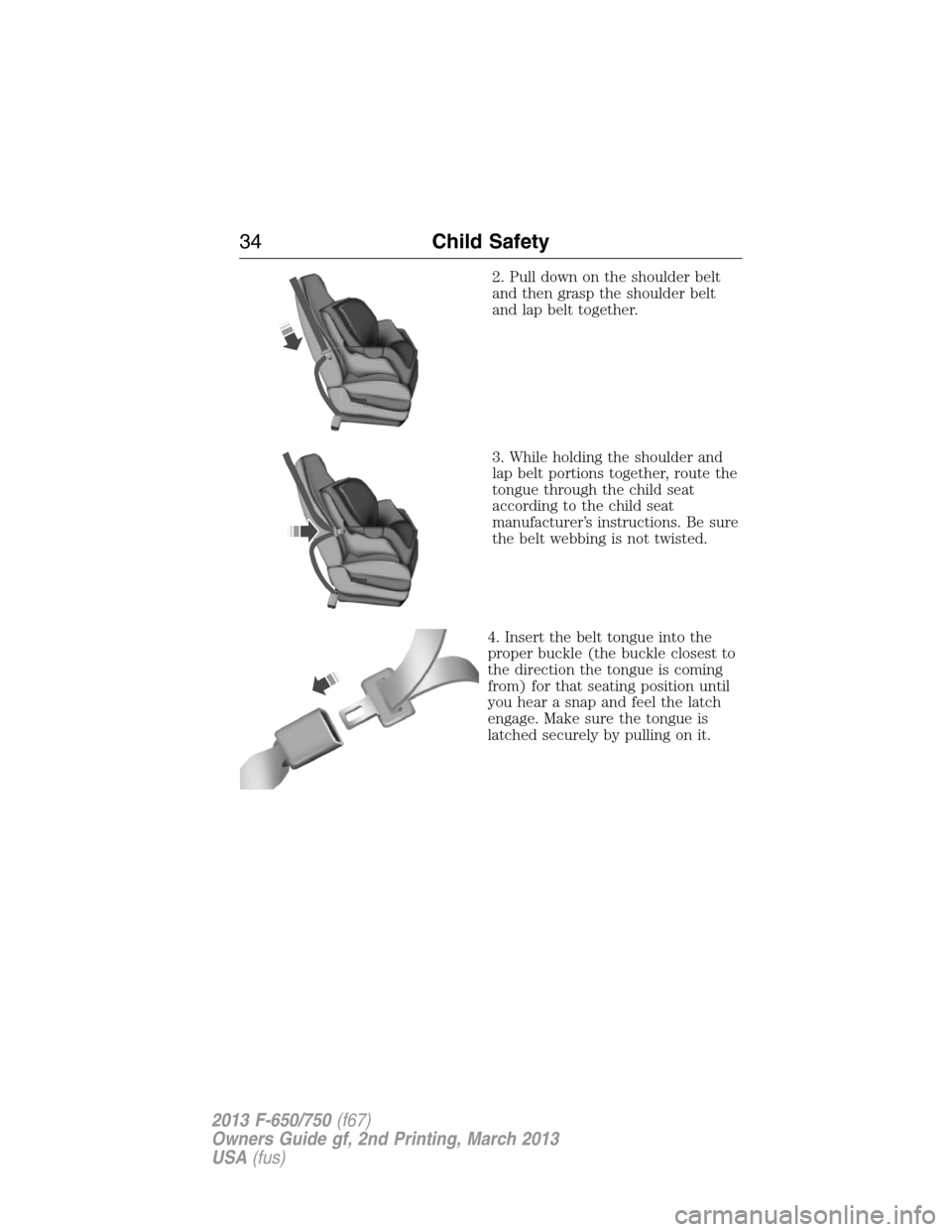
2. Pull down on the shoulder belt
and then grasp the shoulder belt
and lap belt together.
3. While holding the shoulder and
lap belt portions together, route the
tongue through the child seat
according to the child seat
manufacturer’s instructions. Be sure
the belt webbing is not twisted.
4. Insert the belt tongue into the
proper buckle (the buckle closest to
the direction the tongue is coming
from) for that seating position until
you hear a snap and feel the latch
engage. Make sure the tongue is
latched securely by pulling on it.
34Child Safety
2013 F-650/750(f67)
Owners Guide gf, 2nd Printing, March 2013
USA(fus)
Page 37 of 378
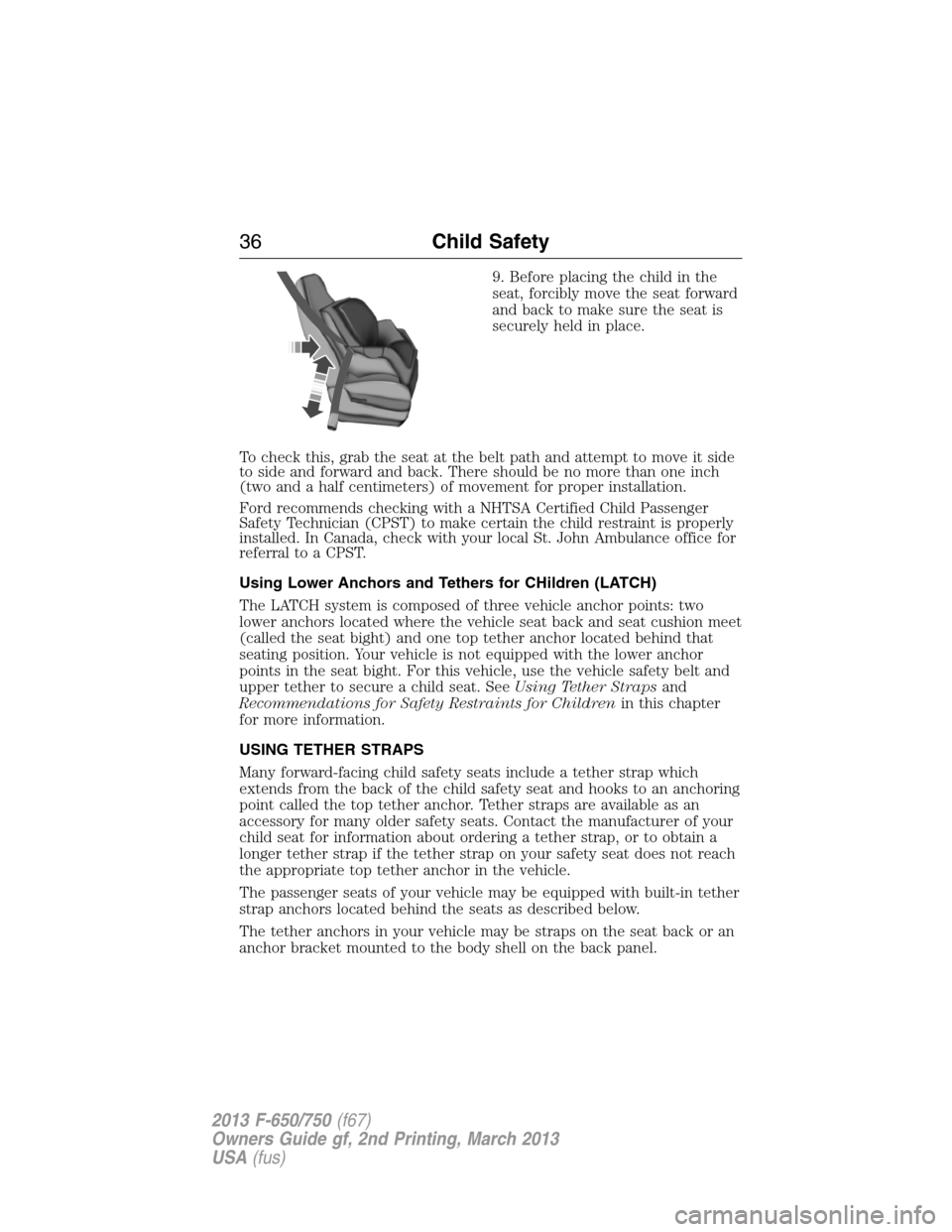
9. Before placing the child in the
seat, forcibly move the seat forward
and back to make sure the seat is
securely held in place.
To check this, grab the seat at the belt path and attempt to move it side
to side and forward and back. There should be no more than one inch
(two and a half centimeters) of movement for proper installation.
Ford recommends checking with a NHTSA Certified Child Passenger
Safety Technician (CPST) to make certain the child restraint is properly
installed. In Canada, check with your local St. John Ambulance office for
referral to a CPST.
Using Lower Anchors and Tethers for CHildren (LATCH)
The LATCH system is composed of three vehicle anchor points: two
lower anchors located where the vehicle seat back and seat cushion meet
(called the seat bight) and one top tether anchor located behind that
seating position. Your vehicle is not equipped with the lower anchor
points in the seat bight. For this vehicle, use the vehicle safety belt and
upper tether to secure a child seat. SeeUsing Tether Strapsand
Recommendations for Safety Restraints for Childrenin this chapter
for more information.
USING TETHER STRAPS
Many forward-facing child safety seats include a tether strap which
extends from the back of the child safety seat and hooks to an anchoring
point called the top tether anchor. Tether straps are available as an
accessory for many older safety seats. Contact the manufacturer of your
child seat for information about ordering a tether strap, or to obtain a
longer tether strap if the tether strap on your safety seat does not reach
the appropriate top tether anchor in the vehicle.
The passenger seats of your vehicle may be equipped with built-in tether
strap anchors located behind the seats as described below.
The tether anchors in your vehicle may be straps on the seat back or an
anchor bracket mounted to the body shell on the back panel.
36Child Safety
2013 F-650/750(f67)
Owners Guide gf, 2nd Printing, March 2013
USA(fus)
Page 39 of 378
3. You may need to pull the seat back forward to access the tether
anchors. Make sure the seat is locked in the upright position before
installing the child seat.
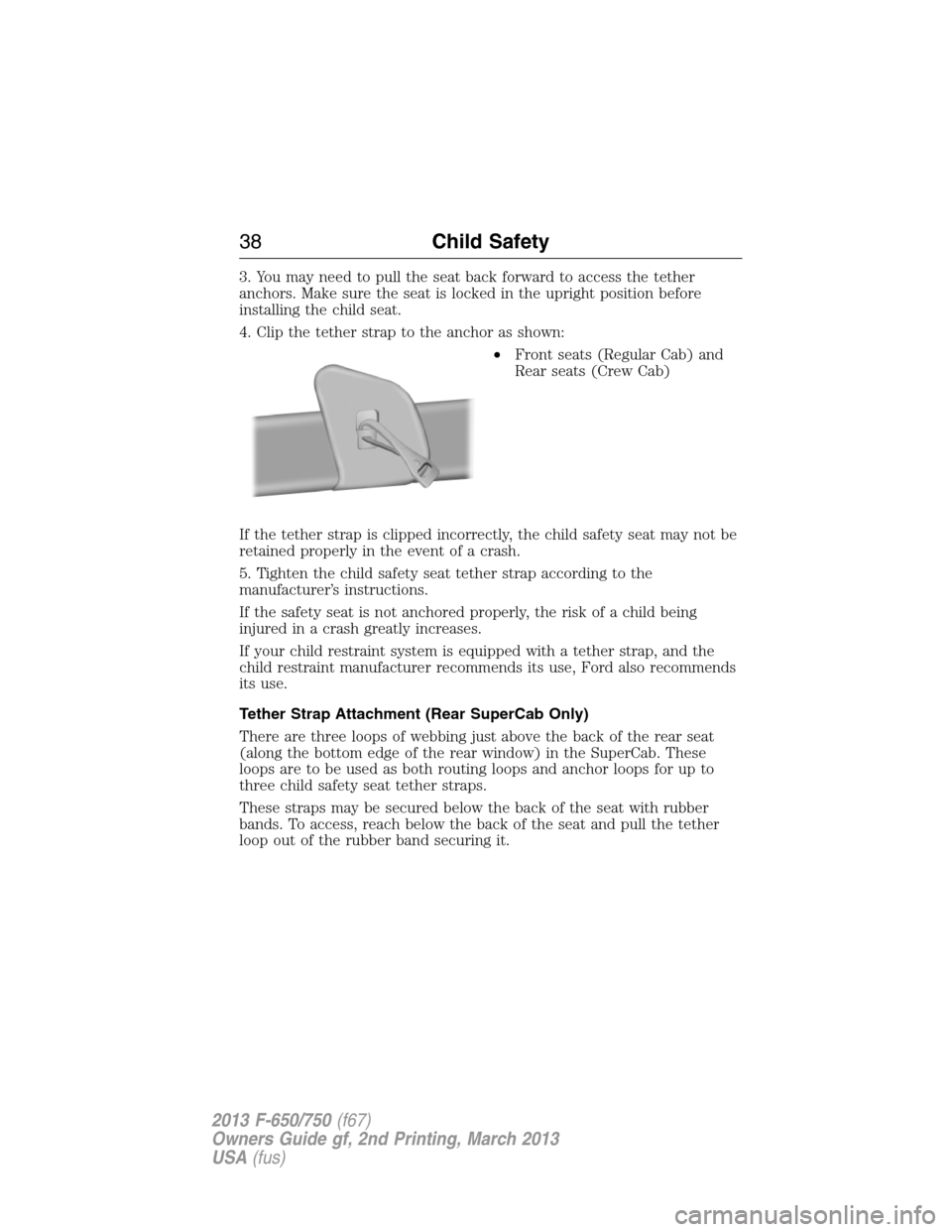
4. Clip the tether strap to the anchor as shown:
•Front seats (Regular Cab) and
Rear seats (Crew Cab)
If the tether strap is clipped incorrectly, the child safety seat may not be
retained properly in the event of a crash.
5. Tighten the child safety seat tether strap according to the
manufacturer’s instructions.
If the safety seat is not anchored properly, the risk of a child being
injured in a crash greatly increases.
If your child restraint system is equipped with a tether strap, and the
child restraint manufacturer recommends its use, Ford also recommends
its use.
Tether Strap Attachment (Rear SuperCab Only)
There are three loops of webbing just above the back of the rear seat
(along the bottom edge of the rear window) in the SuperCab. These
loops are to be used as both routing loops and anchor loops for up to
three child safety seat tether straps.
These straps may be secured below the back of the seat with rubber
bands. To access, reach below the back of the seat and pull the tether
loop out of the rubber band securing it.
38Child Safety
2013 F-650/750(f67)
Owners Guide gf, 2nd Printing, March 2013
USA(fus)