ECU FORD FESTIVA 1991 Owner's Guide
[x] Cancel search | Manufacturer: FORD, Model Year: 1991, Model line: FESTIVA, Model: FORD FESTIVA 1991Pages: 454, PDF Size: 9.53 MB
Page 360 of 454
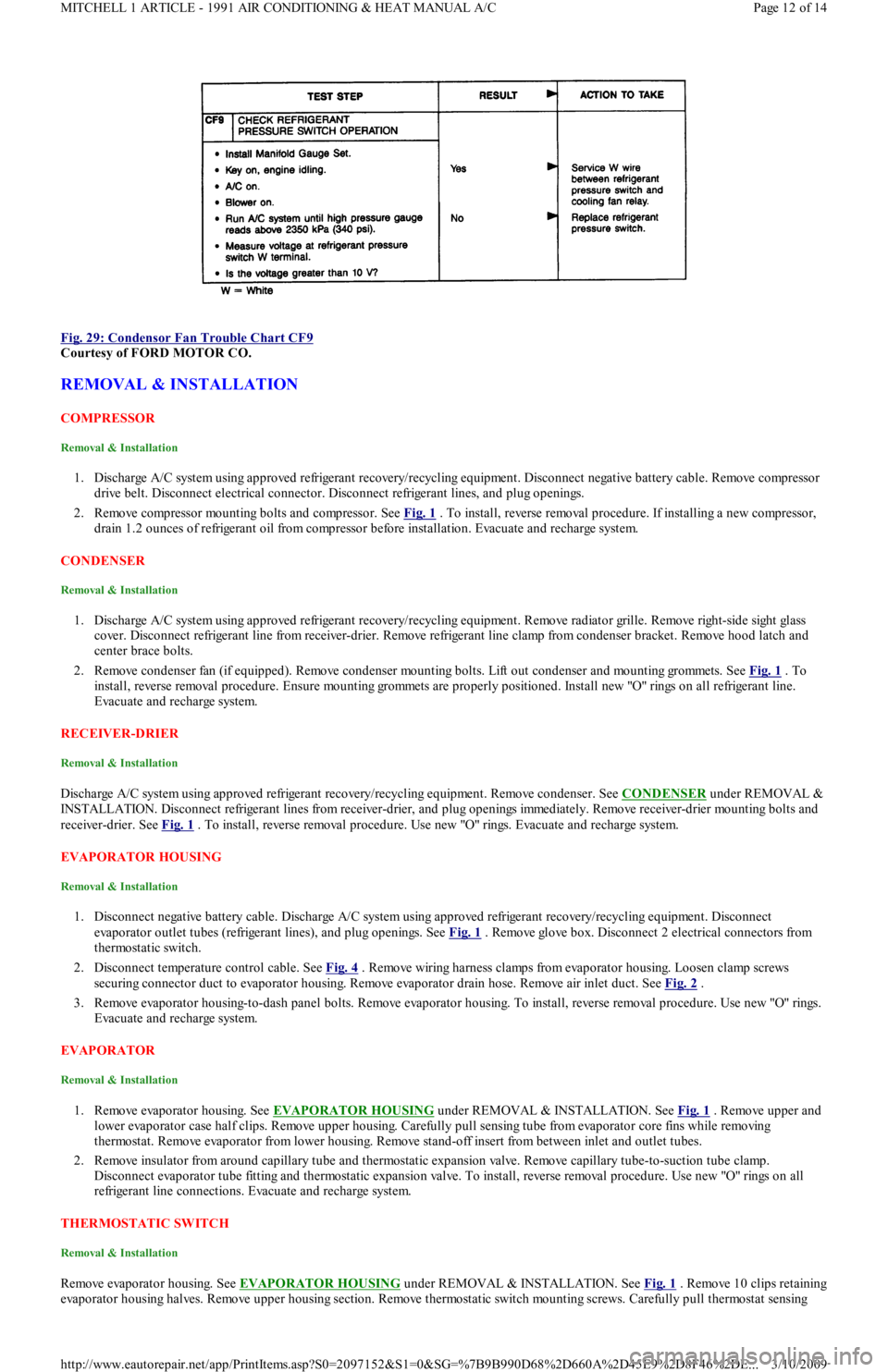
Fig. 29: Condensor Fan Trouble Chart CF9
Courtesy of FORD MOTOR CO.
REMOVAL & INSTALLATION
COMPRESSOR
Removal & Installation
1. Discharge A/C system using approved refrigerant recovery/recycling equipment. Disconnect negative battery cable. Remove compressor
drive belt. Disconnect electrical connector. Disconnect refrigerant lines, and plug openings.
2. Remove compressor mounting bolts and compressor. See Fig. 1
. To install, reverse removal procedure. If installing a new compressor,
drain 1.2 ounces of refrigerant oil from compressor before installation. Evacuate and recharge system.
CONDENSER
Removal & Installation
1. Discharge A/C system using approved refrigerant recovery/recycling equipment. Remove radiator grille. Remove right-side sight glass
cover. Disconnect refrigerant line from receiver-drier. Remove refrigerant line clamp from condenser bracket. Remove hood latch and
center brace bolts.
2. Remove condenser fan (if equipped). Remove condenser mounting bolts. Lift out condenser and mounting grommets. See Fig. 1
. To
install, reverse removal procedure. Ensure mounting grommets are properly positioned. Install new "O" rings on all refrigerant line.
Evacuate and recharge system.
RECEIVER-DRIER
Removal & Installation
Discharge A/C system using approved refrigerant recovery/recycling equipment. Remove condenser. See CONDENSER under REMOVAL &
INSTALLATION. Disconnect refrigerant lines from receiver-drier, and plug openings immediately. Remove receiver-drier mounting bolts and
receiver-drier. See Fig. 1
. To install, reverse removal procedure. Use new "O" rings. Evacuate and recharge system.
EVAPORATOR HOUSING
Removal & Installation
1. Disconnect negative battery cable. Discharge A/C system using approved refrigerant recovery/recycling equipment. Disconnect
evaporator outlet tubes (refrigerant lines), and plug openings. See Fig. 1
. Remove glove box. Disconnect 2 electrical connectors from
thermostatic switch.
2. Disconnect temperature control cable. See Fig. 4
. Remove wiring harness clamps from evaporator housing. Loosen clamp screws
securing connector duct to evaporator housing. Remove evaporator drain hose. Remove air inlet duct. See Fig. 2
.
3. Remove evaporator housing-to-dash panel bolts. Remove evaporator housing. To install, reverse removal procedure. Use new "O" rings.
Evacuate and recharge system.
EVAPORATOR
Removal & Installation
1. Remove evaporator housing. See EVAPORATOR HOUSING under REMOVAL & INSTALLATION. See Fig. 1 . Remove upper and
lower evaporator case half clips. Remove upper housing. Carefully pull sensing tube from evaporator core fins while removing
thermostat. Remove evaporator from lower housing. Remove stand-off insert from between inlet and outlet tubes.
2. Remove insulator from around capillary tube and thermostatic expansion valve. Remove capillary tube-to-suction tube clamp.
Disconnect evaporator tube fitting and thermostatic expansion valve. To install, reverse removal procedure. Use new "O" rings on all
refrigerant line connections. Evacuate and recharge system.
THERMOSTATIC SW ITCH
Removal & Installation
Remove evaporator housing. See EVAPORATOR HOUSING under REMOVAL & INSTALLATION. See Fig. 1. Remove 10 clips retaining
evaporator housing halves. Remove upper housing section. Remove thermostatic switch mounting screws. Carefully pull thermostat sensing
Page 12 of 14 MITCHELL 1 ARTICLE - 1991 AIR CONDITIONING & HEAT MANUAL A/C
3/10/2009 http://www.eautorepair.net/app/PrintItems.asp?S0=2097152&S1=0&SG=%7B9B990D68%2D660A%2D45E9%2D8F46%2DE
...
Page 370 of 454
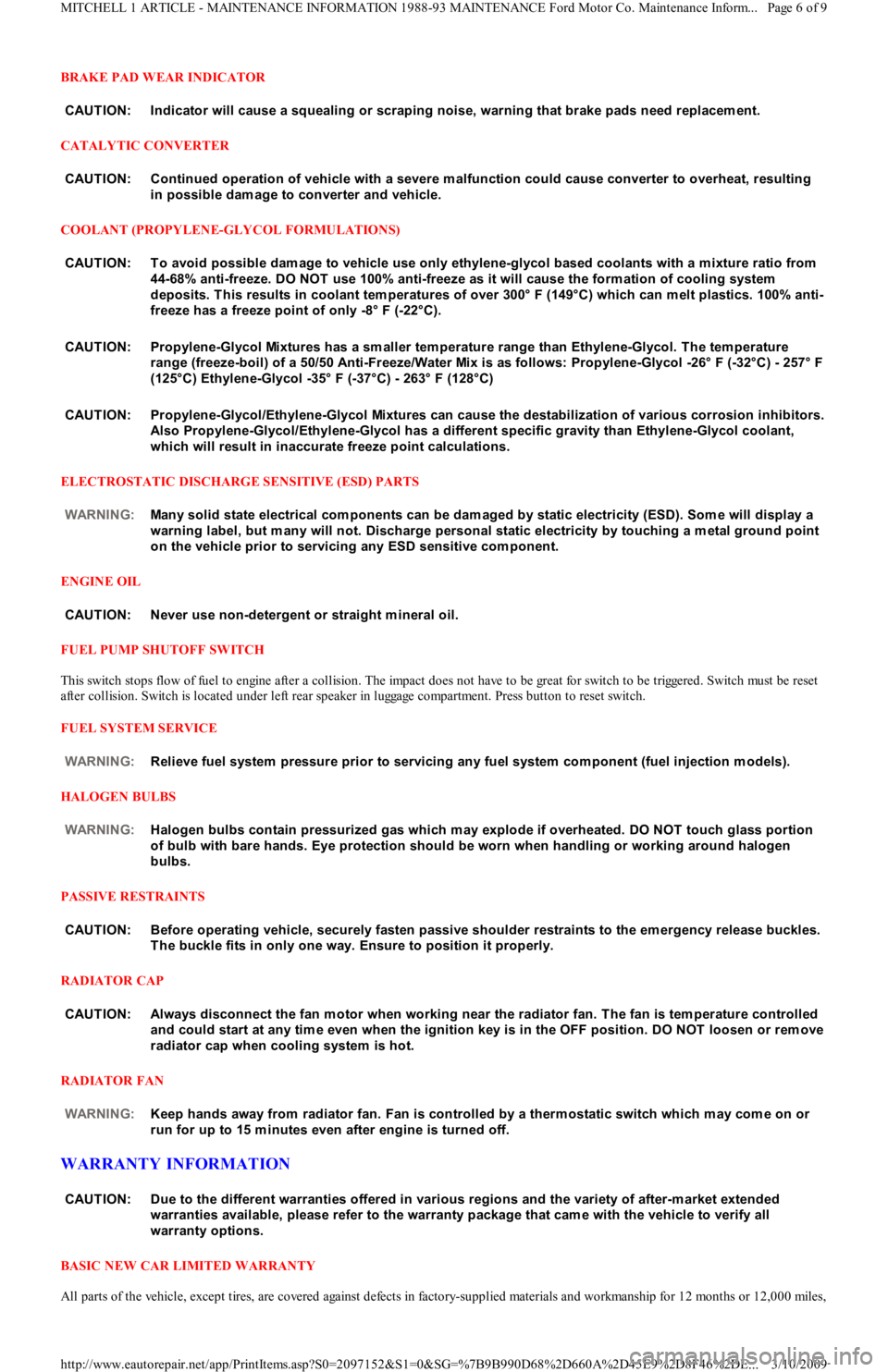
BRAKE PAD WEAR INDICATOR
CATALYTIC CONVERTER
COOLANT (PROPYLENE-GLYCOL FORMULATIONS)
ELECTROSTATIC DISCHARGE SENSITIVE (ESD) PARTS
ENGINE OIL
FUEL PUMP SHUTOFF SWITCH
This switch stops flow of fuel to engine after a collision. The impact does not have to be great for switch to be triggered. Switch must be reset
after collision. Switch is located under left rear speaker in luggage compartment. Press button to reset switch.
FUEL SYSTEM SERVICE
HALOGEN BULBS
PASSIVE RESTRAINTS
RADIATOR CAP
RADIATOR FAN
WARRANTY INFORMATION
BASIC NEW CAR LIMITED WARRANTY
All parts of the vehicle, except tires, are covered against defects in factory-supplied materials and workmanship for 12 months or 12,000 miles, CAUT ION: Indicator will cause a squealing or scraping noise, warning that brake pads need replacem ent.
CAUT ION: Continued operation of vehicle with a severe m alfunction could cause converter to overheat, resulting
in possible dam age to converter and vehicle.
CAUT ION: T o avoid possible dam age to vehicle use only ethylene-glycol based coolants with a m ixture ratio from
44-68% anti-freeze. DO NOT use 100% anti-freeze as it will cause the form ation of cooling system
deposits. T his results in coolant tem peratures of over 300° F (149°C) which can m elt plastics. 100% anti-
freeze has a freeze point of only -8° F (-22°C).
CAUT ION: Propylene-Glycol Mixtures has a sm aller tem perature range than Ethylene-Glycol. T he tem perature
range (freeze-boil) of a 50/50 Anti-Freeze/Water Mix is as follows: Propylene-Glycol -26° F (-32°C) - 257° F
(125°C) Ethylene-Glycol -35° F (-37°C) - 263° F (128°C)
CAUT ION: Propylene-Glycol/Ethylene-Glycol Mixtures can cause the destabilization of various corrosion inhibitors.
Also Propylene-Glycol/Ethylene-Glycol has a different specific gravity than Ethylene-Glycol coolant,
which will result in inaccurate freeze point calculations.
WARNING:Many solid state electrical com ponents can be dam aged by static electricity (ESD). Som e will display a
warning label, but m any will not. Discharge personal static electricity by touching a m etal ground point
on the vehicle prior to servicing any ESD sensitive com ponent.
CAUT ION: Never use non-detergent or straight m ineral oil.
WARNING:Relieve fuel system pressure prior to servicing any fuel system com ponent (fuel injection m odels).
WARNING:Halogen bulbs contain pressurized gas which m ay explode if overheated. DO NOT touch glass portion
of bulb with bare hands. Eye protection should be worn when handling or working around halogen
bulbs.
CAUT ION: Before operating vehicle, securely fasten passive shoulder restraints to the em ergency release buckles.
T he buckle fits in only one way. Ensure to position it properly.
CAUT ION: Always disconnect the fan m otor when working near the radiator fan. T he fan is tem perature controlled
and could start at any tim e even when the ignition key is in the OFF position. DO NOT loosen or rem ove
radiator cap when cooling system is hot.
WARNING:Keep hands away from radiator fan. Fan is controlled by a therm ostatic switch which m ay com e on or
run for up to 15 m inutes even after engine is turned off.
CAUT ION: Due to the different warranties offered in various regions and the variety of after-m arket extended
warranties available, please refer to the warranty package that cam e with the vehicle to verify all
warranty options.
Page 6 of 9 MITCHELL 1 ARTICLE - MAINTENANCE INFORMATION 1988-93 MAINTENANCE Ford Motor Co. Maintenance Inform...
3/10/2009 http://www.eautorepair.net/app/PrintItems.asp?S0=2097152&S1=0&SG=%7B9B990D68%2D660A%2D45E9%2D8F46%2DE
...
Page 376 of 454
the WHEEL ALIGNMENT section.
OVERHAUL
STEERING GEAR
Disassembly
1. With steering gear removed from vehicle, place steering gear in a soft-jawed vise. Mark threaded portion of tie rod for reassembly.
Remove tie rod ends. Remove tie rod boots. Remove lock pins from both ends of rack. See Fig. 1
.
2. Remove tie rod ball socket from end of rack. Remove both tie rods. Remove lock nut from yoke plug. Remove yoke plug, spring and
yoke support. Use a small screwdriver to remove pinion oil seal from pinion shaft. Remove pinion bearing snap ring.
3. Remove pinion and bearing assembly. If necessary use Valve Body Puller (T78P-3504-B) to remove pinion and bearing assembly.
Remove rack from pinion side of housing. If lower pinion bearing needs replacing, use Blind Hole Bearing Puller (D80L-100-L) and
Slide Hammer (T50T-100-A) to remove.
4. Press bushing lock tabs into the 3 slots located at end of rack housing. Use Blind Hole Bearing Puller (D80L-100-L), to remove rack
support bushing from right end of rack housing.
Inspection
1. Check rubber boots, ball bearings and tooth surface of rack for wear or damage. Using a dial indicator and "V" blocks, check rack for
straightness. Maximum allowable runout is 0.012" (0.3 mm). If rack support bushings are worn, use a screwdriver to release the tab lock
on the side opposite the pinion. Use blind hole Bearing Puller (D80L-100R) with slide hammer to remove bushing.
2. Check tie rod ball joints for smooth operation. Replace parts as necessary. Check sliding surface of rack support and gear housing for
cracks or damage. Check rack bushing for excessive wear. Replace entire gear housing assembly if any of these parts are worn or
damaged.
Reassembly
1. Apply lithium grease to ball bearing, roller bearing, inside of gear housing, lip of oil seal, sliding surface and back of rack support,
sliding surface of rack bushing, rack pinion teeth and ball joints. Install rack support bushing into right end of rack housing. Ensure lock
tabs engage with slots in housing.
2. If previously removed, install a new lower pinion bearing using a bushing installer or a piece of wooden dowel stock. Carefully insert
non-toothed side of rack into left end of rack housing, with rack teeth facing pinion bore. Position rack in housing so rack protrudes
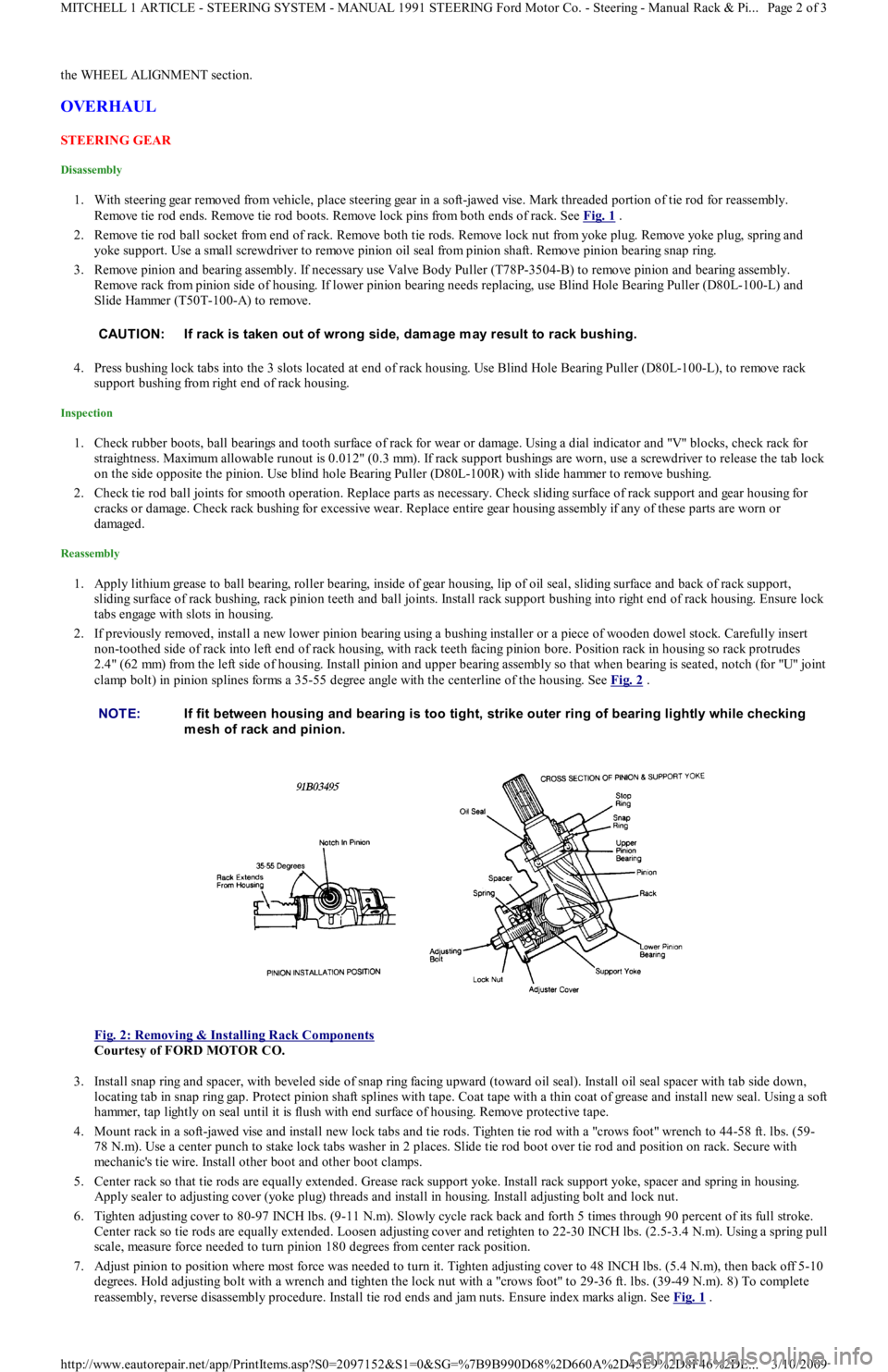
2.4" (62 mm) from the left side of housing. Install pinion and upper bearing assembly so that when bearing is seated, notch (for "U" joint
clamp bolt) in pinion splines forms a 35-55 degree angle with the centerline of the housing. See Fig. 2
.
Fig. 2: Removing & Installing Rack Components
Courtesy of FORD MOTOR CO.
3. Install snap ring and spacer, with beveled side of snap ring facing upward (toward oil seal). Install oil seal spacer with tab side down,
locating tab in snap ring gap. Protect pinion shaft splines with tape. Coat tape with a thin coat of grease and install new seal. Using a soft
hammer, tap lightly on seal until it is flush with end surface of housing. Remove protective tape.
4. Mount rack in a soft-jawed vise and install new lock tabs and tie rods. Tighten tie rod with a "crows foot" wrench to 44-58 ft. lbs. (59-
78 N.m). Use a center punch to stake lock tabs washer in 2 places. Slide tie rod boot over tie rod and position on rack. Secure with
mechanic's tie wire. Install other boot and other boot clamps.
5. Center rack so that tie rods are equally extended. Grease rack support yoke. Install rack support yoke, spacer and spring in housing.
Apply sealer to adjusting cover (yoke plug) threads and install in housing. Install adjusting bolt and lock nut.
6. Tighten adjusting cover to 80-97 INCH lbs. (9-11 N.m). Slowly cycle rack back and forth 5 times through 90 percent of its full stroke.
Center rack so tie rods are equally extended. Loosen adjusting cover and retighten to 22-30 INCH lbs. (2.5-3.4 N.m). Using a spring pull
scale, measure force needed to turn pinion 180 degrees from center rack position.
7. Adjust pinion to position where most force was needed to turn it. Tighten adjusting cover to 48 INCH lbs. (5.4 N.m), then back off 5-10
degrees. Hold adjusting bolt with a wrench and tighten the lock nut with a "crows foot" to 29-36 ft. lbs. (39-49 N.m). 8) To comp l et e
reassembly, reverse disassembly procedure. Install tie rod ends and jam nuts. Ensure index marks align. See Fig. 1
. CAUT ION: If rack is taken out of wrong side, dam age m ay result to rack bushing.
NOTE:If fit between housing and bearing is too tight, strike outer ring of bearing lightly while checking
m esh of rack and pinion.
Page 2 of 3 MITCHELL 1 ARTICLE - STEERING SYSTEM - MANUAL 1991 STEERING Ford Motor Co. - Steering - Manual Rack & Pi
...
3/10/2009 http://www.eautorepair.net/app/PrintItems.asp?S0=2097152&S1=0&SG=%7B9B990D68%2D660A%2D45E9%2D8F46%2DE
...
Page 381 of 454
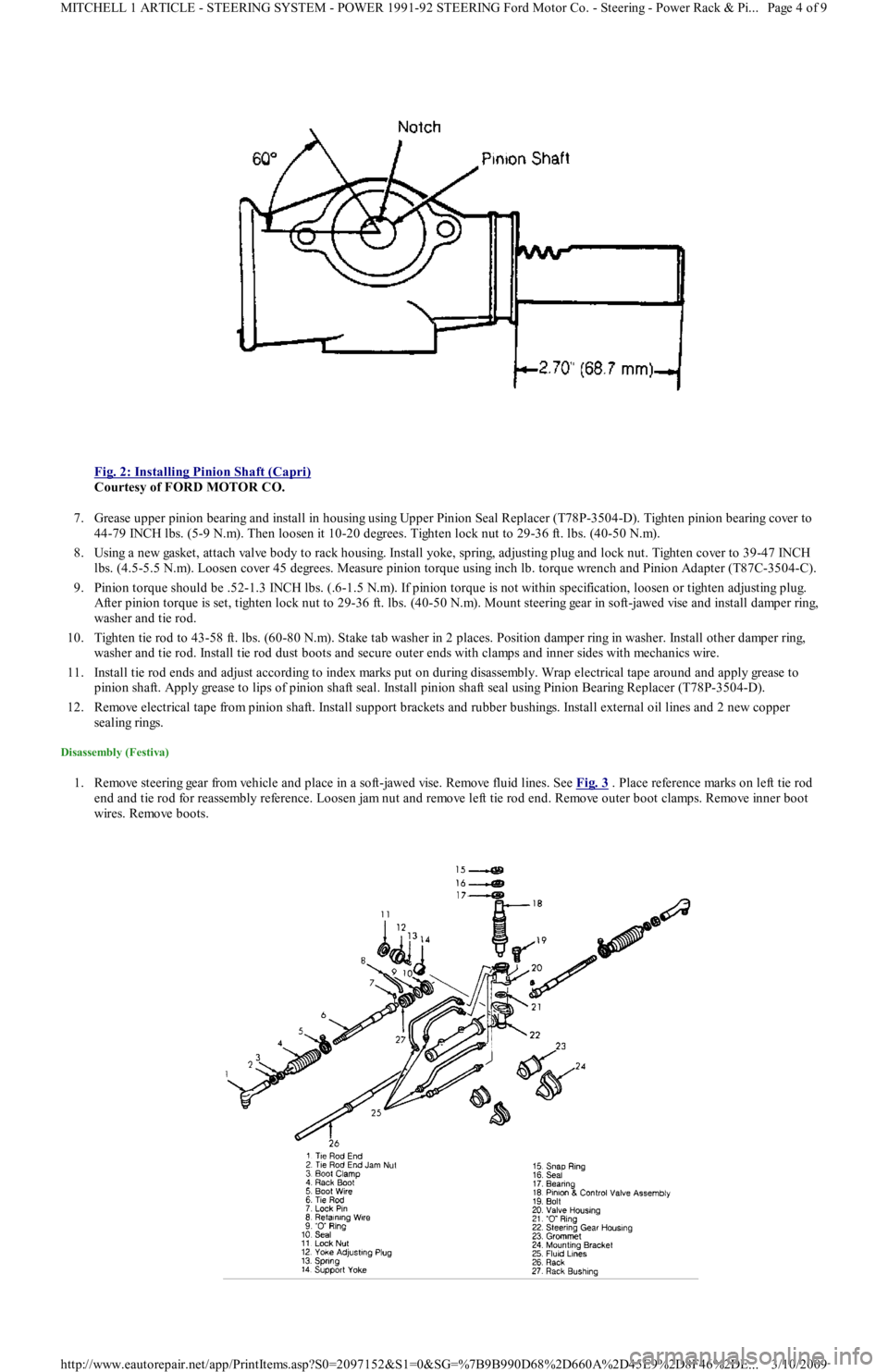
Fig. 2: Installing Pinion Shaft (Capri)
Courtesy of FORD MOTOR CO.
7. Grease upper pinion bearing and install in housing using Upper Pinion Seal Replacer (T78P-3504-D). Tighten pinion bearing cover to
44-79 INCH lbs. (5-9 N.m). Then loosen it 10-20 degrees. Tighten lock nut to 29-36 ft. lbs. (40-50 N.m).
8. Using a new gasket, attach valve body to rack housing. Install yoke, spring, adjusting plug and lock nut. Tighten cover to 39-47 INCH
lbs. (4.5-5.5 N.m). Loosen cover 45 degrees. Measure pinion torque using inch lb. torque wrench and Pinion Adapter (T87C-3504-C).
9. Pinion torque should be .52-1.3 INCH lbs. (.6-1.5 N.m). If pinion torque is not within specification, loosen or tighten adjusting plug.
After pinion torque is set, tighten lock nut to 29-36 ft. lbs. (40-50 N.m). Mount steering gear in soft-jawed vise and install damper ring,
washer and tie rod.
10. Tighten tie rod to 43-58 ft. lbs. (60-80 N.m). Stake tab washer in 2 places. Position damper ring in washer. Install other damper ring,
washer and tie rod. Install tie rod dust boots and secure outer ends with clamps and inner sides with mechanics wire.
11. Install tie rod ends and adjust according to index marks put on during disassembly. Wrap electrical tape around and apply grease to
pinion shaft. Apply grease to lips of pinion shaft seal. Install pinion shaft seal using Pinion Bearing Replacer (T78P-3504-D).
12. Remove electrical tape from pinion shaft. Install support brackets and rubber bushings. Install external oil lines and 2 new copper
sealing rings.
Disassembly (Festiva)
1. Remove steering gear from vehicle and place in a soft-jawed vise. Remove fluid lines. See Fig. 3 . Place reference marks on left tie rod
end and tie rod for reassembly reference. Loosen jam nut and remove left tie rod end. Remove outer boot clamps. Remove inner boot
wires. Remove boots.
Page 4 of 9 MITCHELL 1 ARTICLE - STEERING SYSTEM - POWER 1991-92 STEERING Ford Motor Co. - Steering - Power Rack & Pi
...
3/10/2009 http://www.eautorepair.net/app/PrintItems.asp?S0=2097152&S1=0&SG=%7B9B990D68%2D660A%2D45E9%2D8F46%2DE
...
Page 384 of 454
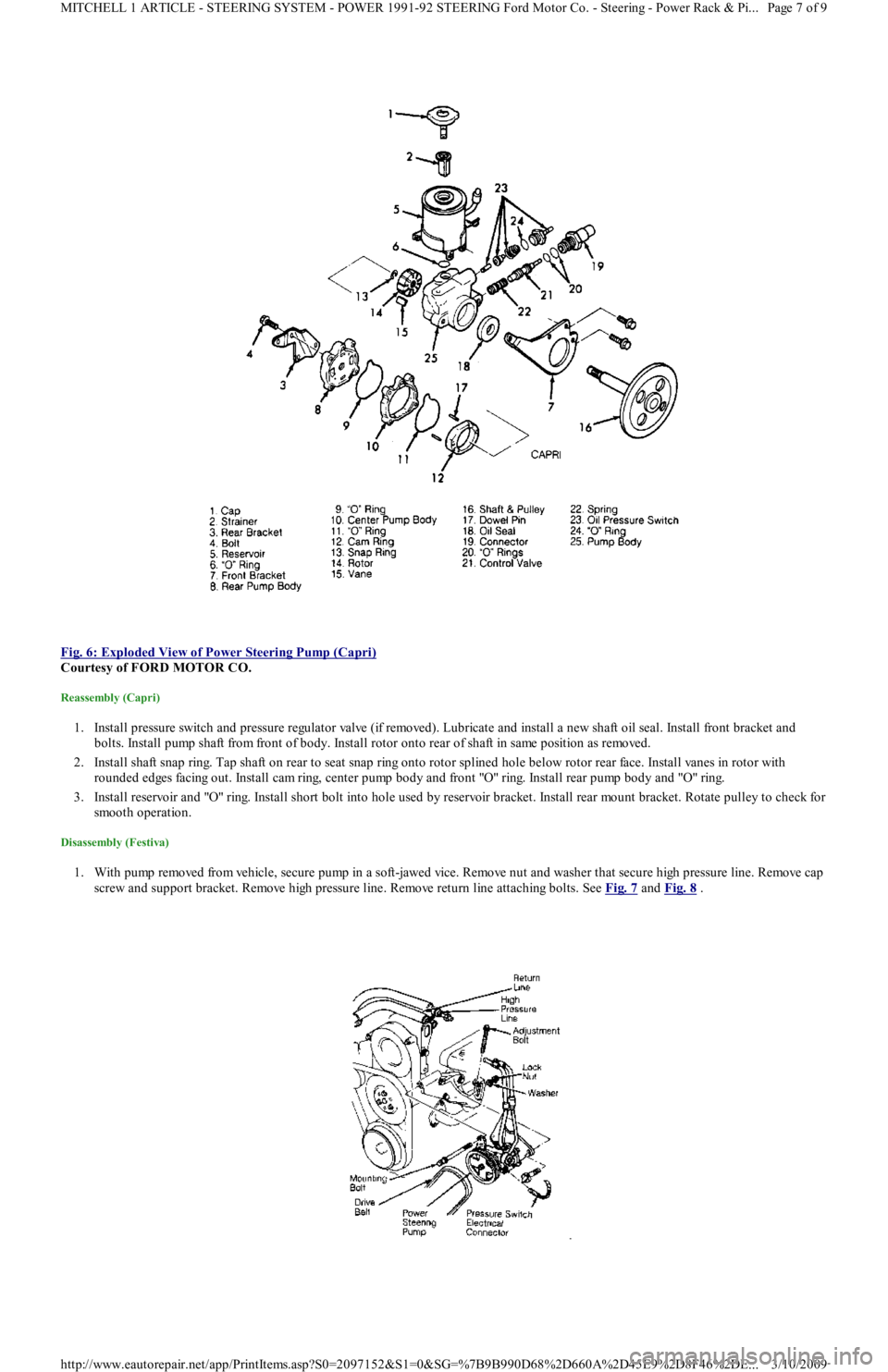
Fig. 6: Exploded View of Power Steering Pump (Capri)
Courtesy of FORD MOTOR CO.
Reassembly (Capri)
1. Install pressure switch and pressure regulator valve (if removed). Lubricate and install a new shaft oil seal. Install front bracket and
bolts. Install pump shaft from front of body. Install rotor onto rear of shaft in same position as removed.
2. Install shaft snap ring. Tap shaft on rear to seat snap ring onto rotor splined hole below rotor rear face. Install vanes in rotor with
rounded edges facing out. Install cam ring, center pump body and front "O" ring. Install rear pump body and "O" ring.
3. Install reservoir and "O" ring. Install short bolt into hole used by reservoir bracket. Install rear mount bracket. Rotate pulley to check for
smooth operation.
Disassembly (Festiva)
1. With pump removed from vehicle, secure pump in a soft-jawed vice. Remove nut and washer that secure high pressure line. Remove cap
screw and support bracket. Remove high pressure line. Remove return line attaching bolts. See Fig. 7
and Fig. 8 .
Page 7 of 9 MITCHELL 1 ARTICLE - STEERING SYSTEM - POWER 1991-92 STEERING Ford Motor Co. - Steering - Power Rack & Pi
...
3/10/2009 http://www.eautorepair.net/app/PrintItems.asp?S0=2097152&S1=0&SG=%7B9B990D68%2D660A%2D45E9%2D8F46%2DE
...
Page 388 of 454
Removal & Installation (Capri)
Disconnect negative battery cable. With steering wheel removed, remove screws from lower column cover and remove lower cover. Remove
steering column upper retaining bolts. Steering column will rest on instrument panel bracket. Release wiring harness clip and unplug
connectors. Remove 2 switch retaining screws and remove switch from steering column. To install, reverse removal procedure.
Removal & Installation (Festiva)
Disconnect negative battery cable. With steering wheel removed, remove screws from lower column cover and remove both upper and lower
cover. Release wiring harness clip and unplug connectors. Loosen band clamp securing switch hub to steering column jacket. Remove swit c h
from steering column. To install, reverse removal procedure.
IGNITION SWITCH & LOCK
Removal & Installation (Capri Ignition Switch)
1. Disconnect negative battery cable. With steering wheel removed, remove upper and lower column covers. Remove center access panel
and trim panel under steering wheel. Remove left side defroster connector tube.
2. Remove steering column upper attaching bolts. Lower steering column onto instrument panel brace. Remove ignition tumbler. With
ignition key inserted, rotate tumbler while pushing release pin with .125" (3.17 mm) drift. Pull tumbler out of ignition lock housing.
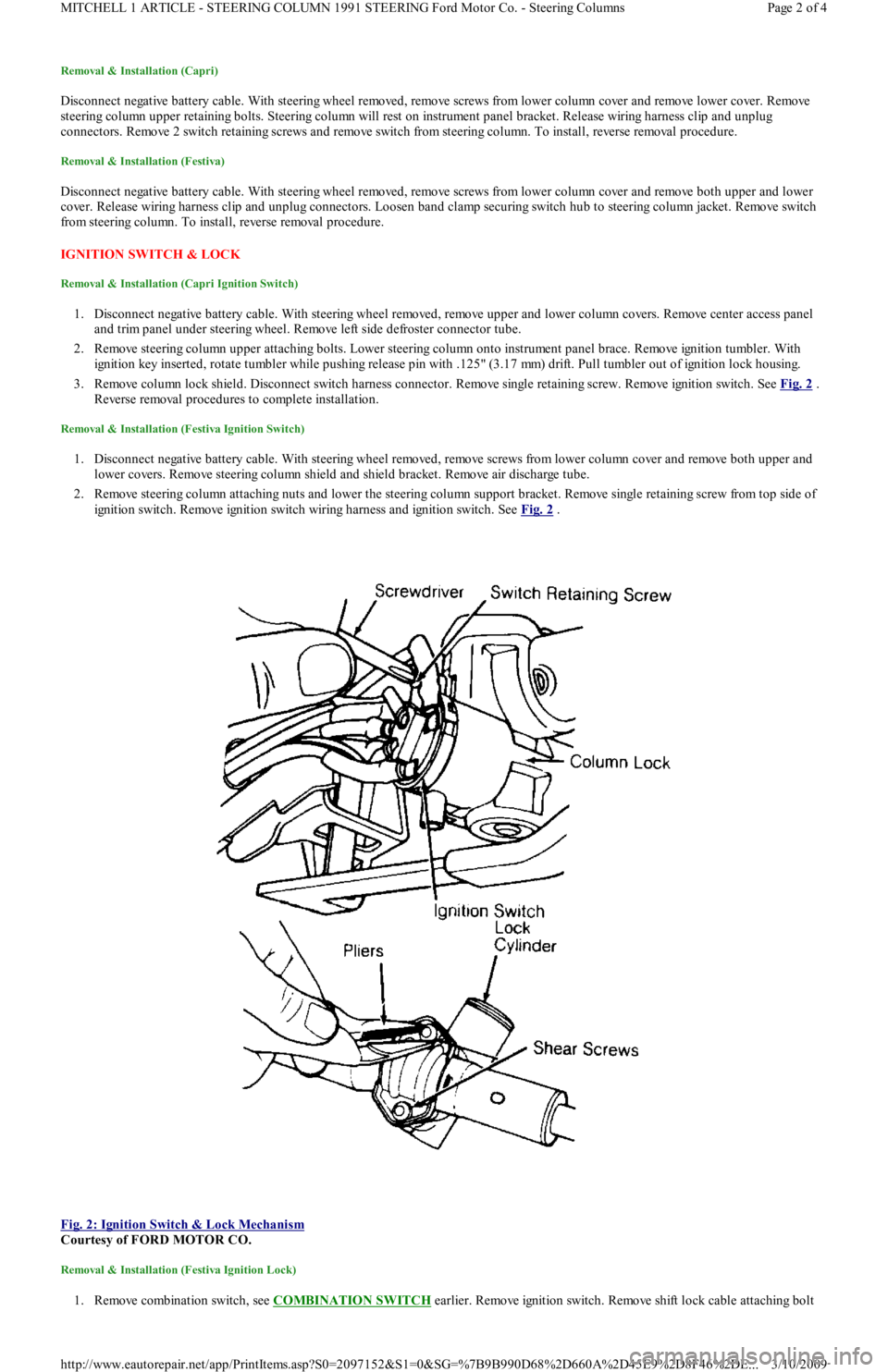
3. Remove column lock shield. Disconnect switch harness connector. Remove single retaining screw. Remove ignition switch. See Fig. 2
.
Reverse removal procedures to complete installation.
Removal & Installation (Festiva Ignition Switch)
1. Disconnect negative battery cable. With steering wheel removed, remove screws from lower column cover and remove both upper and
lower covers. Remove steering column shield and shield bracket. Remove air discharge tube.
2. Remove steering column attaching nuts and lower the steering column support bracket. Remove single retaining screw from top side of
ignition switch. Remove ignition switch wiring harness and ignition switch. See Fig. 2
.
Fig. 2: Ignition Switch & Lock Mechanism
Courtesy of FORD MOTOR CO.
Removal & Installation (Festiva Ignition Lock)
1. Remove combination switch, see COMBINATION SW ITCH earlier. Remove ignition switch. Remove shift lock cable attaching bolt
Page 2 of 4 MITCHELL 1 ARTICLE - STEERING COLUMN 1991 STEERING Ford Motor Co. - Steering Columns
3/10/2009 http://www.eautorepair.net/app/PrintItems.asp?S0=2097152&S1=0&SG=%7B9B990D68%2D660A%2D45E9%2D8F46%2DE
...
Page 389 of 454
and disconnect cable from lock housing. Using slim-nose locking pliers, grip and remove round headed shear screws securing column
lock housing and cap to column jacket. See Fig. 2
.
2. Remove lock housing. To install lock housing, position lock cylinder and cap on column jacket. Using new screws, tighten only enough
to hold lock housing in position. Use ignition key to ensure lock works correctly without binding. Adjust switch if necessary. Tighten
shear screws until heads break off. Install ignition switch in cylinder. Reverse removal procedures to complete installation.
STEERING COLUMN
Removal & Installation (Capri)
1. Place wheels in a straight-ahead position. Remove ignition key and lock steering wheel. Disconnect negative battery cable and air bag
back-up power supply. Back-up power supply is a Blue rectangular unit located behind glove box, attached to instrument panel.
2. Remove air bag module from steering wheel. Remove steering column access cover and trim panel. Remove defroster duct connecting
hose. Remove steering column lower shroud. Loosen lower steering c o l u mn r e t a in in g n u t s. R e mo ve st e e r in g c o l u mn u p p e r r e t a in in g
nuts.
3. Remove ignition lock shield and ignition switch mount screw. Disconnect all necessary electrical connectors. Mark and remove steering
shaft universal joint bolt. Remove steering column from instrument panel. To install, reverse removal procedure. Once steering column
is completely installed, check all switches and functions for proper operation.
Removal (Festiva)
1. Disconnect battery ground cable. Place wheels in a straight-ahead position. Remove steering wheel, upper and lower column covers,
combination switch, ignition switch and harness connectors.
2. Remove steering column shield and air duct from below steering column. Remove 2 steering column upper mounting bracket-to-
instrument panel crossmember nuts.
3. Lower upper end of column as necessary to gain access to intermediate shaft upper "U" joint. Mark steering shaft and upper "U" jo in t fo r
reassembly reference.
4. Remove "U" joint attaching bolt. Loosen 2 steering column hinge bracket-to-clutch/brake pedal support nuts. Remove steering column
with upper "U" joint by pulling toward passenger compartment.
Installation (Festiva)
1. Align marks made during removal and install column with intermediate shaft upper "U" joint over intermediate shaft. Install, but do not
tighten, "U" joint clamp bolt.
2. Install and tighten hinge bracket nuts. Install shim clips on column upper bracket flanges (if removed). Position upper end of steering
column to instrument panel mounting studs.
3. Install upper bracket retaining nuts. Turn steering wheel lock-to-lock several times to align "U" joint splines. Tighten "U" joint clamp
bolt.
4. Install air duct and instrument panel brace. Install harness connectors, ignition switch, combination switch, upper and lower column
covers and steering wheel.
OVERHAUL
STEERING COLUMN
Disassembly & Reassembly (Capri)
1. Remove steering column. See STEERING COLUMN under REMOVAL & INSTALLATION. Position steering column in soft-jawed
vise. Using Steering Wheel Remover (T67L-3600-A), remove steering wheel. Put 2 strips of tape on air bag clockspring, to avoid
rotation.
2. Remove 3 clockspring retaining screws and remove clockspring. With ignition key installed, rotate tumbler to Run position while
pushing tumbler release pin with .125" (3.17 mm) drift. Remove tumbler and upper column shroud. Remove key warning switch.
3. Remove bearing plate. Remove and discard snap ring located at front end of steering column. Remove multifunction switch. Remove
column lock and upper bearing using a suitable bearing puller. To reassemble, reverse disassembly procedure.
Disassembly (Festiva)
Disassembly of steering column assembly is not recommended by manufacturer. If any components are found defective, replace steering
column assembly.
Inspection (Festiva)
1. Measure steering shaft for signs of collapse. Steering shaft length should be between 23.86-23.94" (606-608 mm). If measurement is not
within specification, replace steering column assembly.
2. Check for steering shaft side play. Any detectable side play can adversely affect steering control. If side play in excess of .03" (.75 mm)
is present, bearings are badly worn. Replace steering column assembly.
Reassembly (Festiva)
NOTE:If steering rack and interm ediate shaft are also rem oved, "U" joints and interm ediate shaft m ust be
m arked for reassem bly reference. Both ends of shaft are identical.
CAUT ION: If steering shaft shear pins break during housing or bearing rem oval, the com plete shaft and colum n
m ust be replaced. T o determ ine if pins have sheared, m easure steering shaft from top end of shaft to
center of U-
joint bearing. If length is less than 24.23" (615.7 m m ) or greater than 24.66" (617.7 m m ), pins
have sheared.
Page 3 of 4 MITCHELL 1 ARTICLE - STEERING COLUMN 1991 STEERING Ford Motor Co. - Steering Columns
3/10/2009 http://www.eautorepair.net/app/PrintItems.asp?S0=2097152&S1=0&SG=%7B9B990D68%2D660A%2D45E9%2D8F46%2DE
...
Page 392 of 454
WHEEL BEARINGS
Wheel bearing preload is maintained by a selective spacer in the steering knuckle, between the inner and outer hub bearings. For adjustment
procedures and inspection, see WHEEL BEARING under REMOVAL & INSTALLATION.
BALL JOINT CHECKING
Raise and support vehicle until tire is just off ground. Move wheel vertically and check for play. If play is noticed between steering knuckle
and control arm, control arm assembly should be replaced. If play is present but ball joint is okay, wheel bearings should be checked for wear
and replaced if necessary.
REMOVAL & INSTALLATION
STABILIZER BAR
Removal & Installation (Festiva)
1. Remove stabilizer mounting bracket nuts and brackets. Remove split bushings from stabilizer bar. Remove stabilizer bushing nuts at
lower control arms. Remove rear dished washers and bushings.
2. To loosen stabilizer bar, pull forward from control arms. Remove front bushings and washers. Install control arm bushing washers on
ends of stabilizer and install control arm front bushings. Insert ends of stabilizer bar into control arm bushings and install rear bushings
and washers on stabilizer bar ends.
3. Install retaining nuts finger tight. Install split bushings on stabilizer cross bar with split side forward. Position split bushings next to
White locating marks on bar. Install stabilizer mounting brackets. Tighten all bolts and nuts to specification.
STRUT ASSEMBLY & COIL SPRING
Removal
1. Raise and support front of vehicle so struts are fully extended. Remove front wheels. Remove brake line clip from strut lower mounting
bracket and remove brake line.
2. Remove 2 bolts retaining strut lower bracket to steering knuckle. Working inside engine compartment, remove 2 nuts retaining strut
mounting block in strut tower. Disengage strut lower bracket from steering knuckle and lower strut from vehicle.
Disassembly & Reassembly
1. Using spring compressor, compress spring to unload strut. Pry out mounting block cap and remove strut upper nut and lock washer.
2. Remove strut mounting block and spacer plate. Remove washer, bearing seal and bearing from strut rod. Remove spring upper seat, seat
insulator and coil spring. Remove jounce bumper and dust shield from strut. Reverse disassembly procedure to install coil spring a n d
reassemble strut.
Installation
1. Position strut, with spacer plate installed, in strut tower with White alignment mark facing outward. Install and tighten nuts on upper
mounting block studs.
2. Install steering knuckle in strut lower bracket. To complete installation, reverse removal procedure. Tighten all bolts and nuts to
specification.
HUB & KNUCKLE ASSEMBLY
Removal
1. Raise and support vehicle. Remove wheel. Straighten staked edge of drive axle lock nut flange. DO NOT damage groove or threads in
end of drive axle. Apply brakes to prevent hub assembly from turning. Remove and discard drive axle lock nut.
2. Remove clip which secures brake hose to strut bracket. Remove cotter pin and tie rod end attaching nut. Using Tie Rod End Separator
(T85M-3395A), remove tie rod end from steering knuckle.
3. Remove brake caliper attaching bolts and remove assembly from steering knuckle. Do not allow caliper to hang by brake hose. Remove
clamp bolt and nut where lower control arm ball joint connects to steering knuckle.
4. Using a pry bar, pull down on lower control arm and release ball joint from steering knuckle. Remove 2 bolts which attach steering
knuckle between flanges of MacPherson strut bracket. Slide hub/knuckle assembly off end of drive axle. If binding is present or drive
hub is rusted to half-shaft, use a hub puller to push axle from drive hub.
Installation
1. Apply a thin coat of SAE 30 weight oil to drive axle splines. Slide steering knuckle/rotor/hub assembly onto drive axle. Stop at area
where uppermost arm of steering knuckle seats into MacPherson strut bracket.
2. To complete installation, reverse removal procedure. Install NEW drive axle lock nut. Tighten all bolts and nuts to specification. Stake
axle lock nut into shaft groove.
WHEEL BEARING NOTE:Inform ation for stabilizer bar rem oval and installation on Capri is not available from m anufacturer.
NOTE:Always use a new drive axle lock nut when servicing drive hub or drive axle.
CAUT ION: DO NOT use a pointed tool to stake nut. If lock nut flange cracks, even slightly, during staking process,
it m ust be replaced.
Page 2 of 5 MITCHELL 1 ARTICLE - SUSPENSION - FRONT 1991-92 SUSPENSION Front
3/10/2009 http://www.eautorepair.net/app/PrintItems.asp?S0=2097152&S1=0&SG=%7B9B990D68%2D660A%2D45E9%2D8F46%2DE
...
Page 431 of 454
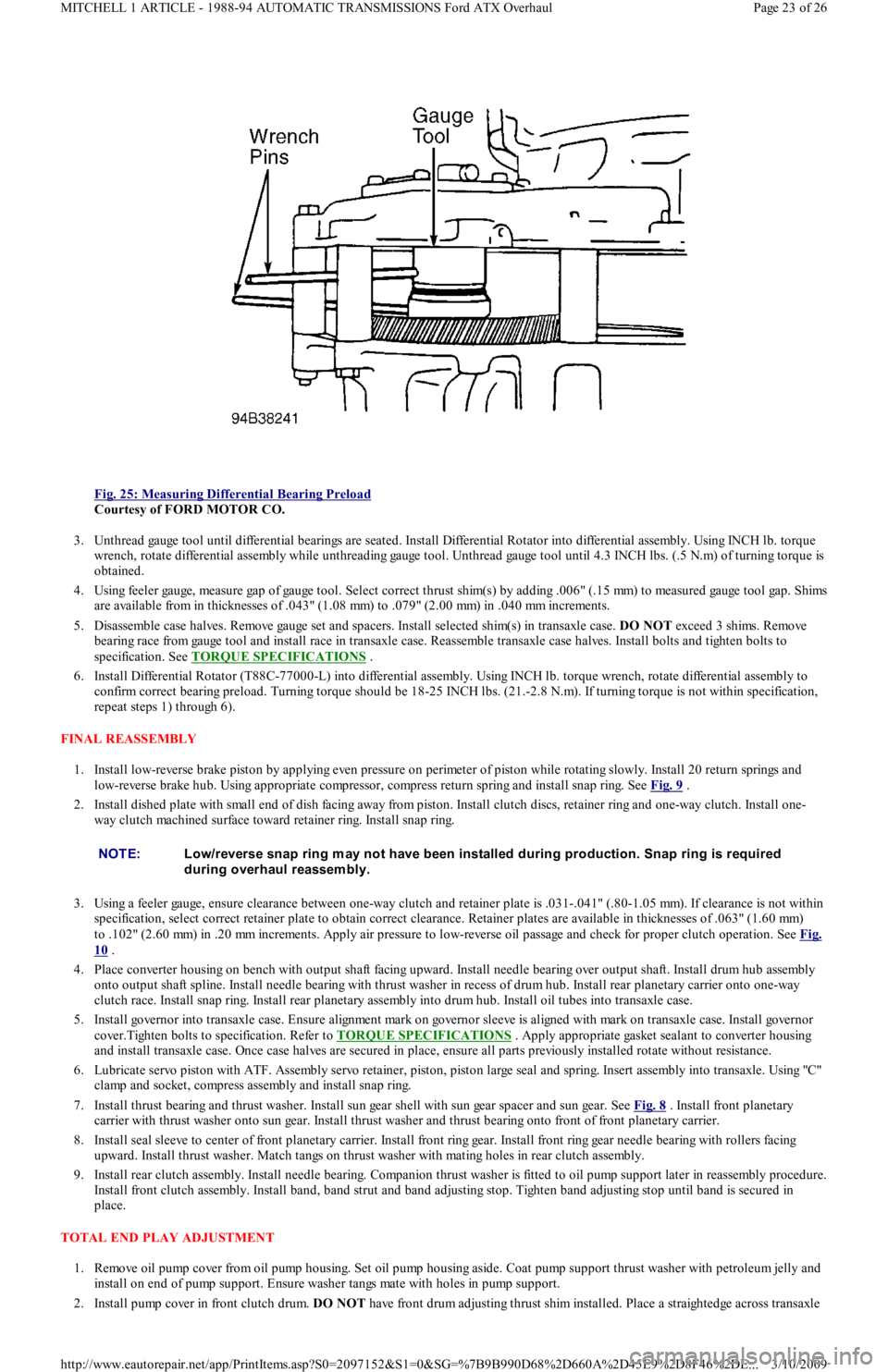
Fig. 25: Measuring Differential Bearing Preload
Courtesy of FORD MOTOR CO.
3. Unthread gauge tool until differential bearings are seated. Install Differential Rotator into differential assembly. Using INCH lb. torque
wrench, rotate differential assembly while unthreading gauge tool. Unthread gauge tool until 4.3 INCH lbs. (.5 N.m) of turning torque is
obtained.
4. Using feeler gauge, measure gap of gauge tool. Select correct thrust shim(s) by adding .006" (.15 mm) to measured gauge tool ga p . S h ims
are available from in thicknesses of .043" (1.08 mm) to .079" (2.00 mm) in .040 mm increments.
5. Disassemble case halves. Remove gauge set and spacers. Install selected shim(s) in transaxle case. DO NOT exceed 3 shims. Remove
bearing race from gauge tool and install race in transaxle case. Reassemble transaxle case halves. Install bolts and tighten bolts to
specification. See TORQUE SPECIFICATIONS
.
6. Install Differential Rotator (T88C-77000-L) into differential assembly. Using INCH lb. torque wrench, rotate differential assembly to
confirm correct bearing preload. Turning torque should be 18-25 INCH lbs. (21.-2.8 N.m). If turning torque is not within specification,
repeat steps 1) through 6).
FINAL REASSEMBLY
1. Install low-reverse brake piston by applying even pressure on perimeter of piston while rotating slowly. Install 20 return springs and
low-reverse brake hub. Using appropriate compressor, compress return spring and install snap ring. See Fig. 9
.
2. Install dished plate with small end of dish facing away from piston. Install clutch discs, retainer ring and one-way clutch. Install one-
way clutch machined surface toward retainer ring. Install snap ring.
3. Using a feeler gauge, ensure clearance between one-way clutch and retainer plate is .031-.041" (.80-1.05 mm). If clearance is not within
specification, select correct retainer plate to obtain correct clearance. Retainer plates are available in thicknesses of .063" (1.60 mm)
to .102" (2.60 mm) in .20 mm increments. Apply air pressure to low-reverse oil passage and check for proper clutch operation. See Fig.
10 .
4. Place converter housing on bench with output shaft facing upward. Install needle bearing over output shaft. Install drum hub assembly
onto output shaft spline. Install needle bearing with thrust washer in recess of drum hub. Install rear planetary carrier onto one-way
clutch race. Install snap ring. Install rear planetary assembly into drum hub. Install oil tubes into transaxle case.
5. Install governor into transaxle case. Ensure alignment mark on governor sleeve is aligned with mark on transaxle case. Install go ve r n o r
cover.Tighten bolts to specification. Refer to TORQUE SPECIFICATIONS
. Apply appropriate gasket sealant to converter housing
and install transaxle case. Once case halves are secured in place, ensure all parts previously installed rotate without resistance.
6. Lubricate servo piston with ATF. Assembly servo retainer, piston, piston large seal and spring. Insert assembly into transaxle. Usin g "C"
clamp and socket, compress assembly and install snap ring.
7. Install thrust bearing and thrust washer. Install sun gear shell with sun gear spacer and sun gear. See Fig. 8
. Install front planetary
carrier with thrust washer onto sun gear. Install thrust washer and thrust bearing onto front of front planetary carrier.
8. Install seal sleeve to center of front planetary carrier. Install front ring gear. Install front ring gear needle bearing with rollers facing
upward. Install thrust washer. Match tangs on thrust washer with mating holes in rear clutch assembly.
9. Install rear clutch assembly. Install needle bearing. Companion thrust washer is fitted to oil pump support later in reassembly procedure.
Install front clutch assembly. Install band, band strut and band adjusting stop. Tighten band adjusting stop until band is secured in
place.
TOTAL END PLAY ADJUSTMENT
1. Remove oil pump cover from oil pump housing. Set oil pump housing aside. Coat pump support thrust washer with petroleum jelly and
install on end of pump support. Ensure washer tangs mate with holes in pump support.
2. Install pump cover in front clutch drum. DO NOT have front drum adjusting thrust shim installed. Place a straightedge across transaxle
NOTE:Low/reverse snap ring m ay not have been installed during production. Snap ring is required
during overhaul reassem bly.
Page 23 of 26 MITCHELL 1 ARTICLE - 1988-94 AUTOMATIC TRANSMISSIONS Ford ATX Overhaul
3/10/2009 http://www.eautorepair.net/app/PrintItems.asp?S0=2097152&S1=0&SG=%7B9B990D68%2D660A%2D45E9%2D8F46%2DE
...
Page 441 of 454
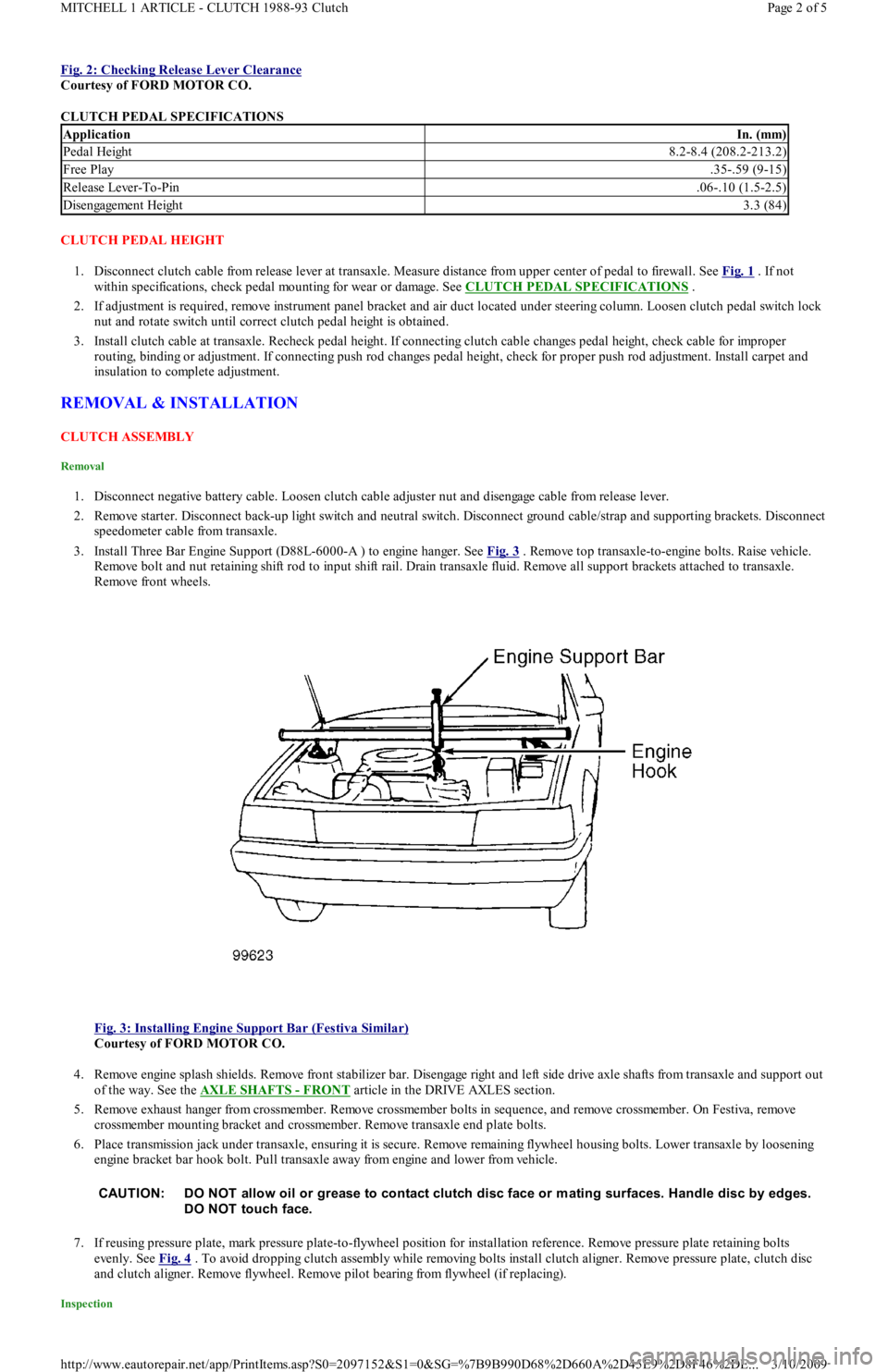
Fig. 2: Checking Release Lever Clearance
Courtesy of FORD MOTOR CO.
CLUTCH PEDAL SPECIFICATIONS
CLUTCH PEDAL HEIGHT
1. Disconnect clutch cable from release lever at transaxle. Measure distance from upper center of pedal to firewall. See Fig. 1
. If not
within specifications, check pedal mounting for wear or damage. See CLUTCH PEDAL SPECIFICATIONS
.
2. If adjustment is required, remove instrument panel bracket and air duct located under steering column. Loosen clutch pedal switch lock
nut and rotate switch until correct clutch pedal height is obtained.
3. Install clutch cable at transaxle. Recheck pedal height. If connecting clutch cable changes pedal height, check cable for improper
routing, binding or adjustment. If connecting push rod changes pedal height, check for proper push rod adjustment. Install carpet and
insulation to complete adjustment.
REMOVAL & INSTALLATION
CLUTCH ASSEMBLY
Removal
1. Disconnect negative battery cable. Loosen clutch cable adjuster nut and disengage cable from release lever.
2. Remove starter. Disconnect back-up light switch and neutral switch. Disconnect ground cable/strap and supporting brackets. Disconnect
speedometer cable from transaxle.
3. Install Three Bar Engine Support (D88L-6000-A ) to engine hanger. See Fig. 3
. Remove top transaxle-to-engine bolts. Raise vehicle.
Remove bolt and nut retaining shift rod to input shift rail. Drain transaxle fluid. Remove all support brackets attached to transaxle.
Remove front wheels.
Fig. 3: Installing Engine Support Bar (Festiva Similar)
Courtesy of FORD MOTOR CO.
4. Remove engine splash shields. Remove front stabilizer bar. Disengage right and left side drive axle shafts from transaxle and support out
of the way. See the AXLE SHAFTS
- FRONT article in the DRIVE AXLES section.
5. Remove exhaust hanger from crossmember. Remove crossmember bolts in sequence, and remove crossmember. On Festiva, remove
crossmember mounting bracket and crossmember. Remove transaxle end plate bolts.
6. Place transmission jack under transaxle, ensuring it is secure. Remove remaining flywheel housing bolts. Lower transaxle by loosening
engine bracket bar hook bolt. Pull transaxle away from engine and lower from vehicle.
7. If reusing pressure plate, mark pressure plate-to-flywheel position for installation reference. Remove pressure plate retaining bolts
evenly. See Fig. 4
. To avoid dropping clutch assembly while removing bolts install clutch aligner. Remove pressure plate, clutch disc
and clutch aligner. Remove flywheel. Remove pilot bearing from flywheel (if replacing).
Inspection
ApplicationIn. (mm)
Pedal Height8.2-8.4 (208.2-213.2)
Free Play.35-.59 (9-15)
Release Lever-To-Pin.06-.10 (1.5-2.5)
Disengagement Height3.3 (84)
CAUT ION: DO NOT allow oil or grease to contact clutch disc face or m ating surfaces. Handle disc by edges.
DO NOT touch face.
Page 2 of 5 MITCHELL 1 ARTICLE - CLUTCH 1988-93 Clutch
3/10/2009 http://www.eautorepair.net/app/PrintItems.asp?S0=2097152&S1=0&SG=%7B9B990D68%2D660A%2D45E9%2D8F46%2DE
...