automatic transmission FORD FIESTA 2007 User Guide
[x] Cancel search | Manufacturer: FORD, Model Year: 2007, Model line: FIESTA, Model: FORD FIESTA 2007Pages: 1226, PDF Size: 61.26 MB
Page 165 of 1226
205-04-1 3 Front Drive Halfshafts 205-04-1 3
REMOVAL AND INSTALLATION
Intermediate Shaft
I
Materials
Name Specification
Removal
Manual transmission
1 fluid
A WARN1NG:Refer to the Material Safety Data
Sheets for the Automatic Transmission
Fluid E-AW. Failure to follow this
instruction may result in personal injury.
Certain Transmission and Power Steering
fluids supplied to Ford contain additives
which may cause skin irritation or other
skin reactions after contact.
WSD-M2C200-C
For additional information, refer to: Health
and Safety Precautions
(1 00-00 General
Information, Description and Operation).
See
- Transmission Fluids.
I. Remove the right-hand halfshaft.
, For additional information, refer to: Front
i, Halfshaft RH (205-04 Front Drive Halfshafts,
Removal and Installation).
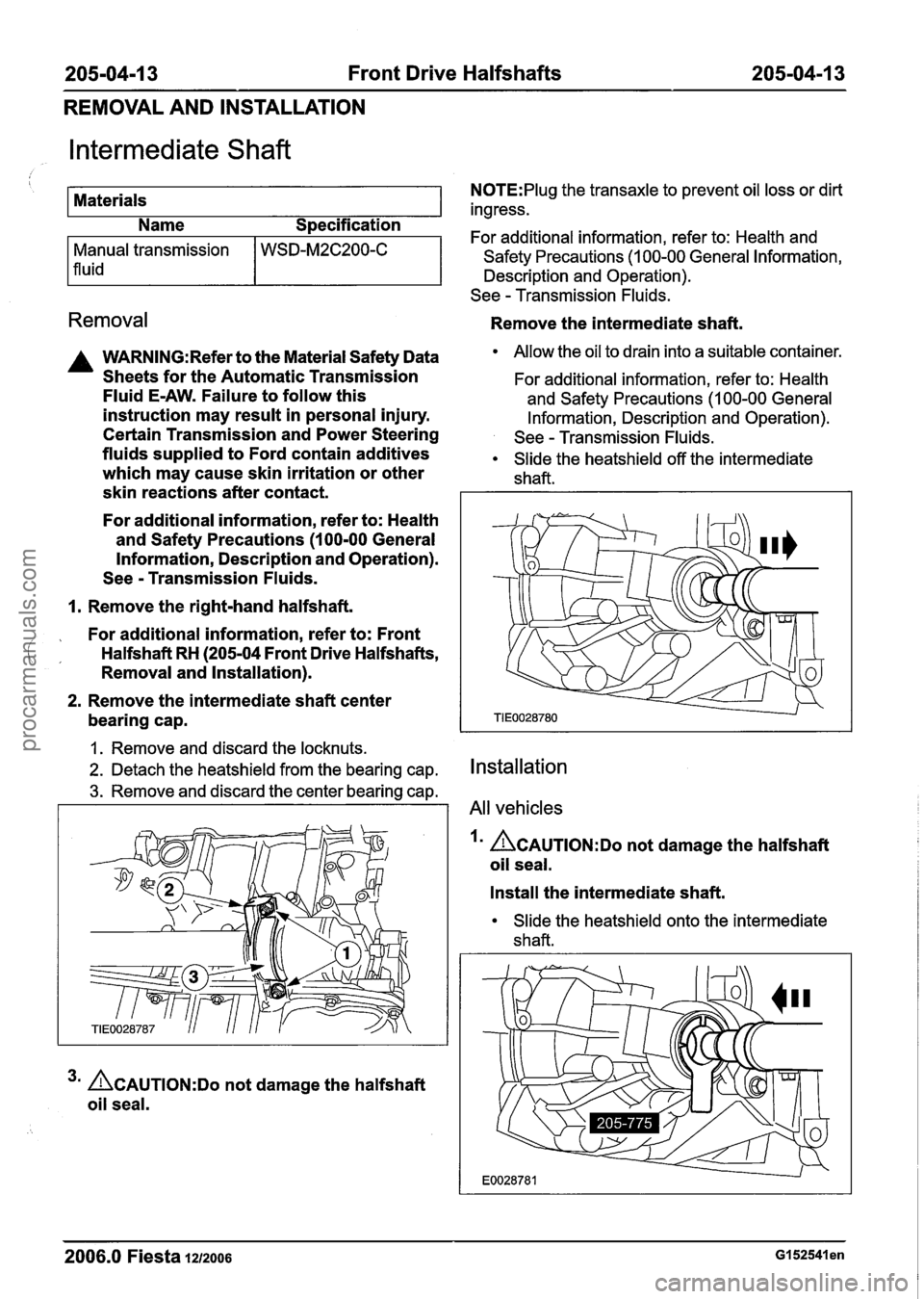
2. Remove the intermediate shaft center
bearing cap.
1. Remove and discard the locknuts.
2. Detach the heatshield from the bearing cap.
3. Remove and discard the center bearing cap.
3m ACAUTION:D~ not damage the halfshaft
oil seal.
N0TE:Plug the transaxle to prevent oil loss or dirt
ingress.
For additional information, refer to: Health and
Safety Precautions
(1 00-00 General Information,
Description and Operation).
See
- Transmission Fluids.
Remove the intermediate shaft.
Allow the oil to drain into a suitable container.
For additional information, refer to: Health
and Safety Precautions
(I 00-00 General
Information, Description and Operation).
See
- Transmission Fluids.
Slide the heatshield off the intermediate
shaft.
Installation
All vehicles
I' ACAUTION:D~ not damage the halfshaft
oil seal.
Install the intermediate shaft.
Slide the heatshield onto the intermediate
shaft.
2006.0 Fiesta 1212006 GI 52541 en
procarmanuals.com
Page 166 of 1226
205-04-1 4 Front Drive Halfshafts 205-04-1 4
REMOVAL AND INSTALLATION
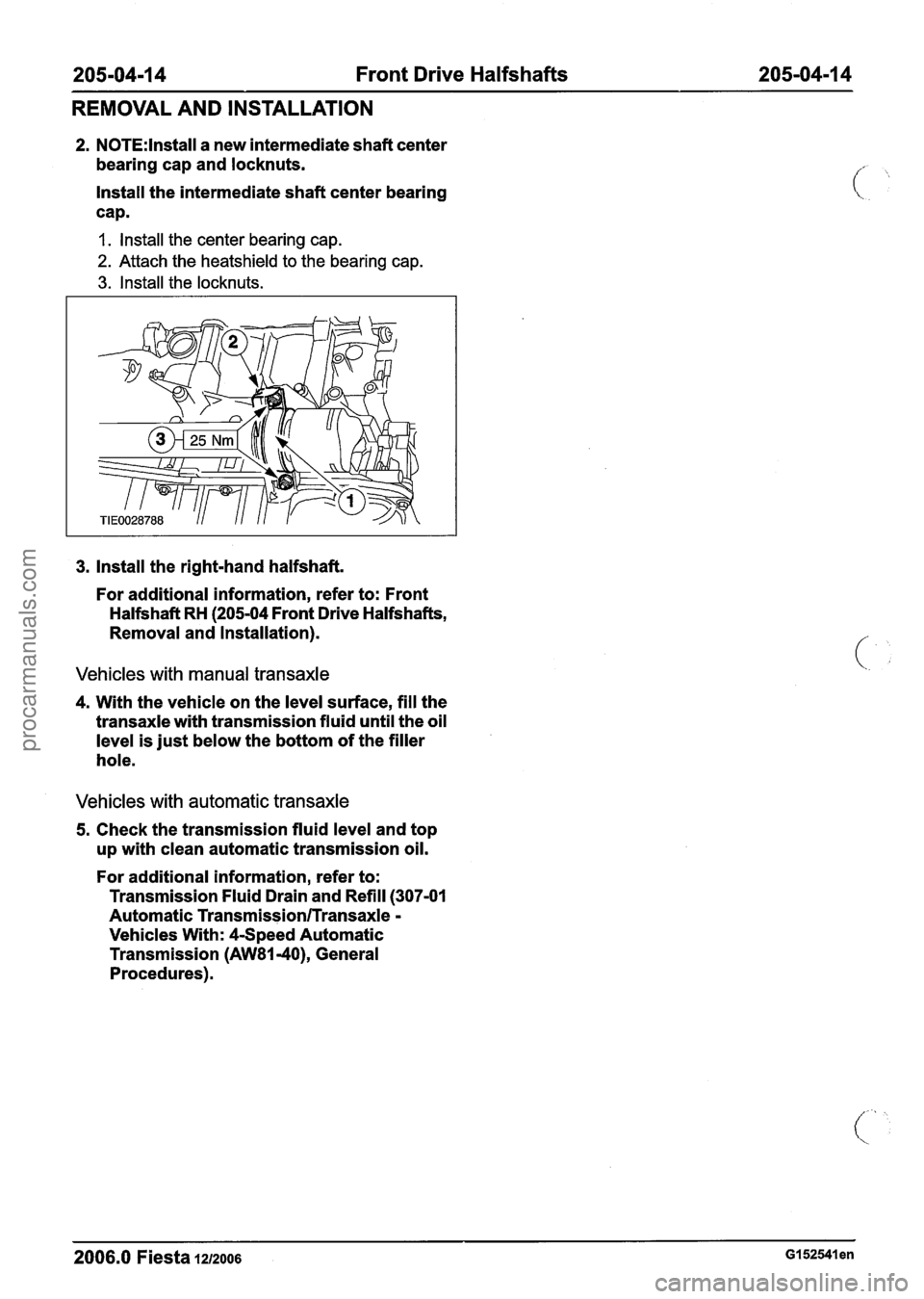
2. N0TE:lnstall a new intermediate shaft center
bearing cap and locknuts.
Install the intermediate shaft center bearing
cap.
I. Install the center bearing cap.
2. Attach the heatshield to the bearing cap.
3. Install the locknuts.
3. Install the right-hand halfshaft.
For additional information, refer to: Front
Halfshaft RH (205-04 Front Drive Halfshafts,
Removal and Installation).
Vehicles with manual transaxle
4. With the vehicle on the level surface, fill the
transaxle with transmission fluid until the oil
level is just below the bottom of the filler
hole.
Vehicles with automatic transaxle
5. Check the transmission fluid level and top
up with clean automatic transmission oil.
For additional information, refer to:
Transmission Fluid Drain and Refill
(307-01
Automatic Transmission/Transaxle -
Vehicles With: 4-Speed Automatic
Transmission
(AW81-40), General
Procedures).
2006.0 Fiesta 1212006 GI 52541 en
procarmanuals.com
Page 198 of 1226
206-00-26 Brake System - General Information 206-00-26
DIAGNOSIS AND TESTING
TEST CONDITIONS DETAILSIRESU LTSIACTIONS
I J6: CHECK BRAKE PEDAL LINKAGE If
rn Disconnect the actuator rod from the pedal pin
and apply the brake pedal fully.
Did the pedal move freely?
-+ Yes
GO to J7.
+ No
REPAIR or INSTALL new brake pedal bush-
ings. REFER to: (206-06 Hydraulic Brake
Actuation)
Brake Pedal
- LHD, Vehicles With: Manual
Transaxle (Removal and Installation),
Brake Pedal
- LHD, Vehicles With: 4-Speed
Automatic Transmission
(AW81-40), Vehicles
With: Automated Gearshift (Removal and
Installation),
Brake Pedal
- RHD (Removal and Installation).
TEST the system for normal operation.
157: CHECK BRAKE PRESSURE CONTROL VALVE I
rn Check the brake pressure control valve for
contamination.
Is the brake fluid contaminated?
+ Yes
INSTALL a new brake pressure control valve.
FILL the brake master cylinder reservoir.
BLEED the brake system. REFER to: (206-00
Brake System
- General Information)
1 Brake System Bleeding (General Procedures),
Brake System Pressure Bleeding (General
Procedures). TEST the system for normal operation.
1 * Ehicle OK.
2006.0 Fiesta 1212006 G28494en
procarmanuals.com
Page 200 of 1226
206-00-28 Brake System - General Information 206-00-28
DIAGNOSIS AND TESTING
PINPOINT TEST L : SLOW OR INCOMPLETE BRAKE PEDAL RETURN
TEST CONDITIONS
DETAILSIRESU LTSIACTIONS /"'
I L1: CHECK FOR BRAKE PEDAL RETURN I[<.
Run the engine at fast idle while making several
brake applications. Pull the brake pedal rear-
ward with approximately 44.5 N
(1 0 lbs) force.
Release the brake pedal and measure the
distance to the floor pan. Make a hard brake
application. Release the brake pedal and
measure the brake pedal to floor pan distance.
The brake pedal should return to its original
position.
Did the brake pedal return to its original posi-
tion?
+ Yes
Vehicle OK.
+ No
GO to L2.
I L2: CHECK FOR BRAKE PEDAL BINDING
1 171 Check the brake pedal for free operation.
I Is the brake pedal operating freely?
+ Yes
I INSTALL a new brake booster. REFER to:
(206-07 Power Brake Actuation)
Brake Booster
- LHD (Removal and lnstallation),
Brake Booster
- RHD (Removal and lnstallation).
TEST the system for normal operation.
+ No
REPAIR or INSTALL new brake pedal bush-
ings. REFER to: (206-06 Hydraulic Brake
Actuation)
Brake Pedal
- LHD, Vehicles With: Manual
Transaxle (Removal and lnstallation),
Brake Pedal
- LHD, Vehicles With: 4-Speed
Automatic Transmission
(AW81-40), Vehicles
With: Automated Gearshift (Removal and
Installation),
Brake Pedal
- RHD (Removal and lnstallation).
TEST the system for normal operation.
Component Tests It is possible that all evidence of fluid leakage may
have washed off if the vehicle has been operated
in rain or snow, as brake fluid is water-soluble.
Hydraulic Leak Check Refill the system, bleed then apply the brakes
several times. Examine the system to verify that
NOTE:Thet-e is a common clutch and brake fluid
the reservoir fluid level is actually dropping. Locate
reservoir, therefore it is possible that a clutch leak
can lead to reduction in the reservoir level.
-- --
2006.0 Fiesta 1212006 G28494en
procarmanuals.com
Page 558 of 1226
Engine - 1.25L Duratec-1 6V (Sigma)ll.4L
303-0 I Am82 Duratec-1 6V (Sigma)ll .6L Duratec-1 6V (Sigma)
303-01 Am82
REMOVAL
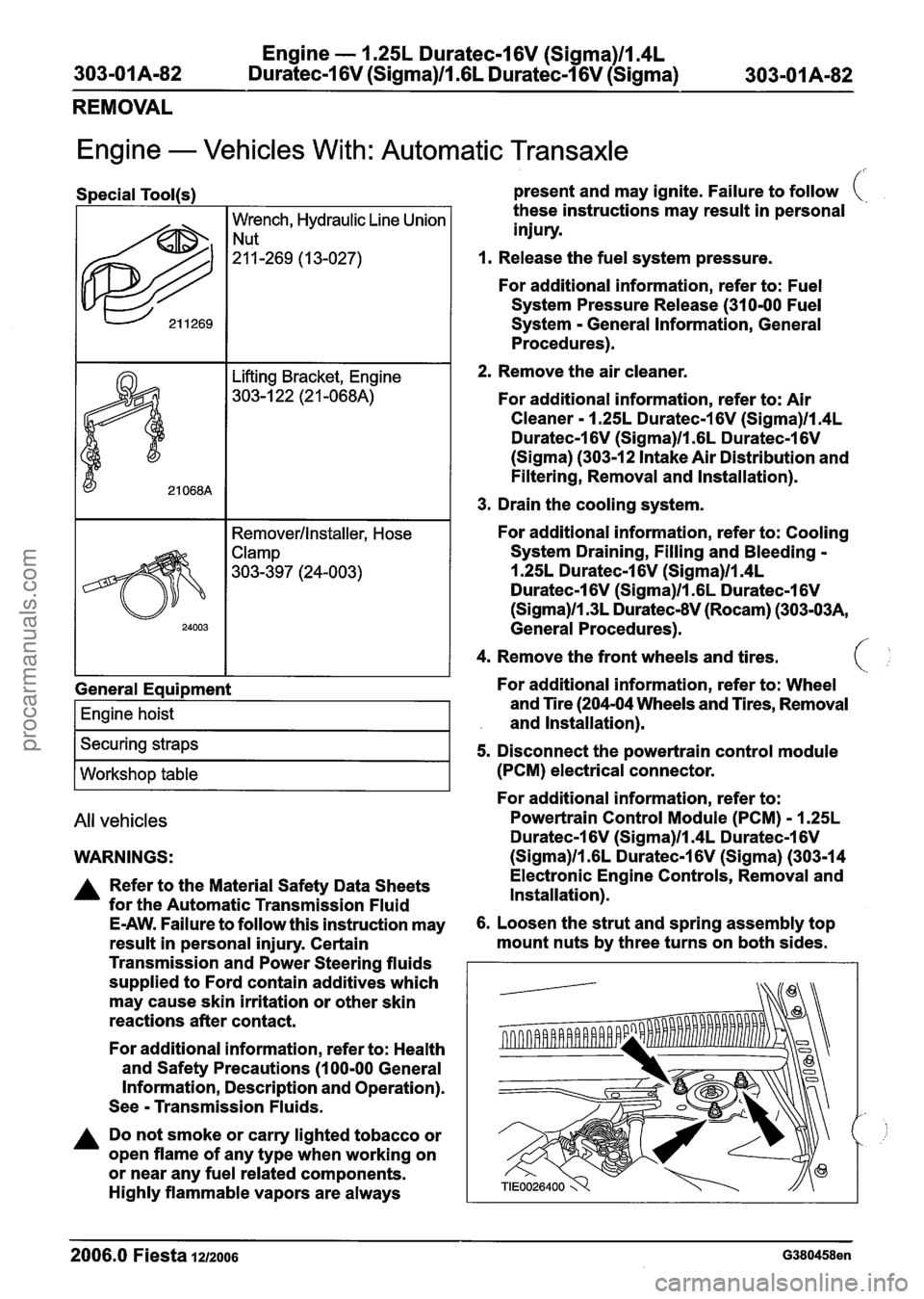
Lifting Bracket, Engine
303-1 22 (21 -068A)
Engine - Vehicles With: Automatic Transaxle
Special Tool(s) present and may ignite. Failure to follow (.
2. Remove the air cleaner.
622
For additional information, refer to: Air
Cleaner - 1.25L Duratec-1 6V (Sigma)ll.4L
Duratec-1 6V (Sigma)/l .6L Duratec-1 6V
(Sigma) (303-12 Intake Air Distribution and
Filtering, Removal and Installation).
I I 1 3. Drain the cooling system.
Wrench, Hydraulic Line Union
"-269 (13-027)
I I Remover/lnstaller, Hose I
these instructions may result in personal
injury.
1. Release the fuel system pressure.
For
additional information, refer to: Fuel
System Pressure Release (31 0-00 Fuel
System - General Information, General
Procedures).
General Eaui~ment
I Engine hoist I
I Securing straps I
I Workshop table I
All vehicles
WARNINGS:
A Refer to the Material Safety Data Sheets
for the Automatic Transmission
Fluid
E-AW. Failure to follow this instruction may
result in personal injury. Certain
Transmission and Power Steering fluids
supplied to Ford contain additives which
may cause skin irritation or other skin
reactions after contact.
For
additional information, refer to: Health
and Safety Precautions (1 00-00 General
Information, Description and Operation).
See
- Transmission Fluids.
A Do not smoke or carry lighted tobacco or
open flame of any type when working on
or near any
fuel related components.
Highly flammable vapors are always
For additional information, refer to: Cooling
System Draining, Filling and Bleeding -
1.25L Duratec-1 6V (Sigma)ll.4L
Duratec-1 6V (Sigma)ll .6L Duratec-1 6V
(Sigma)llm3L Duratec-8V (Rocam) (303-03A,
General Procedures). ,'
4. Remove the front wheels and tires. C'
For additional information, refer to: Wheel
and Tire (204-04 Wheels and Tires, Removal
and Installation).
5. Disconnect the powertrain control module
(PCM) electrical connector.
For
additional information, refer to:
Powertrain
Control Module (PCM) - 1.25L
Duratec-1 6V (Sigma)ll.4L Duratec-1 6V
(Sigma)ll .6L Duratec-1 6V (Sigma) (303-14
Electronic Engine Controls, Removal and
Installation).
6. Loosen the strut and spring assembly top
mount nuts by three turns on both sides.
--
2006.0 Fiesta 1212006 G380458en
procarmanuals.com
Page 616 of 1226
Engine - 1.25L Duratec-1 6V (Sigma)ll.4L
303-01 A-1 40 Duratec-1 6V (Sigma)ll .6L
Duratec-1 6V (Sigma) 303-01 A-1 40
INSTALLATION
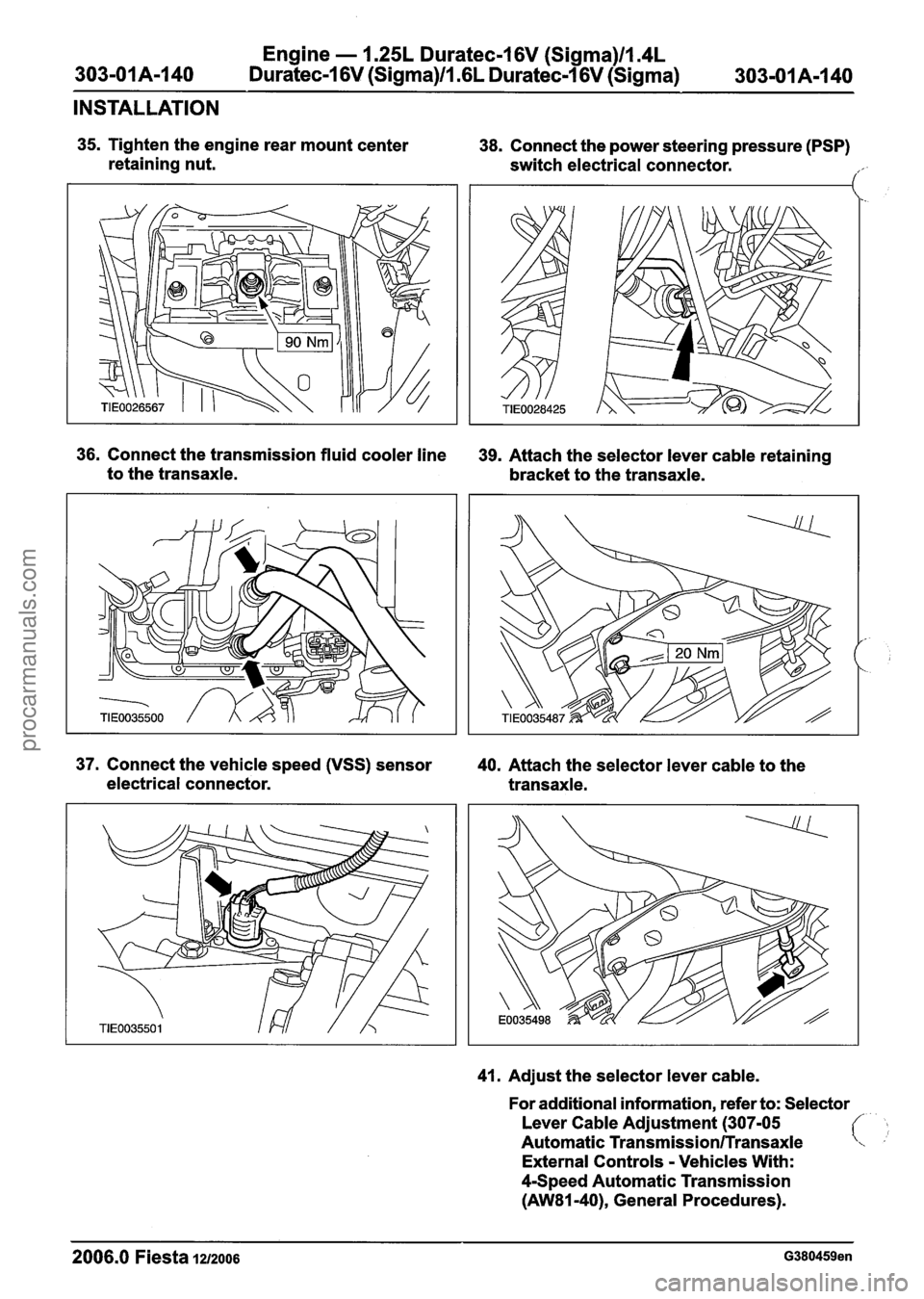
35. Tighten the engine rear mount center
retaining nut. 38. Connect the power steering pressure (PSP)
switch electrical connector.
,/'
36. Connect the transmission fluid cooler line 39. Attach the selector lever cable retaining
to the transaxle.
bracket to the transaxle.
37. Connect the vehicle speed (VSS) sensor
40. Attach the selector lever cable to the
electrical connector. transaxle.
41. Adjust the selector lever cable.
For additional information, refer to: Selector
Lever Cable Adjustment (307-05
Automatic
Transmission/Transaxle
External Controls - Vehicles With:
4-Speed Automatic Transmission
(AW81-40), General Procedures).
2006.0 Fiesta 1212006 G380459en
procarmanuals.com
Page 621 of 1226
Engine - 1.25L Duratec-1 6V (Sigma)ll.4L
303-01 A-1 45 Duratec-1 6V (Sigma)ll .6L
Duratec-1 6V (Sigma) 303-01 A-1 45
INSTALLATION
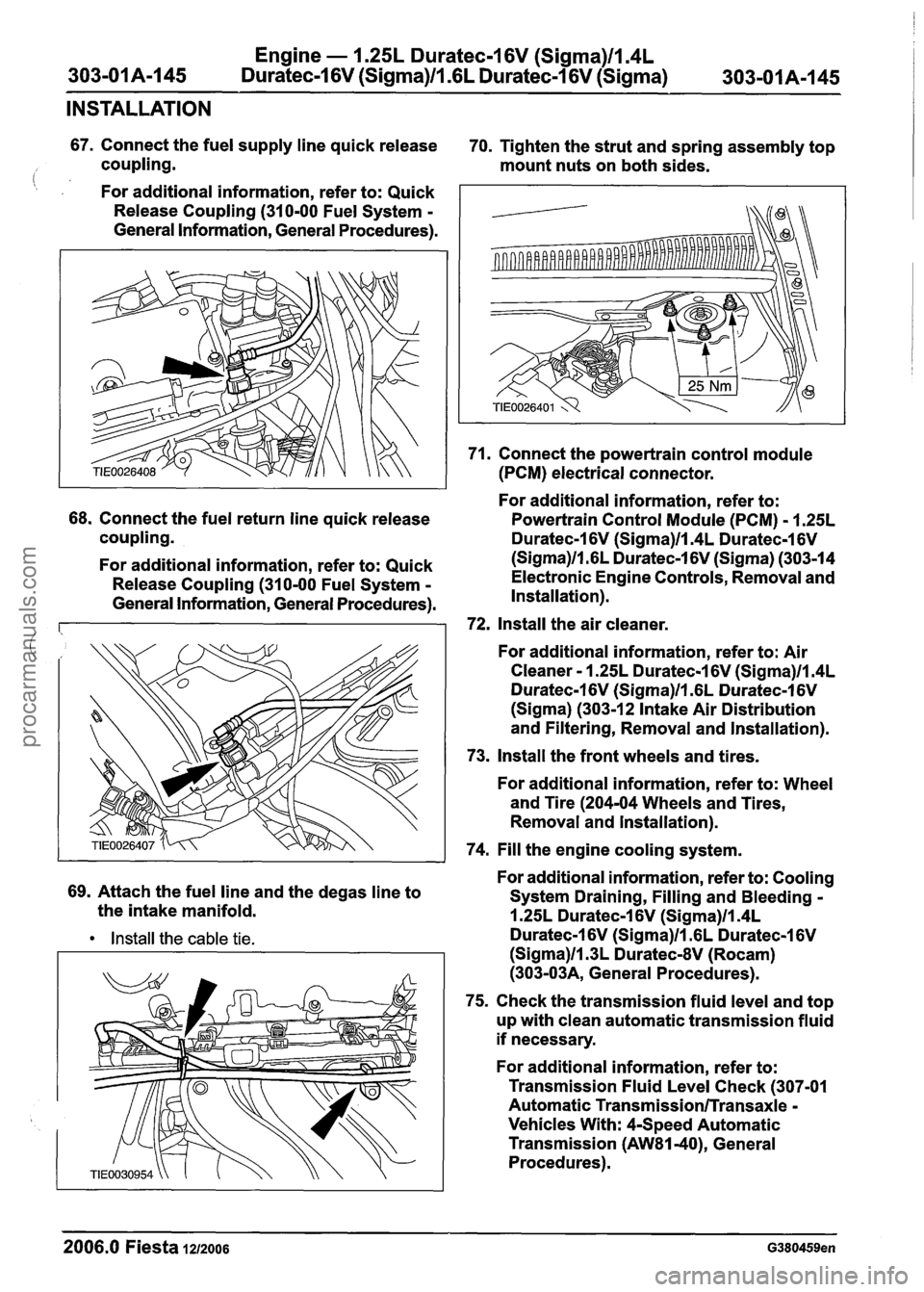
67. Connect the fuel supply line quick release
70. Tighten the strut and spring assembly top
coupling. mount nuts on both sides.
(: , For additional information, refer to: Quick
Release Coupling (310-00 Fuel System
-
General Information, General Procedures).
68. Connect the fuel return line quick release
coupling.
For additional information, refer to: Quick
Release Coupling (310-00 Fuel System
-
General Information, General Procedures).
69. Attach the fuel line and the degas line to
the intake manifold.
Install the cable tie.
71. Connect the powertrain control module
(PCM) electrical connector.
For additional information, refer to:
Powertrain Control Module (PCM)
- 1.25L
Duratec-1 6V (Sigma)llm4L Duratec-1 6V
(Sigma)ll.GL Duratec-1 6V (Sigma) (303-14
Electronic Engine Controls, Removal and
Installation).
72, Install the air cleaner.
For additional information, refer to: Air
Cleaner
- 1.25L Duratec-1 6V (Sigma)ll.4L
Duratec-1 6V (Sigma)ll.GL Duratec-1 6V
(Sigma) (303-1 2 Intake Air Distribution
and Filtering, Removal and Installation).
73. Install the front wheels and tires.
For additional information, refer to: Wheel
and Tire (204-04 Wheels and Tires,
Removal and lnstallation).
74. Fill the engine cooling system.
For additional information, refer to: Cooling
System Draining, Filling and Bleeding
-
1.25L Duratec-1 6V (Sigma)ll.4L
Duratec-1 6V (Sigma)ll .6L Duratec-1 6V
(Sigma)ll.3L DuratecdV (Rocam)
(303-03A, General Procedures).
75. Check the transmission fluid level and top
up with clean automatic transmission fluid
if necessary.
For additional information, refer to:
Transmission Fluid Level Check (307-01
Automatic
Transmission/Transaxle -
Vehicles With: 4-Speed Automatic
Transmission
(AW81-40), General
Procedures).
--
2006.0 Fiesta 1212006 G380459en
procarmanuals.com
Page 759 of 1226
Engine Cooling - I .3L Duratec-8V
(Rocam)llm25L Duratec-1 6V (Sigma)ll.4L
303-03A-17 Duratec-1 6V (Sigma)/lm6L Duratec-1 6V (Sigma) 303-03A-17
DIAGNOSIS AND TESTING
RPM - engine speed
i DSRPM - desired engine speed
The IAT sensor output is useful if the engine being
tested is cold or after an over-night cold soak. The
ECT sensor or CHT sensor and the IAT sensor
should either indicate the same value or be within
1 to 2 degrees Celsius of each other.
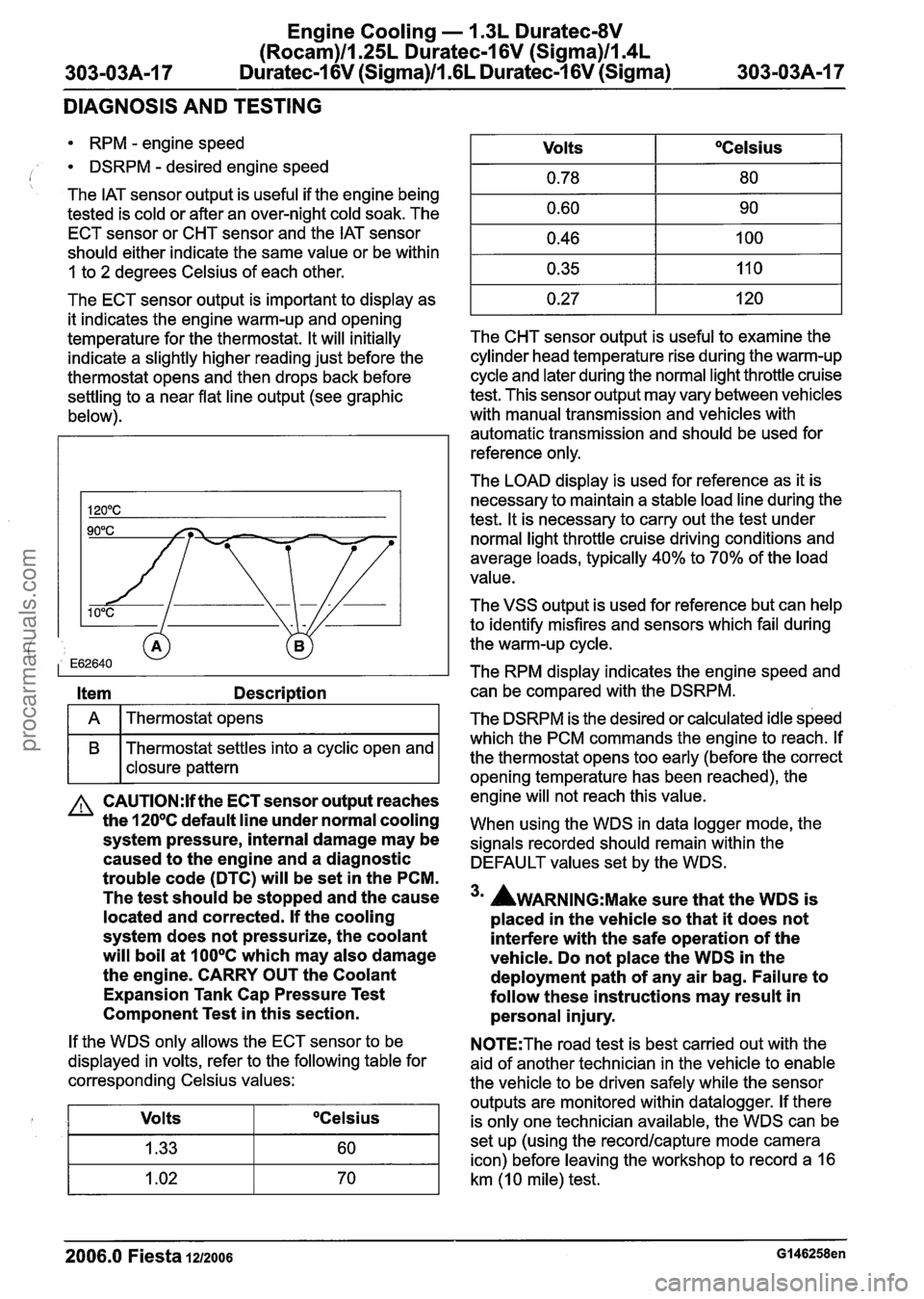
The ECT sensor output is important to display as
it indicates the engine warm-up and opening
temperature for the thermostat. It will initially
indicate a slightly higher reading just before the
thermostat opens and then drops back before
settling to a near flat line output (see graphic
below).
Item Description
I A I Thermostat opens I
B Thermostat settles into a cyclic open and
I I closure pattern
A CAUTI0N:lf the ECT sensor output reaches
the
120°C default line under normal cooling
system pressure, internal damage may be
caused to the engine and a diagnostic
trouble code (DTC) will be set in the PCM.
The test should be stopped and the cause
located and corrected. If the cooling
system does not pressurize, the coolant
will boil at
100°C which may also damage
the engine. CARRY OUT the Coolant
Expansion Tank Cap Pressure Test
Component Test in this section.
If the WDS only allows the ECT sensor to be
displayed in volts, refer to the following table for
corresponding Celsius values:
Volts
OCelsius
The CHT sensor output is useful to examine the
cylinder head temperature rise during the warm-up
cycle and later during the normal light throttle cruise
test. This sensor output may vary between vehicles
with manual transmission and vehicles with
automatic transmission and should be used for
reference only.
Volts
0.78
0.60
0.46
0.35
0.27
The
LOAD display is used for reference as it is
necessary to maintain a stable load line during the
test. It is necessary to carry out the test under
normal light throttle cruise driving conditions and
average loads, typically
40% to 70% of the load
value.
OCelsius
80
90
100
11 0
120
The VSS output is used for reference but can help
to identify misfires and sensors which fail during
the warm-up cycle.
The RPM display indicates the engine speed and can be compared with the DSRPM.
The DSRPM is the desired or calculated idle speed
which the PCM commands the engine to reach. If
the thermostat opens too early (before the correct
opening temperature has been reached), the
engine will not reach this value.
When using the WDS in data logger mode, the
signals recorded should remain within the
DEFAULT values set by the WDS.
3m AWARNING:M~~~ sure that the WDS is
placed in the vehicle so that it does not
interfere with the safe operation of the
vehicle. Do not place the WDS in the
deployment path of any air bag. Failure to
follow these instructions may result in personal injury.
N0TE:The road test is best carried out with the
aid of another technician in the vehicle to enable
the vehicle to be driven safely while the sensor
outputs are monitored within datalogger. If there
is only one technician available, the WDS can be
set up (using the
recordlcapture mode camera
icon) before leaving the workshop to record a
16
km (1 0 mile) test.
2006.0 Fiesta 1212006 GI 46258en
procarmanuals.com
Page 785 of 1226
303-03B-15 Engine Cooling - 2.OL Duratec-HE (M14) 303-03B-15
DIAGNOSIS AND TESTING
A CAUTI0N:lf the ECT sensor output reaches
the
120°C default line under normal cooling
system pressure, internal damage may be
caused to the engine and a diagnostic
trouble code (DTC) will be set in the PCM.
The test should be stopped and the cause
located and corrected. If the cooling
system does not pressurize, the coolant
will boil at
1 OO°C which may also damage
the engine. CARRY
OUT the Coolant
Expansion Tank Cap Pressure Test
Component Test in this section.
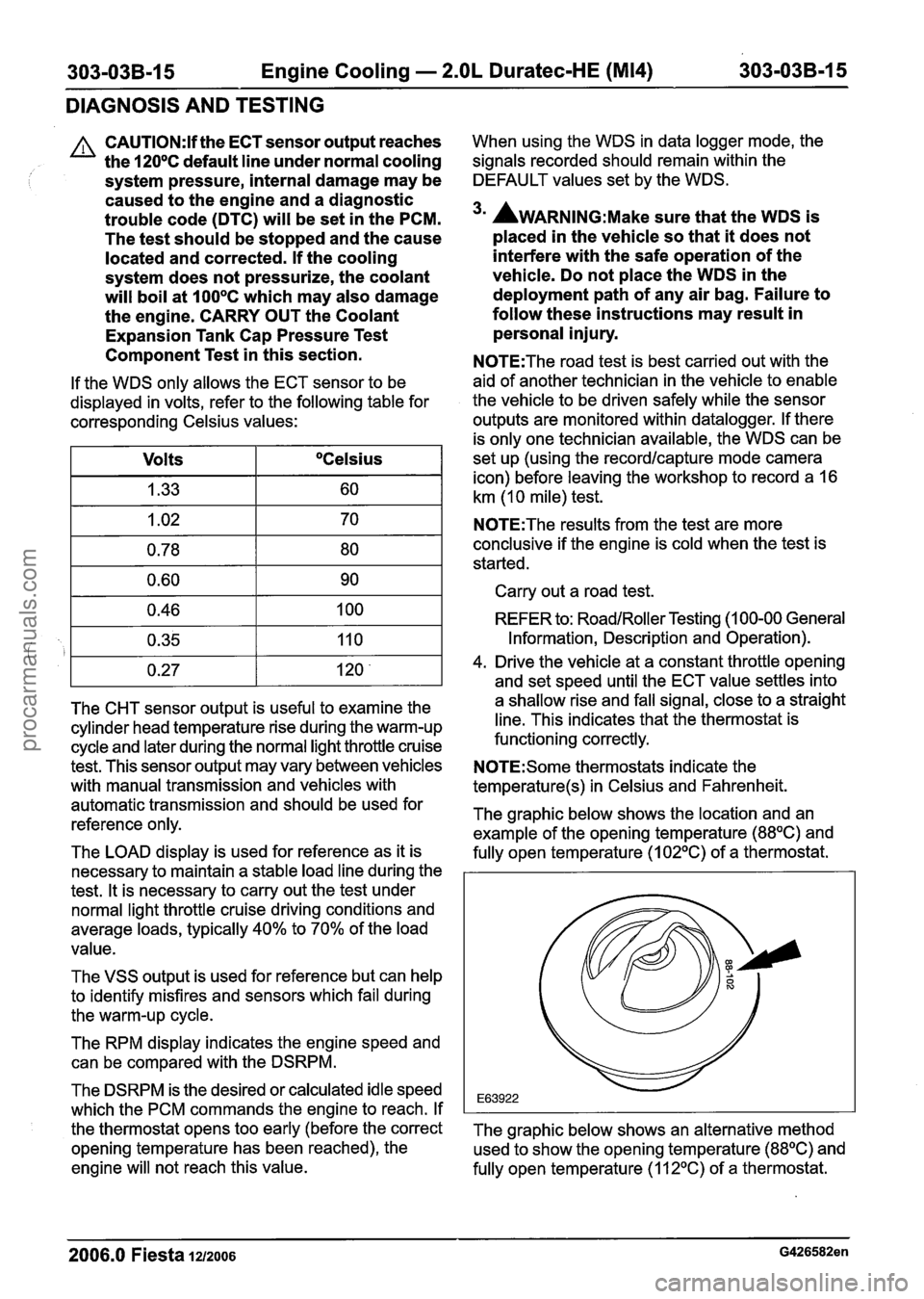
If the WDS only allows the ECT sensor to be
displayed in volts, refer to the following table for
corresponding Celsius values:
The CHT sensor output is useful to examine the
cylinder head temperature rise during the warm-up
cycle and later during the normal light throttle cruise
test. This sensor output may vary between vehicles
with manual transmission and vehicles with automatic transmission and should be used for
reference only.
Volts
1.33
1.02
0.78
0.60
0.46
0.35 0.27
The LOAD display is used for reference as it is
necessary to maintain a stable load line during the
test. It is necessary to carry out the test under
normal light throttle cruise driving conditions and
average loads, typically 40% to 70% of the load
value.
OCelsius
60
70
80
90
100
110
120 '
The VSS output is used for reference but can help
to identify misfires and sensors which fail during
the warm-up cycle.
The RPM display indicates the engine speed and
can be compared with the DSRPM.
The DSRPM is the desired or calculated idle speed
which the PCM commands the engine to reach. If
the thermostat opens too early (before the correct
opening temperature has been reached), the
engine will not reach this value. When
using the WDS in data logger mode, the
signals recorded should remain within the
DEFAULT values set by the WDS.
3m AWARNING:M~~~ sure that the WDS is
placed in the vehicle so that it does not
interfere with the safe operation of the
vehicle. Do not place the WDS in the
deployment path of any air bag. Failure to
follow these instructions may result in personal injury.
N0TE:The road test is best carried out with the
aid of another technician in the vehicle to enable
the vehicle to be driven safely while the sensor
outputs are monitored within datalogger. If there
is only one technician available, the WDS can be
set up (using the
recordlcapture mode camera
icon) before leaving the workshop to record a 16
km (1 0 mile) test.
N0TE:The results from the test are more
conclusive if the engine is cold when the test is
started.
Carry out a road test.
REFER to:
RoadIRoller Testing (1 00-00 General
Information, Description and Operation).
4. Drive the vehicle at a constant throttle opening
and set speed until the ECT value settles into
a shallow rise and fall signal, close to a straight
line. This indicates that the thermostat is
functioning correctly.
N0TE:Some thermostats indicate the
temperature(s) in Celsius and Fahrenheit.
The graphic below shows the location and an
example of the opening temperature
(88OC) and
fully open temperature (1
02OC) of a thermostat.
The graphic below shows an alternative method used to show the opening temperature
(88OC) and
fully open temperature
(112OC) of a thermostat.
2006.0 Fiesta 1212006 G426582en
procarmanuals.com
Page 961 of 1226
Automatic Transmission/Transaxle .
Vehicles With: 4-Speed Automatic
Transmission
(AW81-40)
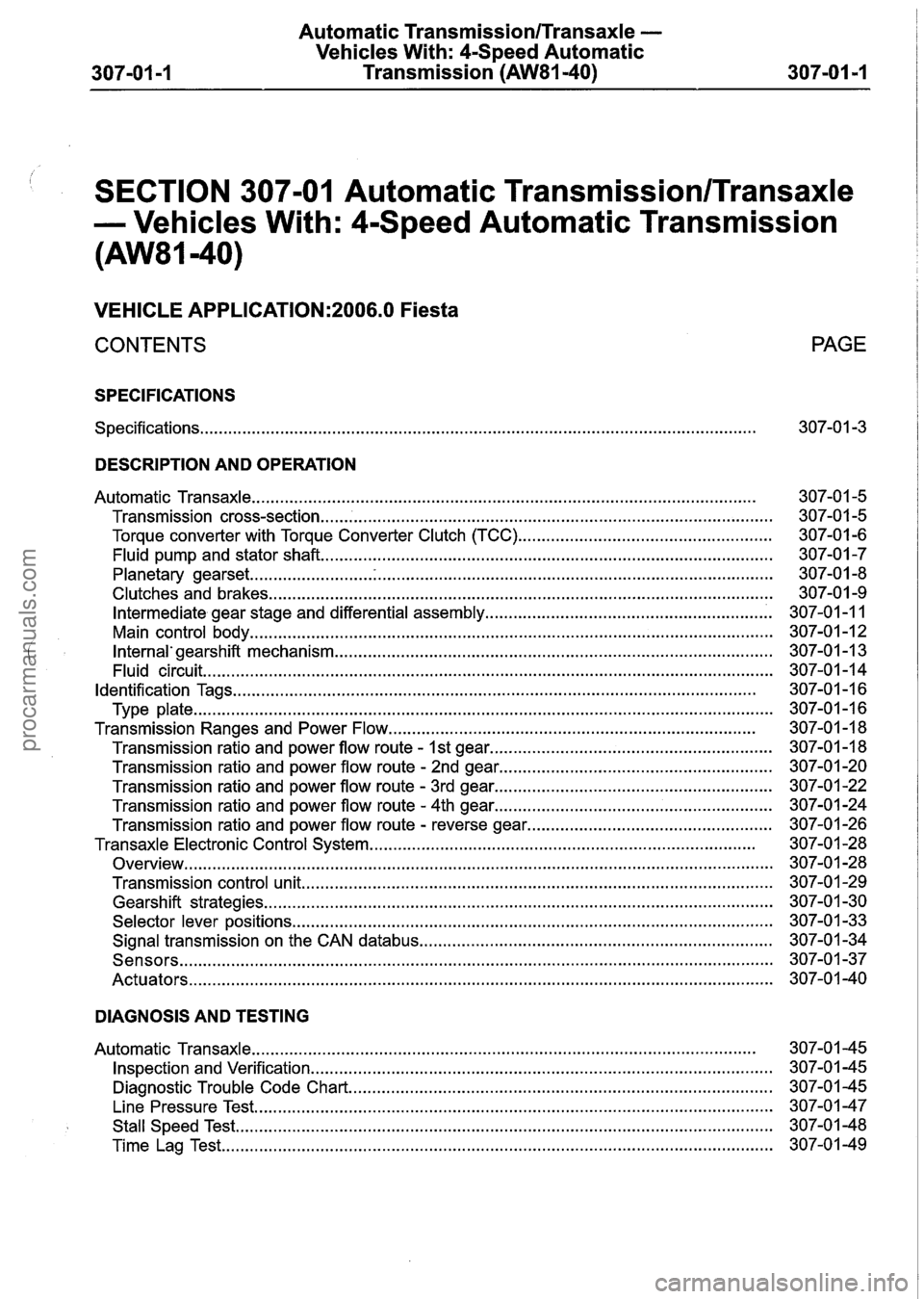
SECTION 307-01 Automatic Transmission/Transaxle
. Vehicles With: 4-Speed Automatic Transmission
(AW81-40)
VEHICLE APPLICATION:2006.0 Fiesta
CONTENTS PAGE
SPECIFICATIONS
Specifications
........................................................................\
.............................................. 307-0 1 -3
DESCRIPTION AND OPERATION
Automatic Transaxle
........................................................................\
...................................
Transmission cross-section ........................................................................\
........................
Torque converter with Torque Converter Clutch (TCC) ......................................................
Fluid pump and stator shaft ........................................................................\
........................
........................................................................\
......... Planetary gearset ......................... .:
Clutches and brakes ........................................................................\
...................................
Intermediate gear stage and differential assembly .............................................................
Main control body ........................................................................\
.......................................
Internal' gearshift mechanism ........................................................................\
.....................
Fluid circuit ........................................................................\
.................................................
........................................................................\
....................................... Identification Tags
Type plate
........................................................................\
...................................................
Transmission Ranges and Power Flow ........................................................................\
......
Transmission ratio and power flow route - 1st gear ............................................................
Transmission ratio and power flow route - 2nd gear ..........................................................
Transmission ratio and power flow route . 3rd gear ...........................................................
Transmission ratio and power flow route . 4th gear ...........................................................
Transmission ratio and power flow route . reverse gear ....................................................
Transaxle Electronic Control System ........................................................................\
..........
........................................................................\
..................................................... Overview
Transmission control unit
........................................................................\
............................
........................................................................\
.................................... Gearshift strategies
Selector lever positions
........................................................................\
..............................
Signal transmission on the CAN databus ........................................................................\
...
........................................................................\
...................................................... Sensors
........................................................................\
.................................................... Actuators
DIAGNOSIS AND TESTING
Automatic Transaxle
........................................................................\
................................... 307-01
Inspection and Verification ........................................................................\
.................... 307-01
Diagnostic Trouble Code Chart
........................................................................\
.................. 307-01
........................................................................\
...................................... Line Pressure Test 307-01
Stall Speed Test
........................................................................\
....................................... 307-01
Time Lag Test
........................................................................\
............................................. 307-01
procarmanuals.com