brakes FORD FIESTA 2007 User Guide
[x] Cancel search | Manufacturer: FORD, Model Year: 2007, Model line: FIESTA, Model: FORD FIESTA 2007Pages: 1226, PDF Size: 61.26 MB
Page 136 of 1226
204-02-1 4 Rear Suspension 204102-14
REMOVAL AND INSTALLATION
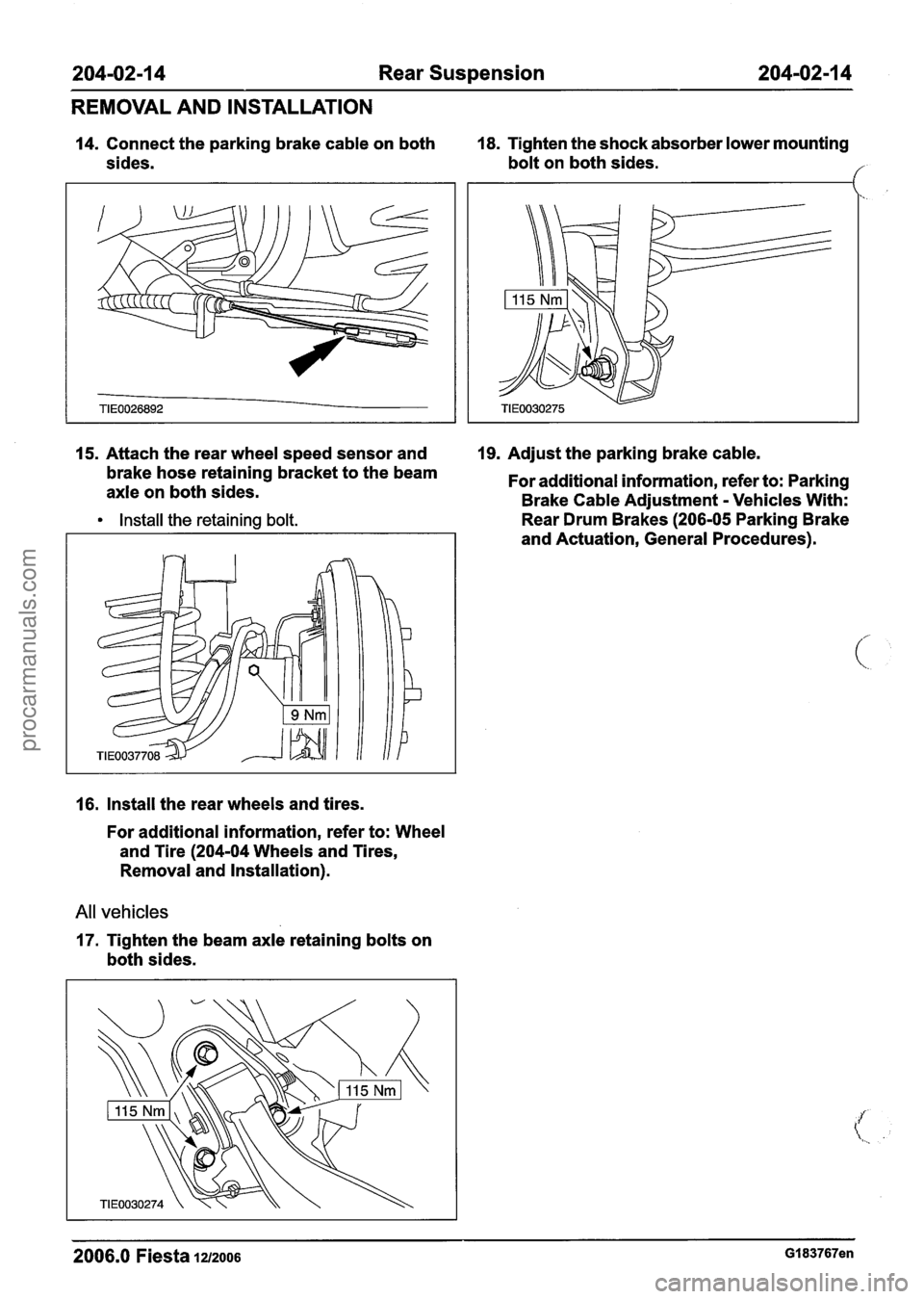
14. Connect the parking brake cable on both 18. Tighten the shock absorber lower mounting
sides. bolt on both sides.
f
15. Attach the rear wheel speed sensor and 19. Adjust the parking brake cable.
brake hose retaining bracket to the beam
For additional information, refer to: Parking
axle on both sides.
Brake Cable Adjustment
- Vehicles With:
Install the retaining bolt. Rear Drum Brakes (206-05 Parking Brake
and Actuation, General Procedures).
16. Install the rear wheels and tires.
For additional information, refer to: Wheel
and Tire
(204-04 Wheels and Tires,
Removal and Installation).
All vehicles
17. Tighten the beam axle retaining bolts on
both sides.
2006.0 Fiesta 1212006 GI 83767en
procarmanuals.com
Page 137 of 1226
204-02-1 5 Rear Suspension 204-02-1 5
REMOVAL AND INSTALLATION
Wheel Spindle(l5 366 0)
ji t
' Removal
All vehicles
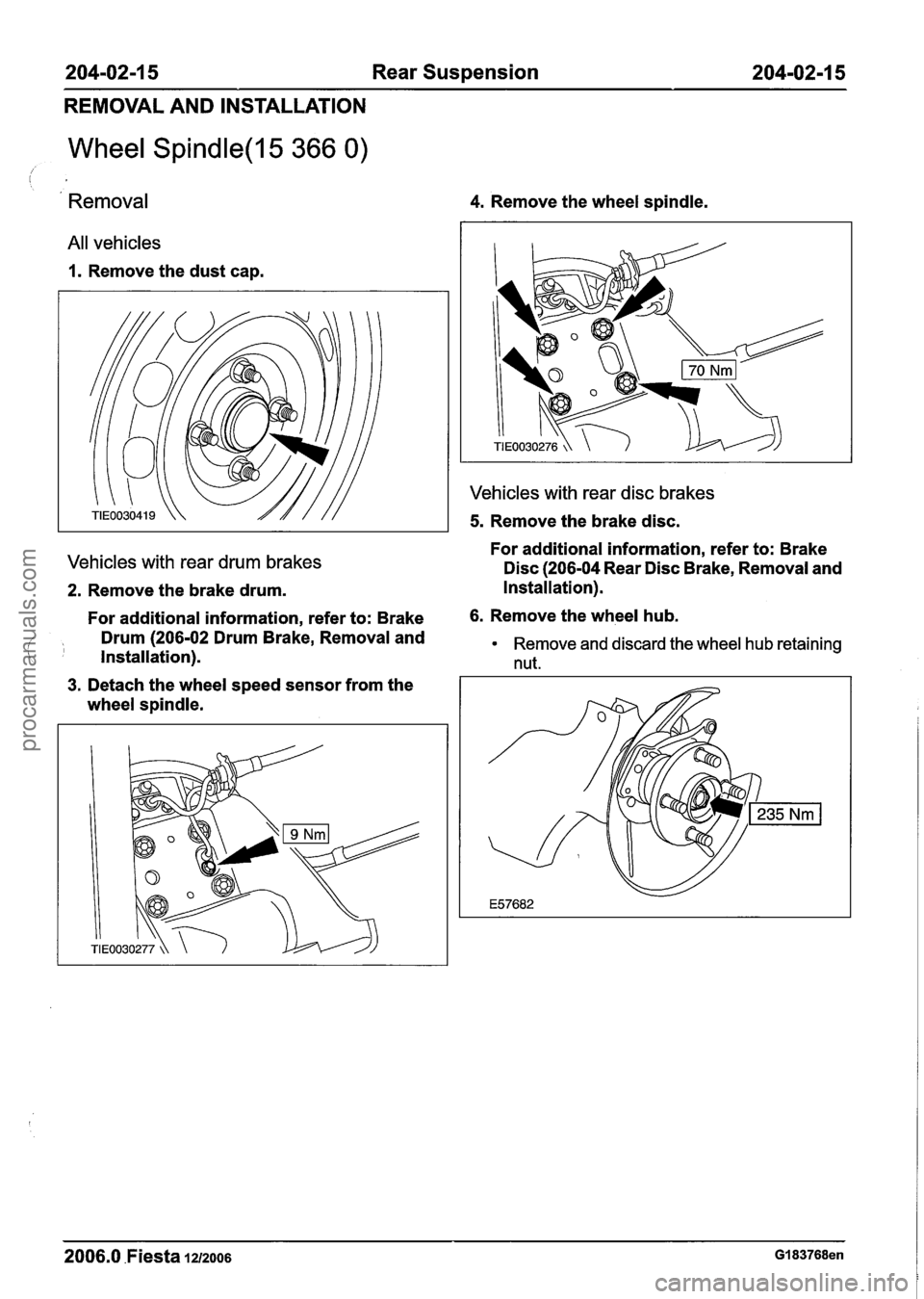
I. Remove the dust cap.
Vehicles with rear drum brakes
2. Remove the brake drum.
4. Remove the wheel spindle.
Vehicles with rear disc brakes
5. Remove the brake disc.
For additional information, refer to: Brake
Disc
(206-04 Rear Disc Brake, Removal and
Installation).
For additional information, refer to: Brake
6. Remove the wheel hub.
Drum
(206-02 Drum Brake, Removal and Remove and discard the wheel hub retaining ( Installation). nut.
3. Detach the wheel speed sensor from the
wheel spindle.
procarmanuals.com
Page 139 of 1226
204-02-1 7 Rear Suspension 204-02-1 7
REMOVAL AND INSTALLATION
Rear Wheel Bearing
Special Tool(s)
General Equipment
17041
I Soft faced hammer I
Installer, Input Shaft Seal
307-2 1 0 (1 7-04 1 )
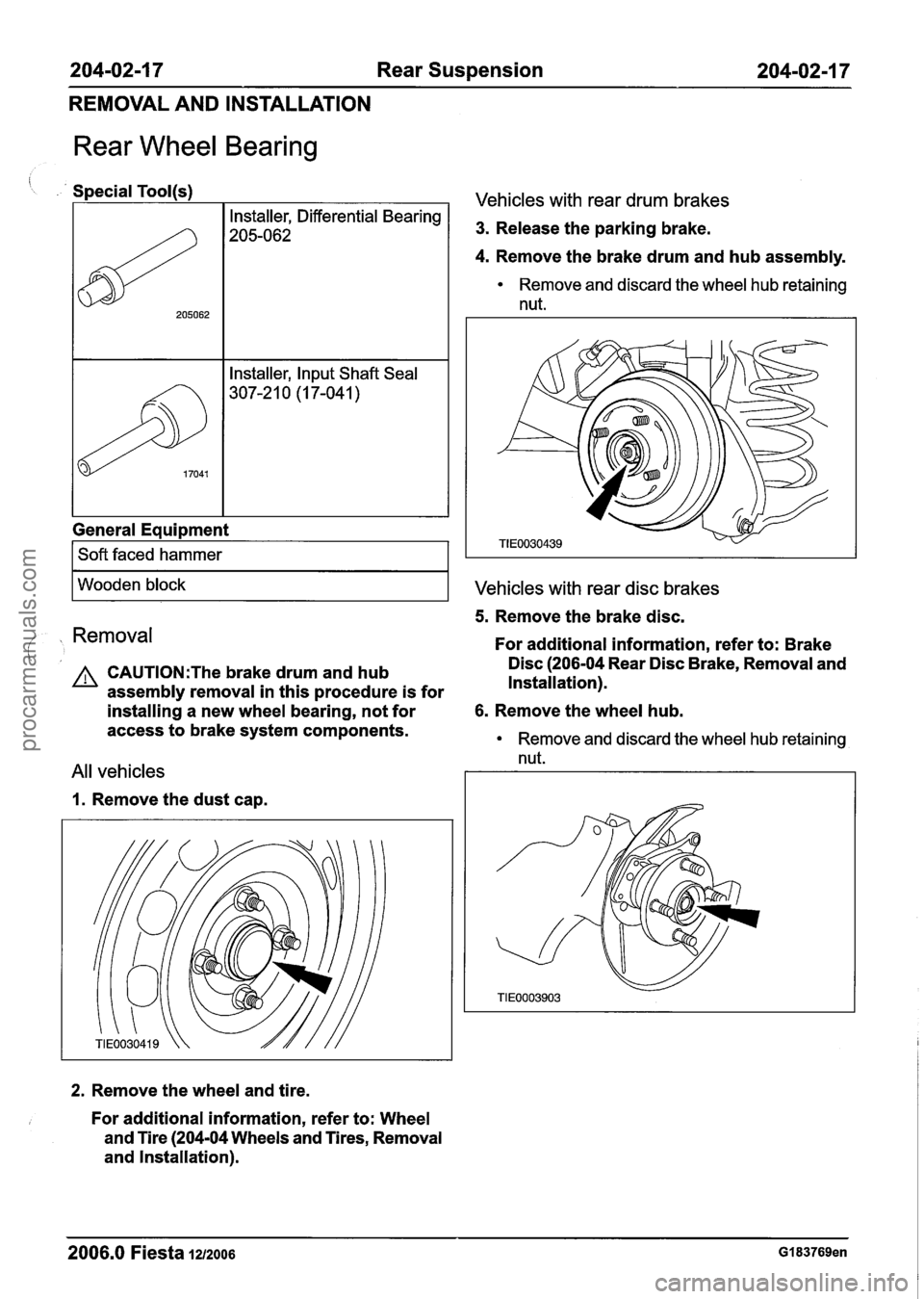
Vehicles with rear drum brakes
3. Release the parking brake.
4. Remove the brake drum and hub assembly.
Remove and discard the wheel hub retaining
nut.
I Wooden block I Vehicles with rear disc brakes
i , Removal
CAUTI0N:The brake drum and hub
assembly removal in this procedure is for
5. Remove the brake disc.
For additional information, refer to: Brake
Disc
(206-04 Rear Disc Brake, Removal and
Installation).
installing a new wheel bearing, not for
6. Remove the wheel hub.
access to brake system components.
Remove and discard the wheel hub retaining
nut.
All vehicles
1. Remove the dust cap.
2. Remove the wheel and tire.
For additional information, refer to: Wheel
and Tire
(204-04 Wheels and Tires, Removal
and installation).
2006.0 Fiesta 1212006 GI 83769en
procarmanuals.com
Page 141 of 1226
204-02-1 9 Rear Suspension 204-02-1 9
REMOVAL AND INSTALLATION
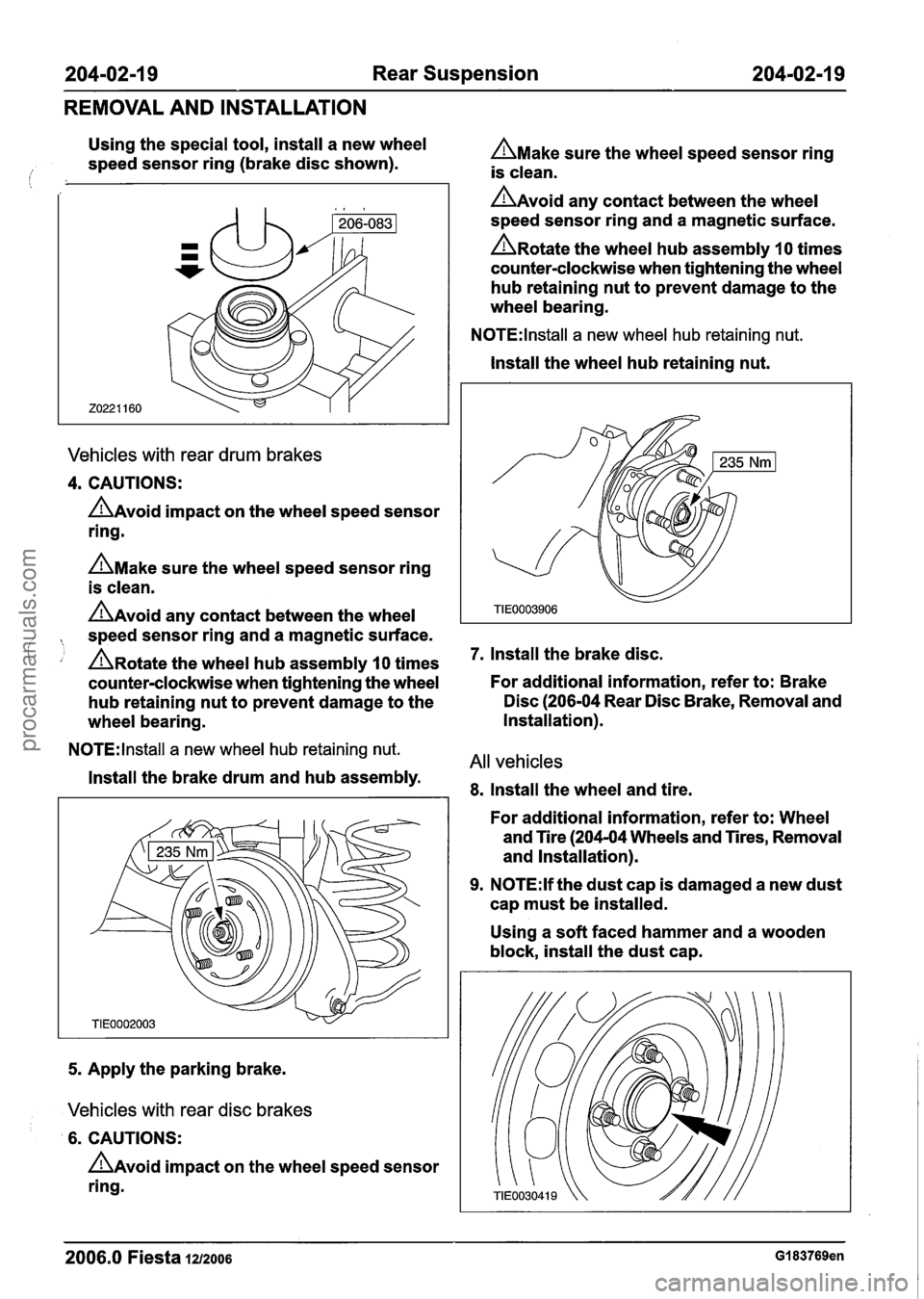
Using the special tool, install a new wheel
speed sensor ring (brake disc shown).
Vehicles with rear drum brakes
4. CAUTIONS:
AAvoid impact on the wheel speed sensor
ring.
AMake sure the wheel speed sensor ring
is clean.
AAvoid any contact between the wheel
, speed sensor ring and a magnetic surface.
' , A~otate the wheel hub assembly 10 times
counter-clockwise when tightening the wheel
hub retaining nut to prevent damage to the
wheel bearing.
N0TE:lnstall a new wheel hub retaining nut.
Install the brake drum and hub assembly.
5. Apply the parking brake.
Vehicles with rear disc brakes
6. CAUTIONS:
AAvoid impact on the wheel speed sensor
ring.
AMake sure the wheel speed sensor ring
is clean.
AAvoid any contact between the wheel
speed sensor ring and a magnetic surface.
A~otate the wheel hub assembly 10 times
counter-clockwise when tightening the wheel
hub retaining nut to prevent damage to the
wheel bearing.
N0TE:lnstall a new wheel hub retaining nut.
Install the wheel hub retaining nut.
7. lnstall the brake disc.
For additional information, refer to: Brake
Disc (206-04 Rear Disc Brake, Removal and
Installation).
All vehicles
8. Install the wheel and tire.
For additional information, refer to: Wheel
and Tire (204-04 Wheels and Tires, Removal
and Installation).
9. N0TE:lf the dust cap is damaged a new dust
cap must be installed.
Using a soft faced hammer and a wooden
block, install the dust cap.
2006.0 Fiesta 1212006 GI 83769en
procarmanuals.com
Page 156 of 1226
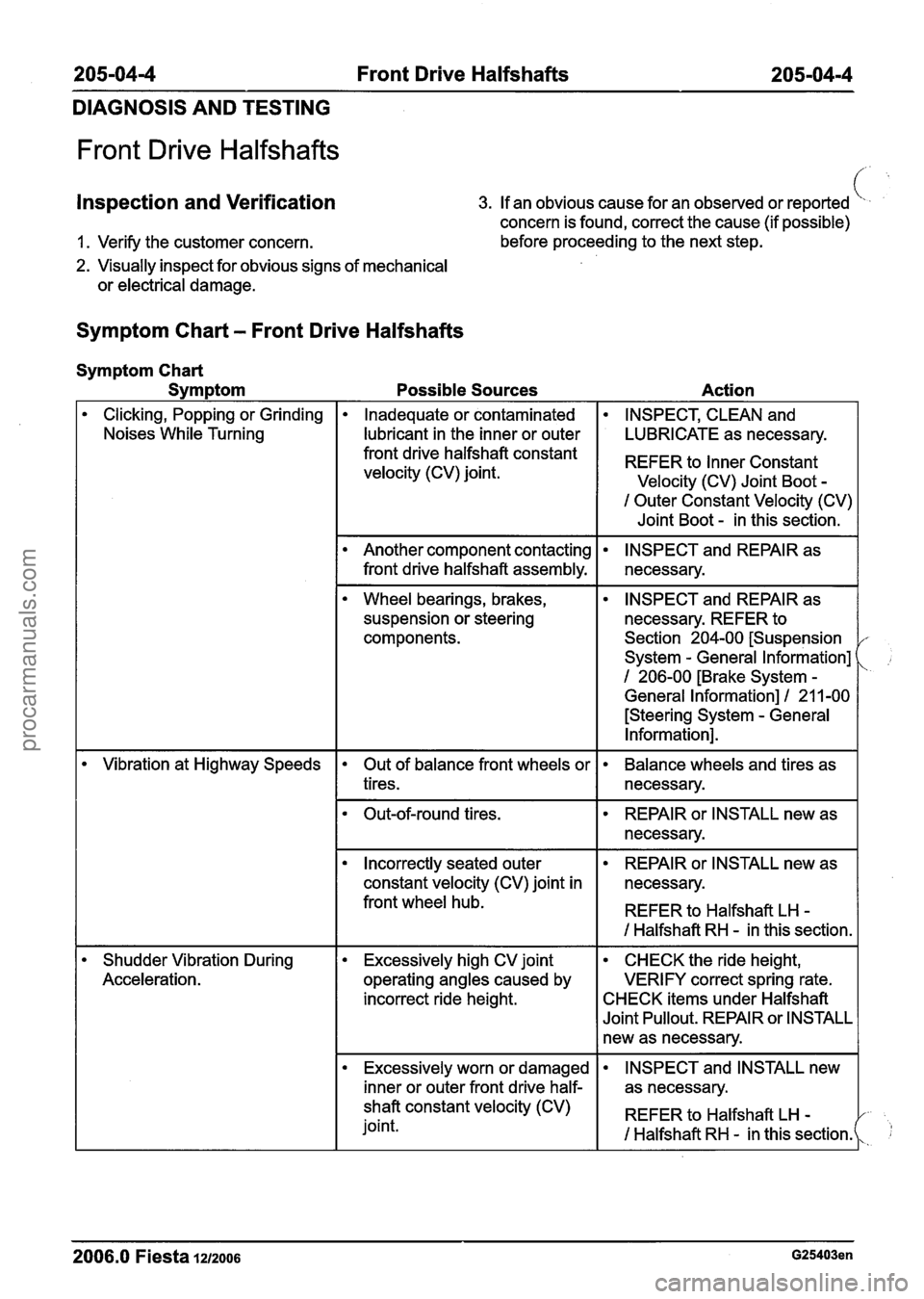
205-0414 Front Drive Halfshafts 205-04-4
DIAGNOSIS AND TESTING
Front Drive Halfshafts
Inspection and Verification 3. If an obvious cause for an observed or reported
concern is found, correct the cause (if possible) c.# '
1. Verify the customer concern. before proceeding
to the next step.
2. Visually inspect for obvious signs of mechanical
or electrical damage.
Symptom Chart - Front Drive Halfshafts
Symptom Chart
Symptom
Possible Sources Action
Clicking, Popping or Grinding
Noises While Turning Inadequate or contaminated INSPECT, CLEAN and
I lubricant in the inner or outer I LUBRICATE as necessary.
I Outer Constant Velocity (CV)
I Joint Boot - in this section.
front drive halfshaft constant
velocity (CV) joint.
REFER to Constant
Velocity (CV) Joint Boot -
Wheel bearings, brakes,
suspension or steering
components.
Another component contacting
front drive halfshaft assembly.
--
INSPECT and REPAIR as
necessary. REFER to
Section 204-00 [Suspension
System
- General Information]
1 206-00 [Brake System -
General Information] I 21 1-00
[Steering System
- General
Information].
INSPECT and REPAIR as
necessary.
- --
Vibration at Highway Speeds
Shudder Vibration During
Acceleration. Out of balance front wheels or
tires. Balance wheels and tires as
necessary.
I Incorrectly seated outer I REPAIR or INSTALL new as I
Out-of-round tires.
constant velocity (CV) joint in necessary.
front wheel hub.
I REFER to Halfshaft LH -
REPAIR or INSTALL new as
necessary.
I I I Halfshaft RH - in this section. I
Excessively high CV joint
operating angles caused by
incorrect ride height. CHECK the ride height,
VERIFY correct spring rate.
CHECK items under Halfshaft
Joint Pullout. REPAIR or INSTALL
new as necessary.
Excessively worn or damaged
I inner or outer front drive half-
- - - - --
2006.0 Fiesta 1212006 G25403en
INSPECT and INSTALL new
as necessary.
shaft constant velocity (CV)
joint. REFER
to Halfshaft LH
-
I Halfshaft RH - in this sectionk 1;
procarmanuals.com
Page 174 of 1226
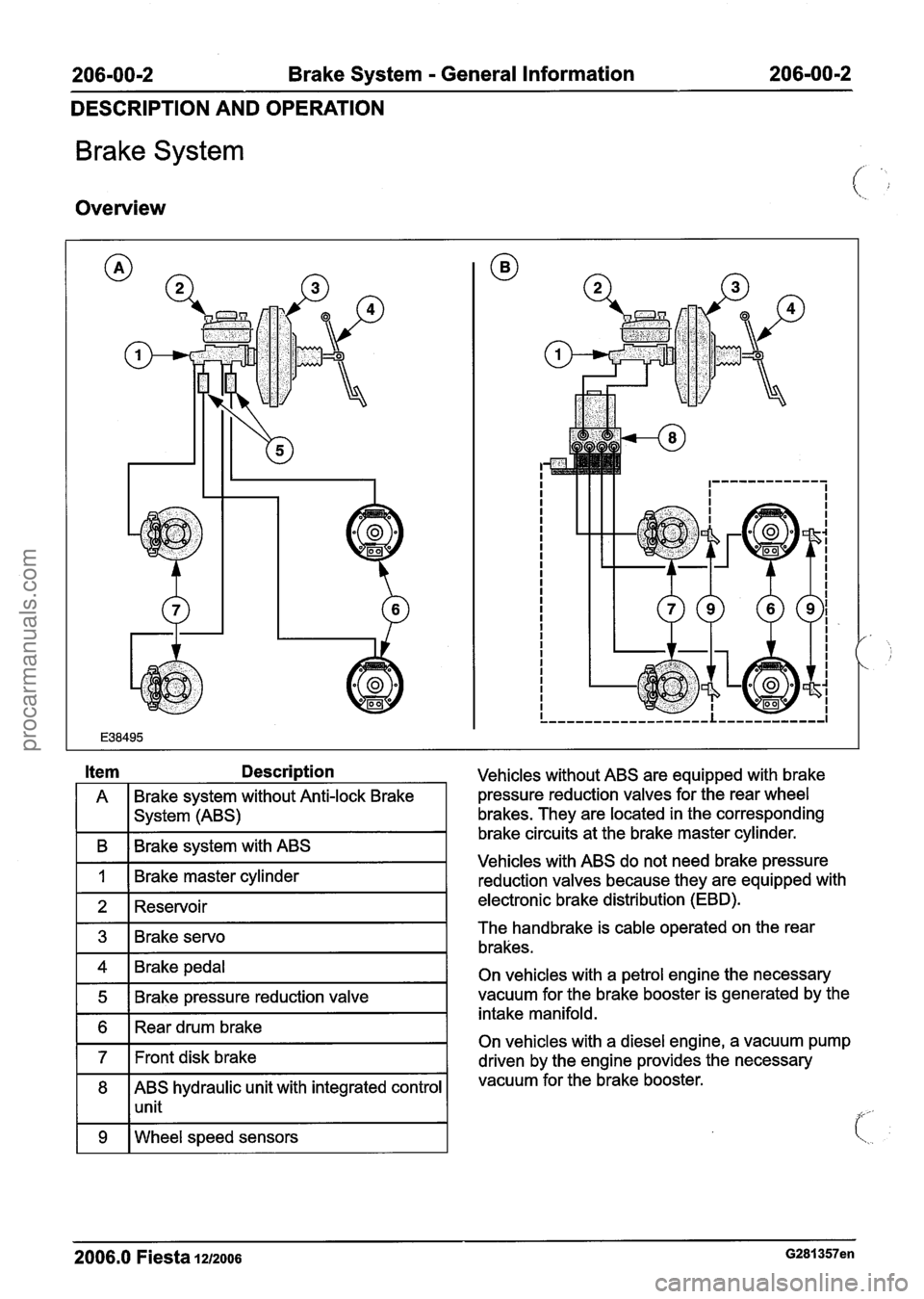
206-00-2 Brake System - General Information 206-00-2
DESCRIPTION AND OPERATION
Brake System
Overview
A Brake system without Anti-lock
Brake
I I system (ABS)
I B I Brake system with ABS I
I 1 I Brake master cylinder I -
1 2 1 Reservoir I
1 4 1 Brake pedal I
1 5 1 Brake pressure reduction valve I
1 6 1 Rear drum brake I
171t disk brake I
8 ABS hydraulic unit with integrated control
1 1 unit
1 9 I Wheel speed sensors I
Vehicles without ABS are equipped with brake
pressure reduction valves for the rear wheel
brakes. They are located in the corresponding
brake circuits at the brake master cylinder.
Vehicles with ABS do not need brake pressure
reduction valves because they are equipped with
electronic brake distribution (EBD).
The handbrake is cable operated on the rear
brakes.
On vehicles with a petrol engine the necessary
vacuum for the brake booster is generated by the
intake manifold.
On vehicles with a diesel engine, a vacuum pump
driven by the engine provides the necessary
vacuum for the brake booster.
2006.0 Fiesta lu2006 G281357en
procarmanuals.com
Page 175 of 1226
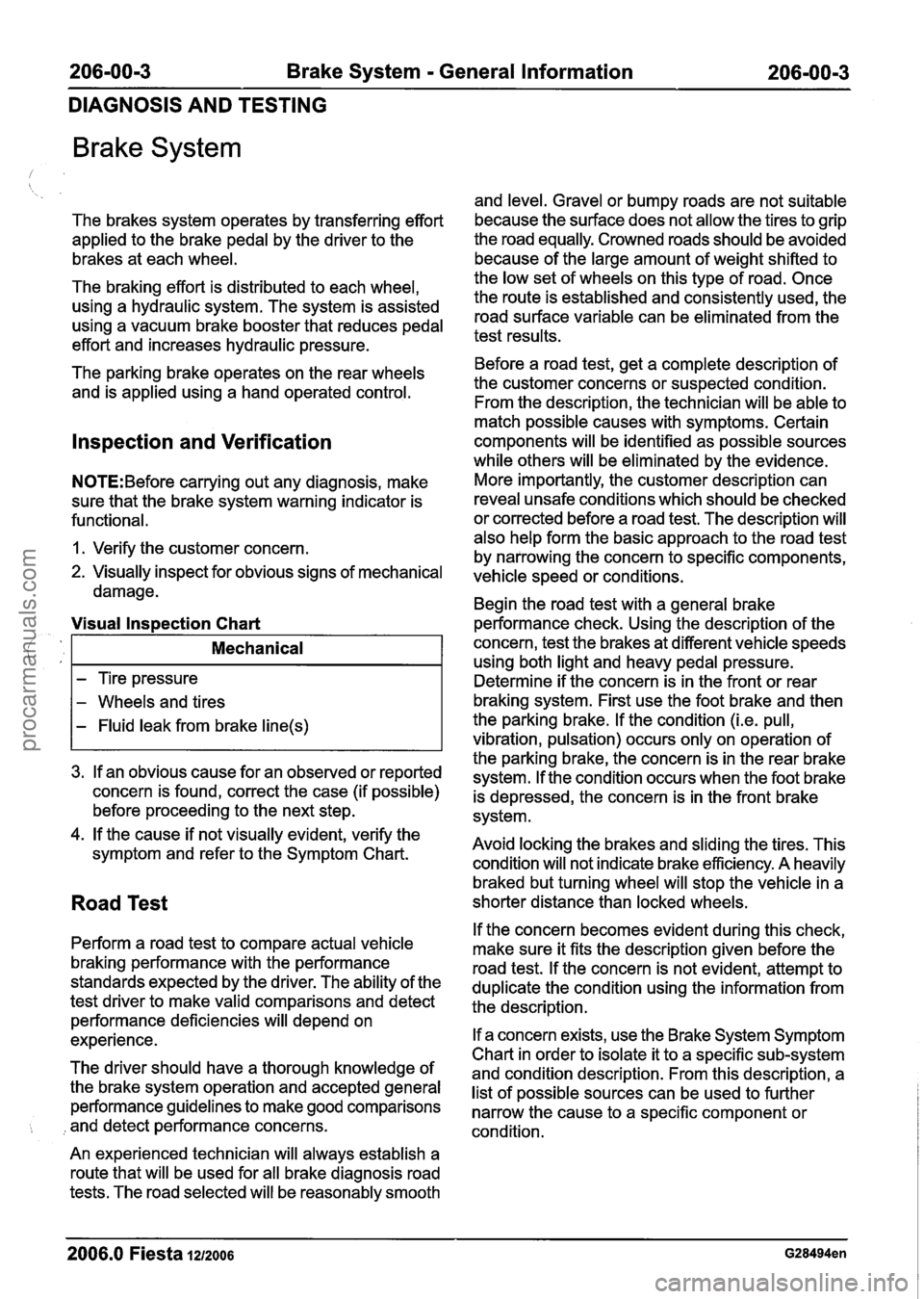
206-00-3 Brake System - General Information 206-00-3
DIAGNOSIS AND TESTING
Brake System
The brakes system operates by transferring effort
applied to the brake pedal by the driver to the
brakes at each wheel.
The braking effort is distributed to each wheel,
using a hydraulic system. The system is assisted
using a vacuum brake booster that reduces pedal
effort and increases hydraulic pressure.
The parking brake operates on the rear wheels
and is applied using a hand operated control.
lnspection and Verification
N0TE:Before carrying out any diagnosis, make
sure that the brake system warning indicator is
functional.
1. Verify the customer concern.
2. Visually inspect for obvious signs of mechanical
damage.
3. If an obvious cause for an observed or reported
concern is found, correct the case (if possible)
before proceeding to the next step.
4. If the cause if not visually evident, verify the
symptom and refer to the Symptom Chart.
Visual lnspection Chart
Road Test
1.
Perform a road test to compare actual vehicle
braking performance with the performance
standards expected by the driver. The ability of the
test driver to make valid comparisons and detect
performance deficiencies will depend on
experience.
Mechanical
- Tire pressure
- Wheels and tires
- Fluid leak from brake line(s)
The driver should have a thorough knowledge of
the brake system operation and accepted general
performance guidelines to make good comparisons
, and detect performance concerns.
An experienced technician will always establish a
route that will be used for all brake diagnosis road
tests. The road selected will be reasonably smooth and level. Gravel
or bumpy roads are not suitable
because the surface does not allow the tires to grip
the road equally. Crowned roads should be avoided
because of the large amount of weight shifted to
the low set of wheels on this type of road. Once
the route is established and consistently used, the
road surface variable can be eliminated from the
test results.
Before a road test, get a complete description of
the customer concerns or suspected condition.
From the description, the technician will be able to
match possible causes with symptoms. Certain
components will be identified as possible sources
while others will be eliminated by the evidence.
More importantly, the customer description can
reveal unsafe conditions which should be checked
or corrected before a road test. The description will
also help form the basic approach to the road test
by narrowing the concern to specific components,
vehicle speed or conditions.
Begin the road test with a general brake
performance check. Using the description of the
concern, test the brakes at different vehicle speeds
using both light and heavy pedal pressure.
Determine if the concern is in the front or rear
braking system. First use the foot brake and then
the parking brake. If the condition
(i.e. pull,
vibration, pulsation) occurs only on operation of
the parking brake, the concern is in the rear brake
system.
If the condition occurs when the foot brake
is depressed, the concern is in the front brake
system.
Avoid locking the brakes and sliding the tires. This
condition will not indicate brake efficiency. A heavily
braked but turning wheel will stop the vehicle in a
shorter distance than locked wheels.
If the concern becomes evident during this check,
make sure it fits the description given before the
road test. If the concern is not evident, attempt to
duplicate the condition using the information from
the description.
If a concern exists, use the Brake System Symptom
Chart in order to isolate it to a specific sub-system
and condition description. From this description, a
list of possible sources can be used to further
narrow the cause to a specific component or
condition.
- -
2006.0 Fiesta 1212006 G28494en
procarmanuals.com
Page 176 of 1226
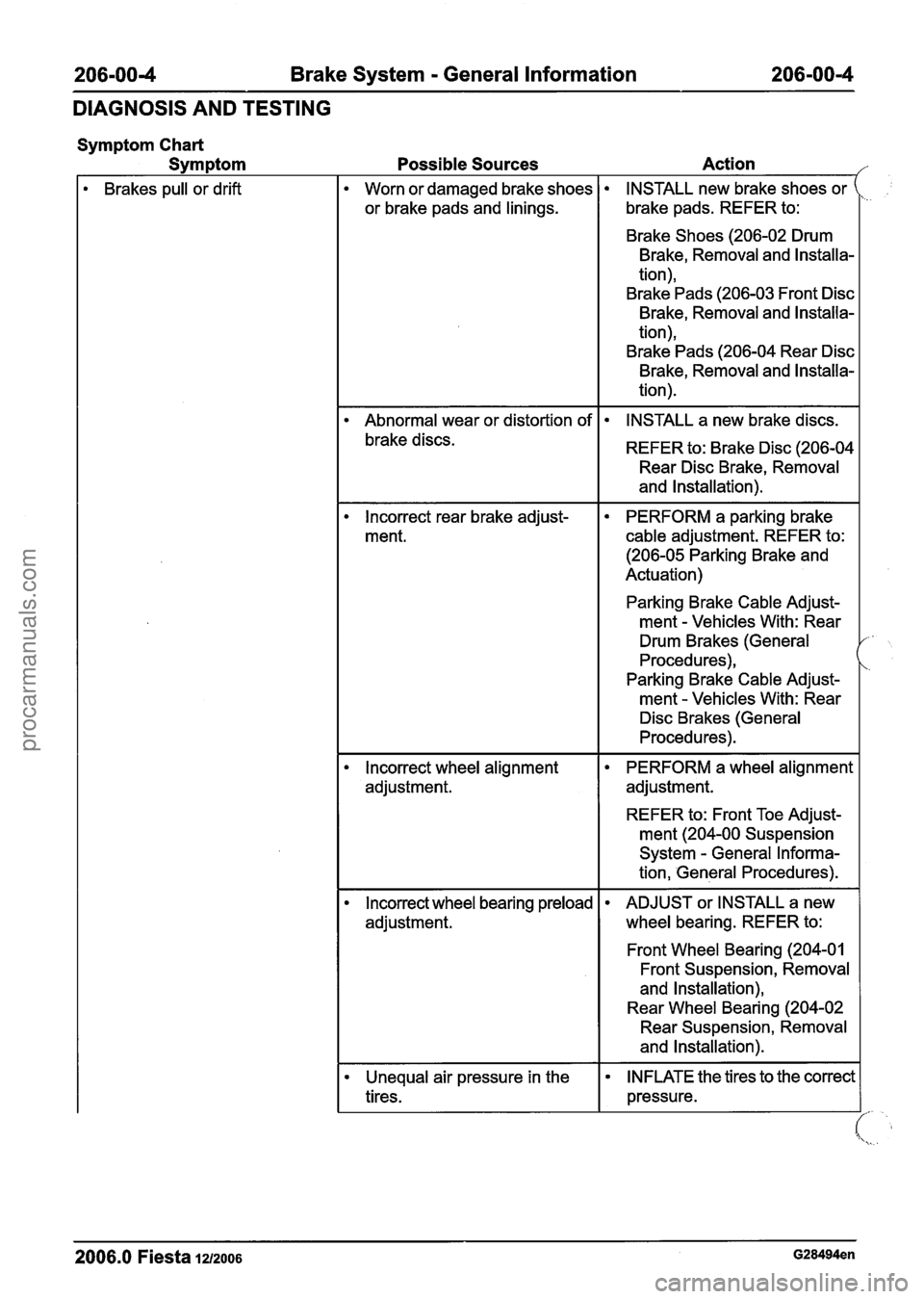
206-004 Brake System - General Information 206-00-4
DIAGNOSIS AND TESTING
Symptom Chart - -
Symptom
Brakes pull or drift
Possible Sources Action
Worn or damaged brake shoes
or brake pads and linings. INSTALL
new brake shoes or ,
brake pads. REFER to:
Brake Shoes (206-02 Drum
Brake, Removal and Installa-
tion),
Brake Pads (206-03 Front Disc
Brake, Removal and Installa-
tion),
Brake Pads (206-04 Rear Disc Brake, Removal and Installa-
tion).
Abnormal wear or distortion of
brake discs.
INSTALL a new brake discs.
REFER to: Brake Disc (206-04
Rear Disc Brake, Removal
and Installation).
lncorrect rear brake adjust-
ment. PERFORM
a parking brake
cable adjustment. REFER to:
(206-05 Parking Brake and
Actuation)
Parking Brake Cable Adjust-
ment
- Vehicles With: Rear
Drum Brakes (General
Procedures),
Parking Brake Cable Adjust-
ment
- Vehicles With: Rear
Disc Brakes (General
Procedures).
lncorrect wheel alignment
adjustment. PERFORM a
wheel alignment
adjustment.
REFER to: Front Toe Adjust-
ment (204-00 Suspension
System
- General Informa-
tion, General Procedures).
l ncorrect wheel bearing preload
adjustment. ADJUST or INSTALL a new
wheel bearing. REFER to:
Front Wheel Bearing (204-01 Front Suspension, Removal
and Installation),
Rear Wheel Bearing (204-02 Rear Suspension, Removal
and Installation).
2006.0 Fiesta 1212006 G28494en
Unequal air pressure in the
tires. INFLATE the tires to the correct
pressure.
procarmanuals.com
Page 177 of 1226
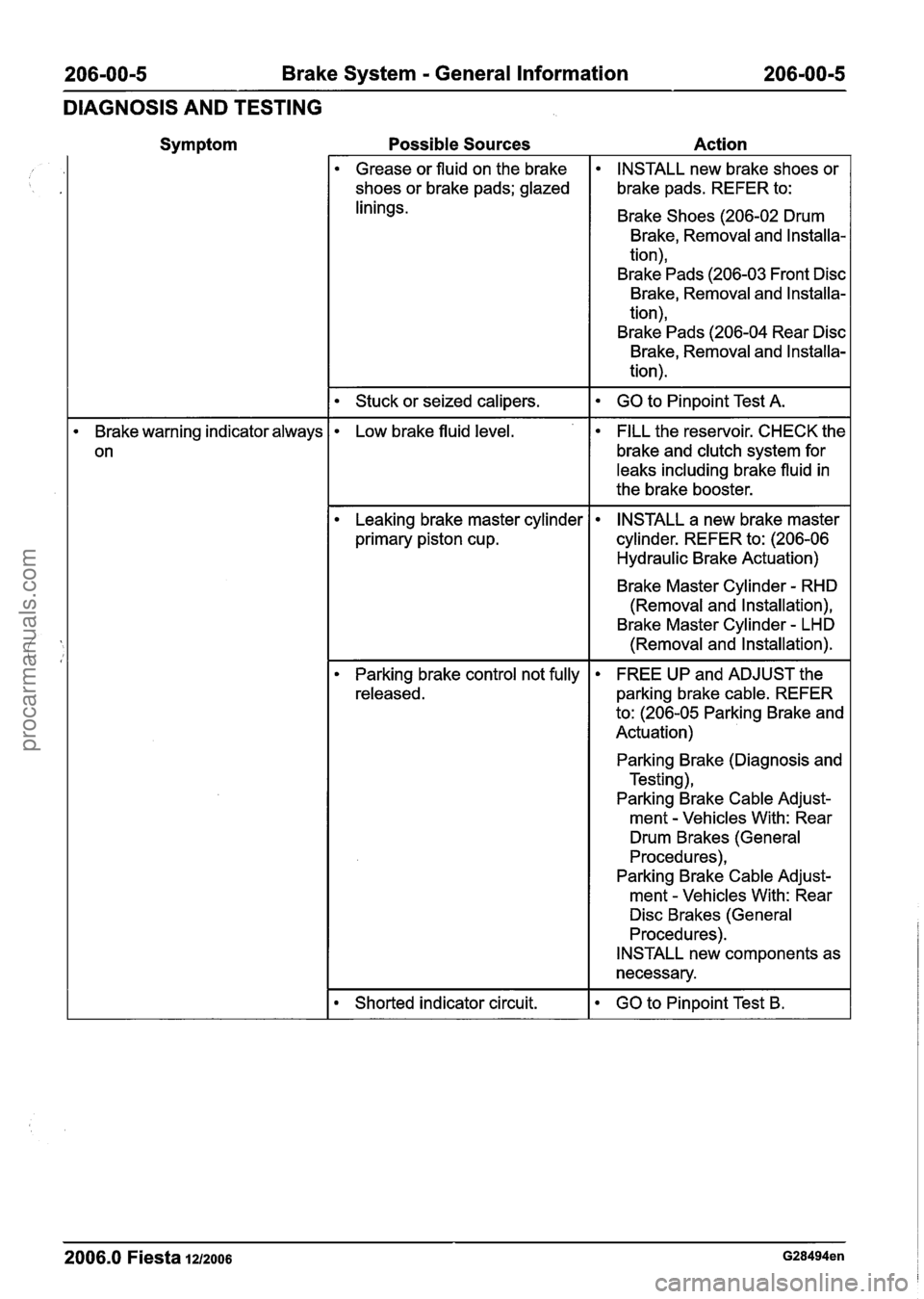
206-00-5 Brake System - General Information 206-00-5
DIAGNOSIS AND TESTING
Symptom Possible Sources
Action
Grease or fluid on the brake
shoes or brake pads; glazed
linings. INSTALL
new brake shoes or
brake pads. REFER to:
Brake Shoes (206-02 Drum Brake, Removal and Installa-
tion),
Brake Pads (206-03 Front Disc
Brake, Removal and Installa-
tion),
Brake Pads (206-04 Rear Disc Brake, Removal and Installa-
tion).
I Stuck or seized calipers. I GO to Pinpoint Test A. I
Brake warning indicator always
on Low
brake fluid level. FILL the reservoir. CHECK the
brake and clutch system for
leaks including brake fluid in
the brake booster.
--
Leaking brake master cylinder
primary piston cup. INSTALL a new brake master
cylinder. REFER to: (206-06
Hydraulic Brake Actuation)
Brake Master Cylinder
- RHD
(Removal and Installation),
Brake Master Cylinder
- LHD
(Removal and Installation).
Parking brake control not fully
released. FREE UP and
ADJUST the
parking brake cable. REFER
to: (206-05 Parking Brake and
Actuation)
Parking Brake (Diagnosis and Testing),
Parking Brake Cable Adjust-
ment
- Vehicles With: Rear
Drum Brakes (General
Procedures),
Parking Brake Cable Adjust-
ment
- Vehicles With: Rear
Disc Brakes (General
Procedures).
INSTALL new components as
necessary.
I Shorted indicator circuit. I GO to Pinpoint Test B. I
2006.0 Fiesta 12/2006 G28494en
procarmanuals.com
Page 178 of 1226
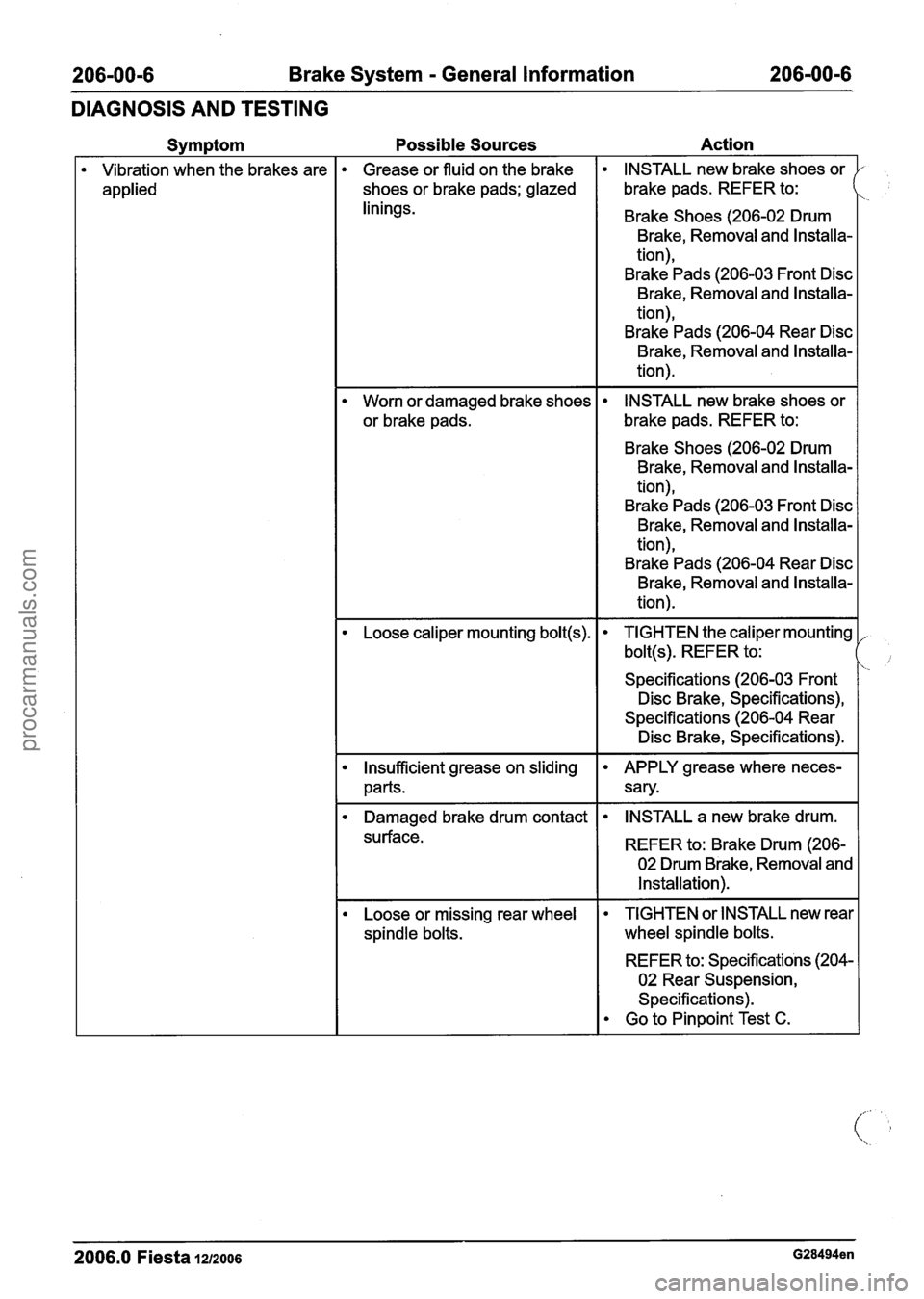
206-00-6 Brake System - General Information 206-00-6
DIAGNOSIS AND TESTING
Symptom
Vibration when the brakes are
applied Possible
Sources Action
Grease or fluid on the brake
shoes or brake pads; glazed
linings. INSTALL
new brake shoes or
brake pads. REFER to:
i
Brake Shoes (206-02 Drum
Brake, Removal and Installa-
tion),
Brake Pads (206-03 Front Disc
Brake, Removal and Installa-
tion),
Brake Pads (206-04 Rear Disc Brake, Removal and Installa-
tion).
Worn or damaged brake shoes
or brake pads. INSTALL
new brake shoes or
brake pads. REFER to:
Brake Shoes (206-02 Drum
Brake, Removal and Installa-
tion),
Brake Pads (206-03 Front Disc
Brake, Removal and Installa-
tion),
Brake Pads (206-04 Rear Disc
Brake, Removal and Installa-
tion).
Loose caliper mounting
bolt(s). TIGHTEN the caliper mounting
bolt(s). REFER to:
Specifications (206-03 Front Disc Brake, Specifications),
Specifications (206-04 Rear Disc Brake, Specifications).
Insufficient grease on sliding grease
where neces-
parts.
Damaged brake drum contact
surface. REFER to: Brake Drum (206-
02 Drum Brake, Removal and
Installation).
Loose or missing rear wheel
spindle bolts. TIGHTEN or
INSTALL new rear
wheel spindle bolts.
REFER to: Specifications (204-
02 Rear Suspension, Specifications).
Go to Pinpoint Test
C.
2006.0 Fiesta 1212006 G28494en
procarmanuals.com