air con FORD FIESTA 2007 Owner's Manual
[x] Cancel search | Manufacturer: FORD, Model Year: 2007, Model line: FIESTA, Model: FORD FIESTA 2007Pages: 1226, PDF Size: 61.26 MB
Page 37 of 1226
I 00-00-21 General Information 1 00-00-21
DESCRIPTION AND OPERATION
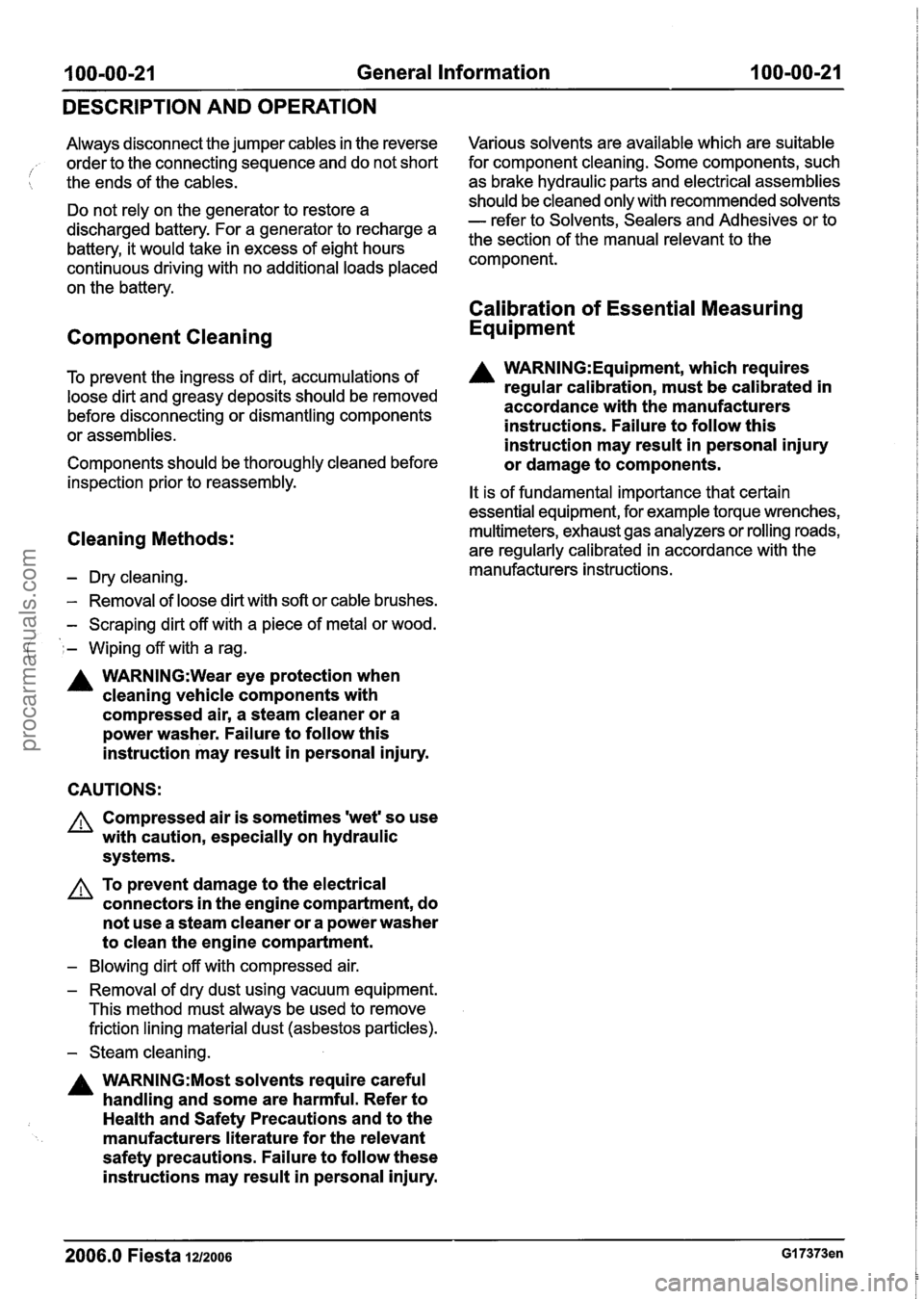
Always disconnect the jumper cables in the reverse
order to the connecting sequence and do not short
i the ends of the cables.
Do not rely on the generator to restore a
discharged battery. For a generator to recharge a
battery, it would take in excess of eight hours
continuous driving with no additional loads placed
on the battery.
Component Cleaning
To prevent the ingress of dirt, accumulations of
loose dirt and greasy deposits should be removed
before disconnecting or dismantling components
or assemblies.
Components should be thoroughly cleaned before inspection prior to reassembly.
Cleaning Methods:
- Dry cleaning.
- Removal of loose dirt with soft or cable brushes.
- Scraping dirt off with a piece of metal or wood.
( ,- Wiping off with a rag.
A WARN1NG:Wear eye protection when
cleaning vehicle components with
compressed air, a steam cleaner or a
power washer. Failure to follow this
instruction may result in personal injury.
CAUTIONS:
A Compressed air is sometimes 'wet' so use
with caution, especially on hydraulic
systems.
A To prevent damage to the electrical
connectors in the engine compartment, do
not use a steam cleaner or a power washer
to clean the engine compartment.
- Blowing dirt off with compressed air.
- Removal of dry dust using vacuum equipment.
This method must always be used to remove
friction lining material dust (asbestos particles).
- Steam cleaning.
A WARN1NG:Most solvents require careful
handling and some are harmful. Refer to
Health and Safety Precautions and to the
manufacturers literature for the relevant
safety precautions. Failure to follow these
instructions may result in personal injury.
Various solvents are available which are suitable
for component cleaning. Some components, such
as brake hydraulic parts and electrical assemblies
should be cleaned only with recommended solvents
- refer to Solvents, Sealers and Adhesives or to
the section of the manual relevant to the
component.
Calibration of Essential Measuring
Equipment
A WARNING:Equipment, which requires
regular calibration, must be calibrated in
accordance with the manufacturers
instructions. Failure to follow this
instruction may result in personal injury
or damage to components.
It is of fundamental importance that certain
essential equipment, for example torque wrenches,
multimeters, exhaust gas analyzers or rolling roads,
are regularly calibrated in accordance with the
manufacturers instructions.
2006.0 Fiesta 1212006 GI 7373en
procarmanuals.com
Page 40 of 1226
100-00-24 General Information 100-00-24
DESCRIPTION AND OPERATION
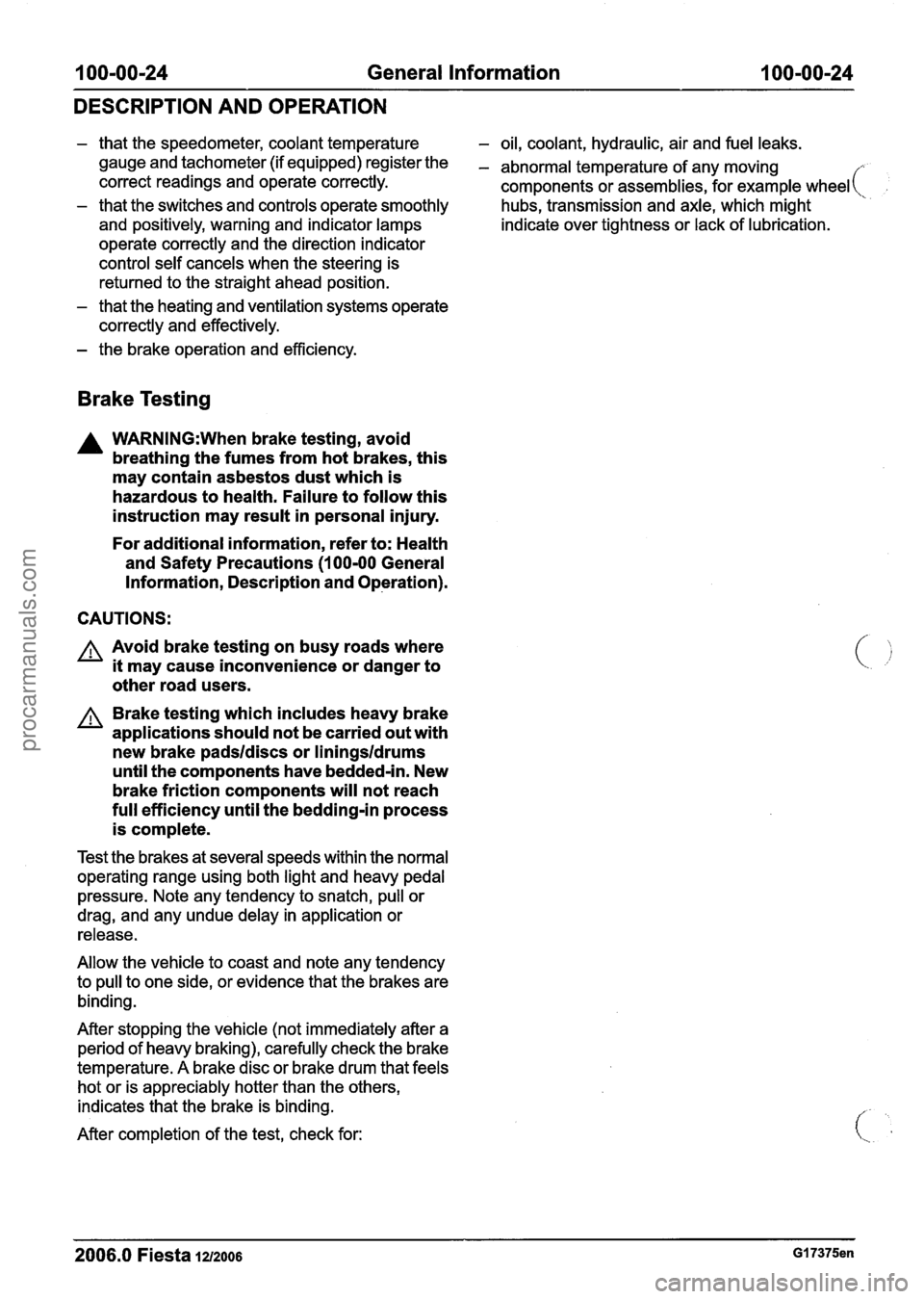
- that the speedometer, coolant temperature - oil, coolant, hydraulic, air and fuel leaks.
gauge and tachometer (if equipped) register the - abnormal temperature of any moving
correct readings and operate correctly.
components or assemblies, for example wheel
(
- that the switches and controls operate smoothly hubs, transmission and axle, which might
and positively, warning and indicator lamps
indicate over tightness or lack of lubrication.
operate correctly and the direction indicator
control self cancels when the steering is
returned to the straight ahead position.
- that the heating and ventilation systems operate
correctly and effectively.
- the brake operation and efficiency.
Brake Testing
A WARNING:When brake testing, avoid
breathing the fumes from hot brakes, this
may contain asbestos dust which is
hazardous to health. Failure to follow this
instruction may result in personal injury.
For additional information, refer to: Health
and Safety Precautions
(1 00-00 General
Information, Description and Operation).
CAUTIONS:
A Avoid brake testing on busy roads where
it may cause inconvenience or danger to
other road users.
A Brake testing which includes heavy brake
applications should not be carried out with
new brake
padsldiscs or liningsldrums
until the components have bedded-in. New
brake friction components will not reach
full efficiency until the bedding-in process
is complete.
Test the brakes at several speeds within the normal
operating range using both light and heavy pedal
pressure. Note any tendency to snatch, pull or
drag, and any undue delay in application or
release.
Allow the vehicle to coast and note any tendency
to pull to one side, or evidence that the brakes are
binding.
After stopping the vehicle (not immediately after a
period of heavy braking), carefully check the brake
temperature.
A brake disc or brake drum that feels
hot or is appreciably hotter than the others,
indicates that the brake is binding.
After completion of the test, check for:
2006.0 Fiesta 1212006 GI 7375en
procarmanuals.com
Page 58 of 1226
100-04-2 Noise, Vibration and Harshness 100-04-2
DESCRIPTION AND OPERATION
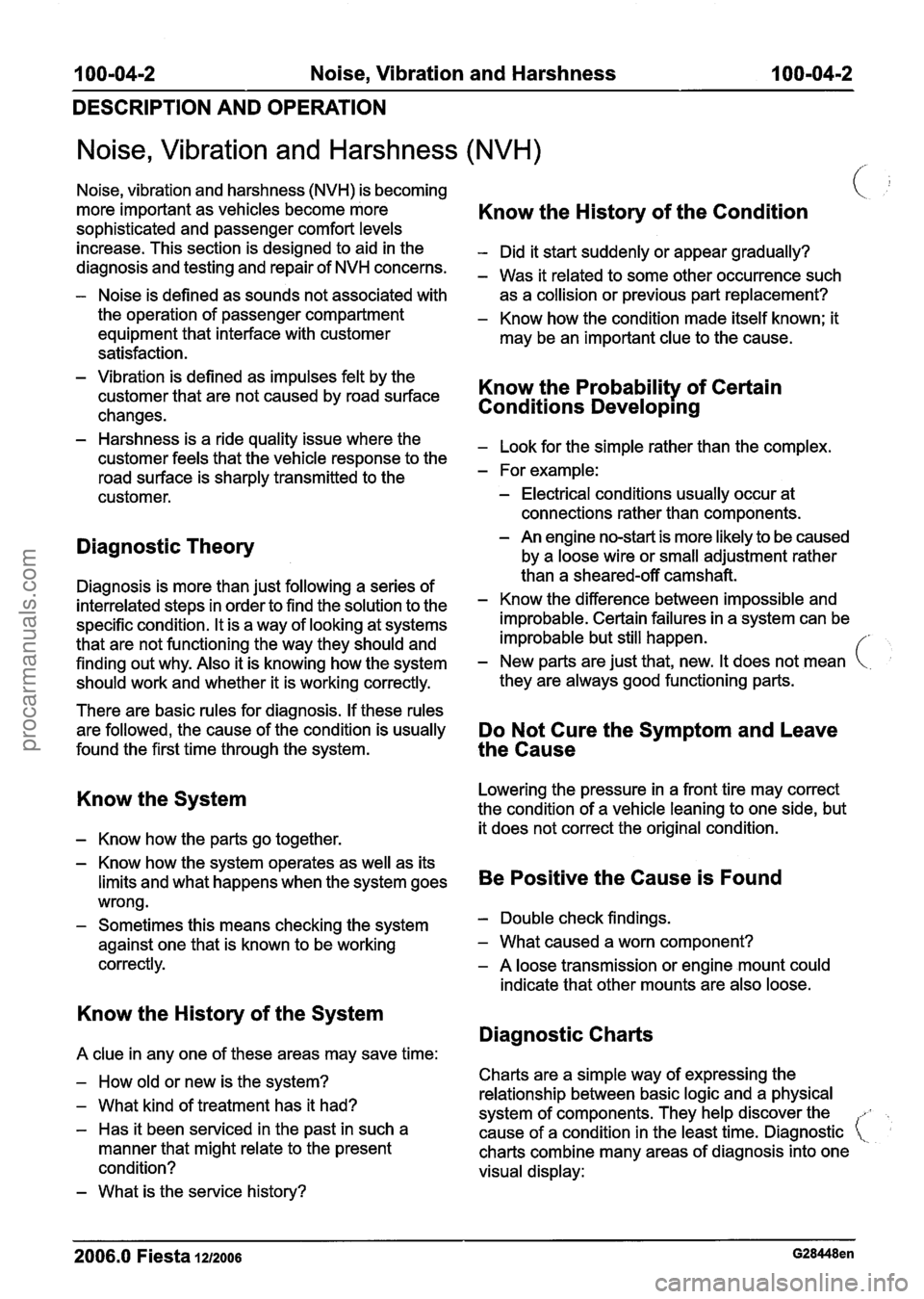
Noise, Vibration and Harshness (NVH)
Noise, vibration and harshness (NVH) is becoming
more important as vehicles become more '
Know the History of the Condition
sophisticated and passenger comfort levels
increase. This section is designed to aid in the
- Did it start suddenly or appear gradually?
diagnosis and testing and repair of NVH concerns.
- Was it related to some other occurrence such
- Noise is defined as sounds not associated with
as a collision or previous part replacement?
the operation of passenger compartment
- Know how the condition made itself known; it
equipment that interface with customer
may be an important clue to the cause.
satisfaction.
- Vibration is defined as impulses felt by the
customer that are not caused by road surface Know the Probability of Certain
changes. Conditions Develop~ng
- Harshness is a ride quality issue where the - Look for the simple rather than the complex.
customer feels that the vehicle response to the
road surface is sharply transmitted to the
- For example:
customer.
- Electrical conditions usually occur at
connections rather than components.
Diagnostic Theory - An engine no-start is more likely to be caused
by a loose wire or small adjustment rather
than a sheared-off
camshafi. Diagnosis is more than just following a series of
interrelated steps in order to find the solution to the - Know the difference between impossible and
specific condition. It is a way of looking at systems improbable. Certain failures
in a system can be
that are not functioning the way they should and improbable
but still happen.
finding out why. Also it is knowing how the system
- New parts are just that, new. It does not mean
should work and whether it is working correctly. they are always
good functioning parts.
There are basic rules for diagnosis. If these rules
are followed, the cause of the condition is usually
Do Not Cure the Symptom and Leave
found the first time through the system. the Cause
Know the System
- Know how the parts go together. Lowering
the pressure in a front tire may correct
the condition of a vehicle leaning to one side, but
it does not correct the original condition.
- Know how the system operates as well as its
limits and what happens when the system goes
Be Positive the Cause is Found
wrong.
- Sometimes this means checking the system - Double check findings.
against one that is known to be working
- What caused a worn component?
correctly.
- A loose transmission or engine mount could
indicate that other mounts are also loose.
Know the History of the System
Diagnostic Charts
A clue in any one of these areas may save time:
- How old or new is the system? Charts are a simple
way of expressing the
relationship between basic logic and a physical
- What kind of treatment has it had?
system of components. They help discover the ,.
- Has it been serviced in the past in such a
cause of a condition in the least time. Diagnostic (,-
manner that might relate to the present
charts combine many areas of diagnosis into one
condition? visual display:
- What is the service history?
2006.0 Fiesta 12/2006 G28448en
procarmanuals.com
Page 62 of 1226
100-04-6 Noise, Vibration and Harshness 100-04-6
DIAGNOSIS AND TESTING
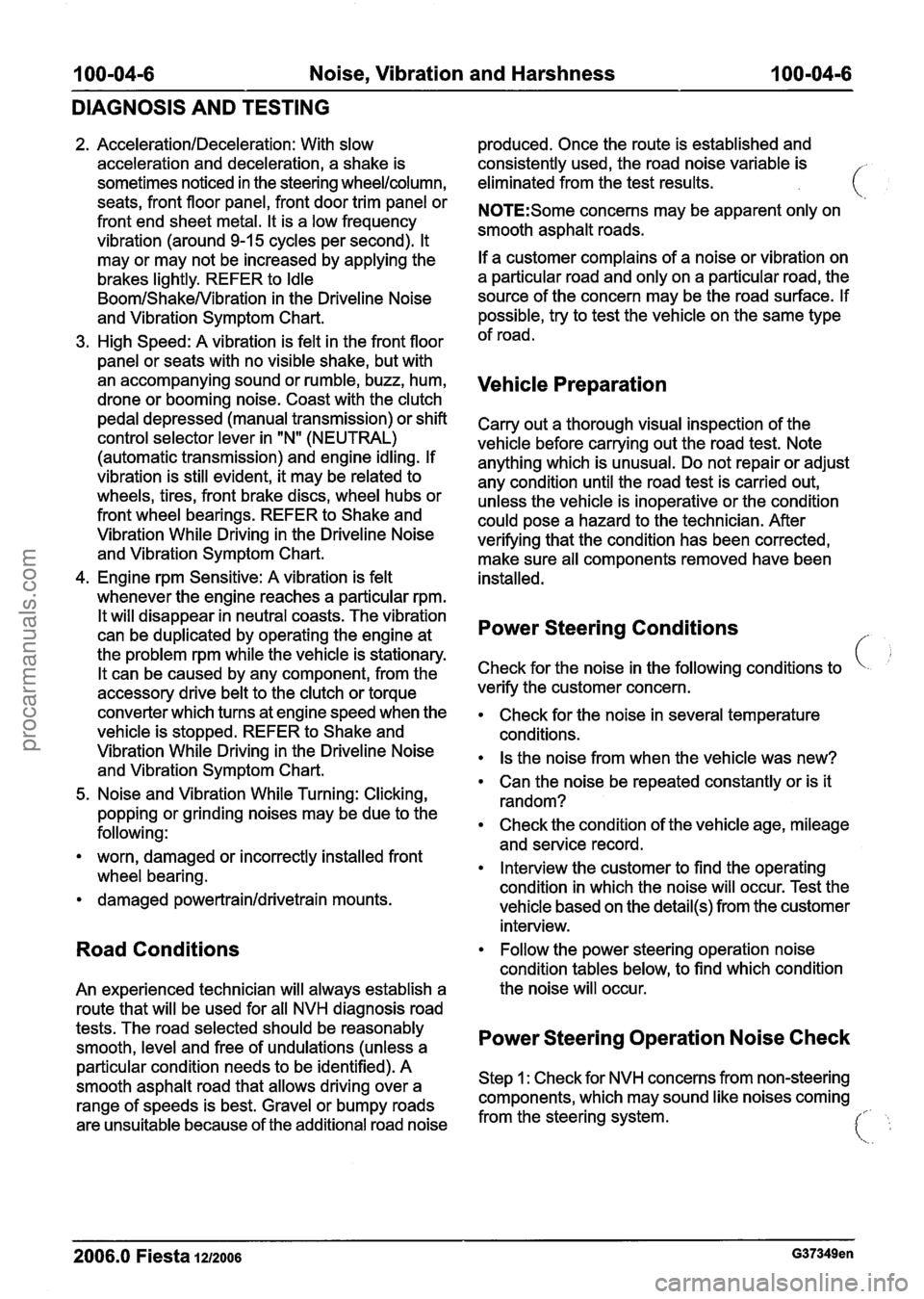
2. AccelerationIDeceleration: With slow
acceleration and deceleration, a shake is
sometimes noticed in the steering
wheellcolumn,
seats, front floor panel, front door trim panel or
front end sheet metal. It is a low frequency
vibration (around
9-1 5 cycles per second). It
may or may not be increased by applying the
brakes lightly. REFER to
Idle
BoomIShakeNibration in the Driveline Noise
and Vibration Symptom Chart.
High Speed: A vibration is felt in the front floor
panel or seats with no visible shake, but with
an accompanying sound or rumble, buzz, hum,
drone or booming noise. Coast with the clutch
pedal depressed (manual transmission) or shift
control selector lever in "N" (NEUTRAL)
(automatic transmission) and engine idling. If
vibration is still evident, it may be related to
wheels, tires, front brake discs, wheel hubs or
front wheel bearings. REFER to Shake and
Vibration While Driving in the Driveline Noise
and Vibration Symptom Chart.
4. Engine rpm Sensitive: A vibration is felt
whenever the engine reaches a particular rpm.
It will disappear in neutral coasts. The vibration
can be duplicated by operating the engine at
the problem rpm while the vehicle is stationary.
It can be caused by any component, from the
accessory drive belt to the clutch or torque
converter which turns at engine speed when the
vehicle is stopped. REFER to Shake and
Vibration While Driving in the Driveline Noise
and Vibration Symptom Chart.
5. Noise and Vibration While Turning: Clicking,
popping or grinding noises may be due to the
following:
worn, damaged or incorrectly installed front
wheel bearing.
damaged
powertrainldrivetrain mounts.
Road Conditions
An experienced technician will always establish a
route that will be used for all NVH diagnosis road
tests. The road selected should be reasonably
smooth, level and free of undulations (unless a
particular condition needs to be identified). A
smooth asphalt road that allows driving over a
range of speeds is best. Gravel or bumpy roads
are unsuitable because of the additional road noise produced.
Once the route is established and
consistently used, the road noise variable is
eliminated from the test results.
N0TE:Some concerns may be apparent only on
smooth asphalt roads.
If a customer complains of a noise or vibration on
a particular road and only on a particular road, the
source of the concern may be the road surface. If
possible, try to test the vehicle on the same type
of road.
Vehicle Preparation
Carry out a thorough visual inspection of the
vehicle before carrying out the road test. Note
anything which is unusual. Do not repair or adjust
any condition until the road test is carried out,
unless the vehicle is inoperative or the condition
could pose a hazard to the technician. After
verifying that the condition has been corrected,
make sure all components removed have been
installed.
Power Steering Conditions
c !
Check for the noise in the following conditions to
verify the customer concern.
Check for the noise in several temperature
conditions.
Is the noise from when the vehicle was new?
Can the noise be repeated constantly or is it
random?
Check the condition of the vehicle age, mileage
and service record.
Interview the customer to find the operating
condition in which the noise will occur. Test the
vehicle based on the
detail(s) from the customer
interview.
Follow the power steering operation noise
condition tables below, to find which condition
the noise will occur.
Power Steering Operation Noise Check
Step 1 : Check for NVH concerns from non-steering
components, which may sound like noises coming
from the steering system.
I:. ':
2006.0 Fiesta 121zoo6 G37349en
procarmanuals.com
Page 65 of 1226
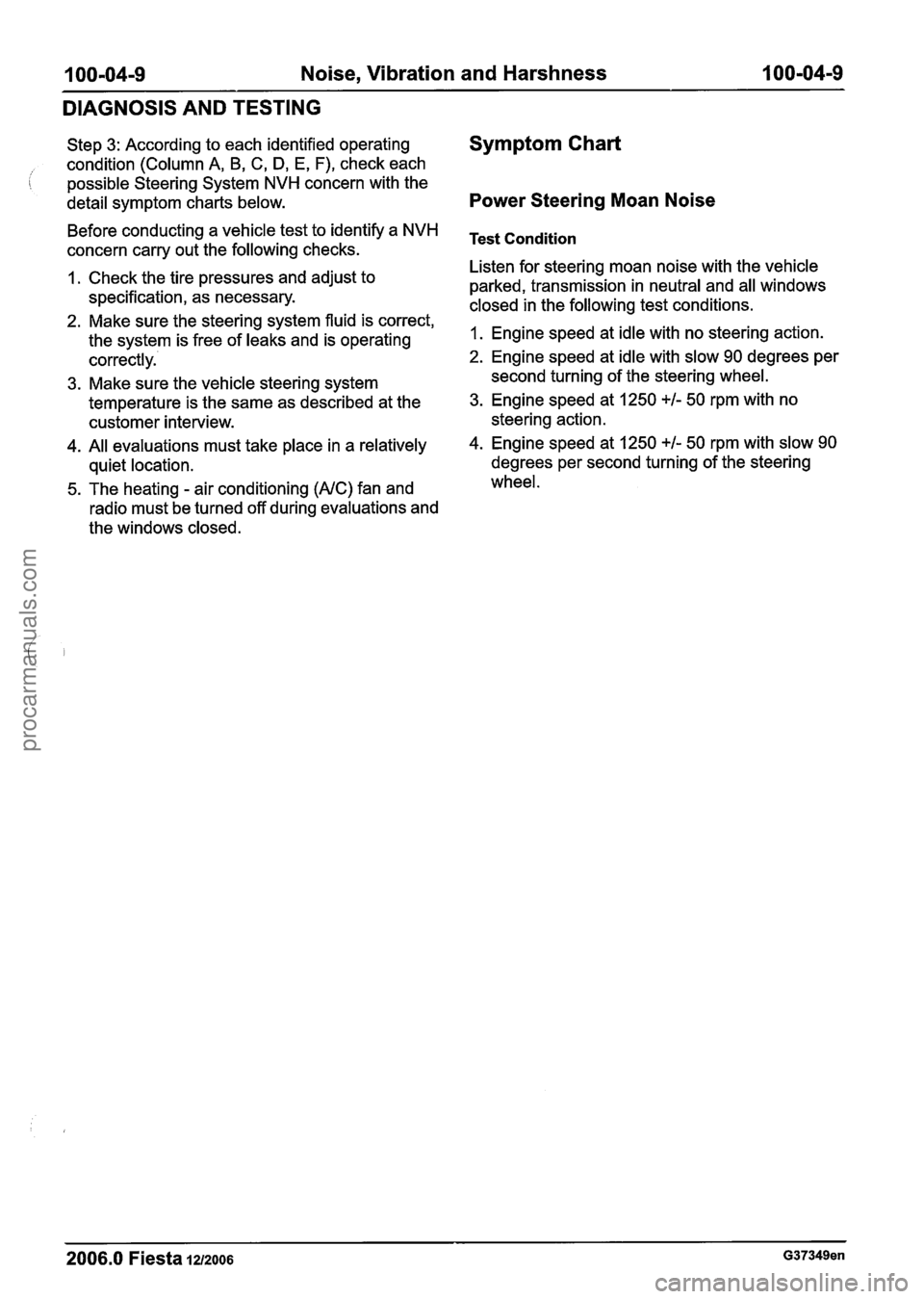
100-04-9 Noise, Vibration and Harshness 1 00-04-9
DIAGNOSIS AND TESTING
Step 3: According to each identified operating
condition (Column A, B,
C, D, E, F), check each
possible Steering System
NVH concern with the
detail symptom charts below.
Before conducting a vehicle test to identify a
NVH
concern carry out the following checks.
1. Check the tire pressures and adjust to
specification, as necessary.
2. Make sure the steering system fluid is correct,
the system is free of leaks and is operating
correctly.
3. Make sure the vehicle steering system
temperature is the same as described at the
customer interview.
4. All evaluations must take place in a relatively
quiet location.
5. The heating
- air conditioning (AIC) fan and
radio must be turned off during evaluations and
the windows closed.
Symptom Chart
Power Steering Moan Noise
Test Condition
Listen for steering moan noise with the vehicle
parked, transmission in neutral and all windows
closed in the following test conditions.
1. Engine speed at idle with no steering action.
2. Engine speed at idle with slow 90 degrees per
second turning of the steering wheel.
3. Engine speed at 1250 +I- 50 rpm with no
steering action.
4. Engine speed at 1250 +I- 50 rpm with slow 90
degrees per second turning of the steering
wheel.
2006.0 Fiesta 12/2006 G37349en
procarmanuals.com
Page 68 of 1226
I 00-04-1 2 Noise, Vibration and Harshness I 00=04m12
DIAGNOSIS AND TESTING
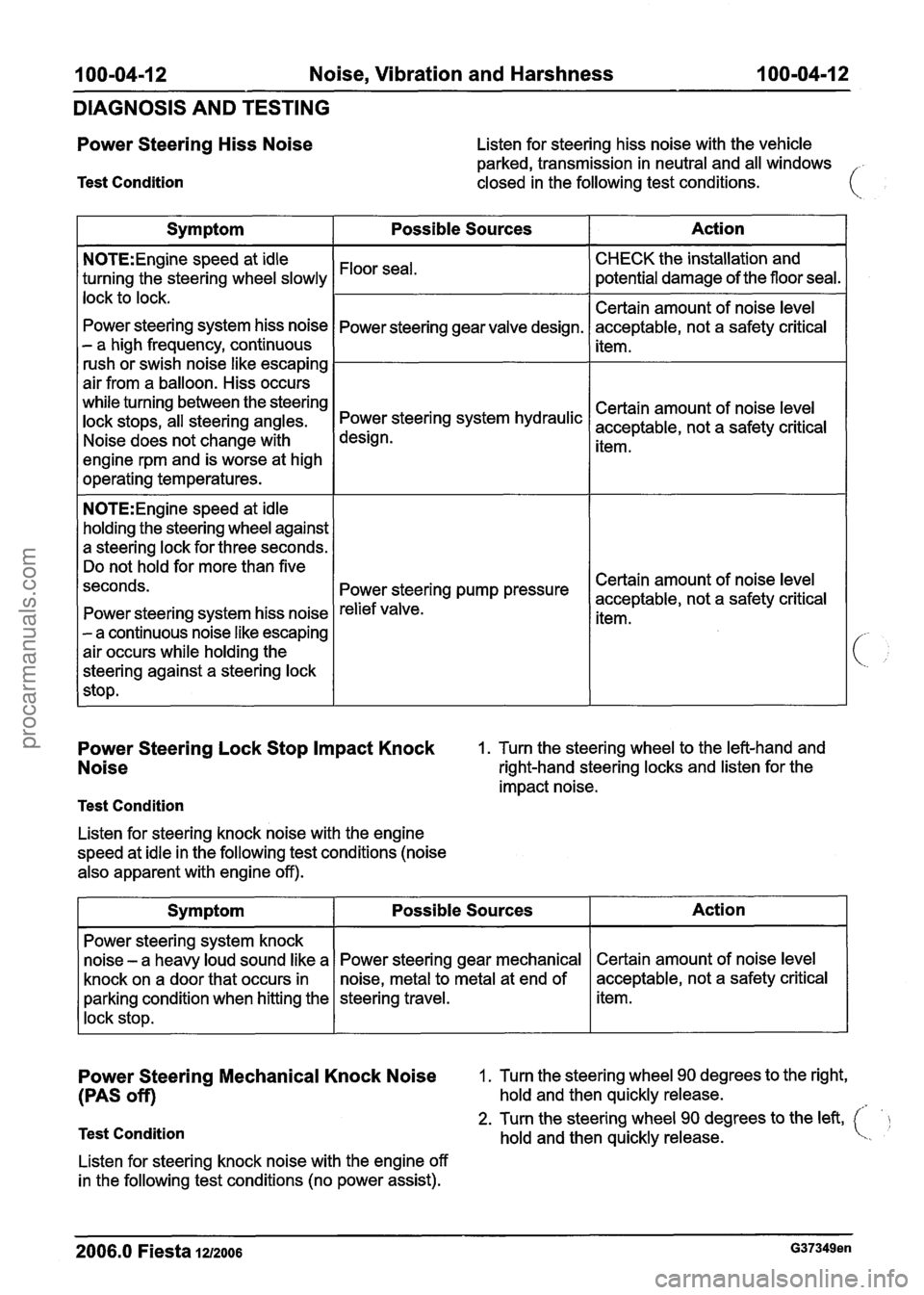
Power Steering Hiss Noise
Test Condition
Listen for steering hiss noise with the vehicle
parked, transmission in neutral and all windows
-
closed in the following test conditions.
Power Steering Lock Stop Impact Knock 1. Turn the steering wheel to the left-hand and
Noise right-hand steering locks and listen for the
impact noise.
Test Condition
Listen for steering knock noise with the engine
speed at idle in the following test conditions (noise
also apparent with engine off).
Action
CHECK the installation and
potential damage of the floor seal.
Certain amount of noise level
acceptable, not a safety critical
item.
Certain amount of noise level
acceptable, not a safety critical
item.
Certain amount of noise level
acceptable, not a safety critical
item.
Symptom
N0TE:Engine speed at idle
turning the steering wheel slowly
lock to lock.
Power steering system hiss noise
- a high frequency, continuous
rush or swish noise like escaping
air from a balloon. Hiss occurs
while turning between the steering
lock stops, all steering angles.
Noise does not change with
engine rpm and is worse at high
operating temperatures.
N0TE:Engine speed at idle
holding the steering wheel against
a steering lock for three seconds.
Do not hold for more than five
seconds.
Power steering system hiss noise
- a continuous noise like escaping
air occurs while holding the
steering against a steering lock
stop.
Possible Sources
Floor seal.
Power steering gear valve design.
Power steering system hydraulic
design.
Power pump pressure
relief valve.
Power Steering Mechanical Knock Noise 1. Turn the steering wheel 90 degrees to the right,
(PAS off) hold and then quickly release.
2. Turn the steering wheel 90 degrees to the left, Test Condition hold and then quickly release.
Listen for steering knock noise with the engine off
in the following test conditions (no power assist).
2006.0 Fiesta 1212006 G37349en
Action
Certain amount of noise level
acceptable, not a safety critical
item.
Symptom
Power steering system knock
noise
- a heavy loud sound like a
knock on a door that occurs in
parking condition when hitting the
lock stop.
Possible Sources
Power steering gear mechanical
noise, metal to metal at end of
steering travel.
procarmanuals.com
Page 72 of 1226
100-04-16 Noise, Vibration and Harshness 100-04-1 6
DIAGNOSIS AND TESTING
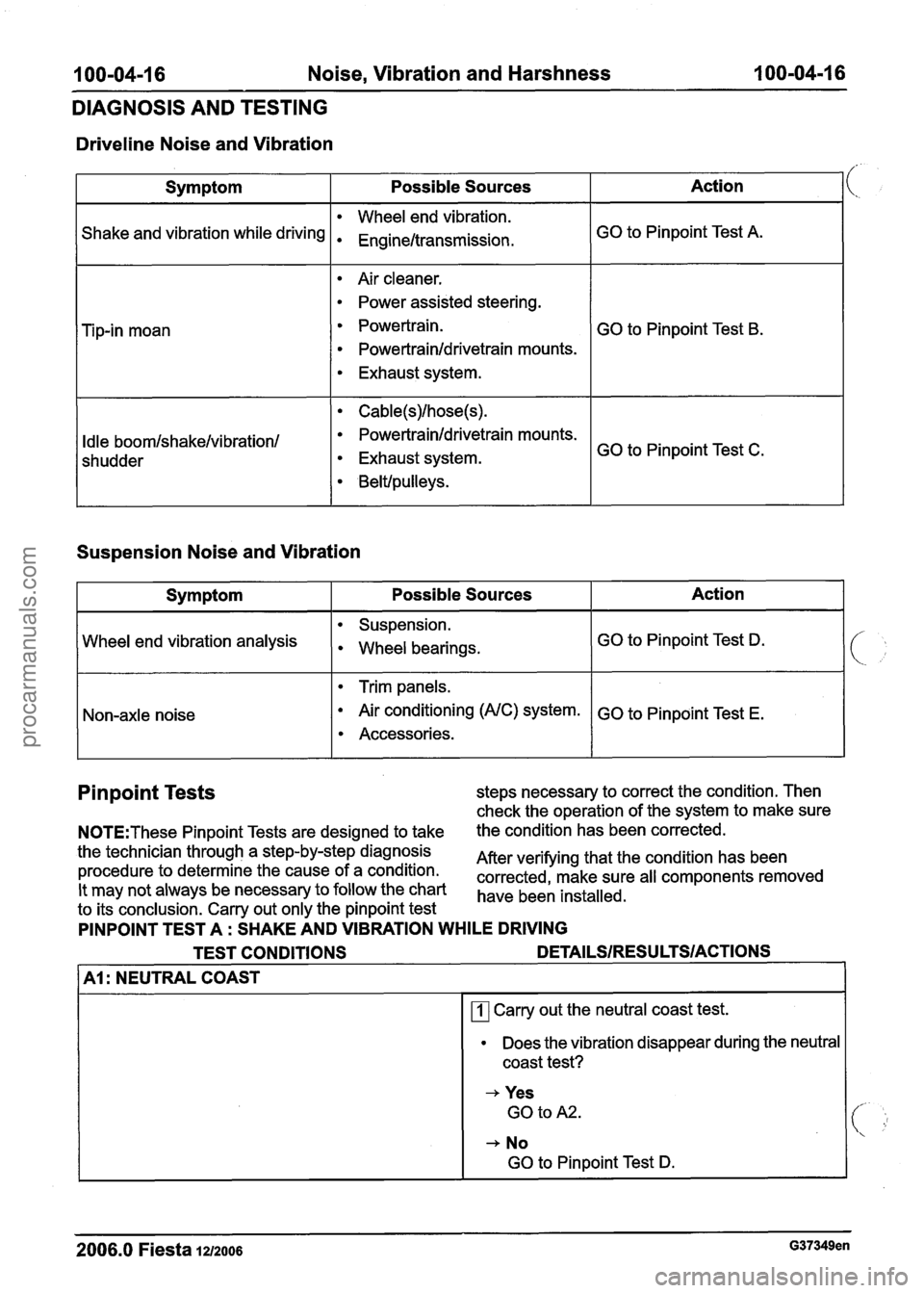
Driveline Noise and Vibration
Suspension Noise and Vibration
Action
GO to Pinpoint Test A.
GO to Pinpoint Test
B.
GO to Pinpoint Test C.
Symptom
Shake and vibration while driving
Tip-in moan
Idle boomlshake/vibration/
shudder
Pinpoint Tests steps necessary to correct the condition. Then
check the operation of the system to make sure
N0TE:These Pinpoint Tests are designed to take the
condition has been corrected.
the technician through
a step-by-step diagnosis ~fi~~ verifying that the condition has been procedure to determine the cause of a condition. corrected, make sure all components removed It may not always be necessary to follow the chart have been installed. to its conclusion. Carry out only the pinpoint test
PINPOINT TEST A : SHAKE AND VIBRATION WHILE DRIVING
TEST CONDITIONS
DETAILSIRESU LTSIACTIONS 1
Possible Sources
Wheel end vibration.
. Engine/transmissiOnm
Air cleaner.
Power assisted steering.
Powertrain.
Powertrainldrivetrain mounts.
Exhaust system.
Cable(s)lhose(s).
Powertrainldrivetrain mounts.
Exhaust system.
Belt/ pulleys.
I A1 : NEUTRAL COAST I
Action
GO to Pinpoint Test D.
GO to Pinpoint Test E,
Symptom
Wheel end vibration analysis
Nan-axle noise
Carry out the neutral coast test.
Does the vibration disappear during the neutral
coast test?
+ Yes
GO to A2.
+ No
GO to Pinpoint Test D.
Possible Sources
Suspension.
. Wheel bearings,
Trim panels.
Air conditioning (A/C) system.
Accessories.
- --
2006.0 Fiesta 1212006 G37349en
procarmanuals.com
Page 73 of 1226
100-04-1 7 Noise, Vibration and Harshness 100-04-17
DIAGNOSIS AND TESTING
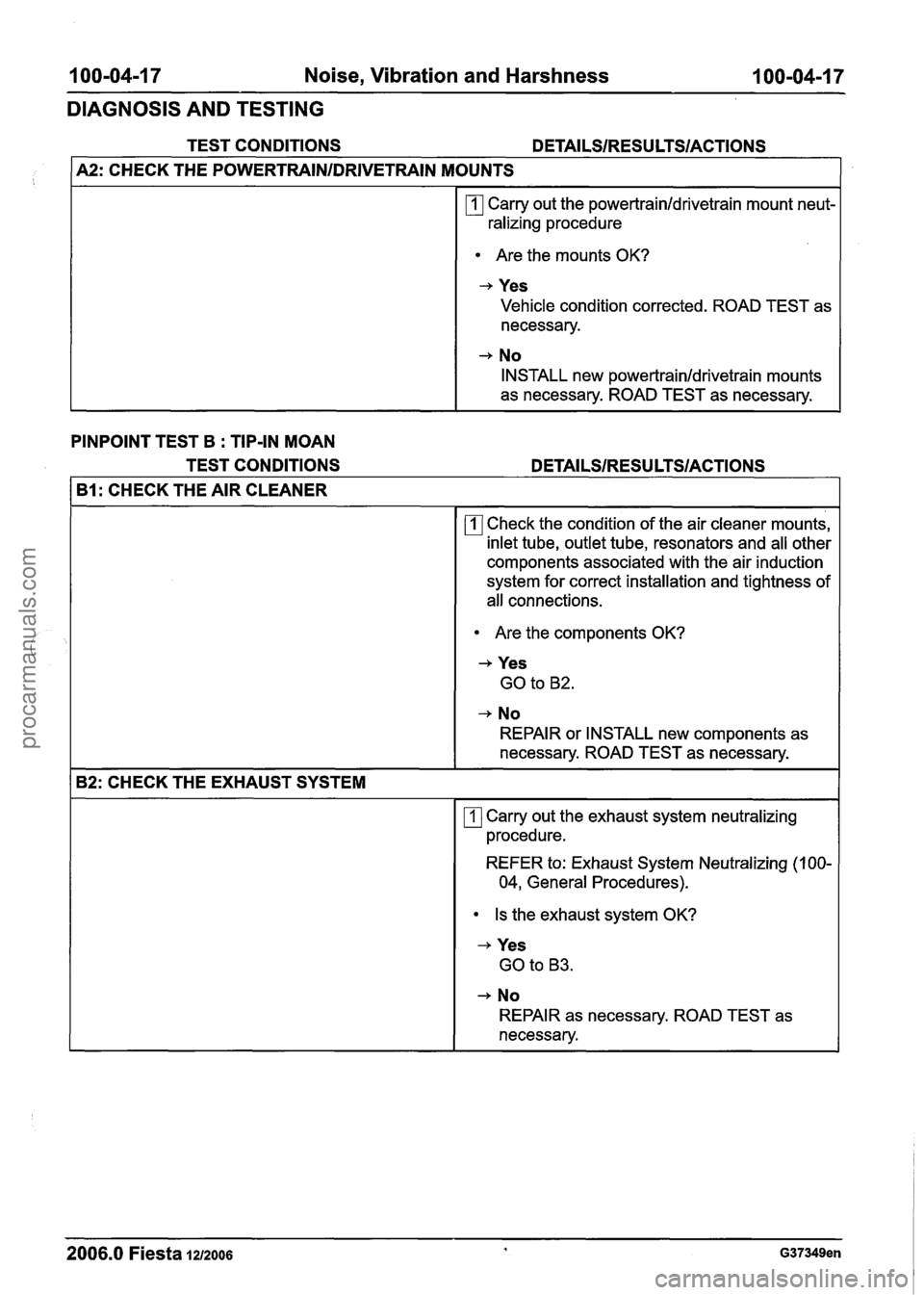
TEST CONDITIONS DETAILSIRESULTSIACTIONS
A2: CHECK THE POWERTRAINIDRIVETRAIN MOUNTS
Carry out the
powertrainldrivetrain mount neut-
ralizing procedure
Are the mounts OK?
-+ Yes
Vehicle condition corrected. ROAD TEST as
necessary.
+ No
INSTALL new
powertrainldrivetrain mounts
as necessary. ROAD TEST as necessary.
PINPOINT TEST B
: TIP-IN MOAN
TEST CONDITIONS
DETAILSIRESU LTSIACTIONS
B1: CHECK THE AIR CLEANER
Check the condition of the air cleaner mounts,
inlet tube, outlet tube, resonators and all other
components associated with the air induction
system for correct installation and tightness of
all connections.
Are the components OK?
+ Yes
GO to
B2.
-+ No
REPAIR or INSTALL new components as
necessary. ROAD TEST as necessary.
82: CHECK THE EXHAUST SYSTEM
Carry out the exhaust system neutralizing
procedure.
REFER to: Exhaust System Neutralizing
(1 00-
04, General Procedures).
Is the exhaust system
OK?
-+ Yes GO to
B3.
+ No
REPAIR as necessary. ROAD TEST as
necessary.
- -
2006.0 Fiesta 1212006 + G37349en
procarmanuals.com
Page 74 of 1226
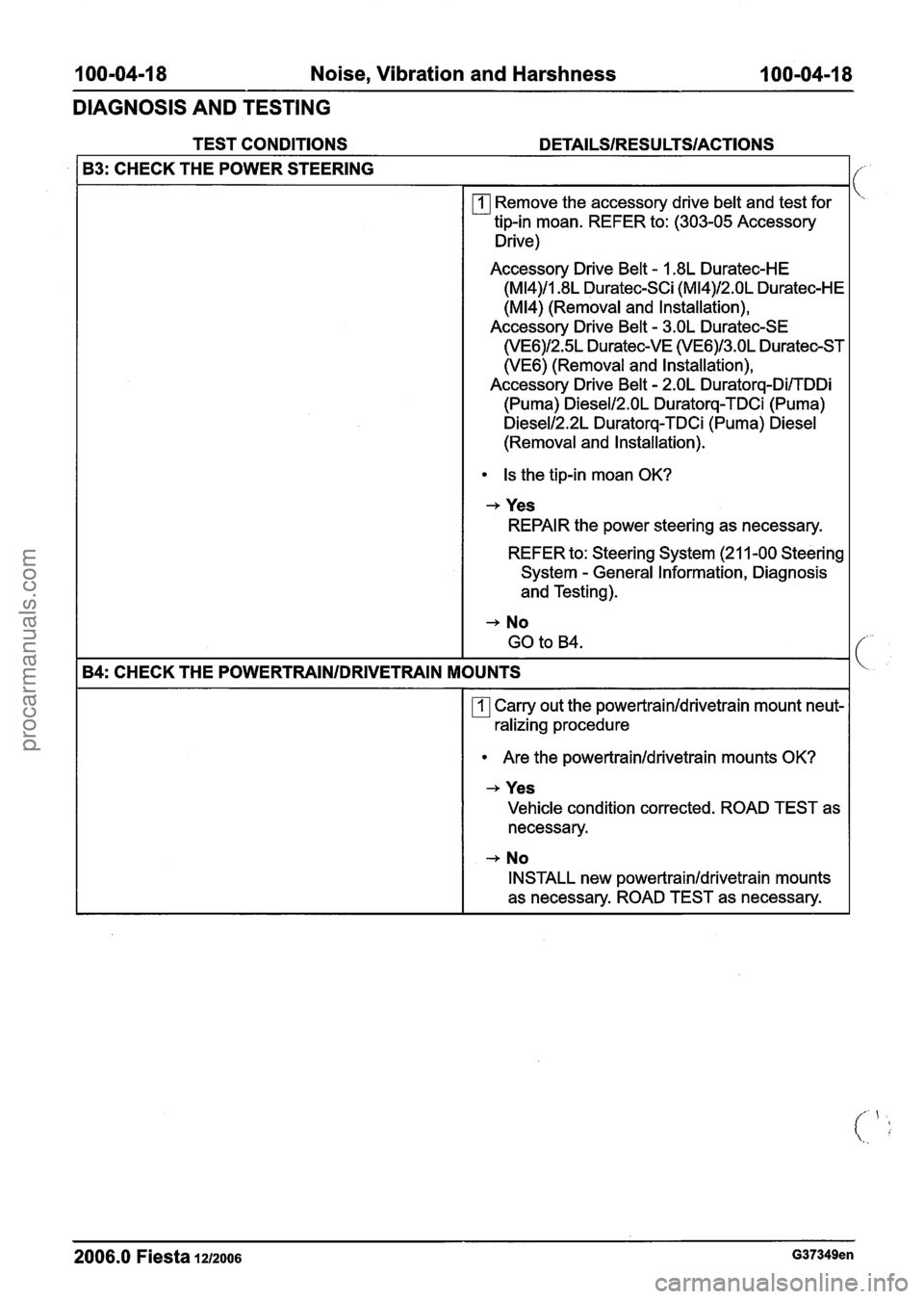
100=04=18 Noise, Vibration and Harshness 100-04-18
DIAGNOSIS AND TESTING
TEST CONDITIONS DETAILSIRESU LTSIACTIONS
--
2006.0 Fiesta 1212006 G37349en
B3: CHECK THE POWER STEERING
B4: CHECK THE POWERTRAINIDRIVETRAIN
rn Remove the accessory drive belt and test for
tip-in moan. REFER to: (303-05 Accessory
Drive)
Accessory Drive Belt
- 1.8L Duratec-HE
(M14)/1.8L Duratec-SCi (M14)/2.OL Duratec-HE
(M14) (Removal and Installation),
Accessory Drive Belt
- 3.OL Duratec-SE
(VE6)/2.5L Duratec-VE (VE6)/3.OL Duratec-ST
(VE6) (Removal and Installation),
Accessory Drive Belt
- 2.OL Duratorq-DilTDDi
(Puma) Diesell2.0L Duratorq-TDCi (Puma)
Diesel12.2L Duratorq-TDCi (Puma) Diesel
(Removal and lnstallation).
Is the tip-in moan OK?
-+ Yes
REPAIR the power steering as necessary.
REFER to: Steering System (21 1-00 Steering
System
- General Information, Diagnosis
and Testing).
-+ No
GO to B4.
MOUNTS
rn Carry out the powertrainldrivetrain mount neut-
ralizing procedure
Are the
powertrainldrivetrain mounts OK?
-+ Yes
Vehicle condition corrected. ROAD TEST as
necessary.
-+ No
l NSTALL new powertrainldrivetrain mounts
as necessary. ROAD TEST as necessary.
procarmanuals.com
Page 75 of 1226
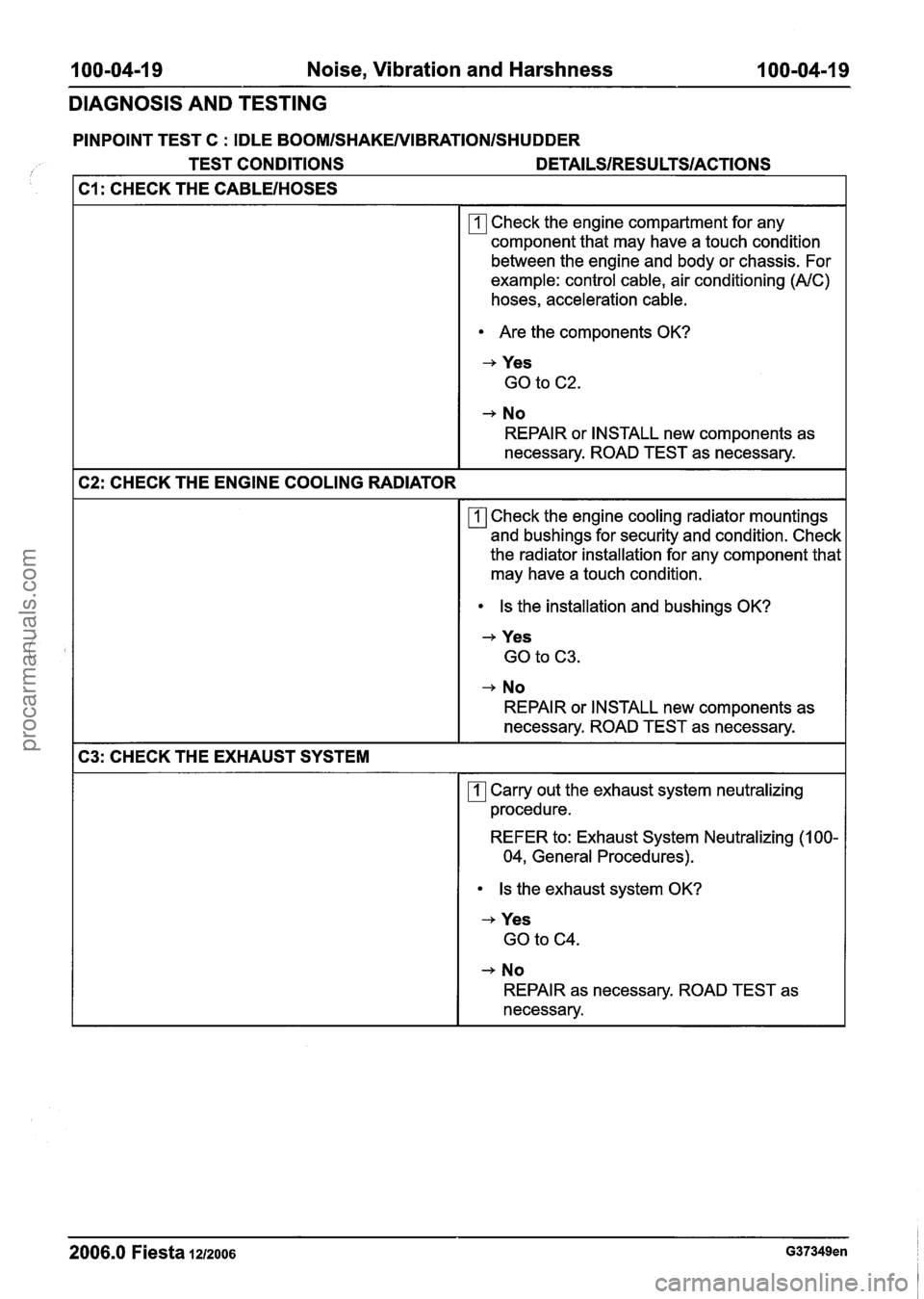
I 00-04-1 9 Noise, Vibration and Harshness 100-04-19
DIAGNOSIS AND TESTING
PINPOINT TEST C : IDLE BOOMISHAKENIBRATIONISHUDDER
1 TEST CONDITIONS DETAILSIRESU LTSIACTIONS
C1: CHECK THE CABLEIHOSES
rn Check the engine compartment for any
component that may have a touch condition
between the engine and body or chassis. For
example: control cable, air conditioning
(AIC)
hoses, acceleration cable.
Are the components OK?
-+ Yes
GO to C2.
+ No
REPAIR or INSTALL new components as
necessary. ROAD TEST as necessary.
C2: CHECK THE ENGINE COOLING RADIATOR
rn Check the engine cooling radiator mountings
and bushings for security and condition. Check
the radiator installation for any component that
may have a touch condition.
Is the installation and bushings OK?
+ Yes
GO to C3.
-+ No
REPAIR or INSTALL new components as
necessary. ROAD TEST as necessary.
C3: CHECK THE EXHAUST SYSTEM
rn Carry out the exhaust system neutralizing
procedure.
REFER to: Exhaust System Neutralizing
(1 00-
04, General Procedures).
Is the exhaust system OK?
+ Yes
GO to C4.
+ No
REPAIR as necessary. ROAD TEST as
necessary.
2006.0 Fiesta 1212006 G37349en
procarmanuals.com