oil temperature FORD FIESTA 2007 Owner's Manual
[x] Cancel search | Manufacturer: FORD, Model Year: 2007, Model line: FIESTA, Model: FORD FIESTA 2007Pages: 1226, PDF Size: 61.26 MB
Page 618 of 1226
Engine - 1.25L Duratec-1 6V (Sigma)ll.4L
303-01A-I42 Duratec-1 6V (Sigma)/l .6L Duratec-I 6V (Sigma)
INSTALLATION
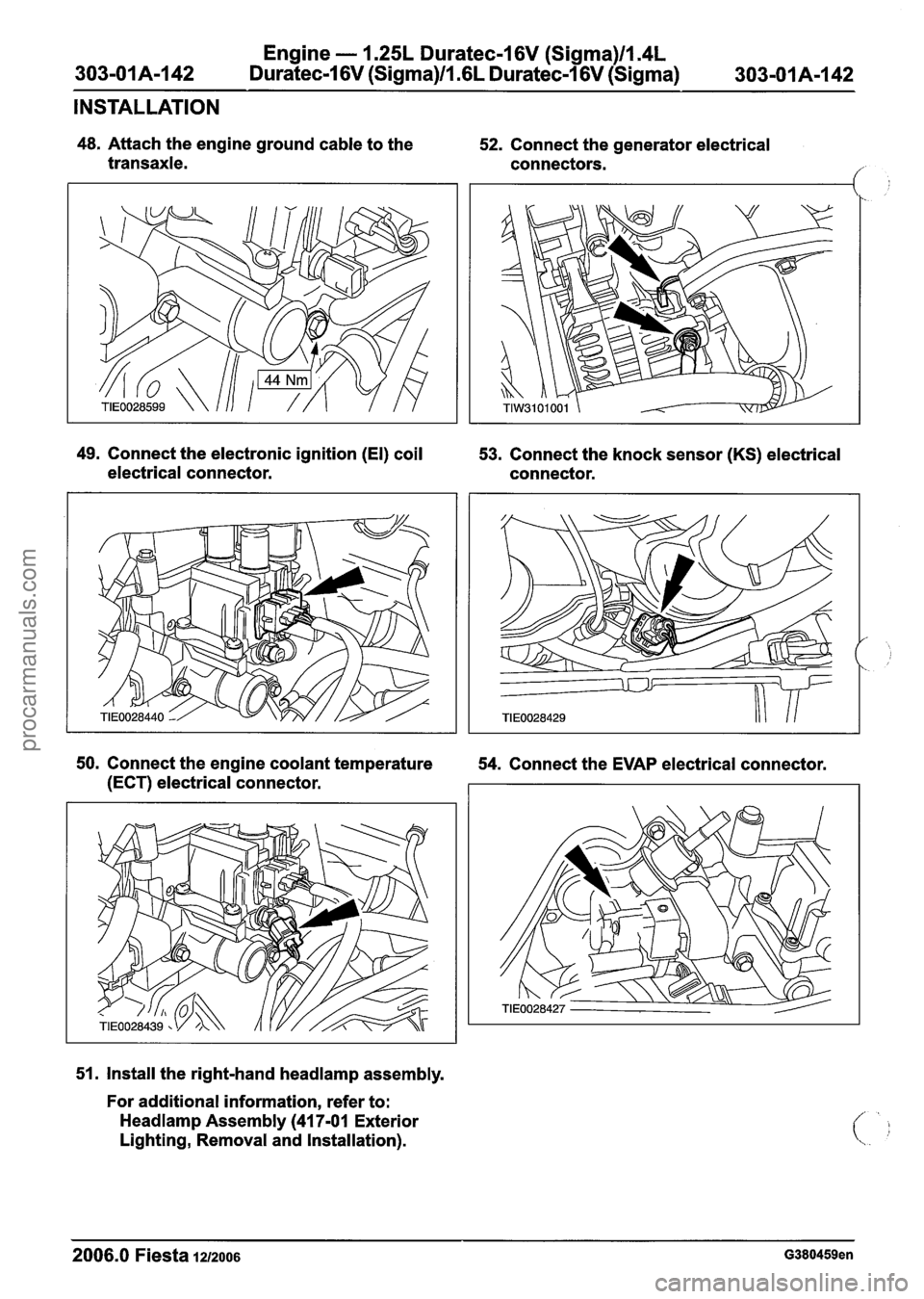
48. Attach the engine ground cable to the
transaxle. 52.
Connect the generator electrical
connectors.
49. Connect the electronic ignition (El) coil
53. Connect the knock sensor
(KS) electrical
electrical connector. connector.
50. Connect the engine coolant temperature
54. Connect the EVAP electrical connector.
(ECT) electrical connector.
51. Install the right-hand
headlamp assembly.
For additional information, refer to:
Headlamp Assembly (41 7-01 Exterior
Lighting, Removal and Installation).
2006.0 Fiesta 1212006 G380459en
procarmanuals.com
Page 625 of 1226
Engine - 2.OL Duratec-HE (M14)
SPECIFICATIONS
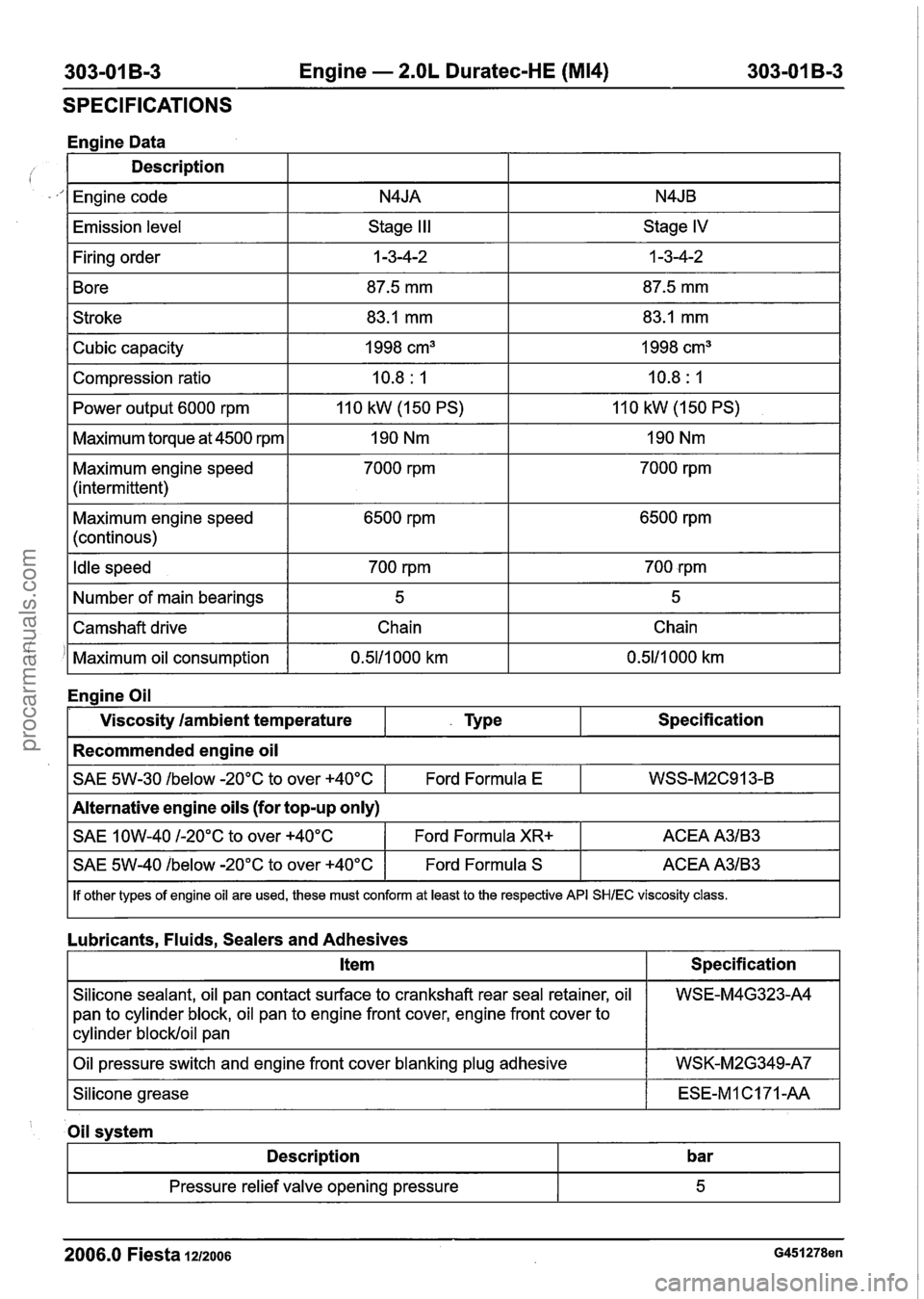
Engine Data
Description
I Engine code I N4JA I N4JB I
IEmission level I Stage III I Stage IV I
I Firing order I 1 -3-4-2 I 1 -3-4-2 I
1 Bore I 87.5 mm I 87.5 mm I
1 Stroke I 83.1 mm I 83.1 mm I
I Power output 6000 rpm 1 110 kW (150 PS) I 110 kW (1 50 PS) I
Cubic capacity
Compression ratio
I Maximum torque at 4500 rpm I 190 Nm I 190 Nm I
Maximum engine speed
(intermittent) 1998
cm3
10.8
: I
7000 rprn 1998
cm3
10.8
: 1
7000 rprn
Maximum engine speed
(continous) 6500
rprn 6500 rprn
I Idle speed I 700 rpm I 700 rpm I
I Number of main bearings I 5 I 5 I
!
Engine Oil
I SAE 1 OW-40 I-20°C to over +40°C I Ford Formula XR+ I ACEA A3lB3 I
Camshaft drive
Maximum oil consumption
Viscosity
/ambient temperature
Recommended engine oil
~40%%0w -20°C to over +40°C I Ford Formula S I ACEA A3lB3 I
SAE 5W-30 /below -20°C to over +40°C
I If other types of engine oil are used, these must conform at least to the respective API SHlEC viscosity class.
Chain
0.5111 000 km
- Type
Lubricants, Fluids, Sealers and Adhesives Chain
0.5111 000 km
Specification
Alternative engine oils (for top-up only) Ford Formula
E
I Item I Specification I
WSS-M2C913-B
I Oil pressure switch and engine front cover blanking plug adhesive I WSK-M2G349-A7 I
Silicone sealant, oil pan contact surface to crankshaft rear seal retainer, oil
pan to
cylinder block, oil pan to engine front cover, engine front cover to
cylinder blockloil pan
ISilicohe grease I ESE-MlC171-AA I
WSE-M4G323-A4
' Oil svstem
I Description I bar I
2006.0 Fiesta 1212006 G451278en
- -
Pressure relief valve opening pressure 5
procarmanuals.com
Page 749 of 1226
Enaine Cooling - 1.3L Duratec-8V
(~ocah)ll.25L ~Cratec-1 6~ (Sigma)ll.4L
303-03A-7 Duratec-1 6V (Sigma)ll .6L Duratec-1 6V (Sigma) 303-03A-7
DESCRIPTION AND OPERATION
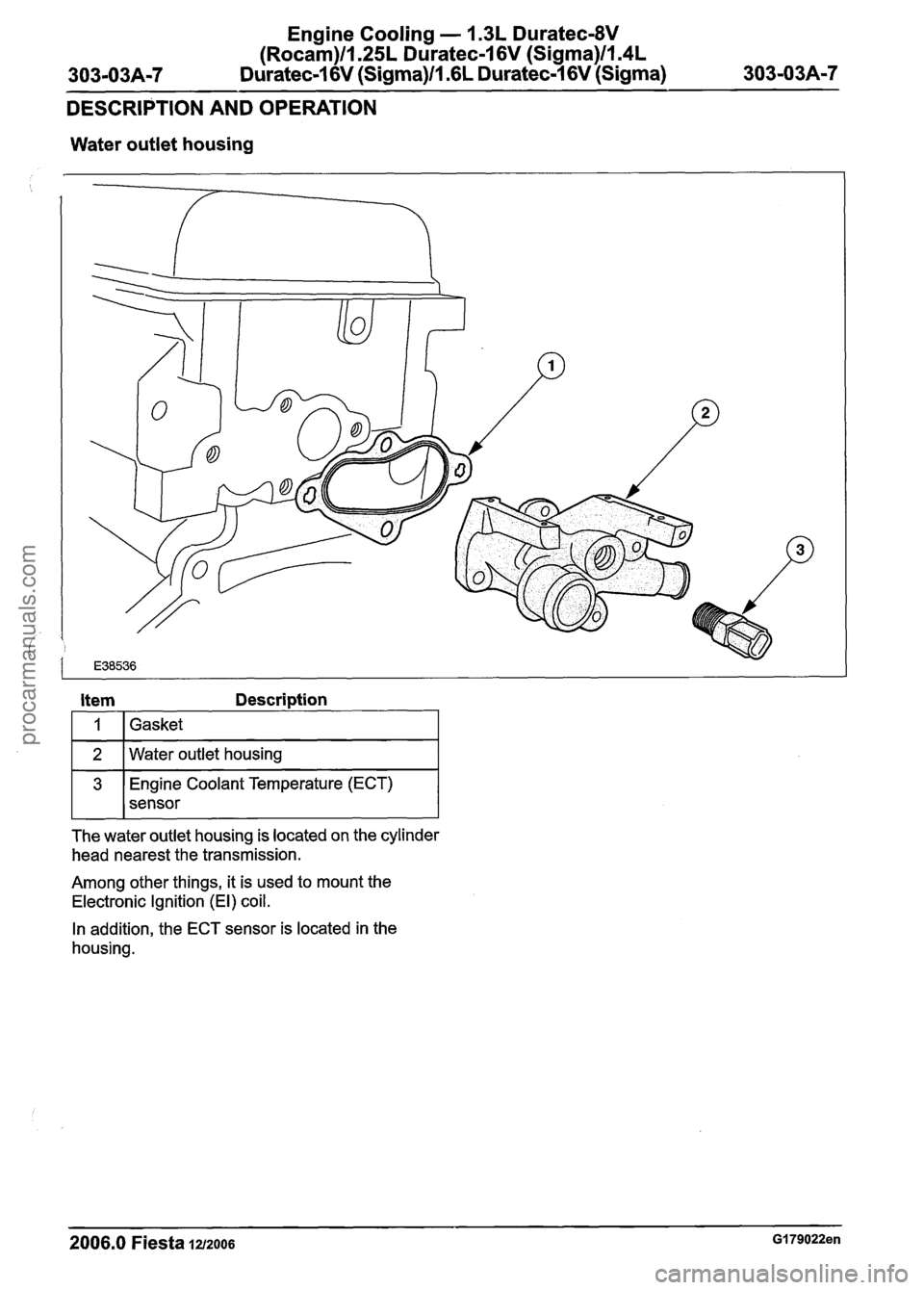
Water outlet housing
Coolant Temperature (ECT)
sensor
Item Description
The water outlet housing is located on the cylinder
head nearest the transmission.
1
2
Among other things, it is used to mount the
Electronic Ignition (El) coil.
Gasket
Water outlet housing
In addition, the ECT sensor is located in the
housing.
2006.0 Fiesta 1212006 GI 79022en
procarmanuals.com
Page 759 of 1226
Engine Cooling - I .3L Duratec-8V
(Rocam)llm25L Duratec-1 6V (Sigma)ll.4L
303-03A-17 Duratec-1 6V (Sigma)/lm6L Duratec-1 6V (Sigma) 303-03A-17
DIAGNOSIS AND TESTING
RPM - engine speed
i DSRPM - desired engine speed
The IAT sensor output is useful if the engine being
tested is cold or after an over-night cold soak. The
ECT sensor or CHT sensor and the IAT sensor
should either indicate the same value or be within
1 to 2 degrees Celsius of each other.
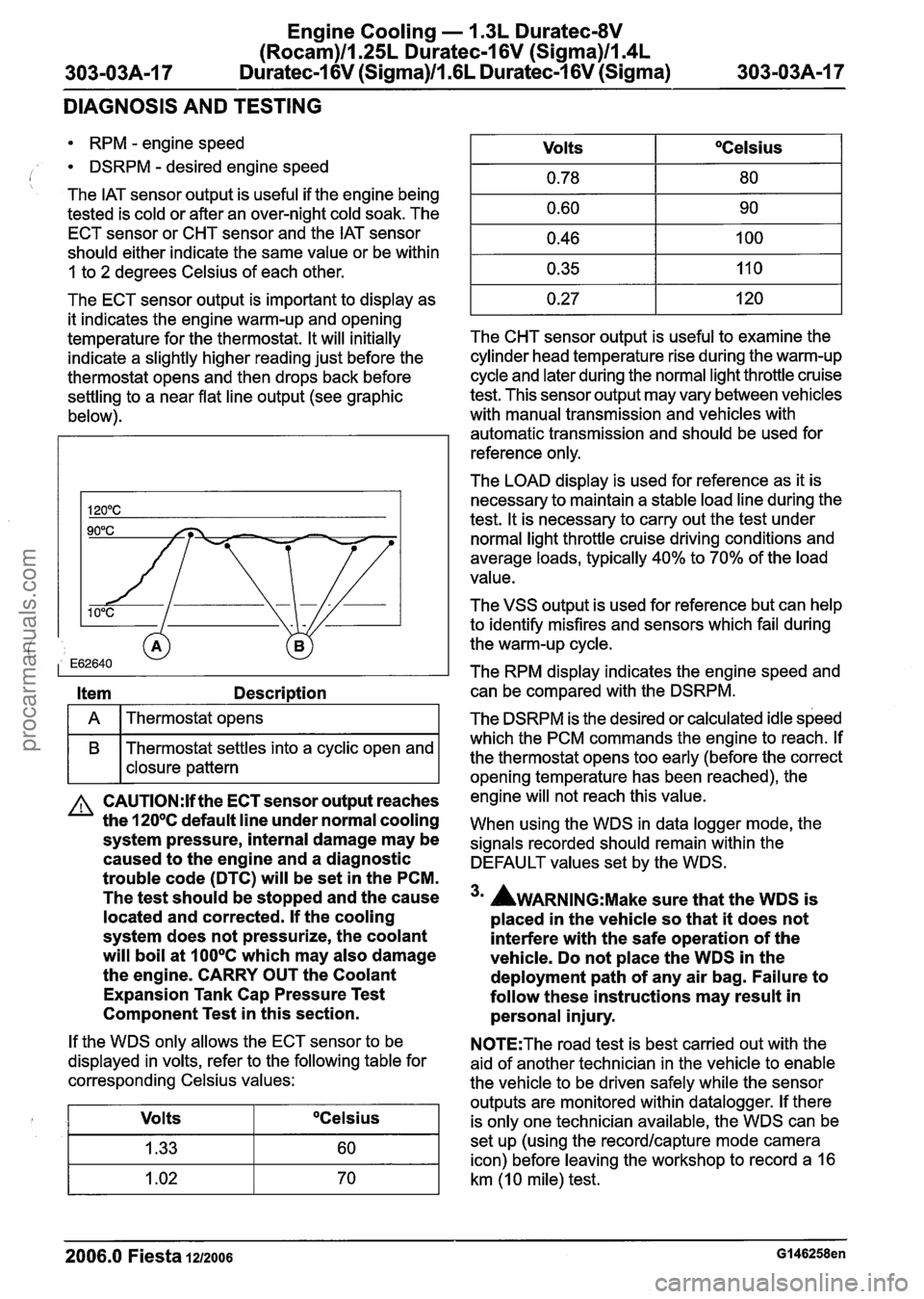
The ECT sensor output is important to display as
it indicates the engine warm-up and opening
temperature for the thermostat. It will initially
indicate a slightly higher reading just before the
thermostat opens and then drops back before
settling to a near flat line output (see graphic
below).
Item Description
I A I Thermostat opens I
B Thermostat settles into a cyclic open and
I I closure pattern
A CAUTI0N:lf the ECT sensor output reaches
the
120°C default line under normal cooling
system pressure, internal damage may be
caused to the engine and a diagnostic
trouble code (DTC) will be set in the PCM.
The test should be stopped and the cause
located and corrected. If the cooling
system does not pressurize, the coolant
will boil at
100°C which may also damage
the engine. CARRY OUT the Coolant
Expansion Tank Cap Pressure Test
Component Test in this section.
If the WDS only allows the ECT sensor to be
displayed in volts, refer to the following table for
corresponding Celsius values:
Volts
OCelsius
The CHT sensor output is useful to examine the
cylinder head temperature rise during the warm-up
cycle and later during the normal light throttle cruise
test. This sensor output may vary between vehicles
with manual transmission and vehicles with
automatic transmission and should be used for
reference only.
Volts
0.78
0.60
0.46
0.35
0.27
The
LOAD display is used for reference as it is
necessary to maintain a stable load line during the
test. It is necessary to carry out the test under
normal light throttle cruise driving conditions and
average loads, typically
40% to 70% of the load
value.
OCelsius
80
90
100
11 0
120
The VSS output is used for reference but can help
to identify misfires and sensors which fail during
the warm-up cycle.
The RPM display indicates the engine speed and can be compared with the DSRPM.
The DSRPM is the desired or calculated idle speed
which the PCM commands the engine to reach. If
the thermostat opens too early (before the correct
opening temperature has been reached), the
engine will not reach this value.
When using the WDS in data logger mode, the
signals recorded should remain within the
DEFAULT values set by the WDS.
3m AWARNING:M~~~ sure that the WDS is
placed in the vehicle so that it does not
interfere with the safe operation of the
vehicle. Do not place the WDS in the
deployment path of any air bag. Failure to
follow these instructions may result in personal injury.
N0TE:The road test is best carried out with the
aid of another technician in the vehicle to enable
the vehicle to be driven safely while the sensor
outputs are monitored within datalogger. If there
is only one technician available, the WDS can be
set up (using the
recordlcapture mode camera
icon) before leaving the workshop to record a
16
km (1 0 mile) test.
2006.0 Fiesta 1212006 GI 46258en
procarmanuals.com
Page 777 of 1226
303-03B-7 Engine Cooling - 2.OL Duratec-HE (M14) 303-03B-7
DESCRIPTION AND OPERATION
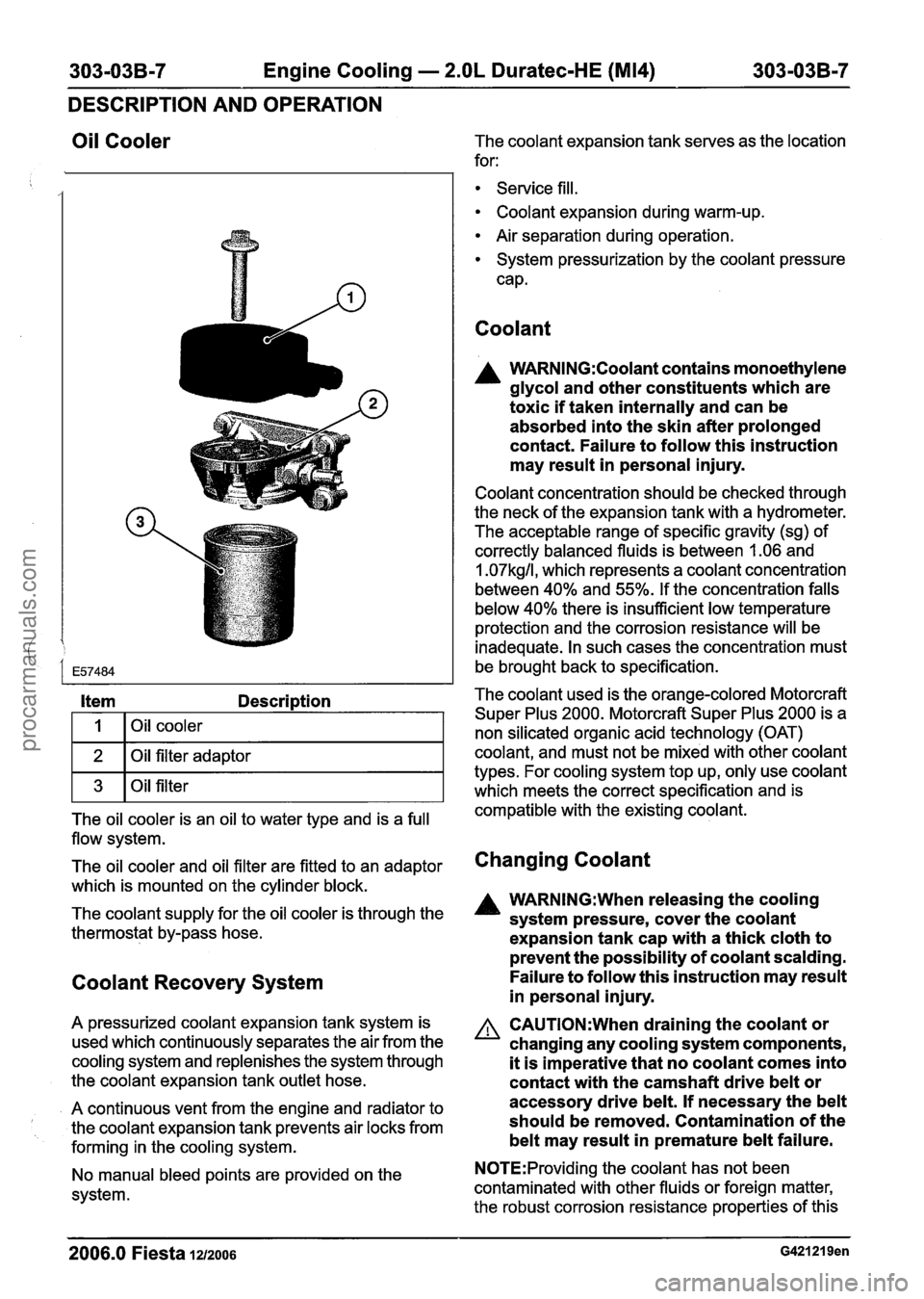
Oil Cooler
Item Description
I I I Oil cooler I
1 2 1 Oil filter adaptor I
1 3 1 Oil filter I
The oil cooler is an oil to water type and is a full
flow system.
The oil cooler and oil filter are fitted to an adaptor
which is mounted on the cylinder block.
The coolant supply for the oil cooler is through the
thermostat by-pass hose.
Coolant Recovery System
A pressurized coolant expansion tank system is
used which continuously separates the air from the
cooling system and replenishes the system through
the coolant expansion tank outlet hose.
A continuous vent from the engine and radiator to
I the coolant expansion tank prevents air locks from
forming in the cooling system.
No manual bleed points are provided on the
system. The coolant expansion tank serves
as the location
for:
Service fill.
Coolant expansion during warm-up.
Air separation during operation.
System pressurization by the coolant pressure
cap.
Coolant
A WARN1NG:Coolant contains monoethylene
glycol and other constituents which are
toxic if taken internally and can be
absorbed into the skin after prolonged
contact. Failure to follow this instruction
may result in personal injury.
Coolant concentration should be checked through
the neck of the expansion tank with a hydrometer.
The acceptable range of specific gravity (sg) of
correctly balanced fluids is between
1.06 and
1.07kg/l, which represents a coolant concentration
between 40% and 55%. If the concentration falls
below 40% there is insufficient low temperature
protection and the corrosion resistance will be
inadequate. In such cases the concentration must
be brought back to specification.
The coolant used is the orange-colored Motorcraft
Super Plus 2000. Motorcraft Super Plus 2000 is a
non silicated organic acid technology (OAT)
coolant, and must not be mixed with other coolant
types. For cooling system top up, only use coolant
which meets the correct specification and is
compatible with the existing coolant.
Changing Coolant
A WARN1NG:When releasing the cooling
system pressure, cover the coolant
expansion tank cap with a thick cloth to
prevent the possibility of coolant scalding.
Failure to follow this instruction may result
in personal injury.
A CAUTI0N:When draining the coolant or
changing any cooling system components,
it is imperative that no coolant comes into
contact with the camshaft drive belt or
accessory drive belt. If necessary the belt
should be removed. Contamination of the
belt may result in premature belt failure.
N0TE:Providing the coolant has not been
contaminated with other fluids or foreign matter,
the robust corrosion resistance properties of this
2006.0 Fiesta 1212006 G421219en
procarmanuals.com
Page 785 of 1226
303-03B-15 Engine Cooling - 2.OL Duratec-HE (M14) 303-03B-15
DIAGNOSIS AND TESTING
A CAUTI0N:lf the ECT sensor output reaches
the
120°C default line under normal cooling
system pressure, internal damage may be
caused to the engine and a diagnostic
trouble code (DTC) will be set in the PCM.
The test should be stopped and the cause
located and corrected. If the cooling
system does not pressurize, the coolant
will boil at
1 OO°C which may also damage
the engine. CARRY
OUT the Coolant
Expansion Tank Cap Pressure Test
Component Test in this section.
If the WDS only allows the ECT sensor to be
displayed in volts, refer to the following table for
corresponding Celsius values:
The CHT sensor output is useful to examine the
cylinder head temperature rise during the warm-up
cycle and later during the normal light throttle cruise
test. This sensor output may vary between vehicles
with manual transmission and vehicles with automatic transmission and should be used for
reference only.
Volts
1.33
1.02
0.78
0.60
0.46
0.35 0.27
The LOAD display is used for reference as it is
necessary to maintain a stable load line during the
test. It is necessary to carry out the test under
normal light throttle cruise driving conditions and
average loads, typically 40% to 70% of the load
value.
OCelsius
60
70
80
90
100
110
120 '
The VSS output is used for reference but can help
to identify misfires and sensors which fail during
the warm-up cycle.
The RPM display indicates the engine speed and
can be compared with the DSRPM.
The DSRPM is the desired or calculated idle speed
which the PCM commands the engine to reach. If
the thermostat opens too early (before the correct
opening temperature has been reached), the
engine will not reach this value. When
using the WDS in data logger mode, the
signals recorded should remain within the
DEFAULT values set by the WDS.
3m AWARNING:M~~~ sure that the WDS is
placed in the vehicle so that it does not
interfere with the safe operation of the
vehicle. Do not place the WDS in the
deployment path of any air bag. Failure to
follow these instructions may result in personal injury.
N0TE:The road test is best carried out with the
aid of another technician in the vehicle to enable
the vehicle to be driven safely while the sensor
outputs are monitored within datalogger. If there
is only one technician available, the WDS can be
set up (using the
recordlcapture mode camera
icon) before leaving the workshop to record a 16
km (1 0 mile) test.
N0TE:The results from the test are more
conclusive if the engine is cold when the test is
started.
Carry out a road test.
REFER to:
RoadIRoller Testing (1 00-00 General
Information, Description and Operation).
4. Drive the vehicle at a constant throttle opening
and set speed until the ECT value settles into
a shallow rise and fall signal, close to a straight
line. This indicates that the thermostat is
functioning correctly.
N0TE:Some thermostats indicate the
temperature(s) in Celsius and Fahrenheit.
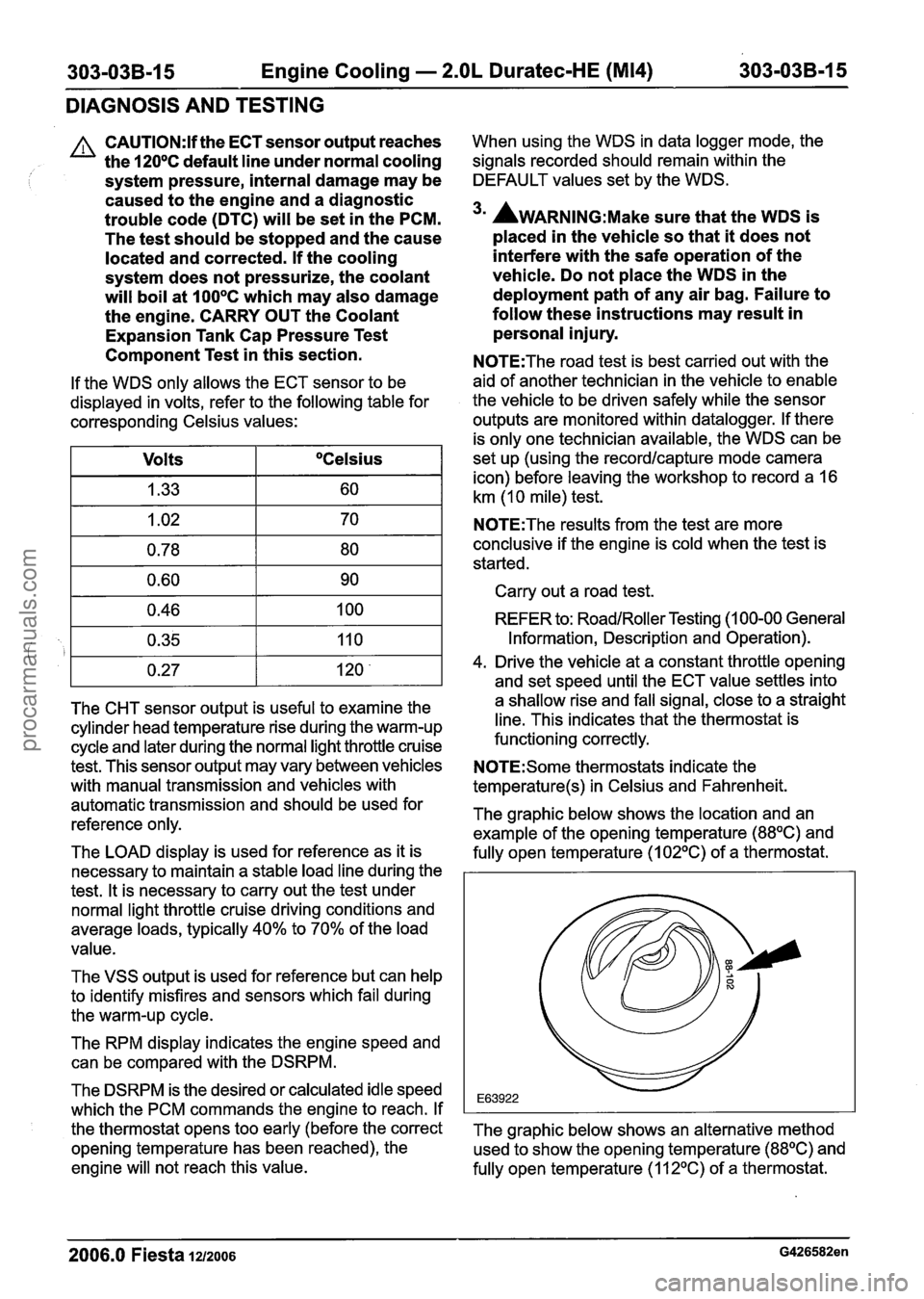
The graphic below shows the location and an
example of the opening temperature
(88OC) and
fully open temperature (1
02OC) of a thermostat.
The graphic below shows an alternative method used to show the opening temperature
(88OC) and
fully open temperature
(112OC) of a thermostat.
2006.0 Fiesta 1212006 G426582en
procarmanuals.com
Page 794 of 1226
303-03B-24 Engine Cooling - 2.OL Duratec-HE (M14) 303-03B-24
REMOVAL AND INSTALLATION
Coolant Outlet Connector
Removal
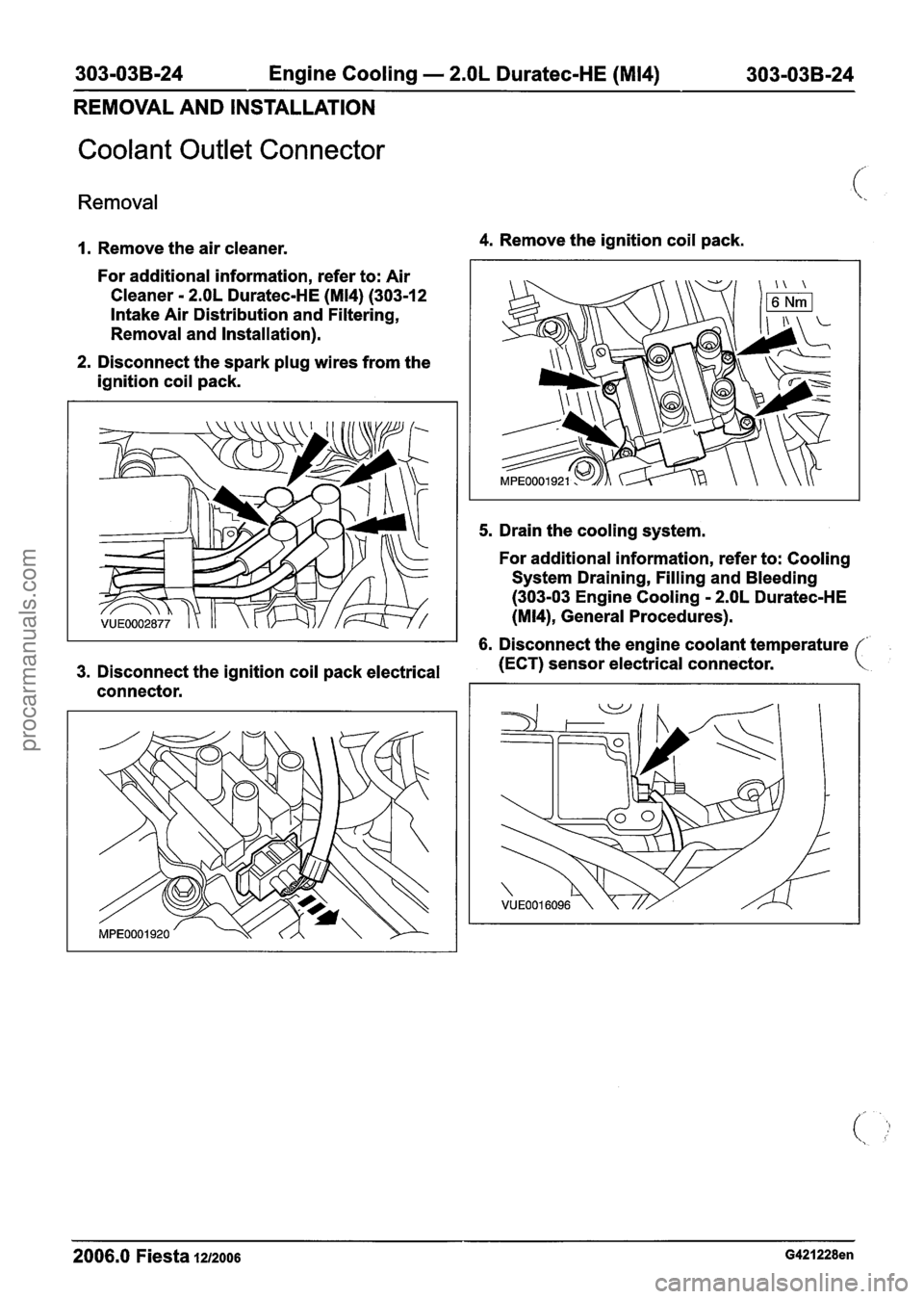
1. Remove the air cleaner.
For additional information, refer to: Air
Cleaner
- 2.OL Duratec-HE (M14) (303-12
Intake Air Distribution and Filtering,
Removal and Installation).
2. Disconnect the spark plug wires from the
ignition coil pack.
4. Remove the ignition coil pack.
5. Drain the cooling system.
For additional information, refer to: Cooling
System Draining, Filling and Bleeding
(303-03 Engine Cooling
- 2.OL Duratec-HE
(M14), General Procedures).
6. Disconnect the engine coolant temperature
3. Disconnect the ignition coil pack electrical
(ECT) sensor electrical connector.
connector.
2006.0 Fiesta 1212006 G421228en
procarmanuals.com
Page 803 of 1226
Fuel Charging and Controls - 1.25L
Duratec-1 6V (Sigma)llI4L Duratec-1 6V
(Sigma)llI6L Duratec-1 6V (Sigma)
REMOVAL AND INSTALLATION
Fuel Charging Wiring Harness(36 437 0)
Removal
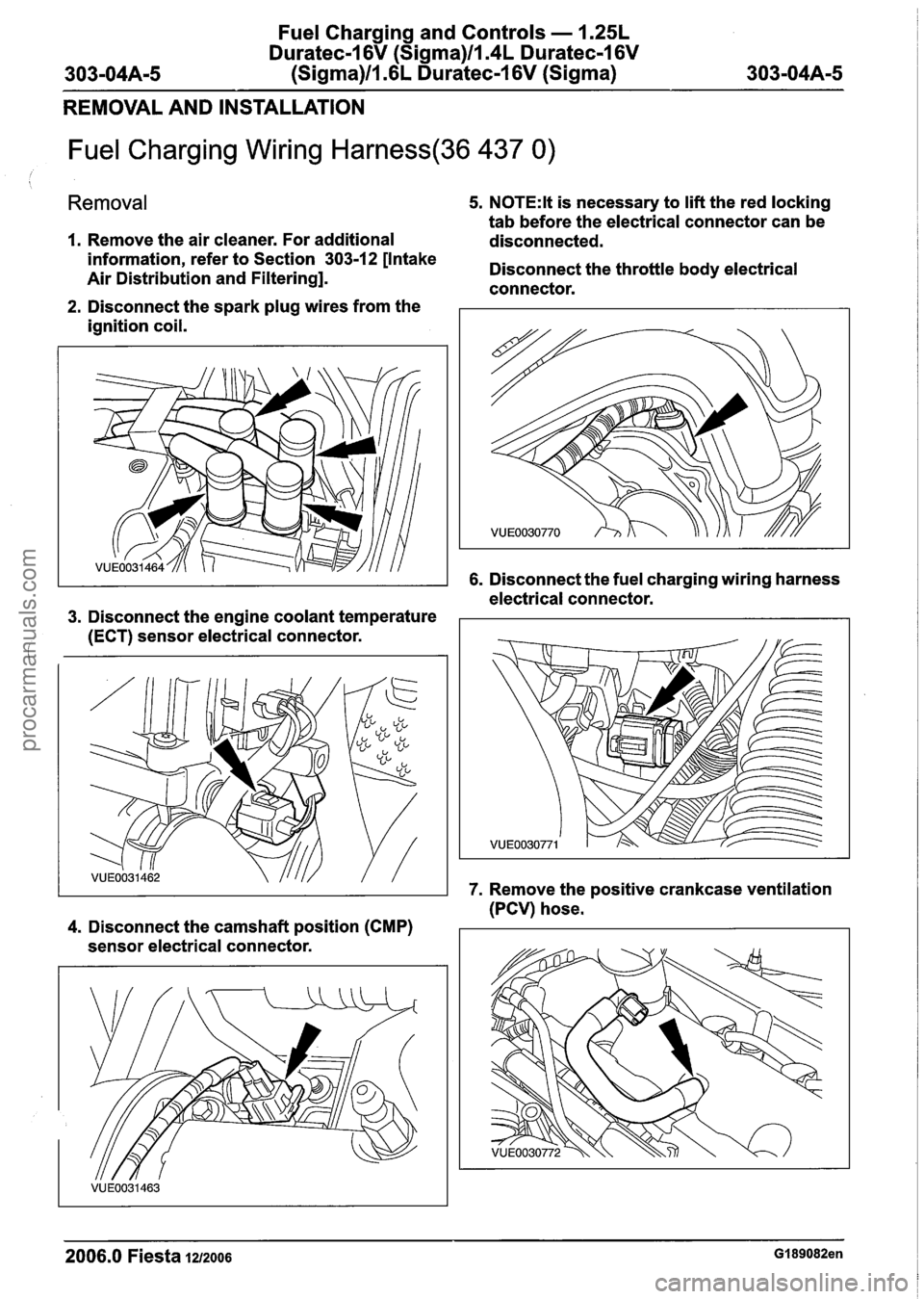
1. Remove the air cleaner. For additional
5. N0TE:lt is necessary to lift the red locking
tab before the electrical connector can be
disconnected.
information, refer to Section
303-12 [Intake the throttle body electrical Air Distribution and Filtering].
connector.
2. Disconnect the spark plug wires from the
ignition coil.
6. Disconnect the fuel charging wiring harness
electrical connector.
3. Disconnect the engine coolant temperature
(ECT) sensor electrical connector.
(
7. Remove the positive crankcase ventilation
(PCV) hose.
4. Disconnect the camshaft position (CMP)
sensor electrical connector.
2006.0 Fiesta 1212006 GI 89082en
procarmanuals.com
Page 818 of 1226
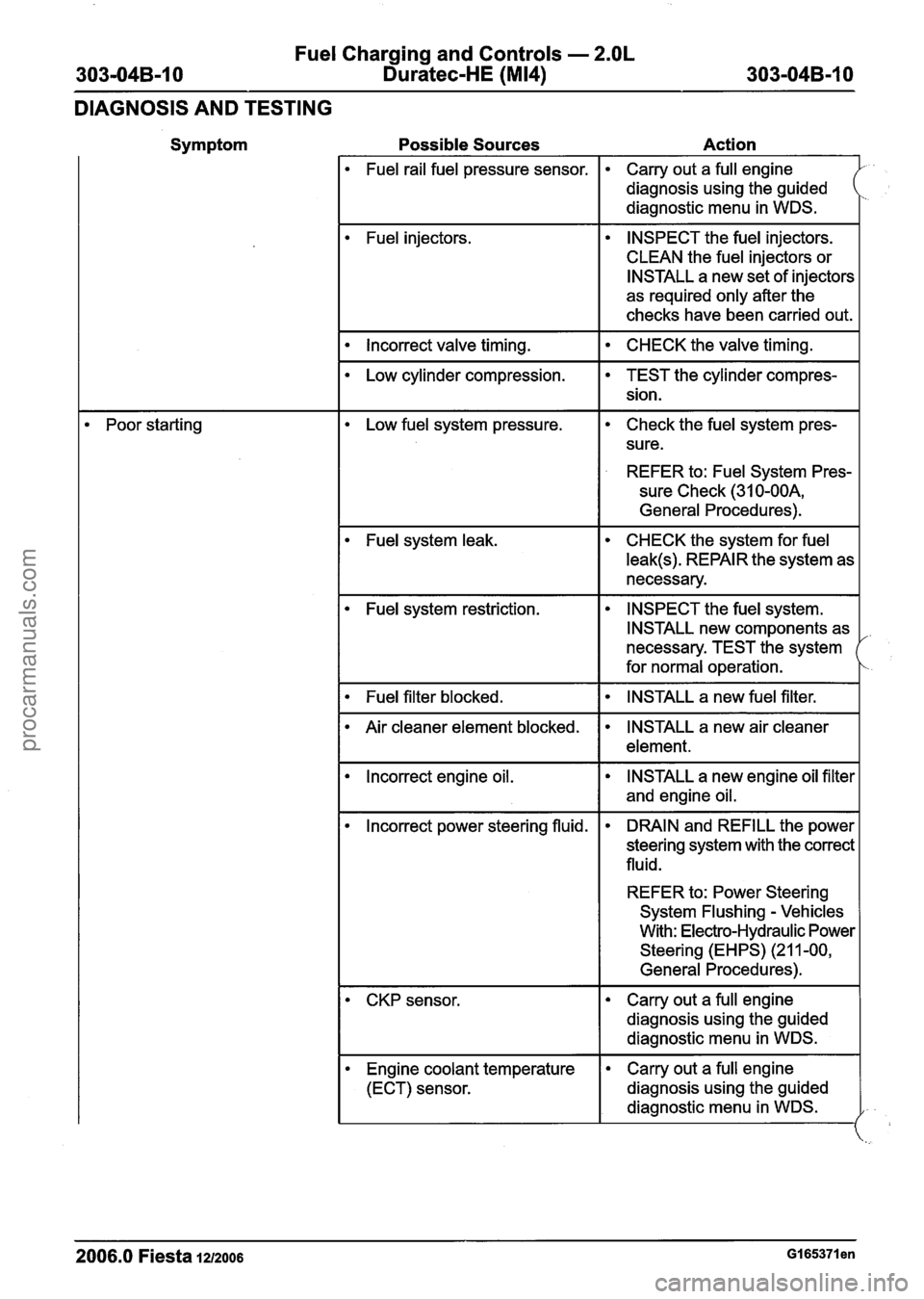
Fuel Charging and Controls - 2.OL
303-048-1 0 Duratec-HE (M14) 303-04B-10
DIAGNOSIS AND TESTING
Symptom Possible Sources Action
Fuel rail fuel pressure sensor. Carry out a full engine
diagnosis using the guided
diagnostic menu in WDS.
Fuel injectors. INSPECT
the fuel injectors.
CLEAN the fuel injectors or
INSTALL a new set of injectors
as required only after the
checks have been carried out.
I Incorrect valve timing. I CHECK the valve timing. I
Poor starting
Low cylinder compression.
Low fuel system pressure.
TEST the cylinder compres-
sion.
Check the fuel system pres-
sure.
REFER to: Fuel System Pres-
sure Check (31
0-OOA,
General Procedures).
Fuel system leak. CHECK the system for fuel
leak(s). REPAIR the system as
necessary.
Fuel system restriction. INSPECT the
fuel system.
INSTALL new components as
necessary. TEST the system
for normal operation.
I Fuel filter blocked. I INSTALL a new fuel filter. I
lncorrect engine oil.
Air
cleaner element blocked.
INSTALL a new engine oil filter
and engine oil.
INSTALL a new air cleaner
element.
lncorrect power steering fluid. DRAIN and REFILL the
power
steering system with the correct
fluid.
REFER to: Power Steering
System Flushing
- Vehicles
With: Electro-Hydraulic Power
Steering (EHPS) (21 1-00,
General Procedures).
2006.0 Fiesta 1212006 GI 65371 en
CKP sensor.
Engine coolant temperature
(ECT) sensor. Carry out a
full engine
diagnosis using the guided
diagnostic menu in WDS.
Carry out a full engine
diagnosis using the guided
diagnostic menu in WDS.
procarmanuals.com
Page 926 of 1226
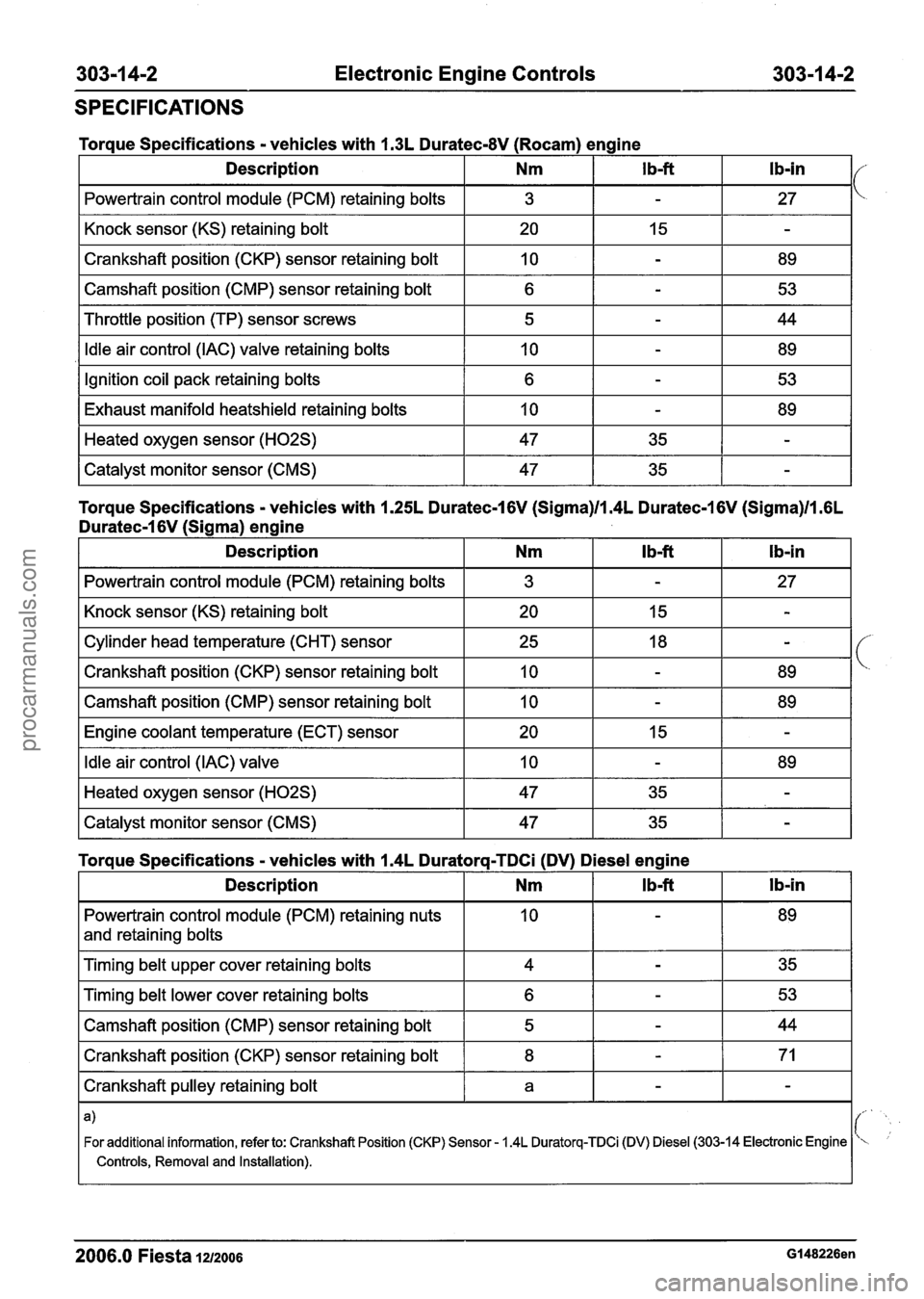
303-1 4-2 Electronic Engine Controls 303-1 4-2
SPECIFICATIONS
I Powertrain control module (PCM) retaining bolts I 3 I - I 27 I
Torque Specifications - vehicles with 1.3L Duratec-8V (Rocam) engine
I Knock sensor (KS) retaining bolt I 20 I 15 I - I
Description
I Crankshaft position (CKP) sensor retaining bolt I 10 I - I 89 I
I Camshaft position (CMP) sensor retaining bolt I
I Throttle position (TP) sensor screws I 5 I - I 44 I
Ib-in I/ Nm
I Idle air control (IAC) valve retaining bolts I 10 I - I 89 I
I b-ft
Ignition coil pack retaining bolts
Exhaust manifold heatshield retaining
bolts
Torque Specifications - vehicles with 1.25L Duratec-1 6V (Sigma)ll.4L Duratec-1 6V (Sigma)ll .6L
Duratec-I 6V (Sigma) engine
Heated oxygen sensor (H02S)
Catalyst monitor sensor (CMS)
I Powertrain control module (PCM) retaining bolts I 3 I - I 27 I
6
10
I Knock sensor (KS) retaining bolt I 20 I 15 I - I
47
47
-
-
I Camshaft position (CMP) sensor retaining bolt I 10 I - I 89 I
53
89
35
35
Cylinder head temperature (CHT) sensor
Crankshaft position (CKP) sensor retaining bolt
I Engine coolant temperature (ECT) sensor I 20 I 15 I - I
-
-
I Idle air control (IAC) valve I 10 I - I 89 I
25
10
I Heated oxygen sensor (H02S) I 47 I 35 I - I -- --
I Catalyst monitor sensor (CMS) 47 I 35 1 - I
18
-
-
89
Powertrain control module (PCM) retaining nuts
and retaining bolts
Torque Specifications - vehicles with 1.4L Duratorq-TDCi (DV) Diesel engine
1 Timing belt upper cover retaining bolts I 4 I - I 35 I
I Timing belt lower cover retaining bolts I 6 I - I 53 I
l b-in
Description
I Camshaft position (CMP) sensor retaining bolt I 5 I - I 44 I
I Crankshaft position (CKP) sensor retaining bolt I 8 I - I 71 I
Nm
I Crankshaft pulley retaining bolt I a I - I - I
I b-ft
I- .
For additional information, refer to: Crankshaft Position (CKP) Sensor - 1.4L Duratorq-Ci D) Diesel (303-14 Electronic Engine ''
I Controls, Removal and Installation).
2006.0 Fiesta 1212006 Gl48226en
procarmanuals.com