parking brake FORD FIESTA 2007 Owner's Manual
[x] Cancel search | Manufacturer: FORD, Model Year: 2007, Model line: FIESTA, Model: FORD FIESTA 2007Pages: 1226, PDF Size: 61.26 MB
Page 201 of 1226
206-00-29 Brake System - General Information 206-00-29
DIAGNOSIS AND TESTING
and repair the external leak. If the fluid level drops
and no external leak can be found, check for a
brake master cylinder bore end seal leak.
Brake System Check
Brake Pedal Reserve Check
Where a low brake pedal or the feel of a
bottomed-out condition exists, check for brake
pedal reserve.
1. Operate the engine at idle with the transaxle in
NEUTRAL.
2. Apply the brake pedal lightly three or four times.
3. Allow 15 seconds for vacuum to replenish the
brake booster.
N0TE:This increased resistance may feel like
something has bottomed out.
4. Apply the brake pedal until it stops moving
downward or an increased resistance to the
pedal travel occurs.
5. Hold the brake pedal in the applied position and
raise the engine speed to approximately 2000
rpm.
N0TE:The additional movement of the brake pedal
is the result of the increased engine intake manifold
vacuum which exerts more force on the brake
booster during engine rundown. This means that
additional stroke is available in the brake master
cylinder and the brake system is not bottoming out.
6. Release the accelerator pedal and observe that
the brake pedal moves downward as the engine
returns to idle speed.
Brake Booster Functional Test
lnspect all hoses and connections. All unused
vacuum connectors should be capped. Hoses and
their connections should be correctly secured and
in good condition with no holes and no collapsed 2.
With the transaxle in NEUTRAL, stop the engine
and apply the parking brake. Apply the brake
pedal several times to exhaust all vacuum in
the system.
3. With the engine turned off and all vacuum in the
system exhausted, apply the brake pedal and hold it down. Start the engine. If the vacuum
system is operating, the brake pedal will tend
to move downward under constant foot
pressure. If no motion is felt, the vacuum
booster system is not functioning.
4. Remove the vacuum hose from the brake
booster.
Intake manifold vacuum should be
available at the brake booster end of the hose
with the engine at idle speed and the transaxle
in NEUTRAL. Make sure that all unused vacuum
outlets are correctly capped, hose connectors
are correctly secured and vacuum hoses are in
good condition. When it is established that
manifold vacuum is available to the brake
booster, connector the vacuum hose to the
brake booster and repeat Step
3. If no
downward movement of the brake pedal is felt,
install a new brake booster. REFER to: (206-07
Power Brake Actuation)
Brake Booster
- LHD (Removal and lnstallation),
Brake Booster
- RHD (Removal and lnstallation).
5. Operate the engine a minimum of 10 seconds
at fast idle. Stop the engine and let the vehicle
stand for
10 minutes. Then, apply the brake
pedal with approximately 89
N (20 lb) force. The
pedal feel (brake application) should be the
same as that noted with the engine operating.
If the brake pedal feels hard (no power assist),
install a new vacuum check valve and then
repeat the test. If the brake pedal still feels hard,
install a new brake booster. REFER to: (206-07
Power Brake Actuation)
Brake Booster
- LHD (Removal and Installation),
Brake Booster
- RHD e em oval and installation).
If the brake pedal movement feels spongy, bleed
the brake system. REFER to: (206-00 Brake
System
- General Information)
areas. Inspect the check valve on the brake booster Brake System Bleeding (General Procedures),
for damage. Brake
System Pressure Bleeding (General
Procedures).
Brake Booster Operation Check
Brake Master Cylinder
1. Check the hydraulic brake system for leaks or
low fluid. Usually,
the first and strongest indicator of anything
wrong with the braking system is a feeling through
the brake pedal. In diagnosing the condition of the
brake master cylinder, check pedal feel as
2006.0 Fiesta 1212006 G28494en I
i
procarmanuals.com
Page 202 of 1226
Brake System - General Information
DIAGNOSIS AND TESTING
evidence of a brake concern. Check for the brake
warning indicator illumination and the fluid level in
the master cylinder reservoir.
Normal Conditions
The following conditions are considered normal
and are not indications that the brake master
cylinder is in need of service.
- Modern brake systems are not designed to
produce as hard a pedal effort as in the past.
Complaints of light pedal efforts should be
compared to pedal efforts of another vehicle, of
the same model and year.
- During normal operation of the brake the fluid
level in the reservoir will rise during brake
application and fall during release. The net fluid
level
(i.e., after brake application and release)
will remain unchanged.
- A trace of brake fluid will exists on the brake
booster shell below the master cylinder
mounting flange. This results from the normal
lubricating action of the master cylinder bore
end seal.
- The fluid level will fall with brake shoe and lining
wear.
Abnormal Conditions
N0TE:Prior to performing any diagnosis, make
sure the brake system warning indicator is
functional.
Changes in brake pedal feel or travel are indicators
that something could be wrong with the braking system. The diagnostic procedure and techniques
use brake pedal feel, warning indicator illumination
and low brake fluid level as indicators in diagnosing
braking system concerns. The following conditions
are considered abnormal and indicate that the
brake master cylinder is in need of service.
- The brake pedal effort is excessive. This may
be caused by a bind or obstruction in the pedal
.
or linkage, clogged fluid control valve or ( ' insufficient booster vacuum.
- The rear brakes lock up during light pedal force.
This may be caused by incorrect tire pressures,
grease or fluid on the brake shoes and linings,
damaged brake shoes and linings, incorrectly
adjusted parking brake, or damaged or
contaminated brake pressure control valves.
- The brake pedal effort is erratic. This condition
could be caused by a brake booster malfunction,
extreme caliper piston knock back or incorrectly
installed brake shoes and linings.
- The brake warning indicator is ON. This may
be caused by low fluid level, ignition wire routing
too close to the fluid level indicator assembly,
or float assembly damage.
Bypass Condition Test
1. Check the fluid in brake master cylinder. Fill the
brake master cylinder reservoir if low or empty.
2. Observe the fluid level in the brake master
cylinder reservoir. If after several brake
applications, the fluid level remains the same,
measure the wheel turning torque required to
rotate the wheels with the brakes applied as
follows:
Place the transaxle in NEUTRAL and raise and
support the vehicle. REFER to: (1 00-02 Jacking
and Lifting)
Jacking (Description and Operation),
Lifting (Description and Operation).
Apply the brakes with a minimum of 445 N (100
Ib) and hold for approximately 15 seconds. With
the brakes still applied, exert a torque on the front
wheels of 10.1 Nm (75
1b.R). If either wheel rotates,
install a new brake master cylinder. REFER to:
(206-06 Hydraulic Brake Actuation)
- The brake pedal goes down fast. This could be Brake Master Cylinder - RHD (Removal and
caused by an external or internal leak. Installation),
- The brake
pedal eases down slowly. This could Brake Master Cylinder - LHD
(Removal and
be caused by an external or internal leak. Installation).
- The
brake pedal is low and or feels spongy. This
condition may be caused by no fluid in the brake
Non-Pressure Leaks master cylinder reservoir, reservoir cap vent
holes clogged or air in the hydraulic system.
Any empty brake master cylinder reservoir
condition may be caused by two types of
non-pressure external leaks.
2006.0 Fiesta 1212006
procarmanuals.com
Page 212 of 1226
206-02-6 Drum Brake 206-02-6
REMOVAL AND INSTALLATION
Brake Drum(l2 275 0)
Removal Remove the dust cap.
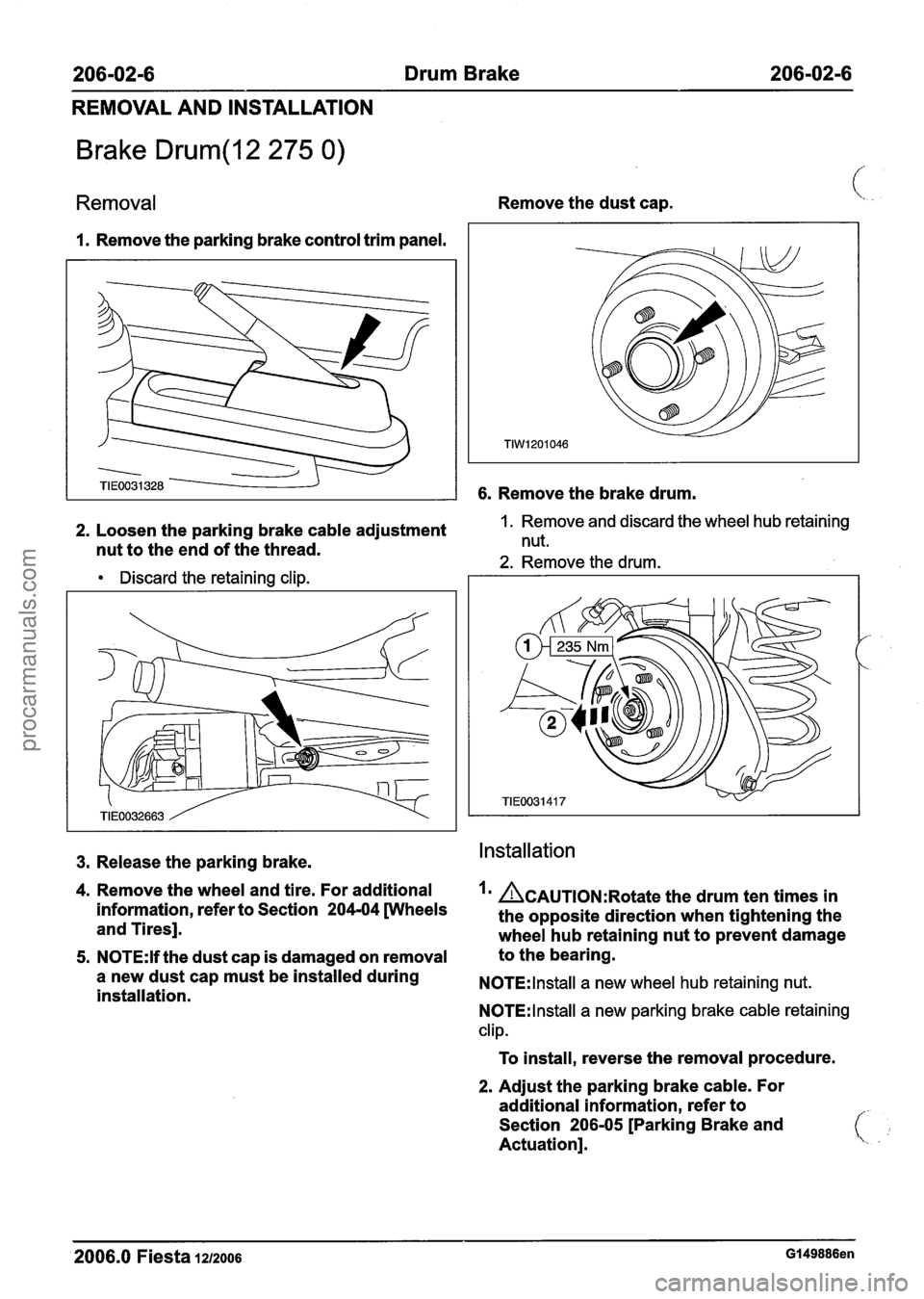
I. Remove the parking brake control trim panel.
6. Remove the brake drum.
2. Loosen the parking brake cable adjustment 1. Remove and discard the wheel hub retaining
nut to the end of the thread. nut.
2. Remove
the drum.
Discard the retaining clip.
3. Release the parking brake. Installation
4. Remove the wheel and tire. For additional 1 ~CAUTION:Rotate the drum ten times in information, refer to Section 204-04 [Wheels
the opposite direction when tightening the
and Tires].
wheel hub retaining nut to prevent damage
5. N0TE:If the dust cap is damaged on removal to
the bearing.
a new dust cap must be installed during
N0TE:lnstall a new wheel hub retaining nut.
installation.
N0TE:lnstall a new parking brake cable retaining
clip.
To install, reverse the removal procedure.
2. Adjust the parking brake cable. For
additional information, refer to
Section
206-05 [Parking Brake and
Actuation].
procarmanuals.com
Page 213 of 1226
206-02-7 Drum Brake 206-02-7
REMOVAL AND INSTALLATION
Brake Shoes(l2 285 0)
Materials 5. Detach the wheel speed sensor from the
backing plate.
Name Specification
Silicon dielectric
compound
Removal
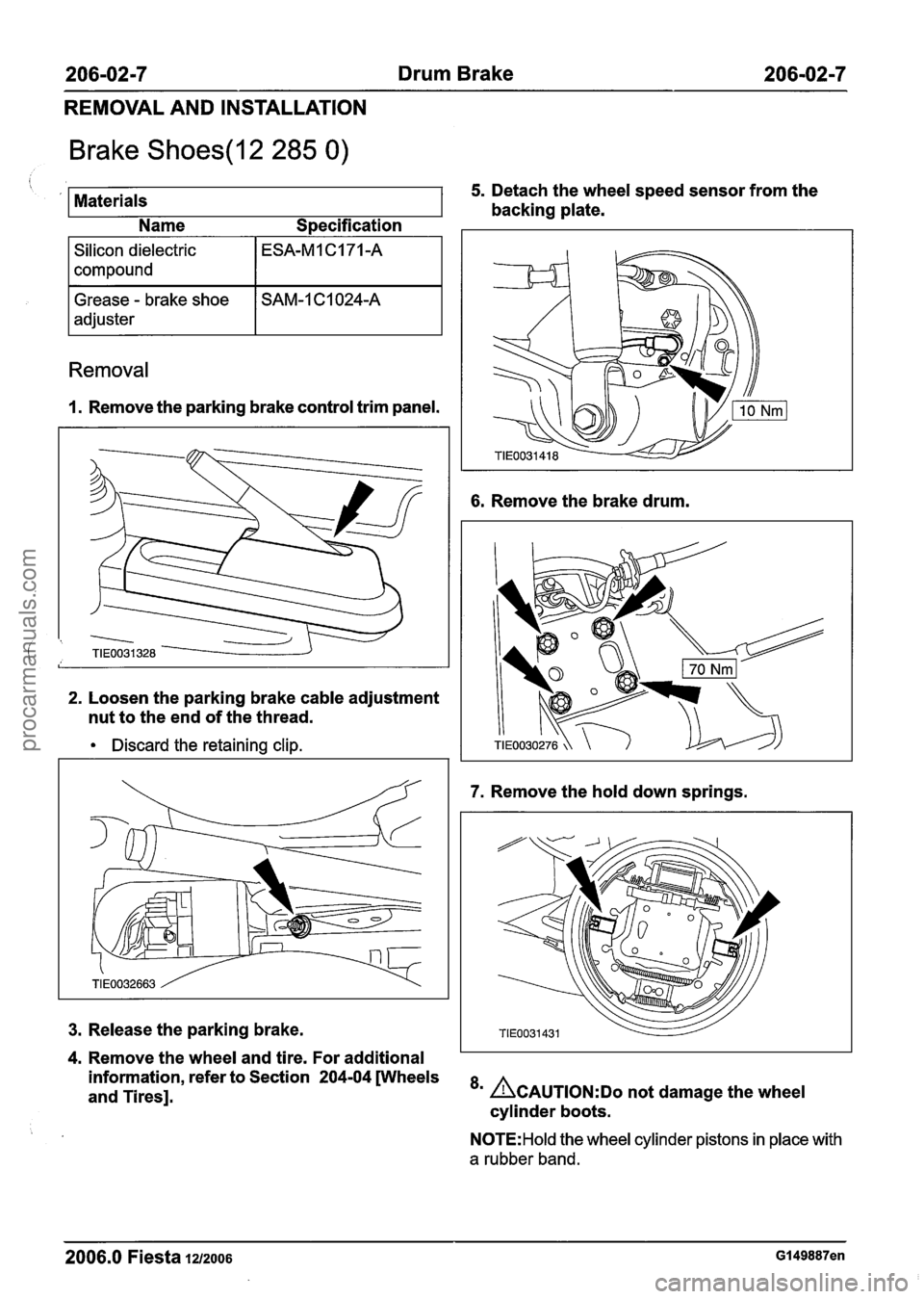
I. Remove the parking brake control trim panel.
Grease - brake shoe
adjuster
2. Loosen the parking brake cable adjustment
nut to the end of the thread.
SAM-1 C1024-A
Discard the retaining clip.
6. Remove the brake drum.
7. Remove the hold down springs.
3. Release the parking brake.
4. Remove the wheel and tire. For additional
information, refer to Section
204-04 [Wheels
and Tires]. *' ACAUTION:DO not damage the wheel
cylinder boots.
N0TE:Hold the wheel cylinder pistons in place with
a rubber band.
2006.0 Fiesta 1212006 GI 49887en
procarmanuals.com
Page 214 of 1226
206-02-8 o Drum Brake 206-02-8
REMOVAL AND INSTALLATION
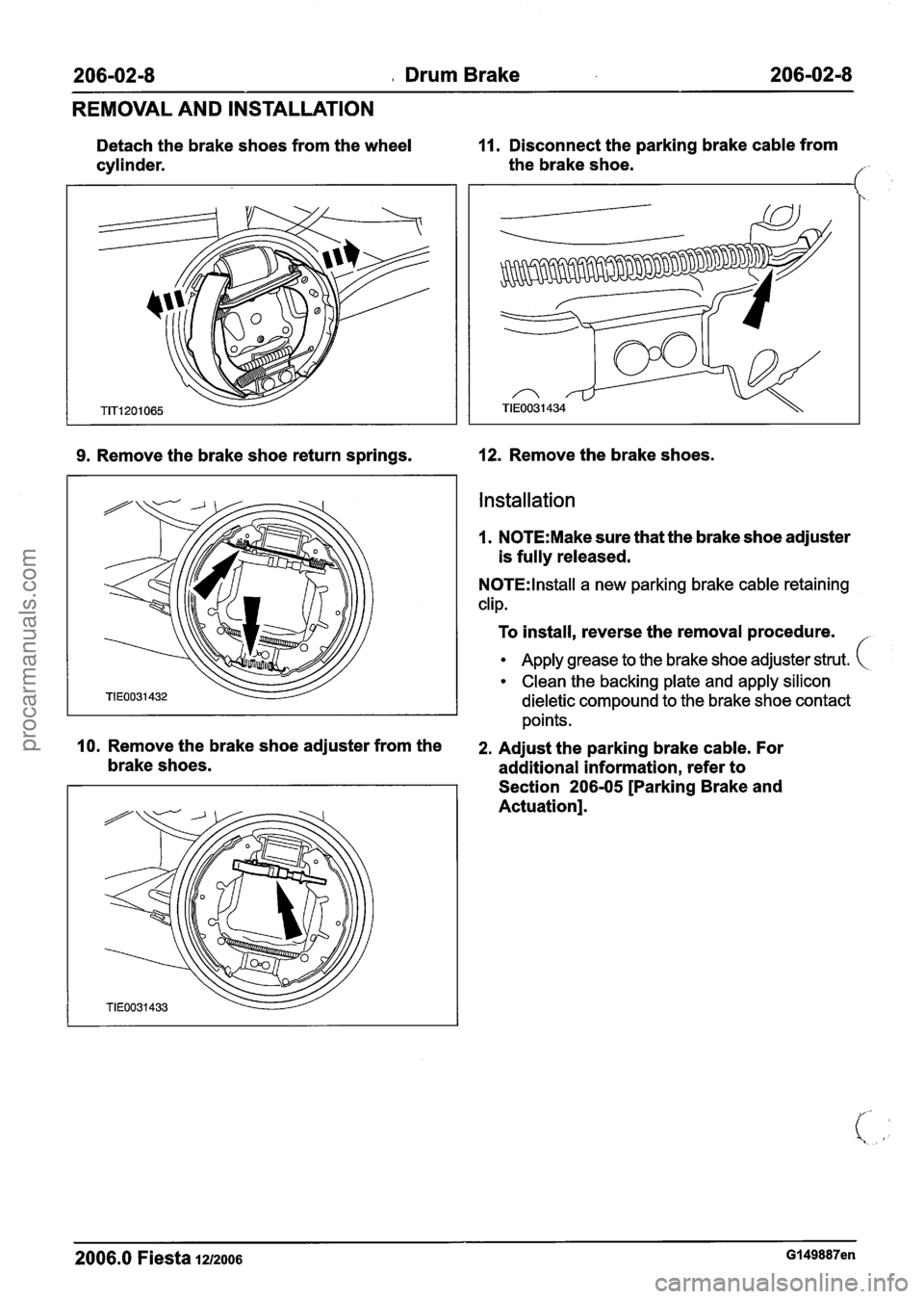
Detach the brake shoes from the wheel 11. Disconnect the parking brake cable from
cylinder. the
brake shoe.
I
9. Remove the brake shoe return springs. 12. Remove the brake shoes.
Installation
I. N0TE:Make sure that the brake shoe adjuster
is fully released.
N0TE:lnstall a new parking brake cable retaining
clip.
To install, reverse the removal procedure.
Apply grease to the brake shoe adjuster strut.
Clean the backing plate and apply silicon
dieletic compound to the brake shoe contact
points.
10. Remove the brake shoe adjuster from the 2, Adjust the parking brake cable. For
brake shoes.
additional information, refer to
Section
206-05 [Parking Brake and
Actuation].
2006.0 Fiesta 1212006 G149887en
procarmanuals.com
Page 216 of 1226
206-02-1 0 Drum Brake 206-02-1 0
REMOVAL AND INSTALLATION
Brake Backing Plate(l2 31 3 0)
General Equipment
I Electric hand drill I
I Blind rivet gun-hand I
Removal
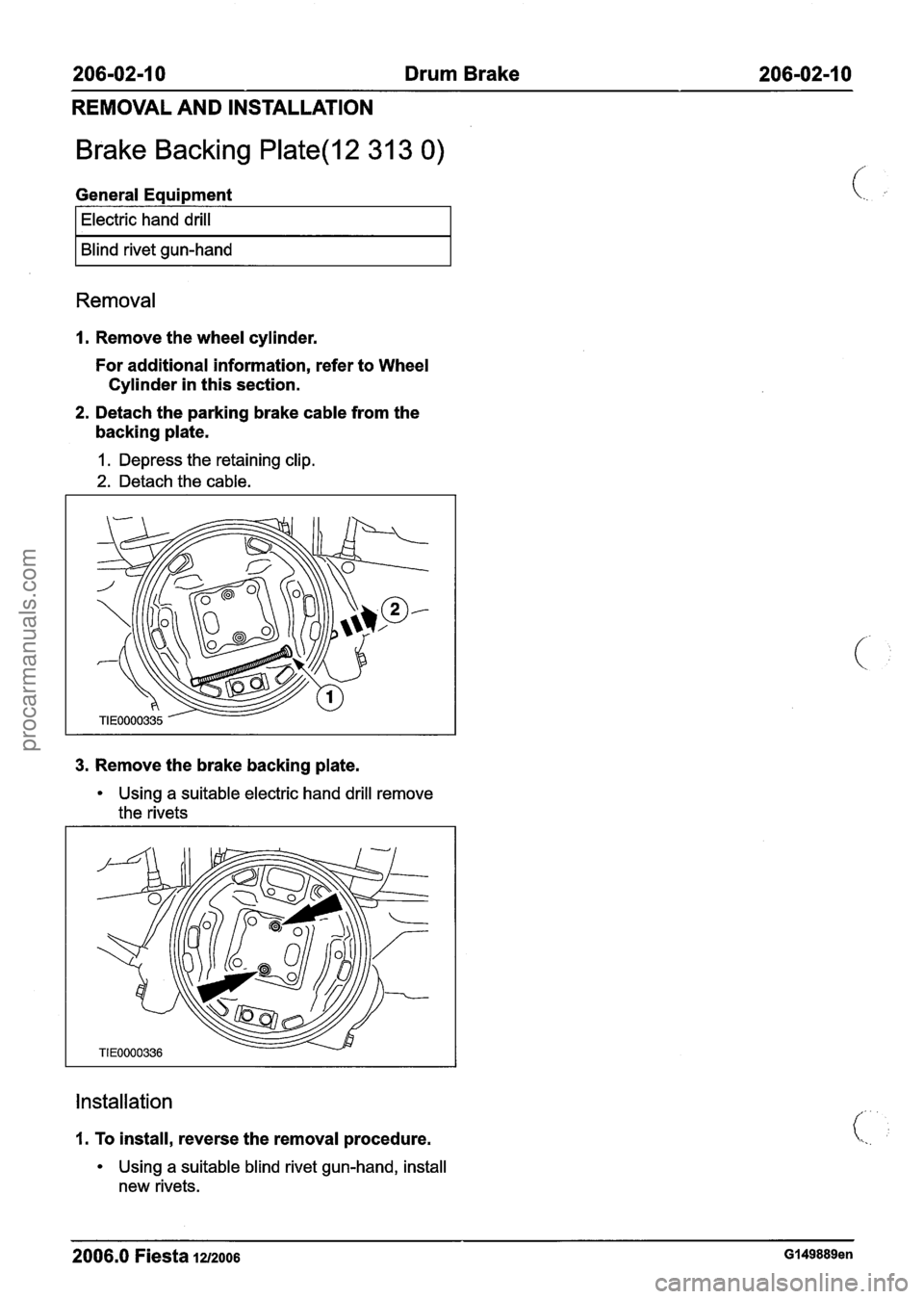
I. Remove the wheel cylinder.
For additional information, refer to Wheel
Cylinder in this section.
2. Detach the parking brake cable from the
backing plate.
I. Depress the retaining clip.
2. Detach the cable.
3.
Remove the brake backing plate.
Using a suitable electric hand drill remove
the rivets
Installation
1. To install, reverse the removal procedure.
Using a suitable blind rivet gun-hand, install
new rivets.
2006.0 Fiesta 1212006 G149889en
procarmanuals.com
Page 230 of 1226
206-04-6 Rear Disc Brake 206-04-6
REMOVAL AND INSTALLATION
Brake Pads(l2 238 0)
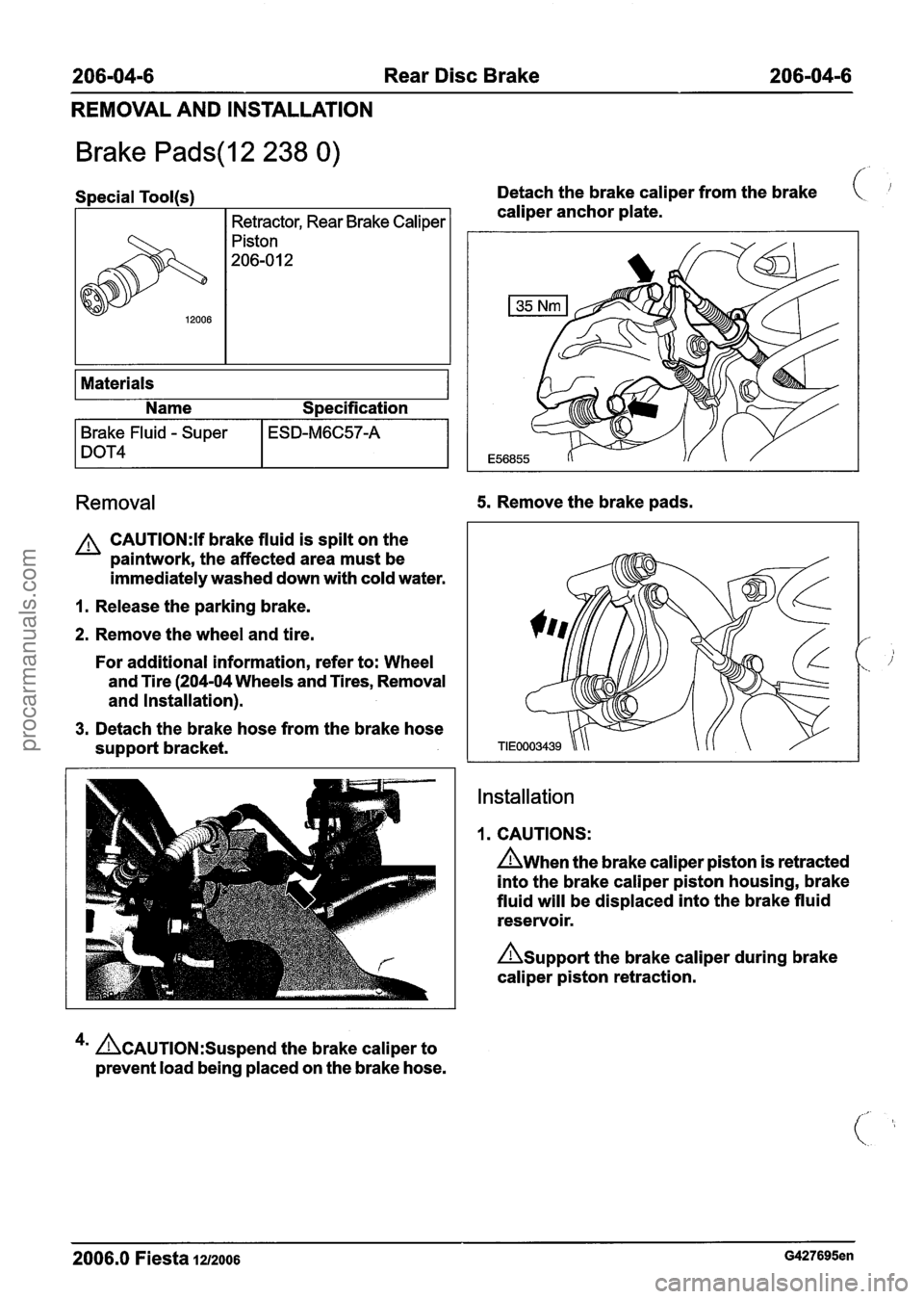
Special Tool(s) Detach the brake caliper from the brake (
I Retractor, Rear Brake Caliper I caliper anchor plate.
Piston
206-0
1 2
Materials
Name Specification
Removal 5. Remove the brake pads.
Brake Fluid - Super
I DOT4
A CAUTI0N:lf brake fluid is spilt on the
paintwork, the affected area must be
immediately washed down with cold water.
ESD-M6C57-A
1. Release the parking brake.
2. Remove the wheel and tire.
For additional information, refer to: Wheel
and Tire (204-04 Wheels and Tires, Removal
and Installation).
3. Detach the brake hose from the brake hose
support bracket.
Installation
1. CAUTIONS:
n~hen the brake caliper piston is retracted
into the brake caliper piston housing, brake
fluid will be displaced into the brake fluid
reservoir.
Asupport the brake caliper during brake
caliper piston retraction.
4m ACAUTION:S~~~~~~ the brake caliper to
prevent load being placed on the brake hose.
2006.0 Fiesta 1212006 G427695en
procarmanuals.com
Page 232 of 1226
206-04-8 Rear Disc Brake 206-04-8
REMOVAL AND INSTALLATION
Brake Caliper(l2 253 0) f
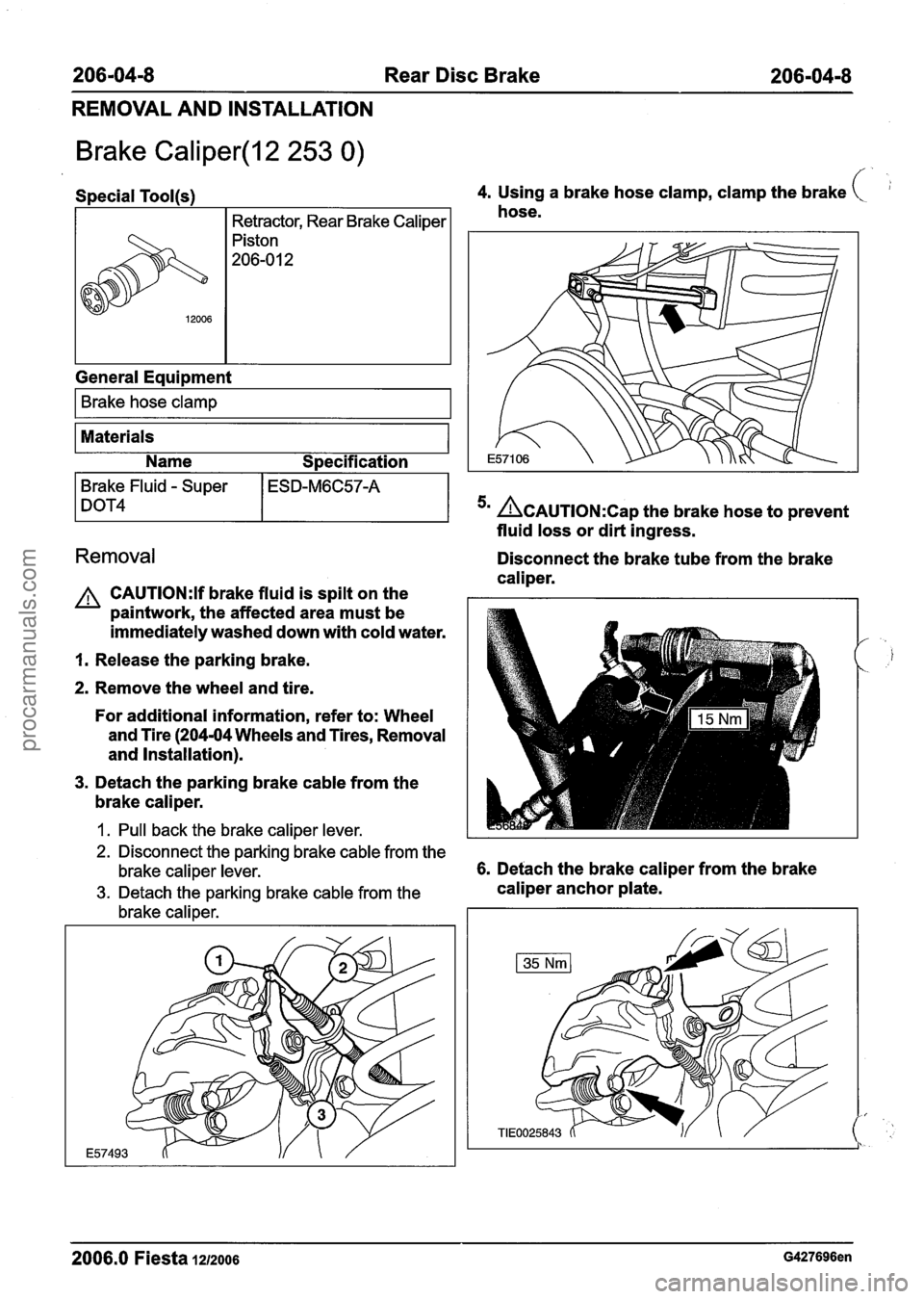
Special Tool(s) 4. Using a brake hose clamp, clamp the brake (
I Retractor, Rear Brake Caliper I hose.
General Equipment
I Brake hose clamp I
Materials
Name Specification
Brake Fluid - Super ESD-M6C57-A
DOT4 5n ~CAUTION:C~~ the brake hose to prevent
fluid loss or dirt ingress.
Removal Disconnect the brake tube from the brake
caliper.
A CAUTI0N:If brake fluid is spilt on the
paintwork, the affected area must be
immediately washed down with cold water.
I. Release the parking brake.
2. Remove the wheel and tire.
For additional information, refer to: Wheel
and Tire (204-04 Wheels and Tires, Removal
and Installation).
3. Detach the parking brake cable from the
brake caliper.
I. Pull back the brake caliper lever.
2. Disconnect the parking brake cable from the
brake caliper lever.
6. Detach the brake caliper from the brake
3. Detach the parking brake cable from the caliper anchor plate.
brake caliper.
2006.0 Fiesta 1212006 G427696en
procarmanuals.com
Page 234 of 1226
206-04-1 0 Rear Disc Brake 206-04-1 0
REMOVAL AND INSTALLATION
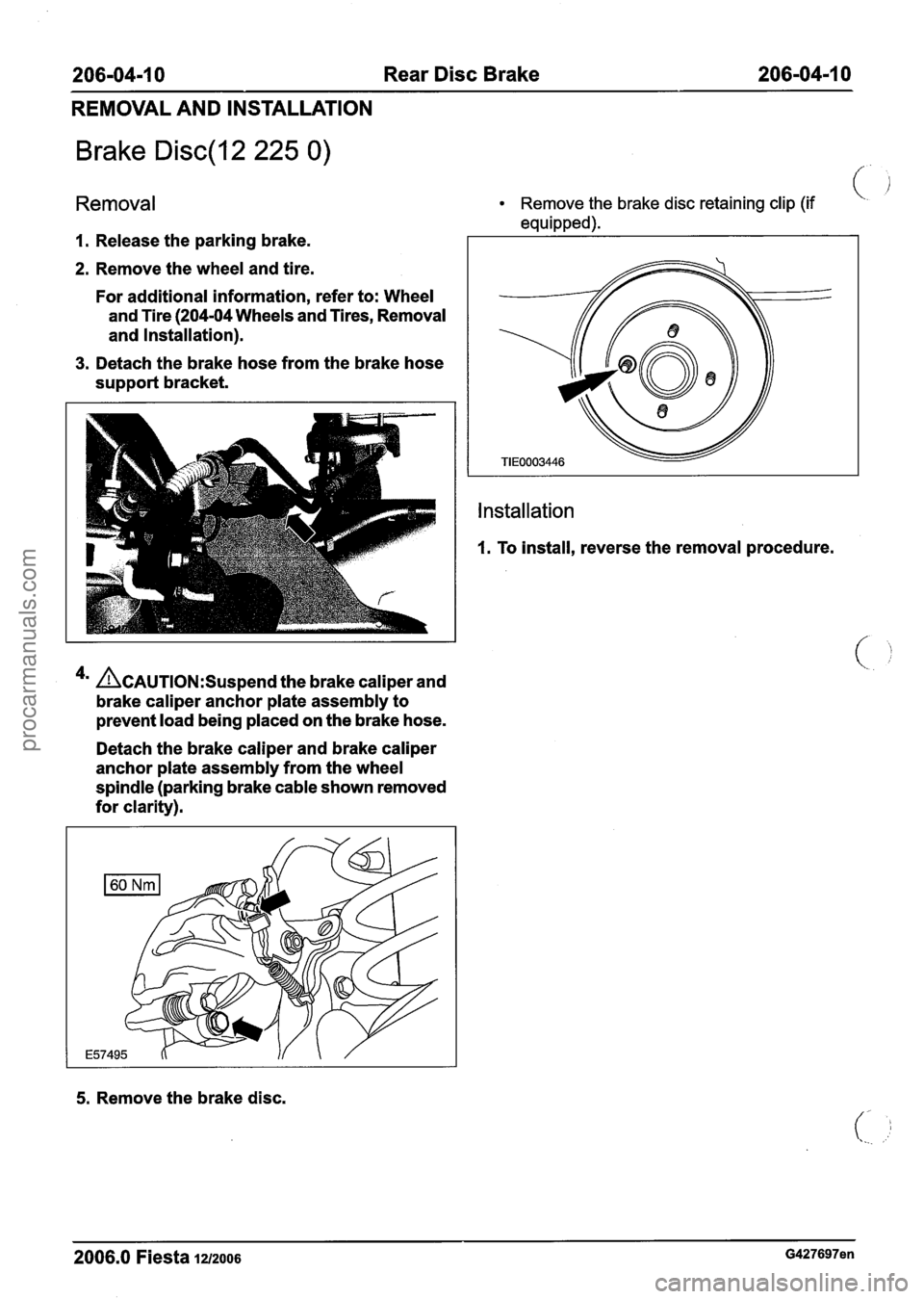
Brake Disc(l2 225 0) /'
Removal
1. Release the parking brake.
2. Remove the wheel and tire.
For additional information, refer to: Wheel
and Tire (204-04 Wheels and Tires, Removal
and Installation).
3. Detach the brake hose from the brake hose
support bracket.
4a &AUTION:S~~~~~~ the brake caliper and
brake caliper anchor plate assembly to
prevent load being placed on the brake hose.
Detach the brake caliper and brake caliper
anchor plate assembly from the wheel
spindle (parking brake cable shown removed
for clarity).
Remove the brake disc retaining clip (if (-
equipped).
Installation
1. To install, reverse the removal procedure.
5. Remove the brake disc.
2006.0 Fiesta 1212006 G427697en
procarmanuals.com
Page 237 of 1226
206-05-1 Parking Brake and Actuation 206-05-1
SECTION 206-05 Parking Brake and Actuation
VEHICLE APPLICATION:2006.0 Fiesta
CONTENTS
PAGE
SPECIFICATIONS
................ Specifications ........................................................................\
............................. ; 206-05-2
DESCRIPTION AND OPERATION
........................................................................\
............................................. Parking Brake 206-05-3
Overview ........................................................................\
..................................................... 206-05-3
DIAGNOSIS AND TESTING
Parking Brake ........................................................................\
............................................. 206-05-5
Inspection and Verification ........................................................................\
.......................... 206-05-5
........................................................................\
........................................... Symptom Chart 206-05-5
Pinpoint Tests ........................................................................\
............................................. 206-05-5
GENERAL PROCEDURES
-- ........ Parking Brake Cable Adjustment Vehicles With: Rear Drum Brakes (12 662 0) 206-05-9
. Parking Brake Cable Adjustment
Vehicles With: Rear Disc Brakes .......... (1 2 662 0) 206-05-1 1
REMOVAL AND INSTALLATION
. Parking Brake Cable Vehicles With: Rear Drum Brakes ........................... (1 2 675 0) 206-05-1 3
. Parking Brake Cable Vehicles With: Rear Disc Brakes ............................. (1 2 675 0) 206-05-1 5
Parking Brake Control ........................................................................\
............ (1 2 664 0) 206-05-1 7
procarmanuals.com