ABS FORD FIESTA 2007 Owner's Guide
[x] Cancel search | Manufacturer: FORD, Model Year: 2007, Model line: FIESTA, Model: FORD FIESTA 2007Pages: 1226, PDF Size: 61.26 MB
Page 267 of 1226
206-0713 Power Brake Actuation 206-0713
DESCRIPTION AND OPERATION
Brake Booster
Emergency brake assistant (EBA) EBA operates purely mechanically, and is
completely integral with the brakeservo.
As ABS braking systems have become widespread,
it has emerged that because of incorrect use of the
Brake servo units with and without EBA are
brakes, many drivers are losing the safety benefit externally identical. For identification purposes,
which ABS
~rovides. brake servo units with EBA carry a white sticker I showing a large letter "A. Drivers are applying the brakes too timidly.
Because of this, the Anti-lock Braking System The tandem master cylinder
is the same for
(ABS) does not engage, and the maximum braking
vehicles with or without
effect is not achieved.
The EBA recognises from the driver's manner of
braking that an emergency situation is occurring,
and automatically applies full braking power.
This occurs in a matter of milliseconds, which is
faster than the driver could do it.
Furthermore, it was observed that after the first
heavy application of the brake pedal, the driver
releases the pressure on the pedal too early.
The EBA ensures that the ABS effect still continues
when the pedal pressure would normally lie below
the ABS range of control. The system is available
j as an option depending on market and vehicle
variant.
Function
In normal braking situations, the brake servo with
EBA operates in the same way as a conventional
brake servo unit. This means that the driver can
always modulate the brakes.
If an activation threshold defined by a characteristic
curve is exceeded during braking, the EBA
operates.
Determination of the activation threshold is based
on the pedal movement parameters, which are a
function of the pressure on the brake pedal and
the speed of movement of the pedal.
Depending on driving manner, EBA results in a The characteristic curve
is separately defined for
reduction in braking distance of 15% for each vehicle model.
experienced drivers, to over
40% for average The mechanical EBA uses the fact that in a brake
drivers. servo unit, the valve piston moves ahead of the
Because EBA decelerates the vehicle up to the control housing
when a braking operation starts.
wheel locking limit, emergency brake assist is only Because of this, there is a relative travel distance used in vehicles with ABS.
between the control housing and the valve piston
which can vary depending on the force applied to
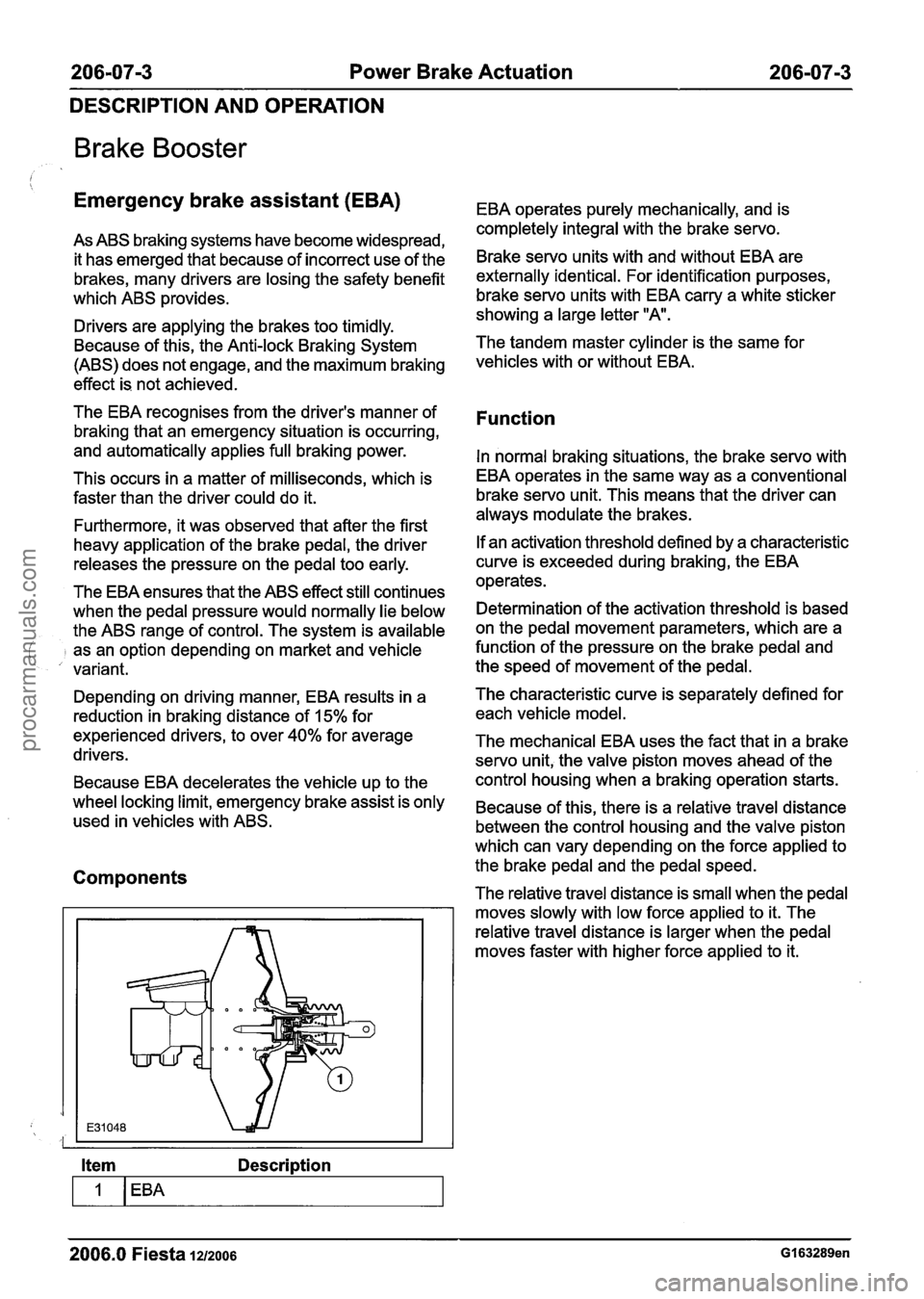
Components the brake pedal and the pedal speed.
The relative travel distance is small when the pedal
moves slowly with low force applied to it. The
relative travel distance is larger when the pedal
moves faster with higher force applied to it.
Item Description
-
2006.0 Fiesta 1212006 GI 63289en
procarmanuals.com
Page 269 of 1226
206-07-5 Power Brake Actuation 206-07-5
DESCRIPTION AND OPERATION
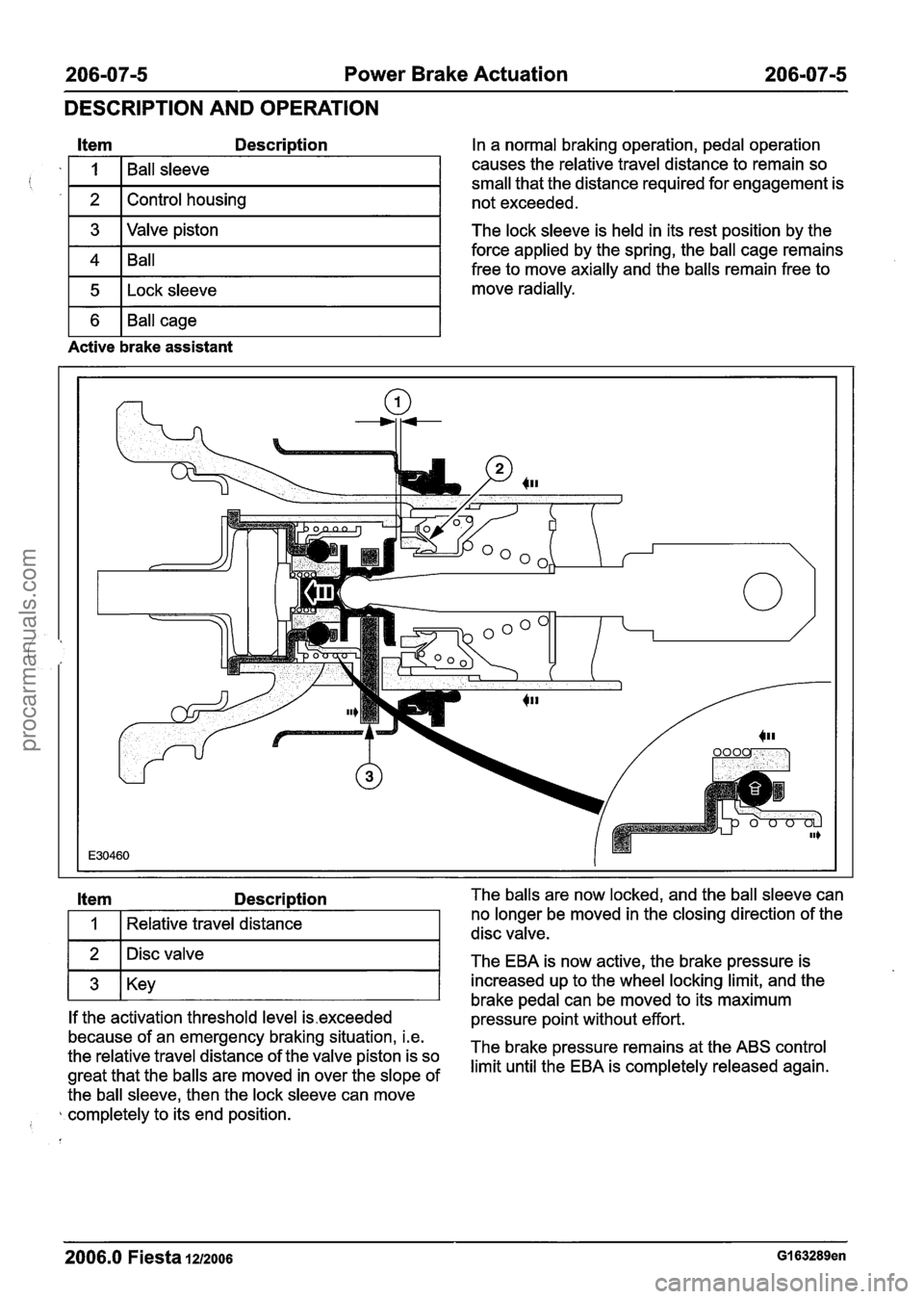
Item Description
1 3 I Valve piston I
i '
1 4 1 Ball I
1 5 1 ~ock sleeve I
I
2
1 6 1 Ball cage I
Ball sleeve
Control housing
Active brake assistant
In a normal braking operation, pedal operation
causes the relative travel distance to remain so
small that the distance required for engagement is
not exceeded.
The lock sleeve is held in its rest position by the
force applied by the spring, the ball cage remains
free to move axially and the balls remain free to
move radially.
Item Description
I 1 I Relative travel distance I
1 2 1 Disc valve I -
1 3 1 Key I
If the activation threshold level is.exceeded
because of an emergency braking situation, i.e.
the relative travel distance of the valve piston is so
great that the balls are moved in over the slope of
the ball sleeve, then the lock sleeve can move
completely to its end position.
I
--
The balls are now locked, and the ball sleeve can
no longer be moved in the closing direction of the
disc valve.
The EBA is now active, the brake pressure is
increased up to the wheel locking limit, and the
brake pedal can be moved to its maximum
pressure point without effort.
The brake pressure remains at the ABS control
limit until the EBA is completely released again.
2006.0 Fiesta 1212006 GI 63289en
procarmanuals.com
Page 272 of 1226
206-07-8 Power Brake Actuation 206-07-8
REMOVAL AND INSTALLATION
Brake Booster - RHD(12 451 0)
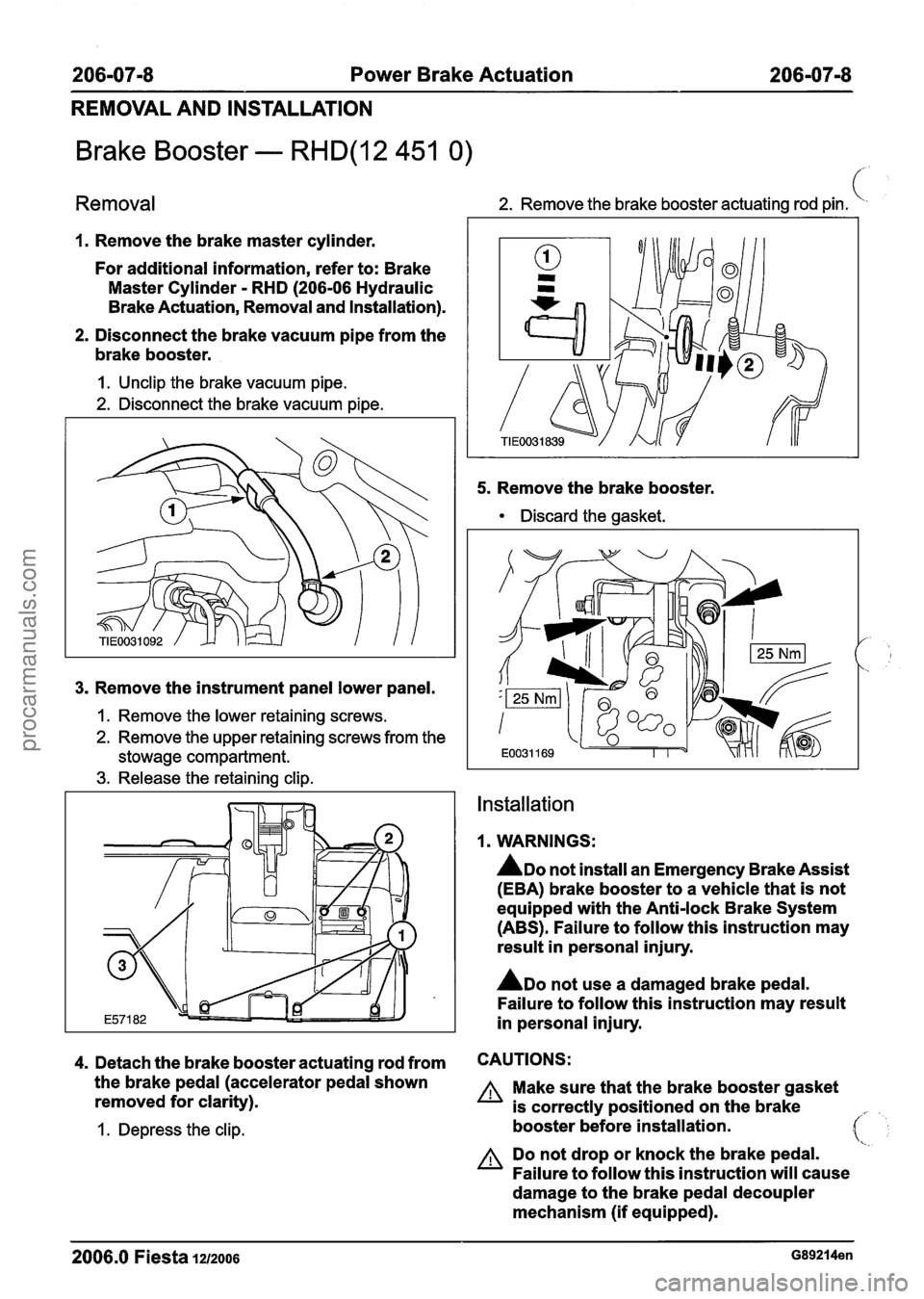
Removal 2. Remove the brake booster actuating rod pin. (
1. Remove the brake master cylinder.
For additional information, refer to: Brake
Master Cylinder
- RHD (206-06 Hydraulic
Brake Actuation, Removal and Installation).
2. Disconnect the brake vacuum pipe from the
brake booster.
I. Unclip the brake vacuum pipe.
2. Disconnect the brake vacuum pipe.
3. Remove the instrument panel lower panel.
1. Remove the lower retaining screws.
2. Remove the upper retaining screws from the
stowage compartment.
3. Release the retaining clip. 5.
Remove
the brake booster.
Discard the gasket.
Installation
1. WARNINGS:
ADO not install an Emergency Brake Assist
(EBA) brake booster to a vehicle that is not
equipped with the Anti-lock Brake System
(ABS). Failure to follow this instruction may
result in personal injury.
ADO not use a damaged brake pedal.
Failure to follow this instruction may result
in personal injury.
4. Detach the brake booster actuating rod from CAUTIONS:
the brake pedal (accelerator pedal shown A Make sure that the brake booster gasket
removed for clarity).
is correctly positioned on the brake
I. Depress the clip. booster before installation. 41
A Do not drop or knock the brake pedal.
Failure to follow this instruction will cause
damage to the brake pedal decoupler
mechanism (if equipped).
2006.0 Fiesta 12/2006 G89214en
procarmanuals.com
Page 275 of 1226

206-09A-1 Anti-Lock Control 206-09A-I
SECTION 206-09A Anti-Lock Control
CONTENTS
PAGE
SPECIFICATIONS
........................................................................\
.............................................. Specifications 206-09A-2
DESCRIPTION AND OPERATION
........................................................................\
......................................... Anti-Lock Control 206-09A-3
........................................................................\
..................................................... Overview 206-09A-3
Function
........................................................................\
...................................................... 206-09A-3
Anti-Lock Control
........................................................................\
........................................ 206-09A-5
MK70 Anti-lock Brake System (ABS) ........................................................................\
......... 206-09A-5
........................................................................\
.................................................. MK60 ABS 206-09A-5
DIAGNOSIS AND TESTING
........................................................................\
........................................ Anti-Lock Control 206-09A-7
........................................................................\
.......................... Inspection and Verification 206-09A-7
REMOVAL AND INSTALLATION
......................................... Hydraulic Control Unit (HCU) -- Vehicles Built Up To: 0512004 206-09A-8
.......................................... Hydraulic Control Unit (HCU) -- Vehicles Built From: 0512004 206-09A-11
Anti-Lock Brake System (ABS) Module -- Vehicles Built Up To: 0512004 ......................... 206-09A-14
.......................... Anti-Lock Brake System (ABS) Module -- Vehicles Built From: 0512004 206-09A-17
........................................................................\
..... Rear Wheel Speed Sensor
(12 785 0) 206-09A-20
Rear Wheel Speed Sensor Ring
................................................................... (12 788 0) 206-09A-22
Front Wheel Speed Sensor
........................................................................\
.... (12 784 0) 206-09A-24
procarmanuals.com
Page 276 of 1226
206-09A-2 Anti-Lock Control 206-09A-2
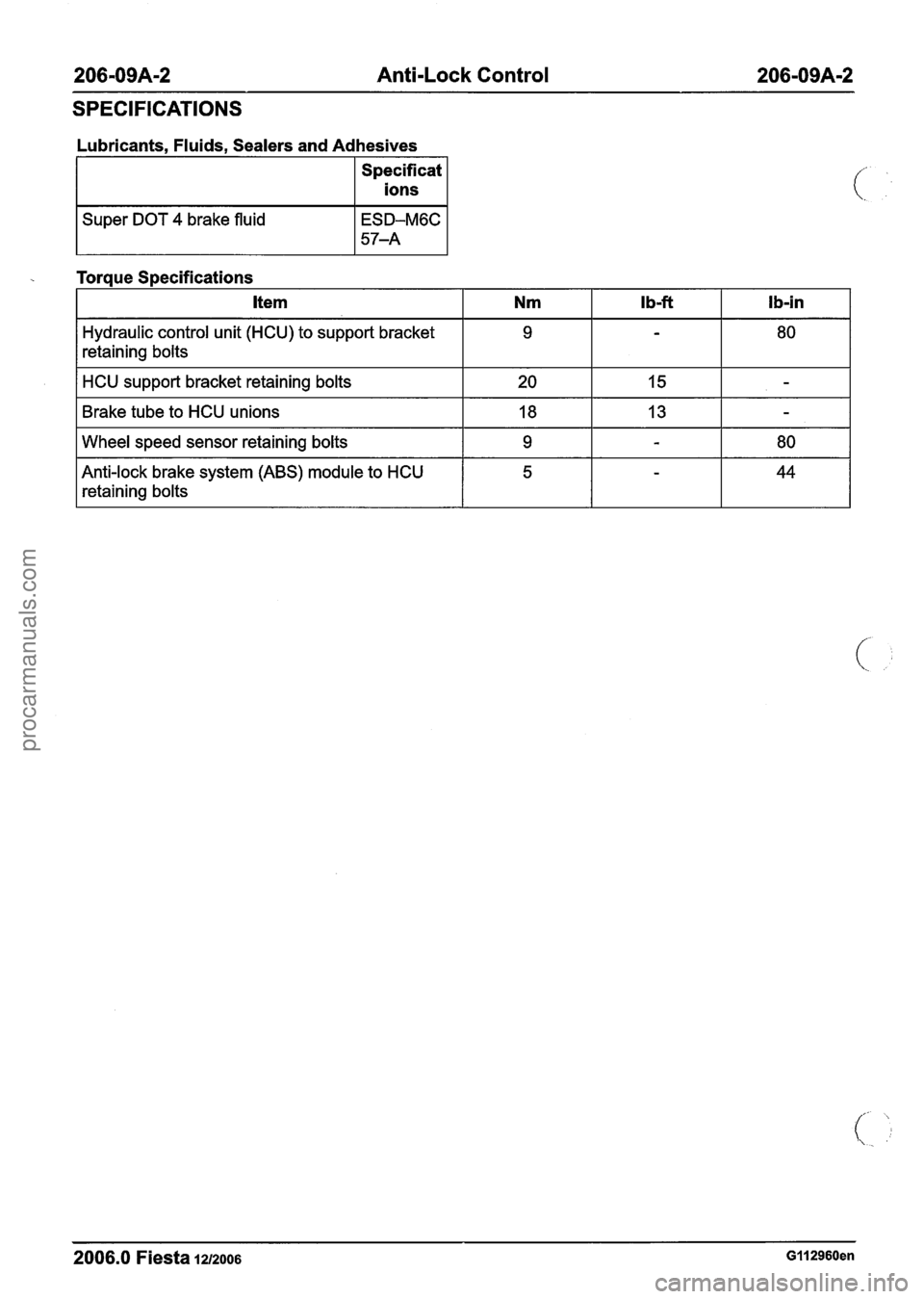
SPECIFICATIONS
Lubricants, Fluids, Sealers and Adhesives
Specificat
1 ions I
I Super DOT 4 brake fluid
Hydraulic control unit (HCU) to support bracket
retaining bolts
I Wheel speed sensor retaining bolts I 9 I - I 80 I
HCU support bracket retaining bolts
Brake tube to HCU unions
I Anti-lock brake system (ABS) module to HCU I 5 I - I 44 I
I retaining bolts
20
18
2006.0 Fiesta 1212006 GII 2960en
15
13 -
-
procarmanuals.com
Page 277 of 1226
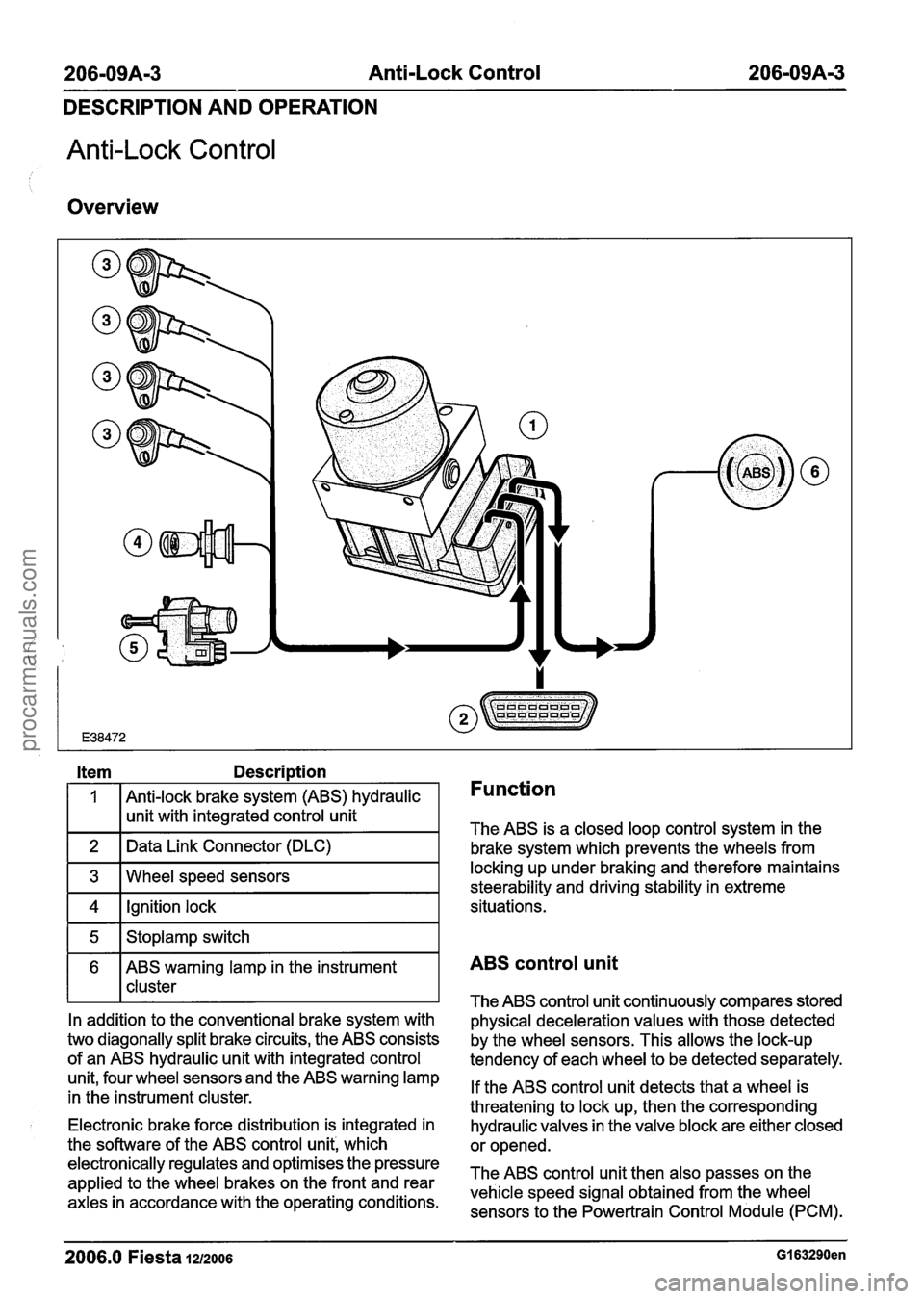
206-09A-3 Anti-Lock Control 206-09A-3
DESCRIPTION AND OPERATION
Anti-Lock Control
Overview
Function
The ABS is a closed loop control system in the
brake system which prevents the wheels from
1 4 1 Ignition lock I situations.
3
1 5 1 Stoplamp switch I
6 ABS warning lamp in the instrument
I 1 cluster
Wheel
speed sensors
In addition to the conventional brake system with
two diagonally split brake circuits, the ABS consists
of an ABS hydraulic unit with integrated control
unit, four wheel sensors and the ABS warning lamp
in the instrument cluster. locking up under
braking and therefore maintains
steerability and driving stability in extreme
Electronic brake force distribution is integrated in
the software of the ABS control unit', which
electronically regulates and optimises the pressure
applied to the wheel brakes on the front and rear
axles in accordance with the operating conditions.
ABS control unit
The ABS control unit continuously compares stored
physical deceleration values with those detected
by the wheel sensors. This allows the lock-up
tendency of each wheel to be detected separately.
If the ABS control unit detects that a wheel is
threatening to lock up, then the corresponding
hydraulic valves in the valve block are either closed
or opened.
The ABS control unit then also passes on the
vehicle speed signal obtained from the wheel sensors to the Powertrain Control Module (PCM).
2006.0 Fiesta 1212oo6 GI 63290en
procarmanuals.com
Page 278 of 1226
206-09A-4 Anti-Lock Control 206-09A-4
DESCRIPTION AND OPERATION
The warning lamp in the instrument cluster is
actuated by the ABS control unit after switching on
the ignition. It remains on up to the end of the ABS
self-test, and is also actuated in the event of
system errors.
It continuously monitors the system for possible
faults and stores these as and when they occur.
The corresponding trouble codes can be
interrogated with the aid of WDS via the DLC
.
The ABS control unit is directly connected via a
diagnostic data link to the DLC.
Valve block
The valve block contains four inlet valves and four
outlet valves. There is one inlet valve and one
outlet valve for each wheel.
When there is no electrical supply the inlet valves
are open and the outlet valves are closed.
The valve block also contains the low-pressure
reservoir and sound damping chambers.
Pump motor
In the event of an ABS intervention the pump motor
ensures that the pressure can be provided to the
regulating channels independently of the brake
master cylinder.
ABS regulating cycle
An ABS regulating cycle has three phases:
Phase
1 - holding pressure
The inlet valve is closed, and the brake pressure
to the wheel brake cannot be increased any
further, even if the actuation pressure (brake
pedal) is increased further.
Phase
2 - pressure reduction
The outlet valve is temporarily opened, and the
brake pressure to the wheel brake is reduced
in a controlled manner.
Phase
3 - pressure build-up
The inlet valve is opened in stages, and the
brake pressure is increased in a controlled
manner to achieve the greatest possible
deceleration.
2006.0 Fiesta 1212006 GI 63290en
procarmanuals.com
Page 279 of 1226
206-0949-5 Anti-Lock Control 206-09A-5 -- -
DESCRIPTION AND OPERATION
Anti-Lock Control
MK70 Anti-lock Brake System (ABS)
The MK70 ABS is similar to the MK60 in
construction and design. The main differences are:
New ABS control unit
New hydraulic lines through a revised valve
block
New wiring harness and electrical connector
(fewer occupied pins)
The MK70 ABS system will be installed from
0512004 in vehicles which only have one ABS
function.
Vehicles with
ESPlBrake Traction Control System
(BTCS) will continue to be equipped with the
MK60.
MK60 ABS
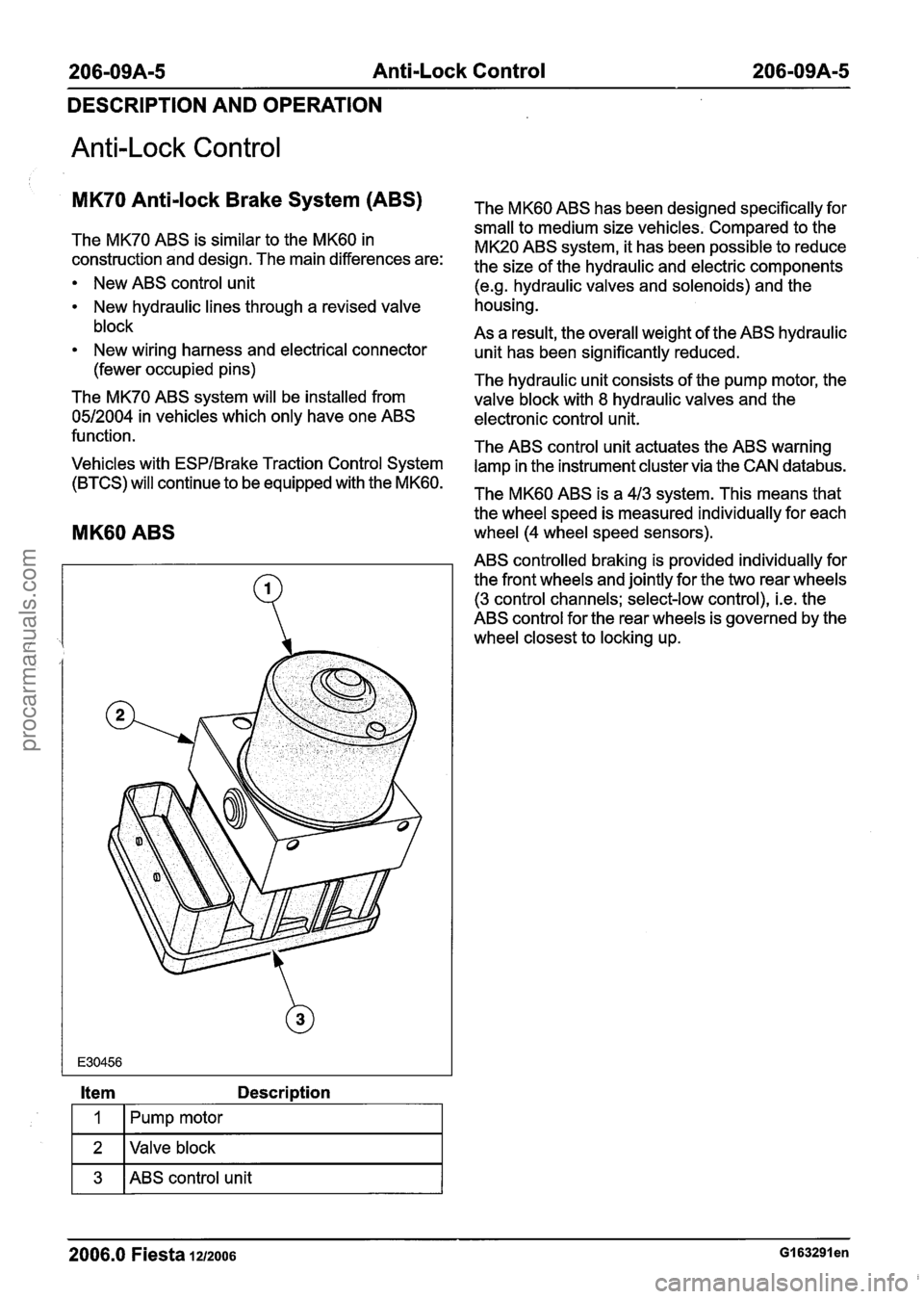
Item Description
Fpump motor I
1 2 I Valve block I
1 3 1 ABS control unit I
The MK60 ABS has been designed specifically for
small to medium size vehicles. Compared to the
MK20 ABS system, it has been possible to reduce
the size of the hydraulic and electric components
(e.g. hydraulic valves and solenoids) and the
housing.
As a result, the overall weight of the ABS hydraulic
unit has been significantly reduced.
The hydraulic unit consists of the pump motor, the
valve block with
8 hydraulic valves and the
electronic control unit.
The ABS control unit actuates the ABS warning lamp in the instrument cluster via the CAN
databus.
The MK60 ABS is a 413 system. This means that
the wheel speed is measured individually for each
wheel (4 wheel speed sensors).
ABS controlled braking is provided individually for the front wheels and jointly for the two rear wheels
(3 control channels; select-low control), i.e. the
ABS control for the rear wheels is governed by the
wheel closest to locking up.
- --
2006.0 Fiesta 1212006 GI 63291 en
procarmanuals.com
Page 280 of 1226
206-09A-6 Anti-Lock Control 206-09A-6
DESCRIPTION AND OPERATION
Wheel speed sensors
I f
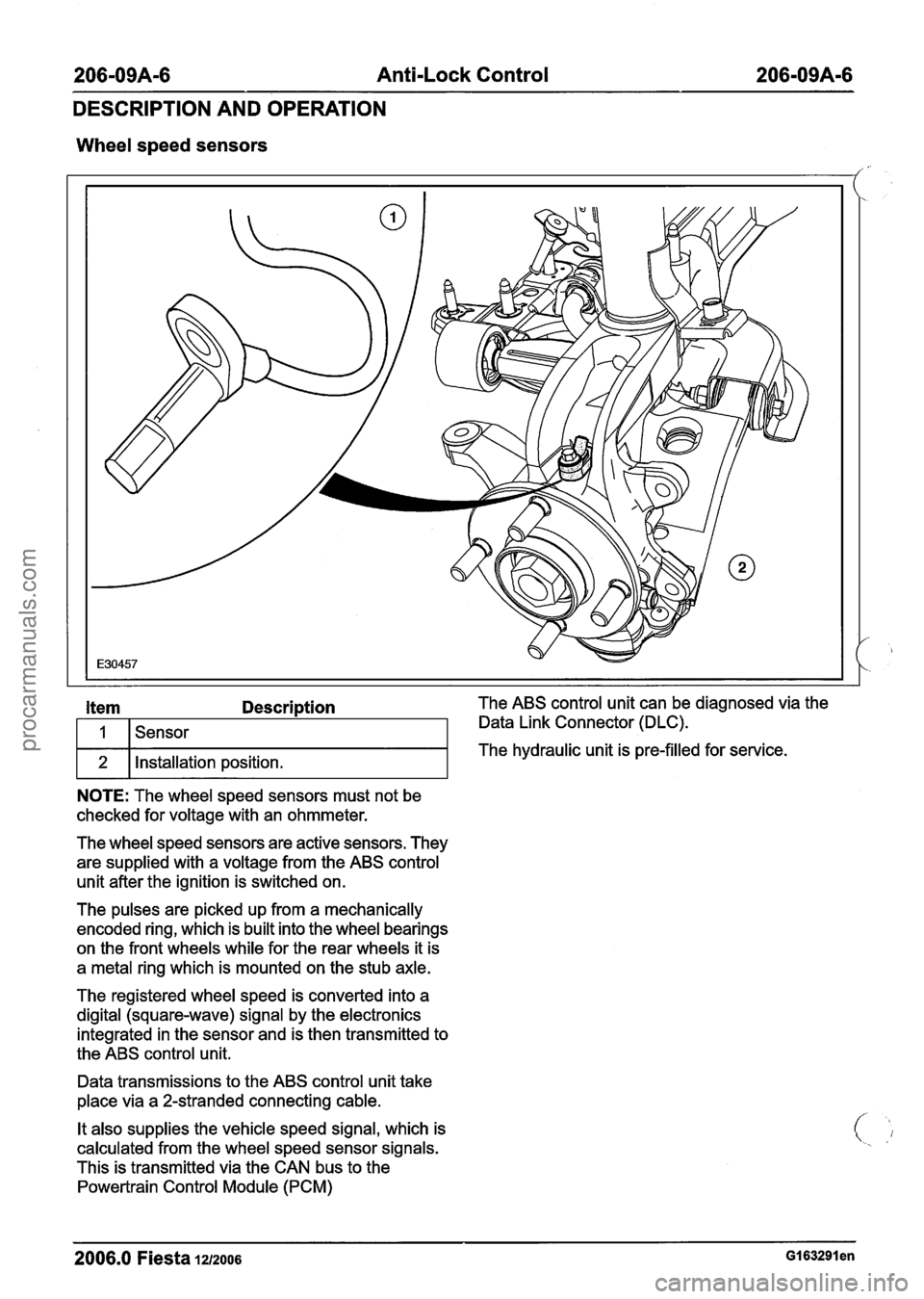
The wheel speed sensors are active sensors. They
are supplied with a voltage from the ABS control
unit after the ignition is switched on.
Item Description The ABS control unit can be diagnosed via the
The pulses are picked up from a mechanically
encoded ring, which is built into the wheel bearings
on the front wheels while for the rear wheels it is
a metal ring which is mounted on the stub axle.
The registered wheel speed is converted into a
digital (square-wave) signal by the electronics
integrated in the sensor and is then transmitted to
the ABS control unit. Data Link Connector
(DLC).
The hydraulic unit is pre-filled for service.
1
2
Data transmissions to the ABS control unit take
place via a 2-stranded connecting cable.
NOTE: The wheel speed sensors must not be
checked for voltage with an ohmmeter.
Sensor
Installation position.
It also supplies the vehicle speed signal, which is
calculated from the wheel speed sensor signals.
This is transmitted via the CAN bus to the
Powertrain Control Module (PCM)
2006.0 Fiesta 1212006 GI 63291 en
procarmanuals.com
Page 283 of 1226
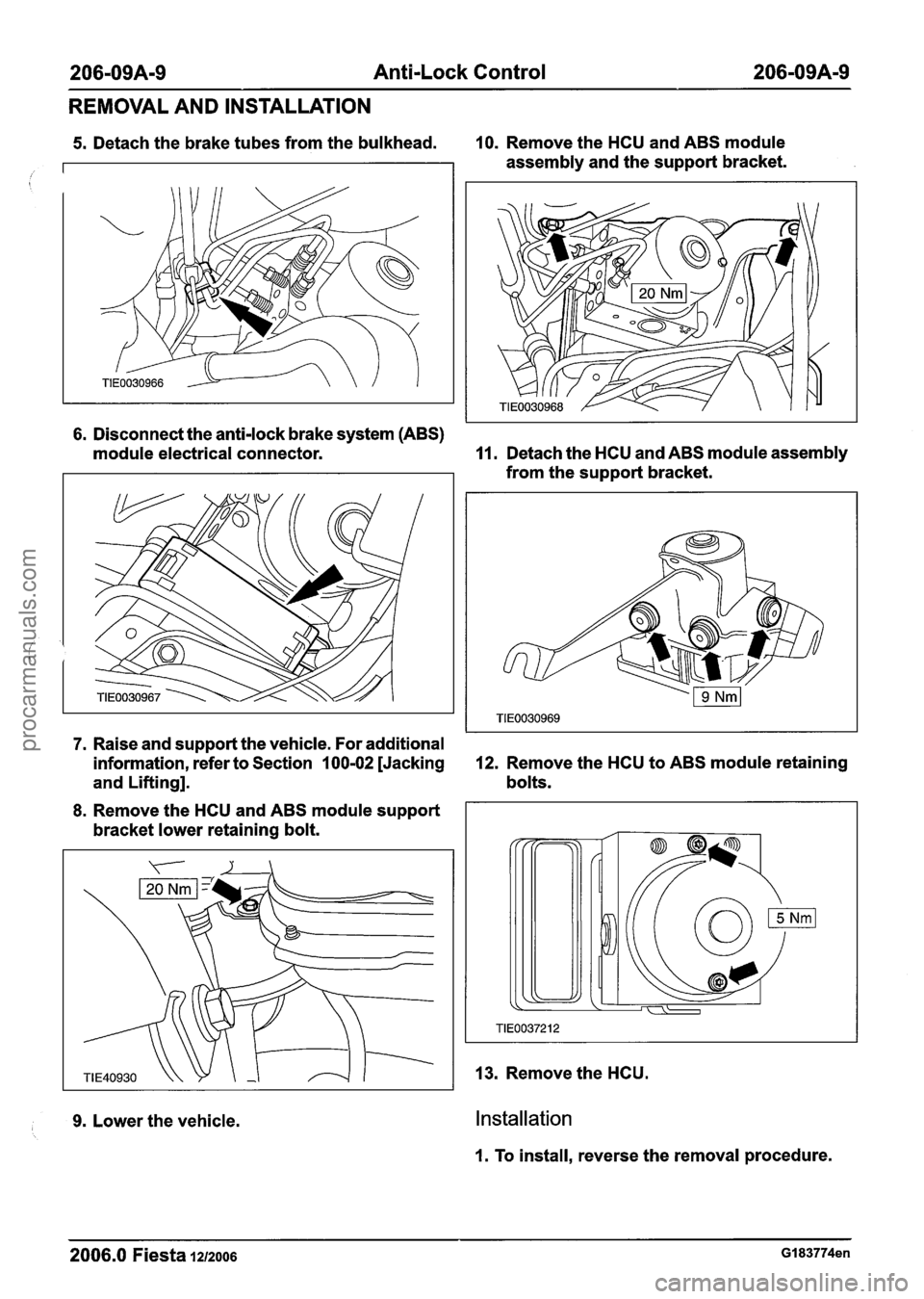
206-09A-9 Anti-Lock Control 206-09A-9
REMOVAL AND INSTALLATION
6. Disconnect the anti-lock brake system (ABS)
module electrical connector.
11. Detach the HCU and ABS module assembly
from the support bracket.
5. Detach the brake tubes from the bulkhead. 10. Remove the HCU and ABS module
7. Raise and support the vehicle. For additional
information, refer to Section
100-02 [Jacking 12. Remove the HCU to ABS module retaining
and Lifting]. bolts.
/
8. Remove the HCU and ABS module support
bracket lower retaining bolt. assembly
and the support bracket.
9. Lower the vehicle.
13. Remove the HCU.
Installation
1. To install, reverse the removal procedure.
2006.0 Fiesta 1212006 GI 83774en
procarmanuals.com