Engine belt FORD FIESTA 2007 Workshop Manual
[x] Cancel search | Manufacturer: FORD, Model Year: 2007, Model line: FIESTA, Model: FORD FIESTA 2007Pages: 1226, PDF Size: 61.26 MB
Page 62 of 1226
100-04-6 Noise, Vibration and Harshness 100-04-6
DIAGNOSIS AND TESTING
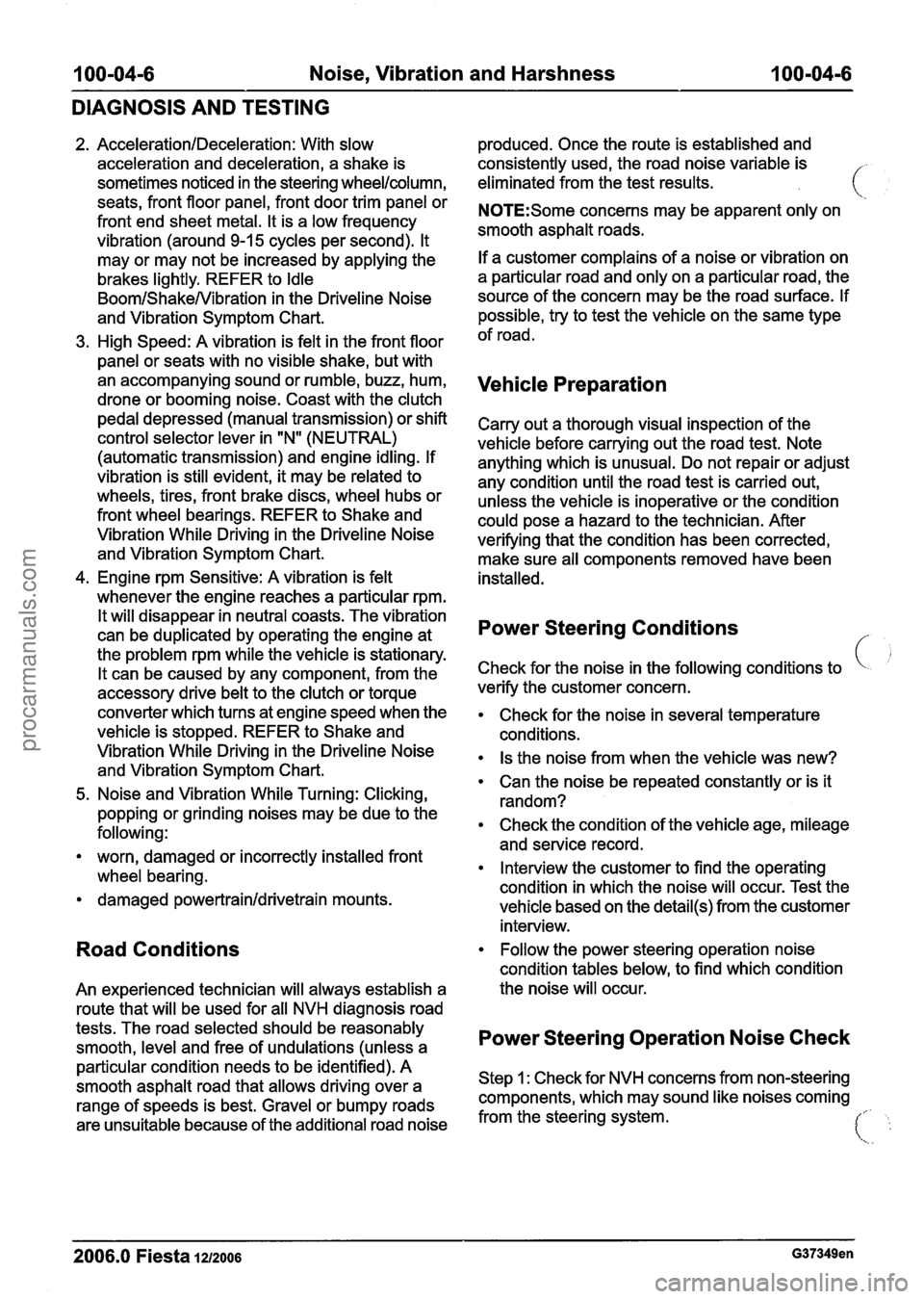
2. AccelerationIDeceleration: With slow
acceleration and deceleration, a shake is
sometimes noticed in the steering
wheellcolumn,
seats, front floor panel, front door trim panel or
front end sheet metal. It is a low frequency
vibration (around
9-1 5 cycles per second). It
may or may not be increased by applying the
brakes lightly. REFER to
Idle
BoomIShakeNibration in the Driveline Noise
and Vibration Symptom Chart.
High Speed: A vibration is felt in the front floor
panel or seats with no visible shake, but with
an accompanying sound or rumble, buzz, hum,
drone or booming noise. Coast with the clutch
pedal depressed (manual transmission) or shift
control selector lever in "N" (NEUTRAL)
(automatic transmission) and engine idling. If
vibration is still evident, it may be related to
wheels, tires, front brake discs, wheel hubs or
front wheel bearings. REFER to Shake and
Vibration While Driving in the Driveline Noise
and Vibration Symptom Chart.
4. Engine rpm Sensitive: A vibration is felt
whenever the engine reaches a particular rpm.
It will disappear in neutral coasts. The vibration
can be duplicated by operating the engine at
the problem rpm while the vehicle is stationary.
It can be caused by any component, from the
accessory drive belt to the clutch or torque
converter which turns at engine speed when the
vehicle is stopped. REFER to Shake and
Vibration While Driving in the Driveline Noise
and Vibration Symptom Chart.
5. Noise and Vibration While Turning: Clicking,
popping or grinding noises may be due to the
following:
worn, damaged or incorrectly installed front
wheel bearing.
damaged
powertrainldrivetrain mounts.
Road Conditions
An experienced technician will always establish a
route that will be used for all NVH diagnosis road
tests. The road selected should be reasonably
smooth, level and free of undulations (unless a
particular condition needs to be identified). A
smooth asphalt road that allows driving over a
range of speeds is best. Gravel or bumpy roads
are unsuitable because of the additional road noise produced.
Once the route is established and
consistently used, the road noise variable is
eliminated from the test results.
N0TE:Some concerns may be apparent only on
smooth asphalt roads.
If a customer complains of a noise or vibration on
a particular road and only on a particular road, the
source of the concern may be the road surface. If
possible, try to test the vehicle on the same type
of road.
Vehicle Preparation
Carry out a thorough visual inspection of the
vehicle before carrying out the road test. Note
anything which is unusual. Do not repair or adjust
any condition until the road test is carried out,
unless the vehicle is inoperative or the condition
could pose a hazard to the technician. After
verifying that the condition has been corrected,
make sure all components removed have been
installed.
Power Steering Conditions
c !
Check for the noise in the following conditions to
verify the customer concern.
Check for the noise in several temperature
conditions.
Is the noise from when the vehicle was new?
Can the noise be repeated constantly or is it
random?
Check the condition of the vehicle age, mileage
and service record.
Interview the customer to find the operating
condition in which the noise will occur. Test the
vehicle based on the
detail(s) from the customer
interview.
Follow the power steering operation noise
condition tables below, to find which condition
the noise will occur.
Power Steering Operation Noise Check
Step 1 : Check for NVH concerns from non-steering
components, which may sound like noises coming
from the steering system.
I:. ':
2006.0 Fiesta 121zoo6 G37349en
procarmanuals.com
Page 72 of 1226
100-04-16 Noise, Vibration and Harshness 100-04-1 6
DIAGNOSIS AND TESTING
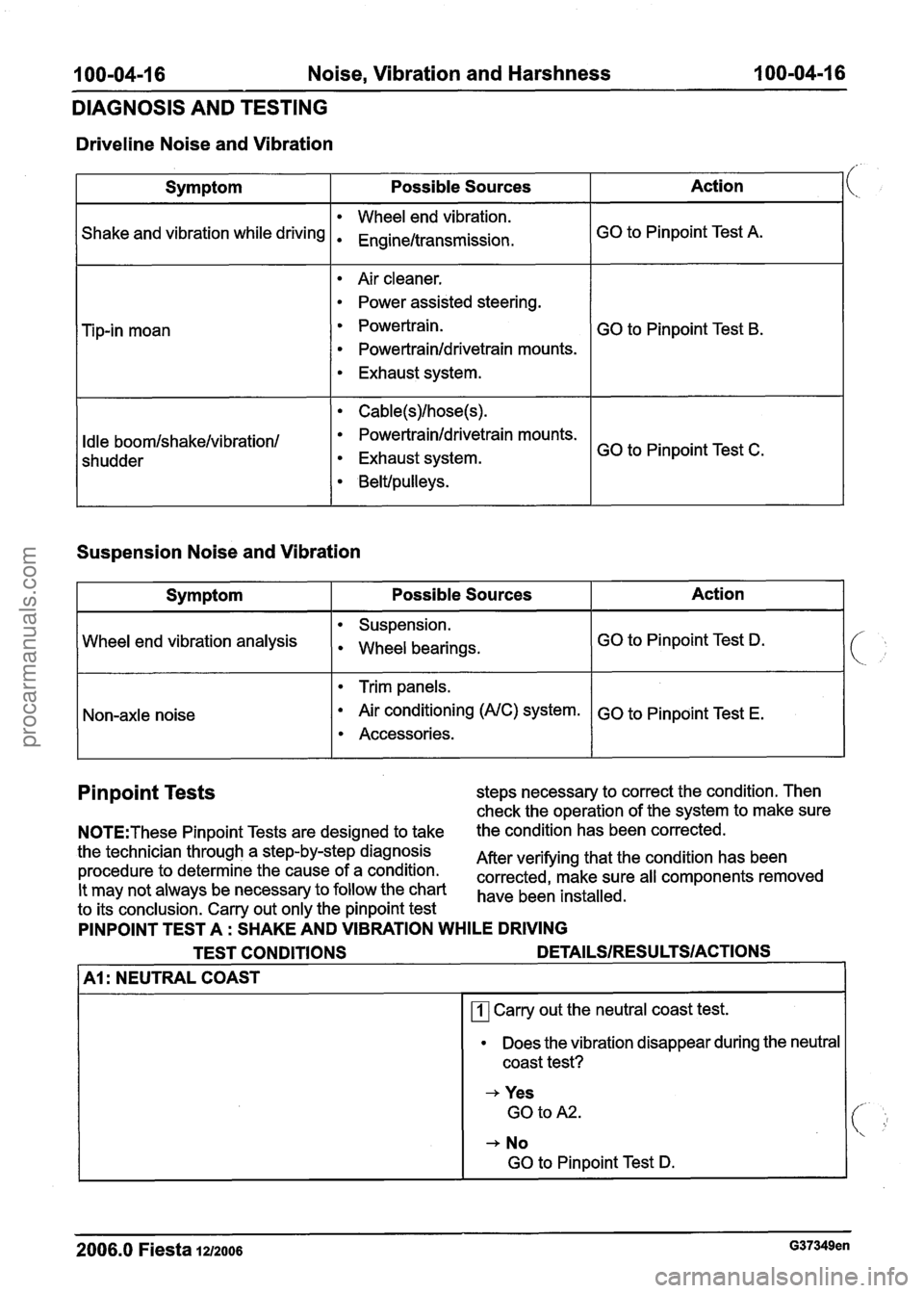
Driveline Noise and Vibration
Suspension Noise and Vibration
Action
GO to Pinpoint Test A.
GO to Pinpoint Test
B.
GO to Pinpoint Test C.
Symptom
Shake and vibration while driving
Tip-in moan
Idle boomlshake/vibration/
shudder
Pinpoint Tests steps necessary to correct the condition. Then
check the operation of the system to make sure
N0TE:These Pinpoint Tests are designed to take the
condition has been corrected.
the technician through
a step-by-step diagnosis ~fi~~ verifying that the condition has been procedure to determine the cause of a condition. corrected, make sure all components removed It may not always be necessary to follow the chart have been installed. to its conclusion. Carry out only the pinpoint test
PINPOINT TEST A : SHAKE AND VIBRATION WHILE DRIVING
TEST CONDITIONS
DETAILSIRESU LTSIACTIONS 1
Possible Sources
Wheel end vibration.
. Engine/transmissiOnm
Air cleaner.
Power assisted steering.
Powertrain.
Powertrainldrivetrain mounts.
Exhaust system.
Cable(s)lhose(s).
Powertrainldrivetrain mounts.
Exhaust system.
Belt/ pulleys.
I A1 : NEUTRAL COAST I
Action
GO to Pinpoint Test D.
GO to Pinpoint Test E,
Symptom
Wheel end vibration analysis
Nan-axle noise
Carry out the neutral coast test.
Does the vibration disappear during the neutral
coast test?
+ Yes
GO to A2.
+ No
GO to Pinpoint Test D.
Possible Sources
Suspension.
. Wheel bearings,
Trim panels.
Air conditioning (A/C) system.
Accessories.
- --
2006.0 Fiesta 1212006 G37349en
procarmanuals.com
Page 324 of 1226
21 1-00-4 Steering System - General Information 21 1-00-4
DESCRIPTION AND OPERATION
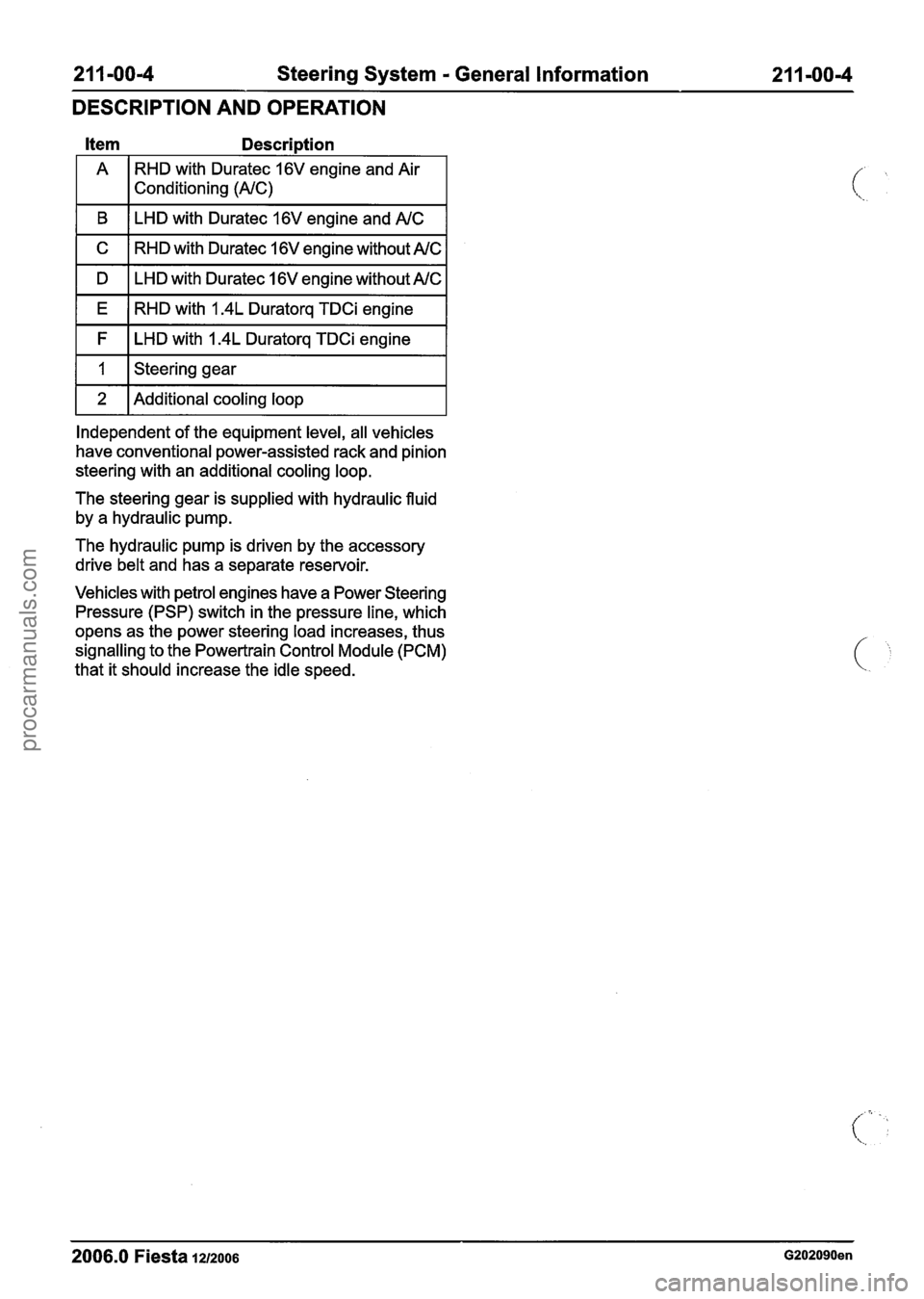
Item Descri~tion
A
RHD with Duratec 16V engine and Air
1 I Conditioning (NC)
I B I LHD with Duratec 16V engine and NC I
I C I RHD with Duratec 16V engine without AM: I
I D I LHD with Duratec 16V engine without NC I
I E ( RHD with 1.4L Duratorq TDCi engine I
I F I LHD with 1.4L Duratorq TDCi engine I
I I I Steering gear I
1 2 1 Additional cooling loop I
Independent of the equipment level, all vehicles
have conventional power-assisted rack and pinion
steering with an additional cooling loop.
The steering gear is supplied with hydraulic fluid
by a hydraulic pump.
The hydraulic pump is driven by the accessory
drive belt and has a separate reservoir.
Vehicles with petrol engines have a Power Steering
Pressure (PSP) switch in the pressure line, which
opens as the power steering load increases, thus
signalling to the Powertrain Control Module (PCM)
that it should increase the idle speed.
- - -- - -
2006.0 Fiesta 1212006 G202090en
procarmanuals.com
Page 325 of 1226
211 -00-5 Steering System - General Information 211 -00-5
DIAGNOSIS AND TESTING
Steering System
/ Special Tool(s)
Alignment Pins, Subframe
205-524
Simulator, Driver and
passenger ~ir Bags and Side
Air Curtains 50
1 -073A
General Eaui~ment
I Worldwide Diagnostic System (WDS) I
Principles of Operation
The steering wheel rotational movement is
transferred to the steering gear through the steering
column shaft. The steering gear converts this
rotational movement, through the action of the rack
and pinion gear into lateral movement. This
movement in turn is transferred to the wheel
knuckles through the tie-rods and tie-rod ends.
Hydraulic fluid under pressure is supplied to the
steering gear by the power steering pump. As the
steering wheel is rotated, the hydraulic fluid is
allowed to pass through the steering gear valve to
one side of a double acting piston, dependent on
which direction the steering wheel is rotated. The
fluid moves the piston, which forms part of the
steering gear, giving power assistance to the effort
required to rotate the steering wheel.
Vehicles with petrol engines, due to the extra load
on the engine imposed by the power steering
pump, have a power steering pressure (PSP)
switch. The switch, which is normally closed, sends a signal
to the powertrain control module (PCM)
during low speed parking manoeuvres. The PCM
responds by maintaining the engine idle speed.
lnspection and Verification
1. Verify the customer concern.
2. Visually inspect for obvious signs of mechanical
or electrical damage.
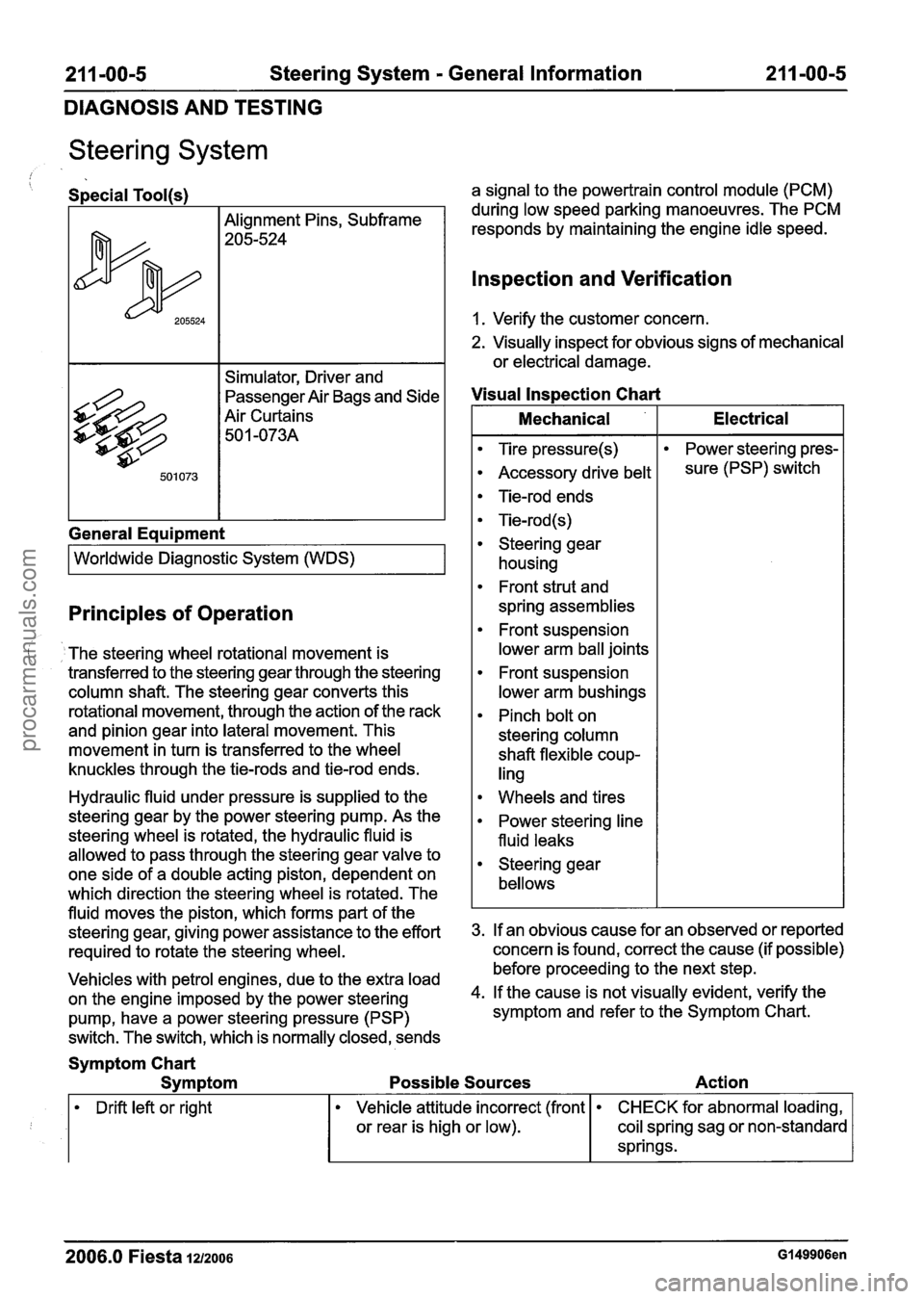
Visual lnspection Chart
I Mechanical I Electrical I
Tire pressure(s)
Accessory drive belt
Tie-rod ends
Tie-rod (s)
Steering gear housing
Front strut and
spring assemblies
Front suspension
lower arm ball joints
Front suspension
lower arm bushings
Pinch bolt on
steering column
shaft flexible coup-
ling Power
steering pres-
sure (PSP) switch
Wheels and tires
Power steering line
fluid leaks
Steering gear
bellows
3. If an obvious cause for an observed or reported
concern is found, correct the cause (if possible)
before proceeding to the next step.
4. If the cause is not visually evident, verify the
symptom and refer to the Symptom Chart.
Symptom Chart
Symptom Possible Sources Action
Drift left or right
2006.0 Fiesta 1212006 Gl49906en
Vehicle attitude incorrect (front
or rear is high or low). CHECK for abnormal loading,
coil spring sag or non-standard
springs.
procarmanuals.com
Page 350 of 1226

21 1-02-2 Power Steering 21 1-02-2
SPECIFICATIONS
Toraue S~ecifications
Description
Steering gear mounting bolts
Power steering line to steering gear valve body
clamp retaining bolt
Power steering line bracket to steering gear
retaining bolt
Power steering line to cylinder head support bracket
retaining bolt (Duratec)
Power steering line to accessory drive belt support 25
bracket retaining bolt (Duratec)
Power steering lines to transaxle bracket retaining
bolt
- vehicles with 1.6L Duratorq-TDCi (DV) Diesel
I Power steering supply hose to engine block (rear) I 25 I 18 I - I
Power steering line to transmission housing
retaining bolt
Power steering line to engine block (front)
- vehicles
with
1.4L Duratorq-TDCi (DV) Diesel without air
conditioning
Power steering line to power steering pump union
- vehicles with 1.3L Duratec-8V (Rocam)
Power steering line to power steering pump union
- vehicles with 1.4L Duratec-I 6V (Sigma), 1.6L
Duratec-1 6V (Sigma) or 2.OL Duratec-HE (M14)
Power steering line to power steering pump union
- vehicles with 1.4L Duratorq-TDCi (DV) Diesel
Power steering line to power steering pump union
- vehicles with 1.6L Duratorq-TDCi (DV) Diesel
Power steering pump to steering gear pressure line
support bracket to inlet manifold retaining nut
-
vehicles with 2.OL Duratec-HE (M14)
Power steering pump retaining bolts - vehicles with
1.3L Duratec-8V (Rocam)
Power steering pump retaining bolts - vehicles with
1.4L Duratec-1 6V (Sigma), 1.6L Duratec-1 6V
(Sigma) or 2.OL Duratec-HE (M14)
Power steering pump retaining bolts - vehicles with
1.4L Duratorq-TDCi (DV) Diesel
Power steering pump retaining nuts
- vehicles with
1.6L Duratorq-TDCi (DV) Diesel
Power steering fluid cooler line to front bumper left-
hand retaining bolt
Power steering fluid cooler line to front bumper
right-hand retaining bolt
2006.0 Fiesta 1212006 GI 05647en
procarmanuals.com
Page 431 of 1226

303-00-9 Engine System - General Information 303-00-9
DIAGNOSIS AND TESTING
Symptom Possible Sources
Action
lgnition system (petrol engines
only).
CHECK the ignition system.
REFER to:
Engine
lgnition (303-07 Engine
Ignition, Diagnosis and
Testing),
Engine
lgnition (303-07 Engine
lgnition - 2.OL Duratec-HE
(M14), Diagnosis and
Testing).
Incorrect valve timing. CHECK and adjust the valve
timing. REFER to:
Timing
Belt (303-01 Engine -
1.25L Duratec-1 6V
(Sigma)ll.4L Duratec-I 6V
(Sigma)ll .6L Duratec-I 6V
(Sigma), I n-vehicle Repair),
Timing Chain (303-01 Engine
- 1.3L Duratec-8V (Rocam),
In-vehicle Repair),
Crankshaft
Pulley (303-01
Engine
- 2.OL Duratec-HE
(M14), In-vehicle Repair),
Timing
Belt (303-01 Engine -
1.4L Duratorq-TDCi (DV)
Diesel, In-vehicle Repair),
Timing
Belt (303-01 Engine -
1.6L Duratorq-TDCi (DV)
Diesel, In-vehicle Repair).
Broken or damaged timing
beltltiming chain or
pulleylsprocket.
CHECK the timing beltltiming
chain and sprocketslpulleys.
INSTALL new components as
necessary. REFER to:
Timing
Belt (303-01 Engine -
1.25L Duratec-1 6V
(Sigma)ll.4L Duratec-1 6V
(Sigma)ll .6L Duratec-I 6V
(Sigma), In-vehicle Repair),
Timing
Belt (303-01 Engine -
1.6L Duratorq-TDCi (DV)
Diesel, In-vehicle Repair),
Timing Chain (303-01 Engine
- 1.3L Duratec-8V (Rocam),
In-vehicle Repair),
Timing Chain (303-01 Engine
- 2.OL Duratec-HE (M14), In-
vehicle Repair),
Timing
Belt (303-01 Engine -
1.4L Duratorq-TDCi (DV)
Diesel, In-vehicle Repair).
2006.0 Fiesta 12,2006 GI 52554en
procarmanuals.com
Page 433 of 1226
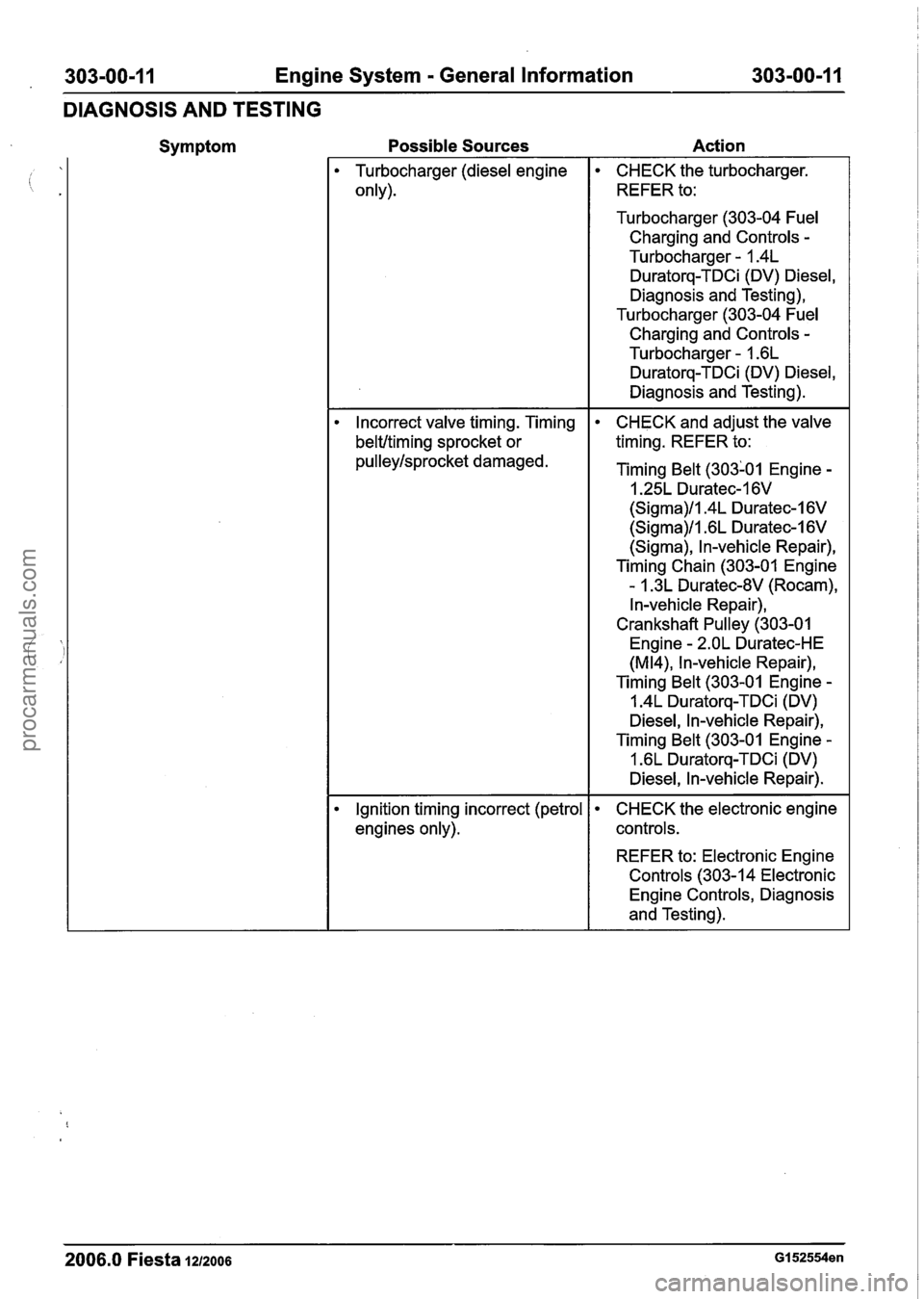
303-00-1 I Engine System - General Information 303-00-1 I
DIAGNOSIS AND TESTING
Symptom Possible
Sources Action --
Turbocharger (diesel engine
only).
CHECK the turbocharger.
REFER to:
Turbocharger (303-04
Fuel
Charging and Controls -
Turbocharger - 1.4L
Duratorq-TDCi (DV) Diesel,
Diagnosis and Testing),
Turbocharger (303-04
Fuel
Charging and Controls -
Turbocharger - 1.6L
Duratorq-TDCi (DV) Diesel,
Diagnosis and Testing).
Incorrect valve timing. Timing
beltltiming sprocket or
pulleylsprocket damaged. CHECK
and adjust the
valve
timing. REFER to:
Timing
Belt (303101 Engine -
I .25L Duratec-1 6V
(Sigma)ll.4L Duratec-1 6V
(Sigma)ll .6L Duratec-1 6V
(Sigma), In-vehicle Repair),
Timing Chain (303-01 Engine
- 1.3L Duratec-8V (Rocam),
In-vehicle Repair),
Crankshaft
Pulley (303-01
Engine
- 2.OL Duratec-HE
(M14), In-vehicle Repair),
Timing
Belt (303-01 Engine -
1.4L Duratorq-TDCi (DV)
Diesel, In-vehicle Repair),
Timing
Belt (303-01 Engine -
1.6L Duratorq-TDCi (DV)
Diesel, In-vehicle Repair).
Ignition timing incorrect (petrol
engines only).
CHECK the electronic engine
controls.
REFER to: Electronic Engine
Controls (303-1 4 Electronic
Engine Controls, Diagnosis
and Testing).
2006.0 Fiesta 1212006 GI 52554en
procarmanuals.com
Page 434 of 1226

303-00-1 2 Engine System - General Information 303-00-1 2
DIAGNOSIS AND TESTING
Symptom Possible Sources Action
Noisy running Engine auxiliary components
loose or damaged. CHECK
engine auxiliary
components for damage or
looseness. REFER to:
Timing Belt
(303-01 Engine -
1.25L Duratec-1 6V
(Sigma)ll.4L Duratec-1 6V
(Sigma)ll .6L Duratec-I 6V
(Sigma), In-vehicle Repair),
Timing Chain
(303-01 Engine
- 1.3L Duratec-8V (Rocam),
In-vehicle Repair),
Timing Chain
(303-01 Engine
- 2.OL Duratec-HE (M14), In-
vehicle Repair),
Timing Belt
(303-01 Engine -
I .4L Duratorq-TDCi (DV)
Diesel, In-vehicle Repair),
Timing Belt
(303-01 Engine -
1.6L Duratorq-TDCi (DV)
Diesel, In-vehicle Repair).
Noisy running, misfiring, back-
firing or knocking
Incorrect fuel DETERMINE which type of fuel
was last put in the tank (note
the country specific fuel
specifications).
Valve timing incorrect, timing
beltlchain or pulleylsprocket
damaged.
Water in fuel or fuel contamin-
ated.
CHECK and adjust the valve
timing. REFER to:
CHECK the fuel system for
water or other contamination.
Timing Belt
(303-01 Engine -
1.25L Duratec-1 6V
(Sigma)ll.4L Duratec-1 6V
(Sigma)/l.GL Duratec-1 6V
(Sigma), In-vehicle Repair),
Timing Chain (303-01 Engine
- 1.3L Duratec-8V (Rocam),
I n-vehicle Repair),
Crankshaft Pulley
(303-01
Engine - 2.OL Duratec-HE
(M14), In-vehicle Repair),
Timing Belt
(303-01 Engine -
1.4L Duratorq-TDCi (DV)
Diesel, In-vehicle Repair),
Timing Belt
(303-01 Engine -
1.6L Duratorq-TDCi (DV)
Diesel, In-vehicle Repair).
2006.0 Fiesta 1212006 f GI 52554en
procarmanuals.com
Page 435 of 1226

303-00-1 3 Engine System - General Information 303-00-1 3
DIAGNOSIS AND TESTING
Symptom
Noisy running or valve train
noise
Possible Sources Action
Valve clearance too large due
to
faulty valve tappets or worn
valve train components.
Timing
belt or timing chain
damaged.
INSTALL new hydraulic lash
adjusters or adjust the valve
clearance. REFER to:
Valve Clearance Adjustment
(303-01 Engine
- 1.25L
Duratec-I 6V (Sigma)ll.4L
Duratec-1 6V (Sigma)/l .6L
Duratec-I 6V (Sigma),
General Procedures),
Camshaft
Followers (303-01
Engine - 1.3L Duratec-8V
(Rocam), In-vehicle Repair),
Valve Clearance Adjustment
(303-01 Engine
- 2.OL
Duratec-H E (M 14), General
Procedures),
Hydraulic Lash Adjuster (303-
01 Engine
- I .4L Duratorq-
TDCi (DV) Diesel, In-vehicle
Repair),
Camshaft (303-01 Engine
-
1.6L Duratorq-TDCi (DV)
Diesel, In-vehicle Repair).
INSTALL a new timing belt or
timing chain. REFER to:
Timing Belt (303-01 Engine
-
1.25L Duratec-1 6V
(Sigma)ll.4L Duratec-I 6V
(Sigma)/l .6L Duratec-1 6V
(Sigma), In-vehicle Repair),
Timing Chain (303-01 Engine
- 1.3L Duratec-8V (Rocam),
In-vehicle Repair),
Timing Chain (303-01 Engine
- 2.OL Duratec-HE (M14), In-
vehicle Repair),
Timing
Belt (303-01 Engine -
1.4L Duratorq-TDCi (DV)
Diesel,
In-vehicle Repair),
Timing
Belt (303-01 Engine -
1.6L Duratorq-TDCi (DV)
Diesel, In-vehicle Repair).
2006.0 Fiesta 1212006 GI 52554en
procarmanuals.com
Page 436 of 1226
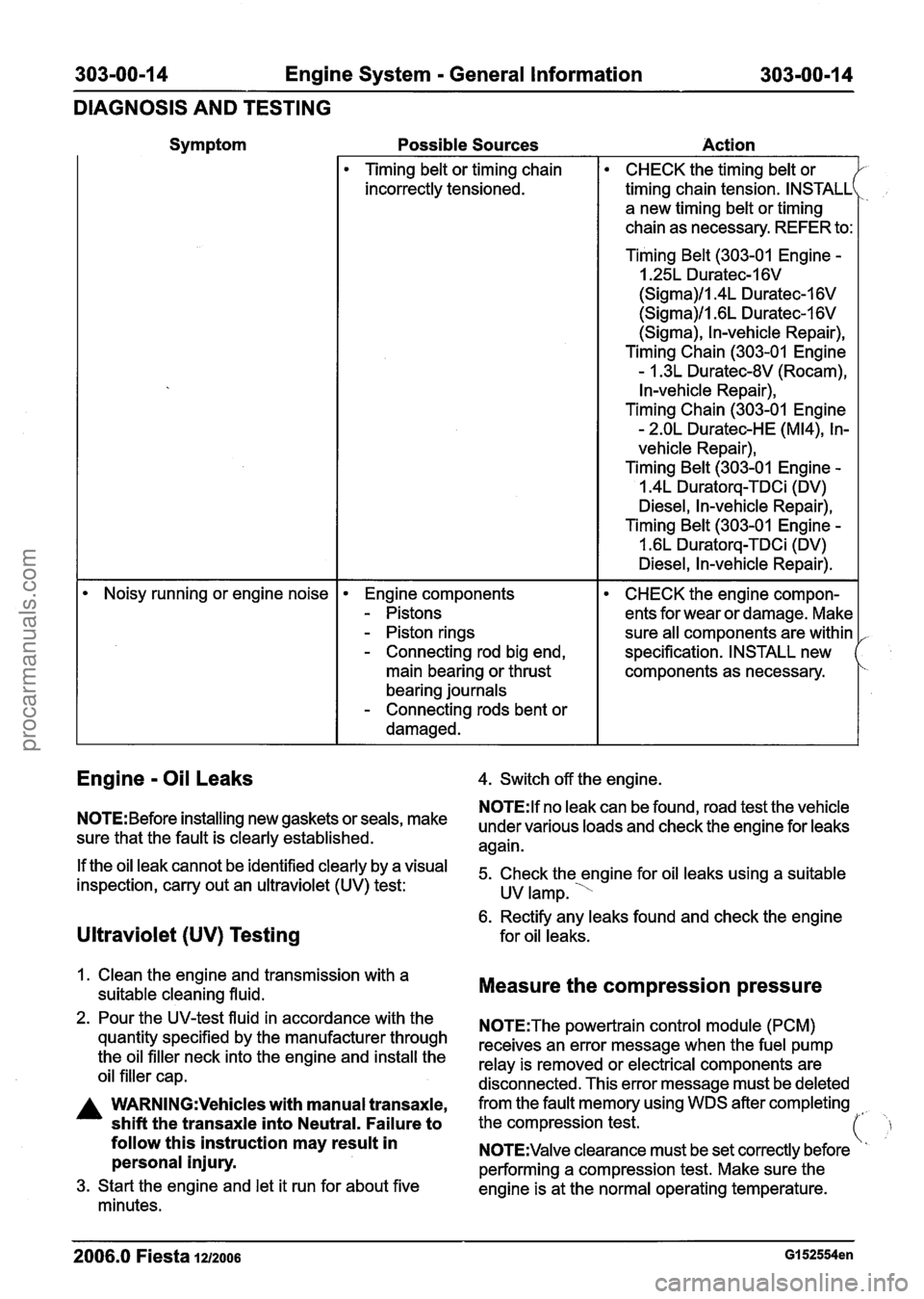
303-00-1 4 Engine System - General Information 303-00-1 4
DIAGNOSIS AND TESTING
Symptom
Possible Sources
Action
Timing belt or timing chain
incorrectly tensioned.
CHECK the timing belt or
timing chain tension. INSTALL
a new timing belt or timing
chain as necessary. REFER to:
Timing Belt (303-01 Engine
-
I .25L Duratec-1 6V
(Sigma)/l.4L Duratec-1 6V
(Sigma)/l .6L Duratec-1 6V
(Sigma), In-vehicle Repair),
Timing Chain (303-01 Engine
- 1.3L Duratec-8V (Rocam),
In-vehicle Repair),
Timing Chain (303-01 Engine
- 2.OL Duratec-HE (M14), In-
vehicle Repair),
Timing Belt
(303-01 Engine -
1.4L Duratorq-TDCi (DV)
Diesel, In-vehicle Repair),
Timing Belt (303-01 Engine
-
I .6L Duratorq-TDCi (DV)
Diesel, In-vehicle Repair).
Noisy running or engine noise
Engine components
- Pistons
- Piston rings
- Connecting rod big end,
main bearing or thrust
bearing journals
- Connecting rods bent or
damaged.
CHECK the engine compon-
ents for wear or damage. Make
sure all components are within
specification. INSTALL new
components as necessary.
Engine - Oil Leaks
NOTE: Before installing new gaskets or seals, make
sure that the fault is clearly established.
If the oil leak cannot be identified clearly by a visual
inspection, carry out an ultraviolet
(UV) test:
Ultraviolet (UV) Testing
1. Clean the engine and transmission with a
suitable cleaning fluid.
2. Pour the UV-test fluid in accordance with the
quantity specified by the manufacturer through
the oil filler neck into the engine and install the
oil filler cap.
A WARN1NG:Vehicles with manual transaxle,
shift the transaxle into Neutral. Failure to
follow this instruction may result in
personal injury.
3. Start the engine and let it run for about five
minutes. 4.
Switch off the engine.
N0TE:lf no leak can be found, road test the vehicle
under various loads and check the engine for leaks
again.
5. Check the engine for oil leaks using a suitable
UV lamp.
'
6. Rectify any leaks found and check the engine
for oil leaks.
Measure the compression pressure
N0TE:The powertrain control module (PCM)
receives an error message when the fuel pump
relay is removed or electrical components are
disconnected. This error message must be deleted
from the fault memory using WDS after completing
the compression test.
(' ,
'I N0TE:Valve clearance must be set correctly before
performing a compression test. Make sure the
engine is at the normal operating temperature.
2006.0 Fiesta 1212006 GI 52554en
procarmanuals.com