display FORD FIESTA 2013 Owner's Manual
[x] Cancel search | Manufacturer: FORD, Model Year: 2013, Model line: FIESTA, Model: FORD FIESTA 2013Pages: 346, PDF Size: 5.27 MB
Page 132 of 346
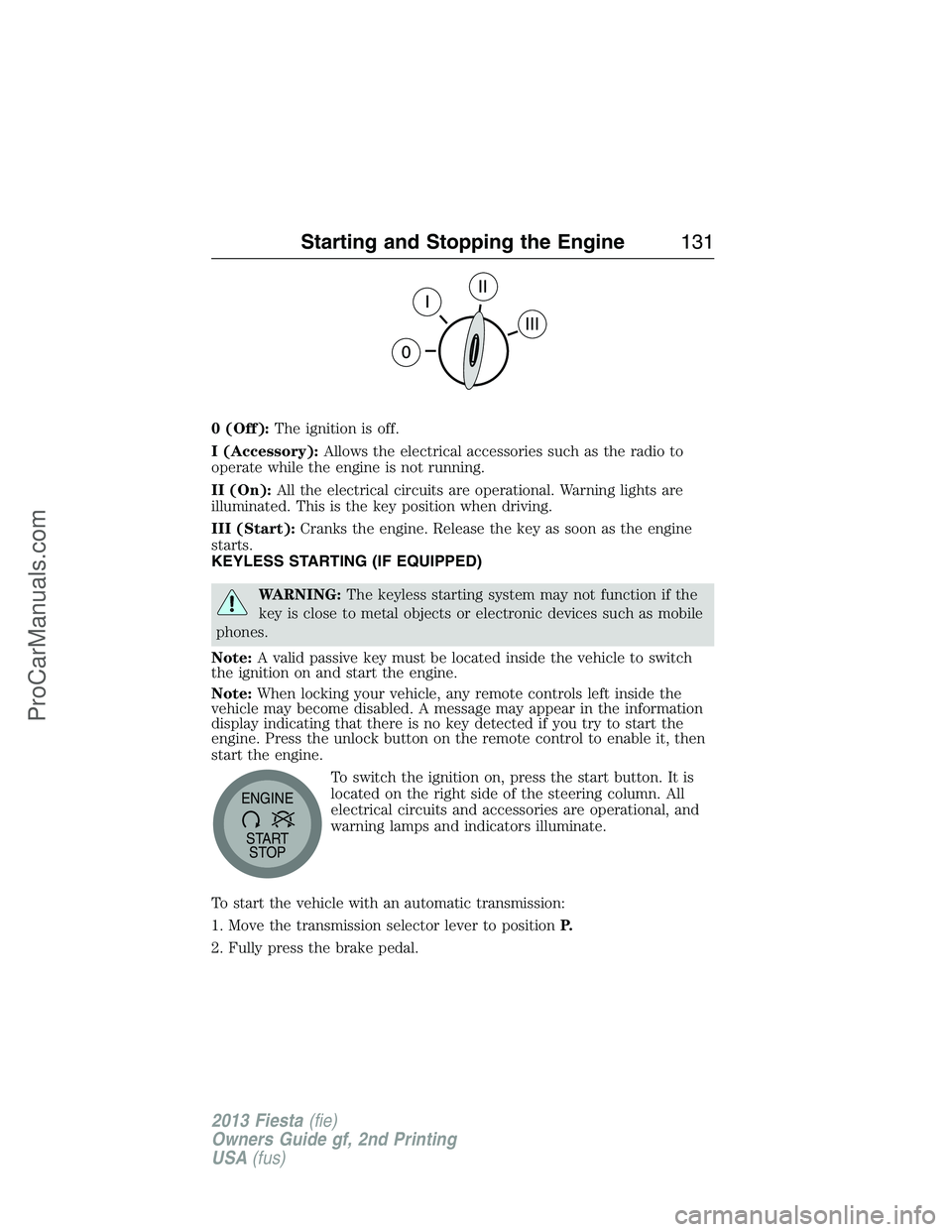
0 (Off):The ignition is off.
I (Accessory):Allows the electrical accessories such as the radio to
operate while the engine is not running.
II (On):All the electrical circuits are operational. Warning lights are
illuminated. This is the key position when driving.
III (Start):Cranks the engine. Release the key as soon as the engine
starts.
KEYLESS STARTING (IF EQUIPPED)
WARNING:The keyless starting system may not function if the
key is close to metal objects or electronic devices such as mobile
phones.
Note:A valid passive key must be located inside the vehicle to switch
the ignition on and start the engine.
Note:When locking your vehicle, any remote controls left inside the
vehicle may become disabled. A message may appear in the information
display indicating that there is no key detected if you try to start the
engine. Press the unlock button on the remote control to enable it, then
start the engine.
To switch the ignition on, press the start button. It is
located on the right side of the steering column. All
electrical circuits and accessories are operational, and
warning lamps and indicators illuminate.
To start the vehicle with an automatic transmission:
1. Move the transmission selector lever to positionP.
2. Fully press the brake pedal.
START
STOP ENGINE
Starting and Stopping the Engine131
2013 Fiesta(fie)
Owners Guide gf, 2nd Printing
USA(fus)
ProCarManuals.com
Page 141 of 346
Using the Easy Fuel™ Capless Fuel System
WARNING:The fuel system may be under pressure. Insert the
fuel nozzle slowly. If you hear a hissing sound near the fuel filler
door, do not refuel until the sound stops. Otherwise, fuel may spray
out, which could cause serious personal injury.
When fueling your vehicle:
1. Put the vehicle inP(Park) and turn the ignition off.
2. Open the fuel filler door.
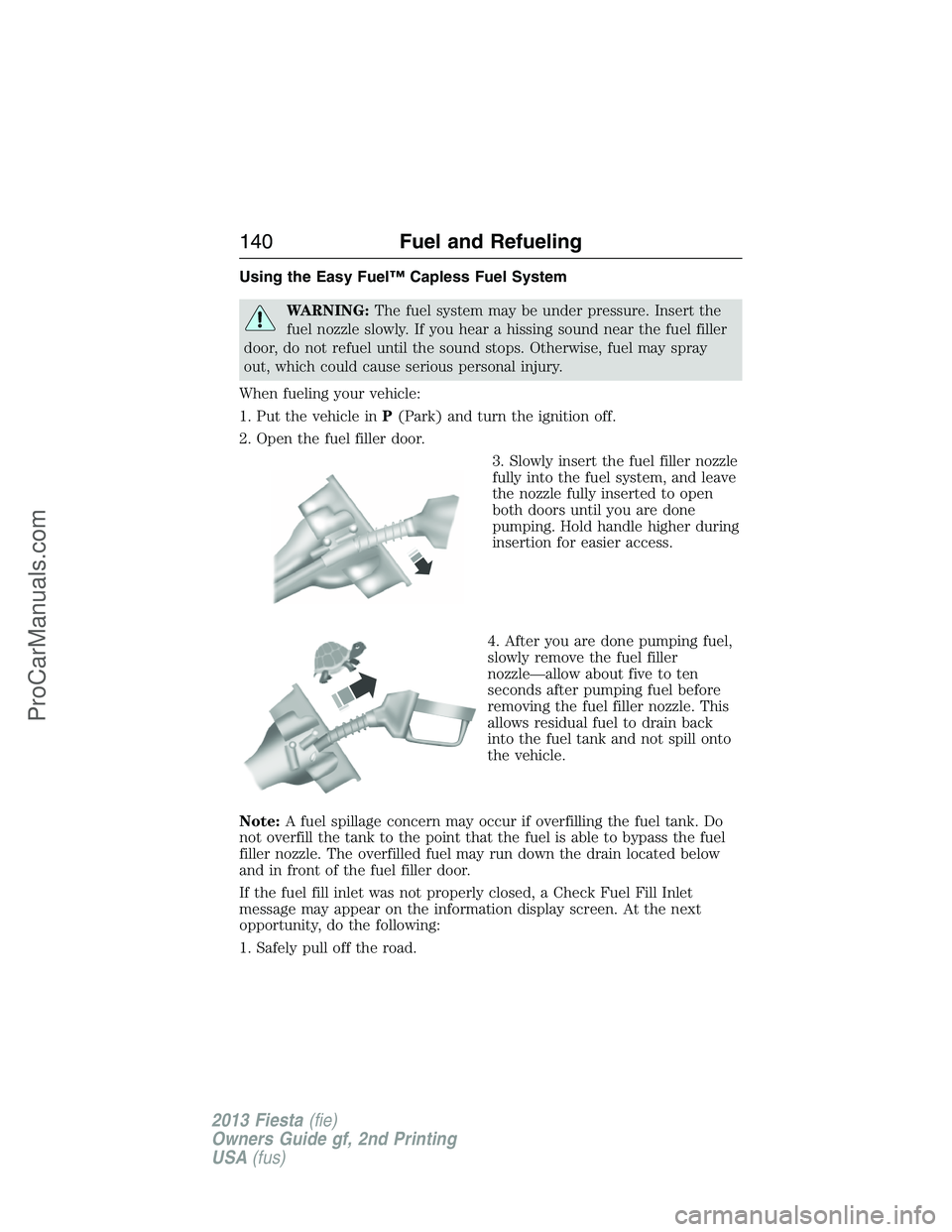
3. Slowly insert the fuel filler nozzle
fully into the fuel system, and leave
the nozzle fully inserted to open
both doors until you are done
pumping. Hold handle higher during
insertion for easier access.
4. After you are done pumping fuel,
slowly remove the fuel filler
nozzle—allow about five to ten
seconds after pumping fuel before
removing the fuel filler nozzle. This
allows residual fuel to drain back
into the fuel tank and not spill onto
the vehicle.
Note:A fuel spillage concern may occur if overfilling the fuel tank. Do
not overfill the tank to the point that the fuel is able to bypass the fuel
filler nozzle. The overfilled fuel may run down the drain located below
and in front of the fuel filler door.
If the fuel fill inlet was not properly closed, a Check Fuel Fill Inlet
message may appear on the information display screen. At the next
opportunity, do the following:
1. Safely pull off the road.
140Fuel and Refueling
2013 Fiesta(fie)
Owners Guide gf, 2nd Printing
USA(fus)
ProCarManuals.com
Page 158 of 346
PRINCIPLES OF OPERATION
The traction control system helps avoid drive wheel spin and loss of
traction.
If your vehicle begins to slide, the system applies the brakes to individual
wheels and, when needed, reduces engine power at the same time. If the
wheels spin when accelerating on slippery or loose surfaces, the system
reduces engine power in order to increase traction.
USING TRACTION CONTROL
In certain situations (for example, stuck in snow or mud), turning the
traction control off may be beneficial as this allows the wheels to spin
with full engine power. Turn off the traction control system through the
information display. See theInformation Displayschapter.
System Indicator Lights and Messages
WARNING:If a failure has been detected within the Traction
Control System, the stability control light will illuminate steadily.
Verify that the Traction Control System was not manually disabled
through the information display. If the stability control light still
illuminates steadily, have the system serviced by an authorized dealer
immediately. Operating your vehicle with Traction Control disabled
could lead to an increased risk of loss of vehicle control, vehicle
rollover, personal injury and death.
The stability control light temporarily illuminates on engine
start-up and flashes when a driving condition activates the
stability system.
The stability control off light temporarily illuminates on engine
start-up and stays on when the traction control system is
turned off.
When the traction control system is turned off or on, a message appears
in the information display showing system status.
Traction Control157
2013 Fiesta(fie)
Owners Guide gf, 2nd Printing
USA(fus)
ProCarManuals.com
Page 163 of 346
STEERING
Electric Power Steering
WARNING:The electric power steering system has diagnostic
checks that continuously monitor the system to ensure proper
operation. When a system error is detected a steering message will
appear in the information display.
WARNING:The electric power steering system has diagnostic
checks that continuously monitor the system to ensure proper
operation of the electronic system. When an electronic error is
detected, a message will be displayed in the information display. If this
happens, stop the vehicle in a safe place, and turn off the engine. After
at least 10 seconds, reset the system by restarting the engine, and
watch the information display for a steering message. If a steering
message returns, or returns while driving, take the vehicle to your
dealer to have it checked.
WARNING:Obtain immediate service if a system error is
detected. You may not notice any difference in the feel of your
steering, but a serious condition may exist. Failure to do so may result
in loss of steering control.
Your vehicle is equipped with an electric power-assisted steering system.
There is no fluid reservoir to check or fill.
If your vehicle loses electrical power while you are driving (or if the
ignition is turned off), you can steer the vehicle manually, but it takes
more effort. Extreme continuous steering may increase the effort it takes
for you to steer. This occurs to prevent internal overheating and
permanent damage to your steering system. If this should occur, you will
neither lose the ability to steer the vehicle manually nor will it cause
permanent damage. Typical steering and driving maneuvers will allow the
system to cool and steering assist will return to normal.
When a steering system error is detected, steering messages may appear
in the information display.
162Driving Aids
2013 Fiesta(fie)
Owners Guide gf, 2nd Printing
USA(fus)
ProCarManuals.com
Page 173 of 346
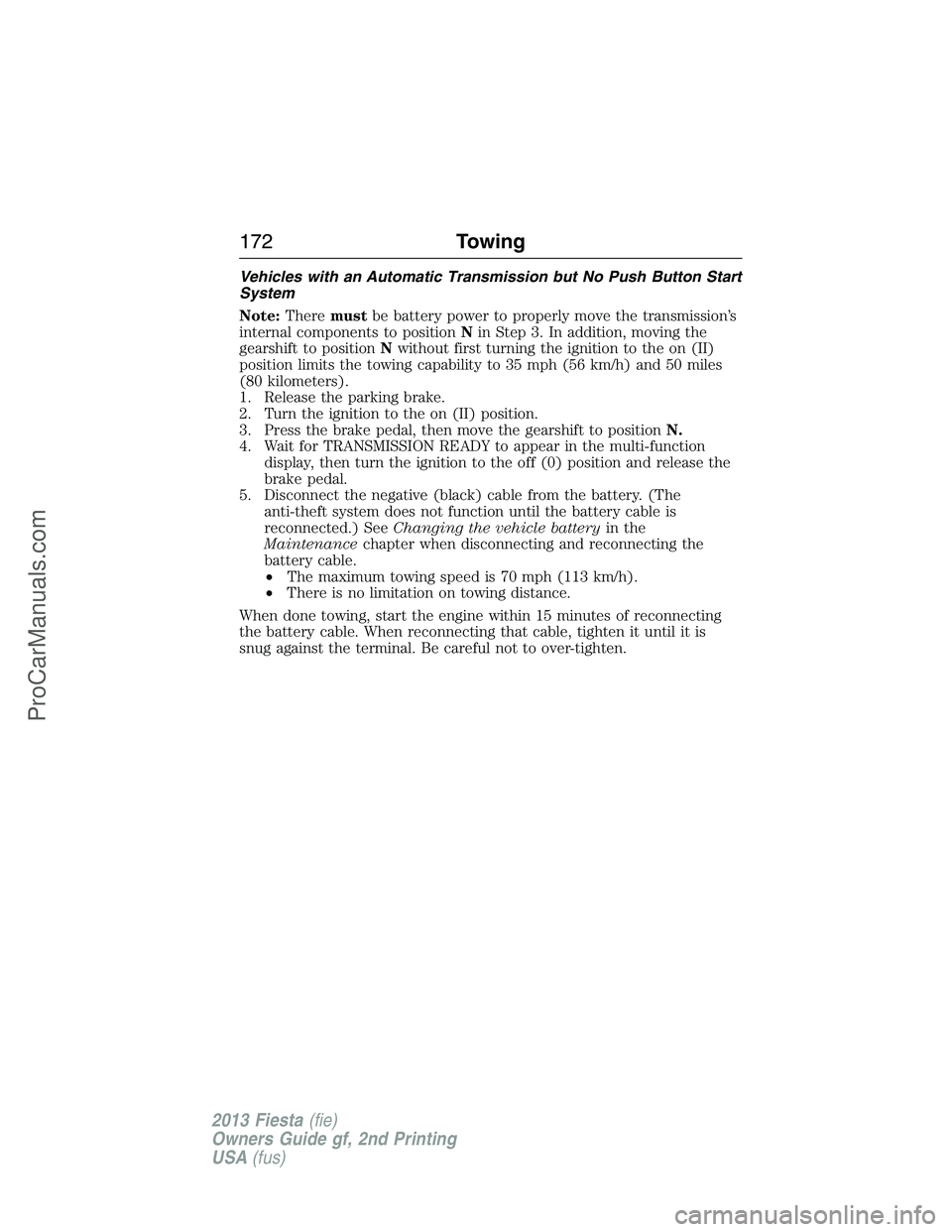
Vehicles with an Automatic Transmission but No Push Button Start
System
Note:Theremustbe battery power to properly move the transmission’s
internal components to positionNin Step 3. In addition, moving the
gearshift to positionNwithout first turning the ignition to the on (II)
position limits the towing capability to 35 mph (56 km/h) and 50 miles
(80 kilometers).
1. Release the parking brake.
2. Turn the ignition to the on (II) position.
3. Press the brake pedal, then move the gearshift to positionN.
4. Wait for TRANSMISSION READY to appear in the multi-function
display, then turn the ignition to the off (0) position and release the
brake pedal.
5. Disconnect the negative (black) cable from the battery. (The
anti-theft system does not function until the battery cable is
reconnected.) SeeChanging the vehicle batteryin the
Maintenancechapter when disconnecting and reconnecting the
battery cable.
•The maximum towing speed is 70 mph (113 km/h).
•There is no limitation on towing distance.
When done towing, start the engine within 15 minutes of reconnecting
the battery cable. When reconnecting that cable, tighten it until it is
snug against the terminal. Be careful not to over-tighten.
172Towing
2013 Fiesta(fie)
Owners Guide gf, 2nd Printing
USA(fus)
ProCarManuals.com
Page 174 of 346
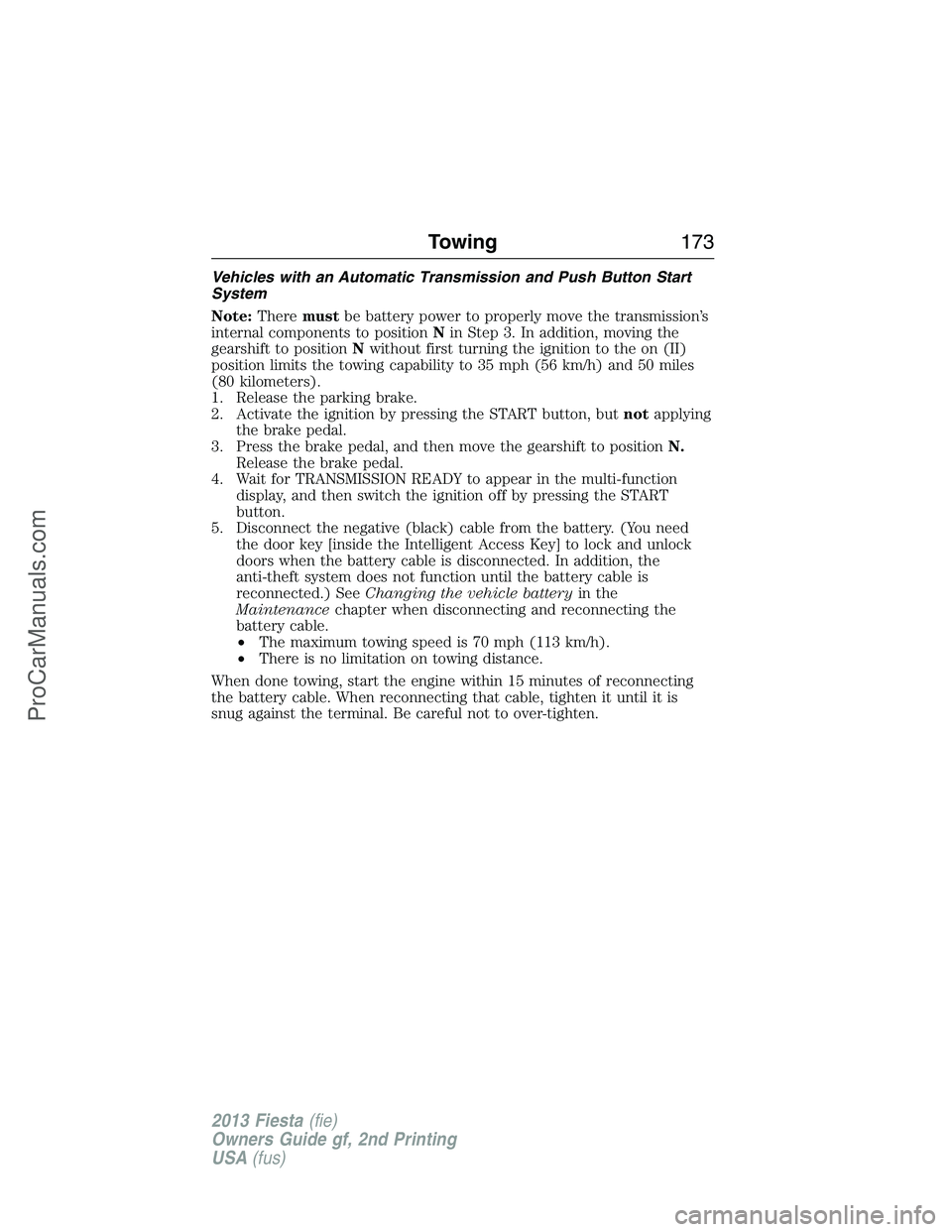
Vehicles with an Automatic Transmission and Push Button Start
System
Note:Theremustbe battery power to properly move the transmission’s
internal components to positionNin Step 3. In addition, moving the
gearshift to positionNwithout first turning the ignition to the on (II)
position limits the towing capability to 35 mph (56 km/h) and 50 miles
(80 kilometers).
1. Release the parking brake.
2. Activate the ignition by pressing the START button, butnotapplying
the brake pedal.
3. Press the brake pedal, and then move the gearshift to positionN.
Release the brake pedal.
4. Wait for TRANSMISSION READY to appear in the multi-function
display, and then switch the ignition off by pressing the START
button.
5. Disconnect the negative (black) cable from the battery. (You need
the door key [inside the Intelligent Access Key] to lock and unlock
doors when the battery cable is disconnected. In addition, the
anti-theft system does not function until the battery cable is
reconnected.) SeeChanging the vehicle batteryin the
Maintenancechapter when disconnecting and reconnecting the
battery cable.
•The maximum towing speed is 70 mph (113 km/h).
•There is no limitation on towing distance.
When done towing, start the engine within 15 minutes of reconnecting
the battery cable. When reconnecting that cable, tighten it until it is
snug against the terminal. Be careful not to over-tighten.
Towing173
2013 Fiesta(fie)
Owners Guide gf, 2nd Printing
USA(fus)
ProCarManuals.com
Page 198 of 346
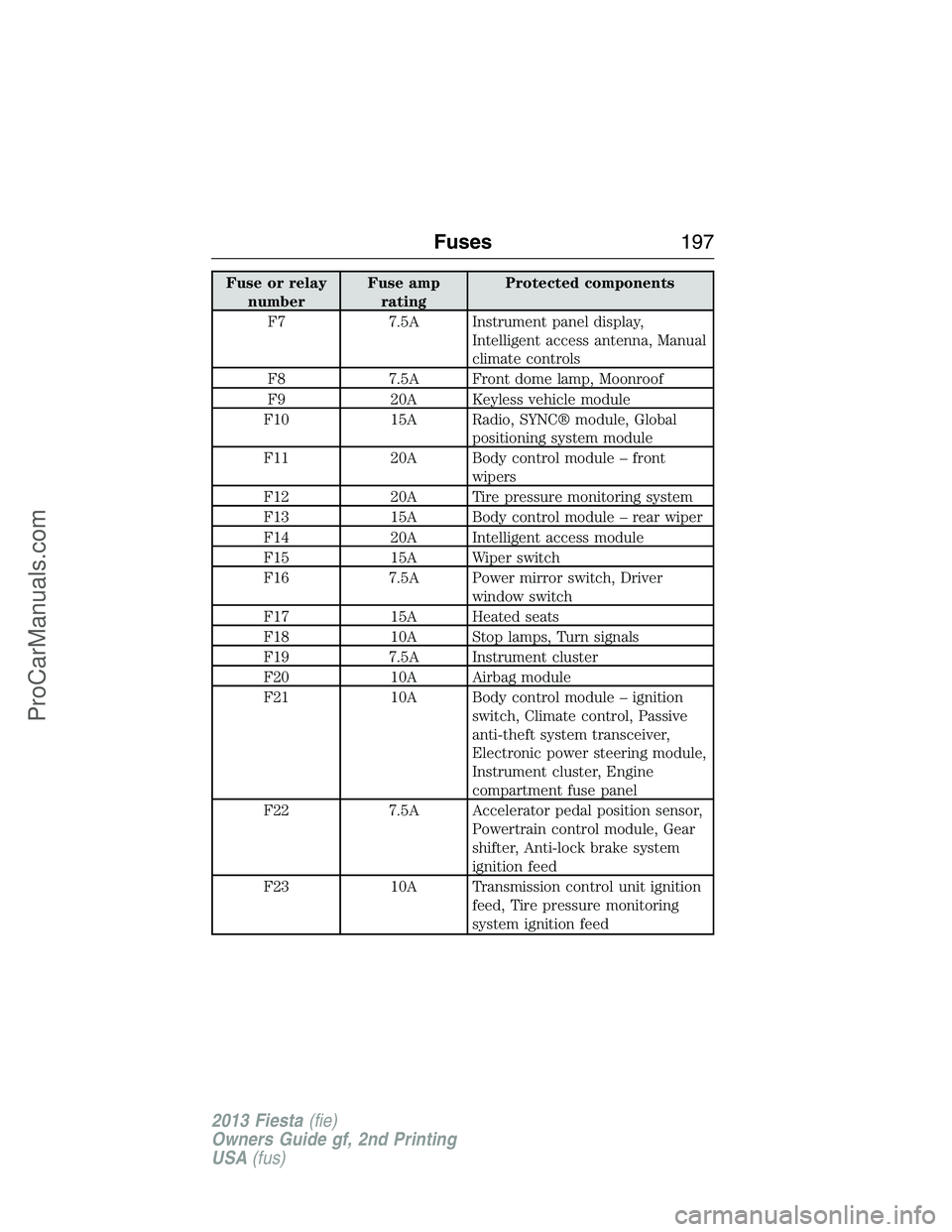
Fuse or relay
numberFuse amp
ratingProtected components
F7 7.5A Instrument panel display,
Intelligent access antenna, Manual
climate controls
F8 7.5A Front dome lamp, Moonroof
F9 20A Keyless vehicle module
F10 15A Radio, SYNC® module, Global
positioning system module
F11 20A Body control module – front
wipers
F12 20A Tire pressure monitoring system
F13 15A Body control module – rear wiper
F14 20A Intelligent access module
F15 15A Wiper switch
F16 7.5A Power mirror switch, Driver
window switch
F17 15A Heated seats
F18 10A Stop lamps, Turn signals
F19 7.5A Instrument cluster
F20 10A Airbag module
F21 10A Body control module – ignition
switch, Climate control, Passive
anti-theft system transceiver,
Electronic power steering module,
Instrument cluster, Engine
compartment fuse panel
F22 7.5A Accelerator pedal position sensor,
Powertrain control module, Gear
shifter, Anti-lock brake system
ignition feed
F23 10A Transmission control unit ignition
feed, Tire pressure monitoring
system ignition feed
Fuses197
2013 Fiesta(fie)
Owners Guide gf, 2nd Printing
USA(fus)
ProCarManuals.com
Page 261 of 346
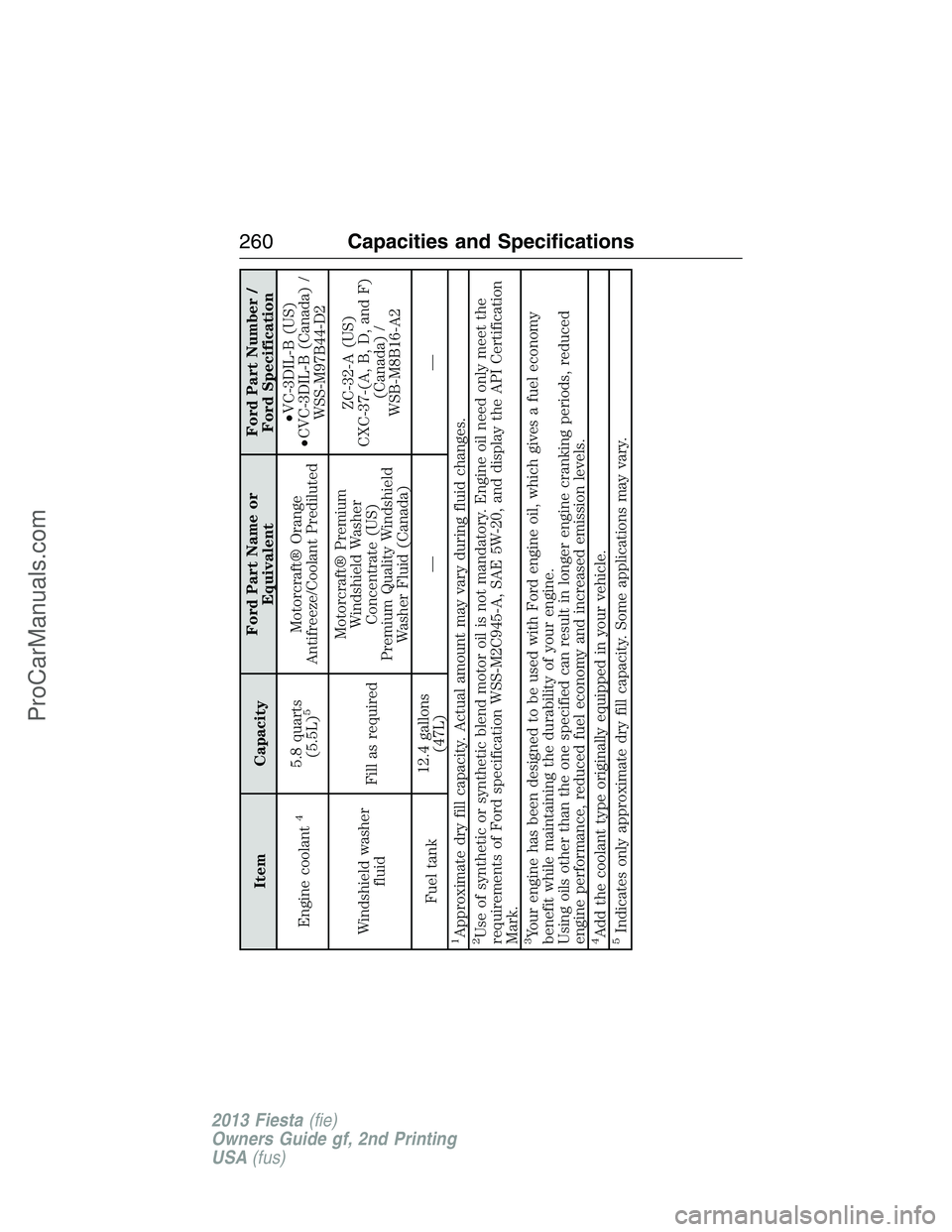
Item CapacityFord Part Name or
EquivalentFord Part Number /
Ford Specification
Engine coolant
4
5.8 quarts
(5.5L)
5
Motorcraft® Orange
Antifreeze/Coolant Prediluted•VC-3DIL-B (US)
•CVC-3DIL-B (Canada) /
WSS-M97B44-D2
Windshield washer
fluidFill as requiredMotorcraft® Premium
Windshield Washer
Concentrate (US)
Premium Quality Windshield
Washer Fluid (Canada)ZC-32-A (US)
CXC-37-(A, B, D, and F)
(Canada) /
WSB-M8B16-A2
Fuel tank12.4 gallons
(47L)——
1Approximate dry fill capacity. Actual amount may vary during fluid changes.2Use of synthetic or synthetic blend motor oil is not mandatory. Engine oil need only meet the
requirements of Ford specification WSS-M2C945-A, SAE 5W-20, and display the API Certification
Mark.3Your engine has been designed to be used with Ford engine oil, which gives a fuel economy
benefit while maintaining the durability of your engine.
Using oils other than the one specified can result in longer engine cranking periods, reduced
engine performance, reduced fuel economy and increased emission levels.4Add the coolant type originally equipped in your vehicle.5Indicates only approximate dry fill capacity. Some applications may vary.
260Capacities and Specifications
2013 Fiesta(fie)
Owners Guide gf, 2nd Printing
USA(fus)
ProCarManuals.com
Page 271 of 346
Protecting your investment
Maintenance is an investment that will pay dividends in the form of
improved reliability, durability and resale value. To maintain the proper
performance of your vehicle and its emission control systems, it is
imperative that scheduled maintenance be completed at the designated
intervals.
Your vehicle is equipped with an information display which displays a
message at the proper oil change service interval; the interval is one year
or 10000 miles (16000 kilometers) under normal driving conditions.
When ENGINE OIL CHANGE DUE NEXT SERVICE or OIL CHANGE
REQUIRED appears in the information display, it’s time for an oil change;
the oil change must be done within two weeks or 500 miles
(800 kilometers) of the ENGINE OIL CHANGE DUE NEXT SERVICE or
OIL CHANGE REQUIRED message appearing. The oil minder system
must be reset after each oil change; see theInstrument Clusterchapter.
If your information display is prematurely reset or becomes inoperative,
you should perform the oil change interval at six months or 5000 miles
(8000 kilometers) from your last oil change.
Your vehicle is very sophisticated and built with multiple, complex,
performance systems. Every manufacturer develops these systems using
different specifications and performance features. That is why it is
important to rely upon your dealership to properly diagnose and repair
your vehicle.
Ford Motor Company has recommended maintenance intervals for
various parts and component systems based upon engineering testing.
Ford Motor Company relies upon this testing to determine the most
appropriate mileage for replacement of oils and fluids to protect your
vehicle at the lowest overall cost to you and recommends against
maintenance schedules that deviate from the scheduled maintenance
information.
Ford strongly recommends the use of only genuine Ford, Motorcraft® or
Ford-authorized remanufactured replacement parts because they are
engineered for your vehicle.
Additives and Chemicals
Ford Motor Company recommended additives and chemicals are listed in
the owner manual and in the Ford Workshop Manual. Additional
chemicals or additives not approved by Ford are not recommended as
part of normal maintenance. Please consult your warranty information.
270Scheduled Maintenance
2013 Fiesta(fie)
Owners Guide gf, 2nd Printing
USA(fus)
ProCarManuals.com
Page 275 of 346
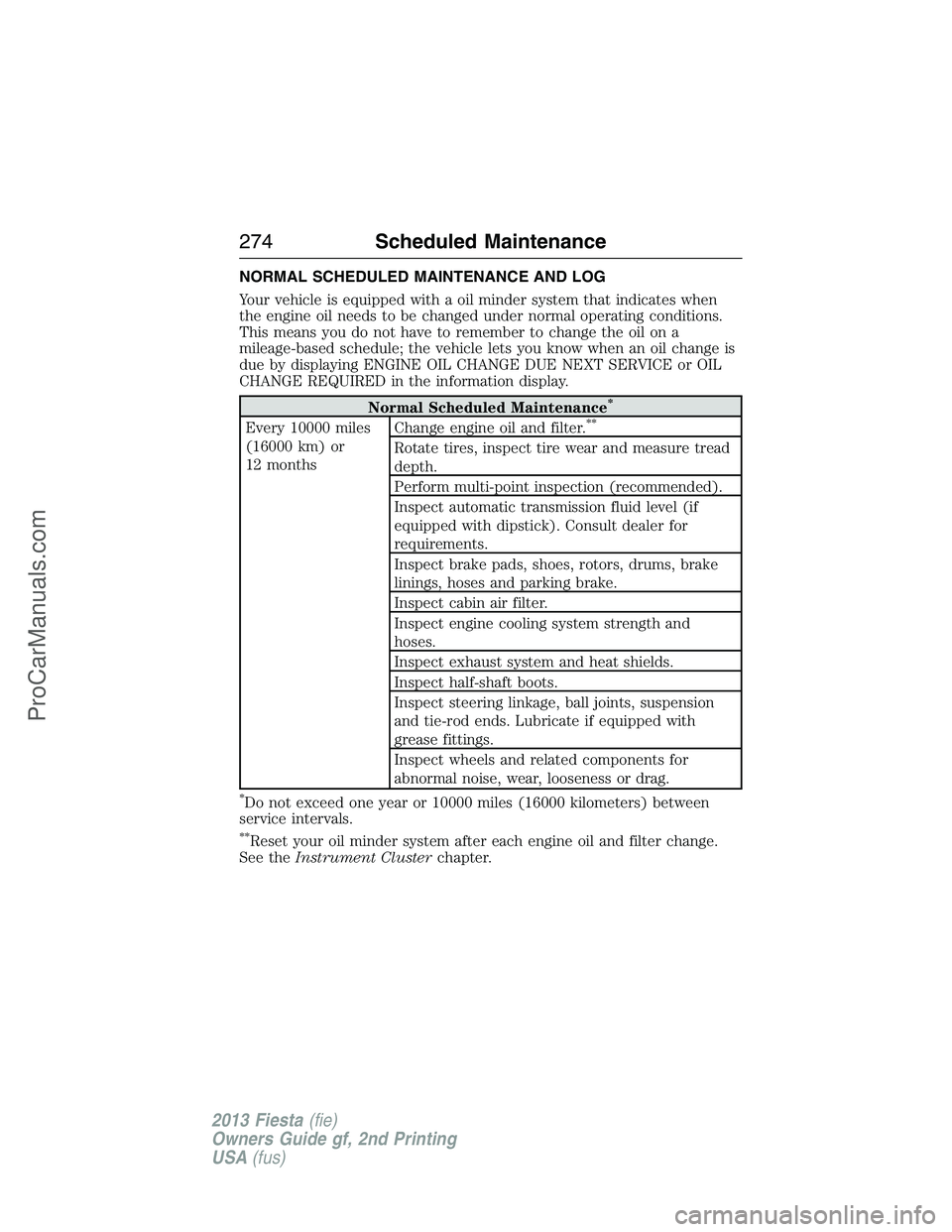
NORMAL SCHEDULED MAINTENANCE AND LOG
Your vehicle is equipped with a oil minder system that indicates when
the engine oil needs to be changed under normal operating conditions.
This means you do not have to remember to change the oil on a
mileage-based schedule; the vehicle lets you know when an oil change is
due by displaying ENGINE OIL CHANGE DUE NEXT SERVICE or OIL
CHANGE REQUIRED in the information display.
Normal Scheduled Maintenance*
Every 10000 miles
(16000 km) or
12 monthsChange engine oil and filter.**
Rotate tires, inspect tire wear and measure tread
depth.
Perform multi-point inspection (recommended).
Inspect automatic transmission fluid level (if
equipped with dipstick). Consult dealer for
requirements.
Inspect brake pads, shoes, rotors, drums, brake
linings, hoses and parking brake.
Inspect cabin air filter.
Inspect engine cooling system strength and
hoses.
Inspect exhaust system and heat shields.
Inspect half-shaft boots.
Inspect steering linkage, ball joints, suspension
and tie-rod ends. Lubricate if equipped with
grease fittings.
Inspect wheels and related components for
abnormal noise, wear, looseness or drag.
*Do not exceed one year or 10000 miles (16000 kilometers) between
service intervals.
**Reset your oil minder system after each engine oil and filter change.
See theInstrument Clusterchapter.
274Scheduled Maintenance
2013 Fiesta(fie)
Owners Guide gf, 2nd Printing
USA(fus)
ProCarManuals.com