maintenance FORD FIESTA 2013 Owners Manual
[x] Cancel search | Manufacturer: FORD, Model Year: 2013, Model line: FIESTA, Model: FORD FIESTA 2013Pages: 346, PDF Size: 5.27 MB
Page 2 of 346
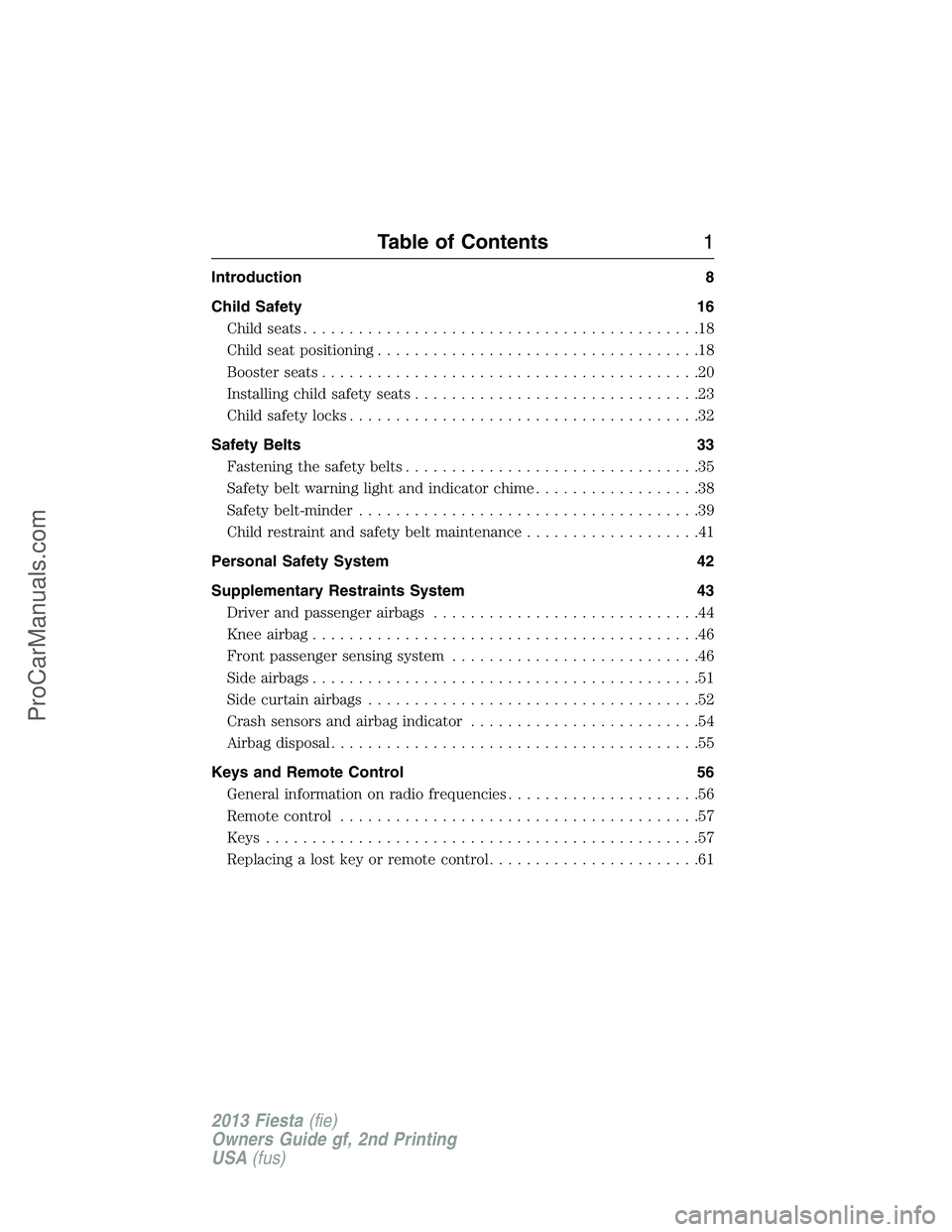
Introduction 8
Child Safety 16
Child seats...........................................18
Child seat positioning...................................18
Booster seats.........................................20
Installing child safety seats...............................23
Child safety locks......................................32
Safety Belts 33
Fastening the safety belts................................35
Safetybeltwarninglightandindicatorchime..................38
Safety belt-minder.....................................39
Child restraint and safety belt maintenance...................41
Personal Safety System 42
Supplementary Restraints System 43
Driver and passenger airbags.............................44
Knee airbag..........................................46
Front passenger sensing system...........................46
Side airbags..........................................51
Side curtain airbags....................................52
Crash sensors and airbag indicator.........................54
Airbag disposal........................................55
Keys and Remote Control 56
General information on radio frequencies.....................56
Remote control.......................................57
Keys...............................................57
Replacing a lost key or remote control.......................61
Table of Contents1
2013 Fiesta(fie)
Owners Guide gf, 2nd Printing
USA(fus)
ProCarManuals.com
Page 7 of 346
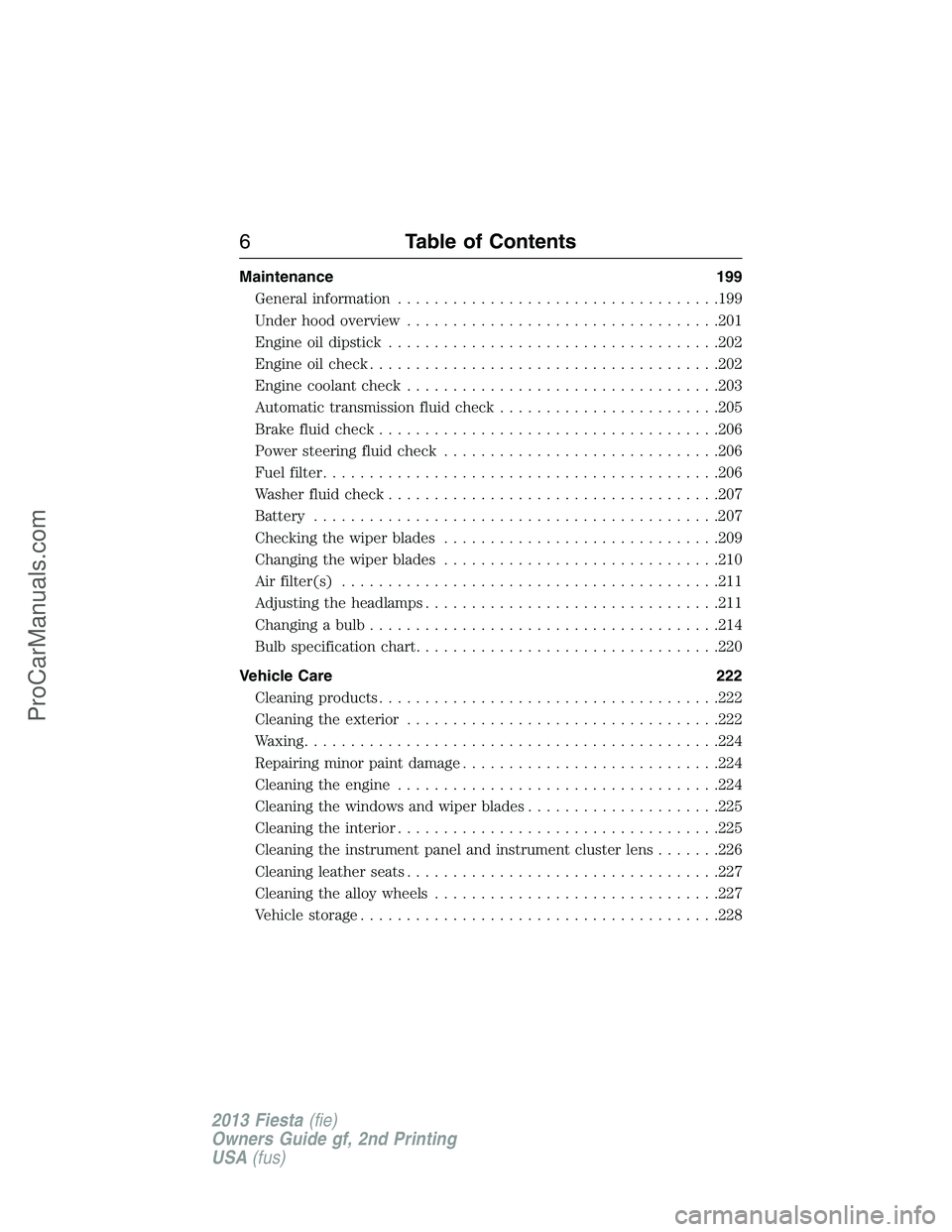
Maintenance 199
General information...................................199
Under hood overview..................................201
Engine oil dipstick....................................202
Engine oil check......................................202
Engine coolant check..................................203
Automatic transmission fluid check........................205
Brake fluid check.....................................206
Power steering fluid check..............................206
Fuel filter...........................................206
Washer fluid check....................................207
Battery ............................................207
Checking the wiper blades..............................209
Changing the wiper blades..............................210
Air filter(s).........................................211
Adjusting the headlamps................................211
Changing a bulb......................................214
Bulb specification chart.................................220
Vehicle Care 222
Cleaning products.....................................222
Cleaning the exterior..................................222
Waxing.............................................224
Repairing minor paint damage............................224
Cleaning the engine...................................224
Cleaning the windows and wiper blades.....................225
Cleaning the interior...................................225
Cleaning the instrument panel and instrument cluster lens.......226
Cleaning leather seats..................................227
Cleaning the alloy wheels...............................227
Vehicle storage.......................................228
6Table of Contents
2013 Fiesta(fie)
Owners Guide gf, 2nd Printing
USA(fus)
ProCarManuals.com
Page 8 of 346
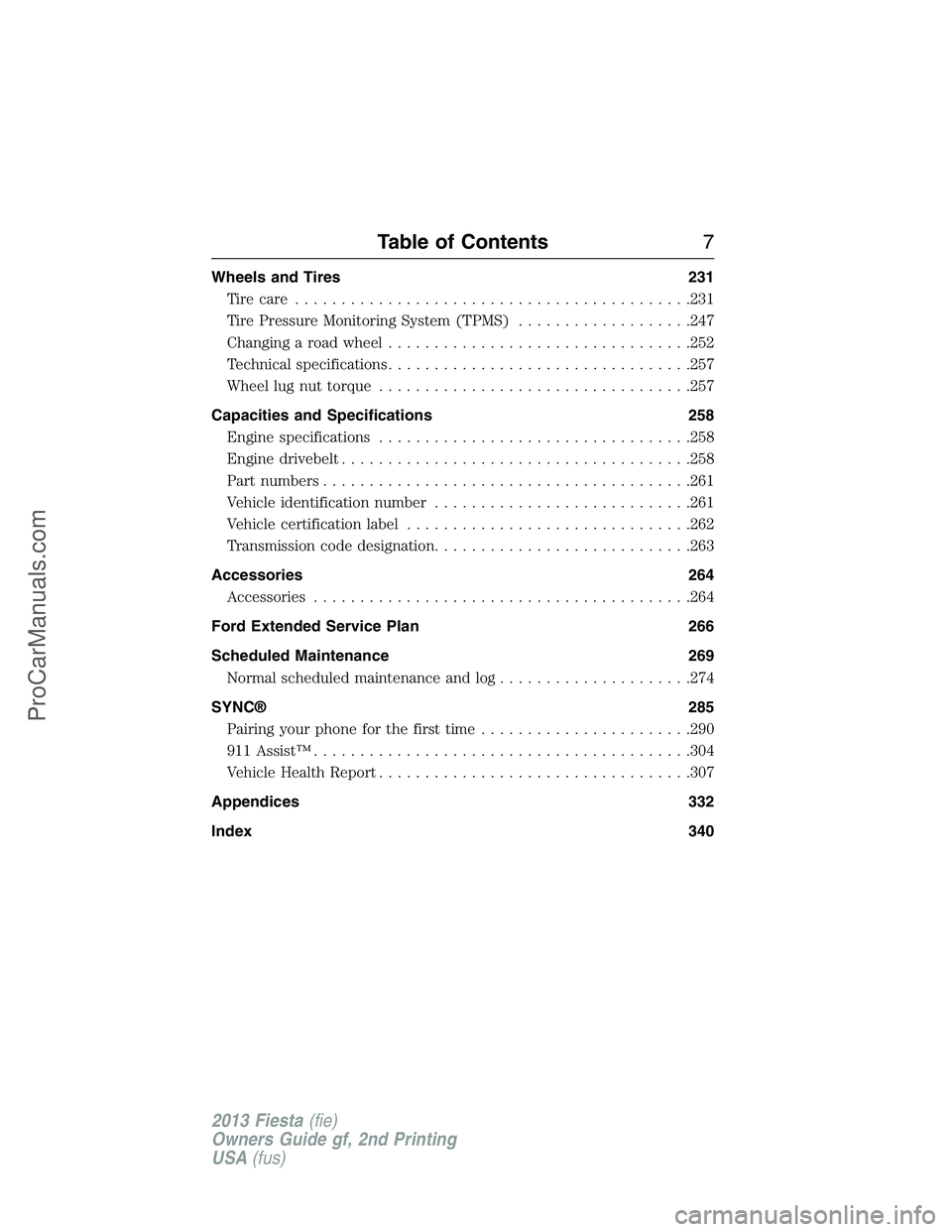
Wheels and Tires 231
Tire care...........................................231
Tire Pressure Monitoring System (TPMS)...................247
Changing a road wheel.................................252
Technical specifications.................................257
Wheel lug nut torque..................................257
Capacities and Specifications 258
Engine specifications..................................258
Engine drivebelt......................................258
Part numbers........................................261
Vehicle identification number............................261
Vehicle certification label...............................262
Transmission code designation............................263
Accessories 264
Accessories.........................................264
Ford Extended Service Plan 266
Scheduled Maintenance 269
Normal scheduled maintenance and log.....................274
SYNC® 285
Pairing your phone for the first time.......................290
911 Assist™.........................................304
Vehicle Health Report..................................307
Appendices 332
Index 340
Table of Contents7
2013 Fiesta(fie)
Owners Guide gf, 2nd Printing
USA(fus)
ProCarManuals.com
Page 14 of 346
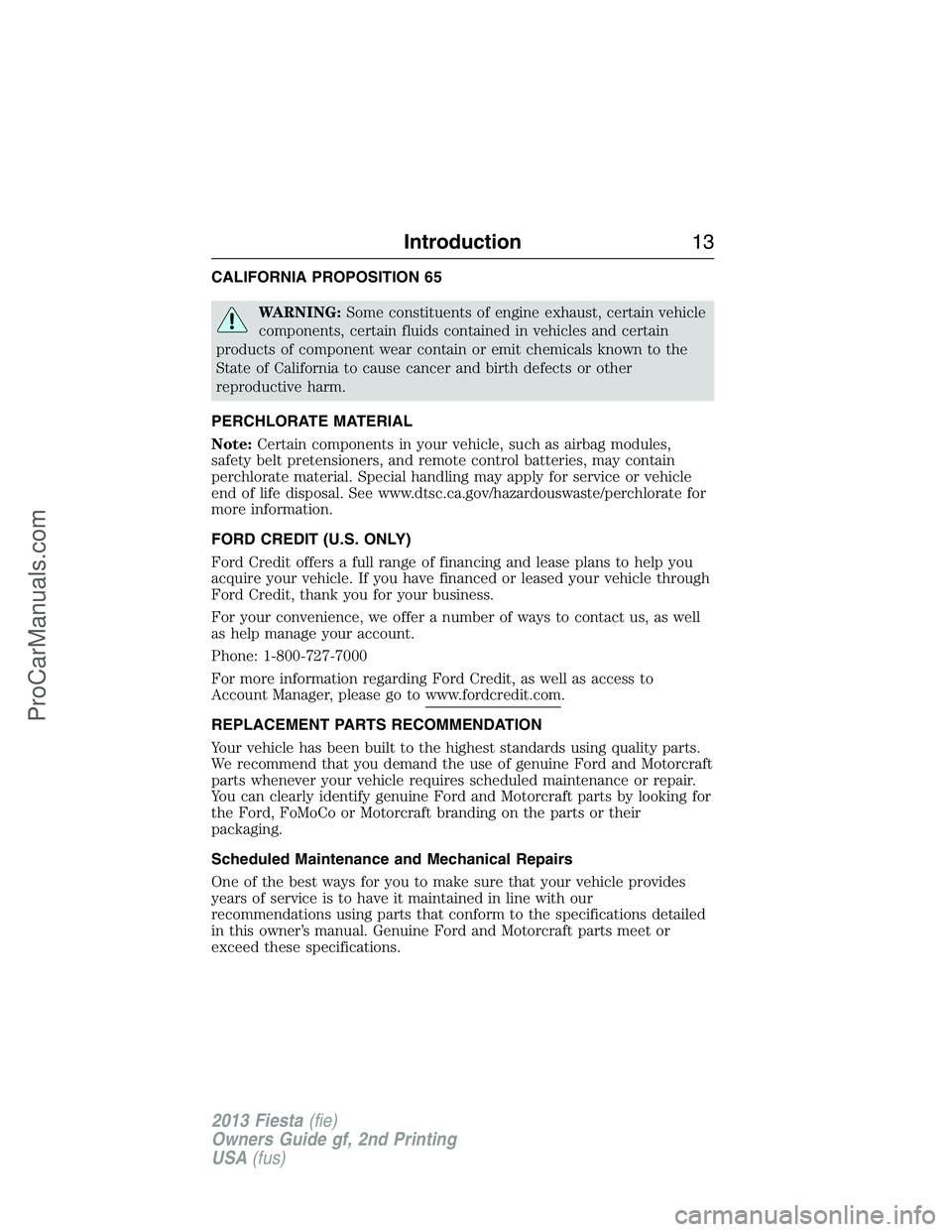
CALIFORNIA PROPOSITION 65
WARNING:Some constituents of engine exhaust, certain vehicle
components, certain fluids contained in vehicles and certain
products of component wear contain or emit chemicals known to the
State of California to cause cancer and birth defects or other
reproductive harm.
PERCHLORATE MATERIAL
Note:Certain components in your vehicle, such as airbag modules,
safety belt pretensioners, and remote control batteries, may contain
perchlorate material. Special handling may apply for service or vehicle
end of life disposal. See www.dtsc.ca.gov/hazardouswaste/perchlorate for
more information.
FORD CREDIT (U.S. ONLY)
Ford Credit offers a full range of financing and lease plans to help you
acquire your vehicle. If you have financed or leased your vehicle through
Ford Credit, thank you for your business.
For your convenience, we offer a number of ways to contact us, as well
as help manage your account.
Phone: 1-800-727-7000
For more information regarding Ford Credit, as well as access to
Account Manager, please go to www.fordcredit.com.
REPLACEMENT PARTS RECOMMENDATION
Your vehicle has been built to the highest standards using quality parts.
We recommend that you demand the use of genuine Ford and Motorcraft
parts whenever your vehicle requires scheduled maintenance or repair.
You can clearly identify genuine Ford and Motorcraft parts by looking for
the Ford, FoMoCo or Motorcraft branding on the parts or their
packaging.
Scheduled Maintenance and Mechanical Repairs
One of the best ways for you to make sure that your vehicle provides
years of service is to have it maintained in line with our
recommendations using parts that conform to the specifications detailed
in this owner’s manual. Genuine Ford and Motorcraft parts meet or
exceed these specifications.
Introduction13
2013 Fiesta(fie)
Owners Guide gf, 2nd Printing
USA(fus)
ProCarManuals.com
Page 42 of 346
•This will disable the Belt-Minder feature for that seating position if it
is currently enabled.
•This will enable the Belt-Minder® feature for that seating position if it
is currently disabled.
CHILD RESTRAINT AND SAFETY BELT MAINTENANCE
Inspect the vehicle safety belts and child safety seat systems periodically
to make sure they work properly and are not damaged. Inspect the
vehicle and child seat safety belts to make sure there are no nicks, tears
or cuts. Replace if necessary. All vehicle safety belt assemblies, including
retractors, buckles, front safety belt buckle assemblies, buckle support
assemblies (slide bar-if equipped), shoulder belt height adjusters (if
equipped), shoulder belt guide on seat back (if equipped), child safety
seat LATCH and tether anchors, and attaching hardware, should be
inspected after a crash. Read the child restraint manufacturer’s
instructions for additional inspection and maintenance information
specific to the child restraint. Ford Motor Company recommends that all
safety belt assemblies in use in vehicles involved in a crash be replaced.
However, if the crash was minor and an authorized dealer finds that the
belts do not show damage and continue to operate properly, they do not
need to be replaced. Safety belt assemblies not in use during a crash
should also be inspected and replaced if either damage or improper
operation is noted.
For proper care of soiled safety belts, seeCleaning the Interiorin the
Vehicle Carechapter.
Safety Belts41
2013 Fiesta(fie)
Owners Guide gf, 2nd Printing
USA(fus)
ProCarManuals.com
Page 45 of 346
passenger from certain upper body injuries. Airbags do not inflate slowly;
there is a risk of injury from a deploying airbag.
Note:You will hear a loud bang and see a cloud of harmless powdery
residue if an airbag deploys. This is normal.
The airbags inflate and deflate rapidly upon activation. After airbag
deployment, it is normal to notice a smoke-like, powdery residue or smell
the burnt propellant. This may consist of cornstarch, talcum powder (to
lubricate the bag) or sodium compounds (for example, baking soda) that
result from the combustion process that inflates the airbag. Small
amounts of sodium hydroxide may be present which may irritate the skin
and eyes, but none of the residue is toxic. While the system is designed
to help reduce serious injuries, contact with a deploying airbag may also
cause abrasions or swelling. Temporary hearing loss is also a possibility
as a result of the noise associated with a deploying airbag. Because
airbags must inflate rapidly and with considerable force, there is the risk
of death or serious injuries, such as fractures, facial and eye injuries or
internal injuries, particularly to occupants who are not properly
restrained or are otherwise out of position at the time of airbag
deployment. Thus, it is extremely important that occupants be properly
restrained as far away from the airbag module as possible while
maintaining vehicle control.
Routine maintenance of the airbags is not required.
SOS POST-CRASH ALERT SYSTEM™
The system flashes the turn signal lamps and sounds the horn
(intermittently) in the event of a serious impact that deploys an airbag
equipped on your vehicle, such as front, side, side curtain or Safety
Canopy®.
The horn and lamps will turn off when:
•the hazard control button is pressed
•the panic button (if equipped) is pressed on the remote entry
transmitter, or
•your vehicle runs out of power.
DRIVER AND PASSENGER AIRBAGS
WARNING:Never place your arm or any objects over an airbag
module. Placing your arm over a deploying airbag can result in
serious arm fractures or other injuries. Objects placed on or over the
airbag inflation area may cause those objects to be propelled by the
airbag into your face and torso causing serious injury.
44Supplementary Restraints System
2013 Fiesta(fie)
Owners Guide gf, 2nd Printing
USA(fus)
ProCarManuals.com
Page 55 of 346
Children 12 years old and under should always be properly restrained in
the back seats. The side curtain airbags will not interfere with children
restrained using a properly installed child or booster seat because it is
designed to inflate downward from the headliner above the doors along
the side window opening.
The design and development of the side curtain airbags included
recommended testing procedures that were developed by a group of
automotive safety experts known as the Side Airbag Technical Working
Group. These recommended testing procedures help reduce the risk of
injuries related to the deployment of side curtain airbags.
CRASH SENSORS AND AIRBAG INDICATOR
WARNING:Modifying or adding equipment to the front end of
your vehicle (including frame, bumper, front end body structure
and tow hooks) may affect the performance of the airbag system,
increasing the risk of injury. Do not modify the front end of your
vehicle.
Your vehicle has a collection of crash and occupant sensors which
provide information to the restraints control module which deploys
(activates) the front safety belt pretensioners, driver airbag, passenger
airbag, knee airbag, seat mounted side airbags, and the side curtain
airbags. Based on the type of crash (frontal impact or side impact) the
restraints control module will deploy the appropriate safety devices.
The restraints control module also monitors the readiness of the above
safety devices plus the crash and occupant sensors. The readiness of the
safety system is indicated by a warning indicator light in the instrument
cluster or by a backup tone if the warning light is not working. See the
Instrument Clusterchapter. Routine maintenance of the airbag is not
required.
A difficulty with the system is indicated by one or more of the following:
•The readiness light will either flash or stay lit.
•The readiness light will not illuminate immediately after the
ignition is turned on.
•A series of five beeps will be heard. The tone pattern will repeat
periodically until the problem or light are repaired.
If any of these things happen, even intermittently, have the supplemental
restraint system serviced at an authorized dealer immediately. Unless
serviced, the system may not function properly in the event of a crash.
54Supplementary Restraints System
2013 Fiesta(fie)
Owners Guide gf, 2nd Printing
USA(fus)
ProCarManuals.com
Page 93 of 346
Service Engine Soon
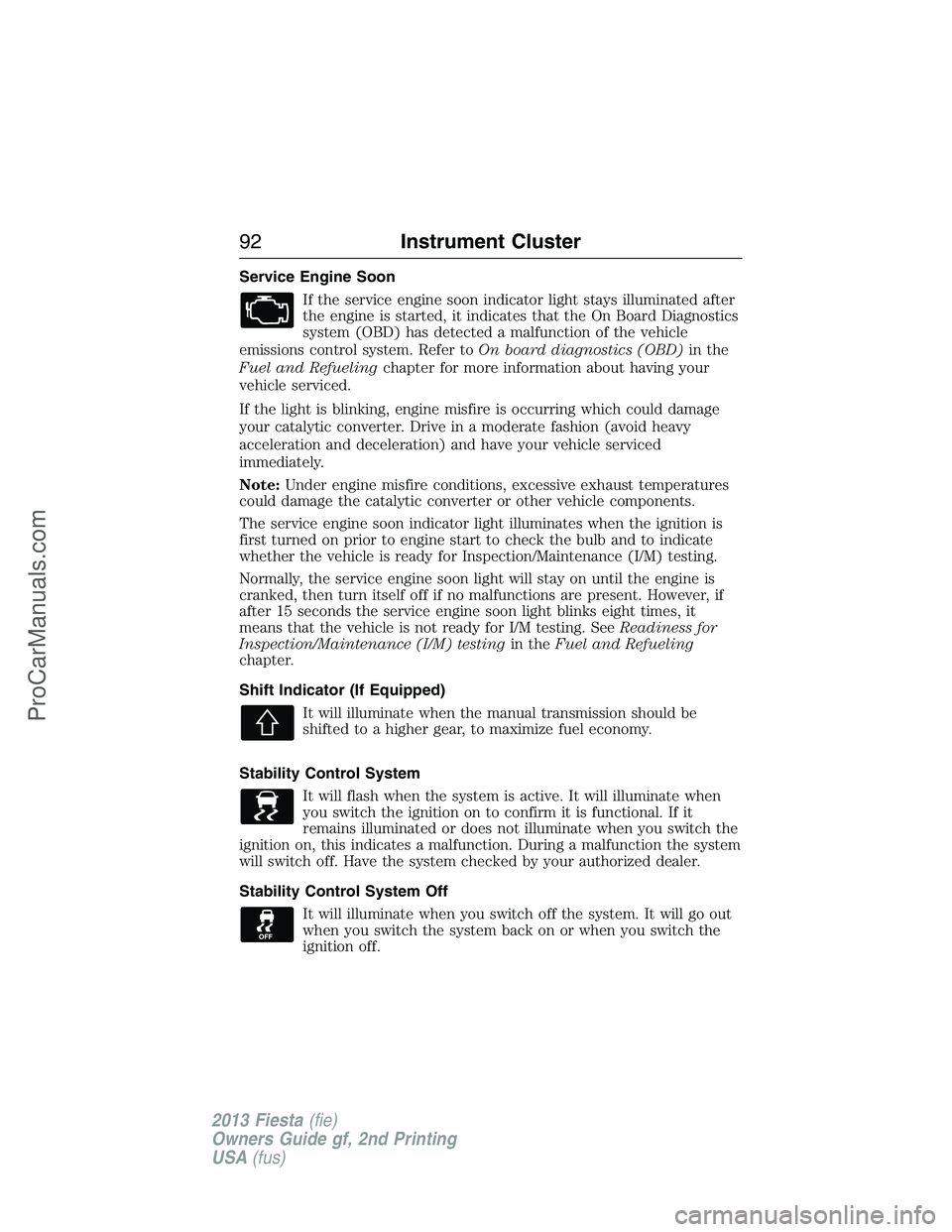
If the service engine soon indicator light stays illuminated after
the engine is started, it indicates that the On Board Diagnostics
system (OBD) has detected a malfunction of the vehicle
emissions control system. Refer toOn board diagnostics (OBD)in the
Fuel and Refuelingchapter for more information about having your
vehicle serviced.
If the light is blinking, engine misfire is occurring which could damage
your catalytic converter. Drive in a moderate fashion (avoid heavy
acceleration and deceleration) and have your vehicle serviced
immediately.
Note:Under engine misfire conditions, excessive exhaust temperatures
could damage the catalytic converter or other vehicle components.
The service engine soon indicator light illuminates when the ignition is
first turned on prior to engine start to check the bulb and to indicate
whether the vehicle is ready for Inspection/Maintenance (I/M) testing.
Normally, the service engine soon light will stay on until the engine is
cranked, then turn itself off if no malfunctions are present. However, if
after 15 seconds the service engine soon light blinks eight times, it
means that the vehicle is not ready for I/M testing. SeeReadiness for
Inspection/Maintenance (I/M) testingin theFuel and Refueling
chapter.
Shift Indicator (If Equipped)
It will illuminate when the manual transmission should be
shifted to a higher gear, to maximize fuel economy.
Stability Control System
It will flash when the system is active. It will illuminate when
you switch the ignition on to confirm it is functional. If it
remains illuminated or does not illuminate when you switch the
ignition on, this indicates a malfunction. During a malfunction the system
will switch off. Have the system checked by your authorized dealer.
Stability Control System Off
It will illuminate when you switch off the system. It will go out
when you switch the system back on or when you switch the
ignition off.
92Instrument Cluster
2013 Fiesta(fie)
Owners Guide gf, 2nd Printing
USA(fus)
ProCarManuals.com
Page 119 of 346
Both mirrors are heated to remove ice, mist and fog when the rear
window defroster is activated.
CABIN AIR FILTER
Note:A screen or filter must be installed at all times to prevent foreign
objects from entering the system. Running the system without a screen
or filter in place could result in degradation or damage to the system.
Your vehicle is equipped with either a screen or filter; it is located
behind the instrument panel.
The particulate air filtration system is designed to reduce the
concentration of airborne particles, such as dust, spores and pollen, in
the air being supplied to the interior of the vehicle. The particulate
filtration system gives the following benefits to customers:
•Improves the customer’s driving comfort by reducing particle
concentration.
•Improves the interior compartment cleanliness.
•Protects the climate control components from particle deposits.
Vehicles without a cabin air filter have a screen which can be washed
clean at periodic intervals.
Vehicles with a cabin air filter should have the filter replaced at regular
intervals. See theScheduled Maintenancechapter.
For additional information, or to replace the filter, see an authorized
dealer.
11 8Climate Control
2013 Fiesta(fie)
Owners Guide gf, 2nd Printing
USA(fus)
ProCarManuals.com
Page 143 of 346
1. Fill the fuel tank completely and record the initial odometer reading.
2. Each time you fill the tank, record the amount of fuel added.
3. After at least three to five tank fill-ups, fill the fuel tank and record
the current odometer reading.
4. Subtract your initial odometer reading from the current odometer
reading.
5. Calculate fuel economy as follows:
Standard: Divide miles traveled by gallons used.
Metric: Multiply liters used by 100, then divide by kilometers traveled.
Keep a record for at least one month and record the type of driving (city
or highway). This provides an accurate estimate of the vehicle’s fuel
economy under current driving conditions. Additionally, keeping records
during summer and winter show how temperature impacts fuel economy.
In general, lower temperatures mean lower fuel economy.
EMISSION CONTROL SYSTEM
WARNING:Do not park, idle, or drive your vehicle in dry grass
or other dry ground cover. The emission system heats up the
engine compartment and exhaust system, which can start a fire.
WARNING:Exhaust leaks may result in entry of harmful and
potentially lethal fumes into the passenger compartment. If you
smell exhaust fumes inside your vehicle, have your dealer inspect your
vehicle immediately. Do not drive if you smell exhaust fumes.
Your vehicle is equipped with various emission control components and a
catalytic converter which will enable your vehicle to comply with
applicable exhaust emission standards. To make sure that the catalytic
converter and other emission control components continue to work
properly:
•Use only the specified fuel listed.
•Avoid running out of fuel.
•Do not turn off the ignition while your vehicle is moving, especially at
high speeds.
•Have the items listed inScheduled Maintenance Information
performed according to the specified schedule.
142Fuel and Refueling
2013 Fiesta(fie)
Owners Guide gf, 2nd Printing
USA(fus)
ProCarManuals.com