sensor FORD FIESTA 2013 Owners Manual
[x] Cancel search | Manufacturer: FORD, Model Year: 2013, Model line: FIESTA, Model: FORD FIESTA 2013Pages: 346, PDF Size: 5.27 MB
Page 2 of 346
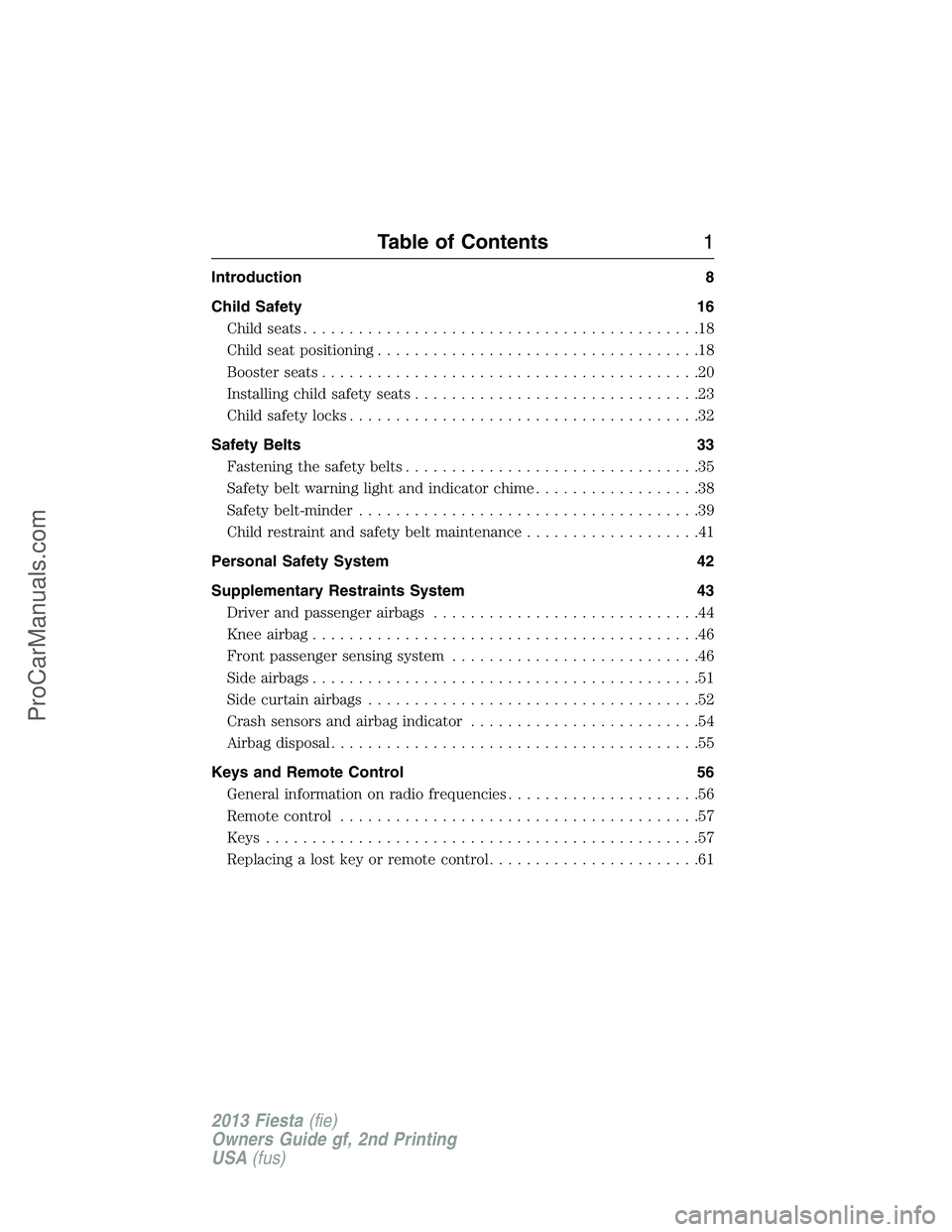
Introduction 8
Child Safety 16
Child seats...........................................18
Child seat positioning...................................18
Booster seats.........................................20
Installing child safety seats...............................23
Child safety locks......................................32
Safety Belts 33
Fastening the safety belts................................35
Safetybeltwarninglightandindicatorchime..................38
Safety belt-minder.....................................39
Child restraint and safety belt maintenance...................41
Personal Safety System 42
Supplementary Restraints System 43
Driver and passenger airbags.............................44
Knee airbag..........................................46
Front passenger sensing system...........................46
Side airbags..........................................51
Side curtain airbags....................................52
Crash sensors and airbag indicator.........................54
Airbag disposal........................................55
Keys and Remote Control 56
General information on radio frequencies.....................56
Remote control.......................................57
Keys...............................................57
Replacing a lost key or remote control.......................61
Table of Contents1
2013 Fiesta(fie)
Owners Guide gf, 2nd Printing
USA(fus)
ProCarManuals.com
Page 13 of 346
To read data recorded by an EDR, special equipment is required,
and access to the vehicle or the EDR is needed. In addition to the
vehicle manufacturer, other parties, such as law enforcement,
that have such special equipment, can read the information if
they have access to the vehicle or the EDR. Ford Motor Company
and Ford of Canada do not access event data recorder
information without obtaining consent, unless pursuant to court
order or where required by law enforcement, other government
authorities or other third parties acting with lawful authority.
Other parties may seek to access the information independently
of Ford Motor Company and Ford of Canada.
Note: Including to the extent that any law pertaining to Event
Data Recorders applies to SYNC® or its features, please note the
following: Once 911 Assist (if equipped) is enabled (set ON), 911
Assist may, through any paired and connected cell phone, disclose
to emergency services that the vehicle has been in a crash
involving the deployment of an airbag or, in certain vehicles, the
activation of the fuel pump shut-off. Certain versions or updates
to 911 Assist may also be capable of being used to electronically
or verbally provide to 911 operators the vehicle location (such as
latitude and longitude), and/or other details about the vehicle or
crash or personal information about the occupants to assist 911
operators to provide the most appropriate emergency services. If
you do not want to disclose this information, do not activate the
911 Assist feature. See your SYNC® chapter for more
information.
Additionally, when you connect to Traffic, Directions and
Information (if equipped, U.S. only), the service uses GPS
technology and advanced vehicle sensors to collect the vehicle’s
current location, travel direction, and speed (“vehicle travel
information”), only to help provide you with the directions,
traffic reports, or business searches that you request. If you do
not want Ford or its vendors to receive this information, do not
activate the service. Ford Motor Company and the vendors it uses
to provide you with this information do not store your vehicle
travel information. For more information, see Traffic, Directions
and Information, Terms and Conditions. See your SYNC®
supplement for more information.
12Introduction
2013 Fiesta(fie)
Owners Guide gf, 2nd Printing
USA(fus)
ProCarManuals.com
Page 35 of 346
WARNING:Safety belts and seats can become hot in a vehicle
that has been closed up in sunny weather; they could burn a
small child. Check seat covers and buckles before you place a child
anywhere near them.
WARNING:Front and rear seat occupants, including pregnant
women, should wear safety belts for optimum protection in an
accident.
All seating positions in this vehicle have lap and shoulder safety belts. All
occupants of the vehicle should always properly wear their safety belts,
even when an airbag supplemental restraint system is provided.
The safety belt system consists of:
•lap and shoulder safety belts.
•shoulder safety belt with automatic locking mode, (except driver
safety belt).
•height adjuster at the front outboard seating positions
•safety belt pretensioner at the front outboard seating positions.
•belt tension sensor at the front outboard passenger seating position.
•Safety belt warning light and chime. SeeSafety belt warning
light and indicator chimelater in this chapter.
•Crash sensors and monitoring system with readiness
indicator. SeeCrash sensors and airbag indicatorin the
Supplemental Restraints Systemchapter.
The safety belt pretensioners at the front seating positions are designed
to tighten the safety belts when activated. In frontal and near-frontal
crashes, the safety belt pretensioners may be activated alone or, if the
crash is of sufficient severity, together with the front airbags. The
pretensioners may also activate when a side curtain airbag is deployed.
34Safety Belts
2013 Fiesta(fie)
Owners Guide gf, 2nd Printing
USA(fus)
ProCarManuals.com
Page 43 of 346
PERSONAL SAFETY SYSTEM™
The Personal Safety System provides an improved overall level of frontal
crash protection to front seat occupants and is designed to help further
reduce the risk of airbag-related injuries. The system is able to analyze
different occupant conditions and crash severity before activating the
appropriate safety devices to help better protect a range of occupants in
a variety of frontal crash situations.
Your vehicle’s Personal Safety System consists of:
•Driver and passenger dual-stage airbag supplemental restraints.
•Front outboard safety belts with pretensioners, energy management
retractors (first row only), and safety belt usage sensors.
•Driver’s seat position sensor.
•Front passenger sensing system.
•Passenger airbag off and on indicator lamp.
•Front crash severity sensors.
•Restraints control module with impact and safing sensors.
•Restraint system warning light and backup tone.
•The electrical wiring for the airbags, crash sensor(s), safety belt
pretensioners, front safety belt usage sensors, driver seat position
sensor, front passenger sensing system, and indicator lights.
How Does the Personal Safety System Work?
The Personal Safety System can adapt the deployment strategy of your
vehicle’s safety devices according to crash severity and occupant
conditions. A collection of crash and occupant sensors provides
information to the restraints control module. During a crash, the
restraints control module may activate the safety belt pretensioners
and/or either one or both stages of the dual-stage airbag supplemental
restraints based on crash severity and occupant conditions.
42Personal Safety System
2013 Fiesta(fie)
Owners Guide gf, 2nd Printing
USA(fus)
ProCarManuals.com
Page 46 of 346
WARNING:Airbags can kill or injure a child in a child seat.
Never place a rear-facing child seat in front of an active airbag. If
you must use a forward-facing child seat in the front seat, move the
seat all the way back.
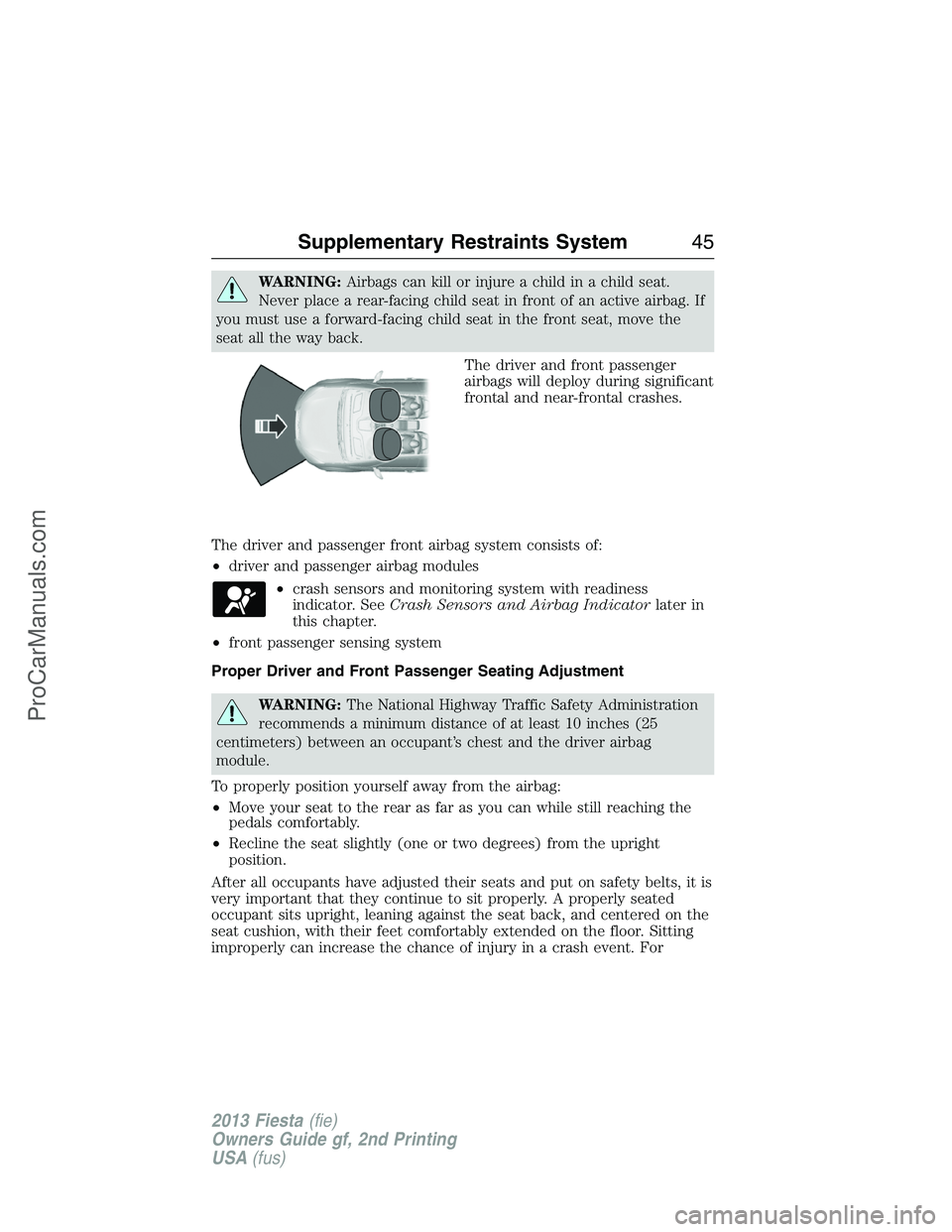
The driver and front passenger
airbags will deploy during significant
frontal and near-frontal crashes.
The driver and passenger front airbag system consists of:
•driver and passenger airbag modules
•crash sensors and monitoring system with readiness
indicator. SeeCrash Sensors and Airbag Indicatorlater in
this chapter.
•front passenger sensing system
Proper Driver and Front Passenger Seating Adjustment
WARNING:The National Highway Traffic Safety Administration
recommends a minimum distance of at least 10 inches (25
centimeters) between an occupant’s chest and the driver airbag
module.
To properly position yourself away from the airbag:
•Move your seat to the rear as far as you can while still reaching the
pedals comfortably.
•Recline the seat slightly (one or two degrees) from the upright
position.
After all occupants have adjusted their seats and put on safety belts, it is
very important that they continue to sit properly. A properly seated
occupant sits upright, leaning against the seat back, and centered on the
seat cushion, with their feet comfortably extended on the floor. Sitting
improperly can increase the chance of injury in a crash event. For
Supplementary Restraints System45
2013 Fiesta(fie)
Owners Guide gf, 2nd Printing
USA(fus)
ProCarManuals.com
Page 47 of 346
example, if an occupant slouches, lies down, turns sideways, sits forward,
leans forward or sideways, or puts one or both feet up, the chance of
injury during a crash is greatly increased.
Children and Airbags
WARNING:Airbags can kill or injure a child in a child seat.
NEVER place a rear-facing child seat in front of an active airbag.
If you must use a forward-facing child seat in the front seat, move the
seat all the way back.
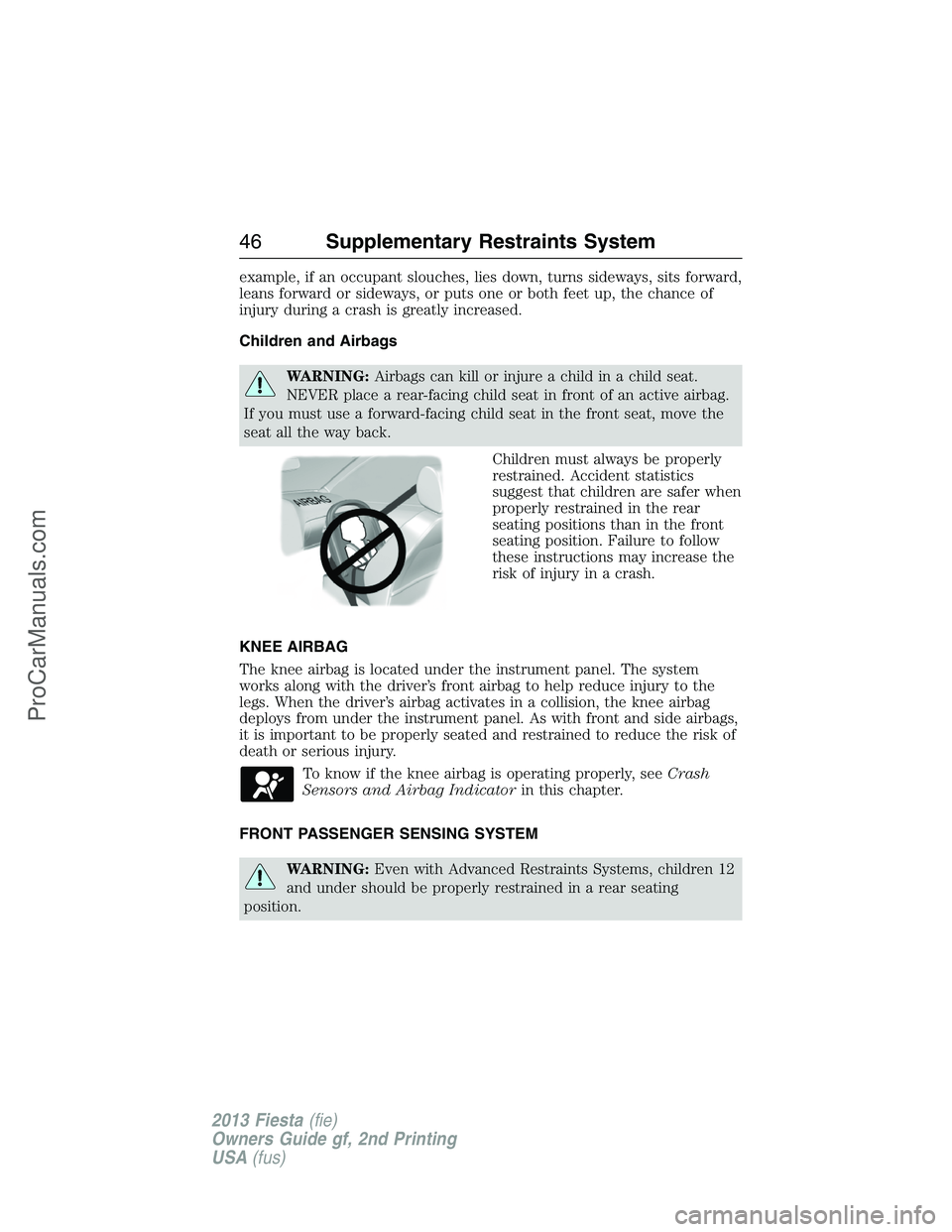
Children must always be properly
restrained. Accident statistics
suggest that children are safer when
properly restrained in the rear
seating positions than in the front
seating position. Failure to follow
these instructions may increase the
risk of injury in a crash.
KNEE AIRBAG
The knee airbag is located under the instrument panel. The system
works along with the driver’s front airbag to help reduce injury to the
legs. When the driver’s airbag activates in a collision, the knee airbag
deploys from under the instrument panel. As with front and side airbags,
it is important to be properly seated and restrained to reduce the risk of
death or serious injury.
To know if the knee airbag is operating properly, seeCrash
Sensors and Airbag Indicatorin this chapter.
FRONT PASSENGER SENSING SYSTEM
WARNING:Even with Advanced Restraints Systems, children 12
and under should be properly restrained in a rear seating
position.
46Supplementary Restraints System
2013 Fiesta(fie)
Owners Guide gf, 2nd Printing
USA(fus)
ProCarManuals.com
Page 48 of 346
WARNING:Sitting improperly out of position or with the seat
back reclined too far can take off weight from the seat cushion
and affect the decision of the front passenger sensing system, resulting
in serious injury or death in a crash.
Always sit upright against your seatback, with your feet on the floor.
WARNING:To reduce the risk of possible serious injury:
Do not stow objects in seat back map pocket (if equipped) or
hang objects off seat back if a child is in the front passenger seat.
Do not place objects underneath the front passenger seat or between
the seat and the center console (if equipped).
Check the passenger airbag off or pass airbag off indicator lamp for
proper airbag status.
Failure to follow these instructions may interfere with the passenger
seat sensing system.
WARNING:Any alteration/modification to the front passenger
seat may affect the performance of the front passenger sensing
system.
This system works with sensors that are part of the front passenger’s
seat and safety belt to detect the presence of a properly-seated occupant
and determine if the front passenger’s frontal airbag should be enabled
(may inflate) or not.
The front passenger sensing system uses a passenger
airbag off or pass airbag off indicator which will
illuminate and stay lit to remind you that the front
passenger frontal airbag is disabled. The indicator lamp
is located at the bottom central portion of the
instrument panel below the hazard warning indicator and
above the climate controls.
Note:The indicator lamp will illuminate for a short period of time when
the ignition is turned to the on position to confirm it is functional.
The front passenger sensing system is designed to disable (will not
inflate) the front passenger’s frontal airbag when the front passenger
seat is unoccupied, or a rear facing infant seat, a forward-facing child
restraint, or a booster seat is detected. Even with this technology,
parents areSTRONGLYencouraged to always properly restrain children
Supplementary Restraints System47
2013 Fiesta(fie)
Owners Guide gf, 2nd Printing
USA(fus)
ProCarManuals.com
Page 49 of 346
in the rear seat. The sensor also turns off the passenger front airbag and
seat-mounted side airbag when the passenger seat is empty.
The front passenger sensing system works with sensors that are part of
the front passenger’s seat and safety belt. The sensors are designed to
detect the presence of a properly seated occupant and determine if the
front passenger’s frontal airbag should be enabled (may inflate) or
disabled (will not inflate).
The front passenger sensing system will disable (will not inflate) the
front passenger’s frontal airbag if:
•the front passenger seat is unoccupied, or has small or medium
objects in the front seat,
•the system determines that an infant is present in a rear-facing infant
seat that is installed according to the manufacturer’s instructions,
•the system determines that a small child is present in a forward-facing
child restraint that is installed according to the manufacturer’s
instructions,
•the system determines that a small child is present in a booster seat,
•a front passenger takes his/her weight off of the seat for a period of
time,
•a child or a small person occupies the front passenger seat.
Note:When the passenger airbag off light is illuminated, the passenger
(seat mounted) side airbag may be disabled to avoid the risk of airbag
deployment injuries.
When the front passenger seat is not occupied (empty seat) or in the
event that the front passenger frontal airbag is enabled (may inflate), the
indicator lamp will be unlit.
The front passenger sensing system is designed to disable (will not
inflate) the front passenger’s frontal airbag when a rear facing infant
seat, a forward-facing child restraint, or a booster seat is detected.
•When the front passenger sensing system disables (will not inflate)
the front passenger frontal airbag, the indicator lamp will illuminate
and stay lit to remind you that the front passenger frontal airbag is
disabled.
•If the child restraint has been installed and the indicator lamp is not
lit, then turn the vehicle off, remove the child restraint from the
vehicle and reinstall the restraint following the child restraint
manufacturer’s instructions.
The front passenger sensing system is designed to enable (may inflate)
the front passenger’s frontal airbag anytime the system senses that a
person of adult size is sitting properly in the front passenger seat.
48Supplementary Restraints System
2013 Fiesta(fie)
Owners Guide gf, 2nd Printing
USA(fus)
ProCarManuals.com
Page 51 of 346
•Other passengers pushing or pulling on the seat
•Rear passenger feet and knees resting or pushing on the seat
The conditions listed above may cause the weight of a properly seated
occupant to be incorrectly interpreted by the passenger sensing system.
The person in the front passenger seat may appear heavier or lighter due
to the conditions described in the list above.
To know if the front passenger sensing system is operating
properly, seeCrash Sensors and Airbag Indicatorin this
chapter.
If the airbag readiness lamp is lit, do the following:
The driver or adult passengers should check for any objects that may be
lodged underneath the front passenger seat or cargo interfering with the
seat.
If objects are lodged or cargo is interfering with the seat; please take the
following steps to remove the obstruction:
•Pull the vehicle over.
•Turn the vehicle off.
•Driver or adult passengers should check for any objects lodged
underneath the front passenger seat or cargo interfering with the seat.
•Remove the obstruction(s) (if found).
•Restart the vehicle.
•Wait at least two minutes and verify that the airbag readiness lamp is
no longer illuminated
•If the airbag readiness lamp remains illuminated, this may or may/not
be a problem due to the front passenger sensing system.
DO NOT attempt to repair or service the system; take your vehicle
immediately to an authorized dealer.
If it is necessary to modify an advanced front airbag system to
accommodate a person with disabilities, contact the Ford Customer
Relationship Center at the phone number shown in theCustomer
Assistancesection of this owner’s guide.
50Supplementary Restraints System
2013 Fiesta(fie)
Owners Guide gf, 2nd Printing
USA(fus)
ProCarManuals.com
Page 53 of 346
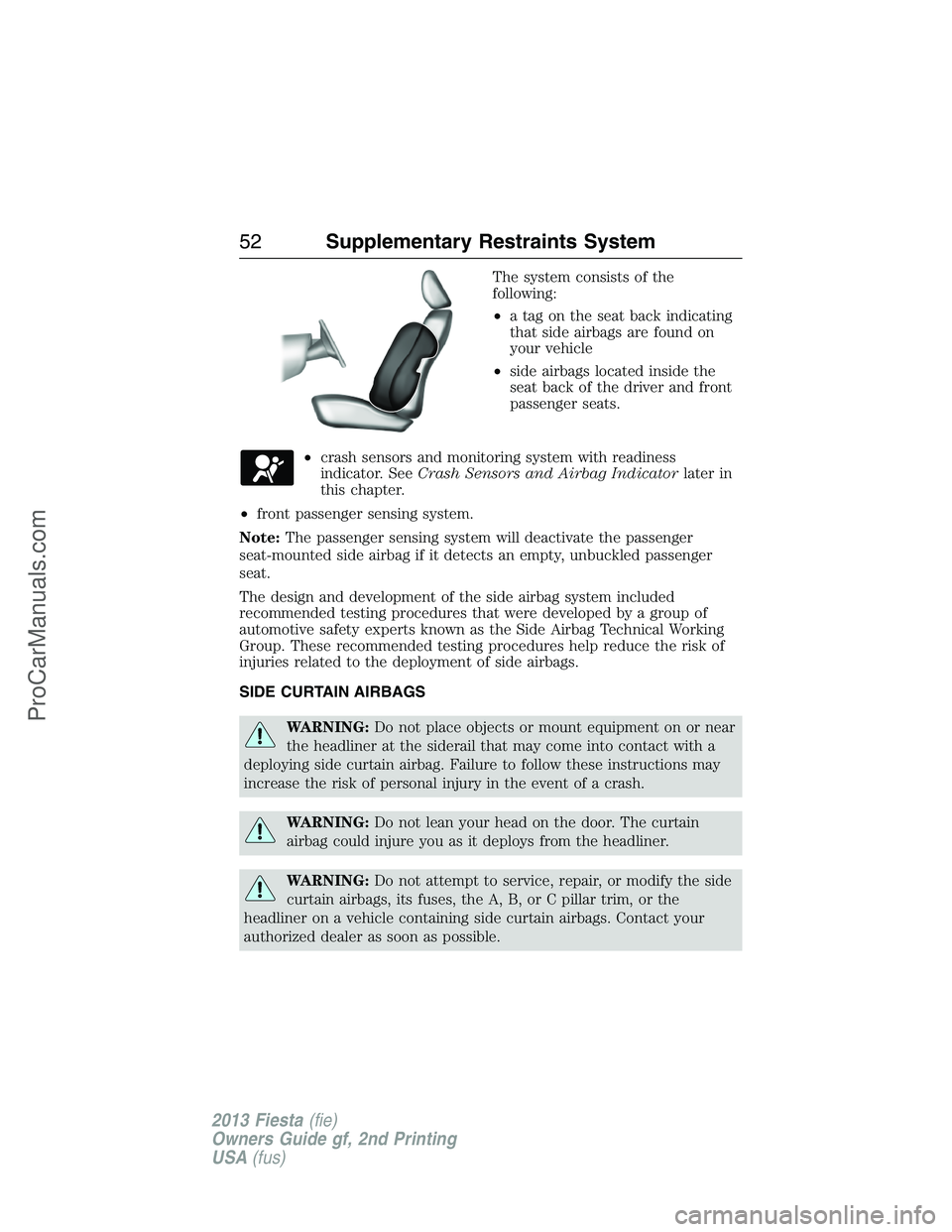
The system consists of the
following:
•a tag on the seat back indicating
that side airbags are found on
your vehicle
•side airbags located inside the
seat back of the driver and front
passenger seats.
•crash sensors and monitoring system with readiness
indicator. SeeCrash Sensors and Airbag Indicatorlater in
this chapter.
•front passenger sensing system.
Note:The passenger sensing system will deactivate the passenger
seat-mounted side airbag if it detects an empty, unbuckled passenger
seat.
The design and development of the side airbag system included
recommended testing procedures that were developed by a group of
automotive safety experts known as the Side Airbag Technical Working
Group. These recommended testing procedures help reduce the risk of
injuries related to the deployment of side airbags.
SIDE CURTAIN AIRBAGS
WARNING:Do not place objects or mount equipment on or near
the headliner at the siderail that may come into contact with a
deploying side curtain airbag. Failure to follow these instructions may
increase the risk of personal injury in the event of a crash.
WARNING:Do not lean your head on the door. The curtain
airbag could injure you as it deploys from the headliner.
WARNING:Do not attempt to service, repair, or modify the side
curtain airbags, its fuses, the A, B, or C pillar trim, or the
headliner on a vehicle containing side curtain airbags. Contact your
authorized dealer as soon as possible.
52Supplementary Restraints System
2013 Fiesta(fie)
Owners Guide gf, 2nd Printing
USA(fus)
ProCarManuals.com