fuel pump FORD FLEX 2009 1.G Owners Manual
[x] Cancel search | Manufacturer: FORD, Model Year: 2009, Model line: FLEX, Model: FORD FLEX 2009 1.GPages: 374
Page 8 of 374
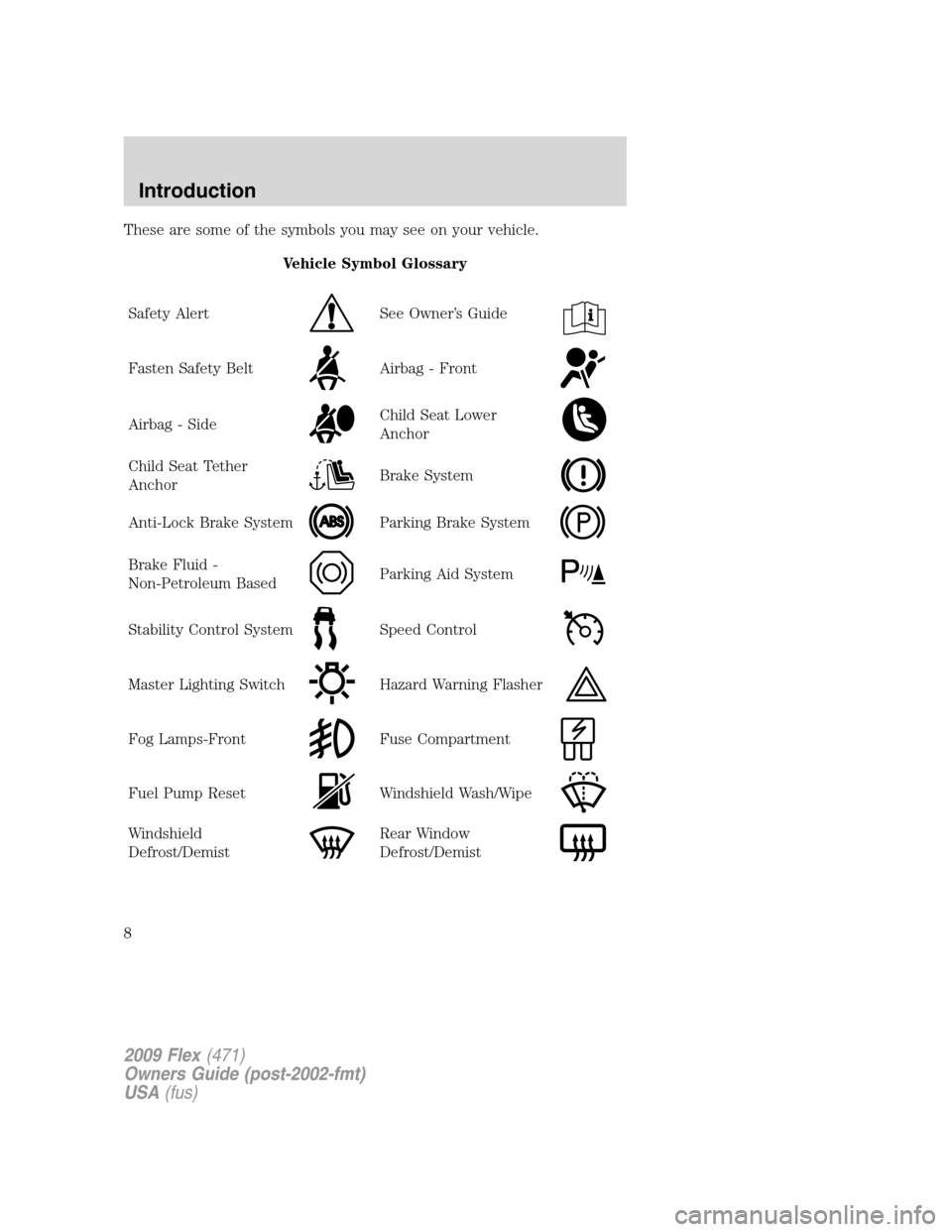
These are some of the symbols you may see on your vehicle.
Vehicle Symbol Glossary
Safety Alert
See Owner’s Guide
Fasten Safety BeltAirbag - Front
Airbag - SideChild Seat Lower
Anchor
Child Seat Tether
AnchorBrake System
Anti-Lock Brake SystemParking Brake System
Brake Fluid -
Non-Petroleum BasedParking Aid System
Stability Control SystemSpeed Control
Master Lighting SwitchHazard Warning Flasher
Fog Lamps-FrontFuse Compartment
Fuel Pump ResetWindshield Wash/Wipe
Windshield
Defrost/DemistRear Window
Defrost/Demist
2009 Flex(471)
Owners Guide (post-2002-fmt)
USA(fus)
Introduction
8
Page 112 of 374
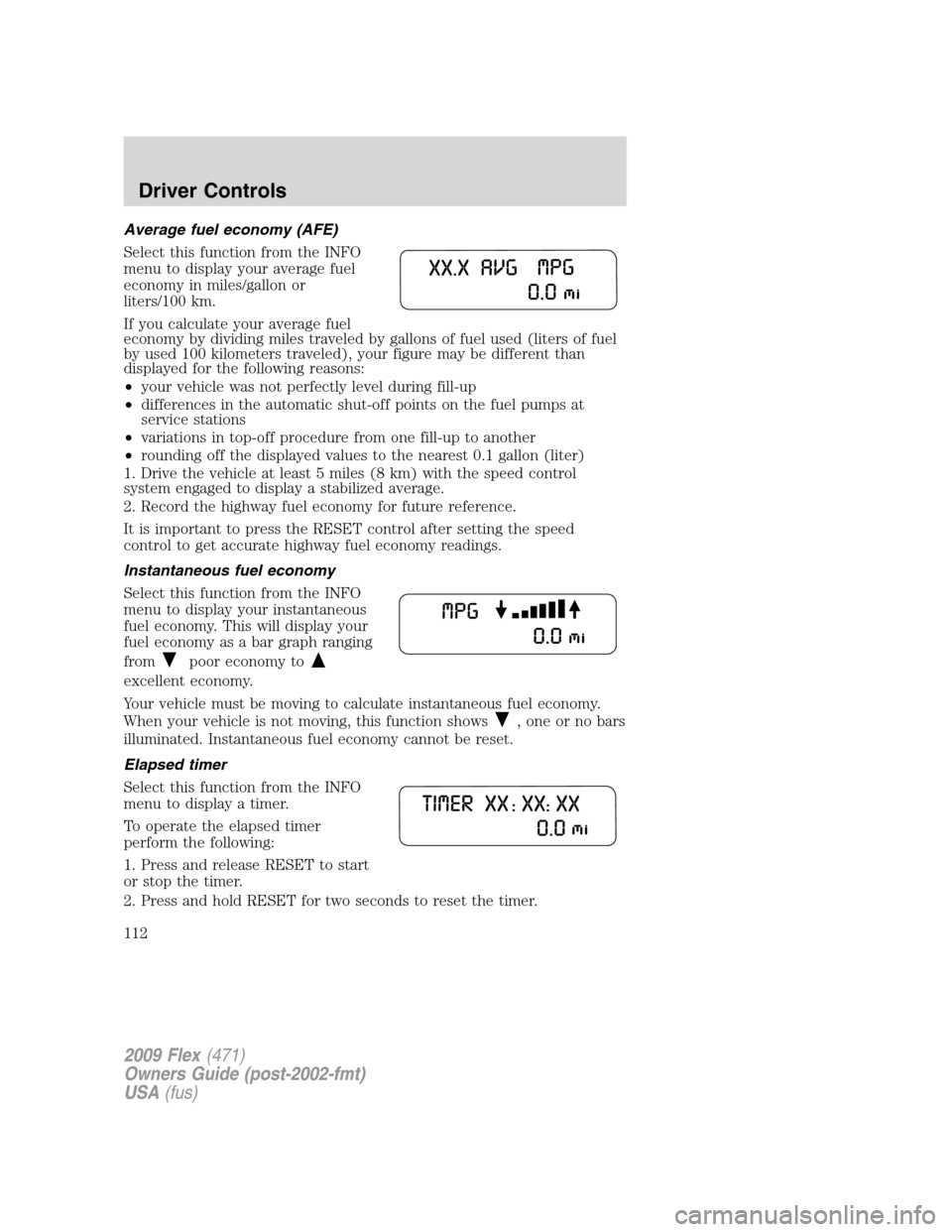
Average fuel economy (AFE)
Select this function from the INFO
menu to display your average fuel
economy in miles/gallon or
liters/100 km.
If you calculate your average fuel
economy by dividing miles traveled by gallons of fuel used (liters of fuel
by used 100 kilometers traveled), your figure may be different than
displayed for the following reasons:
•your vehicle was not perfectly level during fill-up
•differences in the automatic shut-off points on the fuel pumps at
service stations
•variations in top-off procedure from one fill-up to another
•rounding off the displayed values to the nearest 0.1 gallon (liter)
1. Drive the vehicle at least 5 miles (8 km) with the speed control
system engaged to display a stabilized average.
2. Record the highway fuel economy for future reference.
It is important to press the RESET control after setting the speed
control to get accurate highway fuel economy readings.
Instantaneous fuel economy
Select this function from the INFO
menu to display your instantaneous
fuel economy. This will display your
fuel economy as a bar graph ranging
from
poor economy to
excellent economy.
Your vehicle must be moving to calculate instantaneous fuel economy.
When your vehicle is not moving, this function shows
, one or no bars
illuminated. Instantaneous fuel economy cannot be reset.
Elapsed timer
Select this function from the INFO
menu to display a timer.
To operate the elapsed timer
perform the following:
1. Press and release RESET to start
or stop the timer.
2. Press and hold RESET for two seconds to reset the timer.
2009 Flex(471)
Owners Guide (post-2002-fmt)
USA(fus)
Driver Controls
112
Page 280 of 374
FUEL PUMP SHUT-OFF
In the event of a moderate to severe collision, this vehicle is equipped
with a fuel pump shut-off feature that stops the flow of fuel to the
engine. Not every impact will cause a shut-off.
Should your vehicle shut off after a collision due to this feature, you may
restart your vehicle by doing the following:
1. Turn the ignition switch to the off position.
2. Turn the ignition switch to the on position.
In some instances the vehicle may not restart the first time you try to
restart and may take one additional attempt.
WARNING:Failure to inspect and if necessary repair fuel leaks
after a collision may increase the risk of fire and serious injury.
Ford Motor Company recommends that the fuel system be inspected
by an authorized dealer after any collision.
FUSES AND RELAYS
Fuses
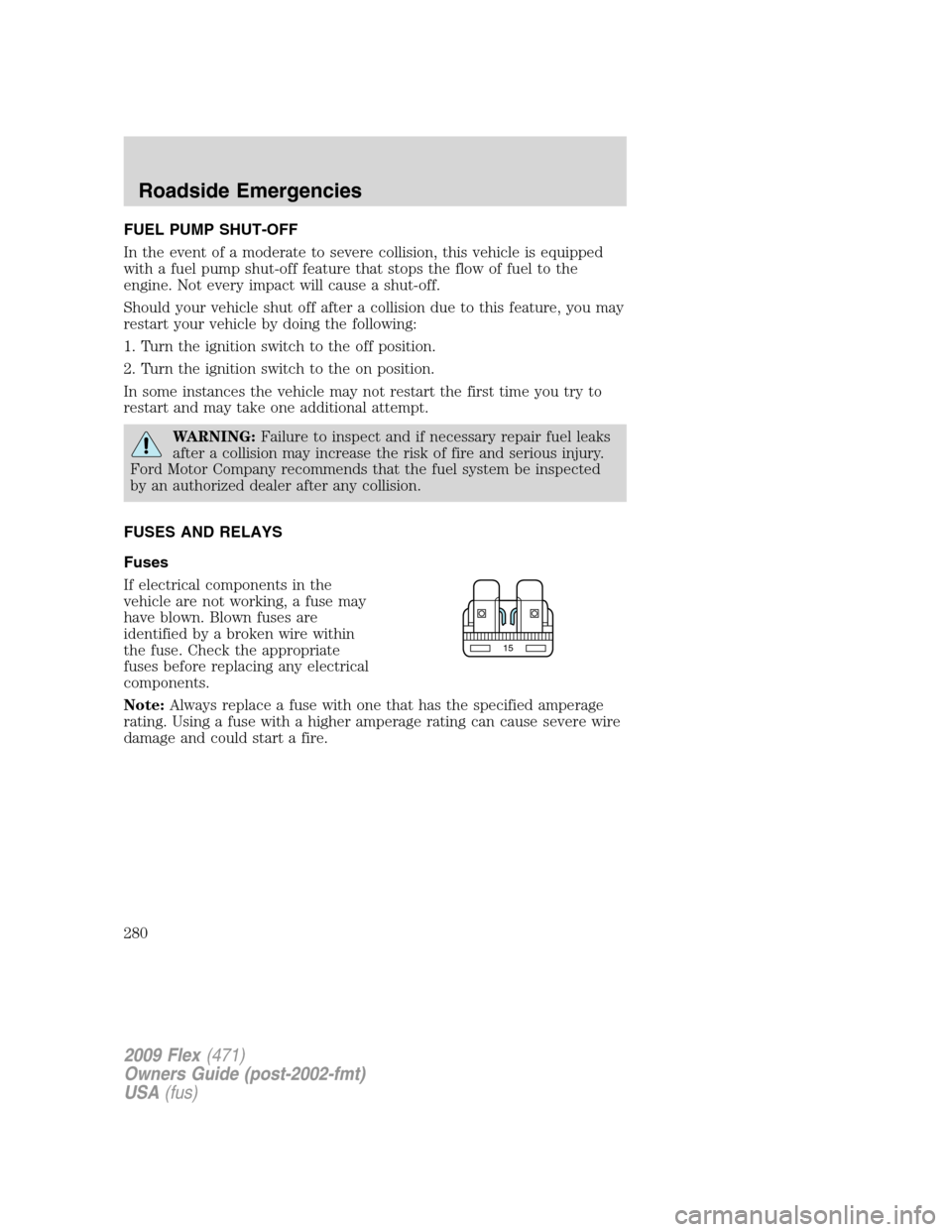
If electrical components in the
vehicle are not working, a fuse may
have blown. Blown fuses are
identified by a broken wire within
the fuse. Check the appropriate
fuses before replacing any electrical
components.
Note:Always replace a fuse with one that has the specified amperage
rating. Using a fuse with a higher amperage rating can cause severe wire
damage and could start a fire.
15
2009 Flex(471)
Owners Guide (post-2002-fmt)
USA(fus)
Roadside Emergencies
280
Page 286 of 374
Fuse/Relay
LocationFuse Amp
RatingProtected Circuits
9 40A* Anti-lock Brake System
(ABS)/AdvanceTrac pump
10 30A* Starter
11 30A* Powertrain Control Module (PCM)
relay
12 20A* ABS/AdvanceTrac valve
13 20A** Left HID
14 10A** Brake on/off (BOO) switch
15 15A** Refrigerator
16 20A** Right HID
17 10A** Alternator
18 20A* Rear quarter panel power point
19 20A* Power point (front console)
20 40A* Rear defroster
21 20A* Rear console power point
22 20A* Sub woofer amp
23 7.5A** PCM Keep alive power, Canister
vent
24 10A** A/C clutch relay
25 25A** Rear wiper
26 20A** Backup relay
27 15A** Fuel relay (Fuel pump driver
module, Fuel pump)
28 80A* Cooling fan
29 30A* E-brake (trailer tow)
30 40A* Battery charge (trailer tow)
31 30A* Auxiliary blower relay
32 30A* Driver seat motors, Memory
module
33 — Not used
34 30A* Power liftgate
35 40A* Front A/C blower motor
2009 Flex(471)
Owners Guide (post-2002-fmt)
USA(fus)
Roadside Emergencies
286
Page 287 of 374
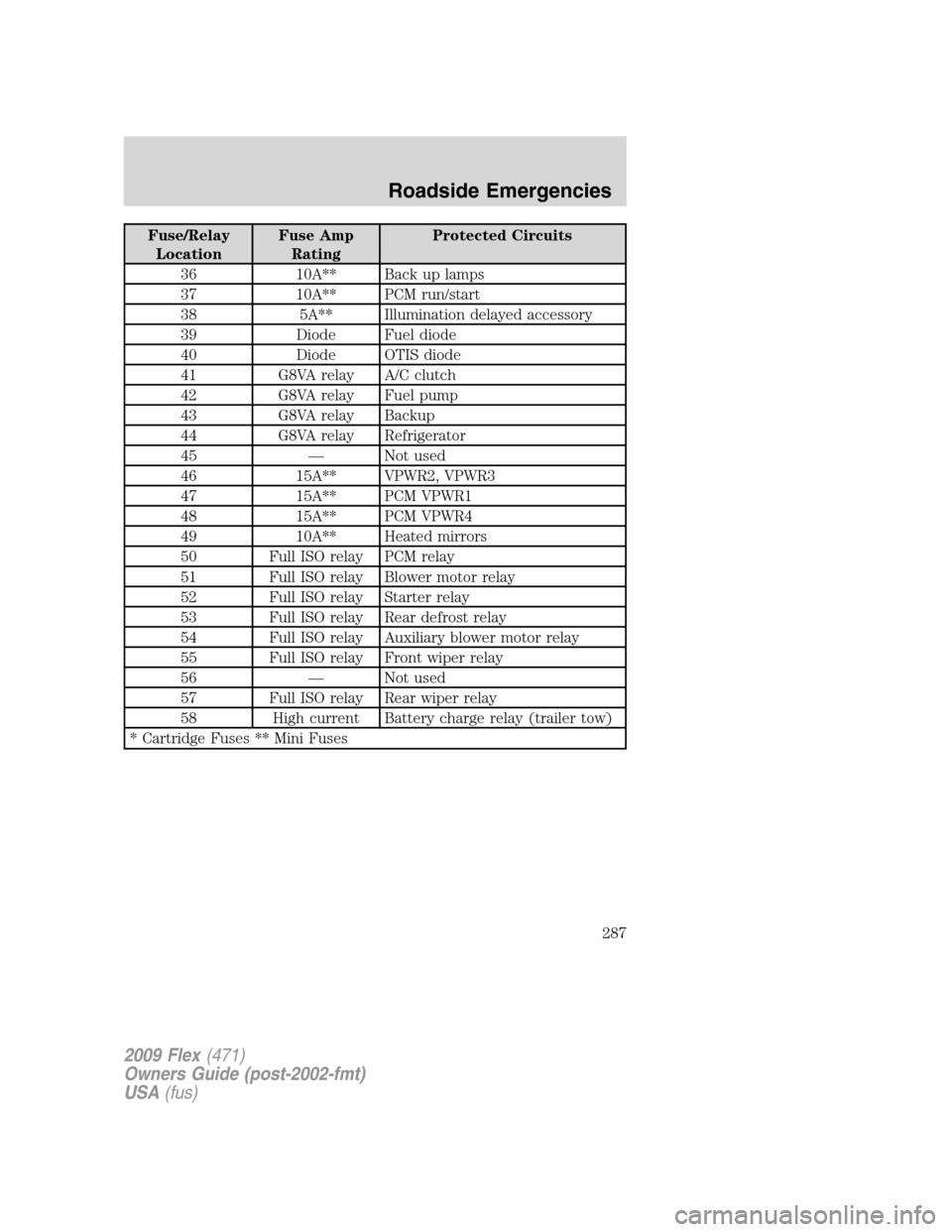
Fuse/Relay
LocationFuse Amp
RatingProtected Circuits
36 10A** Back up lamps
37 10A** PCM run/start
38 5A** Illumination delayed accessory
39 Diode Fuel diode
40 Diode OTIS diode
41 G8VA relay A/C clutch
42 G8VA relay Fuel pump
43 G8VA relay Backup
44 G8VA relay Refrigerator
45 — Not used
46 15A** VPWR2, VPWR3
47 15A** PCM VPWR1
48 15A** PCM VPWR4
49 10A** Heated mirrors
50 Full ISO relay PCM relay
51 Full ISO relay Blower motor relay
52 Full ISO relay Starter relay
53 Full ISO relay Rear defrost relay
54 Full ISO relay Auxiliary blower motor relay
55 Full ISO relay Front wiper relay
56 — Not used
57 Full ISO relay Rear wiper relay
58 High current Battery charge relay (trailer tow)
* Cartridge Fuses ** Mini Fuses
2009 Flex(471)
Owners Guide (post-2002-fmt)
USA(fus)
Roadside Emergencies
287
Page 346 of 374
•Be particularly careful if you are taking “Antabuse” or other forms of
disulfiram for the treatment of alcoholism. Breathing gasoline vapors,
or skin contact could cause an adverse reaction. In sensitive
individuals, serious personal injury or sickness may result. If fuel is
splashed on the skin, promptly wash skin thoroughly with soap and
water. Consult a physician immediately if you experience an adverse
reaction.
WARNING:When refueling always shut the engine off and
never allow sparks or open flames near the filler neck. Never
smoke while refueling. Fuel vapor is extremely hazardous under certain
conditions. Care should be taken to avoid inhaling excess fumes.
WARNING:The flow of fuel through a fuel pump nozzle can
produce static electricity, which can cause a fire if fuel is
pumped into an ungrounded fuel container.
Refueling
WARNING:Fuel vapor burns violently and a fuel fire can cause
severe injuries. To help avoid injuries to you and others:
•Read and follow all the instructions on the pump island;
•Turn off your engine when you are refueling;
•Do not smoke if you are near fuel or refueling your vehicle;
•Keep sparks, flames and smoking materials away from fuel;
•Stay outside your vehicle and do not leave the fuel pump unattended
when refueling your vehicle — this is against the law in some places;
•Keep children away from the fuel pump; never let children pump
fuel.
Use the following guidelines to avoid electrostatic charge build-up when
filling an ungrounded fuel container:
•Place approved fuel container on the ground.
•DO NOT fill a fuel container while it is in the vehicle (including the
cargo area).
•Keep the fuel pump nozzle in contact with the fuel container while
filling.
•DO NOT use a device that would hold the fuel pump handle in the fill
position.
2009 Flex(471)
Owners Guide (post-2002-fmt)
USA(fus)
Maintenance and Specifications
346
Page 347 of 374
Easy Fuel™ “no cap” fuel system
Your fuel tank is equipped with an Easy Fuel™ “no cap” fuel filler
system. This allows you to simply open the fuel filler door and insert the
fuel filler nozzle into the fuel system. The Easy Fuel™ system is
self-sealing and protected against dust, dirt, water and snow/ice.
When fueling your vehicle:
1. Turn the engine off.
2. Open the fuel filler door.
3. Slowly insert the fuel filler nozzle fully into the fuel system. Pump fuel
as normal.
4. After you are done pumping fuel, slowly remove the fuel filler
nozzle—allow about five seconds after pumping fuel before removing the
fuel filler nozzle. This allows residual fuel to drain back into the fuel tank
and not spill onto the vehicle.
If the Check Fuel Fill Inlet lamp or Check Fuel Fill Inlet message comes
on, the fuel fill inlet may not have properly closed. The inlet may have
stuck open or debris may be preventing the inlet from fully closing. At
the next opportunity, safely pull off the road, turn off the engine, open
the fuel filler door and remove any visible debris from the fuel fill
opening. Insert either the fuel fill nozzle or the fuel fill funnel (see
Refilling with a portable fuel containerfor funnel location) provided
with the vehicle several times to dislodge any debris and/or allow the
inlet to close properly. If this action corrects the problem, the Check
Fuel Fill Inlet lamp or Check Fuel Fill Inlet message may not reset
immediately. It may take several driving cycles for the Check Fuel Fill
Inlet lamp or Check Fuel Fill Inlet message to turn off. A driving cycle
consists of an engine start-up (after four or more hours with the engine
off) followed by city/highway driving. Continuing to drive with the Check
Fuel Fill Inlet lamp or Check Fuel Fill Inlet message on may cause the
Service Engine Soon lamp to turn on as well.
2009 Flex(471)
Owners Guide (post-2002-fmt)
USA(fus)
Maintenance and Specifications
347
Page 348 of 374
WARNING:The fuel system may be under pressure. If you hear
a hissing sound near the fuel filler door (Easy Fuel™ “no cap”
fuel system), do not refuel until the sound stops. Otherwise, fuel may
spray out, which could cause serious personal injury.
Choosing the right fuel
Use only UNLEADED fuel or UNLEADED fuel blended with a maximum
of 10% ethanol. Do not use fuel ethanol (E85), diesel, methanol, leaded
fuel or any other fuel. The use of leaded fuel is prohibited by law and
could damage your vehicle.
Your vehicle was not designed to use fuel or fuel additives with metallic
compounds, including manganese-based additives.
Note:Use of any fuel other than those recommended may cause
powertrain damage, a loss of vehicle performance, and repairs may not
be covered under warranty.
Octane recommendations
Your vehicle is designed to use
“Regular” unleaded gasoline with a
pump (R+M)/2 octane rating of 87.
We do not recommend the use of
gasolines labeled as “Regular” in
high altitude areas that are sold with octane ratings less than 87.
Do not be concerned if your engine sometimes knocks lightly. However, if
it knocks heavily under most driving conditions while you are using fuel
with the recommended octane rating, see your authorized dealer to
prevent any engine damage.
87(R+M)/2 METHOD
2009 Flex(471)
Owners Guide (post-2002-fmt)
USA(fus)
Maintenance and Specifications
348
Page 349 of 374
Fuel quality
If you are experiencing starting, rough idle or hesitation driveability
problems, try a different brand of unleaded gasoline. “Premium”
unleaded gasoline is not recommended for vehicles designed to use
“Regular” unleaded gasoline because it may cause these problems to
become more pronounced. If the problems persist, see your authorized
dealer.
Do not add aftermarket fuel additive products to your fuel tank. It
should not be necessary to add any aftermarket products to your fuel
tank if you continue to use high quality fuel of the recommended octane
rating. These products have not been approved for your engine and
could cause damage to the fuel system. Repairs to correct the effects of
using an aftermarket product in your fuel may not be covered by your
warranty.
Many of the world’s automakers approved the World-Wide Fuel Charter
that recommends gasoline specifications to provide improved
performance and emission control system protection for your vehicle.
Gasolines that meet the World-Wide Fuel Charter should be used when
available. Ask your fuel supplier about gasolines that meet the
World-Wide Fuel Charter.
Cleaner air
Ford endorses the use of reformulated “cleaner-burning” gasolines to
improve air quality, per the recommendations in theChoosing the right
fuelsection.
Running out of fuel
Avoid running out of fuel because this situation may have an adverse
effect on powertrain components.
If you have run out of fuel:
•You may need to cycle the ignition from off to on several times after
refueling to allow the fuel system to pump the fuel from the tank to
the engine. On restarting, cranking time will take a few seconds longer
than normal.
•Normally, adding 1 gallon (3.8L) of fuel is enough to restart the
engine. If the vehicle is out of fuel and on a steep grade, more than
1 gallon (3.8L) may be required.
•TheService engine soon
indicator may come on. For more
information on the “service engine soon” indicator, refer toWarning
lights and chimesin theInstrument Clusterchapter.
2009 Flex(471)
Owners Guide (post-2002-fmt)
USA(fus)
Maintenance and Specifications
349
Page 352 of 374
•Use the same side of the same pump and have the vehicle facing the
same direction each time you fill up.
•Have the vehicle loading and distribution the same every time.
Your results will be most accurate if your filling method is consistent.
Calculating fuel economy
1. Fill the fuel tank completely and record the initial odometer reading
(in miles or kilometers).
2. Each time you fill the tank, record the amount of fuel added (in
gallons or liters).
3. After at least three to five tank fill-ups, fill the fuel tank and record
the current odometer reading.
4. Subtract your initial odometer reading from the current odometer
reading.
5. Follow one of the simple calculations in order to determine fuel
economy:
Calculation 1:Divide total miles traveled by total gallons used.
Calculation 2:Multiply liters used by 100, then divide by total
kilometers traveled.
Keep a record for at least one month and record the type of driving (city
or highway). This will provide an accurate estimate of the vehicle’s fuel
economy under current driving conditions. Additionally, keeping records
during summer and winter will show how temperature impacts fuel
economy. In general, lower temperatures give lower fuel economy.
Driving style — good driving and fuel economy habits
Give consideration to the lists that follow and you may be able to change
a number of variables and improve your fuel economy.
Habits
•Smooth, moderate operation can yield up to 10% savings in fuel.
•Steady speeds without stopping will usually give the best fuel
economy.
•Idling for long periods of time (greater than one minute) may waste
fuel.
•Anticipate stopping; slowing down may eliminate the need to stop.
•Sudden or hard accelerations may reduce fuel economy.
2009 Flex(471)
Owners Guide (post-2002-fmt)
USA(fus)
Maintenance and Specifications
352