change wheel FORD FLEX 2011 1.G User Guide
[x] Cancel search | Manufacturer: FORD, Model Year: 2011, Model line: FLEX, Model: FORD FLEX 2011 1.GPages: 418, PDF Size: 2.92 MB
Page 284 of 418
•In the event of an emergency stop, avoid skidding the tires and do not
attempt any sharp steering wheel movements.
•If the vehicle goes from one type of surface to another (i.e., from
concrete to gravel) there will be a change in the way the vehicle
responds to a maneuver (steering, acceleration or braking). Again,
avoid these abrupt inputs.
AWD systems (if equipped)
AWD uses all four wheels to power the vehicle. This increases traction,
enabling you to drive over terrain and road conditions that a
conventional two-wheel drive vehicle cannot.
Sand
When driving over sand, try to keep all four wheels on the most solid
area of the trail. Avoid reducing the tire pressures but shift to a lower
gear and drive steadily through the terrain. Apply the accelerator slowly
and avoid spinning the wheels.
When driving at slow speeds in deep sand under high outside
temperatures, use a low gear when possible. Lower gear operation will
maximize the engine and transmission cooling capability.
Under severe operating conditions, the A/C may cycle on and off to
protect overheating of the engine.
Avoid excessive speed because vehicle momentum can work against you
and cause the vehicle to become stuck to the point that assistance may
be required from another vehicle. Remember, you may be able to back
out the way you came if you proceed with caution.
Mud and water
If you must drive through high water, drive slowly. Traction or brake
capability may be limited.
When driving through water, determine the depth; avoid water higher
than the bottom of the wheel rims (if possible) and proceed slowly. If the
ignition system gets wet, the vehicle may stall.
Once through water, always try the brakes. Wet brakes do not stop the
vehicle as effectively as dry brakes. Drying can be improved by moving
your vehicle slowly while applying light pressure on the brake pedal.
Be cautious of sudden changes in vehicle speed or direction when you
are driving in mud. Even AWD vehicles can lose traction in slick mud. As
when you are driving over sand, apply the accelerator slowly and avoid
spinning your wheels. If the vehicle does slide, steer in the direction of
the slide until you regain control of the vehicle.
Driving
284
2011 Flex(471)
Owners Guide, 1st Printing
USA(fus)
Page 285 of 418
If the engine, transmission, AWD system components or axles are
submerged in water, their fluids should be checked and changed, if
necessary.
Driving through deep water may damage the engine or
transmission.
If the front or rear axle is submerged in water, the axle lubricant and
PTU (Power Transfer Unit) lubricant should be checked and changed if
necessary.
After driving through mud, clean off residue stuck to rotating driveshafts
and tires. Excess mud stuck on tires and rotating driveshafts causes an
imbalance that could damage drive components.
“Tread Lightly” is an educational
program designed to increase public
awareness of land-use regulations
and responsibilities in our nations
wilderness areas. Ford Motor
Company joins the U.S. Forest Service and the Bureau of Land
Management in encouraging you to help preserve our national forest and
other public and private lands by “treading lightly.”
Driving on hilly or sloping terrain
Although natural obstacles may make it necessary to travel diagonally up
or down a hill or steep incline, you should always try to drive straight up
or straight down.Avoid driving crosswise or turning on steep
slopes or hills.A danger lies in losing traction, slipping sideways and
possibly rolling over. Whenever driving on a hill, determine beforehand
the route you will use. Do not drive over the crest of a hill without
seeing what conditions are on the other side. Do not drive in reverse
over a hill without the aid of an observer.
When climbing a steep slope or hill, start in a lower gear rather than
downshifting to a lower gear from a higher gear once the ascent has
started. This reduces strain on the engine and the possibility of stalling.
If you do stall out, Do not try to turn around because you might roll
over. It is better to back down to a safe location.
Apply just enough power to the wheels to climb the hill. Too much
power will cause the tires to slip, spin or lose traction, resulting in loss of
vehicle control.
Driving
285
2011 Flex(471)
Owners Guide, 1st Printing
USA(fus)
Page 286 of 418
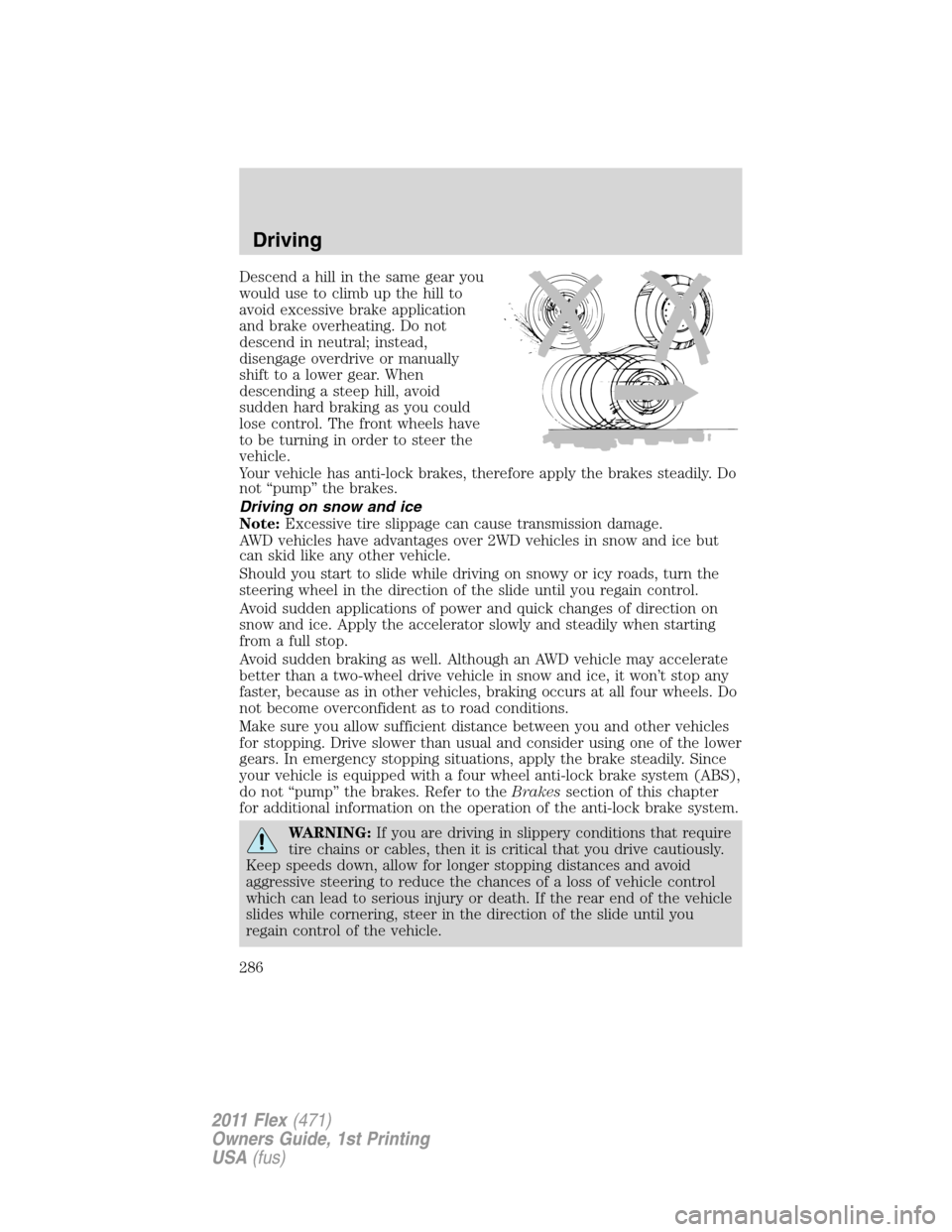
Descend a hill in the same gear you
would use to climb up the hill to
avoid excessive brake application
and brake overheating. Do not
descend in neutral; instead,
disengage overdrive or manually
shift to a lower gear. When
descending a steep hill, avoid
sudden hard braking as you could
lose control. The front wheels have
to be turning in order to steer the
vehicle.
Your vehicle has anti-lock brakes, therefore apply the brakes steadily. Do
not “pump” the brakes.
Driving on snow and ice
Note:Excessive tire slippage can cause transmission damage.
AWD vehicles have advantages over 2WD vehicles in snow and ice but
can skid like any other vehicle.
Should you start to slide while driving on snowy or icy roads, turn the
steering wheel in the direction of the slide until you regain control.
Avoid sudden applications of power and quick changes of direction on
snow and ice. Apply the accelerator slowly and steadily when starting
from a full stop.
Avoid sudden braking as well. Although an AWD vehicle may accelerate
better than a two-wheel drive vehicle in snow and ice, it won’t stop any
faster, because as in other vehicles, braking occurs at all four wheels. Do
not become overconfident as to road conditions.
Make sure you allow sufficient distance between you and other vehicles
for stopping. Drive slower than usual and consider using one of the lower
gears. In emergency stopping situations, apply the brake steadily. Since
your vehicle is equipped with a four wheel anti-lock brake system (ABS),
do not “pump” the brakes. Refer to theBrakessection of this chapter
for additional information on the operation of the anti-lock brake system.
WARNING:If you are driving in slippery conditions that require
tire chains or cables, then it is critical that you drive cautiously.
Keep speeds down, allow for longer stopping distances and avoid
aggressive steering to reduce the chances of a loss of vehicle control
which can lead to serious injury or death. If the rear end of the vehicle
slides while cornering, steer in the direction of the slide until you
regain control of the vehicle.
Driving
286
2011 Flex(471)
Owners Guide, 1st Printing
USA(fus)
Page 301 of 418
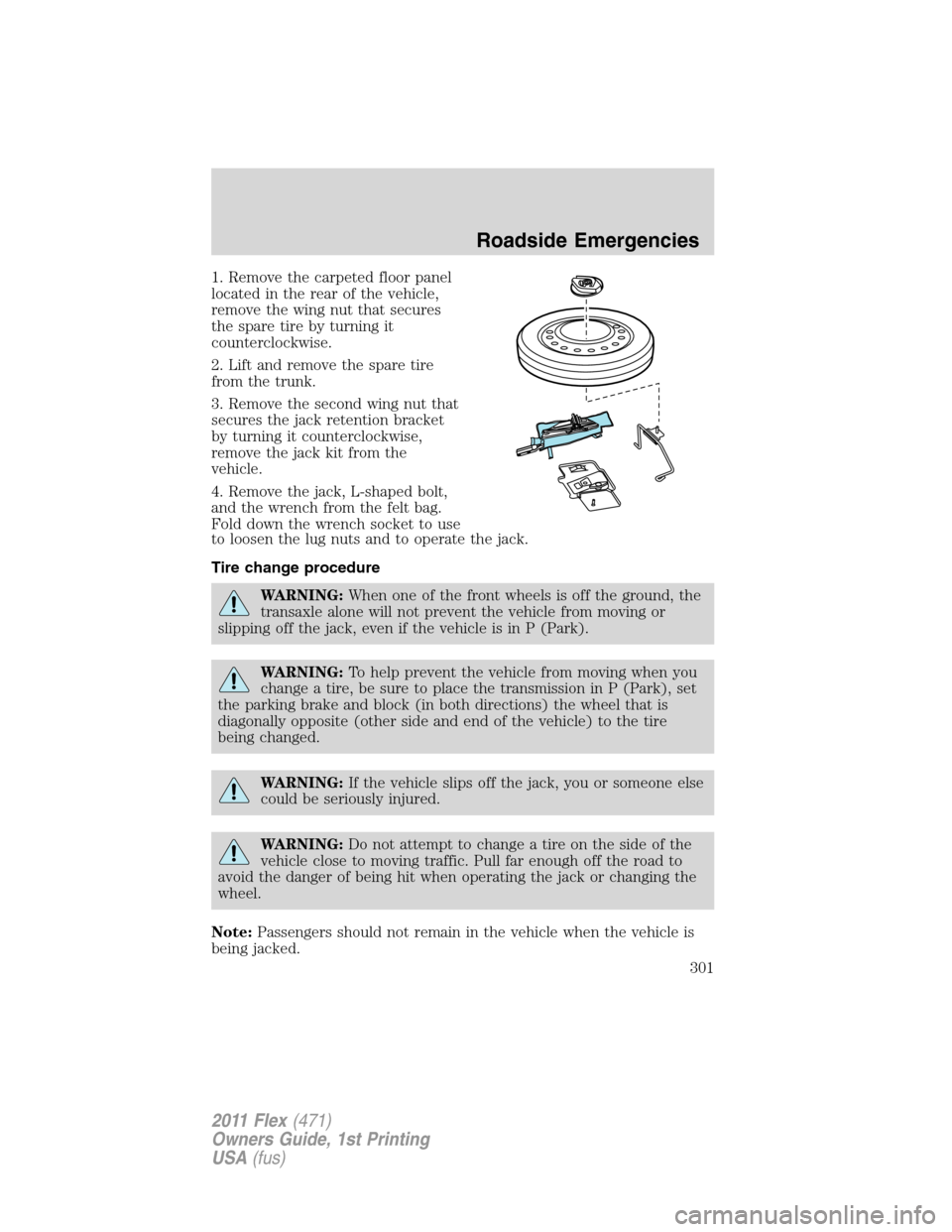
1. Remove the carpeted floor panel
located in the rear of the vehicle,
remove the wing nut that secures
the spare tire by turning it
counterclockwise.
2. Lift and remove the spare tire
from the trunk.
3. Remove the second wing nut that
secures the jack retention bracket
by turning it counterclockwise,
remove the jack kit from the
vehicle.
4. Remove the jack, L-shaped bolt,
and the wrench from the felt bag.
Fold down the wrench socket to use
to loosen the lug nuts and to operate the jack.
Tire change procedure
WARNING:When one of the front wheels is off the ground, the
transaxle alone will not prevent the vehicle from moving or
slipping off the jack, even if the vehicle is in P (Park).
WARNING:To help prevent the vehicle from moving when you
change a tire, be sure to place the transmission in P (Park), set
the parking brake and block (in both directions) the wheel that is
diagonally opposite (other side and end of the vehicle) to the tire
being changed.
WARNING:If the vehicle slips off the jack, you or someone else
could be seriously injured.
WARNING:Do not attempt to change a tire on the side of the
vehicle close to moving traffic. Pull far enough off the road to
avoid the danger of being hit when operating the jack or changing the
wheel.
Note:Passengers should not remain in the vehicle when the vehicle is
being jacked.
Roadside Emergencies
301
2011 Flex(471)
Owners Guide, 1st Printing
USA(fus)
Page 398 of 418
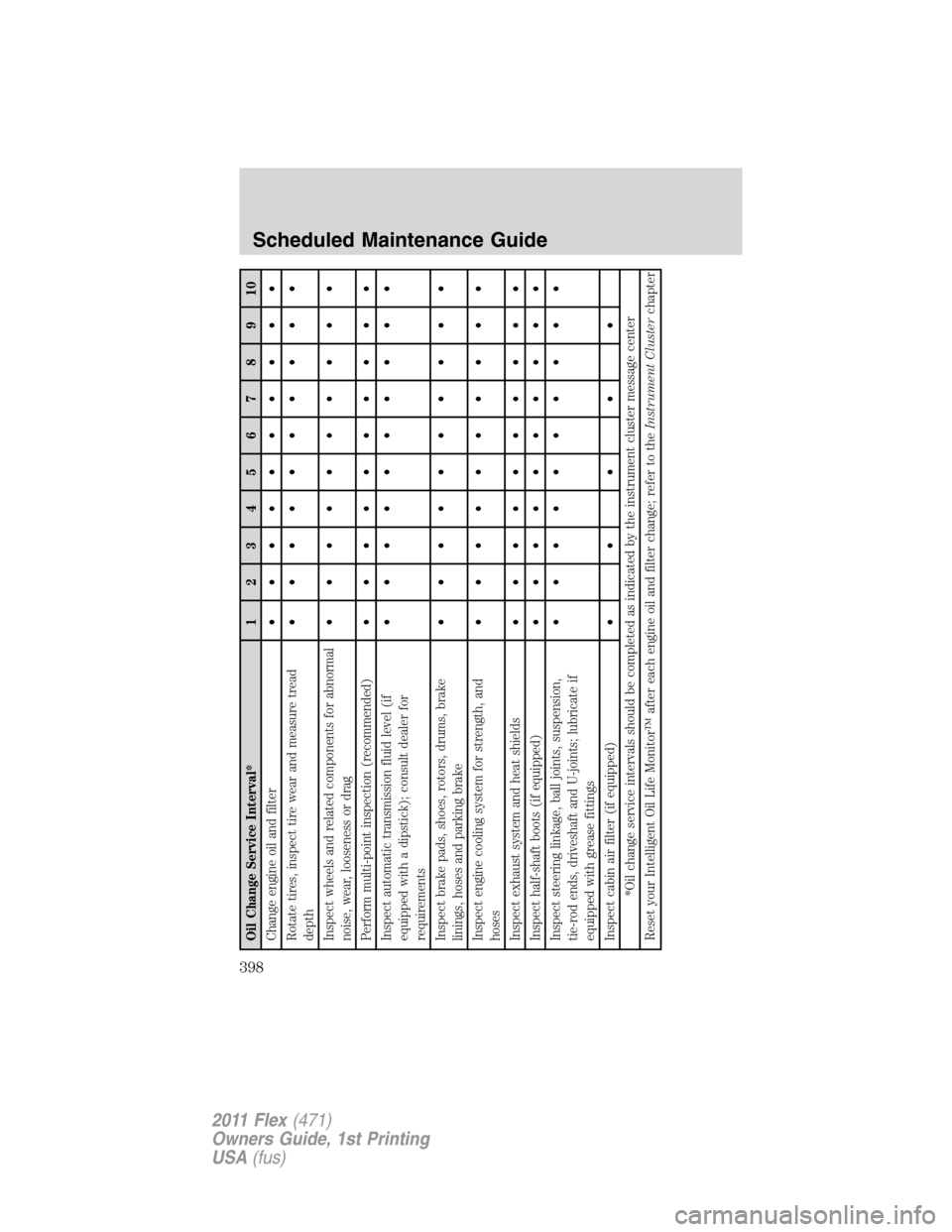
Oil Change Service Interval* 1 2 345678910
Change engine oil and filter• •••••••••
Rotate tires, inspect tire wear and measure tread
depth• •••••••••
Inspect wheels and related components for abnormal
noise, wear, looseness or drag• •••••••••
Perform multi-point inspection (recommended)• •••••••••
Inspect automatic transmission fluid level (if
equipped with a dipstick); consult dealer for
requirements• •••••••••
Inspect brake pads, shoes, rotors, drums, brake
linings, hoses and parking brake• •••••••••
Inspect engine cooling system for strength, and
hoses• •••••••••
Inspect exhaust system and heat shields• •••••••••
Inspect half-shaft boots (if equipped)• •••••••••
Inspect steering linkage, ball joints, suspension,
tie-rod ends, driveshaft and U-joints; lubricate if
equipped with grease fittings• •••••••••
Inspect cabin air filter (if equipped)• ••••
*Oil change service intervals should be completed as indicated by the instrument cluster message center
Reset your Intelligent Oil Life Monitor™ after each engine oil and filter change; refer to theInstrument Clusterchapter
Scheduled Maintenance Guide
398
2011 Flex(471)
Owners Guide, 1st Printing
USA(fus)
Page 399 of 418
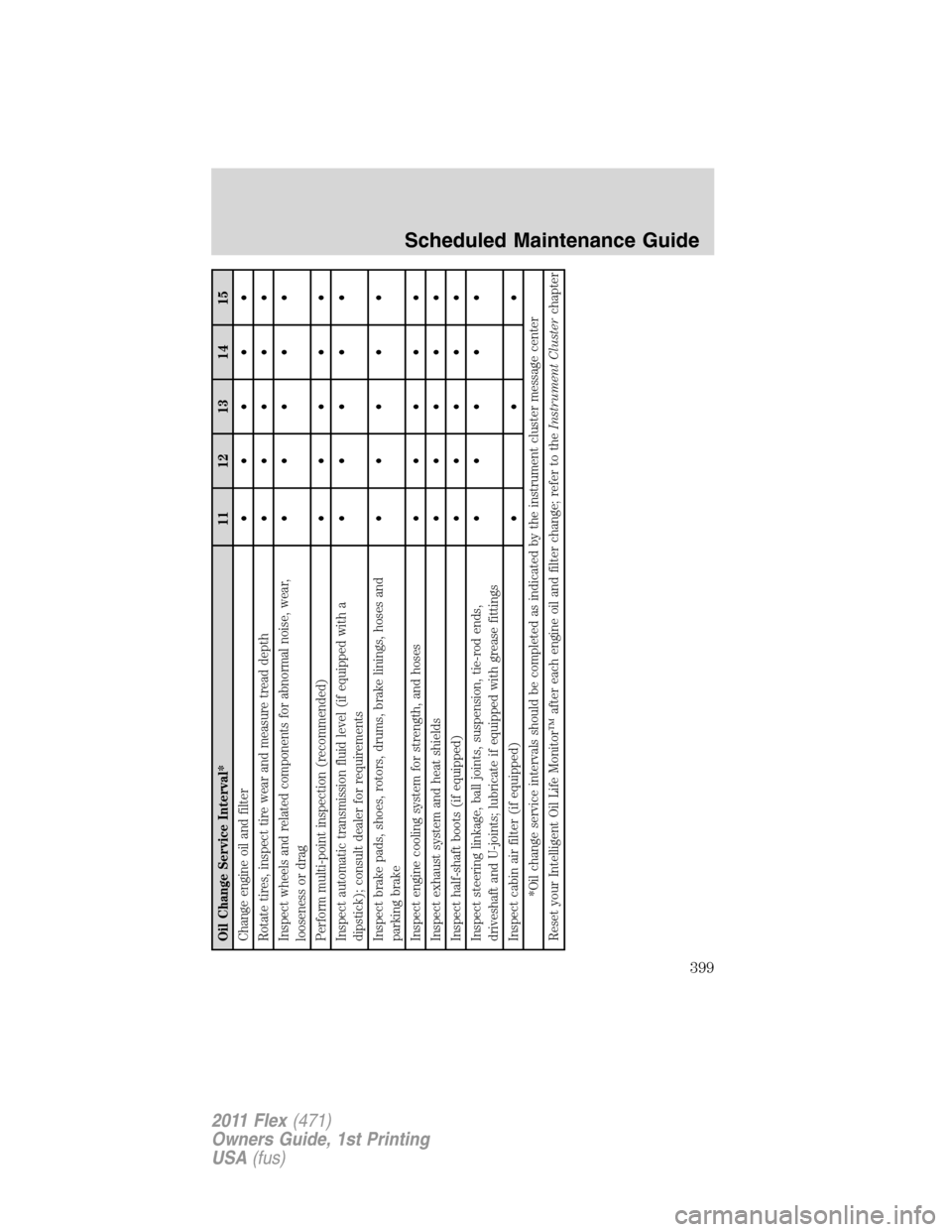
Oil Change Service Interval* 11 12 13 14 15
Change engine oil and filter•••••
Rotate tires, inspect tire wear and measure tread depth•••••
Inspect wheels and related components for abnormal noise, wear,
looseness or drag•••••
Perform multi-point inspection (recommended)•••••
Inspect automatic transmission fluid level (if equipped with a
dipstick); consult dealer for requirements•••••
Inspect brake pads, shoes, rotors, drums, brake linings, hoses and
parking brake•••••
Inspect engine cooling system for strength, and hoses•••••
Inspect exhaust system and heat shields•••••
Inspect half-shaft boots (if equipped)•••••
Inspect steering linkage, ball joints, suspension, tie-rod ends,
driveshaft and U-joints; lubricate if equipped with grease fittings•••••
Inspect cabin air filter (if equipped)•••
*Oil change service intervals should be completed as indicated by the instrument cluster message center
Reset your Intelligent Oil Life Monitor™ after each engine oil and filter change; refer to theInstrument Clusterchapter
Scheduled Maintenance Guide
399
2011 Flex(471)
Owners Guide, 1st Printing
USA(fus)
Page 400 of 418
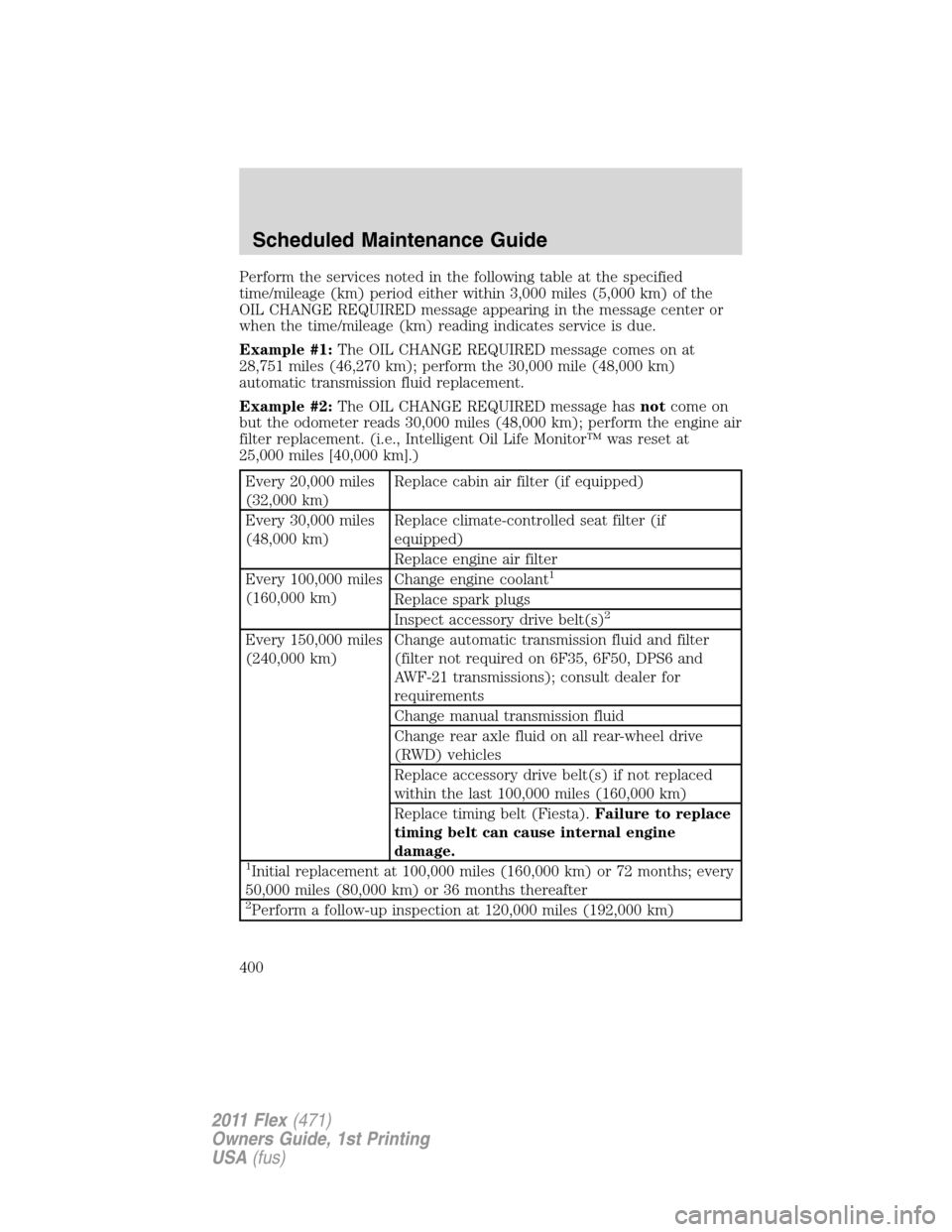
Perform the services noted in the following table at the specified
time/mileage (km) period either within 3,000 miles (5,000 km) of the
OIL CHANGE REQUIRED message appearing in the message center or
when the time/mileage (km) reading indicates service is due.
Example #1:The OIL CHANGE REQUIRED message comes on at
28,751 miles (46,270 km); perform the 30,000 mile (48,000 km)
automatic transmission fluid replacement.
Example #2:The OIL CHANGE REQUIRED message hasnotcome on
but the odometer reads 30,000 miles (48,000 km); perform the engine air
filter replacement. (i.e., Intelligent Oil Life Monitor™ was reset at
25,000 miles [40,000 km].)
Every 20,000 miles
(32,000 km)Replace cabin air filter (if equipped)
Every 30,000 miles
(48,000 km)Replace climate-controlled seat filter (if
equipped)
Replace engine air filter
Every 100,000 miles
(160,000 km)Change engine coolant
1
Replace spark plugs
Inspect accessory drive belt(s)2
Every 150,000 miles
(240,000 km)Change automatic transmission fluid and filter
(filter not required on 6F35, 6F50, DPS6 and
AWF-21 transmissions); consult dealer for
requirements
Change manual transmission fluid
Change rear axle fluid on all rear-wheel drive
(RWD) vehicles
Replace accessory drive belt(s) if not replaced
within the last 100,000 miles (160,000 km)
Replace timing belt (Fiesta).Failure to replace
timing belt can cause internal engine
damage.
1Initial replacement at 100,000 miles (160,000 km) or 72 months; every
50,000 miles (80,000 km) or 36 months thereafter
2Perform a follow-up inspection at 120,000 miles (192,000 km)
Scheduled Maintenance Guide
400
2011 Flex(471)
Owners Guide, 1st Printing
USA(fus)
Page 406 of 418
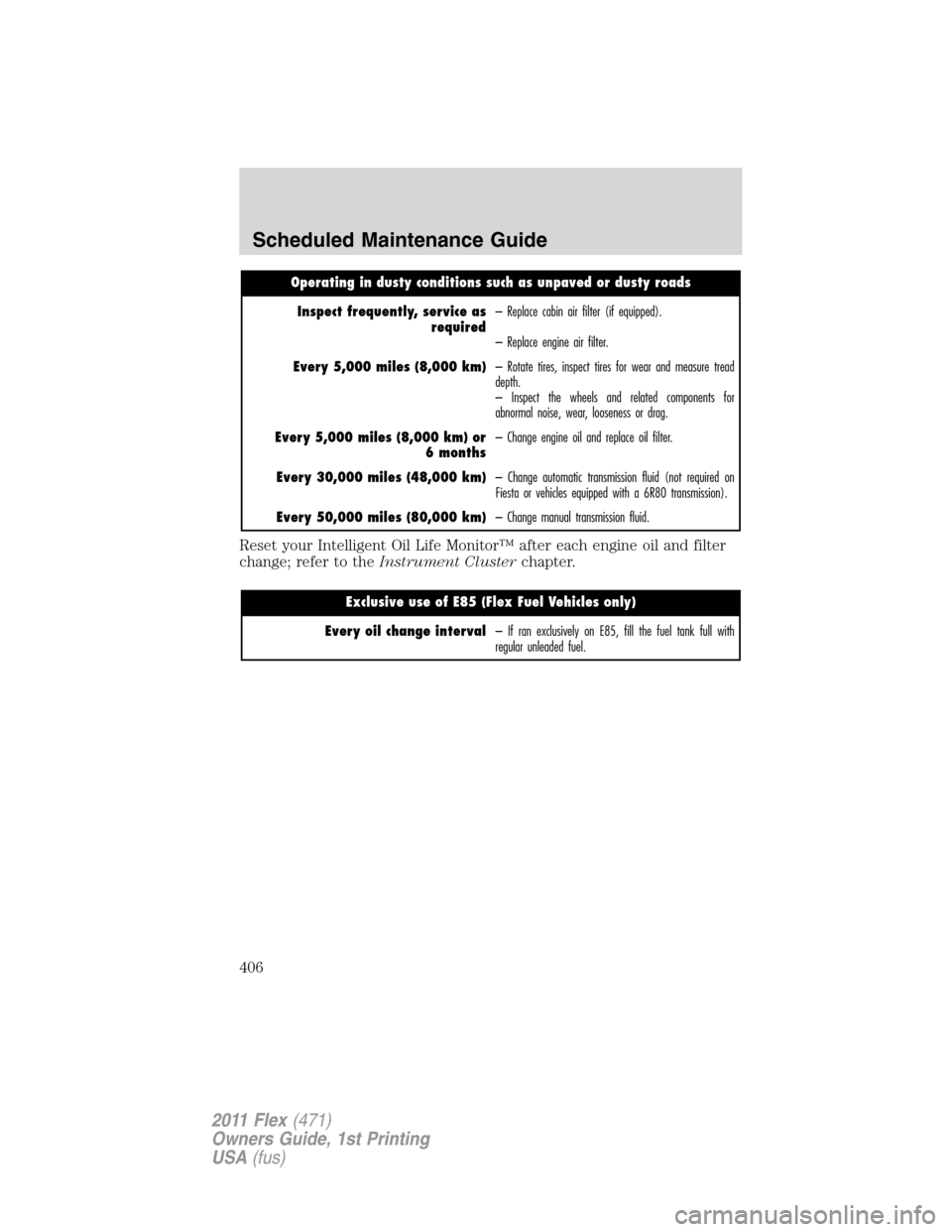
Operating in dusty conditions such as unpaved or dusty roads
Inspect frequently, service as
required– Replace cabin air filter (if equipped).
– Replace engine air filter.
Every 5,000 miles (8,000 km)– Rotate tires, inspect tires for wear and measure tread
depth.
– Inspect the wheels and related components for
abnormal noise, wear, looseness or drag.
Every 5,000 miles (8,000 km) or
6 months– Change engine oil and replace oil filter.
Every 30,000 miles (48,000 km)– Change automatic transmission fluid (not required on
Fiesta or vehicles equipped with a 6R80 transmission).
Every 50,000 miles (80,000 km)– Change manual transmission fluid.
Reset your Intelligent Oil Life Monitor™ after each engine oil and filter
change; refer to theInstrument Clusterchapter.
Exclusive use of E85 (Flex Fuel Vehicles only)
Every oil change interval– If ran exclusively on E85, fill the fuel tank full with
regular unleaded fuel.
Scheduled Maintenance Guide
406
2011 Flex(471)
Owners Guide, 1st Printing
USA(fus)