tow FORD FLEX 2011 1.G Owner's Manual
[x] Cancel search | Manufacturer: FORD, Model Year: 2011, Model line: FLEX, Model: FORD FLEX 2011 1.GPages: 418, PDF Size: 2.92 MB
Page 158 of 418
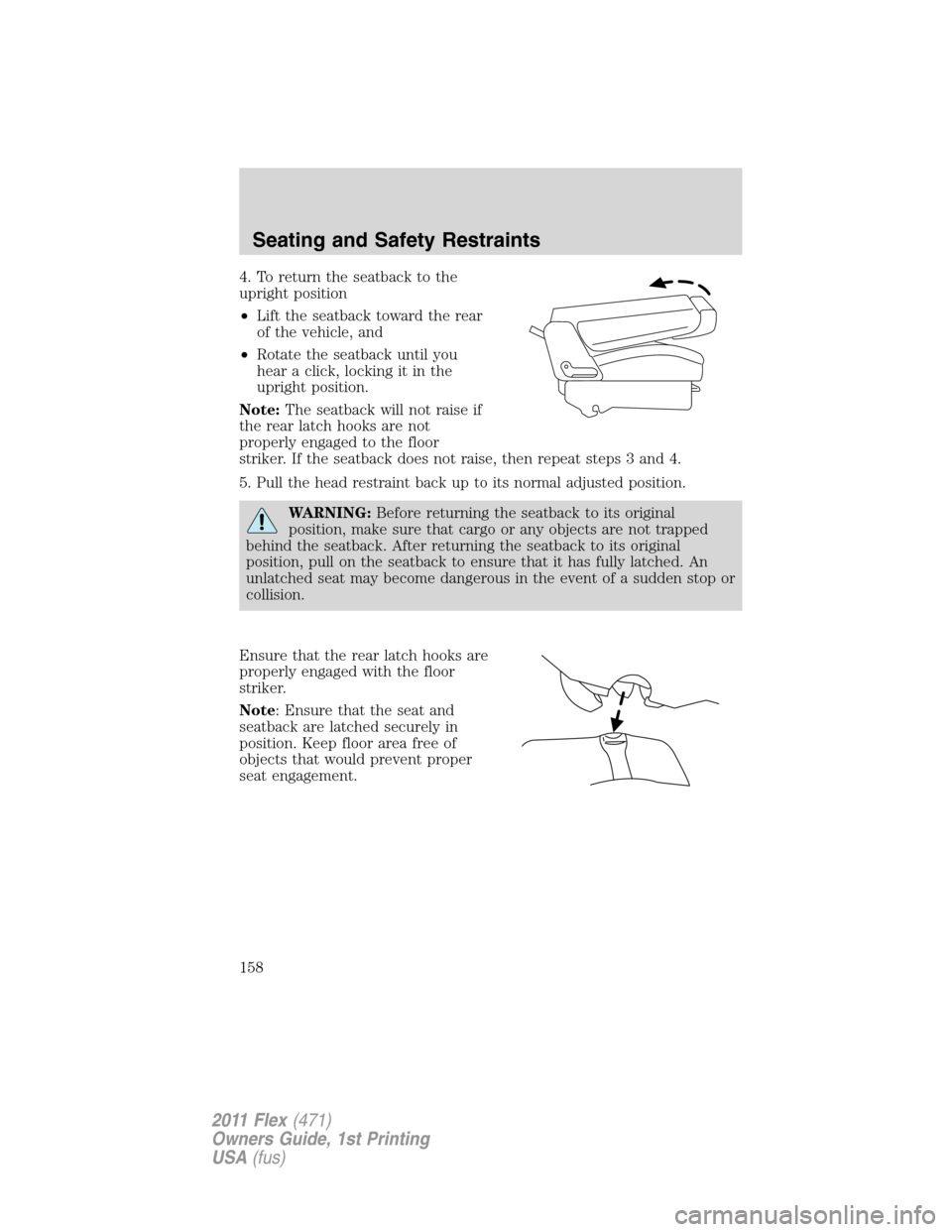
4. To return the seatback to the
upright position
•Lift the seatback toward the rear
of the vehicle, and
•Rotate the seatback until you
hear a click, locking it in the
upright position.
Note:The seatback will not raise if
the rear latch hooks are not
properly engaged to the floor
striker. If the seatback does not raise, then repeat steps 3 and 4.
5. Pull the head restraint back up to its normal adjusted position.
WARNING:Before returning the seatback to its original
position, make sure that cargo or any objects are not trapped
behind the seatback. After returning the seatback to its original
position, pull on the seatback to ensure that it has fully latched. An
unlatched seat may become dangerous in the event of a sudden stop or
collision.
Ensure that the rear latch hooks are
properly engaged with the floor
striker.
Note: Ensure that the seat and
seatback are latched securely in
position. Keep floor area free of
objects that would prevent proper
seat engagement.
Seating and Safety Restraints
158
2011 Flex(471)
Owners Guide, 1st Printing
USA(fus)
Page 160 of 418
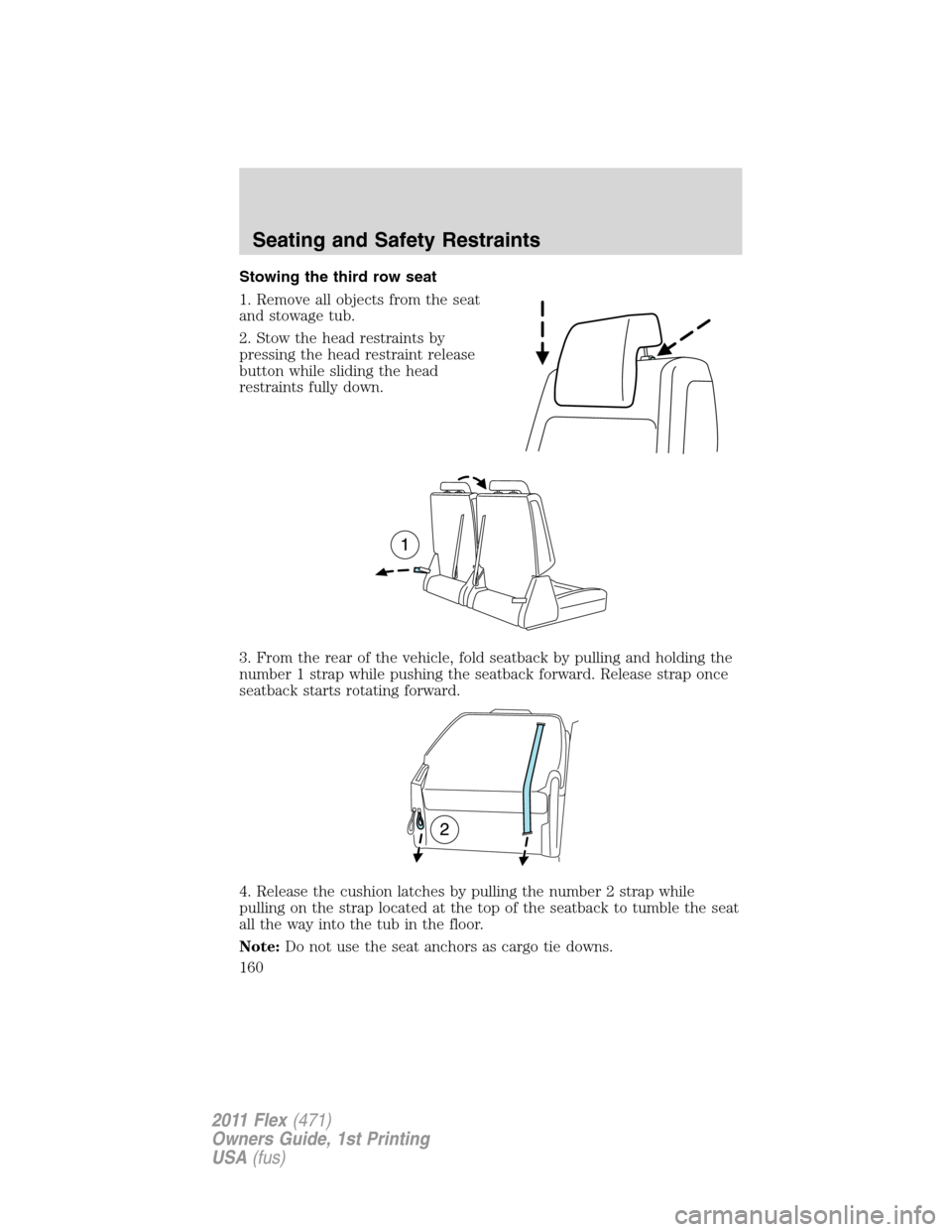
Stowing the third row seat
1. Remove all objects from the seat
and stowage tub.
2. Stow the head restraints by
pressing the head restraint release
button while sliding the head
restraints fully down.
3. From the rear of the vehicle, fold seatback by pulling and holding the
number 1 strap while pushing the seatback forward. Release strap once
seatback starts rotating forward.
4. Release the cushion latches by pulling the number 2 strap while
pulling on the strap located at the top of the seatback to tumble the seat
all the way into the tub in the floor.
Note:Do not use the seat anchors as cargo tie downs.
Seating and Safety Restraints
160
2011 Flex(471)
Owners Guide, 1st Printing
USA(fus)
Page 161 of 418
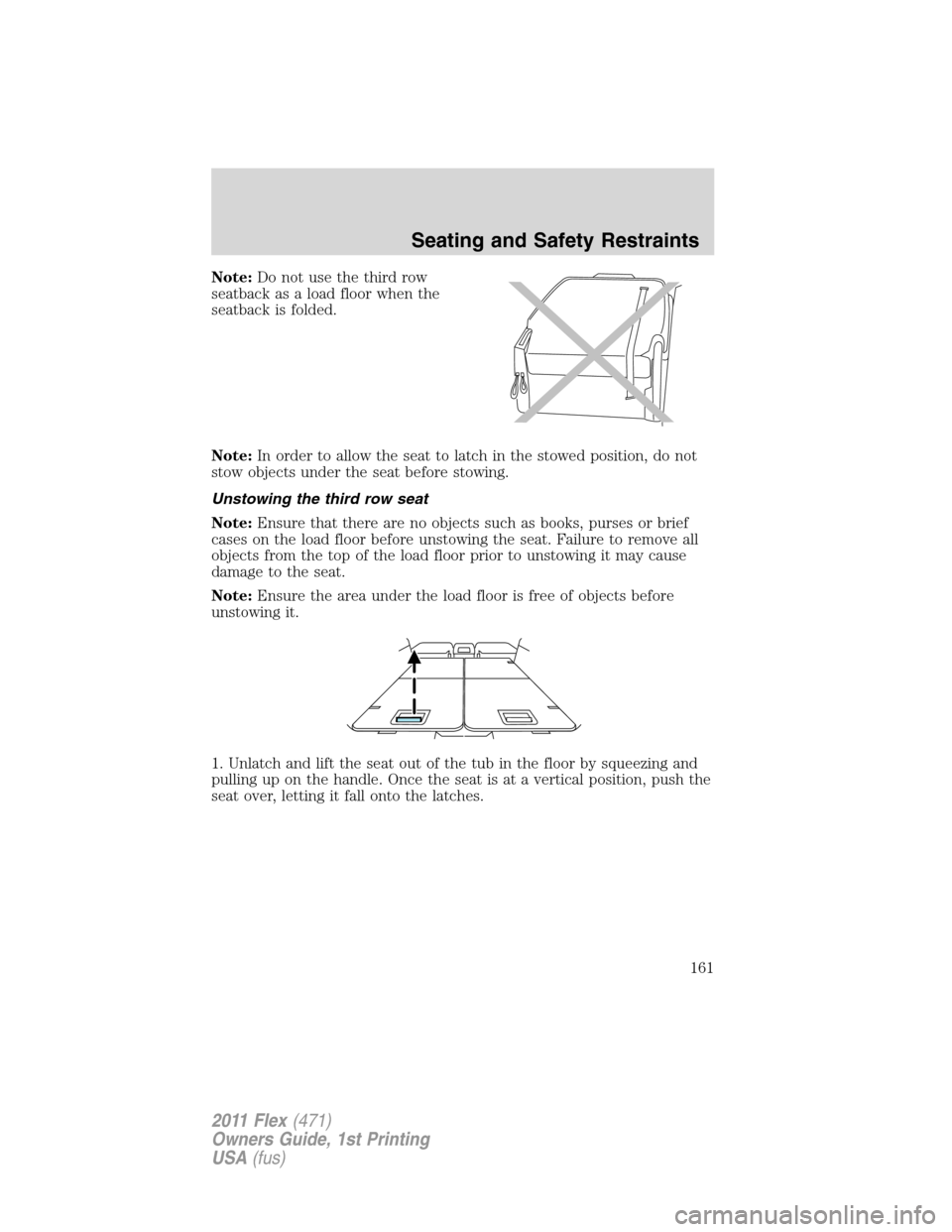
Note:Do not use the third row
seatback as a load floor when the
seatback is folded.
Note:In order to allow the seat to latch in the stowed position, do not
stow objects under the seat before stowing.
Unstowing the third row seat
Note:Ensure that there are no objects such as books, purses or brief
cases on the load floor before unstowing the seat. Failure to remove all
objects from the top of the load floor prior to unstowing it may cause
damage to the seat.
Note:Ensure the area under the load floor is free of objects before
unstowing it.
1. Unlatch and lift the seat out of the tub in the floor by squeezing and
pulling up on the handle. Once the seat is at a vertical position, push the
seat over, letting it fall onto the latches.
Seating and Safety Restraints
161
2011 Flex(471)
Owners Guide, 1st Printing
USA(fus)
Page 162 of 418
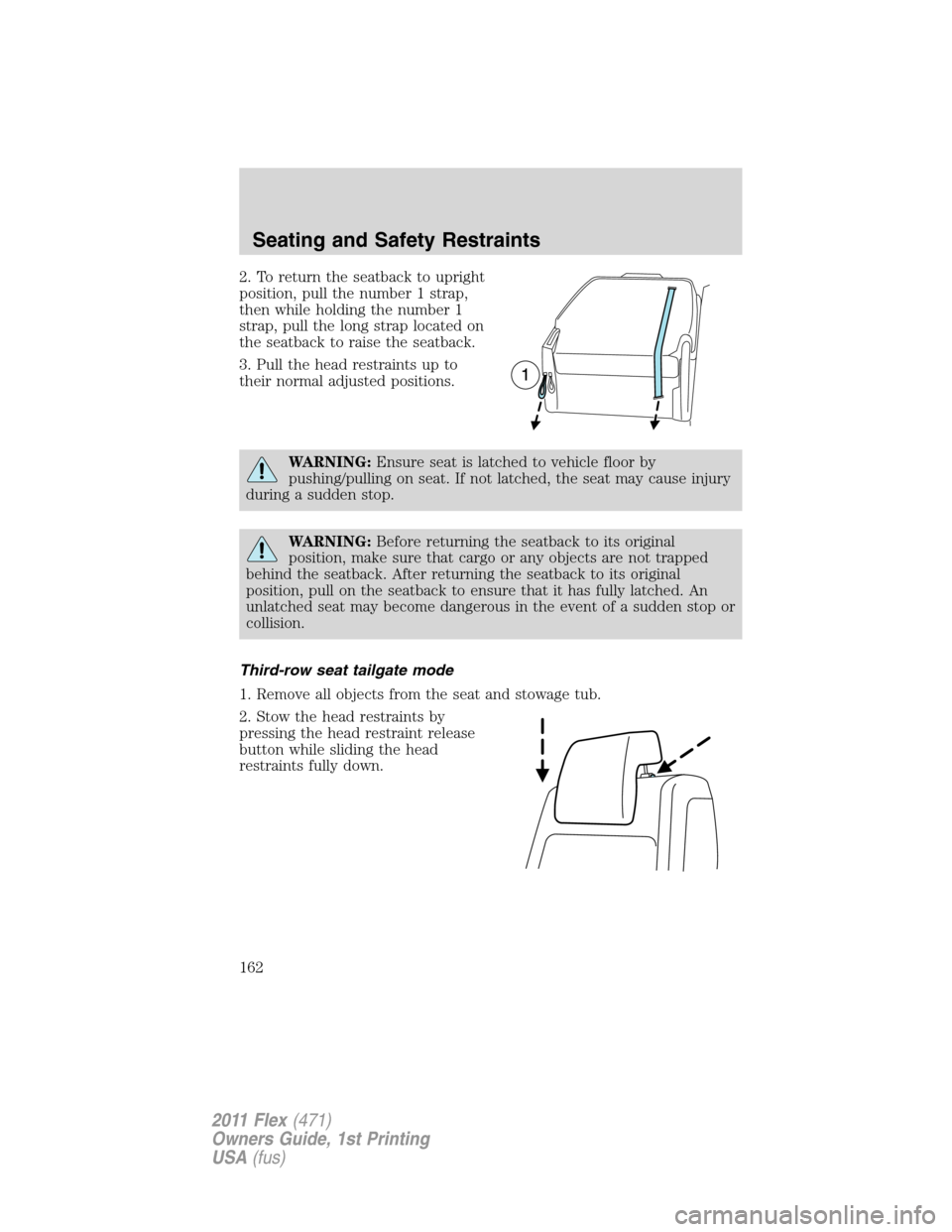
2. To return the seatback to upright
position, pull the number 1 strap,
then while holding the number 1
strap, pull the long strap located on
the seatback to raise the seatback.
3. Pull the head restraints up to
their normal adjusted positions.
WARNING:Ensure seat is latched to vehicle floor by
pushing/pulling on seat. If not latched, the seat may cause injury
during a sudden stop.
WARNING:Before returning the seatback to its original
position, make sure that cargo or any objects are not trapped
behind the seatback. After returning the seatback to its original
position, pull on the seatback to ensure that it has fully latched. An
unlatched seat may become dangerous in the event of a sudden stop or
collision.
Third-row seat tailgate mode
1. Remove all objects from the seat and stowage tub.
2. Stow the head restraints by
pressing the head restraint release
button while sliding the head
restraints fully down.
Seating and Safety Restraints
162
2011 Flex(471)
Owners Guide, 1st Printing
USA(fus)
Page 163 of 418
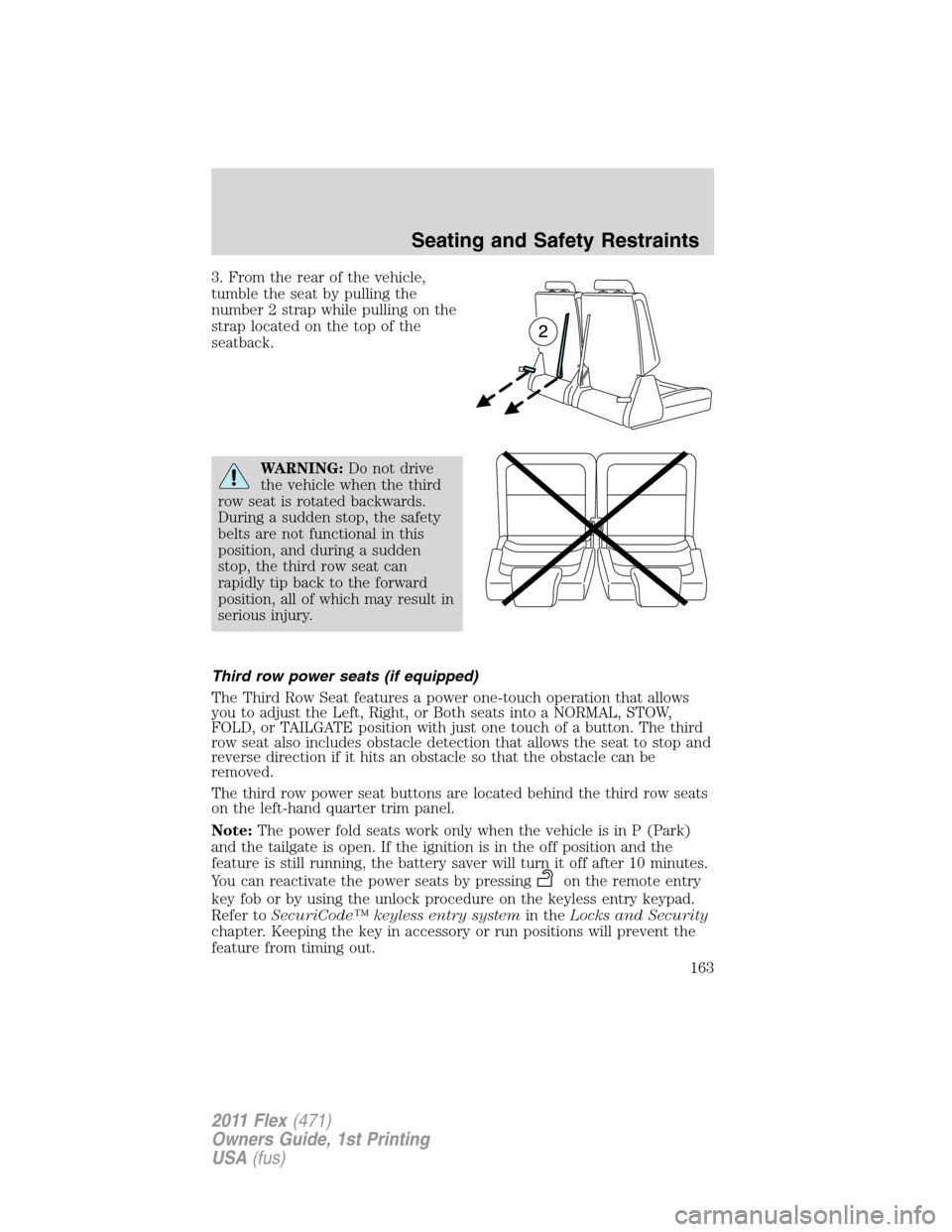
3. From the rear of the vehicle,
tumble the seat by pulling the
number 2 strap while pulling on the
strap located on the top of the
seatback.
WARNING:Do not drive
the vehicle when the third
row seat is rotated backwards.
During a sudden stop, the safety
belts are not functional in this
position, and during a sudden
stop, the third row seat can
rapidly tip back to the forward
position, all of which may result in
serious injury.
Third row power seats (if equipped)
The Third Row Seat features a power one-touch operation that allows
you to adjust the Left, Right, or Both seats into a NORMAL, STOW,
FOLD, or TAILGATE position with just one touch of a button. The third
row seat also includes obstacle detection that allows the seat to stop and
reverse direction if it hits an obstacle so that the obstacle can be
removed.
The third row power seat buttons are located behind the third row seats
on the left-hand quarter trim panel.
Note:The power fold seats work only when the vehicle is in P (Park)
and the tailgate is open. If the ignition is in the off position and the
feature is still running, the battery saver will turn it off after 10 minutes.
You can reactivate the power seats by pressing
on the remote entry
key fob or by using the unlock procedure on the keyless entry keypad.
Refer toSecuriCode™ keyless entry systemin theLocks and Security
chapter. Keeping the key in accessory or run positions will prevent the
feature from timing out.
Seating and Safety Restraints
163
2011 Flex(471)
Owners Guide, 1st Printing
USA(fus)
Page 164 of 418
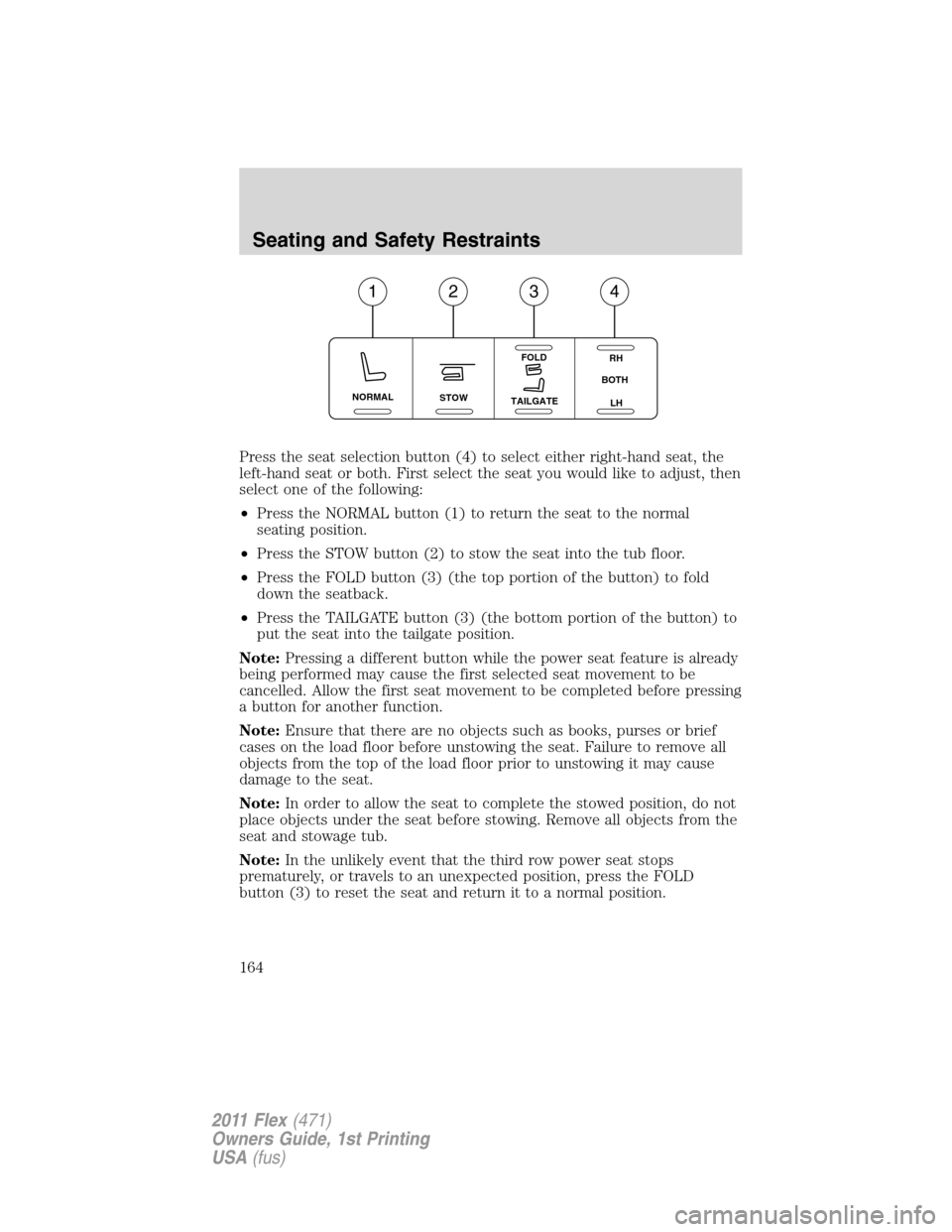
Press the seat selection button (4) to select either right-hand seat, the
left-hand seat or both. First select the seat you would like to adjust, then
select one of the following:
•Press the NORMAL button (1) to return the seat to the normal
seating position.
•Press the STOW button (2) to stow the seat into the tub floor.
•Press the FOLD button (3) (the top portion of the button) to fold
down the seatback.
•Press the TAILGATE button (3) (the bottom portion of the button) to
put the seat into the tailgate position.
Note:Pressing a different button while the power seat feature is already
being performed may cause the first selected seat movement to be
cancelled. Allow the first seat movement to be completed before pressing
a button for another function.
Note:Ensure that there are no objects such as books, purses or brief
cases on the load floor before unstowing the seat. Failure to remove all
objects from the top of the load floor prior to unstowing it may cause
damage to the seat.
Note:In order to allow the seat to complete the stowed position, do not
place objects under the seat before stowing. Remove all objects from the
seat and stowage tub.
Note:In the unlikely event that the third row power seat stops
prematurely, or travels to an unexpected position, press the FOLD
button (3) to reset the seat and return it to a normal position.
1234
NORMAL
STOWRH
BOTH
LH
FOLD
TAILGATE
Seating and Safety Restraints
164
2011 Flex(471)
Owners Guide, 1st Printing
USA(fus)
Page 182 of 418
WARNING:Modifying or adding equipment to the front end of
the vehicle (including frame, bumper, front end body structure
and tow hooks) may affect the performance of the airbag system,
increasing the risk of injury. Do not modify the front end of the
vehicle.
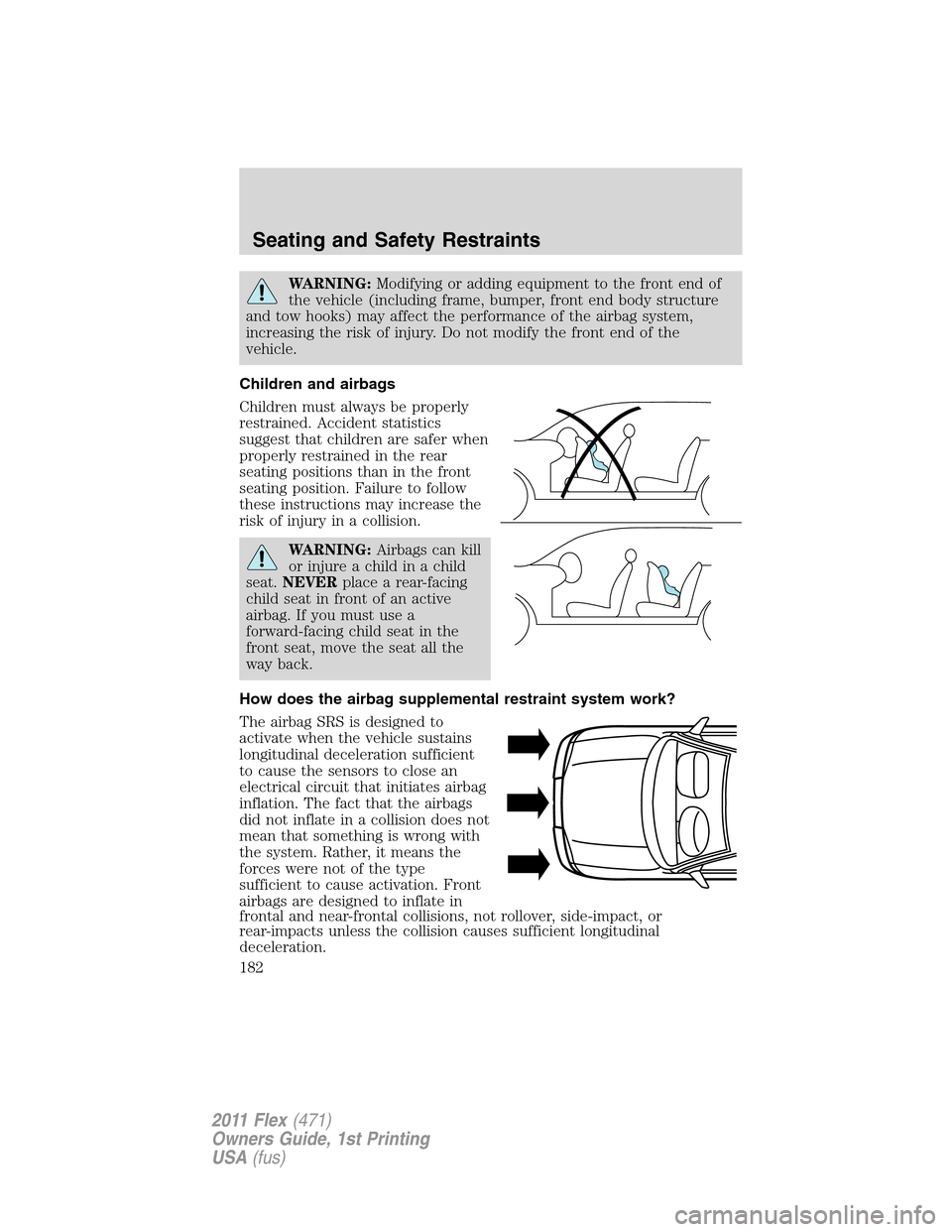
Children and airbags
Children must always be properly
restrained. Accident statistics
suggest that children are safer when
properly restrained in the rear
seating positions than in the front
seating position. Failure to follow
these instructions may increase the
risk of injury in a collision.
WARNING:Airbags can kill
or injure a child in a child
seat.NEVERplace a rear-facing
child seat in front of an active
airbag. If you must use a
forward-facing child seat in the
front seat, move the seat all the
way back.
How does the airbag supplemental restraint system work?
The airbag SRS is designed to
activate when the vehicle sustains
longitudinal deceleration sufficient
to cause the sensors to close an
electrical circuit that initiates airbag
inflation. The fact that the airbags
did not inflate in a collision does not
mean that something is wrong with
the system. Rather, it means the
forces were not of the type
sufficient to cause activation. Front
airbags are designed to inflate in
frontal and near-frontal collisions, not rollover, side-impact, or
rear-impacts unless the collision causes sufficient longitudinal
deceleration.
Seating and Safety Restraints
182
2011 Flex(471)
Owners Guide, 1st Printing
USA(fus)
Page 187 of 418
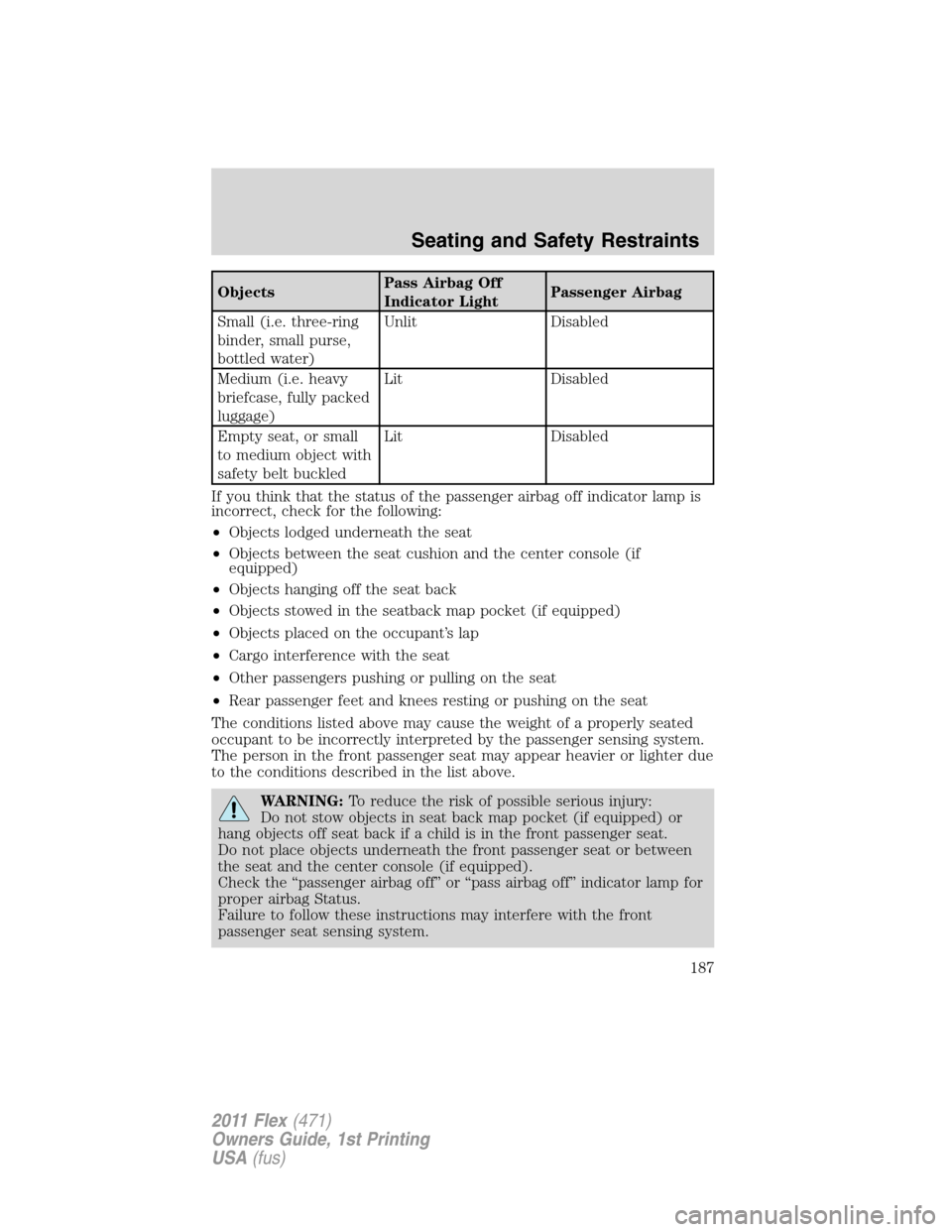
ObjectsPass Airbag Off
Indicator LightPassenger Airbag
Small (i.e. three-ring
binder, small purse,
bottled water)Unlit Disabled
Medium (i.e. heavy
briefcase, fully packed
luggage)Lit Disabled
Empty seat, or small
to medium object with
safety belt buckledLit Disabled
If you think that the status of the passenger airbag off indicator lamp is
incorrect, check for the following:
•Objects lodged underneath the seat
•Objects between the seat cushion and the center console (if
equipped)
•Objects hanging off the seat back
•Objects stowed in the seatback map pocket (if equipped)
•Objects placed on the occupant’s lap
•Cargo interference with the seat
•Other passengers pushing or pulling on the seat
•Rear passenger feet and knees resting or pushing on the seat
The conditions listed above may cause the weight of a properly seated
occupant to be incorrectly interpreted by the passenger sensing system.
The person in the front passenger seat may appear heavier or lighter due
to the conditions described in the list above.
WARNING:To reduce the risk of possible serious injury:
Do not stow objects in seat back map pocket (if equipped) or
hang objects off seat back if a child is in the front passenger seat.
Do not place objects underneath the front passenger seat or between
the seat and the center console (if equipped).
Check the “passenger airbag off” or “pass airbag off” indicator lamp for
proper airbag Status.
Failure to follow these instructions may interfere with the front
passenger seat sensing system.
Seating and Safety Restraints
187
2011 Flex(471)
Owners Guide, 1st Printing
USA(fus)
Page 198 of 418
WARNING:Never let a passenger hold a child on his or her lap
while the vehicle is moving. The passenger cannot protect the
child from injury in a collision, which may result in serious injury or
death.
WARNING:Never use pillows, books, or towels to boost a child.
They can slide around and increase the likelihood of injury or
death in a collision.
WARNING:Always restrain an unoccupied child seat or booster
seat. These objects may become projectiles in a collision or
sudden stop, which may increase the risk of serious injury.
WARNING:Never place, or allow a child to place, the shoulder
belt under a child’s arm or behind the back because it reduces
the protection for the upper part of the body and may increase the risk
of injury or death in a collision.
WARNING:Do not leave children, unreliable adults, or pets
unattended in your vehicle.
Transporting children
Always make sure your child is secured properly in a device that is
appropriate for their age, height and weight. All children are shaped
differently. The child height, age and weight thresholds provided are
recommendations or the minimum requirements of law. The National
Highway Traffic Safety Administration (NHTSA) provides education and
training to ensure that all children ages 0 to 16 are properly restrained in
the correct restraint system. Ford recommends checking with a NHTSA
Certified Child Passenger Safety Technician (CPST) and your
pediatrician to make sure your seat is appropriate for your child and
properly installed in the vehicle. To locate a child seat fitting station and
CPST contact the NHTSA toll free at1-888-327-4236or on the internet
at http://www.nhtsa.dot.gov. In Canada, check with your local St. John
Ambulance office for referral to a CPST or for further information,
contact your provincial ministry of transportation, your local St. John
Ambulance office at http://www.sfa.ca, or Transport Canada at
1–800–333–0371 (http://www.tc.gc.ca).
Seating and Safety Restraints
198
2011 Flex(471)
Owners Guide, 1st Printing
USA(fus)
Page 202 of 418
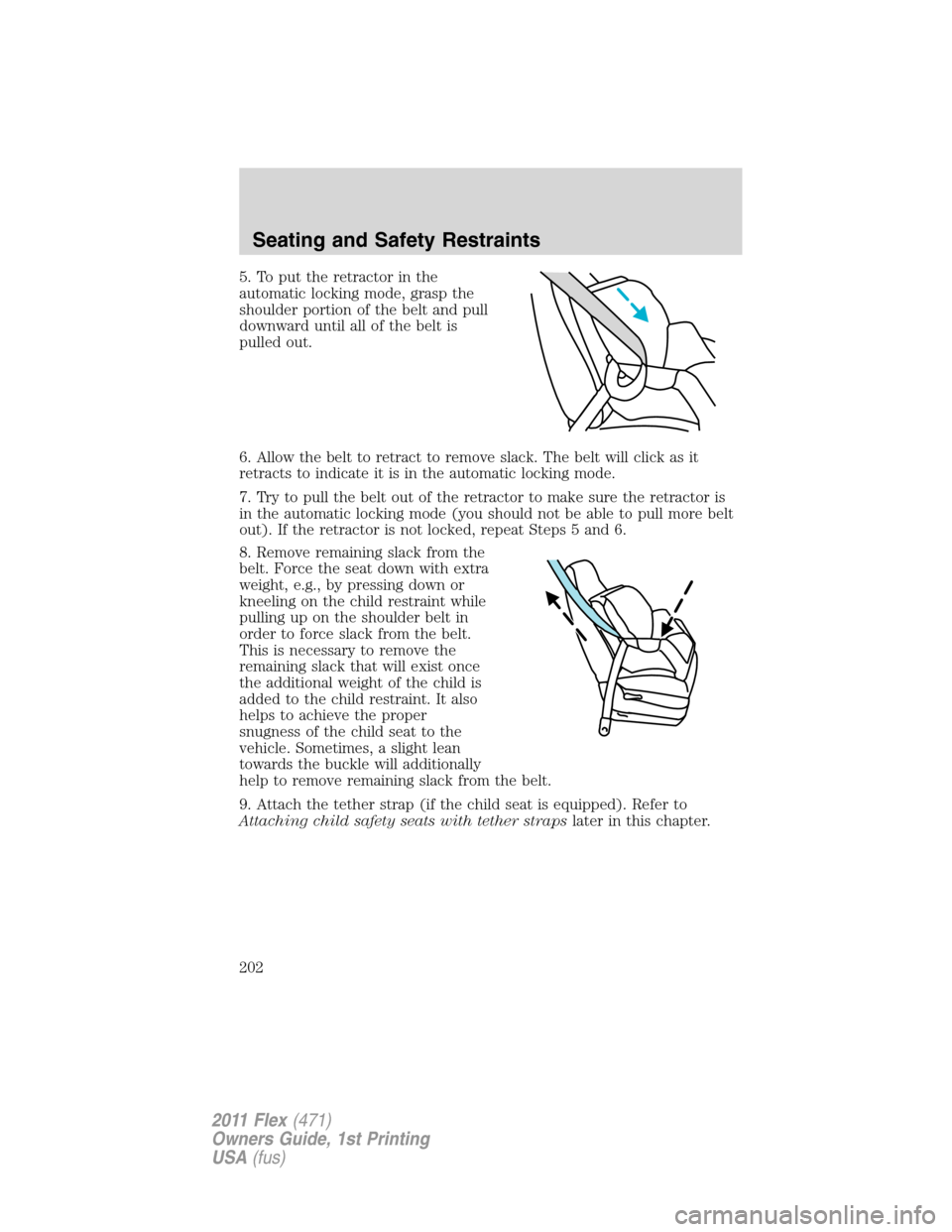
5. To put the retractor in the
automatic locking mode, grasp the
shoulder portion of the belt and pull
downward until all of the belt is
pulled out.
6. Allow the belt to retract to remove slack. The belt will click as it
retracts to indicate it is in the automatic locking mode.
7. Try to pull the belt out of the retractor to make sure the retractor is
in the automatic locking mode (you should not be able to pull more belt
out). If the retractor is not locked, repeat Steps 5 and 6.
8. Remove remaining slack from the
belt. Force the seat down with extra
weight, e.g., by pressing down or
kneeling on the child restraint while
pulling up on the shoulder belt in
order to force slack from the belt.
This is necessary to remove the
remaining slack that will exist once
the additional weight of the child is
added to the child restraint. It also
helps to achieve the proper
snugness of the child seat to the
vehicle. Sometimes, a slight lean
towards the buckle will additionally
help to remove remaining slack from the belt.
9. Attach the tether strap (if the child seat is equipped). Refer to
Attaching child safety seats with tether strapslater in this chapter.
Seating and Safety Restraints
202
2011 Flex(471)
Owners Guide, 1st Printing
USA(fus)