tires FORD FLEX 2017 1.G Service Manual
[x] Cancel search | Manufacturer: FORD, Model Year: 2017, Model line: FLEX, Model: FORD FLEX 2017 1.GPages: 496, PDF Size: 5.92 MB
Page 299 of 496
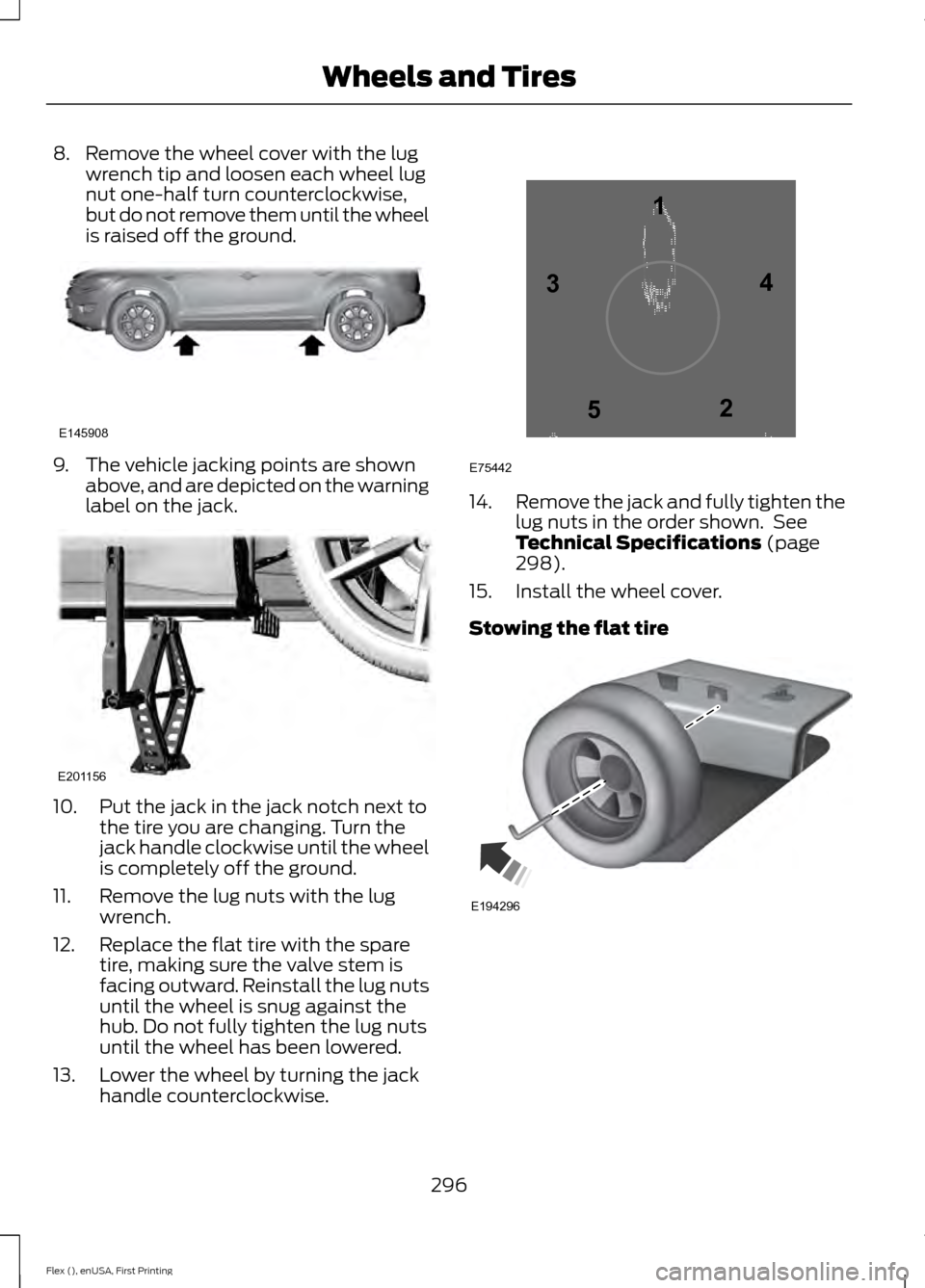
8. Remove the wheel cover with the lug
wrench tip and loosen each wheel lug
nut one-half turn counterclockwise,
but do not remove them until the wheel
is raised off the ground. 9. The vehicle jacking points are shown
above, and are depicted on the warning
label on the jack. 10. Put the jack in the jack notch next to
the tire you are changing. Turn the
jack handle clockwise until the wheel
is completely off the ground.
11. Remove the lug nuts with the lug wrench.
12. Replace the flat tire with the spare tire, making sure the valve stem is
facing outward. Reinstall the lug nuts
until the wheel is snug against the
hub. Do not fully tighten the lug nuts
until the wheel has been lowered.
13. Lower the wheel by turning the jack handle counterclockwise. 14.
Remove the jack and fully tighten the
lug nuts in the order shown. See
Technical Specifications (page
298).
15. Install the wheel cover.
Stowing the flat tire 296
Flex (), enUSA, First Printing Wheels and TiresE145908 E201156 12
3
4
5
E75442 E194296
Page 300 of 496
If you are stowing the flat tire, remove the
L-shaped bolt from the external pocket of
the felt bag. With the third row seat in the
raised position, stand the flat tire in the
rear of the vehicle with the tire
’s valve stem
facing the rear of the vehicle. Fasten the
flat tire to the vehicle by inserting the
L-shaped bolt through one of the lug bolt
holes in the wheel. Turn it clockwise into
the threaded hole in the vehicle until the
tire is secured.
If you are stowing the temporary spare tire,
place the tire over the jack and secure it
with the large wing nut.
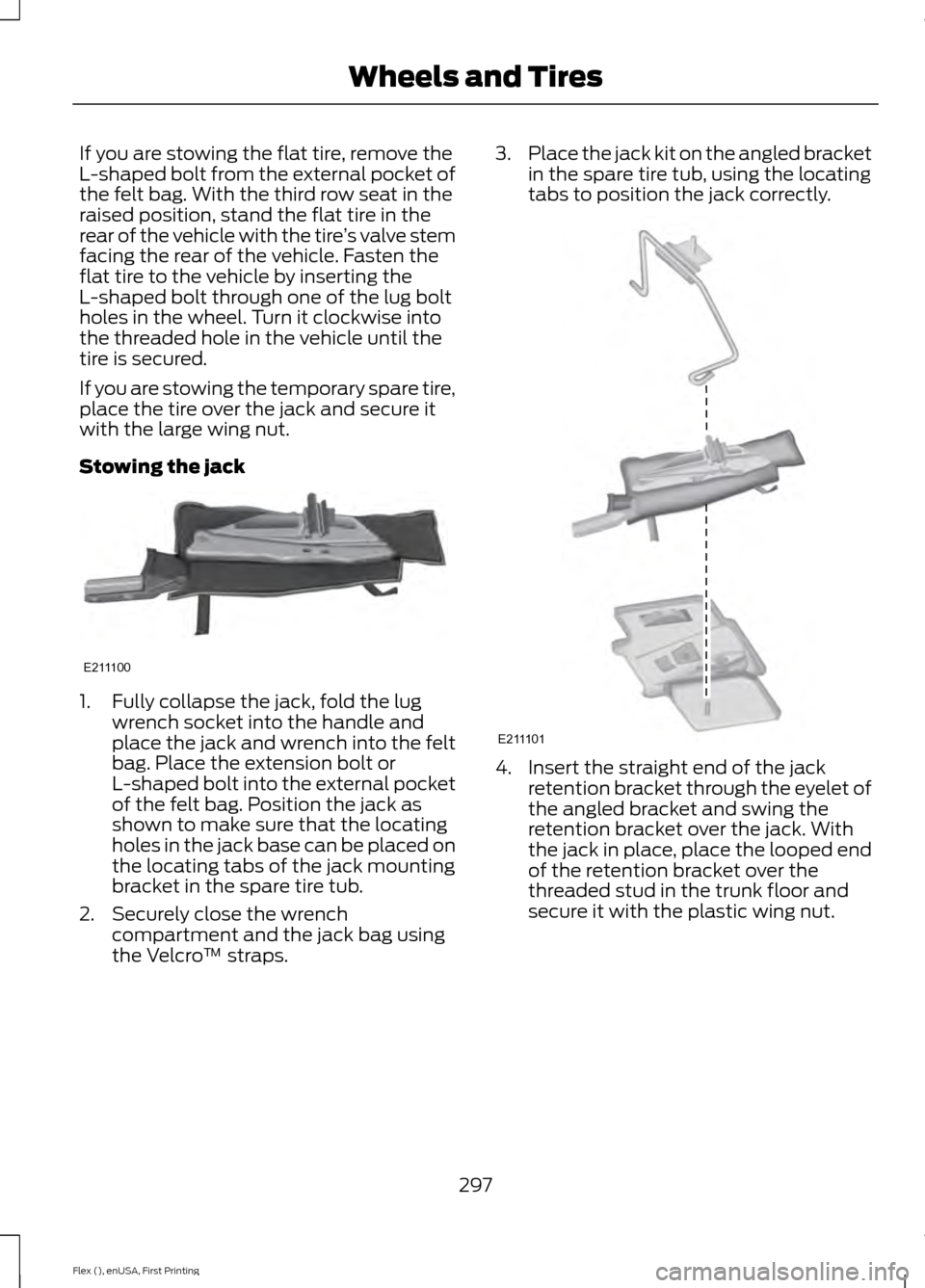
Stowing the jack 1. Fully collapse the jack, fold the lug
wrench socket into the handle and
place the jack and wrench into the felt
bag. Place the extension bolt or
L-shaped bolt into the external pocket
of the felt bag. Position the jack as
shown to make sure that the locating
holes in the jack base can be placed on
the locating tabs of the jack mounting
bracket in the spare tire tub.
2. Securely close the wrench compartment and the jack bag using
the Velcro ™ straps. 3.
Place the jack kit on the angled bracket
in the spare tire tub, using the locating
tabs to position the jack correctly. 4. Insert the straight end of the jack
retention bracket through the eyelet of
the angled bracket and swing the
retention bracket over the jack. With
the jack in place, place the looped end
of the retention bracket over the
threaded stud in the trunk floor and
secure it with the plastic wing nut.
297
Flex (), enUSA, First Printing Wheels and TiresE211100 E211101
Page 301 of 496
TECHNICAL SPECIFICATIONS
Wheel Lug Nut Torque Specifications
WARNING
When you install a wheel, always remove any corrosion, dirt or foreign materials
present on the mounting surfaces of the wheel or the surface of the wheel hub,
brake drum or brake disc that contacts the wheel. Make sure to secure any fasteners
that attach the rotor to the hub so they do not interfere with the mounting surfaces of
the wheel. Installing wheels without correct metal-to-metal contact at the wheel mounting
surfaces can cause the wheel nuts to loosen and the wheel to come off while your vehicle
is in motion, resulting in loss of vehicle control, personal injury or death. lb.ft (Nm) *
Bolt size
100 lb.ft (135 Nm)
1/2 x 20
*Torque specifications are for nut and bolt threads free of dirt and rust. Use only Ford
recommended replacement fasteners.
Retighten the lug nuts to the specified torque within 100 miles (160 kilometers) after any
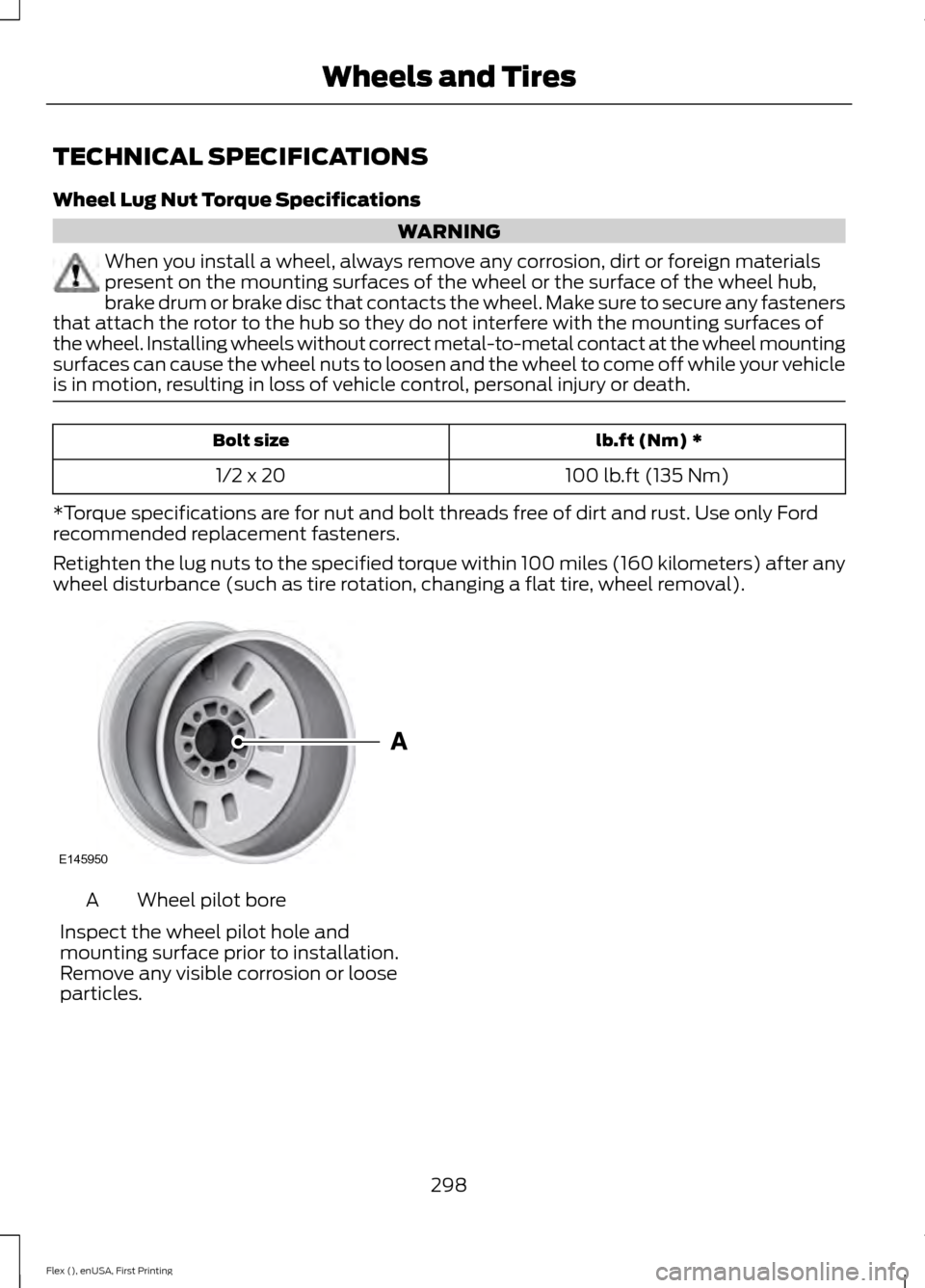
wheel disturbance (such as tire rotation, changing a flat tire, wheel removal). Wheel pilot bore
A
Inspect the wheel pilot hole and
mounting surface prior to installation.
Remove any visible corrosion or loose
particles.
298
Flex (), enUSA, First Printing Wheels and TiresE145950
Page 444 of 496
Check every month
Engine oil level.
Function of all interior and exterior lights.
Tires (including spare) for wear and proper pressure. Windshield washer fluid level. Check every six months
Battery connections. Clean if necessary.
Body and door drain holes for obstructions. Clean if necessary. Cooling system fluid level and coolant strength.
Door weatherstrips for wear. Lubricate if necessary.
Hinges, latches and outside locks for proper operation. Lubricate if necessary. Parking brake for proper operation.
Safety belts and seat latches for wear and function.
Safety warning lamps (brake, ABS, airbag and safety belt) for operation.
Washer spray and wiper operation. Clean or replace blades as necessary.
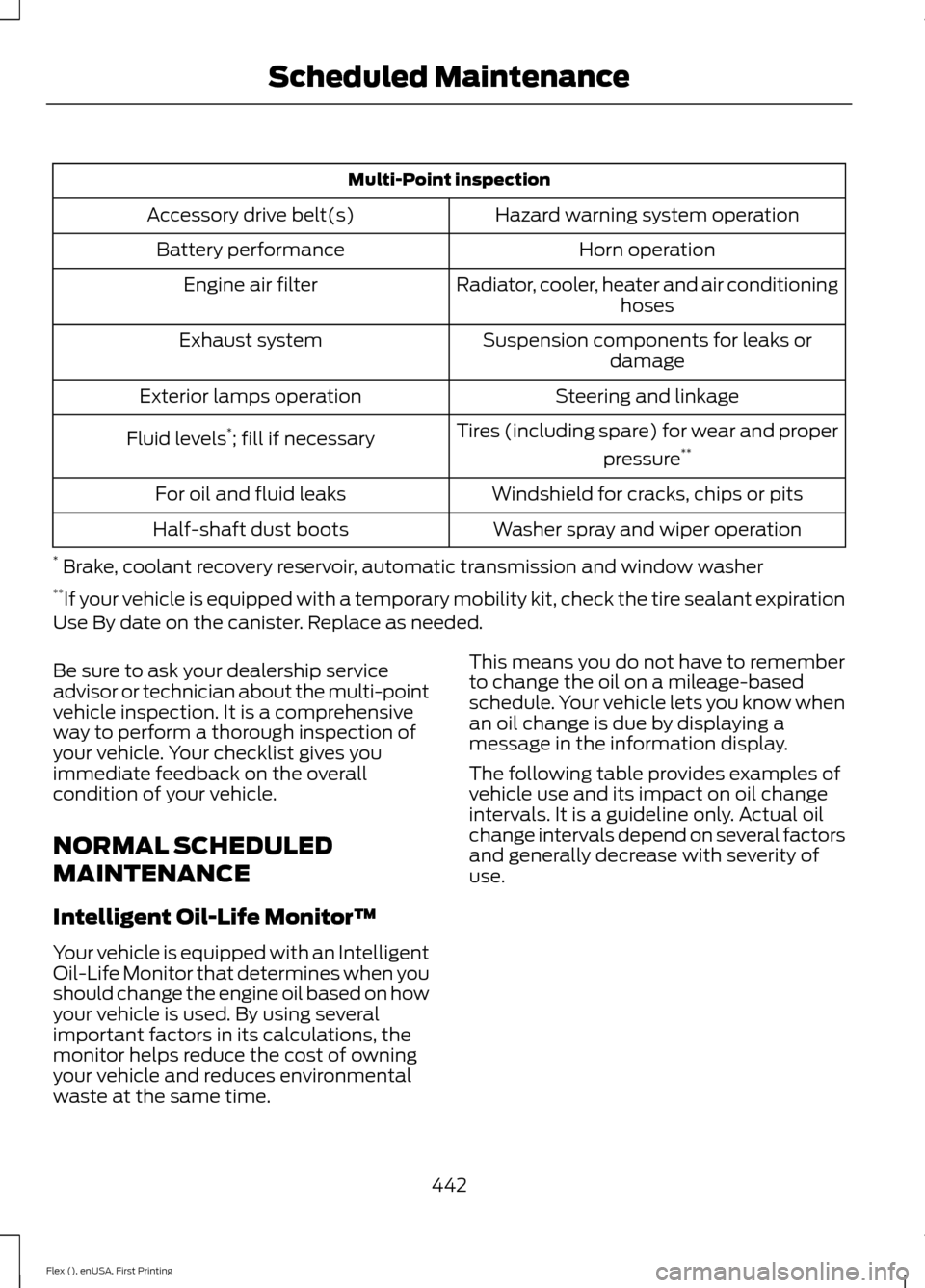
Multi-Point Inspection
In order to keep your vehicle running right,
it is important to have the systems on your
vehicle checked regularly. This can help
identify potential issues and prevent major
problems. We recommend having the
following multi-point inspection performed
at every scheduled maintenance interval
to help make sure your vehicle keeps
running great.
441
Flex (), enUSA, First Printing Scheduled Maintenance
Page 445 of 496
Multi-Point inspection
Hazard warning system operation
Accessory drive belt(s)
Horn operation
Battery performance
Radiator, cooler, heater and air conditioninghoses
Engine air filter
Suspension components for leaks ordamage
Exhaust system
Steering and linkage
Exterior lamps operation
Tires (including spare) for wear and properpressure**
Fluid levels *
; fill if necessary
Windshield for cracks, chips or pits
For oil and fluid leaks
Washer spray and wiper operation
Half-shaft dust boots
* Brake, coolant recovery reservoir, automatic transmission and window washer
** If your vehicle is equipped with a temporary mobility kit, check the tire sealant expiration
Use By date on the canister. Replace as needed.
Be sure to ask your dealership service
advisor or technician about the multi-point
vehicle inspection. It is a comprehensive
way to perform a thorough inspection of
your vehicle. Your checklist gives you
immediate feedback on the overall
condition of your vehicle.
NORMAL SCHEDULED
MAINTENANCE
Intelligent Oil-Life Monitor™
Your vehicle is equipped with an Intelligent
Oil-Life Monitor that determines when you
should change the engine oil based on how
your vehicle is used. By using several
important factors in its calculations, the
monitor helps reduce the cost of owning
your vehicle and reduces environmental
waste at the same time. This means you do not have to remember
to change the oil on a mileage-based
schedule. Your vehicle lets you know when
an oil change is due by displaying a
message in the information display.
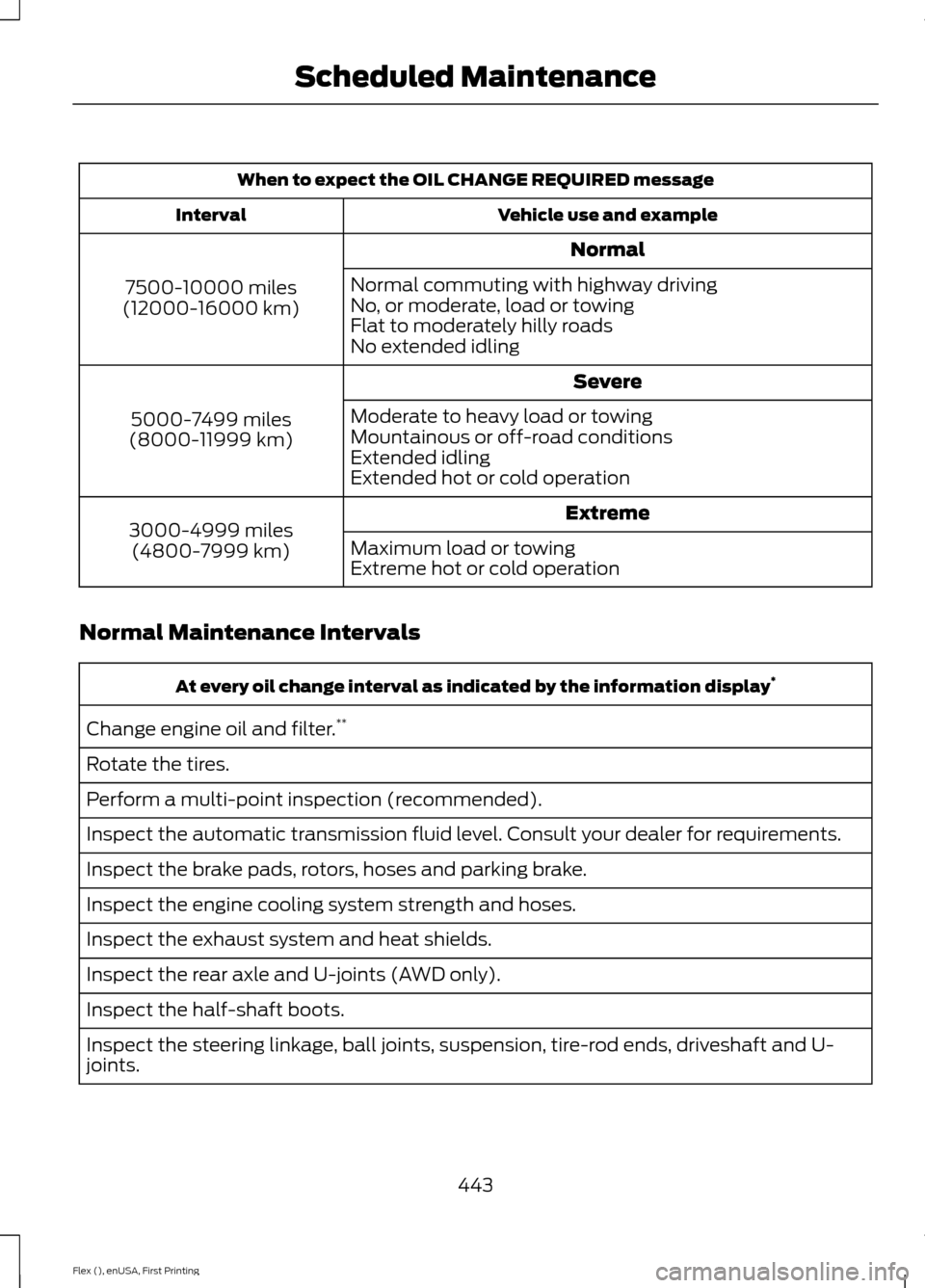
The following table provides examples of
vehicle use and its impact on oil change
intervals. It is a guideline only. Actual oil
change intervals depend on several factors
and generally decrease with severity of
use.
442
Flex (), enUSA, First Printing Scheduled Maintenance
Page 446 of 496
When to expect the OIL CHANGE REQUIRED message
Vehicle use and example
Interval
Normal
7500-10000 miles
(12000-16000 km) Normal commuting with highway driving
No, or moderate, load or towing
Flat to moderately hilly roads
No extended idling
Severe
5000-7499 miles
(8000-11999 km) Moderate to heavy load or towing
Mountainous or off-road conditions
Extended idling
Extended hot or cold operation
Extreme
3000-4999 miles
(4800-7999 km) Maximum load or towing
Extreme hot or cold operation
Normal Maintenance Intervals At every oil change interval as indicated by the information display
*
Change engine oil and filter. **
Rotate the tires.
Perform a multi-point inspection (recommended).
Inspect the automatic transmission fluid level. Consult your dealer for requirements.
Inspect the brake pads, rotors, hoses and parking brake.
Inspect the engine cooling system strength and hoses.
Inspect the exhaust system and heat shields.
Inspect the rear axle and U-joints (AWD only).
Inspect the half-shaft boots.
Inspect the steering linkage, ball joints, suspension, tire-rod ends, driveshaft and U-
joints.
443
Flex (), enUSA, First Printing Scheduled Maintenance
Page 447 of 496
At every oil change interval as indicated by the information display
*
Inspect the tires, tire wear and measure the tread depth.
Inspect the wheels and related components for abnormal noise, wear, looseness or
drag.
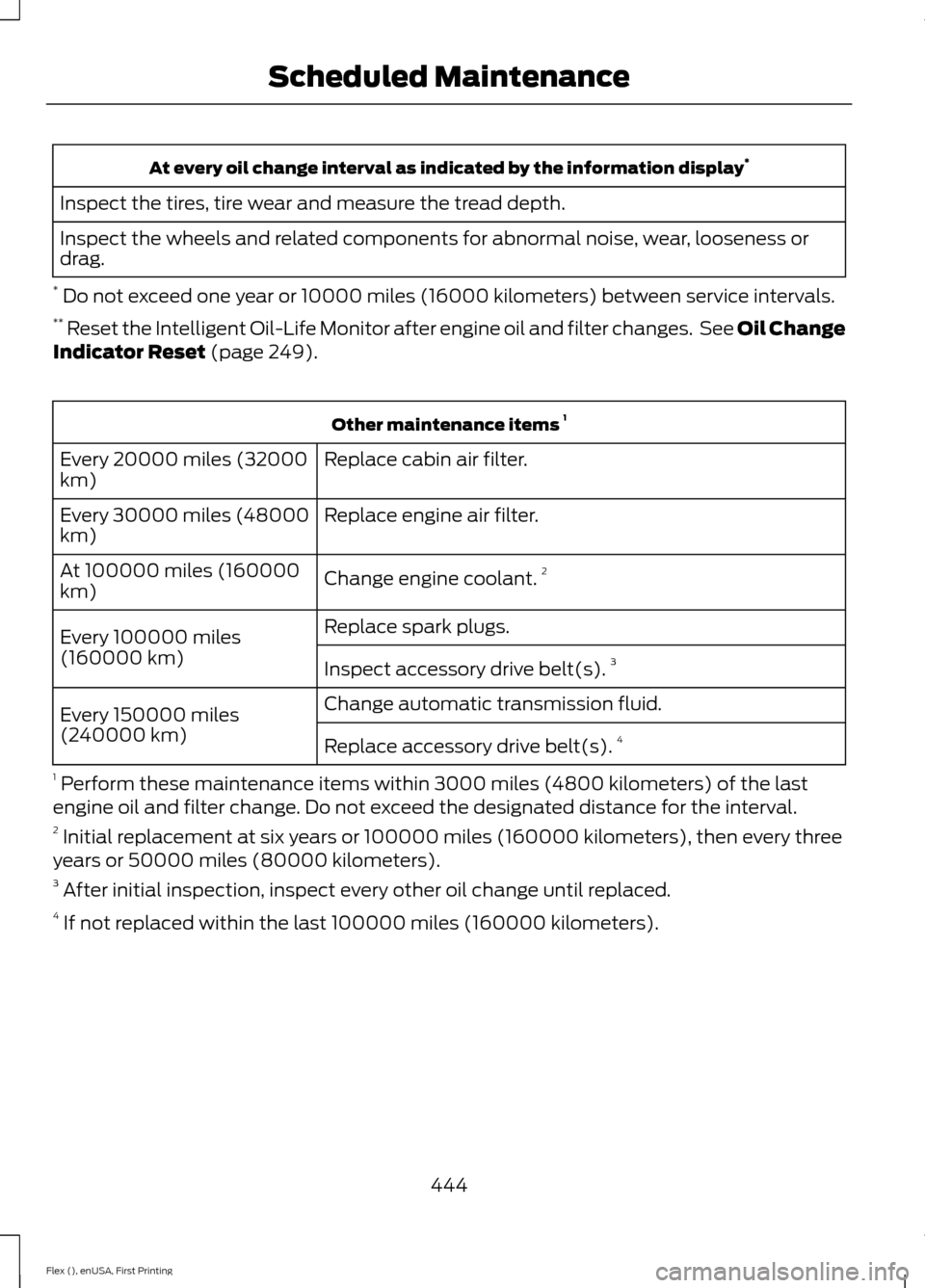
* Do not exceed one year or 10000 miles (16000 kilometers) between service intervals.
** Reset the Intelligent Oil-Life Monitor after engine oil and filter changes. See Oil Change
Indicator Reset (page 249). Other maintenance items
1
Replace cabin air filter.
Every 20000 miles (32000
km)
Replace engine air filter.
Every 30000 miles (48000
km)
Change engine coolant.2
At 100000 miles (160000
km)
Replace spark plugs.
Every 100000 miles
(160000 km) Inspect accessory drive belt(s). 3
Change automatic transmission fluid.
Every 150000 miles
(240000 km)
Replace accessory drive belt(s). 4
1 Perform these maintenance items within 3000 miles (4800 kilometers) of the last
engine oil and filter change. Do not exceed the designated distance for the interval.
2 Initial replacement at six years or 100000 miles (160000 kilometers), then every three
years or 50000 miles (80000 kilometers).
3 After initial inspection, inspect every other oil change until replaced.
4 If not replaced within the last 100000 miles (160000 kilometers).
444
Flex (), enUSA, First Printing Scheduled Maintenance
Page 449 of 496
Operating in off-road (unpaved, sandy, dusty) and Mountainous conditions
Replace cabin air filter.
Inspect frequently, service
as required
Replace engine air filter.
Inspect the wheels and related components for abnormal
noise, wear, looseness or drag.
Every 5000 miles (8000
km)
Rotate tires, inspect tires for wear and measure tread
depth.
Change engine oil and filter.*
Every 5000 miles (8000
km) or six months
Perform multi-point inspection.
Change automatic transmission fluid.
Every 30000 miles (48000
km)
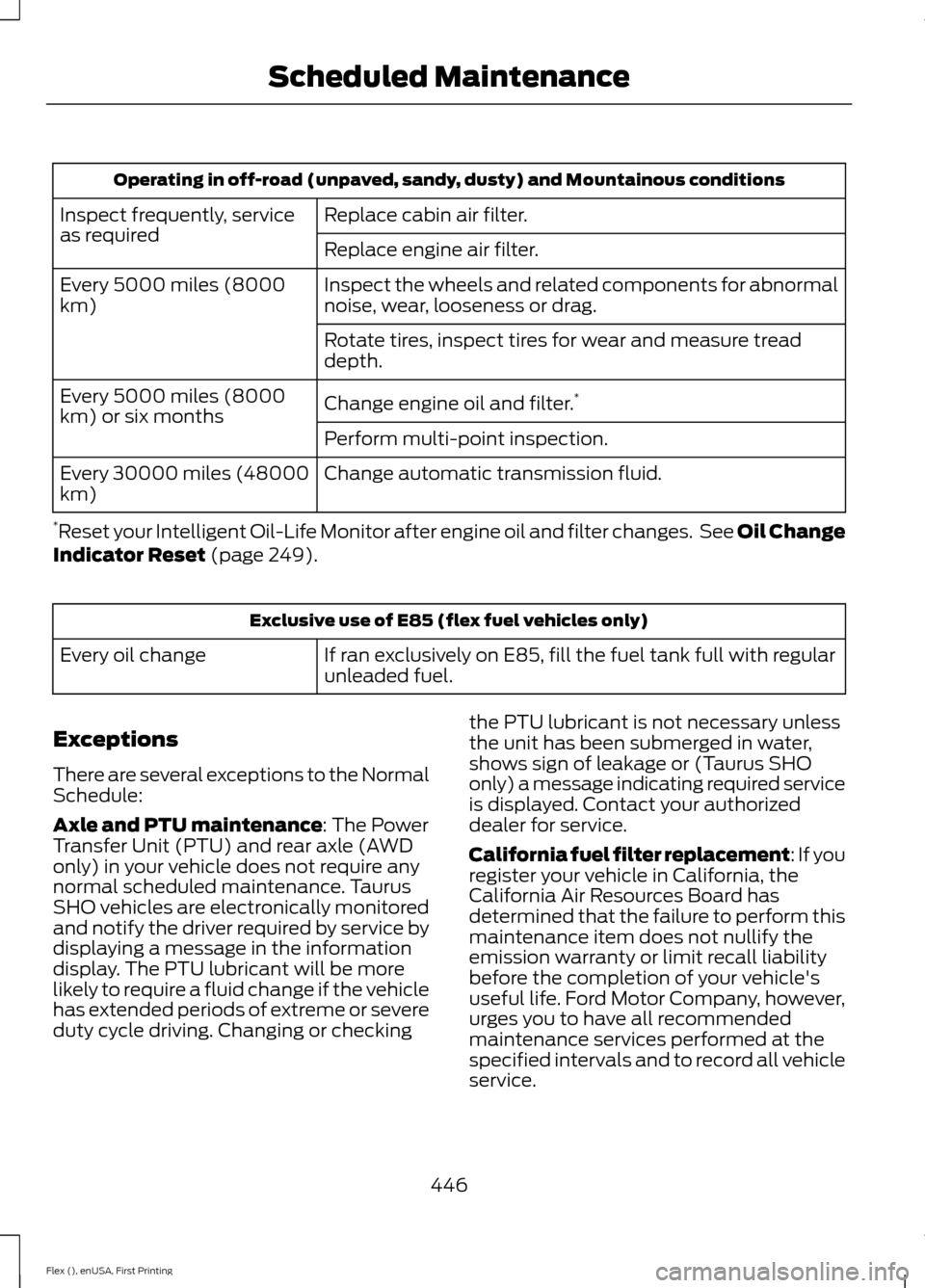
* Reset your Intelligent Oil-Life Monitor after engine oil and filter changes. See Oil Change
Indicator Reset (page 249). Exclusive use of E85 (flex fuel vehicles only)
If ran exclusively on E85, fill the fuel tank full with regular
unleaded fuel.
Every oil change
Exceptions
There are several exceptions to the Normal
Schedule:
Axle and PTU maintenance
: The Power
Transfer Unit (PTU) and rear axle (AWD
only) in your vehicle does not require any
normal scheduled maintenance. Taurus
SHO vehicles are electronically monitored
and notify the driver required by service by
displaying a message in the information
display. The PTU lubricant will be more
likely to require a fluid change if the vehicle
has extended periods of extreme or severe
duty cycle driving. Changing or checking the PTU lubricant is not necessary unless
the unit has been submerged in water,
shows sign of leakage or (Taurus SHO
only) a message indicating required service
is displayed. Contact your authorized
dealer for service.
California fuel filter replacement: If you
register your vehicle in California, the
California Air Resources Board has
determined that the failure to perform this
maintenance item does not nullify the
emission warranty or limit recall liability
before the completion of your vehicle's
useful life. Ford Motor Company, however,
urges you to have all recommended
maintenance services performed at the
specified intervals and to record all vehicle
service.
446
Flex (), enUSA, First Printing Scheduled Maintenance
Page 494 of 496
T
Tailgate
See: Manual Liftgate.......................................... 66
See: Power Liftgate.............................................. 67
Technical Specifications See: Capacities and Specifications............299
The Better Business Bureau (BBB) Auto Line Program (U.S. Only).......................228
Tire Care...........................................................275 Glossary of Tire Terminology.......................... 277
Information About Uniform Tire Quality Grading.............................................................. 275
Information Contained on the Tire Sidewall............................................................ 278
Temperature A B C............................................ 276
Traction AA A B C............................................... 276
Treadwear............................................................. 276
Tire Pressure Monitoring System..........290 Changing Tires With a Tire Pressure
Monitoring System........................................ 291
Understanding Your Tire Pressure Monitoring System ....................................... 291
Tires See: Wheels and Tires...................................... 273
Towing a Trailer
............................................209
Load Placement................................................ 209
Towing the Vehicle on Four Wheels...........................................................215
Emergency Towing............................................. 215
Recreational Towing.......................................... 215
Towing.............................................................209
Traction Control
.............................................177
Principle of Operation........................................ 177
Trailer Sway Control
....................................210
Transmission Code Designation............303
Transmission..................................................164
Transmission See: Transmission.............................................. 164
Transporting the Vehicle...........................224
U
Under Hood Overview - 3.5L Duratec.........................................................246
Under Hood Overview - 3.5L Ecoboost™..................................................247 Universal Garage Door Opener
...............140
HomeLink Wireless Control System...........140
USB Port.........................................................320
Using Adaptive Cruise Control................189 Automatic Cancellation................................... 192
Blocked Sensor................................................... 193
Canceling the Set Speed.................................. 191
Changing the Set Speed.................................. 192
Detection Issues.................................................. 193
Following a Vehicle............................................ 190
Hilly Condition Usage........................................ 192
Overriding the System...................................... 192
Resuming the Set Speed................................. 192
Setting the Adaptive Cruise Speed.............190
Setting the Gap Distance................................. 191
Switching Adaptive Cruise Control Off........................................................................\
192
Switching Adaptive Cruise Control On........................................................................\
189
Switching to Normal Cruise Control...........194
System Not Available....................................... 193
Using All-Wheel Drive................................168 Driving In Special Conditions With
All-Wheel Drive (AWD)............................... 170
Operating AWD Vehicles With Mismatched Tires.................................................................... 169
Operating AWD Vehicles With Spare Tires.................................................................... 169
Using Cruise Control...................................188 Switching Cruise Control Off......................... 189
Switching Cruise Control On.......................... 188
Using MyKey With Remote Start Systems...........................................................61
Using Snow Chains.....................................289
Using Stability Control
................................179
Using SYNC™ With Your Media Player.............................................................342
Accessing Your Play Menu.............................. 347
Connecting Your Digital Media Player to the USB Port........................................................... 342
Media Menu Features...................................... 345
Media Voice Commands................................ 344
System Settings................................................. 349
What's Playing?................................................. 344
Using SYNC™ With Your Phone............326 Accessing Features Through the Phone
Menu.................................................................. 330
Accessing Your Phone Settings.................... 334
491
Flex (), enUSA, First Printing Index
Page 495 of 496
Making a Call.......................................................
329
Pairing a Cell Phone for the First Time................................................................... 326
Pairing Subsequent Cell Phones.................. 327
Phone Options during an Active Call.........329
Phone Voice Commands................................. 327
Receiving Calls.................................................... 329
System Settings................................................. 336
Text Messaging................................................... 332
Using Traction Control.................................177 Switching the System Off................................ 177
System Indicator Lights and Messages........................................................... 177
Using a Switch...................................................... 177
Using the Information Display Controls.............................................................. 177
Using Voice Recognition............................323 Audio Voice Commands.................................. 375
Climate Voice Commands.............................. 376
Initiating a Voice Session................................ 323
Mobile App Voice Commands...................... 379
Navigation Voice Commands....................... 378
Phone Voice Commands................................ 376
SiriusXM Traffic and Travel Link Voice Commands...................................................... 379
System Interaction and Feedback..............324
Voice Settings Commands............................ 380
Utilizing the Mediation/Arbitration Program (Canada Only)........................229
V
Vehicle Care...................................................266 General Information......................................... 266
Vehicle Certification Label.......................303
Vehicle Identification Number................302
Vehicle Storage..............................................271 Battery.................................................................... 272
Body........................................................................\
. 271
Brakes..................................................................... 272
Cooling system.................................................... 272
Engine...................................................................... 271
Fuel system.......................................................... 272
General.................................................................... 271
Miscellaneous...................................................... 272
Removing Vehicle From Storage.................. 272
Tires........................................................................\
. 272Ventilation
See: Climate Control.......................................... 116
VIN See: Vehicle Identification Number............302
Voice Control
....................................................77
W
Warning Lamps and Indicators................94 Adaptive Cruise Control.................................... 94
Airbag Readiness................................................. 95
Anti-Lock Braking System................................ 95
Battery...................................................................... 95
Brake System......................................................... 95
Charging System.................................................. 95
Cruise Control........................................................ 95
Directional Indicator............................................ 97
Door Ajar.................................................................. 95
Engine Coolant Temperature.......................... 95
Engine Oil................................................................ 96
Fasten Seatbelt.................................................... 96
Front Airbag........................................................... 96
Front Fog Lamps.................................................. 96
Head Up Display................................................... 96
High Beam.............................................................. 96
Liftgate Ajar............................................................ 96
Low Fuel Level...................................................... 96
Low Tire Pressure Warning.............................. 96
Low Washer Fluid................................................ 96
Parking Lamps...................................................... 96
Powertrain Malfunction/Reduced Power................................................................... 97
Service Engine Soon............................................ 97
Stability Control.................................................... 97
Stability Control Off............................................ 97
Washer Fluid Check....................................256
Washers See: Cleaning the Exterior.............................. 266
See: Wipers and Washers................................. 79
Waxing.............................................................267
Wheel Nuts See: Changing a Road Wheel....................... 293
Wheels and Tires..........................................273 General Information.......................................... 273
Technical Specifications................................. 298
Windows and Mirrors...................................88
Windshield Washers
.....................................80
492
Flex (), enUSA, First Printing Index