tow FORD FLEX 2017 1.G Owners Manual
[x] Cancel search | Manufacturer: FORD, Model Year: 2017, Model line: FLEX, Model: FORD FLEX 2017 1.GPages: 496, PDF Size: 5.92 MB
Page 5 of 496
Adjusting the Steering Wheel - Vehicles
With: Power Adjustable Steering
Column...........................................................75
Audio Control...................................................76
Voice Control
....................................................77
Cruise Control
...................................................77
Information Display Control........................77
Heated Steering Wheel
................................77
Pedals
Adjusting the Pedals
.....................................78
Wipers and Washers
Windshield Wipers
.........................................79
Autowipers........................................................79
Windshield Washers
.....................................80
Rear Window Wiper and Washers..........80
Lighting
General Information......................................82
Lighting Control..............................................82
Autolamps
........................................................83
Instrument Lighting Dimmer.....................84
Headlamp Exit Delay....................................84
Daytime Running Lamps............................85
Front Fog Lamps
............................................85
Adaptive Headlamps
...................................85
Direction Indicators
.......................................86
Interior Lamps.................................................86
Ambient Lighting
............................................87
Windows and Mirrors
Power Windows.............................................88
Exterior Mirrors................................................89
Interior Mirror
....................................................91
Sun Visors
..........................................................91
Moonroof............................................................91
Instrument Cluster
Gauges...............................................................93 Warning Lamps and Indicators................94
Audible Warnings and Indicators
.............97
Information Displays
General Information.....................................99
Information Messages................................107
Climate Control
Manual Climate Control..............................116
Automatic Climate Control
........................117
Automatic Climate Control - Vehicles With: Premium AM/FM/CD
...................119
Hints on Controlling the Interior Climate.........................................................120
Rear Passenger Climate Controls...........123
Heated Windows and Mirrors
...................123
Cabin Air Filter
................................................124
Remote Start
..................................................124
Seats
Sitting in the Correct Position
..................125
Head Restraints
.............................................125
Manual Seats.................................................128
Power Seats....................................................129
Memory Function.........................................130
Rear Seats
........................................................131
Heated Seats
.................................................138
Climate Controlled Seats..........................139
Universal Garage Door Opener
Universal Garage Door Opener...............140
Auxiliary Power Points
Auxiliary Power Points
................................145
Storage Compartments
Center Console
..............................................147
Overhead Console
.......................................148
2
Flex (), enUSA, First Printing Table of Contents
Page 6 of 496
Starting and Stopping the
Engine
General Information....................................149
Ignition Switch
...............................................149
Keyless Starting............................................149
Starting a Gasoline Engine.......................150
Engine Block Heater....................................153
Fuel and Refueling
Safety Precautions
.......................................155
Fuel Quality
....................................................156
Fuel Filler Funnel Location........................156
Running Out of Fuel....................................156
Refueling..........................................................157
Fuel Consumption
.......................................160
Emission Control System...........................161
Transmission
Automatic Transmission
...........................164
All-Wheel Drive
Using All-Wheel Drive................................168
Brakes
General Information
.....................................175
Hints on Driving With Anti-Lock Brakes............................................................175
Parking Brake
.................................................176
Traction Control
Principle of Operation..................................177
Using Traction Control
.................................177
Stability Control
Principle of Operation.................................178
Using Stability Control
................................179
Parking Aids
Principle of Operation
................................180 Rear Parking Aid...........................................180
Active Park Assist..........................................181
Rear View Camera
.......................................185
Cruise Control
Principle of Operation................................188
Using Cruise Control...................................188
Using Adaptive Cruise Control................189
Driving Aids
Blind Spot Information System..............195
Cross Traffic Alert.........................................197
Steering..........................................................200
Collision Warning System........................200
Load Carrying
Cargo Nets
.....................................................203
Roof Racks and Load Carriers................203
Load Limit
......................................................203
Towing
Towing a Trailer............................................209
Trailer Sway Control
....................................210
Recommended Towing Weights............210
Essential Towing Checks...........................212
Towing the Vehicle on Four Wheels
......215
Driving Hints
Breaking-In......................................................217
Economical Driving.......................................217
Driving Through Water................................218
Floor Mats........................................................218
Roadside Emergencies
Roadside Assistance..................................220
Hazard Warning Flashers
...........................221
Fuel Shutoff
....................................................221
Jump Starting the Vehicle
.........................222
Post-Crash Alert System..........................224
3
Flex (), enUSA, First Printing Table of Contents
Page 18 of 496
PROTECTING THE
ENVIRONMENT
You must play your part in protecting the
environment. Correct vehicle usage and
the authorized disposal of waste, cleaning
and lubrication materials are significant
steps toward this aim.
15
Flex (), enUSA, First Printing Environment
Page 23 of 496
Use a child safety seat (sometimes called
an infant carrier, convertible seat, or
toddler seat) for infants, toddlers or
children weighing 40 lb (18 kg) or less
(generally age four or younger).
Using Lap and Shoulder Belts WARNINGS
Airbags can kill or injure a child in a
child seat. Never place a rear-facing
child seat in front of an active airbag.
If you must use a forward-facing child seat
in the front seat, move the seat upon which
the child seat is installed all the way back. Airbags can kill or injure a child in a
child seat. Children 12 and under
should be properly restrained in the
rear seat whenever possible. Depending on where you secure a
child restraint, and depending on the
child restraint design, you may block
access to certain seatbelt buckle
assemblies and LATCH lower anchors,
rendering those features potentially
unusable. To avoid risk of injury, occupants
should only use seating positions where
they are able to be properly restrained. When installing a child safety seat with
combination lap and shoulder belts:
•
Use the correct seatbelt buckle for that
seating position.
• Insert the belt tongue into the proper
buckle until you hear a snap and feel it
latch. Make sure the tongue is securely
fastened in the buckle.
• Keep the buckle release button
pointing up and away from the safety
seat, with the tongue between the child
seat and the release button, to prevent
accidental unbuckling.
• Place the vehicle seat upon which the
child seat will be installed in the upright
position. •
For second-row seating positions,
adjust the recliner slightly to improve
child seat fit. If needed, remove the
head restraints.
• For third-row seating positions, stow
the head restraints to improve child
seat fit. See
Head Restraints (page
125).
• Put the seatbelt in the automatic
locking mode. See Step 5. This vehicle
does not require the use of a locking
clip.
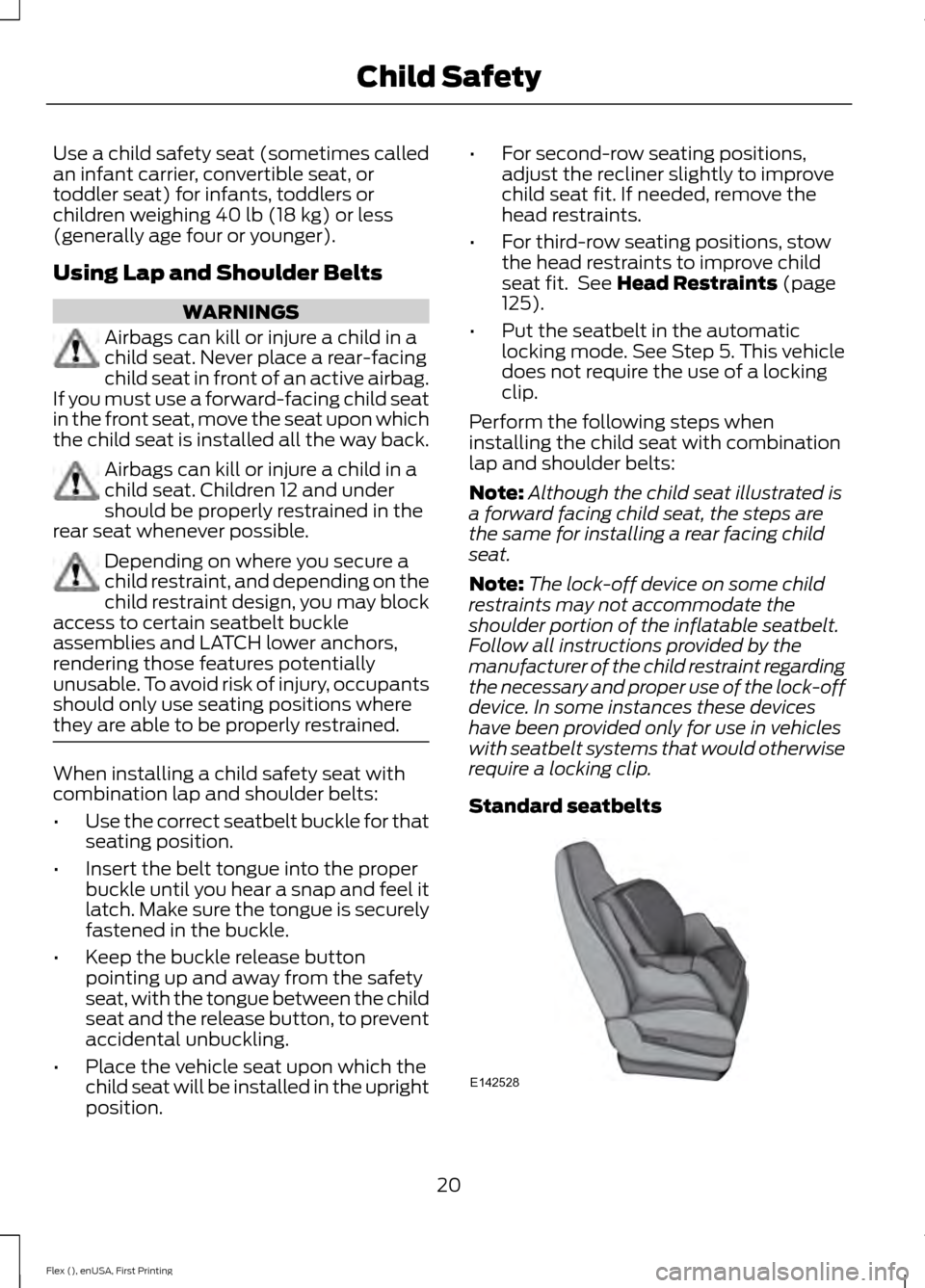
Perform the following steps when
installing the child seat with combination
lap and shoulder belts:
Note: Although the child seat illustrated is
a forward facing child seat, the steps are
the same for installing a rear facing child
seat.
Note: The lock-off device on some child
restraints may not accommodate the
shoulder portion of the inflatable seatbelt.
Follow all instructions provided by the
manufacturer of the child restraint regarding
the necessary and proper use of the lock-off
device. In some instances these devices
have been provided only for use in vehicles
with seatbelt systems that would otherwise
require a locking clip.
Standard seatbelts 20
Flex (), enUSA, First Printing Child SafetyE142528
Page 25 of 496
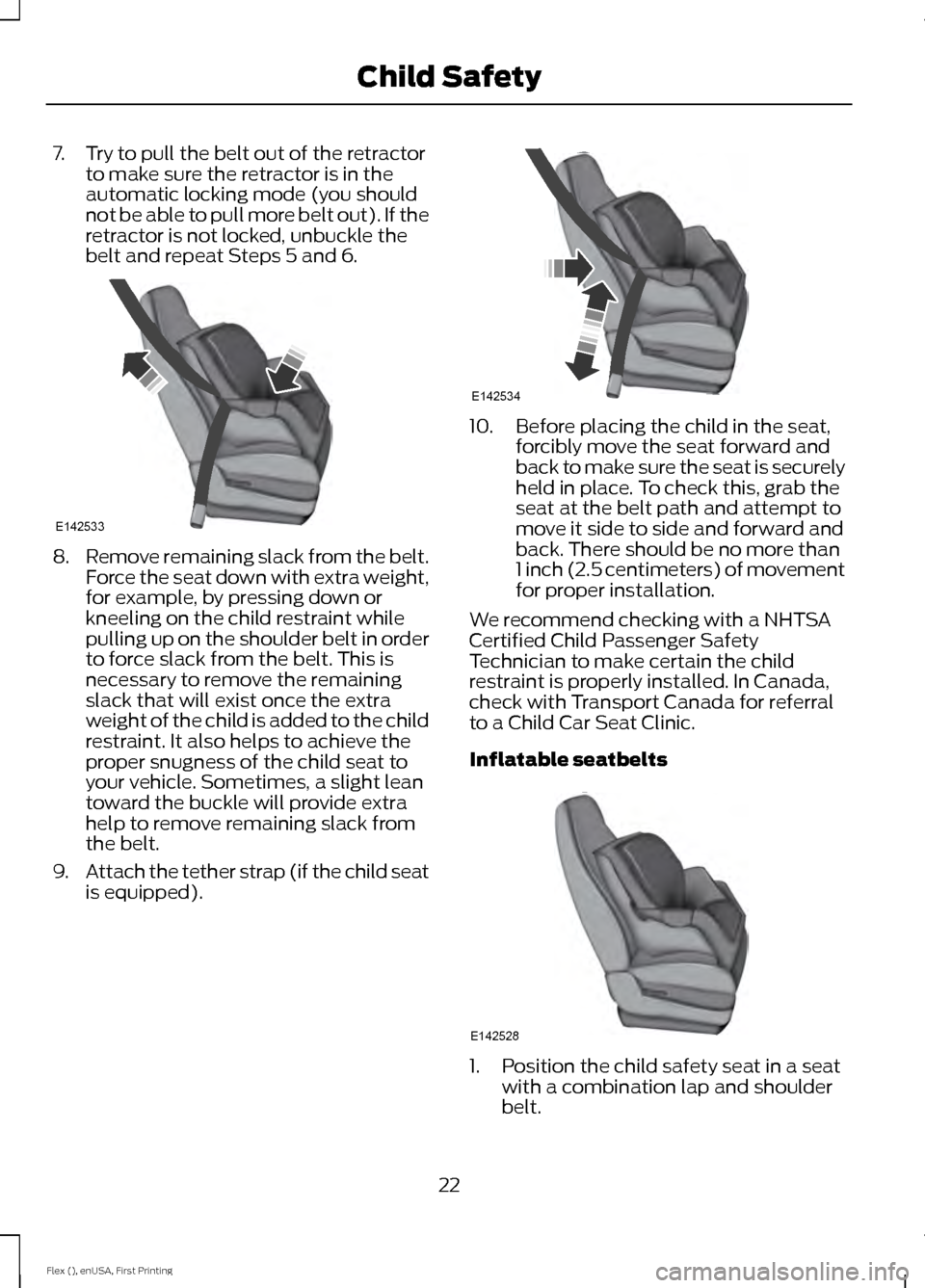
7. Try to pull the belt out of the retractor
to make sure the retractor is in the
automatic locking mode (you should
not be able to pull more belt out). If the
retractor is not locked, unbuckle the
belt and repeat Steps 5 and 6. 8.
Remove remaining slack from the belt.
Force the seat down with extra weight,
for example, by pressing down or
kneeling on the child restraint while
pulling up on the shoulder belt in order
to force slack from the belt. This is
necessary to remove the remaining
slack that will exist once the extra
weight of the child is added to the child
restraint. It also helps to achieve the
proper snugness of the child seat to
your vehicle. Sometimes, a slight lean
toward the buckle will provide extra
help to remove remaining slack from
the belt.
9. Attach the tether strap (if the child seat
is equipped). 10. Before placing the child in the seat,
forcibly move the seat forward and
back to make sure the seat is securely
held in place. To check this, grab the
seat at the belt path and attempt to
move it side to side and forward and
back. There should be no more than
1 inch (2.5 centimeters) of movement
for proper installation.
We recommend checking with a NHTSA
Certified Child Passenger Safety
Technician to make certain the child
restraint is properly installed. In Canada,
check with Transport Canada for referral
to a Child Car Seat Clinic.
Inflatable seatbelts 1. Position the child safety seat in a seat
with a combination lap and shoulder
belt.
22
Flex (), enUSA, First Printing Child SafetyE142533 E142534 E142528
Page 27 of 496
Note:
Unlike the standard seatbelt, the
inflatable seatbelt's unique lap portion locks
the child seat for installation. The ability for
the shoulder portion of the belt to move
freely is normal, even after the lap belt has
been put into the automatic locking mode.
Note: The lock-off device on some child
restraints may not accommodate the
shoulder portion of the inflatable seatbelt.
Follow all instructions provided by the
manufacturer of the child restraint regarding
the necessary and proper use of the lock-off
device. In some instances, these devices
have been provided only for use in vehicles
with seatbelt systems that would otherwise
require a locking clip.
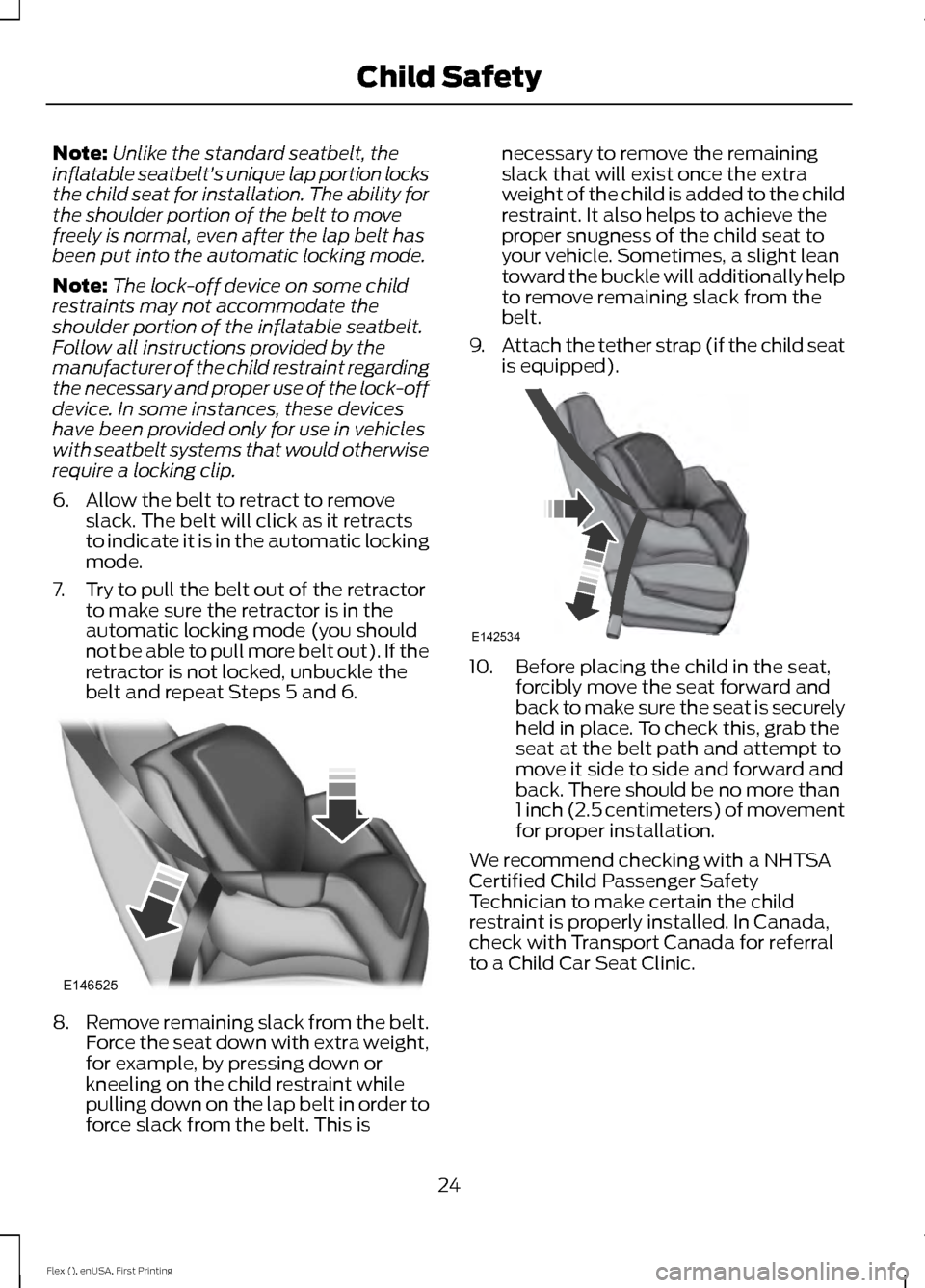
6. Allow the belt to retract to remove slack. The belt will click as it retracts
to indicate it is in the automatic locking
mode.
7. Try to pull the belt out of the retractor to make sure the retractor is in the
automatic locking mode (you should
not be able to pull more belt out). If the
retractor is not locked, unbuckle the
belt and repeat Steps 5 and 6. 8.
Remove remaining slack from the belt.
Force the seat down with extra weight,
for example, by pressing down or
kneeling on the child restraint while
pulling down on the lap belt in order to
force slack from the belt. This is necessary to remove the remaining
slack that will exist once the extra
weight of the child is added to the child
restraint. It also helps to achieve the
proper snugness of the child seat to
your vehicle. Sometimes, a slight lean
toward the buckle will additionally help
to remove remaining slack from the
belt.
9. Attach the tether strap (if the child seat
is equipped). 10. Before placing the child in the seat,
forcibly move the seat forward and
back to make sure the seat is securely
held in place. To check this, grab the
seat at the belt path and attempt to
move it side to side and forward and
back. There should be no more than
1 inch (2.5 centimeters) of movement
for proper installation.
We recommend checking with a NHTSA
Certified Child Passenger Safety
Technician to make certain the child
restraint is properly installed. In Canada,
check with Transport Canada for referral
to a Child Car Seat Clinic.
24
Flex (), enUSA, First Printing Child SafetyE146525 E142534
Page 34 of 496
WARNINGS
the way back. When possible, all children
age 12 and under should be properly
restrained in a rear seating position. If all
children cannot be seated and restrained
properly in a rear seating position, properly
restrain the largest child in the front seat. Always carefully follow the
instructions and warnings provided
by the manufacturer of any child
restraint to determine if the restraint device
is appropriate for your child's size, height,
weight, or age. Follow the child restraint
manufacturer's instructions and warnings
provided for installation and use in
conjunction with the instructions and
warnings provided by your vehicle
manufacturer. A safety seat that is
improperly installed or utilized, is
inappropriate for your child's height, age,
or weight or does not properly fit the child
may increase the risk of serious injury or
death. WARNINGS
Never let a passenger hold a child on
his or her lap while your vehicle is
moving. The passenger cannot
protect the child from injury in a crash,
which may result in serious injury or death. Never use pillows, books, or towels
to boost a child. They can slide
around and increase the likelihood
of injury or death in a crash. Always restrain an unoccupied child
seat or booster seat. These objects
may become projectiles in a crash or
sudden stop, which may increase the risk
of serious injury. Never place, or allow a child to place,
the shoulder belt under a child's arm
or behind the back because it
reduces the protection for the upper part
of the body and may increase the risk of
injury or death in a crash. To avoid risk of injury, do not leave
children or pets unattended in your
vehicle.
31
Flex (), enUSA, First Printing Child Safety
Page 41 of 496
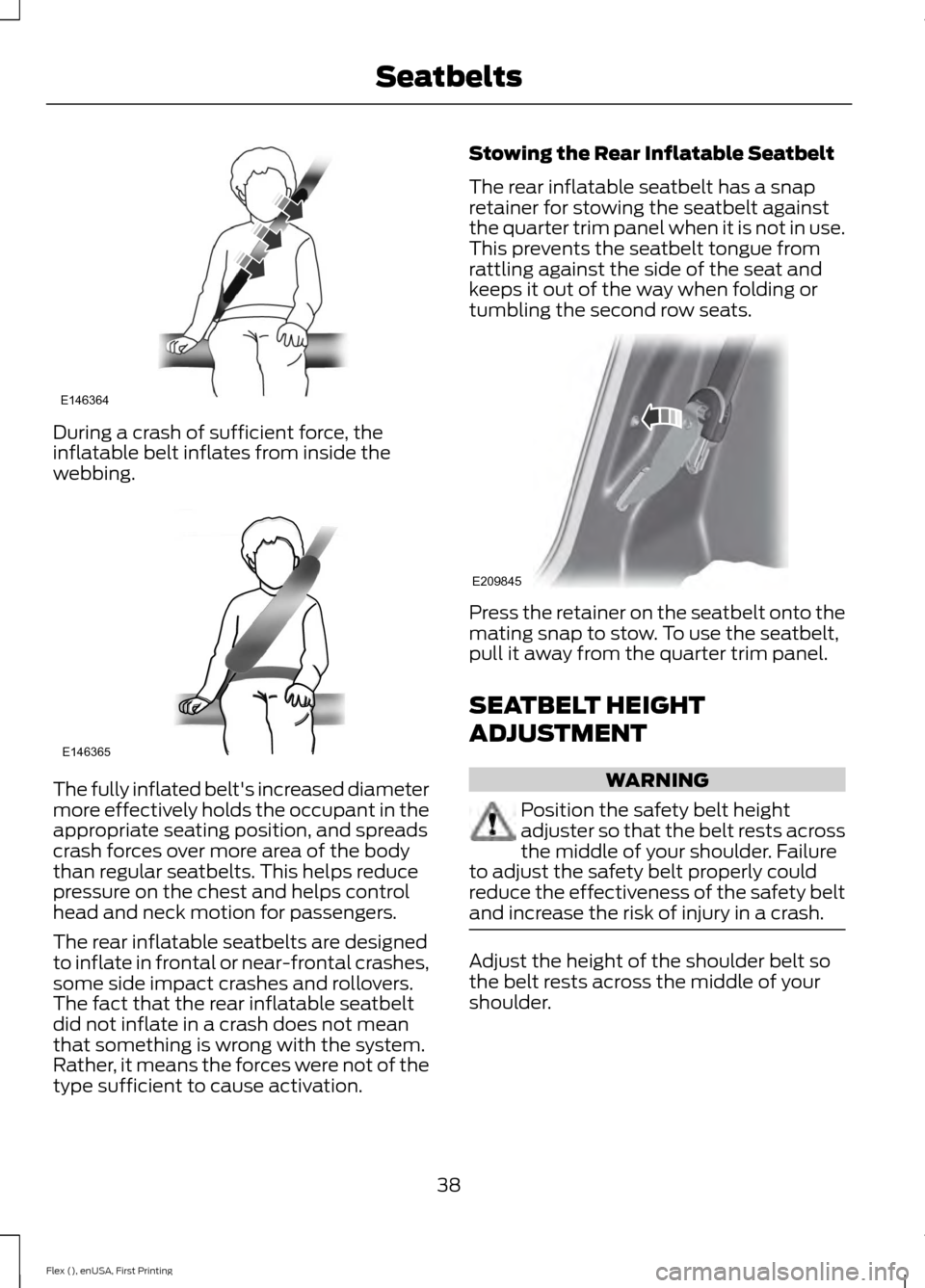
During a crash of sufficient force, the
inflatable belt inflates from inside the
webbing.
The fully inflated belt's increased diameter
more effectively holds the occupant in the
appropriate seating position, and spreads
crash forces over more area of the body
than regular seatbelts. This helps reduce
pressure on the chest and helps control
head and neck motion for passengers.
The rear inflatable seatbelts are designed
to inflate in frontal or near-frontal crashes,
some side impact crashes and rollovers.
The fact that the rear inflatable seatbelt
did not inflate in a crash does not mean
that something is wrong with the system.
Rather, it means the forces were not of the
type sufficient to cause activation. Stowing the Rear Inflatable Seatbelt
The rear inflatable seatbelt has a snap
retainer for stowing the seatbelt against
the quarter trim panel when it is not in use.
This prevents the seatbelt tongue from
rattling against the side of the seat and
keeps it out of the way when folding or
tumbling the second row seats.
Press the retainer on the seatbelt onto the
mating snap to stow. To use the seatbelt,
pull it away from the quarter trim panel.
SEATBELT HEIGHT
ADJUSTMENT
WARNING
Position the safety belt height
adjuster so that the belt rests across
the middle of your shoulder. Failure
to adjust the safety belt properly could
reduce the effectiveness of the safety belt
and increase the risk of injury in a crash. Adjust the height of the shoulder belt so
the belt rests across the middle of your
shoulder.
38
Flex (), enUSA, First Printing SeatbeltsE146364 E146365 E209845
Page 53 of 496
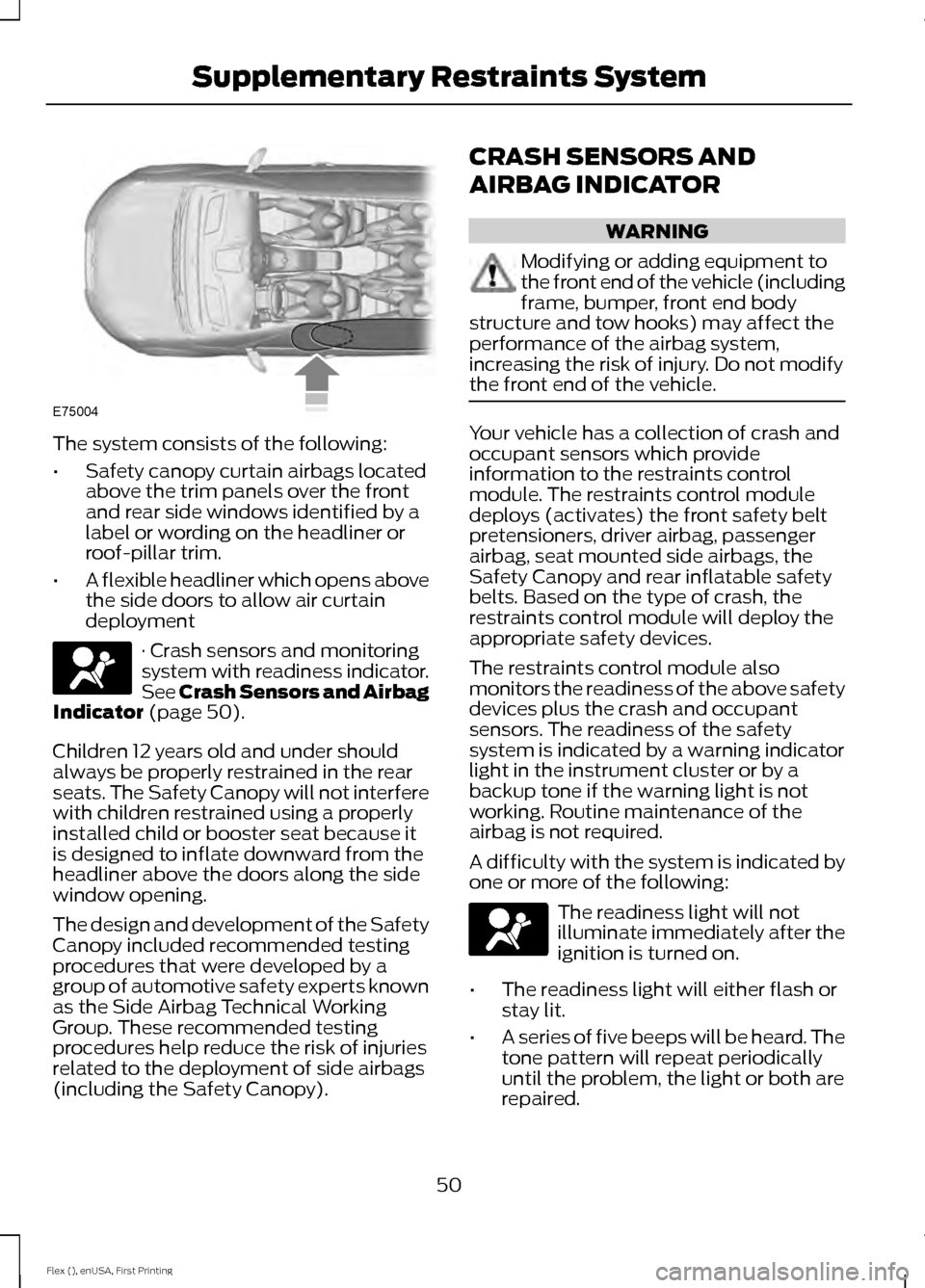
The system consists of the following:
•
Safety canopy curtain airbags located
above the trim panels over the front
and rear side windows identified by a
label or wording on the headliner or
roof-pillar trim.
• A flexible headliner which opens above
the side doors to allow air curtain
deployment · Crash sensors and monitoring
system with readiness indicator.
See Crash Sensors and Airbag
Indicator (page 50).
Children 12 years old and under should
always be properly restrained in the rear
seats. The Safety Canopy will not interfere
with children restrained using a properly
installed child or booster seat because it
is designed to inflate downward from the
headliner above the doors along the side
window opening.
The design and development of the Safety
Canopy included recommended testing
procedures that were developed by a
group of automotive safety experts known
as the Side Airbag Technical Working
Group. These recommended testing
procedures help reduce the risk of injuries
related to the deployment of side airbags
(including the Safety Canopy). CRASH SENSORS AND
AIRBAG INDICATOR WARNING
Modifying or adding equipment to
the front end of the vehicle (including
frame, bumper, front end body
structure and tow hooks) may affect the
performance of the airbag system,
increasing the risk of injury. Do not modify
the front end of the vehicle. Your vehicle has a collection of crash and
occupant sensors which provide
information to the restraints control
module. The restraints control module
deploys (activates) the front safety belt
pretensioners, driver airbag, passenger
airbag, seat mounted side airbags, the
Safety Canopy and rear inflatable safety
belts. Based on the type of crash, the
restraints control module will deploy the
appropriate safety devices.
The restraints control module also
monitors the readiness of the above safety
devices plus the crash and occupant
sensors. The readiness of the safety
system is indicated by a warning indicator
light in the instrument cluster or by a
backup tone if the warning light is not
working. Routine maintenance of the
airbag is not required.
A difficulty with the system is indicated by
one or more of the following:
The readiness light will not
illuminate immediately after the
ignition is turned on.
• The readiness light will either flash or
stay lit.
• A series of five beeps will be heard. The
tone pattern will repeat periodically
until the problem, the light or both are
repaired.
50
Flex (), enUSA, First Printing Supplementary Restraints SystemE75004 E67017 E67017
Page 55 of 496
GENERAL INFORMATION ON
RADIO FREQUENCIES
This device complies with Part 15 of the
FCC Rules and with Industry Canada
license-exempt RSS standard(s).
Operation is subject to the following two
conditions: (1) This device may not cause
harmful interference, and (2) This device
must accept any interference received,
including interference that may cause
undesired operation.
Note:
Changes or modifications not
expressively approved by the party
responsible for compliance could void the
user's authority to operate the equipment.
The term IC before the radio certification
number only signifies that Industry Canada
technical specifications were met.
The typical operating range for your
transmitter is approximately 33 feet (10
meters). Vehicles with the remote start
feature will have a greater range. One of
the following could cause a decrease in
operating range:
• weather conditions
• nearby radio towers
• structures around the vehicle
• other vehicles parked next to your
vehicle
Other short-distance radio transmitters,
such as amateur radios, medical
equipment, wireless headphones, remote
controls and alarm systems may operate
on the same frequency as your remote
control. If other transmitters are operating
on those frequencies, you may not be able
to use your remote control. Using your
remote control near some types of
electronic equipment, such as USB devices, computers or cell phones can interfere with
remote operation. Operating your remote
control near metal or metallic-finished
purses, bags or clothing can interfere with
remote operation. You can lock and unlock
the doors with the key.
Note:
Make sure to lock your vehicle before
leaving it unattended.
Note: If you are in range, the remote control
will operate if you press any button
unintentionally.
Intelligent Access
The system uses a radio frequency signal
to communicate with your vehicle and
authorize your vehicle to unlock when one
of the following conditions are met:
• You touch the inside of any exterior
door handle within
3 ft (1 m) proximity
of an intelligent access key.
• You press the luggage compartment
button.
• You press a button on the transmitter.
If excessive radio frequency interference
is present in the area or if the transmitter
battery is low, you may need to
mechanically unlock your door. You can
use the mechanical key blade in your
intelligent access key to open the driver
door in this situation. See
Remote
Control (page 53).
52
Flex (), enUSA, First Printing Keys and Remote Controls