four wheel drive FORD FLEX 2018 User Guide
[x] Cancel search | Manufacturer: FORD, Model Year: 2018, Model line: FLEX, Model: FORD FLEX 2018Pages: 508, PDF Size: 6.31 MB
Page 285 of 508
G.
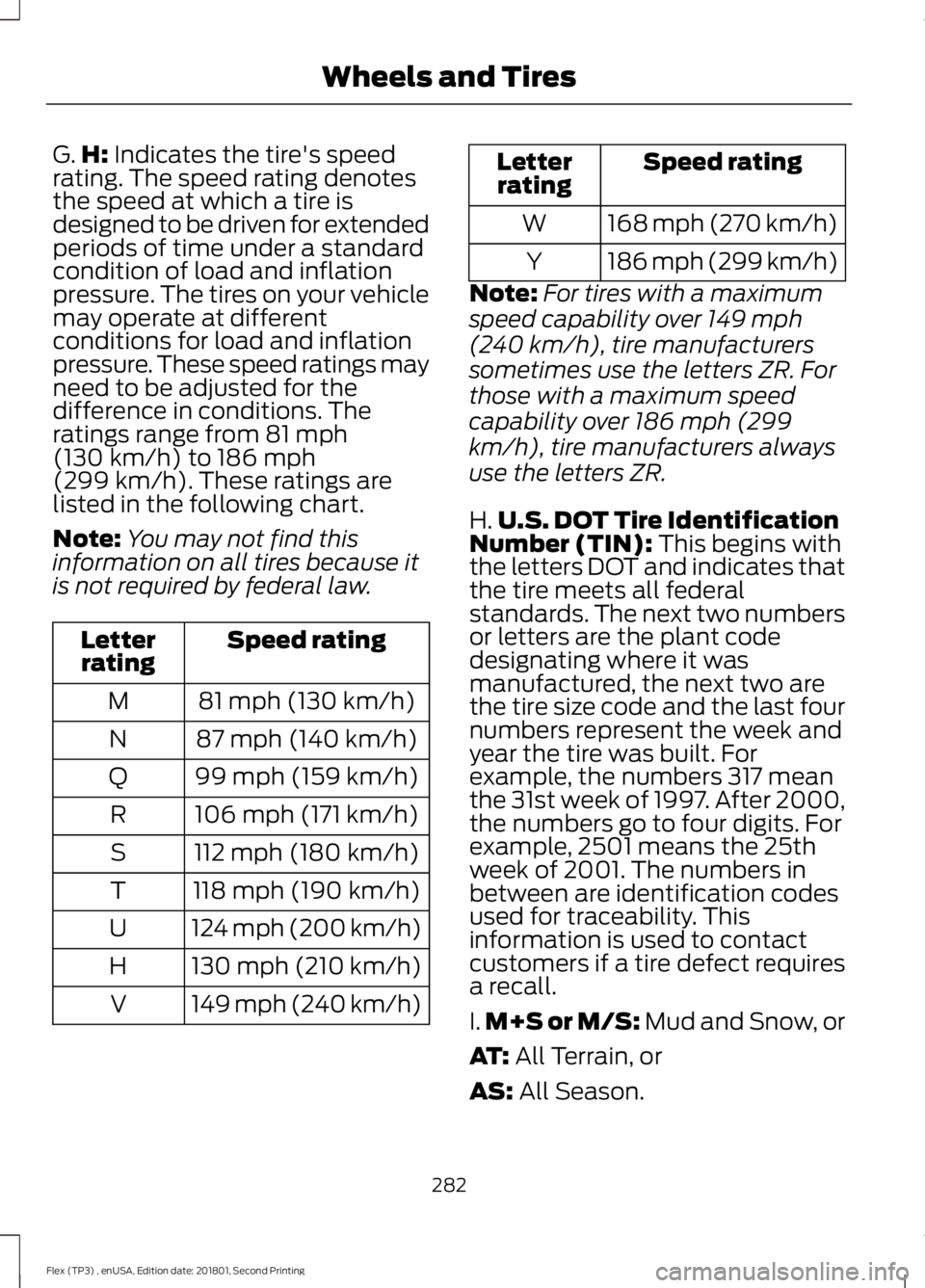
H: Indicates the tire's speed
rating. The speed rating denotes
the speed at which a tire is
designed to be driven for extended
periods of time under a standard
condition of load and inflation
pressure. The tires on your vehicle
may operate at different
conditions for load and inflation
pressure. These speed ratings may
need to be adjusted for the
difference in conditions. The
ratings range from
81 mph
(130 km/h) to 186 mph
(299 km/h). These ratings are
listed in the following chart.
Note: You may not find this
information on all tires because it
is not required by federal law. Speed rating
Letter
rating
81 mph (130 km/h)
M
87 mph (140 km/h)
N
99 mph (159 km/h)
Q
106 mph (171 km/h)
R
112 mph (180 km/h)
S
118 mph (190 km/h)
T
124 mph (200 km/h)
U
130 mph (210 km/h)
H
149 mph (240 km/h)
V Speed rating
Letter
rating
168 mph (270 km/h)
W
186 mph (299 km/h)
Y
Note: For tires with a maximum
speed capability over 149 mph
(240 km/h), tire manufacturers
sometimes use the letters ZR. For
those with a maximum speed
capability over 186 mph (299
km/h), tire manufacturers always
use the letters ZR.
H. U.S. DOT Tire Identification
Number (TIN):
This begins with
the letters DOT and indicates that
the tire meets all federal
standards. The next two numbers
or letters are the plant code
designating where it was
manufactured, the next two are
the tire size code and the last four
numbers represent the week and
year the tire was built. For
example, the numbers 317 mean
the 31st week of 1997. After 2000,
the numbers go to four digits. For
example, 2501 means the 25th
week of 2001. The numbers in
between are identification codes
used for traceability. This
information is used to contact
customers if a tire defect requires
a recall.
I. M+S or M/S:
Mud and Snow, or
AT:
All Terrain, or
AS:
All Season.
282
Flex (TP3) , enUSA, Edition date: 201801, Second Printing Wheels and Tires
Page 291 of 508
Age
WARNING
Tires degrade over time
depending on many factors
such as weather, storage
conditions, and conditions of use
(load, speed, inflation pressure)
the tires experience throughout
their lives.
In general, tires should be
replaced after six years regardless
of tread wear. However, heat
caused by hot climates or
frequent high loading conditions
can accelerate the aging process
and may require tires to be
replaced more frequently.
You should replace your spare tire
when you replace the road tires or
after six years due to aging even if
it has not been used. U.S. DOT Tire Identification
Number
Both United States and Canada
Federal regulations require tire
manufacturers to place
standardized information on the
sidewall of all tires. This
information identifies and
describes the fundamental
characteristics of the tire and also
provides a U.S. DOT Tire
Identification Number for safety
standard certification and in case
of a recall. This begins with the letters DOT
and indicates that the tire meets
all federal standards. The next
two numbers or letters are the
plant code designating where it
was manufactured, the next two
are the tire size code and the last
four numbers represent the week
and year the tire was built. For
example, the numbers 317 mean
the 31st week of 1997. After 2000,
the numbers go to four digits. For
example, 2501 means the 25th
week of 2001. The numbers in
between are identification codes
used for traceability. This
information is used to contact
customers if a tire defect requires
a recall.
Tire Replacement
Requirements
Your vehicle is equipped with tires
designed to provide a safe ride
and handling capability.
WARNINGS
Only use replacement tires
and wheels that are the same
size, load index, speed rating and
type (such as P-metric versus
LT-metric or all-season versus
all-terrain) as those originally
provided by Ford. The
recommended tire and wheel size
may be found on either the Safety
Compliance Certification Label
(affixed to either the door hinge
pillar, door-latch post, or the door
edge that meets the door-latch
post, next to the driver's seating
position), or the Tire Label which
288
Flex (TP3) , enUSA, Edition date: 201801, Second Printing Wheels and Tires
Page 294 of 508
Wheel misalignment in the front
or the rear can cause uneven and
rapid treadwear of your tires and
should be corrected by an
authorized dealer. Front-wheel
drive vehicles and those with an
independent rear suspension (if
equipped) may require alignment
of all four wheels.
The tires should also be balanced
periodically. An unbalanced tire
and wheel assembly may result in
irregular tire wear.
Tire Rotation
Note:
If your tires show uneven
wear, ask an authorized dealer to
check for and correct any wheel
misalignment, tire imbalance or
mechanical problem involved
before tire rotation.
Note: Your vehicle may be
equipped with a dissimilar spare
wheel and tire assembly. A
dissimilar spare wheel and tire
assembly is defined as a spare
wheel and tire assembly that is
different in brand, size or
appearance from the road tires and
wheels. If you have a dissimilar
spare wheel and tire assembly, it is
intended for temporary use only
and should not be used in a tire
rotation.
Note: After having your tires
rotated, inflation pressure must be
checked and adjusted to the
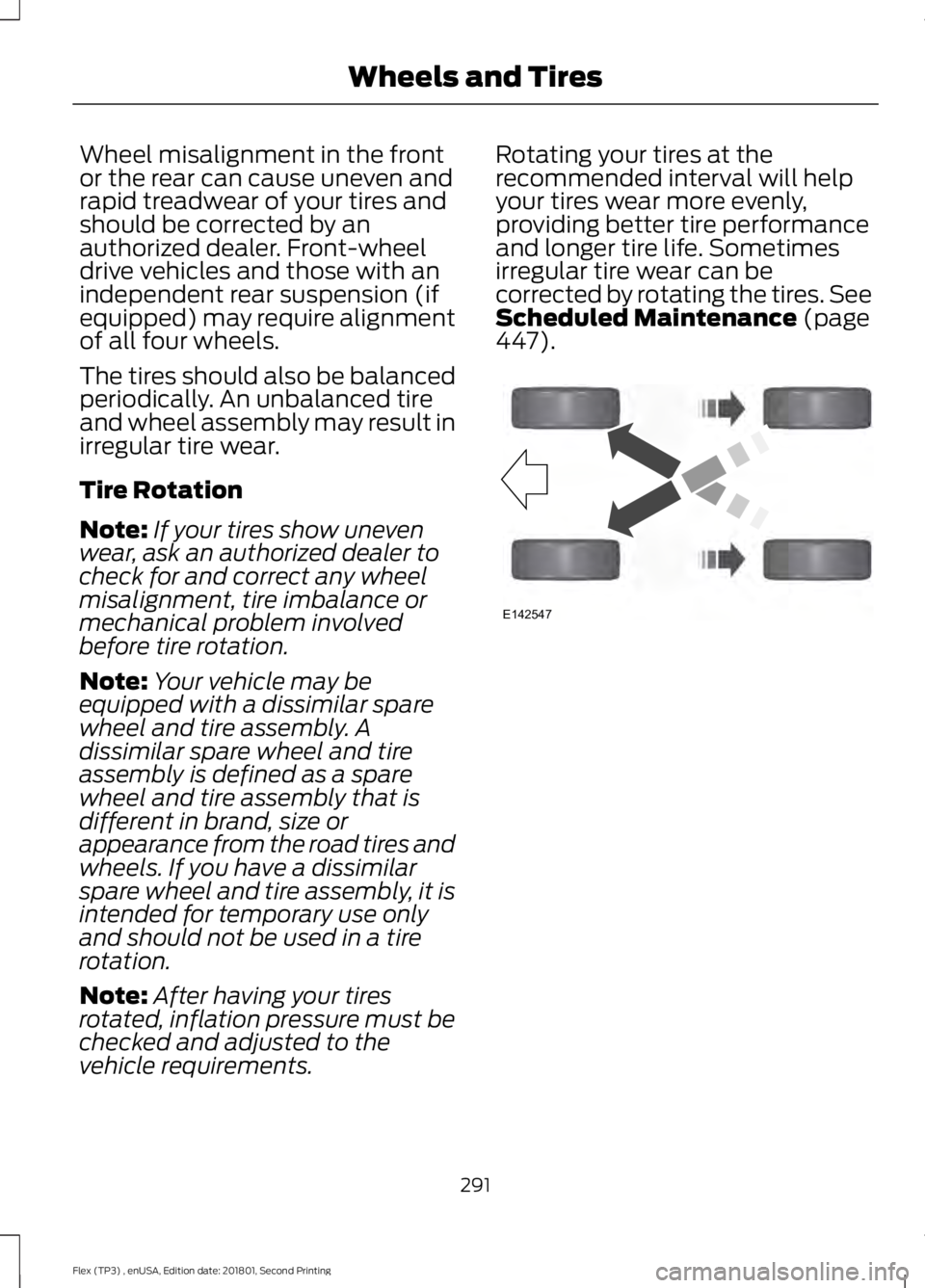
vehicle requirements. Rotating your tires at the
recommended interval will help
your tires wear more evenly,
providing better tire performance
and longer tire life. Sometimes
irregular tire wear can be
corrected by rotating the tires. See
Scheduled Maintenance (page
447). 291
Flex (TP3) , enUSA, Edition date: 201801, Second Printing Wheels and TiresE142547
Page 506 of 508
SYNC™ 3 Troubleshooting.....................430
SYNC™ Applications and
Services........................................................344
911 Assist............................................................... 344
SYNC™ AppLink ™.....................................346
SYNC Mobile Apps............................................ 346
SYNC™............................................................326 General Information......................................... 326
SYNC™ Troubleshooting
..........................357
T
Technical Specifications See: Capacities and Specifications............302
The Better Business Bureau (BBB) Auto Line Program (U.S. Only)
.......................229
Tire Care..........................................................278 Glossary of Tire Terminology........................ 280
Information About Uniform Tire Quality Grading .............................................................. 278
Information Contained on the Tire Sidewall............................................................. 281
Temperature A B C............................................ 279
Traction AA A B C............................................... 279
Treadwear............................................................. 279
Tire Pressure Monitoring System...........293 Changing Tires With a Tire Pressure
Monitoring System....................................... 294
Understanding Your Tire Pressure Monitoring System ...................................... 294
Tires See: Wheels and Tires...................................... 276
Towing a Trailer.............................................210 Load Placement................................................. 210
Towing the Vehicle on Four Wheels...........................................................216
Emergency Towing............................................. 216
Recreational Towing.......................................... 216
Towing..............................................................210
Traction Control
.............................................177
Principle of Operation........................................ 177
Trailer Sway Control......................................211
Transmission Code Designation
............307
Transmission..................................................164
Transporting the Vehicle...........................225 U
Under Hood Overview - 3.5L
Duratec.........................................................246
Under Hood Overview - 3.5L Ecoboost™..................................................247
Universal Garage Door Opener...............138 HomeLink Wireless Control System...........138
USB Port..........................................................325
Using Adaptive Cruise Control................190 Automatic Cancellation................................... 193
Blocked Sensor................................................... 194
Canceling the Set Speed................................. 193
Changing the Set Speed.................................. 193
Detection Issues.................................................. 193
Following a Vehicle............................................. 191
Hilly Condition Usage........................................ 193
Overriding the Set Speed................................ 192
Resuming the Set Speed................................. 193
Setting the Adaptive Cruise Speed..............191
Setting the Gap Distance................................ 192
Switching Adaptive Cruise Control Off....................................................................... 193
Switching Adaptive Cruise Control On........................................................................\
190
Switching to Normal Cruise Control............195
System Not Available....................................... 194
Using All-Wheel Drive................................168 Driving In Special Conditions With
All-Wheel Drive (AWD)............................... 170
Operating AWD Vehicles With Mismatched Tires.................................................................... 169
Operating AWD Vehicles With Spare Tires.................................................................... 169
Using Cruise Control...................................189 Switching Cruise Control Off......................... 189
Switching Cruise Control On.......................... 189
Using MyKey With Remote Start Systems...........................................................61
Using Snow Chains
.....................................292
Using Stability Control................................179
Using SYNC™ With Your Media Player.............................................................347
Accessing Your Play Menu.............................. 352
Connecting Your Digital Media Player to the USB Port........................................................... 347
Media Menu Features...................................... 350
Media Voice Commands................................ 349
503
Flex (TP3) , enUSA, Edition date: 201801, Second Printing Index