lights FORD FOCUS 2005 1.G User Guide
[x] Cancel search | Manufacturer: FORD, Model Year: 2005, Model line: FOCUS, Model: FORD FOCUS 2005 1.GPages: 224, PDF Size: 3.39 MB
Page 36 of 224
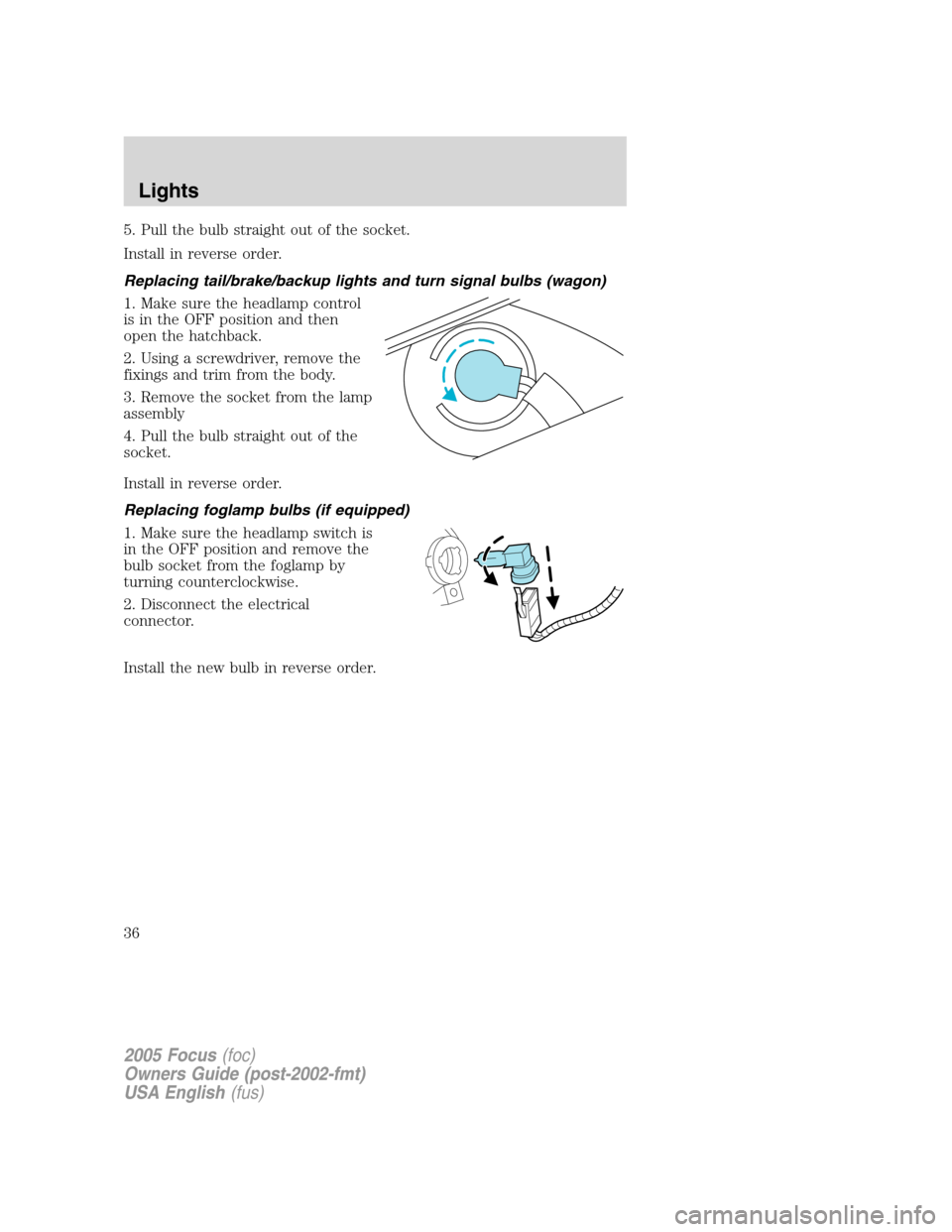
5. Pull the bulb straight out of the socket.
Install in reverse order.
Replacing tail/brake/backup lights and turn signal bulbs (wagon)
1. Make sure the headlamp control
is in the OFF position and then
open the hatchback.
2. Using a screwdriver, remove the
fixings and trim from the body.
3. Remove the socket from the lamp
assembly
4. Pull the bulb straight out of the
socket.
Install in reverse order.
Replacing foglamp bulbs (if equipped)
1. Make sure the headlamp switch is
in the OFF position and remove the
bulb socket from the foglamp by
turning counterclockwise.
2. Disconnect the electrical
connector.
Install the new bulb in reverse order.
2005 Focus(foc)
Owners Guide (post-2002-fmt)
USA English(fus)
Lights
36
Page 37 of 224
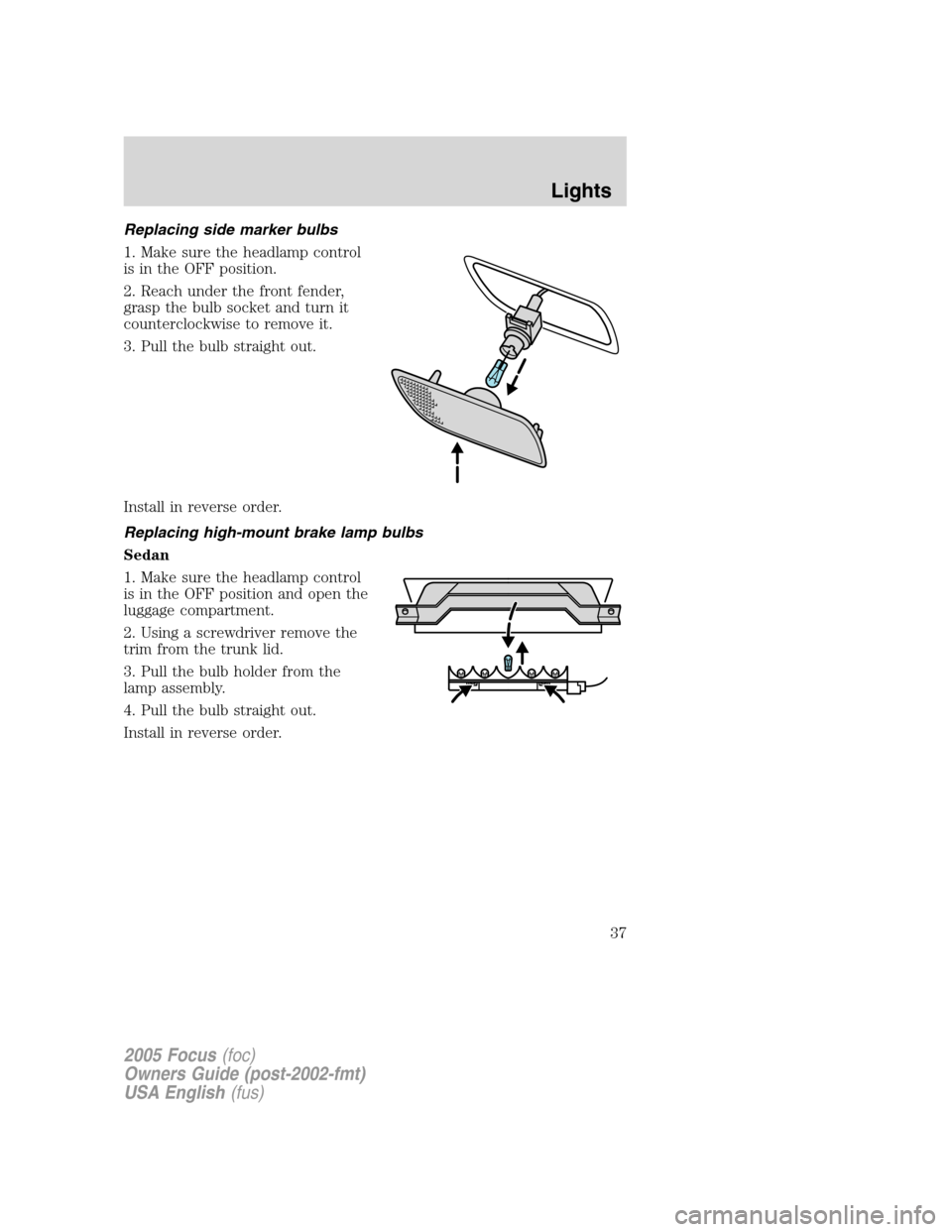
Replacing side marker bulbs
1. Make sure the headlamp control
is in the OFF position.
2. Reach under the front fender,
grasp the bulb socket and turn it
counterclockwise to remove it.
3. Pull the bulb straight out.
Install in reverse order.
Replacing high-mount brake lamp bulbs
Sedan
1. Make sure the headlamp control
is in the OFF position and open the
luggage compartment.
2. Using a screwdriver remove the
trim from the trunk lid.
3. Pull the bulb holder from the
lamp assembly.
4. Pull the bulb straight out.
Install in reverse order.
2005 Focus(foc)
Owners Guide (post-2002-fmt)
USA English(fus)
Lights
37
Page 38 of 224
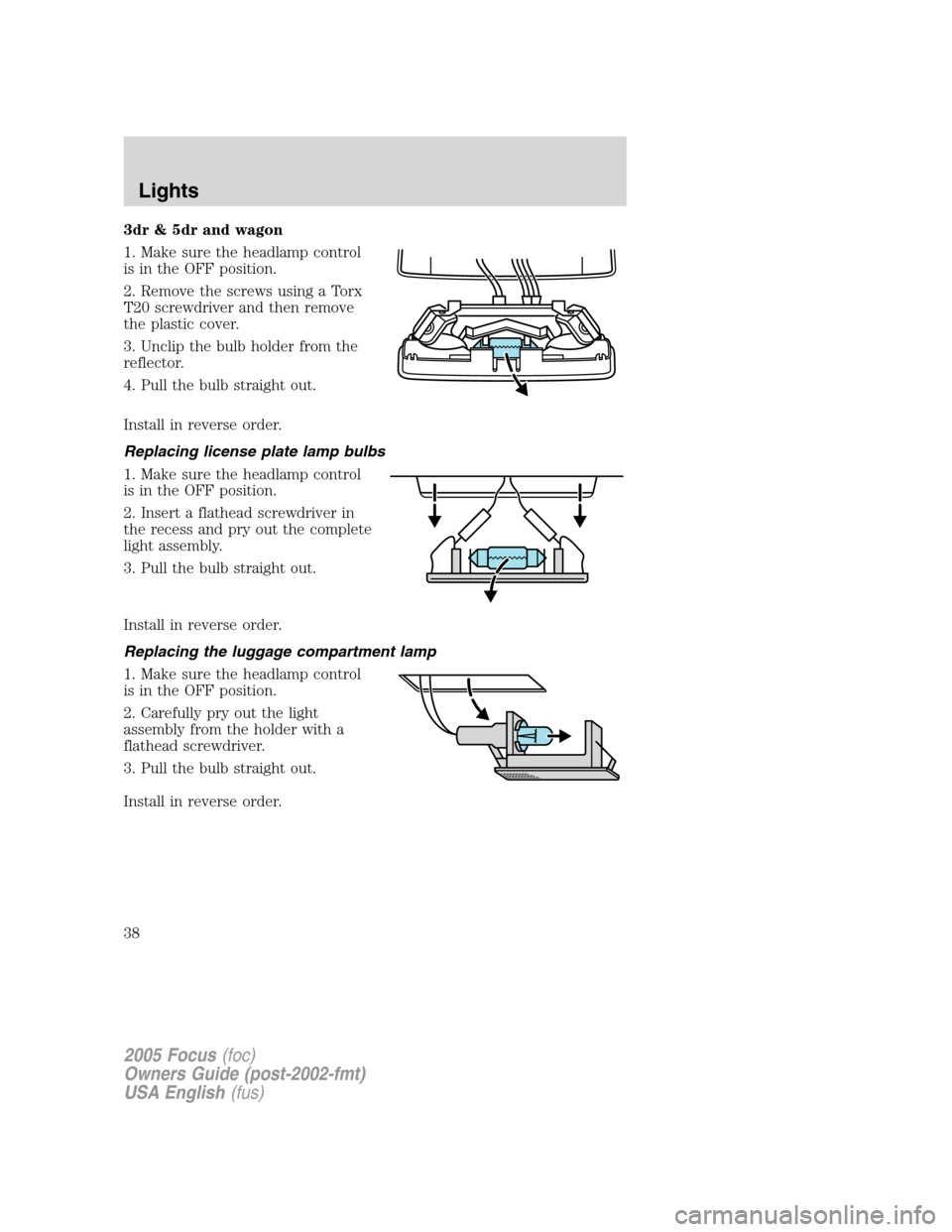
3dr & 5dr and wagon
1. Make sure the headlamp control
is in the OFF position.
2. Remove the screws using a Torx
T20 screwdriver and then remove
the plastic cover.
3. Unclip the bulb holder from the
reflector.
4. Pull the bulb straight out.
Install in reverse order.
Replacing license plate lamp bulbs
1. Make sure the headlamp control
is in the OFF position.
2. Insert a flathead screwdriver in
the recess and pry out the complete
light assembly.
3. Pull the bulb straight out.
Install in reverse order.
Replacing the luggage compartment lamp
1. Make sure the headlamp control
is in the OFF position.
2. Carefully pry out the light
assembly from the holder with a
flathead screwdriver.
3. Pull the bulb straight out.
Install in reverse order.
2005 Focus(foc)
Owners Guide (post-2002-fmt)
USA English(fus)
Lights
38
Page 39 of 224
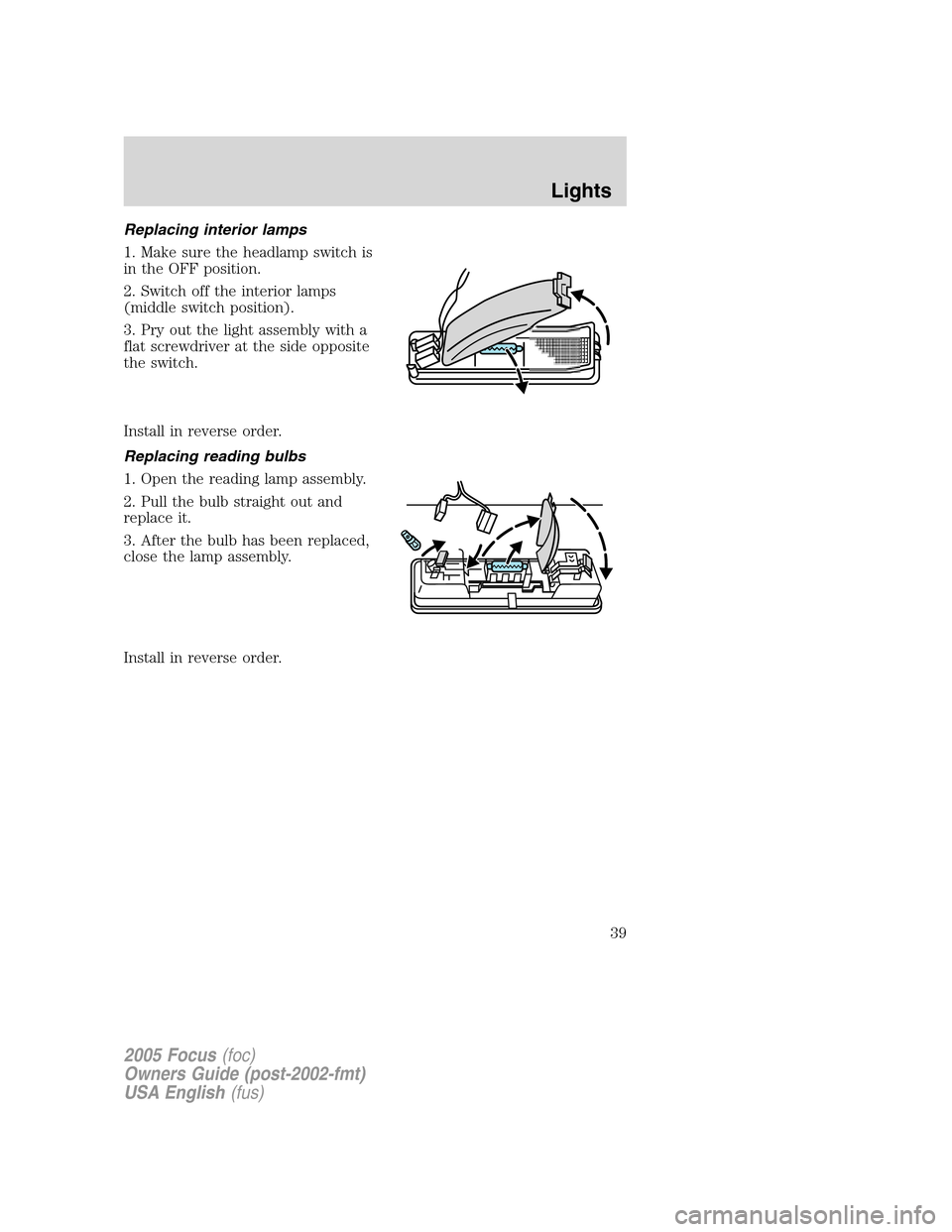
Replacing interior lamps
1. Make sure the headlamp switch is
in the OFF position.
2. Switch off the interior lamps
(middle switch position).
3. Pry out the light assembly with a
flat screwdriver at the side opposite
the switch.
Install in reverse order.
Replacing reading bulbs
1. Open the reading lamp assembly.
2. Pull the bulb straight out and
replace it.
3. After the bulb has been replaced,
close the lamp assembly.
Install in reverse order.
2005 Focus(foc)
Owners Guide (post-2002-fmt)
USA English(fus)
Lights
39
Page 68 of 224
SAFETY RESTRAINTS
Personal Safety System
The Personal Safety System provides an improved overall level of frontal
crash protection to front seat occupants and is designed to help further
reduce the risk of air bag-related injuries. The system is able to analyze
different occupant conditions and crash severity before activating the
appropriate safety devices to help better protect a range of occupants in
a variety of frontal crash situations.
Your vehicle’s Personal Safety System consists of:
•Driver and passenger dual-stage air bag supplemental restraints.
•Front safety belts with pretensioners, energy management retractors,
and safety belt usage sensors.
•Driver’s seat position sensor.
•Front crash severity sensor.
•Front passenger sensing system
•Restraints Control Module (RCM) with impact and safing sensors.
•Restraint system warning light and back-up tone.
•The electrical wiring for the air bags, crash sensor(s), safety belt
pretensioners, front safety belt usage sensors, driver seat position
sensor, and indicator lights.
How does the personal safety system work?
The Personal Safety System can adapt the deployment strategy of your
vehicle’s safety devices according to crash severity and conditions. A
collection of crash sensors provides information to the Restraints Control
Module (RCM). During a crash, the RCM activates the safety belt
pretensioners and/or either none, one, or both stages of the dual-stage
air bag supplemental restraints based on crash severity and conditions.
The fact that the pretensioners or air bags did not activate for both front
seat occupants in a collision does not mean that something is wrong with
the system. Rather, it means the Personal Safety System determined the
accident conditions (crash severity, belt usage, etc.) were not
appropriate to activate these safety devices. Front air bags and
pretensioners are designed to activate only in frontal and near-frontal
collisions, not rollovers, side-impacts, or rear-impacts unless the collision
causes sufficient longitudinal deceleration.
Driver and passenger dual-stage air bag supplemental restraints
The dual-stage air bags offer the capability to tailor the level of air bag
inflation energy. A lower, less forceful energy level is provided for more
2005 Focus(foc)
Owners Guide (post-2002-fmt)
USA English(fus)
Seating and Safety Restraints
68
Page 70 of 224
improperly seated or restrained in the front passenger seat contrary to
proper child-seating or restraint usage recommendations. Even with this
technology, parents areSTRONGLYencouraged to always properly
restrain children in the rear seat. The sensor also turns off the air bag
when the passenger seat is empty to prevent unnecessary replacement of
the air bag(s) after a collision.
When the front passenger seat is occupied and the sensing system has
turned off the passenger’s frontal air bag, the“pass air bag off”indicator
will light and stay lit to remind you that the front passenger frontal air
bag is off. SeeFront passenger sensing systemin the airbags section of
this chapter.
Front safety belt usage sensors
The front safety belt usage sensors detect whether or not the driver and
front outboard passenger safety belts are fastened. This information
allows your Personal Safety System to tailor the air bag deployment and
safety belt pretensioner activation depending upon safety belt usage.
Refer toSafety Beltsection in this chapter.
Front safety belt pretensioners
The safety belt pretensioners are designed to tighten the safety belts
firmly against the occupant’s body during a collision. This maximizes the
effectiveness of the safety belts and helps properly position the occupant
relative to the air bag to improve protection. The safety belt
pretensioners can be either activated alone or, if the collision is of
sufficient severity, together with the air bags.
Front safety belt energy management retractors
The front safety belt energy management retractors allow webbing to be
pulled out of the retractor in a gradual and controlled manner in
response to the occupant’s forward momentum. This helps reduce the
risk of force-related injuries to the occupant’s chest by limiting the load
on the occupant. Refer toSafety Beltsection in this chapter.
Determining if the Personal Safety System is operational
The Personal Safety System uses a warning light in the instrument
cluster or a back-up tone to indicate the condition of the system. Refer
to theWarning Lightsection in theInstrument Clusterchapter.
Routine maintenance of the Personal Safety System is not required.
The Restraints Control Module (RCM) monitors its own internal circuits
and the circuits for the air bag supplemental restraints, crash sensor(s),
safety belt pretensioners, front safety belt buckle sensors, and the driver
2005 Focus(foc)
Owners Guide (post-2002-fmt)
USA English(fus)
Seating and Safety Restraints
70
Page 88 of 224
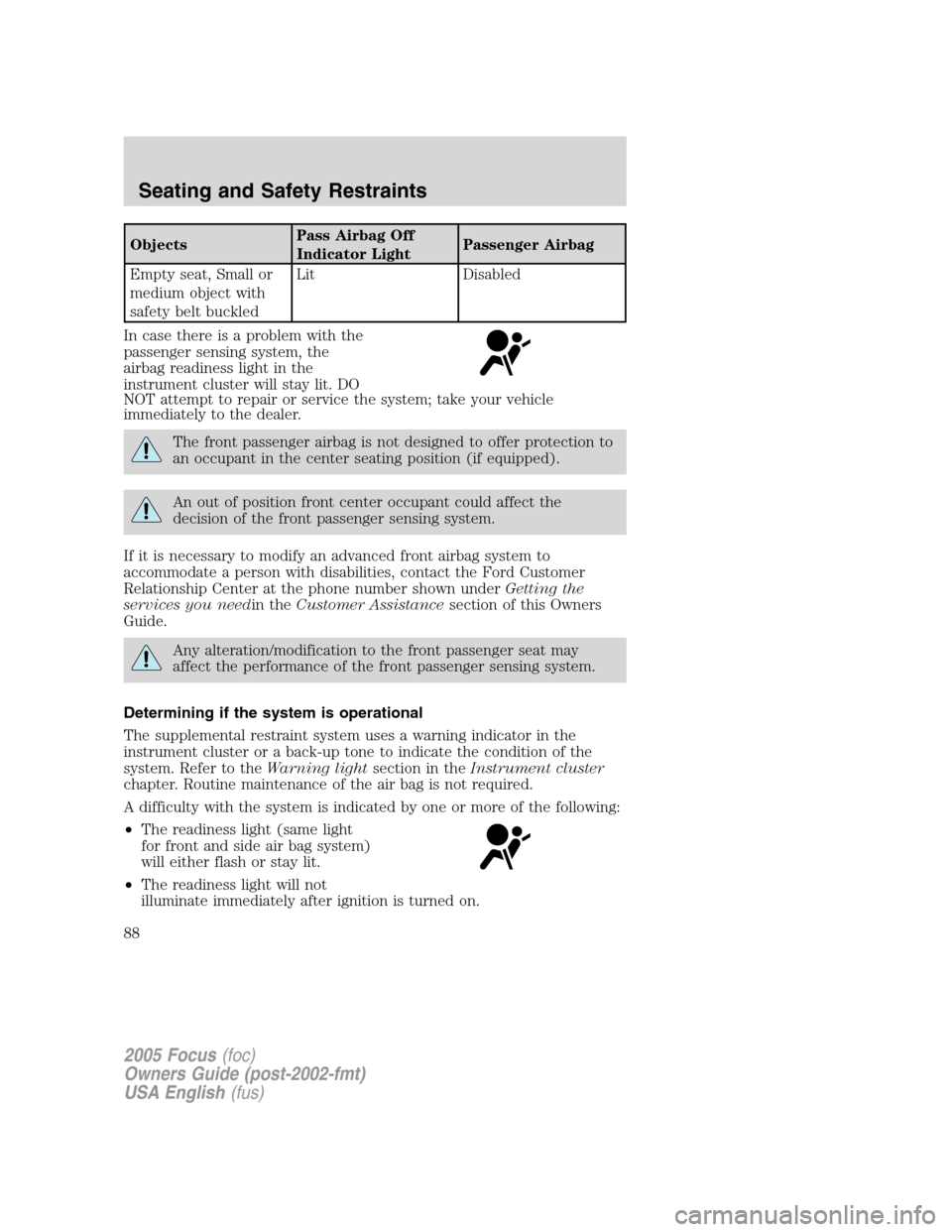
ObjectsPass Airbag Off
Indicator LightPassenger Airbag
Empty seat, Small or
medium object with
safety belt buckledLit Disabled
In case there is a problem with the
passenger sensing system, the
airbag readiness light in the
instrument cluster will stay lit. DO
NOT attempt to repair or service the system; take your vehicle
immediately to the dealer.
The front passenger airbag is not designed to offer protection to
an occupant in the center seating position (if equipped).
An out of position front center occupant could affect the
decision of the front passenger sensing system.
If it is necessary to modify an advanced front airbag system to
accommodate a person with disabilities, contact the Ford Customer
Relationship Center at the phone number shown underGetting the
services you needin theCustomer Assistancesection of this Owners
Guide.
Any alteration/modification to the front passenger seat may
affect the performance of the front passenger sensing system.
Determining if the system is operational
The supplemental restraint system uses a warning indicator in the
instrument cluster or a back-up tone to indicate the condition of the
system. Refer to theWarning lightsection in theInstrument cluster
chapter. Routine maintenance of the air bag is not required.
A difficulty with the system is indicated by one or more of the following:
•The readiness light (same light
for front and side air bag system)
will either flash or stay lit.
•The readiness light will not
illuminate immediately after ignition is turned on.
2005 Focus(foc)
Owners Guide (post-2002-fmt)
USA English(fus)
Seating and Safety Restraints
88
Page 103 of 224
STARTING
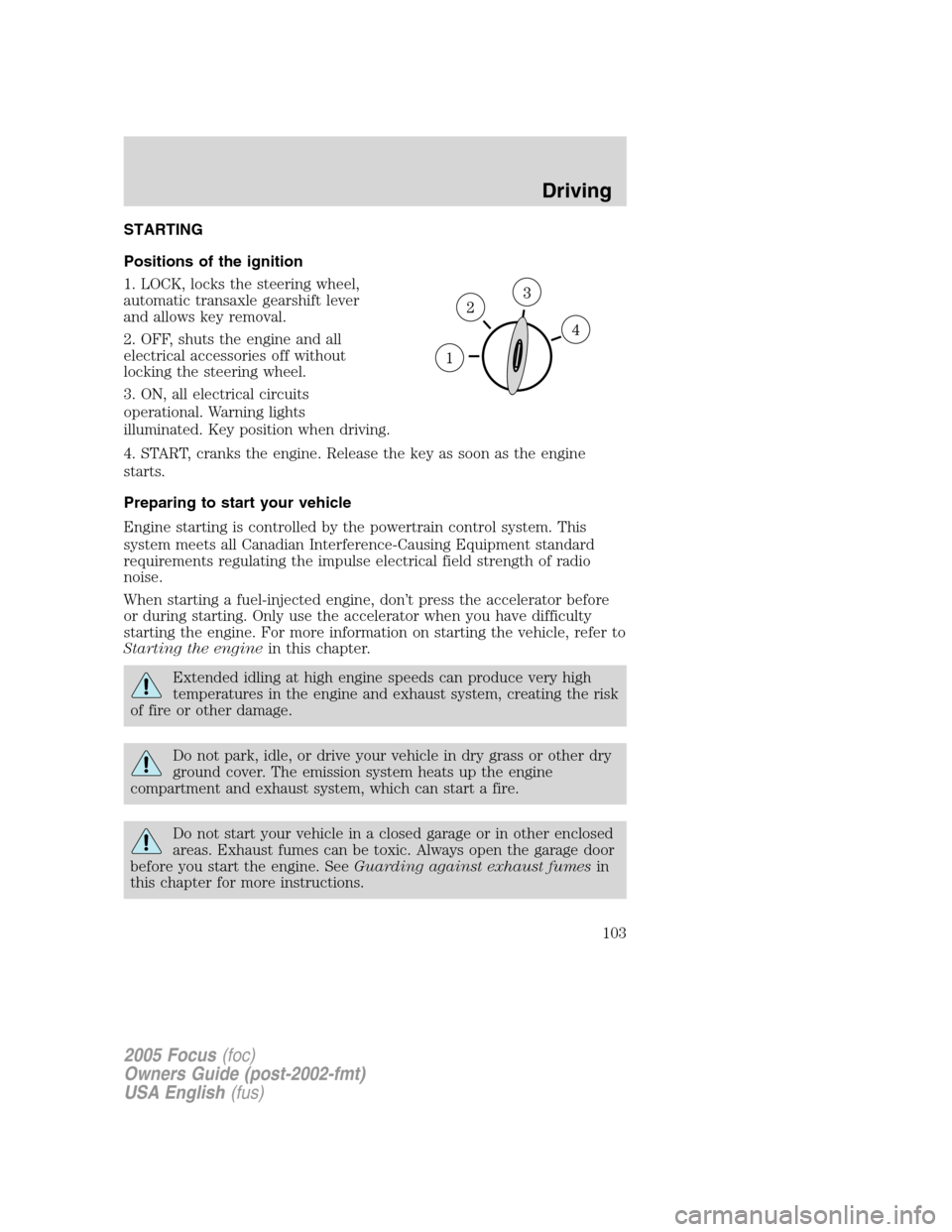
Positions of the ignition
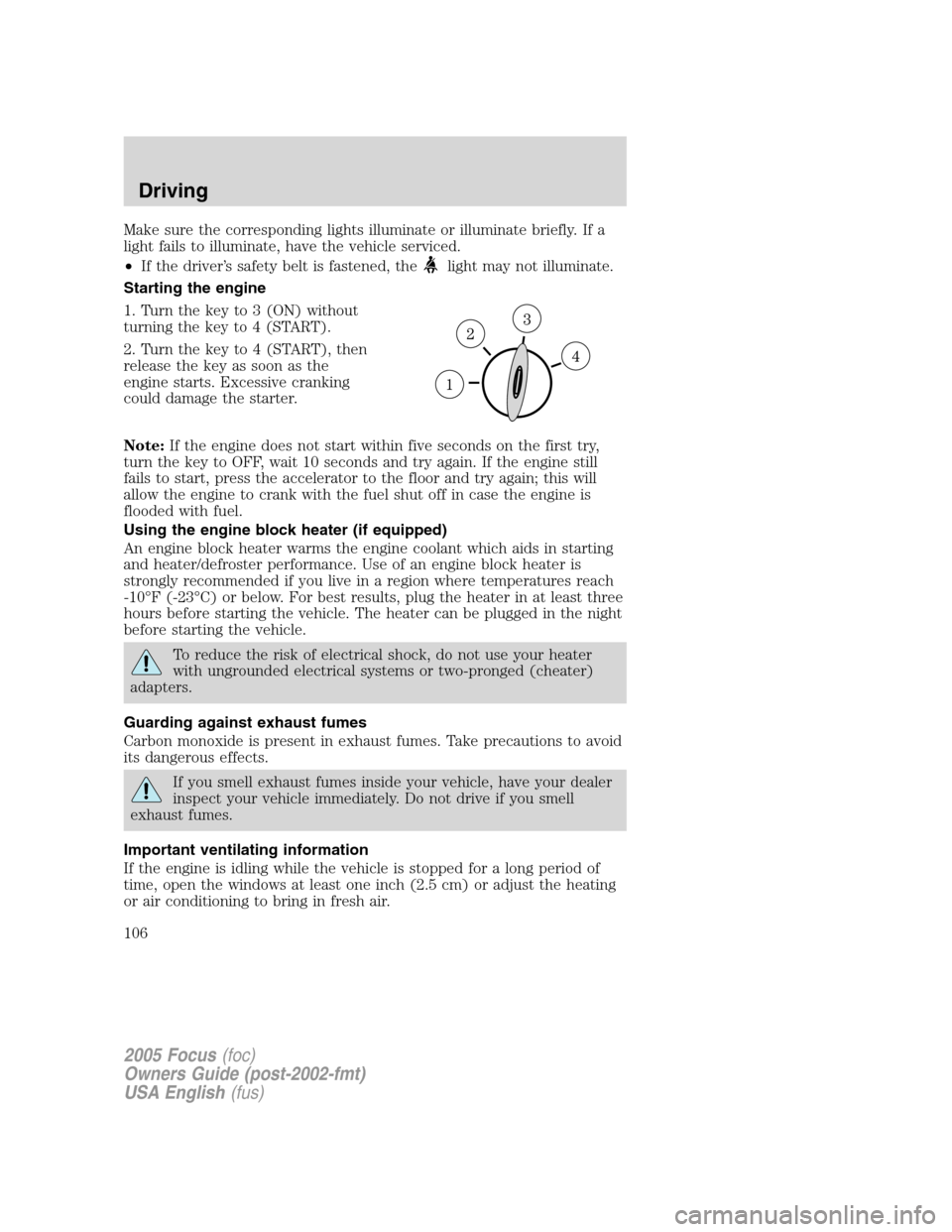
1. LOCK, locks the steering wheel,
automatic transaxle gearshift lever
and allows key removal.
2. OFF, shuts the engine and all
electrical accessories off without
locking the steering wheel.
3. ON, all electrical circuits
operational. Warning lights
illuminated. Key position when driving.
4. START, cranks the engine. Release the key as soon as the engine
starts.
Preparing to start your vehicle
Engine starting is controlled by the powertrain control system. This
system meets all Canadian Interference-Causing Equipment standard
requirements regulating the impulse electrical field strength of radio
noise.
When starting a fuel-injected engine, don’t press the accelerator before
or during starting. Only use the accelerator when you have difficulty
starting the engine. For more information on starting the vehicle, refer to
Starting the enginein this chapter.
Extended idling at high engine speeds can produce very high
temperatures in the engine and exhaust system, creating the risk
of fire or other damage.
Do not park, idle, or drive your vehicle in dry grass or other dry
ground cover. The emission system heats up the engine
compartment and exhaust system, which can start a fire.
Do not start your vehicle in a closed garage or in other enclosed
areas. Exhaust fumes can be toxic. Always open the garage door
before you start the engine. SeeGuarding against exhaust fumesin
this chapter for more instructions.
2005 Focus(foc)
Owners Guide (post-2002-fmt)
USA English(fus)
Driving
Driving
103
Page 106 of 224
Make sure the corresponding lights illuminate or illuminate briefly. If a
light fails to illuminate, have the vehicle serviced.
•If the driver’s safety belt is fastened, the
light may not illuminate.
Starting the engine
1. Turn the key to 3 (ON) without
turning the key to 4 (START).
2. Turn the key to 4 (START), then
release the key as soon as the
engine starts. Excessive cranking
could damage the starter.
Note:If the engine does not start within five seconds on the first try,
turn the key to OFF, wait 10 seconds and try again. If the engine still
fails to start, press the accelerator to the floor and try again; this will
allow the engine to crank with the fuel shut off in case the engine is
flooded with fuel.
Using the engine block heater (if equipped)
An engine block heater warms the engine coolant which aids in starting
and heater/defroster performance. Use of an engine block heater is
strongly recommended if you live in a region where temperatures reach
-10°F (-23°C) or below. For best results, plug the heater in at least three
hours before starting the vehicle. The heater can be plugged in the night
before starting the vehicle.
To reduce the risk of electrical shock, do not use your heater
with ungrounded electrical systems or two-pronged (cheater)
adapters.
Guarding against exhaust fumes
Carbon monoxide is present in exhaust fumes. Take precautions to avoid
its dangerous effects.
If you smell exhaust fumes inside your vehicle, have your dealer
inspect your vehicle immediately. Do not drive if you smell
exhaust fumes.
Important ventilating information
If the engine is idling while the vehicle is stopped for a long period of
time, open the windows at least one inch (2.5 cm) or adjust the heating
or air conditioning to bring in fresh air.
2005 Focus(foc)
Owners Guide (post-2002-fmt)
USA English(fus)
Driving
106
Page 122 of 224
Preparing to tow
Use the proper equipment for towing a trailer and make sure it is
properly attached to your vehicle. See your dealer or a reliable trailer
dealer if you require assistance.
Hitches
Do not use hitches that clamp onto the vehicle bumper. Use a load
carrying hitch. You must distribute the load in your trailer so that
10–15% of the total weight of the trailer is on the tongue.
Safety chains
Always connect the trailer’s safety chains to the frame or hook retainers
of the vehicle hitch. To connect the trailer’s safety chains, cross the
chains under the trailer tongue and allow slack for turning corners.
If you use a rental trailer, follow the instructions that the rental agency
gives to you.
Do not attach safety chains to the bumper.
Trailer brakes
Electric brakes and manual, automatic or surge-type trailer brakes are
safe if installed properly and adjusted to the manufacturer’s
specifications. The trailer brakes must meet local and Federal
regulations.
Do not connect a trailer’s hydraulic brake system directly to your
vehicle’s brake system. Your vehicle may not have enough
braking power and your chances of having a collision greatly increase.
The braking system of the tow vehicle is rated for operation at the
GVWR not GCWR.
Trailer lamps
Trailer lamps are required on most towed vehicles. Make sure all running
lights, brake lights, turn signals and hazard lights are working. See your
dealer or trailer rental agency for proper instructions and equipment for
hooking up trailer lamps.
2005 Focus(foc)
Owners Guide (post-2002-fmt)
USA English(fus)
Driving
122