battery FORD FOCUS 2005 1.G Owner's Manual
[x] Cancel search | Manufacturer: FORD, Model Year: 2005, Model line: FOCUS, Model: FORD FOCUS 2005 1.GPages: 224, PDF Size: 3.39 MB
Page 164 of 224
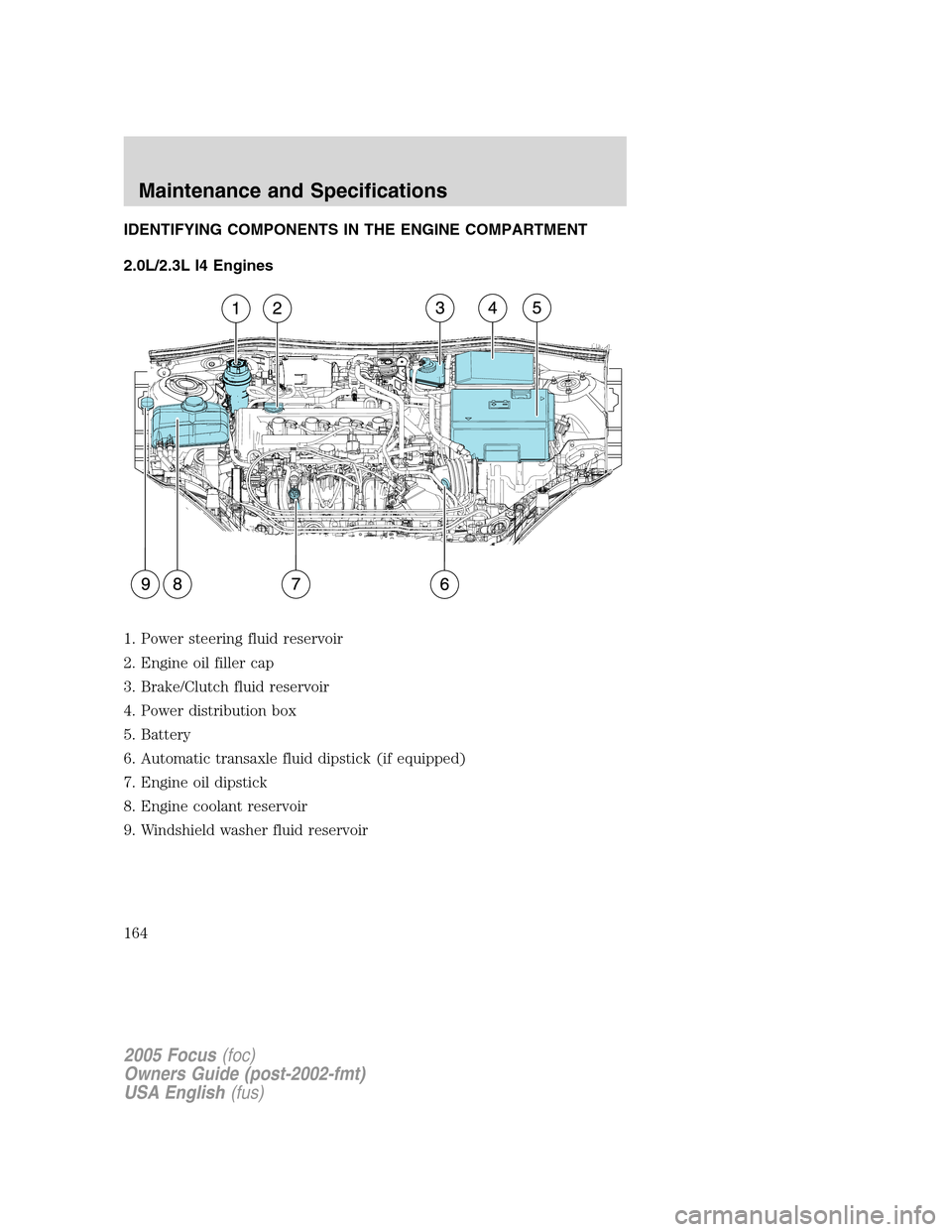
IDENTIFYING COMPONENTS IN THE ENGINE COMPARTMENT
2.0L/2.3L I4 Engines
1. Power steering fluid reservoir
2. Engine oil filler cap
3. Brake/Clutch fluid reservoir
4. Power distribution box
5. Battery
6. Automatic transaxle fluid dipstick (if equipped)
7. Engine oil dipstick
8. Engine coolant reservoir
9. Windshield washer fluid reservoir
2005 Focus(foc)
Owners Guide (post-2002-fmt)
USA English(fus)
Maintenance and Specifications
164
Page 168 of 224
BATTERY
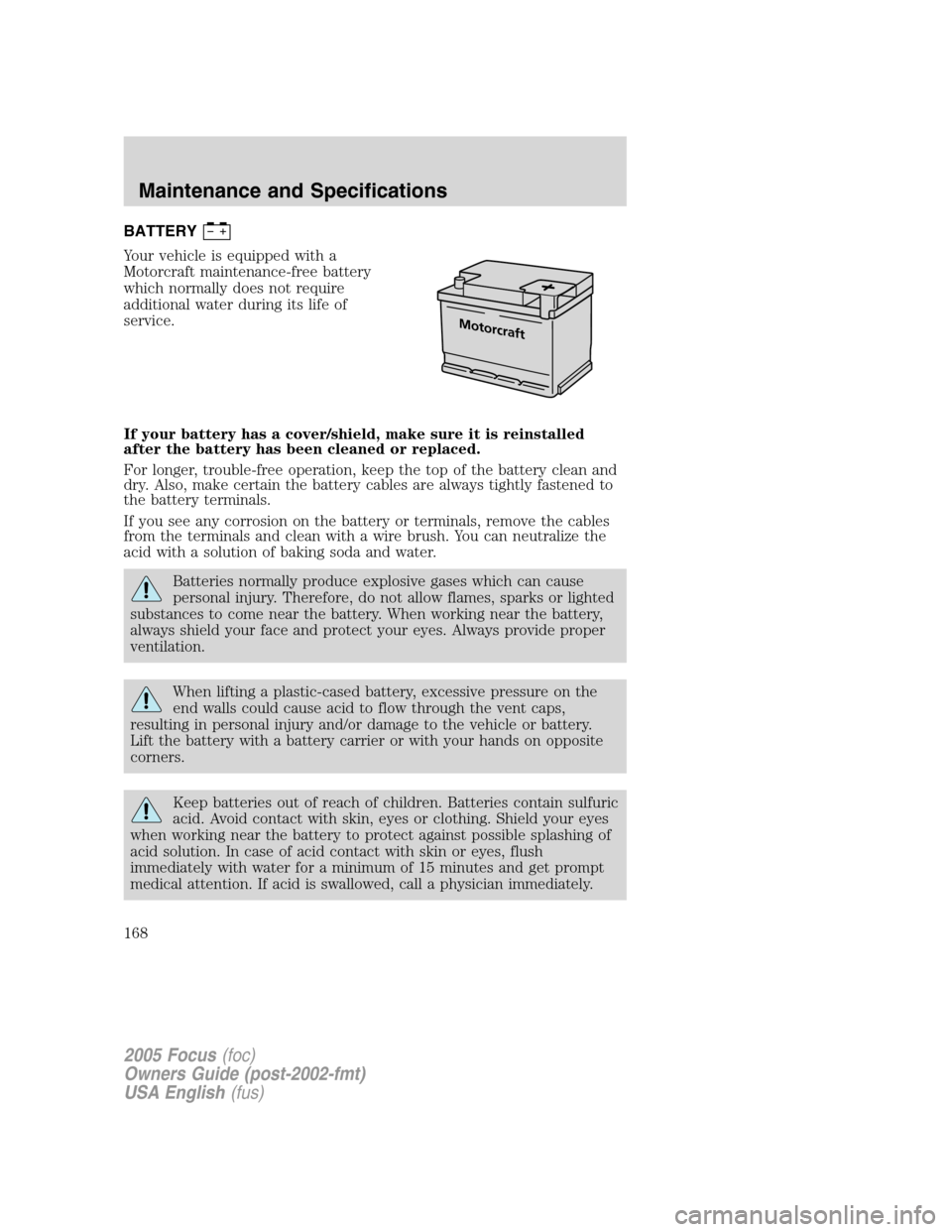
Your vehicle is equipped with a
Motorcraft maintenance-free battery
which normally does not require
additional water during its life of
service.
If your battery has a cover/shield, make sure it is reinstalled
after the battery has been cleaned or replaced.
For longer, trouble-free operation, keep the top of the battery clean and
dry. Also, make certain the battery cables are always tightly fastened to
the battery terminals.
If you see any corrosion on the battery or terminals, remove the cables
from the terminals and clean with a wire brush. You can neutralize the
acid with a solution of baking soda and water.
Batteries normally produce explosive gases which can cause
personal injury. Therefore, do not allow flames, sparks or lighted
substances to come near the battery. When working near the battery,
always shield your face and protect your eyes. Always provide proper
ventilation.
When lifting a plastic-cased battery, excessive pressure on the
end walls could cause acid to flow through the vent caps,
resulting in personal injury and/or damage to the vehicle or battery.
Lift the battery with a battery carrier or with your hands on opposite
corners.
Keep batteries out of reach of children. Batteries contain sulfuric
acid. Avoid contact with skin, eyes or clothing. Shield your eyes
when working near the battery to protect against possible splashing of
acid solution. In case of acid contact with skin or eyes, flush
immediately with water for a minimum of 15 minutes and get prompt
medical attention. If acid is swallowed, call a physician immediately.
2005 Focus(foc)
Owners Guide (post-2002-fmt)
USA English(fus)
Maintenance and Specifications
168
Page 169 of 224
Battery posts, terminals and related accessories contain lead and
lead compounds.Wash hands after handling.
Because your vehicle’s engine is electronically controlled by a computer,
some control conditions are maintained by power from the battery. When
the battery is disconnected or a new battery is installed, the engine must
relearn its idle and fuel trim strategy for optimum driveability and
performance. To begin this process:
1. With the vehicle at a complete stop, set the parking brake.
2. Put the gearshift in P (Park) (automatic transaxle) or the neutral
position (manual transaxle), turn off all accessories and start the engine.
3. Run the engine until it reaches normal operating temperature.
4. Allow the engine to idle for at least one minute.
5. Turn the A/C on and allow the engine to idle for at least one minute.
6. Drive the vehicle to complete the relearning process.
•The vehicle may need to be driven 10 miles (16 km) or more to
relearn the idle and fuel trim strategy.
•If you do not allow the engine to relearn its idle trim, the idle
quality of your vehicle may be adversely affected until the idle
trim is eventually relearned.
When the battery is disconnected or a new battery installed, the
transmission must learn its adaptive strategy. As a result of this, the
transmission may shift firmly. This operation is considered normal and
will fully update transmission operation to its optimum shift feel.
If the battery has been disconnected or a new battery has been installed,
the clock and the preset radio stations must be reset once the battery is
reconnected.
•Always dispose of automotive
batteries in a responsible manner.
Follow your local authorized
standards for disposal. Call your
local authorized recycling center
to find out more about recycling
automotive batteries.
ENGINE COOLANT
Checking engine coolant
The concentration and level of engine coolant should be checked at the
mileage intervals listed in theScheduled Maintenance Guide. The
LEAD
RETURN
RECYCLE
2005 Focus(foc)
Owners Guide (post-2002-fmt)
USA English(fus)
Maintenance and Specifications
169
Page 170 of 224
coolant concentration should be maintained at 50/50 coolant and distilled
water, which equates to a freeze point of -34°F (-36°C). Coolant
concentration testing is possible with a hydrometer or antifreeze tester
(such as the Rotunda Battery and Antifreeze Tester, 014–R1060). The
level of coolant should be maintained at the“FULL COLD”level or
within the“COLD FILL RANGE”in the coolant reservoir. If the level falls
below, add coolant per the instructions in theAdding engine coolant
section.
Your vehicle was factory-filled with a 50/50 engine coolant and water
concentration. If the concentration of coolant falls below 40% or above
60%, the engine parts could become damaged or not work properly.A
50–50 mixture of coolant and water provides the following:
•Freeze protection down to -34°F (-36°C).
•Boiling protection up to 265°F (129°C).
•Protection against rust and other forms of corrosion.
•Enables calibrated gauges to work properly.
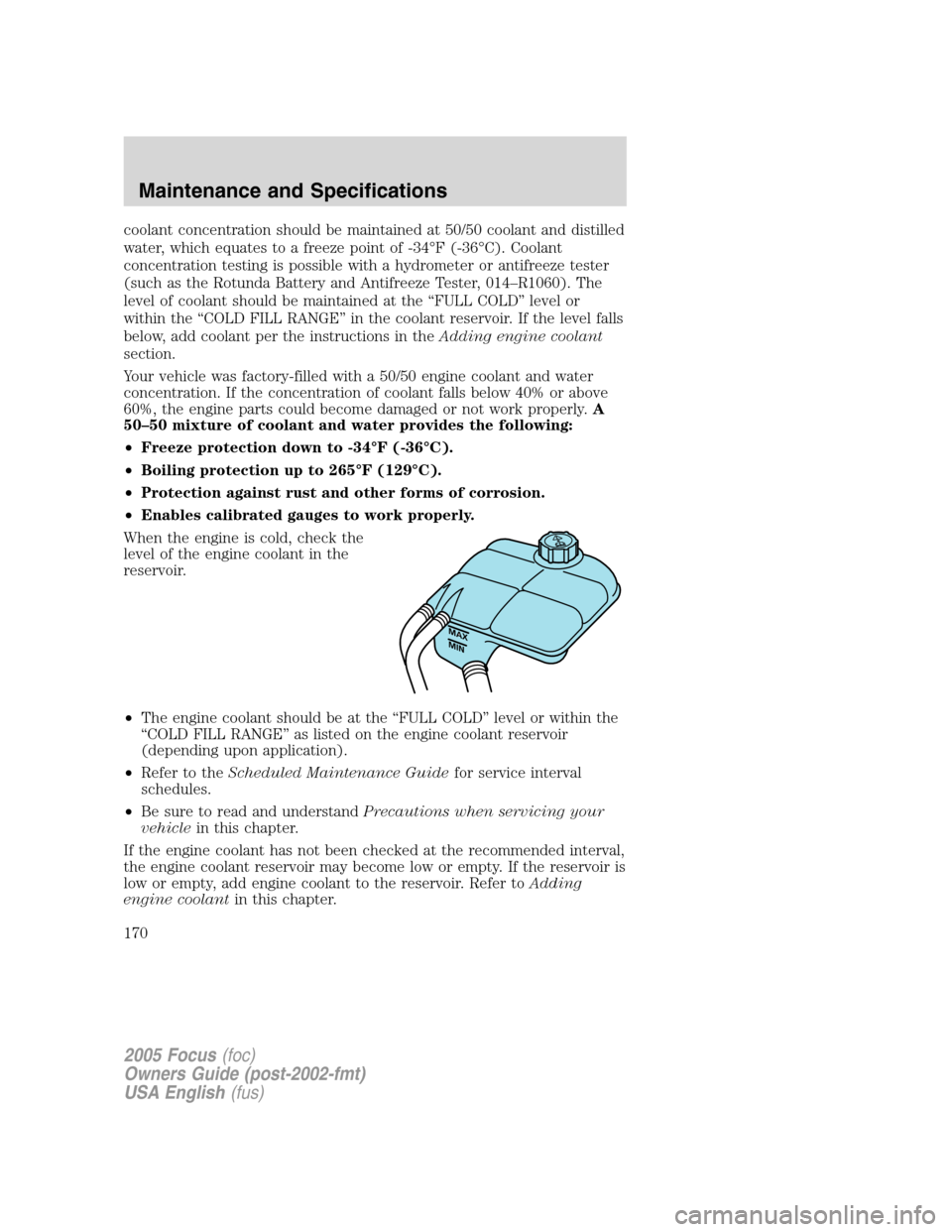
When the engine is cold, check the
level of the engine coolant in the
reservoir.
•The engine coolant should be at the“FULL COLD”level or within the
“COLD FILL RANGE”as listed on the engine coolant reservoir
(depending upon application).
•Refer to theScheduled Maintenance Guidefor service interval
schedules.
•Be sure to read and understandPrecautions when servicing your
vehiclein this chapter.
If the engine coolant has not been checked at the recommended interval,
the engine coolant reservoir may become low or empty. If the reservoir is
low or empty, add engine coolant to the reservoir. Refer toAdding
engine coolantin this chapter.
2005 Focus(foc)
Owners Guide (post-2002-fmt)
USA English(fus)
Maintenance and Specifications
170
Page 184 of 224
government emission standards. The OBD-II system also assists the
service technician in properly servicing your vehicle. When theCheck
engine/Service engine soonlight illuminates, the OBD-II system has
detected a malfunction. Temporary malfunctions may cause yourCheck
engine/Service engine soonlight to illuminate. Examples are:
1. The vehicle has run out of fuel. (The engine may misfire or run
poorly.)
2. Poor fuel quality or water in the fuel.
3. The fuel cap may not have been securely tightened.
These temporary malfunctions can be corrected by filling the fuel tank
with good quality fuel and/or properly tightening the fuel cap. After three
driving cycles without these or any other temporary malfunctions
present, theCheck engine/Service engine soonlight should turn off. (A
driving cycle consists of a cold engine startup followed by mixed
city/highway driving.) No additional vehicle service is required.
If theCheck engine/Service engine soonlight remains on, have your
vehicle serviced at the first available opportunity.
Readiness for Inspection/Maintenance (I/M) testing
In some localities, it may be a legal requirement to pass an I/M test of
the on-board diagnostics system. If your
indicator is on, refer to the
description in theWarning lights and chimessection of the
Instrument Clusterchapter. Your vehicle may not pass the I/M test with
the
indicator on.
If the vehicle’s powertrain system or its battery has just been serviced,
the on-board diagnostics system is reset to a“not ready for I/M test”
condition. To ready the on-board diagnostics system for I/M testing, a
minimum of 30 minutes of city and highway driving is necessary as
described below:
•First, at least 10 minutes of driving on an expressway or highway.
•Next, at least 20 minutes driving in stop-and-go, city-type traffic with
at least four idle periods.
Allow the vehicle to sit for at least eight hours without starting the
engine. Then, start the engine and complete the above driving cycle. The
engine must warm up to its normal operating temperature. Once started,
do not turn off the engine until the above driving cycle is complete.
2005 Focus(foc)
Owners Guide (post-2002-fmt)
USA English(fus)
Maintenance and Specifications
184
Page 202 of 224
•Install chains securely, verifying that the chains do not touch any
wiring, brake lines or fuel lines.
•Drive cautiously. If you hear the chains rub or bang against your
vehicle, stop and re-tighten the chains. If this does not work, remove
the chains to prevent damage to your vehicle.
•If possible, avoid fully loading your vehicle.
•Remove the tire chains when they are no longer needed. Do not use
tire chains on dry roads.
•The suspension insulation and bumpers will help prevent vehicle
damage. Do not remove these components from your vehicle when
using snow tires and chains.
MOTORCRAFT PART NUMBERS
Component 2.0L I4 engine 2.3L I4 engine
Air filter element N/A (Lifetime)1N/A (Lifetime)1
Fuel filter FG-1081 FG-1081
Oil filter FL-9104FL-9104
Battery BXT-96R BXT-96R
Battery (if equipped
with Audiophile radio)BXT-40R BXT-40R
PCV valve
2
Spark plugs3
1
Non Serviceable Part. The air filter is designed to last the life of the
vehicle. See dealer or qualified technician for replacement. The
Technician can check the diagnostics system for the possibility of an
excessively dirty air filter.
2The PCV valve is a critical emission component. It is one of the items
listed in theScheduled Maintenance Guideand is essential to the life
and performance of your vehicle and to its emissions system.
For PCV valve replacement, see your dealer or a qualified service
technician. Refer to theScheduled Maintenance Guidefor the
appropriate intervals for changing the PCV valve.
Replace the PCV valve with one that meets Ford material and
design specifications for your vehicle, such as a Motorcraft or
equivalent replacement part. The customer warranty may be void
for any damage to the emissions system if such a PCV valve is not
used.
2005 Focus(foc)
Owners Guide (post-2002-fmt)
USA English(fus)
Maintenance and Specifications
202
Page 215 of 224
A
Air bag supplemental restraint
system ..............................81–82, 89
and child safety seats ..............83
description ..........................82, 89
disposal ......................................91
driver air bag ......................84, 90
indicator light ...........................88
operation .............................84, 90
passenger air bag ...............84, 90
side air bag ................................89
Air cleaner filter .......................202
Antifreeze
(see Engine coolant) ................169
Anti-lock brake system
(see Brakes) ..............................107
Anti-theft system ........................62
arming the system ....................62
disarming a triggered system ..62
Audio system (see Radio) ...16, 20
Automatic transaxle
fluid, adding ............................186
fluid, checking ........................186
fluid, specification ..................206
Automatic transmission ............110
driving an automatic
overdrive .................................111
fluid, refill capacities ..............203
Auxiliary power point .................43
Axle
lubricant specifications ..........205
refill capacities ........................203
B
Battery .......................................168
acid, treating emergencies .....168
jumping a disabled battery ....139maintenance-free ....................168
replacement, specifications ...202
servicing ..................................168
BeltMinder ...................................76
Brakes ........................................107
anti-lock ...................................107
anti-lock brake system (ABS)
warning light ...........................107
fluid, checking and adding ....185
fluid, refill capacities ..............203
fluid, specifications .........205–206
lubricant specifications ..205–206
parking ....................................108
shift interlock ..........................110
Break-in period .............................5
C
Capacities for refilling fluids ....203
Cargo cover .................................50
Cell phone use ............................49
Certification Label ....................209
Child safety restraints ................92
child safety belts ......................92
Child safety seats ........................95
attaching with tether straps ....99
in front seat ..............................96
in rear seat ................................96
LATCH .....................................101
Cleaning your vehicle
engine compartment ..............157
instrument panel ....................159
interior .....................................159
plastic parts ............................158
washing ....................................156
waxing .....................................156
wheels ......................................157
wiper blades ............................158
2005 Focus(foc)
Owners Guide (post-2002-fmt)
USA English(fus)
Index
Index
215