trailer FORD FOCUS 2006 2.G User Guide
[x] Cancel search | Manufacturer: FORD, Model Year: 2006, Model line: FOCUS, Model: FORD FOCUS 2006 2.GPages: 224, PDF Size: 3.3 MB
Page 152 of 224
A dissimilar spare tire/wheel is defined as a spare tire and/or wheel that
is different in brand, size or appearance from the road tires and wheels
and can be one of three types:
1.T-type mini-spare:This spare tire begins with the letter “T” for tire
size and may have “Temporary Use Only” molded in the sidewall
2.Full-size dissimilar spare with label on wheel:This spare tire has
a label on the wheel that states: “THIS TIRE AND WHEEL FOR
TEMPORARY USE ONLY”
When driving with one of the dissimilar spare tires listed above,do not:
•Exceed 50 mph (80 km/h)
•Load the vehicle beyond maximum vehicle load rating listed on the
Safety Compliance Label
•Tow a trailer
•Use snow chains on the end of the vehicle with the dissimilar spare
tire
•Use more than one dissimilar spare tire at a time
•Use commercial car washing equipment
•Try to repair the dissimilar spare tire
Use of one of the dissimilar spare tires listed above at any one wheel
location can lead to impairment of the following:
•Handling, stability and braking performance
•Comfort and noise
•Ground clearance and parking at curbs
•Winter weather driving capability
•Wet weather driving capability
For vehicles equipped with 4WD, it is not recommended that the vehicle
be operated in 4WD modes with a temporary emergency spare tire. If
4WD operation is necessary, do not operate above speeds of 10 mph
(16 km/h) or for distances above 50 miles (80 km).
3.Full-size dissimilar spare without label on wheel
When driving with the full-size dissimilar spare tire/wheel,do not:
•Exceed 70 mph (113 km/h)
•Use more than one dissimilar spare tire/wheel at a time
•Use commercial car washing equipment
2006 Focus(foc)
Owners Guide (post-2002-fmt)
USA(fus)
Roadside Emergencies
152
Page 153 of 224
•Use snow chains on the end of the vehicle with the dissimilar spare
tire/wheel
The usage of a full-size dissimilar spare tire/wheel can lead to
impairment of the following:
•Handling, stability and braking performance
•Comfort and noise
•Ground clearance and parking at curbs
•Winter weather driving capability
•Wet weather driving capability
•All-Wheel driving capability (if applicable)
•Load leveling adjustment (if applicable)
When driving with the full-size dissimilar spare tire/wheel additional
caution should be given to:
•Towing a trailer
•Driving vehicles equipped with a camper body
•Driving vehicles with a load on the cargo rack
Drive cautiously when using a full-size dissimilar spare tire/wheel and
seek service as soon as possible.
Tire change procedure
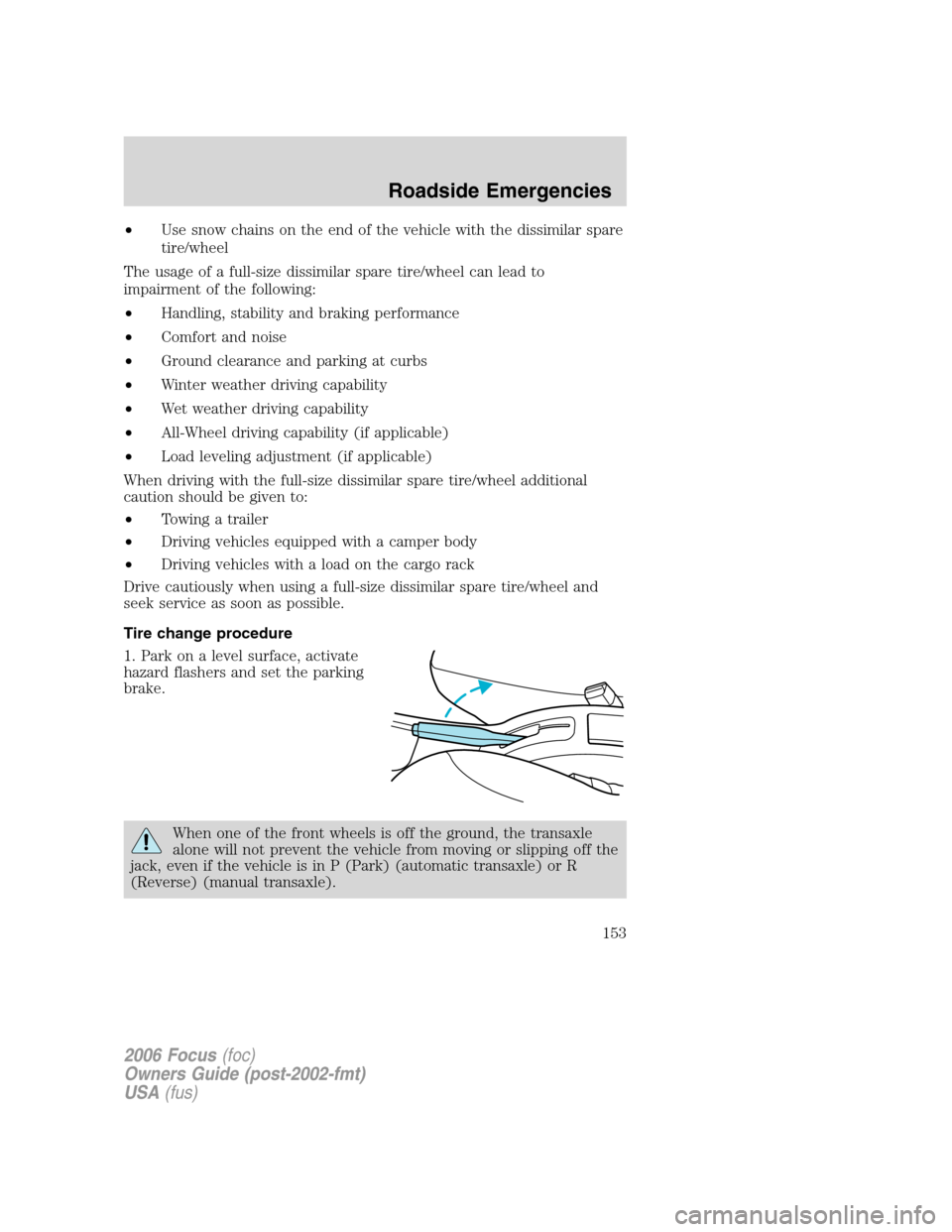
1. Park on a level surface, activate
hazard flashers and set the parking
brake.
When one of the front wheels is off the ground, the transaxle
alone will not prevent the vehicle from moving or slipping off the
jack, even if the vehicle is in P (Park) (automatic transaxle) or R
(Reverse) (manual transaxle).
2006 Focus(foc)
Owners Guide (post-2002-fmt)
USA(fus)
Roadside Emergencies
153
Page 197 of 224
•Using the air conditioner or defroster may reduce fuel economy.
•You may want to turn off the speed control in hilly terrain if
unnecessary shifting between third and fourth gear occurs.
Unnecessary shifting of this type could result in reduced fuel
economy.
•Warming up a vehicle on cold mornings is not required and may
reduce fuel economy.
•Resting your foot on the brake pedal while driving may reduce fuel
economy.
•Combine errands and minimize stop-and-go driving.
Maintenance
•Keep tires properly inflated and use only recommended size.
•Operating a vehicle with the wheels out of alignment will reduce fuel
economy.
•Use recommended engine oil. Refer toLubricant specificationsin
this chapter.
•Perform all regularly scheduled maintenance items. Follow the
recommended maintenance schedule and owner maintenance checks
found inscheduled maintenance information.
Conditions
•Heavily loading a vehicle or towing a trailer may reduce fuel economy
at any speed.
•Carrying unnecessary weight may reduce fuel economy (approximately
1 mpg [0.4 km/L] is lost for every 400 lb [180 kg] of weight carried).
•Adding certain accessories to your vehicle (for example bug
deflectors, rollbars/light bars, running boards, ski/luggage racks) may
reduce fuel economy.
•Using fuel blended with alcohol may lower fuel economy.
•Fuel economy may decrease with lower temperatures during the first
8–10 miles (12–16 km) of driving.
•Driving on flat terrain offers improved fuel economy as compared to
driving on hilly terrain.
•Transaxles give their best fuel economy when operated in the top
cruise gear and with steady pressure on the gas pedal.
•Close windows for high speed driving.
2006 Focus(foc)
Owners Guide (post-2002-fmt)
USA(fus)
Maintenance and Specifications
197
Page 201 of 224
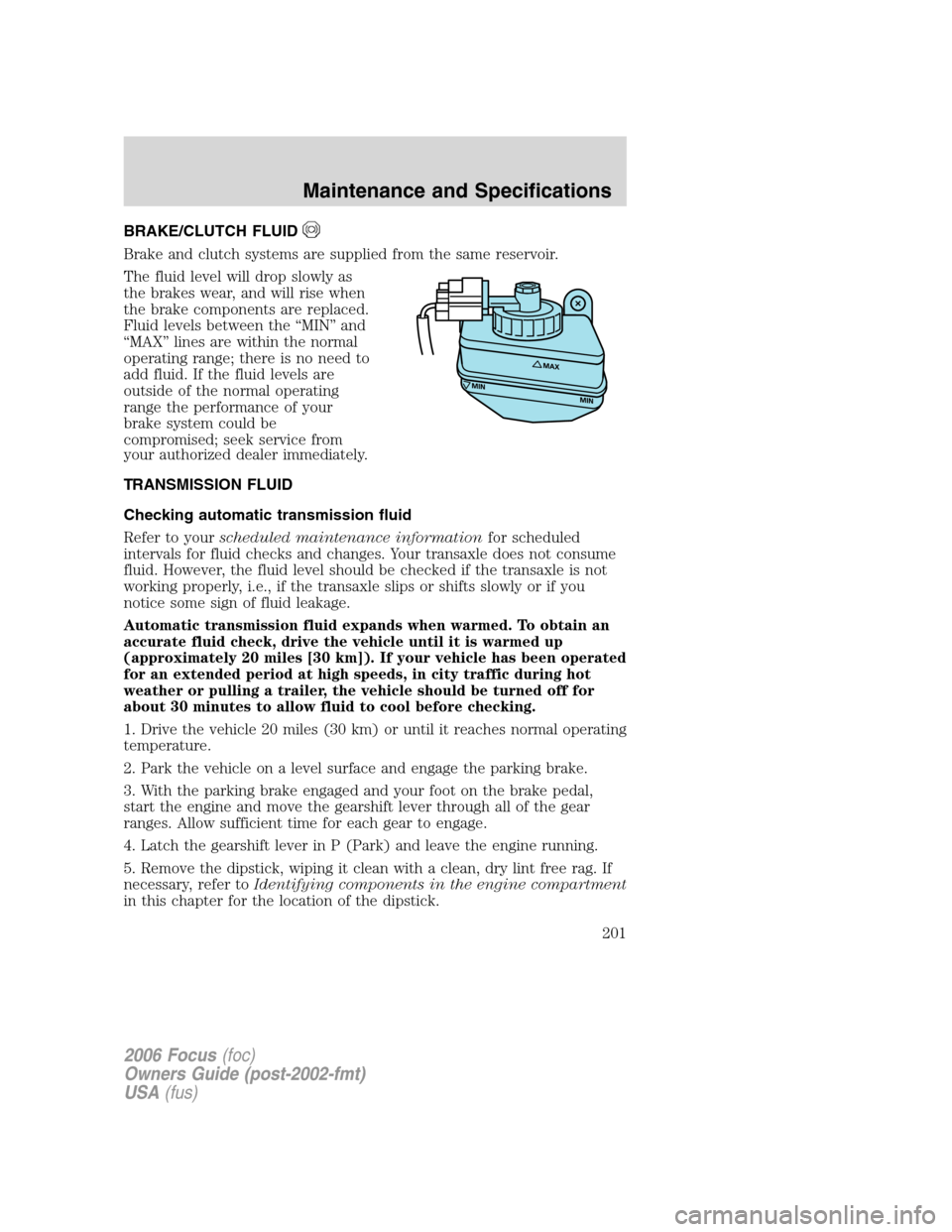
BRAKE/CLUTCH FLUID
Brake and clutch systems are supplied from the same reservoir.
The fluid level will drop slowly as
the brakes wear, and will rise when
the brake components are replaced.
Fluid levels between the “MIN” and
“MAX” lines are within the normal
operating range; there is no need to
add fluid. If the fluid levels are
outside of the normal operating
range the performance of your
brake system could be
compromised; seek service from
your authorized dealer immediately.
TRANSMISSION FLUID
Checking automatic transmission fluid
Refer to yourscheduled maintenance informationfor scheduled
intervals for fluid checks and changes. Your transaxle does not consume
fluid. However, the fluid level should be checked if the transaxle is not
working properly, i.e., if the transaxle slips or shifts slowly or if you
notice some sign of fluid leakage.
Automatic transmission fluid expands when warmed. To obtain an
accurate fluid check, drive the vehicle until it is warmed up
(approximately 20 miles [30 km]). If your vehicle has been operated
for an extended period at high speeds, in city traffic during hot
weather or pulling a trailer, the vehicle should be turned off for
about 30 minutes to allow fluid to cool before checking.
1. Drive the vehicle 20 miles (30 km) or until it reaches normal operating
temperature.
2. Park the vehicle on a level surface and engage the parking brake.
3. With the parking brake engaged and your foot on the brake pedal,
start the engine and move the gearshift lever through all of the gear
ranges. Allow sufficient time for each gear to engage.
4. Latch the gearshift lever in P (Park) and leave the engine running.
5. Remove the dipstick, wiping it clean with a clean, dry lint free rag. If
necessary, refer toIdentifying components in the engine compartment
in this chapter for the location of the dipstick.
2006 Focus(foc)
Owners Guide (post-2002-fmt)
USA(fus)
Maintenance and Specifications
201
Page 221 of 224
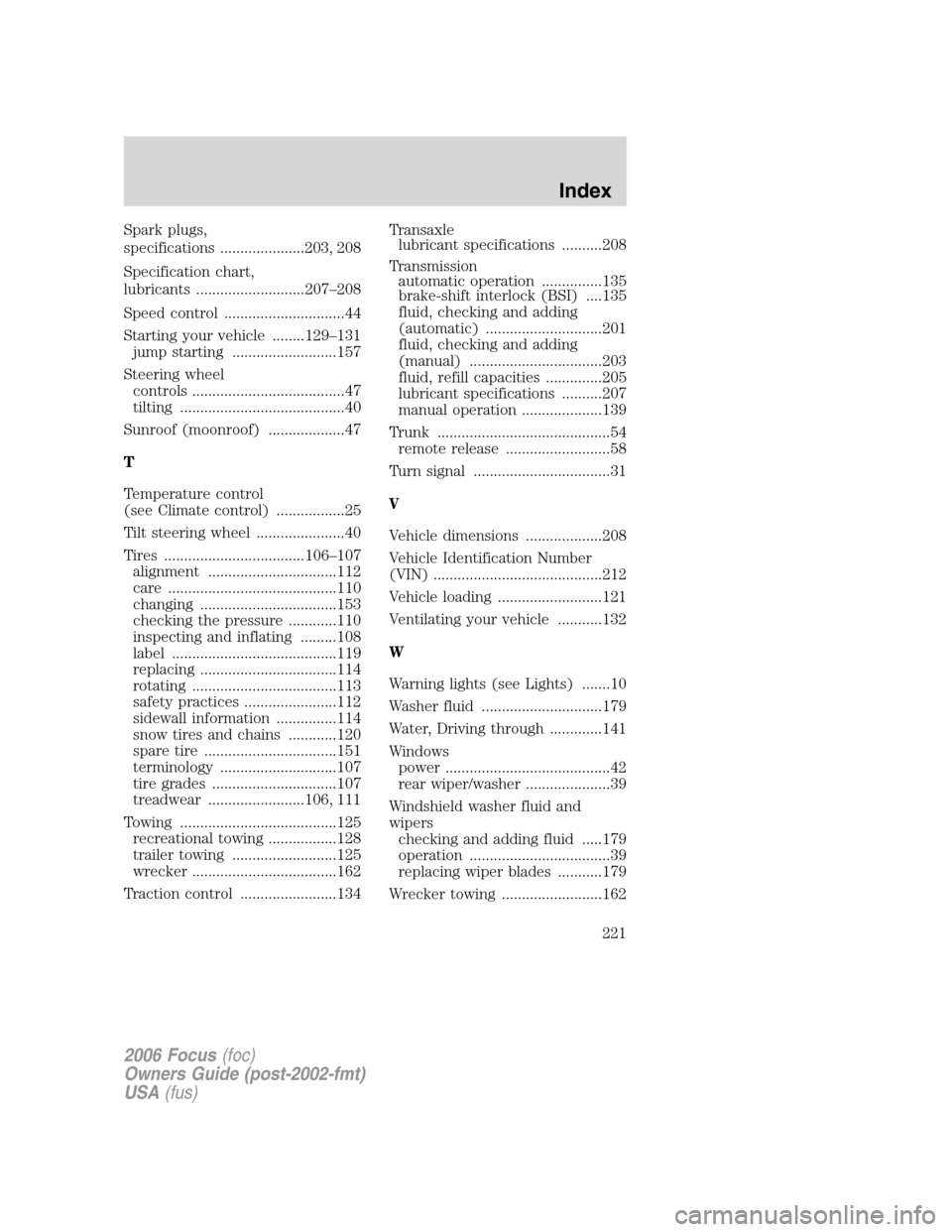
Spark plugs,
specifications .....................203, 208
Specification chart,
lubricants ...........................207–208
Speed control ..............................44
Starting your vehicle ........129–131
jump starting ..........................157
Steering wheel
controls ......................................47
tilting .........................................40
Sunroof (moonroof) ...................47
T
Temperature control
(see Climate control) .................25
Tilt steering wheel ......................40
Tires ...................................106–107
alignment ................................112
care ..........................................110
changing ..................................153
checking the pressure ............110
inspecting and inflating .........108
label .........................................119
replacing ..................................114
rotating ....................................113
safety practices .......................112
sidewall information ...............114
snow tires and chains ............120
spare tire .................................151
terminology .............................107
tire grades ...............................107
treadwear ........................106, 111
Towing .......................................125
recreational towing .................128
trailer towing ..........................125
wrecker ....................................162
Traction control ........................134Transaxle
lubricant specifications ..........208
Transmission
automatic operation ...............135
brake-shift interlock (BSI) ....135
fluid, checking and adding
(automatic) .............................201
fluid, checking and adding
(manual) .................................203
fluid, refill capacities ..............205
lubricant specifications ..........207
manual operation ....................139
Trunk ...........................................54
remote release ..........................58
Turn signal ..................................31
V
Vehicle dimensions ...................208
Vehicle Identification Number
(VIN) ..........................................212
Vehicle loading ..........................121
Ventilating your vehicle ...........132
W
Warning lights (see Lights) .......10
Washer fluid ..............................179
Water, Driving through .............141
Windows
power .........................................42
rear wiper/washer .....................39
Windshield washer fluid and
wipers
checking and adding fluid .....179
operation ...................................39
replacing wiper blades ...........179
Wrecker towing .........................162
2006 Focus(foc)
Owners Guide (post-2002-fmt)
USA(fus)
Index
221